INTRODUCTION
Many marine molluscs deposit embryos in benthic egg masses and most of these species provide no parental protection even though the embryos take several months to hatch (Levin & Bridges, Reference Levin, Bridges and McEdward1995). Neogastropods enclose their embryos within structurally complex proteinaceous capsules (Hunt, Reference Hunt1966; Hawkins & Hutchinson, Reference Hawkins and Hutchinson1988), which may provide protection from physical stresses, caused by such factors as salinity changes (Pechenik, Reference Pechenik1982), temperature variations (Podolsky & Hoffman, Reference Podolsky and Hoffman1998), desiccation (Pechenik, Reference Pechenik1979; Rawlings, Reference Rawlings1999), bacterial attack (Benkendorff et al., Reference Benkendorff, Davis and Bremner2001) and exposure to ultraviolet light (Rawlings, Reference Rawlings1996; Przelawski et al., Reference Przelawski, Davis and Benkendorff2004). The morphology and rigidity of capsules may also provide a barrier against predators (Pechenik, Reference Pechenik1979; Rawlings, Reference Rawlings1994). However, the effectiveness of this barrier can vary with the strength and thickness of the capsule walls. For example, thick capsules of Nucella spp. are more resistant to predation by isopods than thin capsules (Rawlings, Reference Rawlings1990, Reference Rawlings1994). Other defensive strategies include the deposition of empty capsules on the outside of the egg mass, the production of more compact egg masses in which the embryos are less accessible, and the deposition of aggregate egg masses to provide safety in numbers (D'Asaro, Reference D'Asaro1993; Benkendorff, Reference Benkendorff1999).
In the family Buccinidae (Caenogastropoda), females deposit embryos and nurse eggs in capsules that are attached to hard substrata. Several studies report the annual reproductive cycle of the common whelk Buccinum undatum in the north-western (Martel et al., Reference Martel, Larrivee, Klein and Himmelman1986b; Himmelman & Hamel, Reference Himmelman and Hamel1993) and north-eastern Atlantic (Kideys et al., Reference Kideys, Nash and Hartnoll1993; Valentinsson, Reference Valentinsson2002). In the Mingan Islands, eastern Canada, B. undatum mates from late May to mid June and then the females deposit capsules from June through to July (Martel et al., Reference Martel, Larrivée and Himmelman1986a). Females move to shallow water to deposit the capsules on hard surfaces, preferentially on vertical walls and sometimes around kelp stipes (Martel et al., Reference Martel, Larrivée and Himmelman1986a). Some whelks lay an egg mass individually, but often groups of females (up to 21 individuals) deposit their egg masses together (Martel et al., Reference Martel, Larrivée and Himmelman1986a). The peripheral capsules are frequently empty.
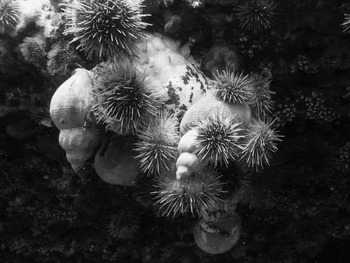
Embryonic development of B. undatum within the capsules takes 3 to 8 months, during which the nurse eggs are consumed to provide energy for development (Martel et al., Reference Martel, Larrivee, Klein and Himmelman1986b). During this time the capsules are exposed to predators (Figure 1). Martel et al. (Reference Martel, Larrivée and Himmelman1986a) observed aggregations of the sea urchin Strongylocentrotus droebachiensis feeding on egg masses and indicated that egg masses are lost when they are detached by wave surge. Sea urchins occur in high densities in shallow waters, and are well known for their destructive grazing of macroalgae (Gagnon et al., Reference Gagnon, Johnson and Himmelman2005). At the same time, they are opportunistic feeders that regularly consume invertebrates (Himmelman & Steele, Reference Himmelman and Steele1971; Briscoe & Sebens, Reference Briscoe and Sebens1988; Drolet et al., Reference Drolet, Himmelman and Rochette2004). Their frequent feeding on whelk capsules in the Mingan Islands, suggests that urchins could substantially reduce the survivorship of whelk embryos.
A collective egg mass of the whelk Buccinum undatum on a boulder at 4 m in depth at Pointe Enragée on June 2004. Four whelks are depositing the egg masses together and sea urchins Strongylocentrotus droebachiensis are already grazing on the capsules. (Photograph by C. Dumont.)

In the present study, we first report a field survey that was made to quantify: (1) the sites selected by female Buccinum undatum for depositing capsules; and (2) the frequency of damaged capsules in the field. We then describe a field experiment comparing rates of predation on capsules on flat rocky bottoms and on vertical walls. Given the high rate of predation observed in the field, we further quantified the rate at which urchins fed on capsules in the laboratory and ran an experiment to determine whether the capsules themselves limited urchin predation.
MATERIALS AND METHODS
Our study was conducted during July and August 2004 in the Mingan Islands in the northern Gulf of St Lawrence, eastern Canada (50°13.6″N 63°41.12″W). We first quantified the proportion of whelk egg masses that were or were not exposed to urchins at four sites, at Cap du Corbeau, Pointe Enragée, Petite Ile au Marteau and Goéland west (sites located within 4 km of one another). Egg masses were considered exposed if they were attached to rocky walls or the sides of boulders and non-exposed when attached within crevices or under macroalgae (mainly Agarum clathratum). Our survey covered the types of habitats where egg masses are normally found; we did not survey flat areas where we have not observed egg masses, except for detached ones that sometimes drift into these areas. In the field, we measured the length, width and thickness of 34 egg masses to permit us to estimate the volume of each mass using the formula for a prolate ellipsoid V = 4/3πab2, where ‘a’ was half the length and ‘b’ half the mean value of width and thickness (Pechenik, Reference Pechenik1982). Each egg mass was identified by a tag attached to a rock placed near the mass. We further measured the surface of attachment of 19 egg masses to determine the correlation between the volume of the mass and surface of attachment. To provide an index of the intensity of predation, we visually observed 37 egg masses, and then estimated the percentage of the surface that had damaged capsules. We considered that damaged capsules were mainly the result of predation. We also counted the number of sea urchins Strongylocentrotus droebachiensis on egg masses. Finally, we estimated the rate of disappearance of egg masses by monitoring egg masses (starting with 26 masses) at 1-week intervals from 12 July to 22 August 2004.
Urchin attacks on egg mass on flat areas and walls
At Pointe Enragée, we compared the numbers of urchins moving towards egg masses, and the weight loss of the masses from urchin predation, in two contrasting habitats, on vertical walls and on flat rocky bottoms. In each habitat type we first removed all visible urchins from ten 0.25 × 0.25 m quadrats (the distance between quadrats was >5 m) and then attached a pre-weighed egg mass (35.4 g, SD = 9.35) to a bolt at the centre of half of the quadrats. Four days later, we returned to each quadrat and counted the number of urchins present (only adults measuring >15 mm) and retrieved the attached egg mass to determine its weight loss. To control for changes in the weight of egg masses in the absence of predation, we measured the weight change of 5 egg masses that were attached to vertical walls within plastic cages that prevented the entry of urchins. In each of two habitats, we also estimated the density of urchins by sampling 25 randomly placed 0.25 × 0.25 m quadrats.
To compare numbers of urchins that moved into quadrats in the presence or absence of egg masses in the two habitats, we applied a 2-way ANOVA with egg mass (presence or absence) and habitat (wall or flat area) as fixed factors. Multiple comparisons on significant effects were made using Tukey tests. Prior to these analyses, normality was evaluated using a Kolmogorov–Smirnov test and homogeneity of variances using a Cochran's test. We examined relative weight lost of masses using a 1-way ANOVA with the fixed factor habitat (flat area, wall or cage). Data were Box–Cox transformed to obtain homogeneity of variance and multiple comparisons on significant effects were made using Tukey tests.
Urchin feeding rate on egg masses, embryos and capsules
In the laboratory, we ran three trials to quantify the feeding rate of urchins on egg masses. Each trial was initiated by providing 5 urchins (50–55 mm in diameter, with a total biomass of 291.0 g, SD = 9.9) with a pre-weighted egg mass (53.2 g, SD = 18.4). Then the weight of each mass was determined after 2, 5, 7 and 9 days. At the same time we controlled for autogenic weight changes by quantifying changes of 3 egg masses maintained in the absence of urchins. All trials were run in 15-l plastic containers, which had a continuous slow inflow of seawater (5 to 8°C). To examine the feeding rates of urchins on egg masses over a 9-day period, we applied a repeated measured ANOVA with time as repeated factor.
We further ran a laboratory experiment to evaluate whether the whelk capsules and embryos had properties that decreased attacks by urchins. This was done by comparing the ingestion rates of individual urchins (50–55 mm in diameter and collected 1 day prior to the trials) provided with three types of agar discs: discs containing: (1) the preferred alga Alaria esculenta; (2) capsule walls and algae; and (3) embryos, intracapsular liquid and algae. Each disc was prepared using 0.5 g of agar, 2.6 g of A. esculenta and seawater, which were blended together. In the second treatment we added 2 g of capsules per disc (the capsules were washed in seawater and then cut into small pieces prior to being blended with the other ingredients) and in the third treatment we added 3 g of embryos and intracapsular liquid (which had been extracted with a syringe) to each disc. We varied the amount of seawater added (22 ml for treatments 1 and 2, and 18.5 ml for treatment 3) so that the discs had a similar consistency. Each trial was run in a 3-l plastic container (supplied with running seawater at 5 to 10°C) and we determined the weight loss of the disc after a period of 16 hours. We ran 6 trials for each disc type per day, and this was repeated for three consecutive days (block factor); thus a total of 18 trials per treatment. We also ran 6 autogenic trials for each disc type to quantify the changes in weight in absence of urchins. Because the weight loss of the autogenic discs with capsules and algae (1.5%, SD±0.6) was less than for the discs with algae (4.1%, 0.9) and the discs with embryos, intracapsular liquid and algae (4.0%, 1.1), the mass of agar discs after 16 hours was adjusted in consequence.
We compared the feeding rates on the three types of agar discs using a 2-way ANOVA with the factors disc type (discs with algae only, with capsules and algae, and with embryos and algae) and block (days 1, 2 and 3). Prior to the analysis, we evaluated normality using a Kolmogorov–Smirnov test and homogeneity of variances using a Cochran's test. Multiple comparisons were made on significant effects using Tukey tests.
RESULTS
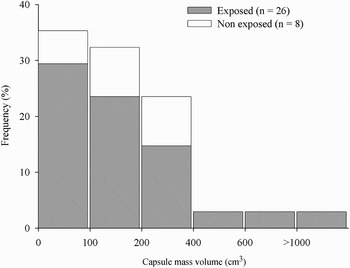
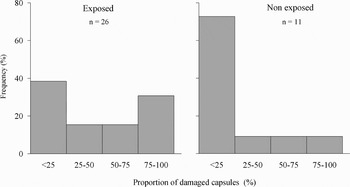
The whelk Buccinum undatum mainly lays its egg masses on vertical surfaces (70.3% were on boulders or walls, depending on the site topography). Most masses observed to be <200 cm3 were on walls and boulders (exposed areas) implying they were laid by individual whelks (Figure 2). The largest egg masses (>400 cm3), which were deposited by a number of females, were observed on boulders at Cap du Corbeau. We observed 1 to 12 urchins on 45% of the egg masses and the urchins were actively grazing on the capsules (Figure 1). There were fewer urchins on egg masses in non-exposed areas (crevices and under macroalgae) probably because urchin densities were lower, and egg-masses less accessible to the urchins, than in exposed areas. In non-exposed areas, 72.7% of the egg masses had only a few damaged capsules. In contrast, in exposed areas damaged masses were common; 46.2% of masses had >50% of the surface damaged (Figure 3). Of the 26 egg masses that were monitored from 12 July to 22 August, one disappeared and one had detached and fallen to the bottom nearby. The detached mass was being eaten by urchins. We further observed large aggregations of urchins covering 3 additional egg masses that had detached and fallen to the bottom. The attachment surface of egg masses was similar for masses of various sizes (25.4 cm2, SD±14.2) and a linear regression (type I) applied to the two variables was not significant (y = 0.02x + 19.76, r = 0.07, P = 0.14).
Frequency distribution of egg mass volume of the whelk Buccinum undatum in exposed (walls and boulders) and non-exposed (under macroalgae and crevices) areas. The number of egg masses measured is indicated in parentheses.

Proportion of damaged whelk Buccinum undatum capsules in exposed (walls and boulders) and non-exposed (under macroalgae and crevices) areas in the Mingan Islands.

Urchin attacks on egg masses on flat areas and walls
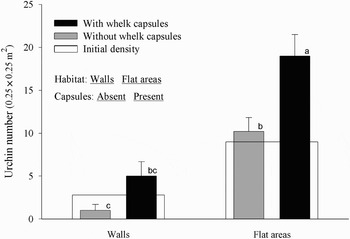
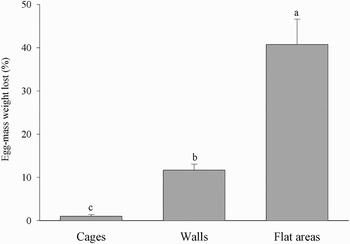
The density of adult (>15 mm) urchins was many-fold greater on flat rocky bottoms than on rock walls (39.5 urchin.m−2, SE±7.9, versus 8.3 urchin.m−2, SE±1.6; t-test, t 48= 6.8, P <0.001) and our study of urchin attacks on egg masses indicated that the habitat where masses were deposited markedly affected their survival. Our data on numbers of urchins immigrating into quadrats with and without egg masses in the two habitats, showed an effect of both habitat (ANOVA: F1, 15= 39.78, P < 0.0001) and presence of egg masses (ANOVA: F1, 15= 12.11, P = 0.003) and no interaction between the two factors (ANOVA: F1, 15= 1.70, P = 0.21). In both flat areas and on walls more urchins immigrated into quadrats where we had attached an egg mass, than in quadrats without an egg mass (Figure 4). The densities observed after 4 days in quadrats with attached egg masses on flat areas were >3 times greater than the densities in quadrats with egg masses on walls (Figure 4). Further, more urchins were actively feeding on egg masses in flat areas (6.4 urchin.m−2, SE±8.87) than on walls (3.4 urchin.m−2, SE±0.81; t-test, t 8 = 2.52, P = 0.02). Finally, the weight lost of egg masses after 4 days was 4 times greater on flat areas than on walls (ANOVA: F2, 12= 84.47, P < 0.0001; Figure 5).
Density (0.25 × 0.25 cm−2) of sea urchins Strongylocentrotus droebachiensis on walls and on the bottom (flat rocky areas) in the presence or absence of an egg mass of the whelk Buccinum undatum. Vertical bars are standard errors.

The loss in mass after 4 days of whelk Buccinum undatum capsules attached to walls and on the bottom (both in the presence of the sea urchin Strongylocentrotus droebachiensis), and in cages (where sea urchins were excluded). Vertical bars are standard errors.

Urchin feeding rate on egg masses, embryos and capsules
In the laboratory, urchins actively fed on whelk egg masses and the mean feeding rate of groups of 5 urchins over a 9-day period was 2.8 g.d−1 (SD±0.9, N = 3). There was no apparent decrease in the feeding rate over time (ANOVA, F3, 6 = 1.81, P = 0.25).
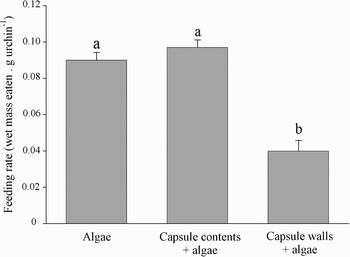
Our analysis of the feeding rates of urchins on the three types of agar food discs revealed an effect of disc type (ANOVA: F2, 45= 62.31, P < 0.0001), no effect of block (ANOVA: F2, 45= 1.91, P = 0.16) and no interaction between the two factors (ANOVA: F4, 45= 1.94, P = 0.12). The addition of whelk capsules to agar discs containing algae decreased the feeding rate of urchins 2.3-fold, compared to agar discs with only algae (Figure 6). In contrast, no decrease in feeding was observed for agar discs containing embryos and intracapsular liquid (which had been extracted from capsules).
Feeding rate of the sea urchin Strongylocentrotus droebachiensis on agar discs containing algae (Alaria esculenta), algae and the contents of whelk capsules (embryos and intracapsular liquid) and algae and capsule walls. Vertical bars are standard errors.

DISCUSSION
Our study indicates that the sea urchin Strongylocentrotus droebachiensis is an important predator of egg masses of the whelk Buccinum undatum. Urchins begin feeding on the capsules (and mucus released by the females depositing the capsules) even as they are being laid (C. Dumont, personal observation; Figure 1), and the feeding continues as the embryos are developing. All egg masses we examined had at least some capsules damaged by urchins. Our monitoring of 26 egg masses over 2 months showed that 7.7% of the masses disappeared over this period. A greater rate of loss of egg masses (69% over 1 month) was observed at the same site by Martel et al. (Reference Martel, Larrivée and Himmelman1986a). The difference likely represents variations from year to year and may be attributed to difference in wave surge as urchin densities remain relatively constant in Mingan Islands (Gagnon et al., Reference Gagnon, Himmelman and Johnson2004). Thus, loss of egg masses is likely a result of both urchin predation and wave action. The damage caused by urchin feeding may make egg masses more likely to be detached by wave action. Once one whelk deposits an egg mass, other females often superimpose their egg masses. The resulting aggregate masses are more likely to be detached and fall to the bottom, as the attachment surface does not increase with the number of egg masses deposited together.
The site where whelks deposit their egg masses clearly influences the survival of the embryos. Most whelks deposit their egg masses on vertical walls or the sides of boulders (Figure 2). This is advantageous because urchin densities are lower on these surfaces, for example four-fold less on walls than on flat rocky bottoms (Figure 4). Further, the ability of urchins to forage is likely reduced on vertical surfaces (Figure 5). Our experiment comparing the rates of attacks by urchins on walls and flat surfaces showed that several-fold more urchins moved into quadrats with egg masses on flat surfaces than on walls. Also, the number of urchins actively feeding on the masses was nearly two-fold greater, and the weight loss of the masses after 4 days was four-fold greater, on flat surfaces than on walls. The number of urchins moving into areas where we had attached egg masses to walls was not significantly greater than on nearby areas on walls without egg masses. Although vertical surfaces present advantages, the safest areas for depositing egg masses appeared to be in crevices and under kelp (and sometimes around the stipes), as the egg masses in such sites were the least damaged (Figure 3). In some cases, the egg masses are deposited around the stipes of the kelp Agarum clathratum, which is not a preferred food of urchins. The feeding of urchins in the vicinity of A. clathratum is likely limited by movement of the kelp blades by wave action (Gagnon et al., Reference Gagnon, Johnson and Himmelman2005). As only 30% of egg masses were found under macroalgae, such sites may be less available, or represent habitats where it is more difficult for whelks to deposit their egg masses.
Using an underwater camera, we recorded the movement of urchins over 9 hours around one of the egg masses that we had attached to a flat area. Only a small number of urchins came in contact with the mass, and in a haphazard manner. Most moved away within 10 minutes. This contrasted with the movement of urchins in the trials where a piece of preferred algae was attached to a flat bottom. In all 18 trials which were filmed there was directional movement of urchins to the algae and the alga became covered with urchins within a few hours (Dumont et al., unpublished data). This suggests that chemodetection plays no role, or at most a weak role, in bringing urchins to whelk egg masses. It is more likely that urchins come into contact with whelk egg masses using random movements. This is how they move on urchin barrens in the absence of drift algae (Lauzon-Guay et al., Reference Lauzon-Guay, Scheibling and Barbeau2006; Dumont et al., Reference Dumont, Himmelman and Russell2007). These observations (that urchins encounter egg masses through random movements and often move away without feeding) suggest that urchins only exploit egg masses as an alternative food source. Nevertheless, urchin predation on egg masses is likely substantial on urchin barrens where the abundance of fleshy algae is low.
Although urchins are primarily herbivorous, adding animal tissues to their diet enhances their growth rate (Briscoe & Sebens, Reference Briscoe and Sebens1988; Nestler & Harris, Reference Nestler, Harris, David, Guille, Féral and Roux1994). Gastropod capsules themselves are likely of low nutritional value, as they have been reported to be indigestible to crabs, gastropods and isopods (Brenchley, Reference Brenchley1982; Rawlings, Reference Rawlings1994). However, the embryos and intracapsular liquid within capsules likely represent a rich source of proteins (Orians & Janzen, Reference Orians and Janzen1974; Rivest, Reference Rivest1986). The egg masses are deposited on urchin barrens where urchins are more likely to be omnivores (Himmelman & Steele, Reference Himmelman and Steele1971). We dissected 5 urchins taken from egg masses, and all contained fragments of capsules in their stomachs.
Urchins are likely the main predator of whelk embryos, as almost all egg masses in the field showed evidence of attacks by urchins. Strongylocentrotus droebachiensis is similarly reported to be an important source of mortality of embryos of the snail Nucella (=Thais) lamellosa (Spright, Reference Spight1977). Isopods and decapods are also predators of gastropod capsules (Rawlings, Reference Rawlings1990), so that Cancer irroratus and Hyas araneus, two common crabs in shallow rocky areas in the Mingan Islands, should also be considered potential predators of whelk egg masses. Although the sea star Leptasterias polaris is a major predator of adult whelks in the Mingan Islands (Gaymer et al., Reference Gaymer, Dutil and Himmelman2004), and adult whelks react to it with a strong escape response (Legault & Himmelman, Reference Legault and Himmelman1993), this sea star has not been seen feeding on whelk egg masses, even when it is found on the egg masses (C. Dumont, personal observation). Predation can cause substantial mortality to brooded embryos and larvae as well as encapsulated embryos (Pechenick, Reference Pechenik1999). Although it is difficult to estimate mortality rates of encapsulated embryos in the field, our observations indicate that the strategy of depositing egg masses in habitats with low predation pressure (e.g. low urchin abundance) should reduce losses.
As both whelks and sea urchins are commercial species, interactions between them are relevant to fishery management. In the Mingan Islands, there is a large whelk fishery, using baited traps, whereas the urchin fishery is new and at a small scale. Extensive rocky areas in the Mingan Islands are characterized by persistent urchin barrens in which urchin grazing strongly limits the recruitment and distribution of many sessile species (Himmelman et al., Reference Himmelman, Cardinal and Bourget1983). The high rate of mortality of whelk embryos from urchin predation likely makes the whelk fishery particularly vulnerable to overfishing. In recent years, increasing harvesting of whelks has caused local depletions of populations in North America and Europe, thus raising concerns about the sustainability of whelk fisheries (Fahy, Reference Fahy2001; FAO Fishery Information, 2006). Also, the disappearance of B. undatum from the Wadden Sea demonstrates the vulnerability of this species to overfishing (Cadee et al., Reference Cadee, Boon, Fischer, Mensink and TenHallers-Tjabbes1995). Our study indicates that urchin density could be an indicator of the risk of substantial egg mass loss in managing whelk stocks. Declines in fisheries, and overall ecosystem degradation, have led to increasing interest in ecosystem-based management of marine resources (Browman & Stergiou, Reference Browman and Stergiou2004). The whelk fishery should be managed using a multispecies strategy, rather than from a single-species perspective.
ACKNOWLEDGEMENTS
We are grateful to J-P. Parent, P. Grondin, and E. Castonguay for their extensive help with the field and laboratory work and to two referees for providing helpful comments on the manuscript. This study was funded by an NSERC grant to J.H.H. and additional financial support to C.P.D. was provided by Québec-Océan and the Biology Department of Université Laval.