


Introduction
The gender revolution is stalled. In both politics and the labour market, substantial gender gaps in participation and leadership stubbornly persist. For example, the World Economic Forum’s Global Gender Gap Report 2024 finds that ‘women’s workforce representation remains below men’s across nearly every industry and economy’ (p. 7), further noting that a majority of countries have never had a woman leader of state. These gender gaps in public life are thought to be driven in no small part by persistent gender differences in unpaid work in the household (for example, Goldin Reference Goldin2021; Hochschild and Machung Reference Hochschild and Machung2003; Sartori, Tuorto and Ghigi Reference Sartori, Tuorto and Ghigi2017). Women, and especially mothers, still take on the vast majority of care and household work across democracies worldwide (Coltrane Reference Coltrane2000; Lachance-Grzela and Bouchard Reference Lachance-Grzela and Bouchard2010; Aassve, Fuochi and Mencarini Reference Aassve, Fuochi and Mencarini2014; Bianchi et al. Reference Bianchi, Milkie, Sayer and Robinson2000), and studies are likely underestimating the true gender gap in unpaid work. Thus far, measures of unpaid work mostly account for time spent in physical household labour. Yet, this is only part of the work involved in managing a household and caring for others. The cognitive dimension of household labour – the ‘mental load’ involved in anticipating, fulfilling, and monitoring household needs (Daminger Reference Daminger2019)- remains largely invisible and understudied. Could gender differences in the mental load provide new insights about why the gender revolution remains persistently out of reach?
Unlike physical household labour, the mental load is boundaryless and disjointed, often going on in the back of one’s mind throughout the day. It includes remembering schedules and deadlines, arranging goods and services, reminding others of what needs to be done, financial management, home maintenance, and juggling priorities. Initial studies suggest it is mostly done by women, especially the routine, non-discretionary tasks such as mental work related to cleaning, child care, scheduling, and anticipating needs (Daminger Reference Daminger2019; Helgøy Reference Helgøy2024; Robertson et al. Reference Robertson, Anderson, Hall and Kim2019; Weeks, Reference Weeks2024). Yet, no major social surveys include questions that measure the mental load, and thus we know little about its consequences for public life. This leaves a gap in our knowledge about how the mental dimension of household work is linked to decisions about participating in public life – and in particular, studies have yet to investigate the causal relationship between the two. As a first step in furthering our knowledge in this area, we use a survey experiment to investigate how the mental load influences men’s and women’s attitudes about participating in public life.
Our main argument is that increasing mental load salience will reduce intentions to participate in public life, both in terms of political engagement and workplace advancement. We theorize that due to a crowding-out mechanism and induced stress, people (both men and women) primed to think about their own mental loads will be more reluctant to express interest in political participation (including a range of activities, from taking an interest in politics to running for office) or taking on more responsibility at work. In addition, we offer two competing hypotheses about the role that respondent gender plays. First, we theorize that this often invisible form of unpaid labour is frequently on women’s, but not men’s, minds. Because of this, priming the mental load could have weaker effects on women compared to men. For women, the treatment could simply reflect a constant reality they already account for when making decisions. Alternatively, because women often have more intimate knowledge of the nature of cognitive labour and its consequences on capacity, the treatment could have greater effects on women compared to men, who do not link such to-do lists with crowding out other activities.
To investigate these hypotheses, we offer a direct test of the causal impact of priming individual mental load on intentions to participate in politics and pursue advancement at work. By manipulating the salience of respondents’ mental load, we can learn about cognitive labour’s effect on these intentions in a way that is grounded in respondents’ real-life experiences. Our study targets employed parents, one subgroup likely to face large mental loads. Previous research establishes a clear ‘motherhood penalty’ in pay and promotion on the birth of a child (Correll, Benard and Paik Reference Correll, Benard and Paik2007; Gangl and Ziefle Reference Gangl and Ziefle2009; Kleven et al. Reference Kleven, Landais, Posch, Steinhauer and Zweimüller2019), in addition to widening gender gaps in political engagement (Naurin, Stolle and Markstedt Reference Naurin, Stolle and Markstedt2022; Voorpostel and Coffe Reference Voorpostel and Coffe2012), making this a crucial site for understanding how dynamics in household labour operate. In line with expectations, we find a sizable negative impact of mental load priming on political interest, likelihood of political participation, and interest in opportunities to advance at work. Our results for politics tend to be stronger among mothers, while we observe the opposite for work (stronger priming effects among fathers) – but these gender differences do not reach statistical significance. Interestingly, in response to the mental load prime, fathers but not mothers prefer reduced working hours for their partners.
Our findings about the effect of mental load priming on intentions to participate in public life are important for several reasons. Most prominently, they represent the first causal evidence of the mental load’s detrimental effect on public participation, using an innovative survey experiment. This evidence suggests that the literature on gendered dynamics in politics and the labour market may underestimate the effect of household inequality by relying on too rigid conceptualizations of household labour. Additionally, our descriptive data provides confirmation from a new case (the UK) that gender gaps in the mental load are large, and associated with stress and negative emotions for mothers but not fathers. Lastly, our findings offer an opportunity to account for this in future policymaking. In the UK, where only two weeks of low-paid paternity leave are offered by the state and the country ranks among the highest in the OECD for childcare costs (Chzhen et al. Reference Chzhen, Rees and Gromada2019), there is much room for innovating policy configurations that actively incentivize fathers’ participation at home.
Gender, the Mental Load, and Public Life
Women’s disproportional household work burden has been argued to affect their capacity to participate in the public sphere in various ways, both in terms of politics and work (Coltrane Reference Coltrane2000; Teele, Kalla and Rosenbluth Reference Teele, Kalla and Rosenbluth2018; Htun Reference Htun2005). Existing research tends to examine these consequences by focusing on some select types of either labour market or political participation. We, however, study these outcomes collectively, as two of the most important public arenas in which economic resources, status, and power are negotiated and distributed. Additionally, as the following literature review shows, outcomes related to work and politics are affected by similar dynamics in the division of household labour.
In the literature on gendered labour market participation, links to household work are well-theorized and often assumed in policy development. Household bargaining models suggest that the capacity for household labour and paid labour exist in a zero-sum game, and women may end up doing more of the former due to comparative advantages (not necessarily biological, but due to existing discrimination in the labour market) (Becker Reference Becker1991), relatively less resources compared to a male partner (Aassve, Fuochi and Mencarini Reference Aassve, Fuochi and Mencarini2014), more time availability for instance due to a more flexible job (Artis and Pavalko Reference Artis and Pavalko2003; Hochschild and Machung Reference Hochschild and Machung2003; Wiesmann et al. Reference Wiesmann, Boeije, van Doorne-Huiskes and den Dulk2008), or having a conservative gender ideology (Lachance-Grzela and Bouchard Reference Lachance-Grzela and Bouchard2010). Household gender inequality and gendered labour market behaviour are thus treated as intrinsically linked, alongside other factors at play in gendered labour market behaviour, such as gendered organizations (Acker Reference Acker1990) or gender-segregated labour markets (Charles and Grusky Reference Charles and Grusky2004).
Research on gender gaps in political participation and engagement similarly highlights women’s disproportional household work burdens among a range of potential explanations. Studies of political gender gaps often distinguish demand- and supply-side factors. On the demand side, for example, studies highlight the role of electoral systems on women’s likelihood of running for office (Skorge Reference Skorge2023) and document that women are less likely to be vigorously recruited to run for office than men (Fox and Lawless Reference Fox and Lawless2010). On the supply side (where our contribution lies), studies suggest that women are motivated by more community-oriented goals (Schneider et al. Reference Schneider, Holman, Diekman and McAndrew2016). Gender differences in political interest – an entry point for broader political participation – are linked to gendered political socialization processes (Bos et al. Reference Bos, Greenlee, Holman, Oxley and Lay2022) and differential resources (Verba, Burns and Schlozman Reference Verba, Burns and Schlozman1997; Burns, Schlozman and Verba Reference Burns, Schlozman and Verba1997a), as well as women’s traditional household role (Fraile and Gomez Reference Fraile and Gomez2017).
The link between gender inequality in household work and various forms of political participation may not be as central as in the literature on gendered labour market behaviour, but can nevertheless be inferred from several empirical findings. For instance, women are more likely to engage in ‘private’ forms of political participation, while men are more likely to partake in ‘public’ political participation such as protests and active engagement in political parties (Coffé and Bolzendahl Reference Coffé and Bolzendahl2010). This can point to women being more constrained to participation that takes place within their households due to their disproportional responsibilities there, whereas men may be more at liberty to consistently participate in politics outside the home. Changes in family structures can affect these tendencies in a gendered way, for instance in voting patterns, where men’s, but not women’s, participation increases after having a child (Voorpostel and Coffe Reference Voorpostel and Coffe2012). Research has further shown that family-intensive life phases such as pregnancy and early parenthood have a stronger negative impact on women’s political interests than men’s (Naurin, Stolle and Markstedt Reference Naurin, Stolle and Markstedt2022; Quaranta and Dotti Sani Reference Quaranta and Dotti Sani2018).
Moreover, literature on the gender gap in political ambition (Fox and Lawless Reference Fox and Lawless2014) often highlights the role of household inequalities. For example, one study proposes a time availability mechanism: a longer commuting time makes women less likely to run for office, as their time is already pressed with household responsibilities (Silbermann Reference Silbermann2015). This is further strengthened by findings that the gender gap in running for office is the smallest at the local level of politics (Devroe et al. Reference Devroe, Coffé, Vandeleene and Wauters2023). Finally, based on data showing that women politicians tend to be wealthier than their male counterparts, research also argues that women require more resources to be elected in order to circumvent or compensate for their disproportional household responsibilities (Bernhard, Eggers and Klašnja Reference Bernhard, Eggers and Klašnja2024).
Still, research which directly tests the link between physical household work and political engagement reports mixed results. Burns, Schlozman and Verba (Reference Burns, Schlozman and Verba1997b; Reference Burns, Schlozman and Verba2002) find no evidence that the share of household work done influences political activity for men or women in the USA. While they do report a link between leisure time and political participation for men, the authors write that, despite their strong theoretical expectations, ‘we could find no evidence that absence of free time handicaps women as citizens’ (Burns, Schlozman and Verba Reference Burns, Schlozman and Verba1997b, 384). This contrasts with more recent evidence from Italy, where Sartori, Tuorto, and Ghigi (Reference Sartori, Tuorto and Ghigi2017) find a negative link between time spent in domestic work and political activities for women, but not for men. This inconclusive evidence illustrates the need for more research explicitly testing the relationship between household work and political engagement.
On the paid work side, gender gaps exist in working time, promotions, and pay, which partly overlap with each other. Part-time work is highly gendered, even in the most gender-equal countries (OECD 2022; Mósesdóttir and Ellingsæter Reference Mósesdóttir and Ellingsæter2017; Emmenegger Reference Emmenegger2009). Working fewer hours becomes more common for women when they have children (Weeden, Cha and Bucca Reference Weeden, Cha and Bucca2016), and there is a negative correlation between the number of children and transitions from part-time to full-time work (Kitterød, Rønsen and Seierstad Reference Kitterød, Rønsen and Seierstad2013). This corresponds to household work becoming even more unequal between female and male partners in the small-children phase (Dominguez-Folgueras, Jurado-Guerrero and Botía-Morillas Reference Dominguez-Folgueras, Jurado-Guerrero and Botía-Morillas2018). Working fewer hours is generally perceived by employers to signal lower work dedication and part-time workers receive fewer promotions and development opportunities at work (Epstein et al. Reference Epstein, Seron, Oglensky and Sauté1999; Abrahamsen and Fekjær Reference Abrahamsen and Fekjær2017; Mandel and Semyonov Reference Mandel and Semyonov2006). Additionally, part-time positions yield lower salaries, not only because of fewer hours worked but also due to an average lower wage base.
Further, and similar to explanations for the gender gap in political ambition, studies suggest a gender ambition gap in the realm of work formed partly by gendered family structures. For instance, the anticipation of family responsibilities influences women’s choices of more family-friendly career paths (Savela and O’Brien Reference Savela and O’Brien2016). In one experiment, single women MBA students avoid expressing professional ambition in front of (especially single) male peers. The authors attribute this finding to marriage market signalling in a society where norms dictate that these skills would not be valued in a wife (Bursztyn, Fujiwara and Pallais Reference Bursztyn, Fujiwara and Pallais2017). For those who do express intentions to pursue leadership positions at the start of their careers, research has shown that women’s ambition is more prone to dwindling in the first few years of employment compared to male peers, in no small part due to the perceived cost to family time (Beaupre Reference Beaupre2022). For wage negotiations, several institutionalized processes contributing to the gender pay gap have been identified (Elomäki, Kantola and Koskinen Sandberg Reference Elomäki, Kantola and Koskinen Sandberg2022). Within these gendered structures, a different behavioural pattern between men and women is also observed. For instance, research shows that women are less likely to negotiate their salaries rigorously, and when they do, they tend to ask for less than men (Babcock and Laschever Reference Babcock and Laschever2009; Mazei et al. Reference Mazei, Hüffmeier, Freund, Stuhlmacher, Bilke and Hertel2015; Säve-Söderbergh Reference Säve-Söderbergh2019). Gendered wage negotiations are linked to several structural factors in work organization and personality traits such as risk aversion (for an overview, see Hernandez-Arenaz and Iriberri Reference Hernandez-Arenaz and Iriberri2019), but the literature generally does not consider the possibility that women are more constrained in the household sphere and therefore, on average, have lower capacity to pursue higher salaries.
There is thus good reason to believe that women’s disproportional household burden is connected to gender disparities in public life. However, in addition to the lack of direct causal evidence, there is also little knowledge about the full picture of household inequality. Traditionally, household work has been assumed to consist of physical tasks relating to the running of a household and care for children or other dependent family members. This is apparent in that household labour is normally measured in time-use surveys, where individuals log which tasks they perform and how much time they spend on them. However, the emerging literature on cognitive and emotional household labour argues that the conceptualization of household work as physical task completion is inadequate. In addition, it is meaningful to also examine cognitive labour loads in order to achieve an encompassing and accurate impression of household work (Mederer Reference Mederer1993; Zimmerman et al. Reference Zimmerman, Haddock, Ziemba and Rust2002).
Cognitive household labour entails the organizational dimension of household work, which is a prerequisite for combining work and family. Empirical research on the mental load is scarce, and especially quantitative findings are lacking. Qualitative literature has outlined important tendencies, namely that cognitive household labour appears highly gender unequal, even in otherwise egalitarian couples, and that this inequality tends to be justified by attributing the division to innate personality traits within the couple that they perceive as ungendered (Daminger Reference Daminger2020; Wiesmann et al. Reference Wiesmann, Boeije, van Doorne-Huiskes and den Dulk2008; Zimmerman et al. Reference Zimmerman, Haddock, Ziemba and Rust2002). Indeed, studies have found that the mental load is less subject to perceptions of unfairness or within-couple conflicts than phyiscal household labour (Helgøy & Van Hootegem Reference Helgøy and Van Hootegem2024; Mederer Reference Mederer1993). Initial quantitative studies offer supportive larger-scale evidence in two quite different gender equality contexts. In one US study, women were reported to be doing over 70 per cent of the mental load (Weeks, Reference Weeks2024), and in a study done in Norway, more than 70 per cent of female respondents claimed to be taking on most of the mental load in their households (Helgøy Reference Helgøy2024).
Carrying the responsibility for cognitive labour does not necessarily imply performing the corresponding physical tasks. For instance, monitoring grocery needs, making shopping lists, and planning meals are distinct from cooking dinner (Holter, Svare and Egeland Reference Holter, Svare and Egeland2008). However, the lack of a physical task does not equate to cognitive labour being less straining. Rather, this kind of household labour can be constant and boundaryless, continuously at the back of one’s mind without being constrained by time and space, as physical tasks are (Dean, Churchill and Ruppanner Reference Dean, Churchill and Ruppanner2022). It is here that potential mechanisms for a reduction in public life participation – including both politics and work – lie. Individuals only have limited rational capacity and must be selective in their decisions about what to pay attention or devote energy to (Simon Reference Simon1956). By taking up significant cognitive space and energy, the mental load may reduce political and work engagement through a crowding-out mechanism (Weeks Reference Weeks2024). This crowding-out could occur through a type of cognitive overload – constraining how much new information individuals can register and use in conscious activities (Miller Reference Miller1956; Plass, Moreno and Brünken Reference Plass, Moreno and Brünken2010) – or it may happen through experienced stress of carrying the mental load. Indeed, research has found that women not only experience higher levels of work-family spillover in that they spend more time thinking about the family while at work but also that this spillover causes more stress in women than men (Offer Reference Offer2014).
In line with this logic, previous research demonstrates descriptively that high cognitive labour loads reduce interest in certain (abstract and national-level) political issues (Weeks Reference Weeks2024). Similarly, experimental results show that a low mental load can lead to a preference for higher working hours (Helgøy Reference Helgøy2024). Summarizing the discussion so far, our principal hypothesis is that increasing mental load salience will lead to decreased intentions to participate in both politics and work (H1). This hypothesis is further supported by studies showing that exposing respondents to higher cognitive loads leads to less risk-taking and strategic behaviour (Deck and Jahedi Reference Deck and Jahedi2015). Our experimental results represent a short-term reaction to experimental stimulus. However, due to the ongoing relevance of this routine, day-to-day dimension of household labour for women in particular, we expect that our experimental findings could well provide one demonstration of a broader, long-term ‘crowding-out’ phenomenon.
Given that cognitive labour is remarkably gendered, we expect the experimental condition to have differing results on women and men. We do not suggest that this is because of any inherent traits but, rather, due to the empirical reality documented by research that women take on the vast majority of this work and, therefore, plausibly have a markedly different relationship to the treatment compared to men, on average. Additionally, even the experience of having an equally high mental load may be different for women and men due to social pressure to keep a well-managed household that is specifically applied to women (Walzer Reference Walzer1996; Hays Reference Hays1996). However, the expected directions of these differences are challenging to hypothesize, given we conducted one of the first studies of the mental load’s effect on public sphere participation. Therefore, we test two competing hypotheses which are both plausible according to the literature’s current state of knowledge.
First, it is possible that the treatment effect will be stronger for men than for women, as men’s baseline mental load salience may be lower than women’s (H2.a). In other words, given women’s higher mental load, implying that cognitive labour is on their minds more often, they may constantly account for it in their decisions about participating in public life. Inducing mental load salience experimentally may therefore not make as much of a difference among women as it would among men. This hypothesis builds on research where other gendered concepts are primed to become salient, such as Klar, Madonia and Schneider’s (Reference Klar, Madonia and Schneider2014) examination into gendered differences in priming the salience of parenthood on policy preferences. Here, they find that the priming effect significantly alters men’s, but not women’s, policy preferences, and argue that this is likely because women’s identity as mothers is constant whereas men’s identity as fathers is more flexible.
However, it is also plausible that women will react to our experimental treatment more strongly than men, for a few reasons. First, the mental load is highly invisible, oftentimes also to the labourer herself or himself (Mederer Reference Mederer1993). This may limit the possibility of the consistent salience described above, as even those with high mental loads may have a rather implicit relationship to it. When salience is then induced, this implicit relationship becomes explicit. When that treatment is given within a subgroup with high mental loads, like women have on average, this group may react on the basis of a more intimate realization of the nature of cognitive labour and its consequences on capacity. Additionally, women may react to the treatment more strongly due to higher social pressure to carry out the mental load well, increasing the stress levels of cognitive labour. Women face extreme social pressure to be highly involved in managing their household and children. For example, the ‘intensive mothering’ paradigm, popular across Western democracies and especially among the highly educated/upper class, suggests that mothers are the ones primarily responsible for childrearing, whereas fathers are there to provide additional help (Damaske Reference Damaske2013; Hays Reference Hays1996). The mental load can thus function as another way of ‘doing gender’ within the home (West and Zimmerman Reference West and Zimmerman1987), with women more likely to notice possibilities for potential action compared to men (McClelland and Sliwa Reference McClelland and Sliwa2023), and to take on the bulk of the routine, interpersonal mental load tasks necessary for households to function (Weeks & Ruppanner Reference Weeks and Ruppanner2024). For these reasons, we offer an alternative hypothesis (H2.b): the mental load priming effect will be stronger for women versus men.
The UK Context
The UK is an example of a familialist family policy regime, that is, its approach to regulating intra-familial dependence results in a reinforcement of traditional gender roles (Leitner Reference Leitner2003; Ciccia and Verloo Reference Ciccia and Verloo2012). This classification is achieved in two ways, one implicit and the other explicit. First, the level of public family support is generally low, making it difficult to combine having children with a dual-earner, full-time working household without the ability to pay for full-time private childcare. This fuels the need for one parent – typically the mother – to in one way or another scale back their labour market involvement, demonstrating implicit familialism (Leitner Reference Leitner2003). Second, explicit familialism directly rewards traditional gender roles through welfare transfers. This is visible in the UK’s parental leave system, in which the mother primarily qualifies for a longer leave after a child is born, and has to actively transfer leave to the father if sharing the leave period is desirable (Banister and Kerrane Reference Banister and Kerrane2022).
The family policy context of our study is thus one of a liberal welfare state reluctant to regulate the private sphere, with family policies that tend to reinforce the gendered status quo. That makes for a ‘most likely’ case scenario where the division of labour might be even more gendered than in other European counterparts. The disproportional burden of the mental load may also be relatively heavier to carry for UK women, given the lack of state support in managing work-life balance. This may impact the generalizability of our results in the sense that they may be stronger when using data from the UK. However, when studying an invisible and abstract concept like the mental load, such a case is ideal, as we would expect to find a more pronounced effect under such conditions.
Data and Methods
To test our hypotheses, we rely on original experimental data collected using the survey provider Prolific in May and June of 2023 (N = 1,002). Prolific is an online platform, which recruits respondents primarily via social media. Respondents were paid £0.75 per completed survey, which is considered good by Prolific’s ethical rewards standards. Our sample includes employed UK parents of dependent children (aged 18 and under) who are married or in a steady partnership. Table 1 presents summary statistics. The sample is balanced on gender, and the mean age (40.3) is similar to the most recent 2021 Census data from England and Wales (median age of 40). The mean number of children (1.72) is also similar to recent Census data (1.77). However, other characteristics of our sample are not representative of the population of UK parents. In particular, ethnic minority groups are underrepresented and our sample is more highly educated than the population.Footnote 1 Our study was pre-registered and approved by our university’s relevant ethics boards.Footnote 2 Balance tests (see Appendix Table A1) show no imbalances in characteristics across treated and control parents in our sample.
Summary Statistics, UK Parents (Prolific Sample)

Notes: All survey respondents are confirmed to be employed parents of children ages 0 to 18 living in the UK (eligibility criteria implemented via blocking on pre-survey data by Prolific). Not all respondents answered the question about the age of the youngest child, and some respondents are parents who do not have children living at home. Note that the response options for the number of children living at home range from minimum ‘0’ to maximum ‘4 or more’, which we code as ‘4’. The study was fielded from May 24, 2023 to June 4, 2023.
Experimental designs are often evaluated in their degrees of experimental realism (whether the treatment is perceived as real, and can therefore be taken seriously, by the respondents), mundane realism (whether the experimental event is something respondents can recognize from their real lives), and psychological realism (especially in lieu of mundane realism; whether the psychological process of the experiment resembles psychological processes in real life) (Aronson, Wilson and Brewer Reference Aronson, Wilson and Brewer1998; Walster, Aronson and Abrahams Reference Walster, Aronson and Abrahams1966; Wilson, Aronson and Carlsmith Reference Wilson, Aronson and Carlsmith2010). The mental load is impossible to observe directly because it goes on inside people’s heads. This makes it a particularly difficult concept to manipulate experimentally, especially with regard to mundane realism – we cannot directly treat it by imposing more cognitive household labour on one group but not another. For many respondents, this experiment may be the first time they are presented with a concrete conceptualization of the mental load. However, we argue that our experiment does have psychological realism, in that our treatment brings a realistic psychological process to the forefront of respondents’ minds. In other words, we can manipulate the salience of individual mental load by asking respondents to think carefully about it, and this is our main methodological contribution.
The approach of using priming to provide a treatment for the mental load is novel, but it has similarities to previous studies which induce cognitive effort in order to understand how this impacts feelings of energy depletion (Lin et al. Reference Lin, Saunders, Friese, Evans and Inzlicht2020) and political engagement (Hjermitslev and Johnston Reference Hjermitslev and Johnston2023). More broadly, a large literature in political science uses priming to understand how people make decisions about politics (for a review, see Stern Reference Stern2019). In the experiment, we randomly manipulate whether respondents are primed to think about their own cognitive household labour – resulting in increased experimental realism by grounding the treatment in personal experiences – before answering a series of questions about political engagement and advancement at work. In the treatment condition, respondents are asked to think about and write down their cognitive household labour ‘to-do’ list, listing up to seven items. Specifically, they are prompted:
“Running a household and taking care of the family involves both physical and mental types of work. In the following set of questions, we want you to think about the mental work involved in managing your household and caring for children, not the physical aspect.
People often find that there are many things they need to think about in their day-to-day life related to family and their household, such as keeping track of family schedules, noticing when the house needs to be tidied, meal planning, noticing when items need to be repaired, or making financial decisions, for example.
Being as specific as possible, please list up to seven mental tasks related to your household and family that are generally your responsibility.”
After the open text response, respondents are asked to estimate their own proportion of cognitive household labour in their household and rate their satisfaction and fairness perception about the division of this labour. They also answer a series of questions about how their list makes them feel (stressed, happy, empty, or motivated). In the control condition, respondents proceed to questions about political and workforce participation without seeing any information about cognitive household labour until after all of the public life questions.
Because thus far we know very little about the consequences of the mental load on public life, we investigate a wide range of potential outcomes related to politics and work. In the section about political engagement, respondents are asked about how likely they are to: 1) take an interest in politics (local, national, and international issues); 2) participate in different private forms of political participation (signing a petition, boycotting, donating or raising money); 3) participate in different public forms of political participation (campaigning, participating in a public demonstration, rally, or protest); 4) vote in the next election, and; 5) ever run for office. We distinguish public versus private forms of participation following research that shows gender gaps in participation tend to be limited to public forms of participation (Coffé and Bolzendahl Reference Coffé and Bolzendahl2010). In the section about work, respondents are asked: 1) their ideal number of working hours, if they could choose; 2) the ideal number of working hours for their partner, if they could choose, and; 3) a series of questions about how likely they are to pursue advancement opportunities at work related to leadership, training, salary negotiation, and additional responsibilities. We thus examine five main dependent variables related to politics (interest, voting, ambition, public participation, and private participation) and three related to work (personal hours, partner hours, and advancement opportunities). All respondents then go on to answer demographic questions in the final stage of the survey, including gender, age, number of children, age of children, and household income.
Describing the Mental Load among UK Parents
Because studies are only beginning to measure cognitive household labour, we start by presenting some descriptive statistics from our data on UK parents. Figure 1 shows the distribution of mental work that respondents estimate is done by them personally to take care of their household, as opposed to someone else. The figure shows a large gender gap of approximately 21 percentage points, with mothers reporting that they are responsible for 78 per cent of such labour on average, compared to fathers’ 57 per cent. A t-test confirms that the difference is statistically significant. While responses for fathers centre around the middle of the distribution (the median response for fathers is 51 per cent), for mothers the median response is skewed left at 80 per cent.
Gender differences in mental household labour among parents in the UK.
The survey question reads, ‘Considering all the mental work to take care of your household, about how much of this work is done by you, as opposed to someone else?’ Response ranges from 0 to 100. Data include 997 respondents (500 women, 497 men).

Next, Table 2 displays the mean results of all survey questions related to the mental load by gender. The table confirms that not only do mothers say that they do more household mental work than fathers, but when asked to list up to seven mental tasks related to their household and family that are generally their responsibility, mothers wrote longer responses (average of 182 characters compared to men’s 151). These measures are imperfect – after all, the amount of text someone writes about their own mental load might not be an accurate reflection of the actual load that they carry. However, given it is not possible to observe cognitive household labour, they nonetheless offer interesting evidence about individuals’ own perceptions. We note that the self-reported share of mental load is weakly correlated with the number of characters written (correlation coefficient = 0.19, p < 0.01).Footnote 3
Mental Load Survey Responses by Gender

Note: Entries for Men and Women are mean values. The Difference column reports the differences in means (Fathers minus mothers) and the final column corresponding p-values according to t-tests.
The final three rows of Table 2 show that mothers are not happy about this unequal division of labour. Mothers report being significantly less satisfied with the division of mental work in their household compared to fathers (among parents, 35 per cent of women are satisfied compared to 63 per cent of men). Mothers are also less likely to believe that the division of mental work in their household is fair and more likely to express negative emotions such as stress or unhappiness about it. The negative emotions index we employ is scaled from 0 to 1, incorporating responses about how stressed, happy, empty, or motivated the individual’s mental load list makes them feel (happy and motivated are reverse coded). All of these gender differences are statistically significant. These findings align with recent research showing that cognitive labour is associated with maternal depression and stress (Aviv et al. Reference Aviv, Waizman, Kim, Liu, Rodsky and Saxbe2024).
Finally, we use a structural topic model (STM) to describe the content of the open-ended responses we collected about individuals’ own mental load tasks. On average, respondents wrote 167 characters when asked to list the mental load tasks that are generally their responsibility. This is roughly equivalent to eighty-three words or four to six sentences. This suggests that respondents took the prompt seriously and engaged with the exercise in a meaningful way. The STM is an unsupervised machine learning algorithm that finds different ‘topics’ and their corresponding features (words) with the highest conditional probability of occurring in documents (here, individual responses) (Roberts et al. Reference Roberts, Stewart, Tingley, Lucas, Leder-Luis, Gadarian, Albertson and Rand2014).
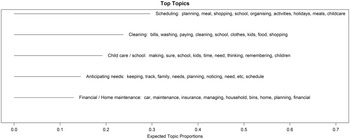
Figure 2 displays the top topics from a 5-topic model and the frequency of these topics within our data. Reassuringly, it shows that the topics emerging from the open-ended responses relate well to qualitative evidence conceptualizing the different domains of cognitive household labour; for example, the most prevalent topic occurring is related to scheduling, followed by mental work related to child care, cleaning, anticipating household needs, and finances and home maintenance (Daminger Reference Daminger2019). We also assess the influence of respondent gender on the topic proportions and find that mothers are significantly more likely to use words associated with the ‘Scheduling’ topic, while fathers are significantly more likely to use words related to the ‘Finances/Home maintenance’ topic.Footnote 4 In summary, the initial descriptive evidence confirms our expectations that gender gaps in the mental load are large, that mothers and fathers specialize in different types of mental work, and that this has negative psychological implications for mothers in particular.
Distribution of Topics Across Open-Ended Responses.
Notes: Expected topic proportions are presented with 10 associated words occurring with the highest probability in the topic. Topics were named after examining highest probability words, frequency-exclusivity words (FREX), and examples of responses that are highly associated with topics.

Experimental Results
We first present our main results on the impact of mental load priming for all respondents, before examining heterogeneous treatment effects by binary gender. For ease of interpretation, we rescale the majority of outcome variables to range between 0 and 1, where higher values refer to greater interest or engagement in public life. The exception is preferred working hours, where we retain hours as the unit of analysis. In the analysis below, we present the results of ordinary least squares models with a binary treatment indicator coded ‘1’ for those asked to think about their own mental load before questions about public life, and ‘0’ otherwise. Recall that our principal hypothesis (H1) is that priming cognitive household labour will reduce interest and intent to advance in politics and work.
Figure 3 presents the results of our analysis examining whether priming respondents to think about their own cognitive household labour affects attitudes towards political engagement and workplace advancement. Starting with Political interest at the top, the figure shows that priming personal mental load significantly reduces reported interest in politics by 0.058 (on a scale of 0 to 1). To put this in context, the mean level of political interest in our data is 0.61, with a standard deviation of 0.23. The effect is thus sizable, equivalent to approximately 25 per cent of a standard deviation.Footnote 5 Moving down the figure, we find that our mental load treatment has similar negative impacts on both Vote intention (effect size = −0.043) and Public participation (including the likelihood of campaigning for a political cause, candidate, or policy, attending a political meeting or rally, or taking part in a demonstration; effect size = −0.047).
Effect of Mental Load Priming on Engagement in Politics and Work.
Notes: The plot depicts point estimates with 95 per cent confidence intervals for the treatment effects (mental load priming) on the outcome variables measuring intentions to engage in politics and workplace advancement (described on the y-axis). Full results can be found in Table A2 of the Appendix. Data include 998 respondents.

However, we do not find evidence that priming the mental load impacts Political ambition (measured as a scale indicating the likelihood of ever running for office), nor do we find that it significantly impacts Private participation (including participating in boycotts, signing petitions, or donating money/raising funds). We did not pre-register hypotheses about differential effects across types of public life engagement, but we offer an interpretation of these findings here which can be tested in future research. Political ambition is rare; only 6 per cent of respondents reported that they were likely to ever think about running for office one day. We are thus not surprised that priming the mental load has little impact on one’s decision of whether or not to pursue political office (although of course, over the long term personal and family circumstances may impact this decision a great deal; for example, Crowder-Meyer Reference Crowder-Meyer2020). Considering the participation results, here our findings correspond well with existing studies suggesting that gender gaps are limited to more formal, public forms of participation, which tend to be more resource-dependent and less easily incorporated into daily life (Coffé and Bolzendahl Reference Coffé and Bolzendahl2010). If the mental load crowds out space or energy for political activities, it is logical for this to occur especially for these more costly forms of participation.
Turning to our outcome variables related to workplace advancement, we continue to find similar, negative results. Priming personal mental load significantly reduces intentions to engage in workplace activities related to advancement (including pursuing a leadership role, further training, and new responsibilities at work, and negotiating for a higher salary), Substantively, the effect size of −0.045 is equivalent to approximately 20 per cent of a standard deviation in our workplace advancement scale (mean = 0.68, SD = 0.22). Additionally, in Figure 4 we present the results of our analysis of the effects of mental load priming on preferred work hours. This question asks respondents how many hours a week they would choose to work if they could choose, keeping in mind that earnings would go up or down according to how many hours they work. We also ask respondents a similar question about their preferred working hours for their partner. Figure 4 shows that priming the mental load causes a reduction in preferred working time by nearly two hours per week. While the treatment is similarly linked to a reduction in preferred working hours for one’s partner, this effect is not significant at conventional levels in our overall sample.
Effect of Mental Load Priming on Preferred Working Hours for Self and Partner.
Notes: The plot depicts point estimates with 95 per cent confidence intervals for the treatment effects (mental load priming) on the outcome variables measuring hours per week respondents would choose to work (described on the y-axis). Full results can be found in Table A2 of the Appendix. Data include 998 respondents.

Subgroup heterogeneity: Fathers versus mothers
Next, we investigate heterogeneous effects by respondent gender. We expect that priming the mental load might impact fathers and mothers in different ways, and thus offer two alternative hypotheses. First, effects might be stronger for fathers than for mothers, if women tend to already account for cognitive household work in their decision-making (H2.a). Conversely, if women have more intimate knowledge of the nature of cognitive labour and its consequences on capacity, the effects might be stronger for mothers than fathers (H2.b). Figures 5 and 6 present the results of the analysis split by gender.
Effect of Mental Load Priming on Engagement in Politics and Work, for Mothers and Fathers.
Notes: The plot depicts point estimates with 95 per cent confidence intervals for the treatment effects (mental load priming) on the outcome variables measuring intentions to engage in politics and workplace advancement (described on the y-axis). Full results can be found in Tables A3 and A4 of the Appendix. Data include 997 respondents (500 women, 497 men).

Effect of Mental Load Priming on Preferred Working Hours for Self and Partner, for Mothers and Fathers.
Notes: The plot depicts point estimates with 95 per cent confidence intervals for the treatment effects (mental load priming) on the outcome variables measuring hours per week respondents would choose to work (described on the y-axis). Full results can be found in Tables A3 and A4 of the Appendix. Data include 997 respondents (500 mothers, 497 fathers).

Figure 5 reveals some similarities between men and women – for both fathers and mothers, the impact of mental load priming tends to be negative, as expected – but also some interesting differences. In line with the expectations of Hypothesis H2.b, we find that treatment effects tend to be larger in size and significant at lower levels for mothers versus fathers (although as the overlapping confidence intervals indicate, gender differences are not statistically significant). This is true for political interest, where the effect size for mothers is approximately double that observed for fathers (effect size = −0.076 for mothers vs −0.037 for fathers), for public forms of participation (effect size = −0.061 for women vs −0.031 for men), and to a lesser extent vote intention (effect size = −0.048 for mothers vs −0.037 for fathers). However, we find the opposite – a larger treatment effect for fathers (support for H2.a) – for the outcome of workplace advancement (effect size = −0.052 for men vs −0.037 for women).
Figure 6 reports mental load priming treatment effects for preferred working hours by gender, and we find stronger results for fathers here too. After being primed to think about their own mental load, fathers prefer to work approximately two hours less per week (compared to control), whereas the treatment effect for mothers is a 1.55 hour reduction.
What might explain the stronger treatment effects for mothers in the context of politics, and fathers in the context of work? First, we note that differences between mothers and fathers are not statistically significant, as evidenced by the overlapping 95 per cent confidence interval bars in Figures 5 and 6. This could be due in part to the loss of statistical power in our subgroup analysis; ideally, the heterogeneous effects presented here should be replicated among larger samples. Additionally, our research design does not allow us to explicitly test the mechanisms implied by H2a (the extent to which mental load is accounted for already in decision-making) and H2b (the perceived impact of mental load on capacity). Instead, our results offer evidence about the (average) observable implications (that is, gender differences) alone – a point we return to in the conclusion.
One interpretation of the greater responsiveness of fathers to work-related activities might be related to their greater commitment to working time compared to mothers. In our sample, 95 per cent of fathers are working full-time, compared to 58 per cent of mothers. Perhaps greater levels of investment in work mean that fathers believe that they can realistically scale back in response to cognitive overload from the household. Because working 2 hours less per week for fathers is equivalent to a smaller reduction in the percentage of working time compared to the same reduction from mothers, this can still be consistent with maintaining male breadwinner and ideal worker norms.
At the same time, our findings also suggest that fathers seek to offload some of this cognitive burden at the expense of their partner’s working time. In our subgroup analysis, we find a treatment effect for the preferred hours that partners would work if the respondent could choose, but only among fathers. After being primed to think about their own mental load, fathers say that they prefer their partners to work 2.3 hours less per week (compared to control), whereas we find no similar treatment effect among mothers (coefficient = −0.23, not significant). Strikingly, this treatment effect of mental load priming on preferred working hours for one’s partner is larger than the reduction men express for their own working hours. It is also larger than the working time reduction mothers themselves express on treatment. Not only do mothers report greater shares of mental load responsibility in their own households compared to fathers, but when parents are primed to think about it our evidence suggests that fathers (but not mothers) consider compensating for this at the expense of their spouse’s working time.
This may be connected to the prominent male-breadwinner identity, which, although increasingly challenged by changing ways of defining status in modern fatherhood, is strongly persisting (Reid Reference Reid2018; Williams, Blair-Loy and Berdahl Reference Williams, Blair-Loy and Berdahl2013). The finding could also be linked to economic self-interest. Considering that men on average earn more than women, it could be seen as a rational solution to a time or resource squeeze problem that the person with the lowest salary cuts their working hours, in line with the theory of relative resources (Aassve, Fuochi and Mencarini Reference Aassve, Fuochi and Mencarini2014). However, experimental findings have shown that there is something beyond economic self-interest ongoing in these dynamics, too – men, but not women, wish to increase their working hours when their partner earns a relatively low salary (Helgøy Reference Helgøy2024).
A potential limitation of our study is that we prime cognitive household work, but do not have a way of measuring how different people might respond to this. In addition to any kind of level or share of the mental load we might conceptualize, people also differ in how they handle mental work. This might affect the extent to which the mental load matters for public life – some people might be able to carry higher loads with ease, while others experience more negative psychological impacts. We cannot fully resolve this issue, but we provide additional tests of whether 1) negative emotions about one’s own mental load explain the process through which the mental load affects public life intentions (mediation) or 2) mental load effects vary depending on negative emotions about it (moderation).
The results, shown in Appendix Tables A5 and A6, provide little evidence that the impact of the mental load is driven by the mechanism of negative emotions. Negative emotions about the mental load are often significantly, negatively correlated with our outcome variables, but the effect size and significance of our treatment variables are not substantially reduced by including this variable, suggesting little evidence that our experimental results are driven by negative emotions. We also report little evidence of the heterogeneous effects of negative emotions. The interaction between treatment and negative emotions is not significant in any model except partner work hours, where the coefficient is positive (that is, those primed to think about their mental load who have more negative emotions about it want their partner to work more, not less as we might expect if we assume that a partner working fewer hours can help take on more of the mental load).Footnote 6 We interpret these results as providing additional evidence for the crowding out theory, suggesting that the negative consequences of mental load are driven by cognitive overload rather than negative emotions alone.
Finally, the treatment effects reported here are short-term; we argue, however, that the experimental results represent more than a temporary reaction to experimental stimulus. Decisions about how to participate in public life likely result from longer-term considerations, during which reminders of the mental load are manifold and norms tend to find gender inequality in its division more justifiable than in physical household labour (Zimmerman et al. Reference Zimmerman, Haddock, Ziemba and Rust2002; Wiesmann et al. Reference Wiesmann, Boeije, van Doorne-Huiskes and den Dulk2008). Our survey also offers some descriptive evidence of these dynamics. At the very end of the survey, respondents had the option to tell us what they think about the relationship between the mental load and public life participation. This optional question read, ‘In this study we are interested in learning about whether the mental work people do to manage their household and care for their families impacts their decisions about whether and how to participate in politics and pursue advancement at work. If you have any comments about how such mental work relates to your decisions about work and politics, please write them here.’ Over 200 respondents responded (21 per cent of our sample, with no significant gender difference). We read through all responses and created a binary indicator for whether the respondent believed that the mental load impacted public life (‘1’) or not (‘0’).Footnote 7 We found that, of those who clearly answered this question directly (a subset of 132 respondents), the majority (71 per cent) believe that the mental load does impact their own decisions. Women are especially likely to take this view; while 81 per cent of women responded that they think it matters in their own lives, only 58 per cent of men did.Footnote 8
Many of the open-ended text responses reveal exactly the kind of crowding-out mechanism we expect at work in parents’ own day-to-day lives. For example, one mother wrote, ‘I find it difficult to imagine having space left in my head to take on more work. I wish for a clone to be a wife for me.’ Another mother responded, ‘I put more of my mental energy into my home life now we have two children under three. I have much less energy left over for thinking about politics and do fewer hours so think less about work so that I can help with more childcare at home. My priorities have definitely shifted.’ Men, too, write about the same kinds of bandwidth pressures. For example, one father says, ‘Basically political activity is on [the] back seat till kids have flown the coop’, and another comments, ‘I currently have a lot to think about in terms of home life and this means I can’t think about taking on active political engagement - my mind is too full of other tasks at this stage in life.’ Of course, not all respondents agree that the mental load matters in this way, and men were more likely to respond that it does not. For example, one father writes, ‘The mental work is not exactly a burden. It’s one thing to notice the dishes need [to be] washed. It’s much more onerous to actually spend the time washing them.’ In sum, however, the majority of open-ended responses expressed the belief that the mental load does indeed reduce public sphere participation and that this often happens through a crowding-out mechanism.
Conclusion
How does priming individual ‘mental load’ impact men and women’s intentions to participate in public life? We offer a novel way of studying the mental load experimentally by priming individuals to think carefully about their own cognitive household tasks and associated feelings. Our study of UK parents reveals strong negative effects of mental load priming on political interest, vote intention, public forms of participation, interest in workplace advancement, and preferred working hours. For fathers (but not mothers), we also find that priming individual mental load causes a reduction in the preferred working hours for their partner. Moreover, our descriptive results reveal that cognitive labour tasks (including mental work related to scheduling, cleaning, child care, anticipating needs, and financial and home maintenance) are widespread among parents and highly gendered. Women, like the UK mothers in our sample, tend to do the majority of this work. We find that mothers report primary responsibility for 78 per cent of their household’s cognitive labour, compared to fathers’ 57 per cent. In addition, our experimental results suggesting negative impacts on intentions to participate in public life are matched by observational data from parents in the USA, where a study finds that high levels of mental load are linked to lower political engagement (Weeks Reference Weeks2024). It is also matched by experimental findings from Norway showing that a lower mental load can lead to increased working hour preferences (Helgøy Reference Helgøy2024).
We find little evidence for significant gender differences within the experimental effect. For outcomes related to politics, effects are generally stronger among women, while for those related to work, effects are stronger among men. However, the differences between mothers and fathers, which emerge in our sub-group analysis, are not statistically significant and should be replicated on larger samples. Importantly, our study design does not allow for explicit testing of the specific drivers of gendered differences in responses to our treatment. Future research could make progress on this by theorizing and testing mechanisms (including those we offer, the extent to which mental load is accounted for in decision making and awareness of mental load impact on capacity) that might contribute to potential gender differences in responses to the mental load.
Our study has several limitations. The analysis relies on a convenience sample that overrepresents highly educated and white parents. This could limit the generalizability of our results. While online convenience samples have been found to replicate social science experiment findings (Strange et al. Reference Strange, Enos, Hill and Lakeman2019), our results might nonetheless be biased if we expect heterogeneous treatment effects by certain demographic characteristics. For example, studies show that caring practices differ across cultures and regions, with, for example, cohabitation of multiple generations and inter-generational parenting more common among certain communities (Kremer Reference Kremer2007; Gallego, Queralt and Tur-Prats Reference Gallego, Queralt and Tur-Prats2022). In families where the mental load for care work is spread over multiple generations (of women), the mental load of mothers might be lighter and engagement in public life higher. One quantitative study of the mental load among US parents finds no evidence that education, income, or relative income in the household determine the share of mental load that mothers or fathers take on, but does report significant differences between ethnic groups (Weeks, Reference Weeks2024). Because much is still unknown about the mental load, we call for further research on how mental load division might differ across demographic groups (not only income, education, and ethnicity, but also class, religion, family structure, and so on) in order to fully understand the potential ways in which its consequences for public life might differ across subgroups.
Moreover, although our experimental design offers valuable causal evidence on the relationship between priming personal mental loads and public participation, some real-world complexity is inevitably lost due to our parsimonious, survey-experimental approach. This potentially lower external validity is necessary in order to achieve high internal validity (Mutz Reference Mutz2011) – but going forward, additional studies, which measure the mental load in different ways and through a variety of methods, are necessary in order to evaluate the extent to which our experimental findings track in the real world.
The implications of our study are sobering. We provide causal evidence suggesting that the mental load can crowd out space for taking an interest in public life. Even though the experimental results are observed for both men and women, in reality, the mental load is highly gendered. So long as women continue to be mostly responsible for this often invisible form of household labour, it follows that they are likely to remain in the background of public life. Thus, the mental load may indeed be a contributor to the stalled gender revolution in Western societies. Indeed, Holter argues that the final step of gender equality in the household is when men take genuine responsibility for chores, rather than just performing them when told (Holter Reference Holter, Borchgrevink and Holter1995). Further, our results highlight a growing need to move beyond time-based measures of unpaid labour. This implies conceptualizing and testing measures of not only cognitive labour but also emotional labour, which we do not focus on here (but see Dean, Churchill and Ruppanner Reference Dean, Churchill and Ruppanner2022). By calling attention to these significant gender gaps and their consequences, we raise awareness of previously hidden inequalities, an important first step to inform future policymaking.
We see two logical next steps for advancing the study of the mental load in political science. First, further research is needed to unpack the specific mechanisms through which the mental load impacts decision-making. Our initial evidence provides support for the crowding out theory as opposed to negative emotions, but we acknowledge that further research is needed to better disentangle these. Qualitative studies would shed valuable light on how men and women experience doing different types of cognitive household work, and how they see this aspect of their everyday private lives related to broader public engagement. Second, as discussed previously, the external validity of our findings should be tested across different samples and using different methods. Given that the UK can be classified as a ‘most likely’ case for this study, a fruitful direction for future research is to assess whether the findings hold in a more gender-egalitarian social policy context. Comparative data will be imperative in helping to pinpoint the micro- and macro-level (social policy) determinants of taking on the mental load for women and men. Does the de-familialist family policy, seen for instance in the Nordic countries, contribute to equalizing the mental load between genders? With this information, policymakers will be well-placed to target new policies and interventions to close gender gaps in private and public life. And with more knowledge on the dynamics of the mental load, we move gradually closer to achieving Holter’s final step of gender equality (Holter Reference Holter, Borchgrevink and Holter1995).
Supplementary material
To view supplementary material for this article, please visit https://doi.org/10.1017/S0007123424000826
Data availability statement
Replication data for this article can be found in Harvard Dataverse at: https://doi.org/10.7910/DVN/NEATCB.
Acknowledgements
We thank Rabia Malik, Tamta Gelashvili, and the participants at research seminars at Gothenburg University, Kings College London, and the annual meeting of the European Political Science Association 2023 for helpful comments on previous versions of this paper. We also thank the editor and three anonymous reviewers for their constructive feedback.
Financial support
Support for this research was provided by the Department of Politics, Languages and International Studies at the University of Bath.
Competing interests
None.




 Open access

