


1. Introduction
During election campaigns, political parties confront a wide array of issues that can shape voters’ electoral choices. Some issues emerge briefly and fade quickly, whereas others remain salient through election day. There are also cases in which a single issue, such as the presidential impeachment crisis preceding South Korea’s 19th presidential election in 2017, plays a decisive role in determining electoral outcomes (Jin, Reference Jin2023). A large body of research accordingly shows that, in electoral contexts, parties’ and candidates’ issue positions and stances influence voters’ support for parties and candidates and ultimately their voting decisions (Green and Hobolt, Reference Green and Hobolt2008; Kwon, Reference Kwon2008; Banda, Reference Banda2021; Song, Reference Song2022). Thus, to maximize electoral support and secure electoral victory, parties have strong incentives to cultivate reputations for being more capable than their competitors at addressing the issues that emerge during campaigns, thereby fostering favourable perceptions among voters. In this sense, for political parties, the electoral process is an arena of intense competition to establish an issue-based advantage.
From this perspective, two key concepts are widely utilized to explain interparty competition: ‘issue ownership’, which refers to a party’s perceived competence to handle or resolve specific issues, and ‘issue salience’, which signifies the relative importance that parties or voters assign to a specific issue among various political topics. Research on issue ownership suggests that parties are likely to employ strategies emphasizing issues they own, or can credibly claim, while avoiding issues of which they lack ownership or where their competitors hold an advantage (Petrocik et al., Reference Petrocik, Benoit and Hansen2003; Green and Hobolt, Reference Green and Hobolt2008). Conversely, studies on issue salience argue that, regardless of who owns an issue, an effective electoral strategy is to focus on issues that have become important to voters (Klüver and Sagarzazu, Reference Klüver and Sagarzazu2016; Ennser-Jedenastik et al., Reference Ennser-Jedenastik, Haselmayer, Huber and Fenz2022).
However, parties’ strategies for issue competition involve more than emphasizing the issues they own or those that are salient. To win elections, parties must secure a relative advantage over their competitors, and to this end, they often resort to offensive communication aimed at weakening rivals’ issue ownership. Specifically, when an electorally important issue is not owned by a party, parties seek to shift voter evaluations in their favour by criticizing opponents’ policy incompetence or highlighting their negative attributes (Damore, Reference Damore2002; Seeberg, Reference Seeberg2020; Seeberg and Nai, Reference Seeberg and Nai2021).
Therefore, a party’s offensive communication on a specific issue should be understood not merely as an emotional reaction or as indiscriminate negative campaigning, but as a strategic behaviour calibrated to the structure of issue ownership and shifts in issue salience. In other words, within an election environment where voter attention is concentrated, parties utilize offensive communication to undermine their opponents’ issue ownership and secure a comparative advantage. In this context, issue ownership and issue salience serve as a critical theoretical foundation for explaining parties’ issue competition strategies. Nevertheless, existing research has largely focused on changes in issue salience or issue ownership as the consequences of offensive communication (Carson et al., Reference Carson, Martin and Ratcliff2020; Lefevere et al., Reference Lefevere, Seeberg and Walgrave2020; Seeberg, Reference Seeberg2020; Seeberg and Nai, Reference Seeberg and Nai2021). Consequently, the strategic conditions under which parties choose to deploy offensive communication in the first place remain underexplored.
Only a limited number of studies have suggested that parties may adopt offensive messaging depending on their issue ownership status and changes in issue salience (Damore, Reference Damore2002; Elmelund-Præstekær, Reference Elmelund-Præstekær2011; Poljak and Seeberg, Reference Poljak and Seeberg2024). While these studies demonstrate that issue ownership and issue salience shape parties’ offensive communication, empirical evidence remains limited regarding how parties adjust their strategies when the logics of issue ownership and issue salience come into conflict in electoral contexts, namely when unowned issues become salient.
Against this backdrop, this study aims to analyze parties’ offensive communication during the 18th to 20th presidential elections in South Korea. The focus on presidential elections is warranted because they are the contests that attract the greatest voter attention, while also being the arenas in which intra-party cohesion is prioritized around the singular goal of electoral victory and interparty competition is most intensely fought. Notably, South Korean presidential elections operate under a de facto two-party system with a winner-take-all power structure, which amplifies the incentives for parties to adopt offensive communication. Accordingly, analyzing these parties’ press releases provides a useful way to study party communication strategies in South Korea’s de facto two-party setting, where electoral competition is particularly high-intensity.
For the empirical analysis, policy-related party press releases issued during the 18th–20th presidential election periods by the major conservative party (the People Power Party and its predecessors) and the major liberal party (the Democratic Party and its predecessors) were collected.Footnote 1 Using these materials, the study investigates how issue ownership and issue salience shape parties’ offensive communication. Offensiveness was quantified by fine-tuning a Korean deep learning model (KcELECTRA) on the Korean Offensive Language Dataset (KOLD). Through this approach, the study aims to objectively measure parties’ offensive communication and empirically verify its relationship with issue ownership and issue salience.
2. Literature review
2.1. Issue ownership
Issue ownership is a concept centred on the argument that if a political party is recognized for its perceived competence regarding a specific issue, it comes to own that issue, thereby gaining an advantage over competing parties when dealing with it (Petrocik, Reference Petrocik1996). Issue ownership has provided a new perspective for understanding political agenda-setting and election outcomes, and it is widely considered a significant factor in vote choice and party strategies (Bélanger and Nadeau, Reference Bélanger and Nadeau2015; Lefevere et al., Reference Lefevere, Tresch and Walgrave2015). Issue ownership can be categorized into long-term and short-term forms. Long-term issue ownership is rooted in enduring political cleavages, stable support bases, and parties’ long-standing issue reputations, whereas short-term ownership is more volatile and responsive to recent events or evaluations of incumbents’ performance (Petrocik et al., Reference Petrocik, Benoit and Hansen2003; Stubager, Reference Stubager2018).
Building on this concept, research on issue ownership generally posits that parties emphasize issues they already own or credibly claim, while avoiding issues on which their competitors hold an advantage (Green and Hobolt, Reference Green and Hobolt2008). Because voters use issue ownership as a heuristic to navigate the political landscape and to differentiate between parties during election campaigns (Stubager and Slothuus, Reference Stubager and Slothuus2013), it follows that parties seeking electoral advantages will assess their issue ownership positions and craft corresponding strategies for issue competition (Krauss et al., Reference Krauss, Praprotnik and Gross2025).
2.2. Issue salience
Issue salience, defined as the perceived relative importance of issues to political parties or voters, has been examined through two broad research approaches. The first concerns the supply-side perspective, which examines how political actors such as parties seek to make issues salient through strategic emphasis. The second adopts a demand-side perspective, focusing on how parties respond to issue salience as reflected in public opinion or media attention (Dennison, Reference Dennison2019). Studies in the former category typically analyze the degree to which parties highlight specific issues in campaign pledges or manifestos (Dolezal et al., Reference Dolezal, Ennser-Jedenastik, Müller and Winkler2014; Krauss et al., Reference Krauss, Praprotnik and Gross2025). From this viewpoint, parties strategically foreground particular issues in order to induce voters to perceive them as important; issue salience is thus treated as a variable that parties can strategically shape.
In contrast, demand-side research on issue salience centres on how parties respond to changing political and social environments. This perspective treats issue salience as exogenous for analytical purposes, rather than as a strategic choice of parties, and examines how it influences party strategy. Party strategies grounded in demand-side salience are often described as ‘riding the wave’ (Ivanusch et al., Reference Ivanusch, Zehnter and Burst2023), insofar as parties align their issue emphasis with shifts in what the public or media regard as important. Considering that short-term issue ownership may also fluctuate in response to media coverage and the resulting public evaluations (Stubager, Reference Stubager2018), ‘riding the wave’ in response to shifts in issue salience constitutes a crucial strategy available to parties during the electoral process.
To analyze parties’ offensive communication, this study focuses on the demand-side perspective of issue salience. While the supply-side approach is useful for identifying which issues parties emphasize, it is limited in explaining why certain issues are prioritized over others. By contrast, the demand-side perspective provides a more robust explanation for why parties prioritize specific issues; thus, alongside issue ownership, it serves as a critical theoretical foundation for explaining parties’ strategies in issue competition.
2.3. Issue ownership, issue salience, and parties’ offensive communication
While issue ownership and issue salience can be viewed as operating complementarily as the two axes of parties’ issue competition strategies (Budge, Reference Budge2015), a fundamental conceptual distinction exists between these two variables: the former refers to ‘a party’s reputation among voters regarding its competence to handle issues (issue ownership)’, whereas the latter denotes ‘the relative importance voters assign to an issue (issue salience)’. Furthermore, considering that the possession of issue ownership and the degree of issue salience can each serve as distinct criteria for issue competition strategies, parties practically select their competitive strategies for electoral victory within the tension between these two factors.
The challenge arises in situations where these two concepts come into conflict. Specifically, a strategic dilemma emerges regarding the optimal course of action for electoral victory when an unowned issue becomes salient to voters. In such cases, parties may adopt an issue ownership-based strategy of avoiding or ignoring the issue (Ansolabehere and Iyengar, Reference Ansolabehere and Iyengar1994; Meguid, Reference Meguid2005; Rovny, Reference Rovny2012; Yang and Williams, Reference Yang and Williams2026). Alternatively, they may attempt to acquire new ownership by actively addressing the issue in response to voter interest (Sides, Reference Sides2007; Seeberg, Reference Seeberg2022). Related research on issue convergence suggests that parties do not necessarily avoid issues emphasized by their rivals, but often engage with overlapping issue agendas when salient issues are at stake (Sigelman and Buell, Reference Sigelman and Buell2004; Martel and Nadeau, Reference Martel and Nadeau2026). This implies that the cost of remaining silent may increase when an unowned issue becomes salient, as continued avoidance may allow the rival party to dominate an electorally advantageous agenda.
However, when an unowned issue becomes salient, mere engagement strategies, such as mentioning the issue or proposing positive policy alternatives, may be insufficient to secure electoral advantage (Damore, Reference Damore2002). In a two-party system, the absence of issue ownership implies that the opposing party enjoys a reputational advantage on that issue, thereby limiting the persuasive effectiveness of late-stage policy appeals.
Under these conditions, offensive communication can serve as a strategic alternative for responding to unowned issues. In this study, offensive communication refers to political messages that seek to undermine the competence, performance, or legitimacy of an opposing party or candidate. It encompasses not only direct criticism of political opponents but also indirect forms of attack, such as sarcasm and metaphorical expressions (Zampieri et al., Reference Zampieri, Malmasi, Nakov, Rosenthal, Farra and Kumar2019; Jeong et al., Reference Jeong, Oh, Lee, Ahn, Moon, Park and Oh2022).
Defined in this way, offensive communication is an issue-specific form of negative campaigning rather than a wholly separate category. Whereas issue stealing generally involves affirmative engagement with or reframing of a rival-owned issue to compete for ownership (Holian, Reference Holian2004; Sides, Reference Sides2007), offensive communication seeks to weaken the rival without necessarily asserting the attacking party’s own competence. It therefore overlaps with issue ownership attacks targeting a rival’s competence, performance, or responsibility (Seeberg, Reference Seeberg2020; Seeberg and Nai, Reference Seeberg and Nai2021). This study extends this literature by examining how issue ownership and issue salience jointly shape offensive communication, specifically whether parties become more offensive as rival-owned issues become salient.
The strategic advantage of offensive communication lies in its potential to weaken a rival party’s existing advantage without requiring a party to persuade voters directly of its own competence on the issue. More specifically, a party may weaken its rival’s issue ownership by criticizing the rival’s poor performance or lack of competence and by attributing responsibility for policy failures to the rival (Holian, Reference Holian2004; Seeberg and Nai, Reference Seeberg and Nai2021). Moreover, because offensive communication can heighten attention to the issue (Carson et al., Reference Carson, Martin and Ratcliff2020), it may structurally constrain the messaging choices available to a rival party that must defend its reputation on an increasingly salient issue (Lefevere et al., Reference Lefevere, Sevenans, Walgrave and Lesschaeve2019). This does not imply, however, that parties invariably adopt offensive communication. Rather, as the salience of an unowned issue increases, parties may have stronger incentives to engage offensively instead of relying solely on avoidance or positive policy appeals.
Nevertheless, research on how issue ownership and issue salience shape parties’ offensive communication remains limited. Elmelund-Præstekær (Reference Elmelund-Præstekær2011), analyzing Danish parliamentary elections, argues that parties tend to promote their competence on issues they own but are more likely to attack competitors on issues they do not own. By contrast, Damore (Reference Damore2002), studying U.S. presidential campaigns, finds that candidates often anchor negative attacks in issues owned by their own party to enhance their credibility. Similarly, Poljak and Seeberg (Reference Poljak and Seeberg2024), using parliamentary question time data from the United Kingdom and Belgium, show that parties with issue ownership tend to intensify offensiveness on highly salient issues.
While prior research has demonstrated that issue ownership and issue salience shape parties’ offensive communication, it has yielded divergent findings regarding the role of issue ownership. Moreover, while Elmelund-Præstekær (Reference Elmelund-Præstekær2011) posited that parties might intensify offensive communication regarding unowned issues, and Poljak and Seeberg (Reference Poljak and Seeberg2024) demonstrated that responses to unowned issues tend to take the form of constrained attacks or rebuttals rather than outright avoidance, no research has yet specified the extent to which offensiveness increases when unowned issues become salient, specifically within the strategic dilemma in which ownership and salience logics come into conflict.
Therefore, this study aims to synthesize the mixed findings in the literature and empirically verify the interactive effects of issue ownership and issue salience on parties’ offensive communication within the context of South Korean presidential elections. Specifically, the analysis centres on the ‘strategic dilemma’, a situation in which an unowned issue becomes a major electoral agenda, and posits that parties are likely to adopt offensive strategies rather than avoidance. Based on this premise, the study proposes and analyzes the following hypotheses:
Hypothesis 1 (Issue Ownership Hypothesis): Parties will exhibit higher levels of offensive communication on unowned issues than on owned issues.
Hypothesis 2 (Issue Salience Hypothesis): As issue salience increases, parties will exhibit higher levels of offensive communication.
Hypothesis 3 (Interaction Hypothesis): As the salience of unowned issues increases, parties will increase the level of offensive communication more than they do on owned issues.
3. Research design
3.1. Cases
This study analyzes parties’ offensive communication using policy-related party press releases, including commentaries and formal press releases. These documents provide a valuable source for examining which issues parties attend to, what positions they take, and how they respond to problems raised by opposing parties (Feddersen and Adams, Reference Feddersen and Adams2022; Feddersen, Reference Feddersen2023). Unlike fragmented exposure through news reports or social media, party press releases provide complete texts that allow researchers to trace parties’ positions and shifts over time systematically. Few other sources organize parties’ full, time-sequenced policy messages as comprehensively. Despite their value, South Korean research has rarely used these data to analyze party behaviour (Park and Lee, Reference Park and Lee2024). Accordingly, this study addresses this gap by collecting and analyzing press releases from South Korea’s two major political parties: the major conservative party (the People Power Party and its predecessors) and the major liberal party (the Democratic Party and its predecessors).
While numerous studies have highlighted the instability and weak institutionalization of the Korean party system, as evidenced by frequent party realignments during election seasons (Kwak, Reference Kwak2009; Hyun, Reference Hyun2021), other scholars contend that two major parties have maintained significant continuity and stability since the establishment of the 1987 democratic regime (Huh and Yoon, Reference Huh and Yoon2021; Cho, Reference Cho2024). While South Korea formally adopts a multi-party system, it operates as a de facto two-party system in actual political dynamics (Jin, Reference Jin2021). Consequently, this study posits that analyzing the party press releases of these two major parties offers a useful way to enhance understanding of party communication strategies within de facto two-party systems.
However, South Korean presidential elections have not always unfolded as competition between the two major parties. In the 19th presidential election in 2017, Ahn Cheol-soo of the People’s Party emerged as a major candidate, resulting in a substantive three-way competition. While acknowledging this exception, the present study limits its analysis to the major conservative and liberal parties. This is because the purpose of the study is not to provide a comprehensive account of competition among all candidates, but to examine how the two major parties, which possess issue ownership rooted in long-established reputations on specific issues, respond to changes in issue salience. Nevertheless, this exceptional context is taken into account when interpreting the results for the 19th presidential election.
The analysis covers the two major parties’ press releases from the start of each party’s primary to the day before the election for the 18th through 20th South Korean presidential elections. The ‘start of the primary’ refers to the date when each party finalized its primary rules and began registering preliminary candidates. The three elections took place under distinct political conditions. In the 18th presidential election in 2012, Park Geun-hye of the Saenuri Party and Moon Jae-in of the Democratic United Party competed as the two major candidates, while economic democratization and welfare expansion emerged as prominent policy agendas. By contrast, the 19th presidential election in 2017 was held early following the impeachment of President Park Geun-hye. The major candidates were Moon Jae-in of the Democratic Party of Korea, Hong Joon-pyo of the Liberty Korea Party, and Ahn Cheol-soo of the People’s Party. The campaign was shaped by the impeachment crisis and demands for anti-corruption and political reform. This exceptional environment and the presence of multiple major candidates may have affected the observed patterns. In the 20th presidential election in 2022, Yoon Suk Yeol of the People Power Party defeated Lee Jae-myung of the Democratic Party of Korea by approximately 0.73 percentage points. Decided by the narrowest margin in South Korean presidential election history, the election was marked by intense partisan confrontation and negative campaigning (Park and Lee, Reference Park and Lee2024). Rapidly rising housing prices, the COVID-19 crisis, and economic recovery also emerged as major issues.
For the empirical analysis, this study focuses on three policy domains: ‘Economy’, ‘Welfare’, and ‘North Korea/national security’.Footnote 2 These topics have been consistently identified in domestic literature as salient issues that significantly influence voter support and choice (Hyun, Reference Hyun2004, Reference Hyun2012; Kwon, Reference Kwon2008; Kang, Reference Kang2012, Reference Kang2013; Choi, Reference Choi2018; Lee, Reference B-J2020; Roh and Ha, Reference Roh and Ha2020; Choi and Song, Reference Choi and Song2022; Song, Reference Song2022). These issues accounted for a substantial proportion of the two major parties’ policy-related press releases, ranging from 31.8% to 63.2% across elections. This volume suggests that parties devoted substantial attention to these domains, underscoring the importance of examining them. The focus on the economy, welfare, and North Korea/national security does not imply that other issues were unimportant in electoral competition. For example, in the 19th presidential election, anti-corruption and political reform, classified under Law and Order in this study, emerged as major campaign issues. Nevertheless, to analyze the interaction between issue ownership and issue salience consistently, this study limits its scope to the economy, welfare, and North Korea/national security, for which comparable survey items measuring issue ownership were repeatedly included in Korea Social Science Data Center (KSDC) surveys.
Accordingly, the data were compiled into a pooled dataset structured at the election-issue-day level, covering the economy, welfare, and North Korea/national security for the two major parties. This dataset is used to examine how parties’ offensive communication changes over the course of election campaigns. In addition, separate analyses were conducted for each presidential election. This approach was adopted to account for the possibility that party behaviour regarding specific issues might differ from other presidential elections, particularly given the exceptional nature of the 19th presidential election, which was triggered by the presidential impeachment.Footnote 3
3.2. Coding process
Party press releases were obtained from each party’s official website. Data were collected using a Python-based web scraper that extracted only the information required for analysis. After collection, the texts were standardized so that each party press release contained only a single issue; multi-issue press releases were split into issue-specific units. Content not directly reflecting the party’s official position on policy issues, such as candidates’ speeches delivered at specific events, ceremonial statements, and announcements regarding internal personnel changes, was excluded from the analysis.
The collected party press releases were first classified into policy-related and non-policy-related issues. Following this, the policy-related texts were further categorized into specific policy domains. For the classification of policy issues, the study follows the coding scheme of the Manifesto Research on Political Representation (MARPOR) project, which has systematically compiled and compared party manifestos across more than 50 countries since 1945 (Geys, Reference Geys2012; Lehmann et al., Reference Lehmann, Franzmann, Al-Gaddooa, Burst, Ivanusch, Regel, Riethmüller, Volkens, Weßels and Zehnter2024). In addition, drawing on prior studies that have applied the MARPOR framework to distinguish policy domains in party press releases and manifestos, several category labels were adjusted to better fit the Korean context (Hyun, Reference Hyun2004, Reference Hyun2012; Ivanusch et al., Reference Ivanusch, Zehnter and Burst2023; Seeberg, Reference Seeberg2023).Footnote 4
The labelling process began with the researcher establishing a set of coding guidelines, followed by the completion of labelling for the entire dataset based on these criteria. Subsequently, a random sample of approximately 10% of the party press releases for each election and party was extracted. This sample was assigned to two independent coders in political science: one Ph.D. candidate and one researcher holding a Ph.D., both of whom applied the same guidelines.
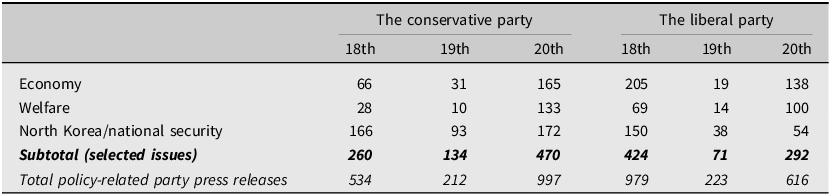
The reliability of the labelling was assessed by comparing the researcher’s coding with the results from the two independent coders. For this assessment, Krippendorff’s alpha was used to evaluate intercoder reliability across the three coders. Alpha was computed separately for (i) the policy/non-policy classification and (ii) the category-level coding. The Krippendorff’s alpha value was 0.890 for the policy/non-policy classification and 0.867 for the category-level coding. In general, alpha values above 0.80 are considered to indicate a high level of reliability, while values between 0.67 and 0.80 may be regarded as acceptable for tentative conclusions (O’Connor and Joffe, Reference O’Connor and Joffe2020). Since the alpha values for both coding tasks exceeded 0.80, the results demonstrate a high level of intercoder reliability. The number of party press releases used in the analysis after this process is presented in Table 1.
Number of party press releases by policy issue and election

Table 1. Long description
The table compares the number of party press releases by policy issue and election for the conservative and liberal parties across three elections (18th, 19th, 20th). It has 6 columns and 5 rows. The columns are labeled ‘The conservative party 18th’, ‘The conservative party 19th’, ‘The conservative party 20th’, ‘The liberal party 18th’, ‘The liberal party 19th’, and ‘The liberal party 20th’. The rows are labeled ‘Economy’, ‘Welfare’, ‘North Korea/national security’, ‘Subtotal (selected issues)’, and ‘Total policy-related party press releases’. Row 1: Economy, 66, 31, 165, 205, 19, 138. Row 2: Welfare, 28, 10, 133, 69, 14, 100. Row 3: North Korea/national security, 166, 93, 172, 150, 38, 54. Row 4: Subtotal (selected issues), 260, 134, 470, 424, 71, 292. Row 5: Total policy-related party press releases, 534, 212, 997, 979, 223, 616.
3.3. Dependent variables: levels of offensive communication
The dependent variables in this study are Aggregate Offensiveness and Offensive Intensity, which are indices calculated by quantitatively measuring the offensiveness of party press releases for each issue. To quantitatively measure offensive party communication, this study draws upon the methodological approach of Park and Lee (Reference Park and Lee2024), who analyzed the use of offensive language in party press releases using the KOLD. Park and Lee (Reference Park and Lee2024) fine-tuned a Korean deep-learning model, KoELECTRA, on KOLD and then estimated the degree of offensiveness expressed in party press releases, thereby capturing patterns of affective polarization in South Korean politics.
KOLD is a dataset consisting of 40,429 comments annotated for linguistic offensiveness and for the target of that offensiveness. It was constructed through a large-scale annotation effort in which 3,124 annotators labelled comments drawn from Naver news articles and YouTube videos posted between March 2020 and March 2022 (Jeong et al., Reference Jeong, Oh, Lee, Ahn, Moon, Park and Oh2022). Although KOLD is composed of user comments, it follows the offensiveness classification framework proposed by Zampieri et al. (Reference Zampieri, Malmasi, Nakov, Rosenthal, Farra and Kumar2019), which enables the identification of not only explicit profanity or threatening statements but also indirect forms of offensive language such as sarcasm and metaphor. For this reason, KOLD is considered appropriate for analyzing offensiveness in party press releases as well.
This study utilizes KcELECTRA (KcELECTRA-base-v2022) to measure offensive communication. KcELECTRA is based on the ELECTRA architecture, which offers superior efficiency and performance relative to models like BERT (Clark et al., Reference Clark, Luong, Le and Manning2020). Because KcELECTRA is a pretrained deep-learning language model built on online news comments and replies, fine-tuning is required to measure the level of offensiveness in the party press releases analyzed in this study. The fine-tuned model yielded an accuracy and F1-score of 0.855, outperforming KoELECTRA under identical conditions.Footnote 5 Consequently, KcELECTRA was adopted as a reliable instrument for the subsequent analysis.
The model developed through this process was applied to the collected party press releases. Drawing on the approach of Park and Lee (Reference Park and Lee2024), the predicted probability of a sentence being classified as offensive was utilized as the offensiveness score. After assigning scores to each sentence within every document, the scores were averaged to produce a quantitative offensiveness index for each document.
Using pooled election-issue-day data, the analysis measures the daily offensiveness of party communication. A key component of this measurement is the number of party press releases a party issued on that issue per day. Even if parties were to produce an unlimited volume of messages during an election campaign, there are inevitable limits to how many of those messages can actually reach voters (Haselmayer et al., Reference Haselmayer, Wagner and Meyer2017). This constraint is especially salient in high-stakes presidential elections, where the range of issues on the agenda is extremely broad, making it difficult for parties to concentrate on any single issue. Under such conditions, an increase in the frequency of references to a particular issue can itself be interpreted as indicating heightened party attention to that issue (Ennser-Jedenastik et al., Reference Ennser-Jedenastik, Haselmayer, Huber and Fenz2022; Feddersen and Adams, Reference Feddersen and Adams2022).
Accordingly, this study measures the offensiveness of party press releases in two ways. First, Aggregate Offensiveness is calculated as the simple sum of daily offensiveness scores across all party press releases issued on a given issue, reflecting the overall volume of offensive communication as well as the extent of party attention devoted to that issue. Second, Offensive Intensity is computed by dividing the summed daily score by the number of party press releases issued that day, indicating the mean level of offensiveness in how the party addressed the issue, independent of release frequency. By analyzing these two variables together, the study aims to capture both the scale of parties’ offensive communication toward an issue (the quantitative dimension) and the intensity of offensiveness (the qualitative dimension) in a multifaceted manner.
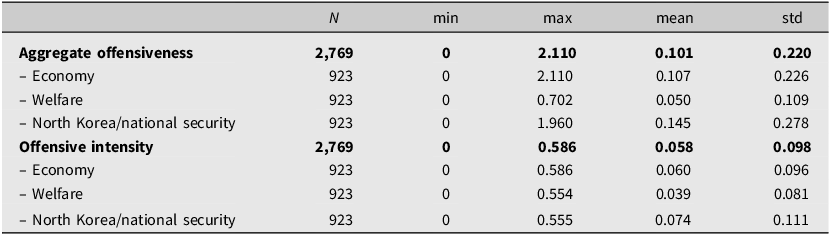
The unit of analysis in this study is the party-election-issue-day, and the dataset includes all calendar days during the campaign period, including weekends. When a party issued no press releases or commentaries concerning a particular issue on a given day, both Aggregate Offensiveness and Offensive Intensity were coded as zero rather than treated as missing values. In this context, a value of zero indicates that the party issued no press releases or commentaries concerning that issue on that day, rather than the absence of data. Descriptive statistics for the dependent variables, as well as issue-specific descriptive statistics, are reported in Table 2.
Descriptive statistics of dependent variables

Table 2. Long description
The table presents descriptive statistics for aggregate offensiveness and offensive intensity across various issues. It has 8 rows and 6 columns. The rows are labeled Aggregate offensiveness and Offensive intensity, each with subcategories for Economy, Welfare, and North Korea/national security. The columns are labeled with statistical measures: N, min, max, mean, and std. Row 1: Aggregate offensiveness, N, 2769; min, 0; max, 2.110; mean, 0.101; std, 0.220. Row 2: Economy, N, 923; min, 0; max, 2.110; mean, 0.107; std, 0.226. Row 3: Welfare, N, 923; min, 0; max, 0.702; mean, 0.050; std, 0.109. Row 4: North Korea/national security, N, 923; min, 0; max, 1.960; mean, 0.145; std, 0.278. Row 5: Offensive intensity, N, 2769; min, 0; max, 0.586; mean, 0.058; std, 0.098. Row 6: Economy, N, 923; min, 0; max, 0.586; mean, 0.060; std, 0.096. Row 7: Welfare, N, 923; min, 0; max, 0.554; mean, 0.039; std, 0.081. Row 8: North Korea/national security, N, 923; min, 0; max, 0.555; mean, 0.074; std, 0.111.
Because both dependent variables contain a large share of zeros (about 62%) and are highly right-skewed, this study employs a Poisson pseudo–maximum likelihood (PPML) model for estimation (see Online Appendix D). Conventional Ordinary Least Squares (OLS) regression, whether in levels or with a log transformation, can yield biased results due to the handling of zero outcomes. By contrast, PPML allows the inclusion of zeros without data loss, is robust to heteroskedasticity, and provides consistent estimates even when the dependent variable is continuous rather than strictly integer-valued. Importantly, PPML can be interpreted as a log-link quasi-maximum-likelihood estimator, so consistency does not require a Poisson distributional assumption; it relies on correct specification of the conditional mean. For these reasons, the PPML model was deemed the most appropriate methodology for this study (Gourieroux et al., Reference Gourieroux, Monfort and Trognon1984; Santos Silva and Tenreyro, Reference Santos Silva and Tenreyro2006).
3.4. Independent variables (I): issue ownership
To measure parties’ issue ownership over the policy domains of the economy, welfare, and North Korea/national security, this study uses four survey datasets of Korean voters made publicly available by the KSDC. In the issue ownership literature, issue ownership is typically measured using survey items asking, ‘Which party is best at handling [the issue]?’ (Walgrave et al., Reference Walgrave, Tresch and Lefevere2015). The KSDC surveys include a question asking, ‘Which party do you think will best handle [the issue]?’, making them suitable for measuring issue ownership among Korean parties.
Although there are slight variations in the wording used to describe issues across surveys, comparable issue-related questions were repeatedly fielded on four occasions over a ten-year period. Given that the distributions of respondents’ evaluations of parties’ issue reputations remain broadly similar across these surveys, the KSDC data are considered an appropriate data source for measuring issue ownership in this study. Moreover, the literature on issue ownership posits that issue ownership is relatively stable, as it is the product of accumulated evaluations of a party’s competence over the long term (Budge, Reference Budge2015). Consistent with this theoretical perspective, this study measures parties’ issue ownership based on the reputation for issue competence identified across the four surveys released by KSDC.
Based on the KSDC surveys, a plurality of respondents in all four surveys indicated that the conservative party would better handle the economy and North Korea/national security. By contrast, the largest share consistently judged the liberal party more capable on welfare-related issues. Accordingly, a value of 1 is assigned when the focal party holds a reputational advantage on an issue, and 0 otherwise. In this study, an unowned issue does not mean an issue owned by neither party. Rather, in a two-party-dominant context, it refers to an issue on which the opposing party is perceived to have a better reputation. Specifically, the economy and North Korea/national security are coded as owned issues for the major conservative party and unowned issues for the major liberal party, whereas welfare is coded as an owned issue for the major liberal party and an unowned issue for the major conservative party. This operationalization allows the analysis to compare how parties communicate about issues on which they or their competitors hold a reputational advantage.
Although issue ownership may vary in response to short-term events (Stubager, Reference Stubager2018), this study treats issue ownership as a fixed variable, acknowledging a limitation inherent to this approach. However, issue ownership measured in this manner was deemed suitable for verifying how a party’s long-accumulated reputation regarding specific issues influences its issue-related communication amidst the daily fluctuations of issue salience. Given the study’s purpose, emphasizing long-term issue ownership, which captures the structural advantages and disadvantages embedded in party competition, was judged more suitable than attempting to incorporate short-term variations.
3.5. Independent variables (II): issue salience
Issue salience is measured using two approaches, voter surveys and media coverage, which are subsequently combined to construct the final issue salience variable. First, to identify the most salient issues among voters, this study utilized survey data conducted by the National Election Commission for the 18th presidential election, and by the Korea Manifesto Center for the 19th and 20th elections. Although the organizations conducting these surveys differed between the 18th and the 19th/20th elections, they shared a common methodological framework: each conducted three rounds of expert Delphi surveys prior to the election to select key agendas, followed by a nationwide survey asking voters to identify ‘the most important agenda’ for the upcoming election. Given this methodological consistency, these datasets were considered suitable for measuring issue salience (Bélanger and Meguid, Reference Bélanger and Meguid2008; Dennison, Reference Dennison2019).
In the 18th presidential election survey, the most important issue was ‘balancing and implementing economic growth and welfare’, which received the highest share of responses (26.4%). In the 19th election, ‘eradicating corruption and political reform’ ranked first at 21.3%. In the 20th election, ‘stabilizing housing prices to secure ordinary citizens’ housing rights’ was the top issue at 14.8%. Although this figure was relatively lower compared to previous elections, the second-ranked issue, ‘creation of future jobs (through innovation and reorganization of economic industrial structure)’, also accounted for a significant share (12.4%), indicating that economic concerns broadly defined still dominated voters’ priorities.
Studies employing the Most Important Issue or Most Important Problem approach typically operationalize salience by identifying the issue that dominates voters’ priorities, even when overall issue concentration is relatively diffuse (Green and Hobolt, Reference Green and Hobolt2008; Budge, Reference Budge2015). Based on these results, this study identified ‘Economy’ and ‘Welfare’ as the salient issues for the 18th election; ‘Law and Order’ for the 19th election; and ‘Economy’ for the 20th election. Consequently, a voter-based issue salience variable was created, assigning a value of 1 to these issues and 0 otherwise. Accordingly, since this study focuses on the economy, welfare, and North Korea/national security issues, Law and Order, which was identified as the most salient issue in the 19th presidential election, is not included among the focal issue domains. Therefore, all voter-based issue salience variables for the 19th presidential election were coded as zero.
However, voter surveys are conducted as cross-sectional surveys shortly before the election, which limits their ability to capture the dynamic nature of issue salience and to reflect shifts in salience that occur over the course of an election campaign (Epstein and Segal, Reference Epstein and Segal2000; Helbling and Tresch, Reference Helbling and Tresch2011). To address this limitation, this study also measures issue salience using the extent to which issues are covered in the media (Meyer and Wagner, Reference Meyer and Wagner2016; Thesen et al., Reference Thesen, Green-Pedersen and Mortensen2017). Media-based issue salience is employed not as a substitute for voter-based issue salience but as a complementary indicator capturing the informational environment to which parties respond during election campaigns.
To measure media-based issue salience, articles were collected from Naver News and Daum News using party names as search keywords. Given that numerous studies have noted political bias in South Korean media (Kim and Lee, Reference Kim and Lee2022; Park, Reference Park2024), the analysis sought to minimize such bias by incorporating seven major national daily newspapers with diverse ideological orientations. Structural Topic Modeling was performed on the collected articles. Drawing on research suggesting that coverage of political events intensifies during elections (Garz and Sörensen, Reference Garz and Sörensen2021), the ‘electoral cycle’, measured on a weekly basis, was incorporated as a metadata covariate in the model. The number of topics for each party and election was determined by evaluating diagnostic statistics such as held-out likelihood, semantic coherence, and residuals.Footnote 6
For each document, the topic with the highest proportion was assigned as that article’s primary topic. Topic labels were then matched to the issue categories used for classifying party press releases by combining the most frequent words and high-exclusivity FREquency and EXclusivity (FREX) terms extracted for each topic (Roberts et al., Reference Roberts, Stewart and Tingley2019), together with close reading of the original texts. Documents in which the dominant topic accounted for less than 25% of the content, as well as non-policy-related articles, were excluded so that only policy-relevant coverage remained in the analysis. Through this procedure, the issue that received the most coverage on a given day among major media outlets was identified. Based on this daily aggregation, a media-based issue salience variable was created, assigning a value of 1 to the dominant issue of the day and 0 to others.Footnote 7
The final issue salience is constructed by combining the voter-based issue salience and the media-based issue salience described above. This approach is intended to capture issue salience in a multidimensional manner by reflecting both voters’ subjective perceptions of importance and the agenda emerging in media coverage. Voter-based issue salience captures baseline issue importance prior to the election, whereas media-based issue salience reflects short-term fluctuations in issue attention over the course of the campaign. The combined indicator ranges from 0 to 2: a value of 2 was assigned if both indicators were coded as 1, a value of 1 if only one indicator was 1, and 0 if both were 0. However, this additive approach has the limitation of treating voter-based and media-based issue salience equally, even though these two forms of salience may influence parties’ strategic choices through different mechanisms. Equal weighting is adopted as a conservative baseline in the absence of strong theoretical or empirical grounds for assigning differential weights to the two measures. Accordingly, this study conducted robustness checks using voter-based issue salience and media-based issue salience separately (see Online Appendix F1).
These checks should be interpreted with caution because the two measures are not equally informative across elections. In the 19th presidential election, Law and Order, rather than Economy, Welfare, or North Korea/national security, was the most salient issue among voters. Consequently, voter-based salience was coded as zero for all three focal issues, so the combined salience measure for that election varies entirely with its media-based component. The separate analyses also show that the findings are more consistently supported by media-based than voter-based salience. This imbalance cautions against treating the two components as equally weighted measures. Future research should consider approaches that incorporate their relative weights.
To account for the possibility of lagged effects and autocorrelation in parties’ responses to salient issues, robustness checks were conducted using the lagged (t−1) issue salience variable (Wilkins, Reference Wilkins2018). The results show that the statistical significance of the issue salience variable for the main findings remains robust even when the lagged measure is included (see Online Appendix F2). Nevertheless, the main analysis in this study utilized the issue salience variable at time t. This decision was based on the nature of high-stakes presidential elections, where voter attention is concentrated in real-time, often prompting immediate party responses, as well as the relatively fixed nature of the voter issue salience measure. In addition, external events were included as control variables to minimize the risk of overestimating changes in parties’ offensiveness that might be driven by exogenous shocks.
3.6. Control variables
To control for potential confounding factors influencing parties’ offensive communication, several variables were included in the analysis. First, party approval ratings were controlled, as fluctuations in support can affect a party’s electoral strategy and the intensity of its offensiveness (Elmelund-Præstekær, Reference Elmelund-Præstekær2011; Ezrow et al., Reference Ezrow, De Vries, Steenbergen and Edwards2011; Pereira, Reference Pereira2019). Weekly data from the ‘Gallup Korea Daily Opinion’ were used, as this survey employs interviewer-administered telephone interviews, which help mitigate some of the potential biases associated with ARS polling methods (Koo, Reference Koo2017). Missing values during the 20th presidential election, which were few and spanned a short duration, were imputed using a moving average method (Junger and de Leon, Reference Junger and de Leon2015).
Next, to reflect the institutional position of the parties, government status was controlled. Whether a party is in government or opposition can create differences in incentives and strategies for issue responsiveness (Klüver and Spoon, Reference Klüver and Spoon2016). While resource differences based on party size should also be considered (Abou-Chadi, Reference Abou-Chadi2018), the high correlation between government status and parliamentary majority status indicated substantial multicollinearity (VIF > 10). Therefore, only government status was included (Akinwande et al., Reference Akinwande, Dikko and Samson2015).
To control for non-electoral external factors, two variables were employed: economic perception and external events. Since economic conditions can influence party approval ratings (Kwon, Reference Kwon2008; Pardos-Prado and Sagarzazu, Reference Pardos-Prado and Sagarzazu2019), the Consumer Sentiment Index was selected as a proxy for economic perception, consistent with prior studies (Park et al., Reference Park, Kim and Lee2015; Jeon and Nam, Reference Jeon and Nam2023; Lee, Reference Lee2023). Additionally, major domestic and international events that could impact party support were coded as dummy variables, based on year-end ‘Events of the Year’ reports by major media and Gallup Korea reports (Park et al., Reference Park, Kim and Lee2015; Lee, Reference Lee2023). Following existing literature, the effect of an external event was assumed to persist for four weeks; if another event occurred within that period, a new four-week window was applied starting from the subsequent event.
Furthermore, the electoral cycle, measured in weeks from the start of the primary to the day before Election Day, was included as a control variable. This accounts for potential shifts in inter-party issue competition dynamics as Election Day approaches or due to specific events during the campaign (Pardos-Prado and Sagarzazu, Reference Pardos-Prado and Sagarzazu2019; Bustikova et al., Reference Bustikova, Siroky, Alashri and Alzahrani2020; Kim et al., Reference Kim, Kim and Hwang2023). The reference date for weekly measurement was aligned with the release date of party support ratings.
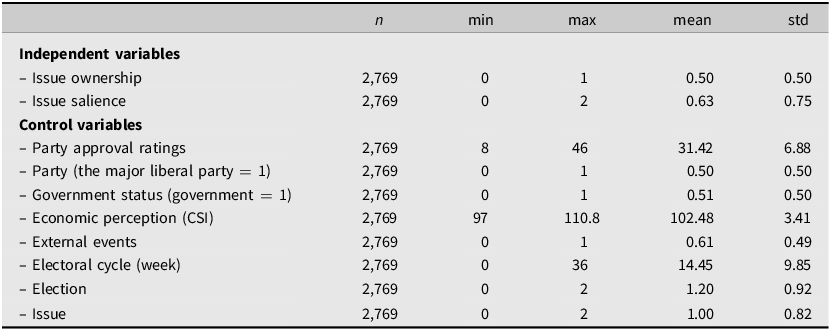
Finally, because the analysis pools issue-by-election observations for the two major parties, a party dummy (the major liberal party = 1) was added. Election fixed effects (with the 18th election as the reference category) and issue fixed effects (with the economy as the reference category) were also included to account for systematic differences across elections and issues. Descriptive statistics for the control variables are reported in Table 3.
Descriptive statistics of variables

Table 3. Long description
A table with descriptive statistics of variables. The table has 12 rows and 6 columns. The columns are labeled n, min, max, mean, and std. The rows are grouped into Independent variables and Control variables. Independent variables include Issue ownership and Issue salience. Control variables include Party approval ratings, Party, Government status, Economic perception, External events, Electoral cycle, Election, and Issue. Each row lists the number of observations (n), minimum value (min), maximum value (max), mean, and standard deviation (std) for each variable. For example, Issue ownership has 2,769 observations, a minimum value of 0, a maximum value of 1, a mean of 0.50, and a standard deviation of 0.50.
4. Results
4.1. Analysis of pooled data
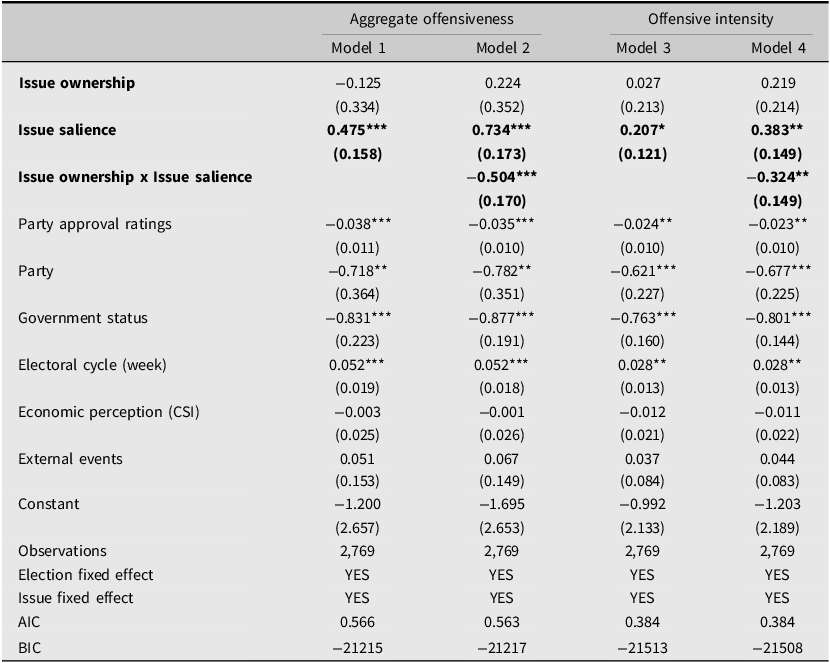
In the analysis of the pooled dataset (Models 1 and 3), the issue ownership variable did not exhibit statistical significance; thus, H1 was not supported. In contrast, the issue salience hypothesis (H2) was supported. Specifically, a one-unit increase in issue salience was associated with an increase in Aggregate Offensiveness as well as an increase in Offensive Intensity. Accordingly, as issue salience rises, parties escalate both the volume and intensity of their offensive communication.
In Models 2 and 4, the analysis tests whether parties increase offensive communication when unowned issues become salient (H3). The results show that the interaction term is statistically significant in both specifications, regardless of whether Aggregate Offensiveness or Offensive Intensity is used as the dependent variable. This pattern is consistent with the argument that parties intensify issue-specific offensive communication when rising salience raises the strategic cost of avoiding an issue on which a rival has a reputational advantage. However, the interaction does not establish that parties successfully engage in issue stealing or weaken the rival’s issue ownership, nor does it indicate a general increase in negative campaigning unrelated to that issue. Because models with interaction terms cannot be fully interpreted through coefficient signs alone (Brambor et al., Reference Brambor, Clark and Golder2006), marginal effects were estimated to assess how increases in issue salience affect the dependent variables conditional on issue ownership. The resulting margins plots are presented in Figure 1.
Predicted offensive communication by issue ownership and salience (95% confidence intervals).

Figure 1 illustrates how the effect of issue salience on parties’ offensive communication varies depending on issue ownership. The predicted values of offensive communication display different patterns depending on whether a party owns the issue. For parties that do not own the issue, increases in issue salience are associated with steep increases in both Aggregate Offensiveness and Offensive Intensity. By contrast, when parties own the issue, offensiveness changes only slightly as issue salience increases. At the highest level of issue salience, however, the confidence intervals become wider, particularly for unowned issues, indicating greater uncertainty surrounding the corresponding estimates. Although the confidence intervals overlap in some areas, visual overlap alone does not necessarily imply that the differences between the two conditions are statistically indistinguishable.
Figure 1 should therefore be interpreted not as evidence that the differences between the two conditions are statistically significant at every level of issue salience, but as a graphical illustration of the overall pattern in conjunction with the statistically significant interaction terms reported in Table 4. Taken together, the results suggest that when electorally disadvantageous issues, namely unowned issues, rise to the top of the campaign agenda, parties may have stronger incentives to employ offensive rhetoric in order to defend themselves or shift the terrain of political competition.
Effects of issue ownership and issue salience on offensive communication

Table 4. Long description
The table presents data on the effects of issue ownership and issue salience on offensive communication, divided into four models: Model 1 and Model 2 for aggregate offensiveness, and Model 3 and Model 4 for offensive intensity. The table has 11 rows and 8 columns, including headers. Row 1: Issue ownership, Model 1: -0.125 (0.334), Model 2: 0.224 (0.352), Model 3: 0.027 (0.213), Model 4: 0.219 (0.214). Row 2: Issue salience, Model 1: 0.475*** (0.158), Model 2: 0.734*** (0.173), Model 3: 0.207* (0.121), Model 4: 0.383** (0.149). Row 3: Issue ownership x Issue salience, Model 1: (not applicable), Model 2: -0.504*** (0.170), Model 3: (not applicable), Model 4: -0.324** (0.149). Row 4: Party approval ratings, Model 1: -0.038*** (0.011), Model 2: -0.035*** (0.010), Model 3: -0.024** (0.010), Model 4: -0.023** (0.010). Row 5: Party, Model 1: -0.718** (0.364), Model 2: -0.782** (0.351), Model 3: -0.621*** (0.227), Model 4: -0.677*** (0.225). Row 6: Government status, Model 1: -0.831*** (0.223), Model 2: -0.877*** (0.191), Model 3: -0.763*** (0.160), Model 4: -0.801*** (0.144). Row 7: Electoral cycle (week), Model 1: 0.052*** (0.019), Model 2: 0.052*** (0.018), Model 3: 0.028** (0.013), Model 4: 0.028** (0.013). Row 8: Economic perception (CSI), Model 1: -0.003 (0.025), Model 2: -0.001 (0.026), Model 3: -0.012 (0.021), Model 4: -0.011 (0.022). Row 9: External events, Model 1: 0.051 (0.153), Model 2: 0.067 (0.149), Model 3: 0.037 (0.084), Model 4: 0.044 (0.083). Row 10: Constant, Model 1: -1.200 (2.657), Model 2: -1.695 (2.653), Model 3: -0.992 (2.133), Model 4: -1.203 (2.189). Row 11: Observations, Election fixed effect, Issue fixed effect, AIC, BIC values are listed for each model.
Note: Standard errors in parentheses, ***p < 0.01, **p < 0.05, *p < 0.1.
4.2. Analysis by presidential election
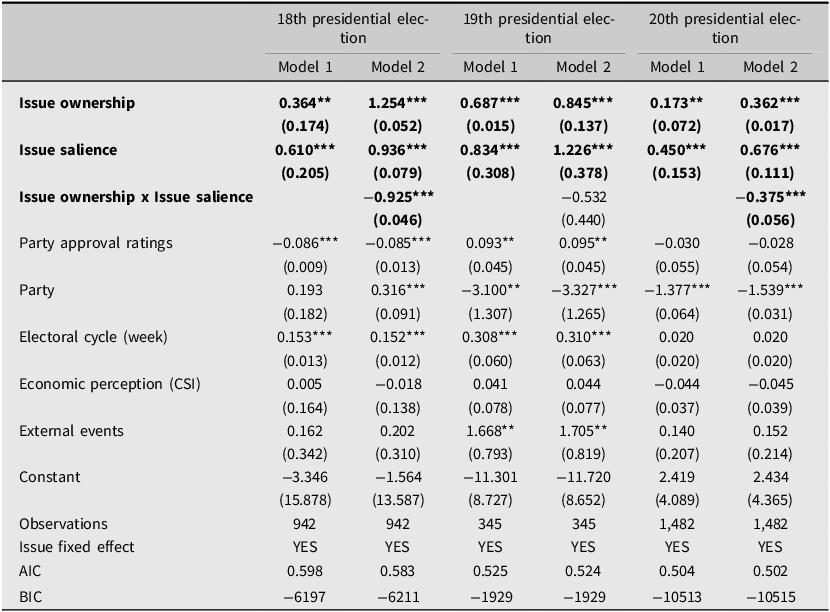
To examine whether parties’ offensive communication varies across different elections, separate analyses were conducted for each presidential election. First, the results using Aggregate Offensiveness as the dependent variable are presented in Table 5. Unlike the pooled data analysis, the election-specific analysis revealed that both issue ownership and issue salience were statistically significant variables across all elections. According to the results of Model 1, issue ownership was associated with higher Aggregate Offensiveness. Similarly, a one-unit increase in issue salience also led to an increase in Aggregate Offensiveness.
Election-specific effects on aggregate offensiveness

Table 5. Long description
The table presents data on the effects of issue ownership, issue salience, and other factors on aggregate offensiveness across the 18th, 19th, and 20th presidential elections. It includes two models for each election, with columns for Model 1 and Model 2. The rows are labeled with variables such as Issue ownership, Issue salience, Issue ownership x Issue salience, Party approval ratings, Party, Electoral cycle (week), Economic perception (CSI), External events, and Constant. Each cell contains numerical values representing the coefficients and standard errors for these variables. The table also includes observations, issue fixed effect, AIC, and BIC values for each model. Notable trends include the statistical significance of issue ownership and issue salience across all elections in Model 1, with varying impacts on aggregate offensiveness.
Note: In the election-specific analyses, the government status variable was excluded as it conveys virtually identical information to the party variable; Standard errors in parentheses, ***p < 0.01, **p < 0.05, *p < 0.1.
In Model 2, which includes the interaction term, the interaction effect was statistically significant only for the 18th and 20th presidential elections. In the case of the 19th election, which was held early due to the presidential impeachment, both issue ownership and issue salience remained statistically significant in Model 2, with each independently increasing Aggregate Offensiveness. To further analyze the interaction effects for the 18th and 20th elections, a marginal effects analysis was performed, the results of which are visualized in Figure 2.
Predicted Aggregate Offensiveness by issue ownership and salience (95% confidence intervals).

In the specific contexts of the 18th and 20th elections, distinct differences in offensiveness based on issue ownership were observed. When issue salience increased, parties possessing issue ownership showed almost no change in Aggregate Offensiveness, yet they still maintained a higher level of offensive communication compared to parties without ownership. Furthermore, consistent with the pooled analysis, parties without issue ownership were found to engage in significantly more offensive communication as issue salience increased. However, in the 20th election, parties possessing issue ownership also exhibited a tendency to increase their Aggregate Offensiveness; this suggests that, within the context of the 20th election, inter-party competition surrounding issues was intensifying overall.
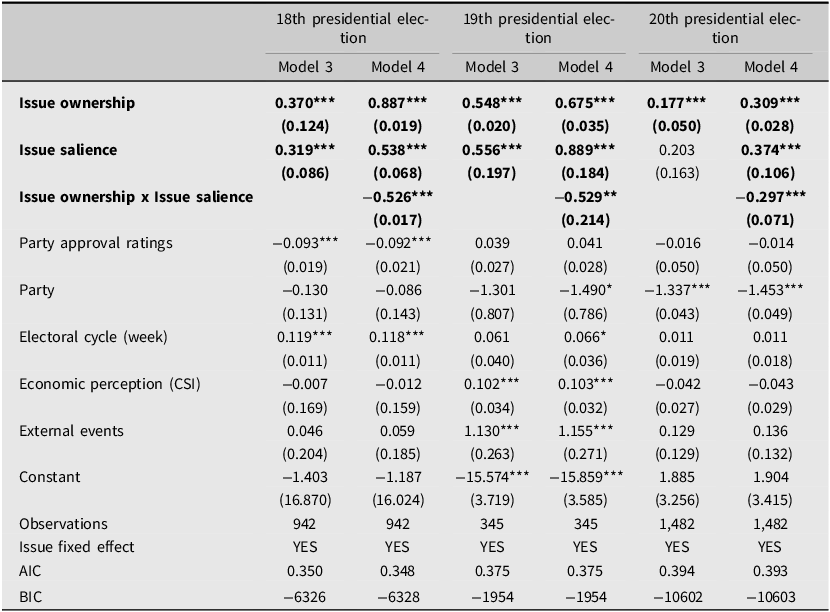
The results using Offensive Intensity as the dependent variable are presented in Table 6. According to Model 3, the presence of issue ownership was associated with an increase in Offensive Intensity across all elections. Additionally, with the exception of the 20th election, a one-unit increase in issue salience also led to an increase in Offensive Intensity.
Election-specific effects on offensive intensity

Table 6. Long description
The table presents data on the effects of issue ownership and issue salience on offensive intensity across the 18th, 19th, and 20th presidential elections using two models. It has 11 rows and 12 columns. The columns are labeled as Model 3 and Model 4 for each of the three elections. The rows are labeled with variables such as Issue ownership, Issue salience, Issue ownership x Issue salience, Party approval ratings, Party, Electoral cycle (week), Economic perception (CSI), External events, Constant, Observations, Issue fixed effect, AIC, and BIC. Each cell contains numerical values representing the coefficients, standard errors, and other statistical measures. Notable trends include the positive association of issue ownership with offensive intensity across all elections in Model 3 and the varying effects of issue salience.
Note: In the election-specific analyses, the government status variable was excluded as it conveys virtually identical information to the party variable; Standard errors in parentheses, ***p < 0.01, **p < 0.05, *p < 0.1.
In Model 4, which includes the interaction term, the interaction effect was found to be statistically significant across all presidential elections. To interpret these interaction effects, a marginal effects analysis was conducted, and the results are visualized in Figure 3.
Predicted Offensive Intensity by issue ownership and salience (95% confidence intervals).

The analysis revealed that at the lowest levels of issue salience, distinct differences between parties based on issue ownership were observed, mirroring the findings from the analysis using Aggregate Offensiveness as the dependent variable. However, as issue salience increased, different patterns emerged. In the 18th and 20th presidential elections, a significant rise in Offensive Intensity for parties without issue ownership was confirmed. In contrast, for the 19th election, although the interaction coefficient was statistically significant (p < 0.05), the difference in slopes based on issue ownership was not distinct. Furthermore, in the highest ranges of issue salience, the confidence intervals widened, rendering the difference in Offensive Intensity between parties with and without issue ownership statistically indistinguishable.
Synthesizing the results from the analyses of both dependent variables, the phenomenon of intensified offensive communication in response to the salience of unowned issues was consistently observed in the 18th and 20th presidential elections. However, this pattern did not hold for the 19th election. This finding suggests that parties’ offensive communication strategies regarding salient unowned issues are not uniform but may vary depending on the electoral context. Specifically, these strategies can be altered in the presence of exceptional circumstances, such as the presidential impeachment, where a single dominant issue overshadows the entire election.
Beyond this election-level heterogeneity, the interaction between issue ownership and issue salience is not uniform across policy domains. The issue-specific checks reported in Online Appendix A show that the interaction is not statistically supported for welfare. This null result may reflect the convergence of the two major parties’ welfare agendas since the 2012 election, when both candidates campaigned on expansive welfare platforms. Such convergence may have reduced incentives to respond to rising welfare salience through opponent-directed attacks. Because this explanation is not directly tested, the welfare result is treated as a provisional boundary condition of the proposed mechanism.
5. Conclusion
This study empirically investigates the determinants of parties’ offensive communication during the 18th–20th presidential elections, focusing on the interplay between issue ownership and issue salience. First, issue salience operates as a key mechanism that intensifies parties’ offensive communication, although the pattern varies somewhat across elections. In most models, increases in issue salience significantly raise both Aggregate Offensiveness and Offensive Intensity. By contrast, the main effect of issue ownership was not significant in the pooled data analysis but was consistently associated with higher levels of offensive communication in election-specific models. This divergence suggests that the effect of issue ownership is contingent on electoral context.
Second, issue ownership demonstrated a significant effect as a mechanism moderating the impact of issue salience on offensiveness. The analysis of the interaction term revealed that parties sharply intensified their offensive communication when the salience of unowned issues increased. This pattern was particularly evident in the 18th and 20th presidential elections, where parties without issue ownership adopted a more offensive strategy, increasing both Aggregate Offensiveness and Offensive Intensity as issue salience rose. Rising issue salience thus triggers issue competition mediated through offensive rhetoric, extending beyond mere agenda-setting rivalry.
Third, the interaction between issue ownership and issue salience varied depending on the political context of each election. In the 18th election, which featured a conventional two-party contest, parties possessing issue ownership showed little change in Aggregate Offensiveness even as the issue salience increased. In contrast, during the 20th election, even parties owning the issue were observed increasing their Aggregate Offensiveness in response to rising salience. This suggests that in the 20th election, often characterized as an unprecedentedly unfavourable election due to intense negative campaigning, even the issue-owning party was compelled to adopt a counter-offensive strategy.
Furthermore, in the case of the 19th election, while the interaction term was statistically significant only in the model using Offensive Intensity as the dependent variable, the marginal effects analysis revealed wide overlapping confidence intervals, making the difference based on issue ownership unclear. This ambiguity likely reflects the unstable electoral environment at the time. The political shock caused by the presidential impeachment may have weakened the strategic leverage implied by existing issue ownership structures. In addition, the campaign preparation period was substantially shorter than in ordinary presidential elections, and the emergence of Ahn Cheol-soo of the People’s Party as a major candidate resulted in a substantive three-way competition. These exceptional conditions may have blurred parties’ issue competition strategies.
In addition to varying across elections, the interaction between issue ownership and issue salience proved uneven across policy domains. The issue-specific analyses in Online Appendix A indicate that the interaction is not statistically supported for welfare, unlike the economy and national security. This result points to a potential issue-level boundary condition, suggesting that the mechanism may depend on the structure of party competition within particular policy domains.
These results are theoretically meaningful because they show that offensive communication, conceptualized as an issue-specific form of negative campaigning that may overlap with issue ownership attacks, is jointly conditioned by issue ownership and issue salience. Unlike issue stealing, which generally involves engaging with or reframing a rival-owned issue, offensive communication seeks to weaken the rival’s standing without necessarily establishing the attacking party’s competence. The findings indicate that offensive party communication is not merely an electoral tactic, but a strategic instrument for securing advantage within a structure of issue competition. In particular, the evidence that parties intensify offensive interventions, rather than remaining silent or avoiding the issue, when unowned issues rise in salience underscores the extent to which parties’ strategic behaviour adapts to changes in the issue environment.
Methodologically, this study contributes a systematic and replicable approach to quantifying the offensiveness of political texts by combining KcELECTRA and KOLD. Furthermore, by employing a dual approach that measures Aggregate Offensiveness and Offensive Intensity, the analysis captures the multidimensional nature of issue competition by assessing both the scale and intensity of offensive communication.
Finally, this study confirms that the use of offensive language has become normalized even within policy domains during elections, serving as a tool to secure the initiative over issues. The phenomenon observed in the 20th presidential election, where even parties possessing issue ownership increased their Aggregate Offensiveness, suggests that South Korean politics is shifting away from policy-centred competition toward increasingly affective and antagonistic forms of political contestation, as pointed out by Park and Lee (Reference Park and Lee2024). Since this trend carries the inherent risk of fuelling voter cynicism and deepening affective polarization, future research is warranted to more closely analyze the dynamics and consequences of such offensive party communication.
Supplementary material
The supplementary material for this article can be found at https://doi.org/10.1017/S1468109926100437.
Data availability statement
All data used in this study are shared at Harvard Dataverse (https://dataverse.harvard.edu/dataset.xhtml?persistentId=doi:10.7910/DVN/N1PDOY).
Funding statement
This work was supported by the Ministry of Education of the Republic of Korea and the National Research Foundation of Korea (NRF-2020S1A3A2A03096777).
Competing interests
The author declares none.




 Open access

