INTRODUCTION
In long-term care facilities (LTCFs), 70% of residents receive at least 1 course of antibiotics annually, up to 75% of which is inappropriate. 1 Inappropriate antimicrobial use increases risk of antimicrobial resistance and Clostridium difficile infection. The Centers for Disease Control and Prevention recently recommended that all nursing homes take steps to improve antibiotic use (ie, antimicrobial stewardship [AMS]) following 7 core elements: leadership commitment, pharmacy expertise, action, education, accountability, tracking and reporting data, and education. 1 Additionally, the Centers for Medicare and Medicaid Services is proposing a new rule for LTCFs that includes “requiring an infection prevention and control officer, and an AMS program that includes antibiotic use protocols and a system to monitor antibiotic use.” 2 Although these recommendations are needed, the scope of AMS among LTCFs is largely unknown. We conducted a statewide survey to determine the scope of AMS practices among Rhode Island (RI) LTCFs.
METHODS
In August 2014, the RI Department of Health developed an AMS and Environmental Care Task Force composed of members from infection control, pharmacy, medicine, and administration with AMS and/or infection control expertise. The task force developed a survey to assess the scope of AMS among RI LTCFs. Questions were based on Advancing Excellence in America’s Nursing Homes campaign materials which were designed to evaluate processes to prevent and manage infections in nursing homes, 3 and the Centers for Disease Control and Prevention’s checklist for Core Elements of Hospital Antibiotic Stewardship Programs. 4
The RI Department of Health’s public reporting contractor, Healthcentric Advisors, faxed a written notice to all RI LTCFs (N=88) and emailed copies of the survey to a subset of LTCF staff on a statewide email distribution list. Notices recommended that each facility complete the survey as a round-table exercise involving the director of nursing, infection control nurse, and any other staff responsible for infection prevention and/or AMS activities. Survey notices requested a 3-week turnaround for responses using an online survey tool. Facility administrators who had not responded were emailed directly to remind them of the deadline. No incentives were given for participation. This was deemed a quality improvement exercise with responses tabulated at the facility level. Thus, institutional review board permission was not solicited.
RESULTS
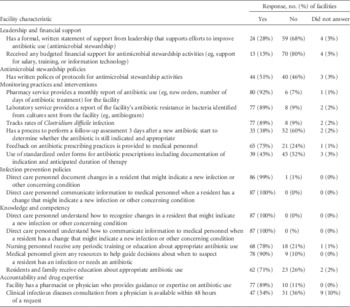
Representatives from 87 (99%) of the 88 RI LTCFs responded. Most respondents were directors of nursing (51 [59%]). The median (range) facility size was 95 (29–260) beds; 39 (45%) of facilities had greater than 100 beds. Forty-one facilities (47%) were for-profit, and 44 (51%) were part of a multifacility corporation. Survey results can be found in Table 1.
Antimicrobial Stewardship Practices Across 87 Rhode Island Long-Term Care Facilities

Of 87 facilities, 64 (74%) reported at least some facility-wide full-time equivalent (FTE) allocations for infection preventionists and 23 (26%) reported at least some AMS FTE allocations for infection preventionists (Table 2). Some facilities reported AMS FTE allocations for other interdisciplinary team members: 5 (6%) for infectious disease (ID) physicians, 13 (15%) for pharmacists, and 4 (5%) for ID pharmacists. The mean AMS allocations for ID physicians and ID pharmacists were 0.02 and 0.01 FTE, respectively.
Full-Time Equivalent (FTE) Allocations at 87 Long-Term Care Facilities in Rhode Island: Facility-Wide and Antimicrobial Stewardship Program-Specific Allocations

NOTE. AMS, antimicrobial stewardship program; FAC, facility.
DISCUSSION
Half of RI LTCFs reported written policies for AMS. Formal AMS programs among RI LTCFs were less common (28% have a formal program with written support; only 15% with budgeted support). These findings align with those from a recent survey of AMS practices among Michigan LTCFs, which showed 75% of LTCFs had written AMS policies and 23% had formal programs with dedicated staffing.Reference Malani, Brennan, Collins, Finks, Pogue and Kaye 5 The lack of written leadership support, financial support, and dedicated staffing are barriers to AMS in LTCFs and may explain the few formal programs in both states.
In contrast to our findings, a survey of AMS practices in Nebraska LTCFs found a higher occurrence of formal programs (59% [22/37]).Reference Van Schooneveld, Miller, Sayles, Watkins and Smith 6 The Nebraska definition of a formal program differed and was based on having “a person or groups of persons involved in monitoring antibiotic use or implementing programs to ensure appropriate use.”Reference Van Schooneveld, Miller, Sayles, Watkins and Smith 6 Additionally, both the Nebraska and Michigan surveys had low response rates (16%–20%) and it is possible that facilities with AMS programs were more likely to respond. A statewide survey of AMS practices among Maryland LTCFs did not assess the occurrence of formal programs.Reference Yang, Vleck, Bellantoni and Sood 7
As in previous surveys, we found high rates of basic activities, such as monitoring antibiotic use, antibiograms, and tracking C. difficile infection.Reference Van Schooneveld, Miller, Sayles, Watkins and Smith 6 , Reference Yang, Vleck, Bellantoni and Sood 7 The occurrence of more resource-intensive strategies, such as monitoring individual prescribers (Nebraska: 11% [4/37]), having an antibiotic approval process (Maryland: 25% [31/124]), and performing follow-up antibiotic assessments (RI: 38% [33/87]) was low.Reference Van Schooneveld, Miller, Sayles, Watkins and Smith 6 , Reference Yang, Vleck, Bellantoni and Sood 7
Since LTCFs have scarce resources, it is not surprising that few FTEs were available to support multidisciplinary programs. In our survey and the Nebraska and Michigan surveys, infection preventionists were the most commonly reported AMS team members (RI: 26% [23/87)], Nebraska: 68% [15/22], Michigan: 85% [51/60]).Reference Malani, Brennan, Collins, Finks, Pogue and Kaye 5 , Reference Van Schooneveld, Miller, Sayles, Watkins and Smith 6 These results suggest that in LTCFs, infection preventionists are the team members most responsible for monitoring antimicrobial use and implementing AMS programs. However, effectively implementing AMS initiatives requires expertise in antimicrobial use and awareness of emerging treatment pathways, ever-changing resistance patterns, and C. difficile infection rates. 1 , Reference Dellit, Owens and McGowan 8 It is unlikely that an infection preventionist alone can implement effective AMS strategies without the support of team members with antimicrobial expertise.
Guidelines for developing an AMS program in hospitals note the importance of a multidisciplinary program co-led by an ID physician and a clinical pharmacist trained in ID.Reference Dellit, Owens and McGowan 8 This may be untenable in LTCFs because presence of personnel with ID clinical expertise was found to be moderate at best. 1 , Reference Dellit, Owens and McGowan 8 , Reference Morrill, Caffrey, Jump, Dosa and LaPlante 9 In RI, approximately 80% of facilities reported not having facility-wide FTE allocations for ID physicians or ID pharmacists. One obstacle to implementing AMS noted by Michigan LTCFs was lack of knowledge regarding ways to initiate a program.Reference Malani, Brennan, Collins, Finks, Pogue and Kaye 5 In Michigan, 47 facilities were interested in training for a variety of topics, such as clinical guideline development, antimicrobial de-escalation education, and dose optimization.Reference Malani, Brennan, Collins, Finks, Pogue and Kaye 5 Bringing additional providers with ID expertise to LTCFs could be helpful but may represent a financial hardship for facilities if not otherwise funded. Strategies to mitigate these financial challenges could prove useful, such as several LTCFs sharing the expense of an ID consultant, contracting a consultant from a local hospital, or identifying individuals with interest in AMS and providing education through alternative means—for example, certificate training.Reference Morrill, Caffrey, Jump, Dosa and LaPlante 9 , Reference Jump, Olds and Seifi 10
Overall, our survey provides a comprehensive assessment of the AMS practices within RI LTCFs. Formal AMS programs in RI LTCFs are lacking. Infection preventionists are largely responsible for ensuring appropriate antibiotic use in their facility. Our findings suggest a need for increased access to pharmacists or physicians with antibiotic expertise. Future research is warranted to determine the scope of AMS in other states and to identify novel strategies to advance AMS efforts in LTCFs across the United States.
ACKNOWLEDGMENTS
We thank the RI Department of Health and its public reporting contractor, Healthcentric Advisors, for administering the survey and for providing the data for this analysis; the RI Department of Health’s Antimicrobial Stewardship and Environmental Cleaning Task Force, for assistance in developing the survey; and the RI LTCF staff, for completing the survey.
Financial support. None reported.
Potential conflicts of interest. H.J.M. reports that she is supported in part by a Career Development Award, Department of Veterans Affairs, and has received research funding from Merck. D.D. reports that he is a Veterans Affairs government employee and has received research funding through the Veterans Affairs Department, the West Foundation, and the National Institute on Aging. L.A.M. reports that he has served as a consultant for Medicines Company and has received research support from Astellas and Pfizer. K.L.L. reports that she has received research funding from, or acted as an advisor or consultant for, BARD/Davol, Merck, Forest, and Pfizer. All other authors report no conflicts of interest relevant to this article.
Disclaimer: The views expressed are those of the authors and do not necessarily reflect the position or policy of the US Department of Veterans Affairs. This material is based upon work supported, in part, by the Office of Research and Development, Department of Veterans Affairs. This research was unfunded.