


Introduction
The metacognitive model of Generalized Anxiety Disorder (GAD) emphasizes the role of positive and negative metacognitive beliefs about worry in the development and maintenance of excessive worry and GAD symptoms (Wells, Reference Wells, Davey and Wells2006). This model characterizes worry as a process that begins with positive beliefs about worry (i.e. beliefs about the benefits and utility of worry). According to this model, elevated positive beliefs tend to lead to Type I worry, or worry about external situations, such as social worries and worry about physical symptoms (Wells, Reference Wells2005). Type I worry is considered somewhat normative, and in the absence of negative beliefs of worry, Type I worry is not expected to lead to the onset of GAD symptoms, including pathological worry.
Further, based on the above mentioned model, negative beliefs about worry are persistent beliefs about negative consequences of worry, including the belief that worry is harmful and dangerous. These beliefs are essentially a negative appraisal of Type I worry, and these beliefs are proposed to be central to the transition from Type I worry to meta-worry (also referred to as Type II worry). More specifically, individuals who experience meta-worry are concerned that their Type I worry will cause harm or lead to a loss of control. In other words, meta-worry can be conceptualized as worry about worry. In contrast to Type I worry, meta-worry appears to be central to the development and maintenance of pathological worry and related GAD symptoms (Wells, Reference Wells2005, Reference Wells, Davey and Wells2006).
Initial findings provide relatively consistent support for the association between worry-related metacognitions and GAD symptoms, including pathological worry, in youth (Ellis and Hudson, Reference Ellis and Hudson2010). Interestingly, although components of the meta-cognitive model have been examined in youth, the potential role of meta-worry in the development and maintenance of pathological worry and related GAD symptoms has yet to be assessed.
Regarding meta-worry, another limitation relates to the use of the Meta-Worry subscale of the Anxious Thoughts Inventory (AnTI), which is the most commonly used measure of meta-worry (AnTI; Wells, Reference Wells2005, Reference Wells, Davey and Wells2006). In particular, this measure includes items that assess the uncontrollability of worry; however, uncontrollability is also a core diagnostic feature of GAD. Consequently, a degree of circularity exists in the argument that the Meta-Worry subscale of the AnTI predicts pathological worry and GAD symptoms (Ellis and Hudson, Reference Ellis and Hudson2010; Wells, Reference Wells2005). In response to this limitation, Wells (Reference Wells2005) developed the Meta-Worry Questionnaire (MWQ), which measures danger and negative consequences of worry while excluding uncontrollability. This measure is also unique in that it examines both frequency and degree to which participants believe in particular meta-worries. Despite these advantages, the use of the MWQ has been surprisingly limited.
In response to the above limitations, the primary objective of this study was to examine the psychometric properties of an adolescent version of the MWQ. Of particular interest was the potential relation between meta-worry and symptoms of pathological worry in an adolescent sample. Further, it was anticipated that the MWQ would predict significant variance in worry symptoms after controlling for other metacognitive beliefs, as measured by the MCQ. It was also anticipated that, relative to other metacognitive beliefs, the MWQ would be the most robust predictor of worry symptoms. The expected associations between the MWQ and pathological worry have the potential to provide additional support for the applicability of the metacognitive model of worry to adolescents.
Method
Participants
Participants were 175 adolescents (116 female and 53 male) recruited from public secondary schools in a medium-sized city in the southeastern United States. Six participants did not report their gender. The mean participant age was 13.94 (SD = 1.52, range 11–18 years), and the ethnic distribution of the sample was mixed but predominantly Caucasian/White (46.0%).
Design and procedures
Self-report measures were administered to adolescents in a classroom setting. Students were required to obtain parental consent to be eligible to participate and, before participating, students were also asked to complete an informed consent form. Upon completion and collection of all survey packets, participants and teachers were verbally debriefed and thanked for their participation.
Measures
Penn State Worry Questionnaire for Children (PSWQ-C; Chorpita, Tracey, Brown, Collica and Barlow, Reference Chorpita, Tracey, Brown, Collica and Barlow1997)
The PSWQ-C) is a 14-item self-report measure that assesses symptoms of generalized anxiety disorder and pathological worry; it has demonstrated adequate reliability and validity, and Cronbach's alpha in the current sample was .91.
Meta-Worry Questionnaire (MWQ; Wells, Reference Wells2005)
The MWQ is designed to measure negative beliefs about worry, including the perceived harmfulness and danger of worry. The scale consists of 7 items, and for each item participants are asked to indicate degree of belief and the frequency with which they experience the belief. Consequently, the MWQ consists of two scales: (1) MWQ-Belief, which measures degree of belief in particular metacognitions, and (2) MWQ-Frequency, which measures frequency of particular meta-worries. The MWQ has yielded adequate reliability and validity (Wells, Reference Wells2005). Some items were reworded to maximize comprehension in a sample of American adolescents. In the current sample, Cronbach's alphas were as follows: MWQ-Belief (α = .82) and MWQ-Frequency (α = .80).
The Metacognitions Questionnaire for Children (MCQ-C; Bacow, Pincus, Ehrenreich and Brody, Reference Bacow, Pincus, Ehrenreich and Brody2009)
The MCQ-C is a 24-item questionnaire designed to assess metacognitive beliefs in youth between the ages of 7–17. This measure consists of four subscales: Positive Beliefs (PB), Negative Beliefs (NB), Cognitive Monitoring (CM), and Superstition, Punishment, and Responsibility Beliefs (SPRB). The MCQ has yielded adequate reliability and validity (Bacow et al., Reference Bacow, Pincus, Ehrenreich and Brody2009). In the current sample, Cronbach's alphas were as follows: PB = .74, NB = .60, CM = .64, and SPRB = .56.
Results
Based on bivariate correlations, robust associations were found between each of the scales of the MWQ and the PSWQ-C (Belief: r(173) = .64, p < .001, Frequency: r(173) = .69, p < .001), indicating that higher levels of MWQ-Belief and Frequency are associated with higher levels of worry as measured by the PSWQ-C. However, when entered simultaneously into a regression equation, MWQ-Frequency (β = .62, p < .001) was a significant predictor of PSWQ-C scores, but the relation between MWQ-Belief was non-significant, β = .08, p = .53.
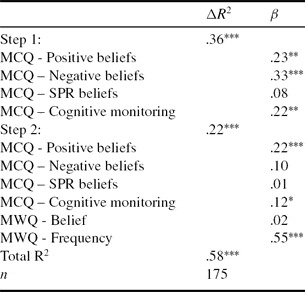
A hierarchical regression was conducted to determine the degree to which the scales of the MWQ predicted scores on the PSWQ-C after controlling for other metacognitions. Subscales of the MCQ were entered in the first step of the equation, and the MWQ subscales were entered into the second step. Both steps of the model were significant, and the addition of the MWQ subscales to the second step led to a significant improvement in the model, ∆ F(2, 165) = 41.70, p < .001, ∆ R 2 = .22 (see Table 1). In particular, the MWQ scales predicted 22% of the variance in PSWQ-C scores after controlling for other metacognitions. Further, inspection of the beta weights indicated that the MWQ-Frequency was the most robust predictor of PSWQ-C scores. Positive Beliefs and Cognitive Monitoring were also found to be significant predictors of worry.
Hierarchical multiple regression examining the unique variance of the MWQ as a predictor of worry

Notes: ***p < .001, **p < .01. MWQ = Meta Worry Questionnaire, MCQ-C = Metacognitions Questionnaire for Children, PSWQ-C = Penn State Worry Questionnaire for Children
Discussion
The purpose of the current study was to examine the psychometric properties of an adolescent version of the MWQ, including the relation between meta-worry and pathological worry symptoms. Support was found for criterion validity, as the subscales of the MWQ were found to predict scores on the PSWQ-C. Further, the MWQ was found to exhibit strong incremental validity, and MWQ was found to be a more robust predictor of worry than each of the subscales of the MCQ-C. It is also noteworthy that positive beliefs and cognitive monitoring were also found to be unique predictors of worry, suggesting that meta-worry, positive beliefs about worry, and cognitive monitoring have an additive effect in the contribution to worry symptoms.
Overall, consistent with previous research with adult samples, the current findings suggest that meta-worry may play a central role in the development and maintenance of GAD symptoms in adolescents (Wells, Reference Wells2005). This study provides unique contributions to the research literature, as possibly being the first to examine the construct of meta-worry in an adolescent sample. In addition, this study provides additional, more general, support for relevance of the Metacognitive Model to youth (Ellis and Hudson, Reference Ellis and Hudson2010).
Although the above results are promising, several limitations and directions for future research are noteworthy. In particular, little is known about the degree to which cognitive development coincides with the development of metacognitive beliefs about worry. Consequently, more research is needed to determine the developmental stages in which metacognitive models become applicable and in which children or adolescents develop the cognitive ability to benefit from metacognitive therapy.
In addition, the current study relied solely on adolescent self-report, which may have led to bias in the reporting of symptoms. Consequently, it is recommended that follow-up studies on meta-worry include the use of multiple informants when assessing worry and related anxiety symptoms. Further, the current study is based on a non-clinical sample, and it is possible that the findings do not generalize to children and adolescents with GAD and related disorders. Consequently, follow-up studies are needed, including studies to determine the degree to which negative metacognitive beliefs discriminate between adolescents with and without a diagnosis of GAD.
Another limitation is that, based on the current study, directionality cannot be determined. In particular, the current study implies that meta-worry leads to the development and maintenance of adolescent worry symptoms, and although this assumption fits with theory, it is not possible to ascertain the directionality of this association in the current study. In order to address this limitation, it may be beneficial to conduct longitudinal studies in which researchers examine the degree to which negative metacognitive beliefs predict worry symptoms over time.
Despite the above mentioned limitations, the current findings, along with previous research, may have implications for the prevention and treatment of GAD in youth. In particular, Metacognitive Therapy (MCT) has been found to be an effective treatment for GAD in adults with impressive recovery rates (e.g. van der Heiden, Muris and van der Molen, Reference van der Heiden, Muris and van der Molen2012). Based on evidence supporting the effectiveness of MCT in adults combined with evidence that the metacognitive model may extend to adolescents, it is possible that MCT may be effective for adolescents with GAD. However, efficacy of MCT has yet to be systematically evaluated in adolescent samples. Finally, it is possible that measures such as the MWQ can be used to assist in the early identification of adolescents who are at risk for developing GAD.




Comments
No Comments have been published for this article.