Copper-plates and paper farmāns in South Asia
Copper-plates (tāmraśāsana, tāmrapaṭṭa or tāmrapaṭṭikā) have long been used as a medium for royal charters and as land-grant documents in South Asia. Such objects have been recovered from areas and periods under Sanskritic cultural systems,Footnote 1 now better known from Sheldon Pollock's formulation of the Sanskrit cosmopolis.Footnote 2 From early in the first millennium of the Common Era, we find endowments of land recorded on copper-plates. The text in such plates often contains toponyms, details of revenue arrangements, and the names of donors and recipients.Footnote 3 Though most copper-plates were donative charters and title deeds, there are instances of religious or literary texts, Buddhist votive plates, and recorded gifts.Footnote 4 The texts that were carried by copper-plates fulfilled a variety of roles, including that of reinforcing a royal genealogy. Hermann Kulke has suggested that the textual content of copper-plates was an enacted substitute for carita literature that went missing for the five centuries, from Bāṇa's Harṣacaritam until the Rāmacarita and the Vikramāṅkadevacarita.Footnote 5 Copper-plate charters were typically made on the orders of a sovereign monarch, or at least claimed to have that pedigree. The text would often contain instructions to the local officials to ensure the enforcement and implementation of orders that the objects bore.
Copper-plate charters and grants were common in the Deccan until the fourteenth century (the area partially covers the modern states of north Karnataka, Maharashtra and Andhra Pradesh). Most of the grants were in Sanskrit, usually in the Devanagari script. A few copper-plate inscriptions in Telugu are found from as early as the sixth century, and some in the Kannada script are encountered from the seventh century onwards.Footnote 6 Inscriptions in an early Marathi language are found only from the reign of the Yadavas and the Silaharas, i.e. from the eleventh century onwards, and are contemporary with the origins of that language.Footnote 7 Barring exceptional early cases, the rise of copper-plate grants inscribed in regional languages was largely a later development, common from the twelfth century onwards. Almost all the copper-plate land grant charters followed a standard format consisting of two parts, the praśasti, a eulogistic praise of the king and his dynasty, often containing details of the genealogy, followed by the details of the donation or deed itself.
From the thirteenth century onwards, copper-plate grants were increasingly replaced by farmāns (royal edicts) on paper, signed and stamped by court officials. These paper farmāns would receive the seals of the local officials when these orders were received and entered into local administrative registers. These secondary seals (and in some cases signatures) on paper farmāns are an index of administrative procedures and bureaucratic apparatus. The shift in the choice of material for imperial and royal charters, from copper-plates to paper, was in large part a function of the widespread availability and use of paper in South Asia in the second millennium of the Common Era. In north India, the rise of the Delhi sultanate in the thirteenth century was the catalyzing force in adopting the widespread use of paper.Footnote 8
By the fourteenth century, most of the Deccan had caught up with these developments in Hindustan (north India). Copper-plate charters were replaced by paper charters in common and courtly administrative practice. Paper clearly had become the favoured medium for recording deeds, grants and transactions. The Persianate culture cultivated by the Bahmanis in the fourteenth century led to the rise of the Deccan as an important centre of paper production. Persianate chancellery and court etiquette accompanied the rise of most regional kingdoms and sultanates in South Asia from the fourteenth century onwards, and there was little social value placed on the medium of the copper-plate, in contrast to earlier Indic practices. By the end of the sixteenth century most of the regional courts in India, whether in Delhi, Bengal, Gujarat or the Deccan, were issuing paper farmāns to confirm land-holdings or confer land and revenue grants. Copper-plate charters were issued regularly under only very few dynasties, e.g. the Vijayanagara Aravidu dynasty (1542–1652 ce) and the later Wodeyars (1881–1947 ce) in Mysore into the nineteenth century.Footnote 9 It is notable that all the courts which issued such charters in this late period (from the fourteenth to the eighteenth century) were ruled by non-Muslim monarchs. Such practices probably resulted from claims to antiquated traditions that conferred greater legitimacy upon the ruler. The administrative practice of inscribing texts on metal plates was clearly obsolete at this point, but still had potent value as a political discourse and in the public imagination.
Though rulers in South Asia continued to issue copper-plate charters until the nineteenth century, these were declining drastically in number and were increasingly seen as symbolic gestures and not intended for use in official record-keeping or administrative practices.Footnote 10 The use of the Sanskrit language on Wodeyar copper-plates as late as the nineteenth century indicates the absurd limit of detachment between real administrative practices and the affect of ritual practice. Of course, the metaphysical properties assigned to grants on copper, either by Indic scriptures and texts on statecraft or even common belief, were instrumental in the retention of this antiquated medium.Footnote 11 The well-entrenched legal and popular reception of these plates was an enormous factor in their continued production and reception,Footnote 12 even though farmāns on paper mentioned royal titles and genealogies and had taken over the function of the copper-plates in terms of textual content.
From the nineteenth century onwards, British validation of property claims for land settlement across many parts of South Asia (particularly under institutions such as the Inam Commission) ensured the complete demise of copper-plate charters. The British method of reconfirming land holdings and tenures was through new documents of their own issue, ushering in a new period and style of paper credentials. Large parts of South Asia were administered directly by the British in the mid-nineteenth century, and many of the smaller princely states that nominally retained their sovereignty adopted similar colonial modes and practices.
Copper-plate charters have been studied philologically to unravel and understand the evolution of languages, and to classify textual production. These copper-plate charters were understood as the vehicles for texts; the latter were privileged as the objects of study. The genealogical lists that they furnished along with epigraphic details were scrutinized by early historians to construct dynasties and understand the nature of their polities. The twentieth century saw analyses of copper-plates as documents of administration providing the dry bureaucratic data which were needed better to understand mechanisms of state and revenue control. Occasionally, the texts were also more subtly read as texts of ritual control with multiple political functions.Footnote 13 Copper-plate grants were upheld as examples of royal courts creating world histories through representations of the sovereign and the state.Footnote 14 But none of these studies moved beyond the fourteenth century, when paper had virtually replaced all other recording media within the administrative apparatus.Footnote 15 The reception of the medium of copper-plates, along with its entrenched nature in popular imagination and practices, has not been adequately scrutinized.Footnote 16 Almost all the plates of this period enumerate lists of officials who were to obey and enforce the particulars of the charter. For earlier periods, it has been argued that these lists themselves were a medium of political authority.Footnote 17 It is unclear whether these charters were routinely read aloud in the presence of officials and local people, a performance that would capture the public imagination. In the context of such a role, perhaps the “authenticity” of the copper-plate charter is only secondary, particularly if non-authorized copies were common.
Non-authorized copies, fakes and forgeries
Copper-plate documents from the late medieval and early modern periods, not issued by royal courts or by local appointees of the court, are not unknown. They were most probably commissioned by the donees themselves, and occasionally even by pretenders. It is possible to conjecture some of the motives behind the creation of such “spurious” documents. Many of these contained text copied from a paper farmān. At a local level, these extra-official copper-plate grants had a greater social value than paper farmāns for at least two reasons. First, the aura of the format, which suggested an antiquarian (and therefore old and well-established) basis for any claim of land tenure or revenue rights; and second, the pragmatism of using metal documents in a region where nature conspires with humans towards the loss of paper was well appreciated. Copper-plates were often buried in small earthen or metal sealed vessels, a mode of physical protection and social convention that paper documents could not enjoy.
There are numerous instances in which copper-plates were replicated to replace lost genuine ones, and this action, in all its benignity, was sometimes considered legally valid. Historically, there are documented instances where replacement copies for lost genuine originals were legally sanctioned.Footnote 18 Richard Salomon has defined “forgery” and “spurious” to address the circumstances and intentions of the creators of such copper-plates, both malevolent and benign.Footnote 19 He argued that in instances where the claims to land or other grants were legitimate and copies were made to represent the damaged or lost originals, the intention to deceive was “… found in the presentation of the replacement as if it were the original”.Footnote 20 This can be countered with the argument that the intention of deception might be completely absent, and neither the official who periodically and ritually confirmed the charter, nor the donee who had it made, were under the impression that this was the original. The simulacrum in a socially sanctioned format to its viewers might have been understood as a durable legitimizing tool, its raison d’être only as a physical representation of the claim.
The nomenclature and systems of designating “originals”, “fakes”, “replicas” and “copies” are reflections of hindsight, and includes universalizing legal conventions from the nineteenth century onwards. Therefore, in discussing the medium of copper-plates across time, it would be wrong to assume the same unchanging understanding of a medium and convention over almost 2,000 years.
There are several examples of forgeries or copies that were made without the agency of the state. For example, several copper-plates of the various Vijayanagara dynasties are confirmed as or suspected of being forgeries.Footnote 21 In the Deccan, copper-plate documents in Marathi were produced as late as the eighteenth-century Maratha state, but the authenticity of all of these metal charters is unclear. Marathi copper-plates from this late period are mostly in the Modi script, and in some cases reproduce extracts from older paper farmāns. One well-known example of such a copper-plate, manufactured by a non-courtly source, is an order issued by the founder of the Maratha kingdom, Shivaji Bhonsale (1627–80 ce). It reproduced part of the text from a farmān in which Bavaji Gujar was punished and his land-rights redistributed to Sonji Gujar.Footnote 22 The metal object was in the possession of the Gujar-Patil family of village Ranje near Nasrapur, and mentioned the details of land and revenue rights. The text claims to be from Shuhur San 1046/1646 ce.Footnote 23 It is fairly certain that the date refers to the text and the royal order, and not the artefact itself.
Such forgeries, made by the recipients of the charters, suggest a social value and reception for antiquated artefacts of governance, a phenomenon well established in other contexts. It would be easy to read a “Hindu” revival of “classical” traditions in these imitation charters, a scenario in which the Vijayanagara or Maratha state tried to renew older material traditions.Footnote 24 This convenient interpretation would follow the contours of nineteenth-century popular historiography. However, some fragmentary evidence suggests a deeper social resonance of such actions, not necessarily associated with the top-down ideological motives of legitimization, but rather with bottom-up societal practices of validation. The lay patronization of this medium followed acceptance from local communities as an idealized presence of state authority that continued beyond the state itself. In this practice, a few copper-plate charters inscribed in the Persian language are a pointer. Their existence demonstrates that the mode of reproducing extracts from paper farmāns as copper-plates was not an eighteenth-century invention, but had precedents in the sixteenth and seventeenth centuries, even under sultanate rule. The agency of local communities in recreating and continuing traditional practices was beyond the discourse of revitalized Hindu or Muslim identities, but rooted in practices and norms that do not neatly fit theoretical models of negotiation between Indic and Persianate cultural modes. The materiality of these objects represents subaltern modes of socially validating contracts and land-grants, irrespective of the contents of the text or the agency that actually manufactured them.
The five unusual farmāns from the Deccan highlighted in this essay are particularly interesting because they are palimpsests of cultural practices over many centuries. These farmāns are inscribed on copper-plates in the Persian language using the Arabic script. We can be fairly sure that they were not issued by the kings to whom they are attributed. A non-royal manufacture for these copper farmāns is based on the following argument: if copper-plate farmāns were indeed a common practice carried on by court officials, we would have seen many more such plates in official archives and records, if not found mention of such charters.Footnote 25 More convincingly, given the volume of farmāns and the complex land tenure and ‘inām arrangements issued in this period in the Deccan, it was easy to maintain paper records in the chancellery, as opposed to disbursing copper-plate charters, a mode confirmed by the large numbers of extant documents and their standard format.Footnote 26 The easy availability of large quantities of good quality paper would facilitate that decision. In addition, the writing on these copper-plates is in a crude hand, and no monarch would have associated such poor workmanship with a royal directive. The royal farmāns produced in this period are lavish and ornamental documents, befitting the royal presence that they represented. The shoddy etching and the absence of any royal seals or stamps would suggest that these copper-plates were texts either modelled along or copied from paper-based farmāns issued by the court.
We have already touched upon the motives for the creation of such objects. Are these then to be considered “copies” in a different medium, or objects with their own lives, as authentic as the paper documents from which they were reproduced? Forged copper-plate charters have also been alluded to as early as the seventh century, certainly suggesting a widespread reception of the potency of these objects, without which such criminal activity would not have been lucrative. In one of the earliest references to a forgery, a copper-plate charter itself declared that a fake had been recovered and broken, and that the land tenure was now confirmed in the name of the new holder.Footnote 27 Such forgeries were not limited to being contemporary with the period of their manufacture. Forgeries also include eleventh- or twelfth-century attempts at reproducing the language and script of a charter from the sixth-seventh century.Footnote 28 Forgeries in this early period are difficult to study, because competent and conscious efforts were made to archaize languages and scripts in order that they appeared genuine, a point astutely observed by Bühler.Footnote 29
In the period from the fourteenth to seventeenth centuries, forged copper-plates would still have been common as a means of claiming land tenure, since many of the rights and revenues of the land were reconfirmed to local landed gentry by the Deccan sultans upon receiving proof and representation of older grants.Footnote 30 But there is reason not to believe that all the locally produced copper-plates were in the spirit of forgeries, certainly in this later period. Many of these “copies” faithfully reproduce texts on paper, and were probably made for pragmatic concerns of displaying a more durable simulacrum of the original fragile paper document in the possession of the holders of the grant. The reverse is also true, more as the exception that proves the rule, that copies of copper-plate land grants preserved on paper were made.Footnote 31
Copper-plate charters in Persian
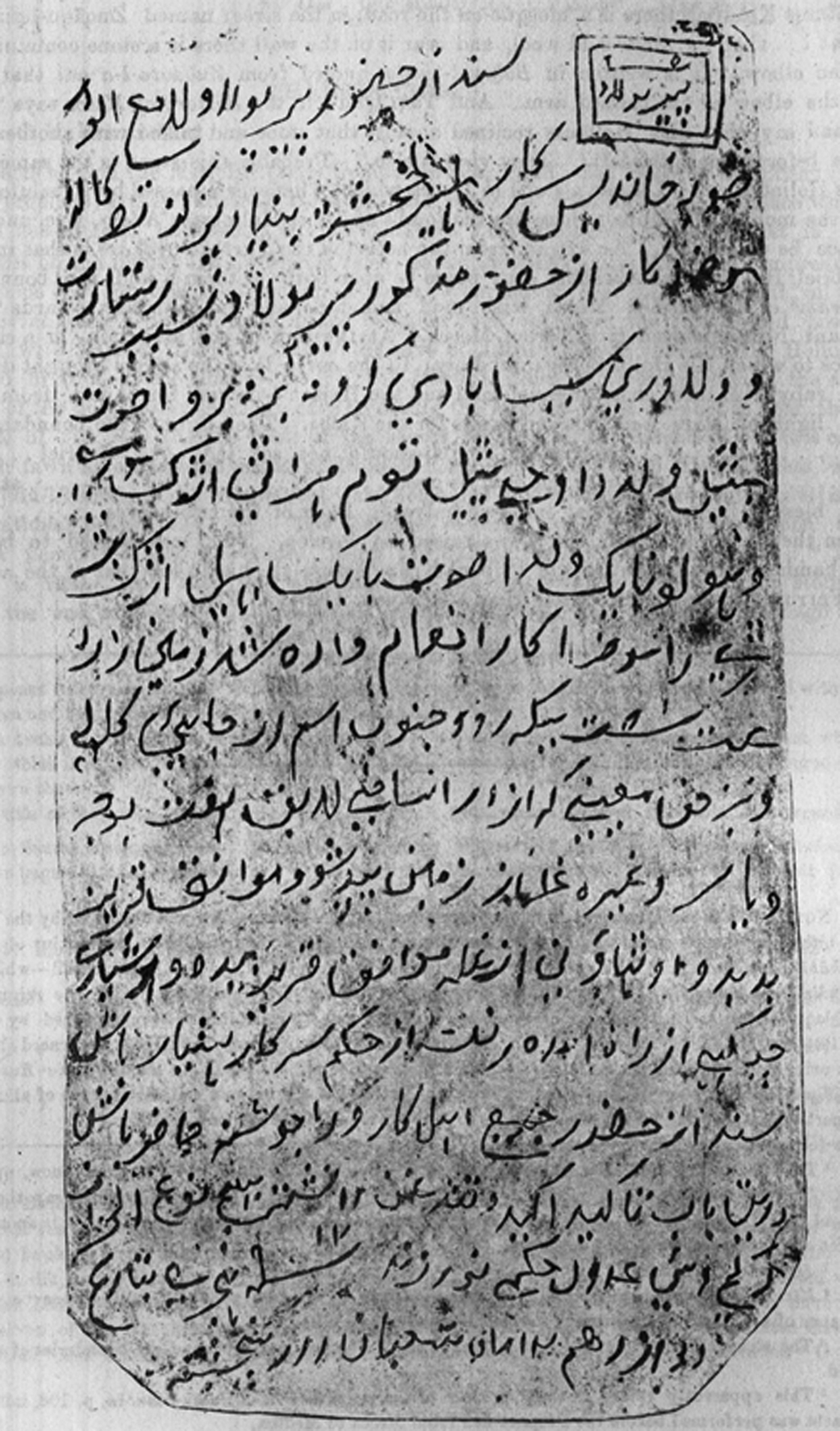
The first known copper-plate of this kind (which we will refer to as Plate A)Footnote 32 was published in Epigraphia Indo-Moslemica in 1913–14 along with a translation, and was reportedly found in the proximity of the Ellora caves in central Maharashtra (Figure 1).Footnote 33 The present location of the object is unknown. Two other copper-plates were found in Nanded district in the late twentieth century and are now in a private collection. One of these two plates (henceforth Plate B; 7.8 cm v x 7.6 cm h) was published in the Samshodhak in 1993 (Figure 2).Footnote 34 However, the transcription and the translation provided in that publication are rather dubious. The third plate (Plate C; 7.1 cm v x 5.3 cm h) has never been published (Figure 3). An eighteenth-century copper-plate in Persian (Plate D), to which I did not have complete access, is located in the collection of the Ahmadnagar City Museum (Figure 4).Footnote 35 The fifth, and much later copper-plate in Persian (Plate E) copies an extract of a land grant issued by the Asaf Jahs, better known as the Nizams of Hyderabad, and is in a private collection (Figure 5).Footnote 36 It is etched in a beautiful legible hand, and is easily amenable to transcription and translation. Other than these, there are unconfirmed reports of similar such objects found in the Deccan, such as a large Adil Shahi farmān inscribed on a copper-plate in the Maharashtra Archives (Peshwa Daftar) at Pune.
Plate A. Found in the vicinity of the Ellora caves. Location presently unknown. (Illustration from Dr Jivanji Jamshedji Modi, “A copper-plate inscription of Khandesh”, Epigraphia Indo-Moslemica, 1913–14, pp. 5–12, Plate II). Present location unknown

Plate B. Copper-plate charter in the name of Bahshah Sultan Humayun (in roundel) reads: “Farmān Humāyūnī Mubārak dar sadr o sādar be jānib hāvāldārān va desāīyān va bārgārān va kārkunān … shahr dar ul mulk Muhammadābād rabi …”. Private collection. With the permission of Sanjay Godbole, Pune
Plate C. Another copper-plate charter in the name of Bahshah Sultan Humayun (in roundel) that begins with “Bā'is tahrīr…”. Private collection. With the permission of Sanjay Godbole, Pune
Plate D. This copper-plate charter is in the Ahmadnagar City Museum regarding land in the Subah of Khandesh, and begins with “Sharh khat khānedār sardār…”. Ahmadnagar City Museum
Plate E. The copper-plate charter attributed to the Nizam of Hyderabad and published in Studies in Indian Epigraphy: Journal of the Epigraphical Society of India, v. 38 (2013). Private collection. With the permission of Sanjay Godbole, Pune
Plate A is unusual and different from the others in that in the top right-hand corner, it has an etched box with the words “naqsheh pir polad”. The use of the word naqsheh suggests a copy, since the word is associated with representations of original objects with a higher ontological status, and can be translated as plan, type, model, layout, scheme, etc.Footnote 37 The other distinguishing feature of this charter is the use of the “four dot” retroflex consonants, which are a South Asian variant on the Perso-Arabic alphabet. When Indian lexicographers in Persian glossed a word they thought would be unfamiliar to their normative reader, who was assumed to be familiar only with Perso-Arabic orthographic conventions, they would spell the word out in terms of Perso-Arabic orthography to signal its foreignness and also ensure its correct vocalization. The orthographic accommodation of Indic sounds to indicate local names is itself suggestive of a shift in the audience, and the convention can be used to date the copper-plate to a later date.Footnote 38 Plates B and C have small roundels etched on top, with the words “Badshah Sultan Humayun” contained within. The actual text in these two plates is very difficult to reconstruct, but plate B is distinctly more legible. These two obviously reproduce an extract from an original paper farmān, emphasizing only the text that was central to the claim of land tenure, invoking the names of the officiating hereditary officers, such as the Desai, Deshpande and other clerical officials (kārkunān). The dates for these plates are unclear, but would be no earlier than the seventeenth century based on philological evidence alone, though they themselves purport to be from the reign of the Bahmani sultan Humayun Shah (1458–61 ce). This conclusion is also borne out by the poor execution of the script, which could only imply a non-courtly production from a later date. Plate D refers to land tenure arrangements somewhere in the region of Khandesh, and from what can be seen of it, it has the Mughal formula of regnal year (jalūs meimanat mānūs) in the second line, though the year itself remains elusive in the photograph. It is therefore certainly no earlier than the seventeenth century. Plate E is unusual in that the date 1145 ah (1732 ce) is clearly visible in the engraved seal impression, and also at the bottom of the text, placing it firmly in the reign of Qamaruddin Khan Asaf Jah I (r. 1720–48 ce), who is named as the donor. The text mentions a land-grant to one Dhanaji Khogre in the vicinity of Kannad (in the district of Aurangabad about 40 km north of Daulatabad) in the presence of the local officials and the court (be-chashm-e darbār-e ‘ām va khās) of the king Asaf Jah I (pādeshāh-e waqt Nizām-ul Mulk Āsaf Jah-avval). This is an interesting example, because there are a number of small devices by which there appears to have been an attempt at reconciling the purported date and donor with political realities from the date of its production. These then provide the reasons to note this copper-plate charter as being of later manufacture: Nizam-ul Mulk Asaf Jah I never called himself a king, but always ruled as the governor for the Mughals, however nominally. This plate mentions the place of issue as Hyderabad, which was not the capital of the Asaf Jahs in this period, but only from 1763 ce when Asaf Jah II (r. 1762–1803 ce) moved it from Aurangabad. The embossed seal seems to be derivative of later coin designs, which were issued only in the nineteenth century.
All these copper-plate documents refer to themselves as farmāns at multiple places, except for Plate E, which refers to itself as a sanad (also commonly a paper-based charter). The texts, in as much as they can be reconstructed, replicate and imitate the language of imperial farmāns from the Deccan sultanates, and are most certainly small extracts from the original documents translated onto a different medium.Footnote 39 Yet not all of these objects were produced or commissioned by the courts from which they claim to have been issued. The text is from the court, but the object itself is produced locally, by the donee and not the donor.
Conclusion
The physical presence of charters enhanced the political and social status of both the donor and the donee, particularly if they were coded in a ritual enactment of central authority and local enfranchisement. The functions for the royal donor are easily understood “as transmitters of the message of royal greatness and privileges to the hinterland” when they were actually issued by the pre-Islamic royal courts.Footnote 40 But in the reign of the Deccan sultanates, where such charters seem to have been commissioned by putative donees to sanctify their land holdings or rights, the empowerment of the donee was already certainly a residual effect of this legacy and it was cherished and enshrined in the material object of the copper-plate charter or grant itself. Local practices thus ritualized the redundant possession of copper-plate charters and provided an impetus towards their manufacture; the language and style, however, was closely modelled on the functional paper farmān.
Thus, the text (including the script used) and the medium (copper-plates as opposed to paper) reflect two different periods of centralized administrative practices, both of which were absorbed and conflated into a single object type at a later date. These objects are at the intersection of several political and social formations across different periods, and thus form a hinge between centralized state authenticity and local acceptance, of courtly land grants and parochial reception. The changing cultural and political landscape in the sixteenth-century Deccan is also marked by the appearance of a greater number of bilingual sanads and farmāns issued by the kings of Ahmadnagar, Bijapur, Golconda and Khandesh as a resistance to the privileged status that the imperial Mughals accorded to Persian. Muzaffar Alam has written extensively on the dynamic between regional kingdoms and the imperial Mughals in their respective deployment of languages towards political ends.Footnote 41 These bilingual documents are also a reflection of the new emergent local landed office-bearers who were increasingly replacing the “Foreigner” (āfāqī)Footnote 42 element in the Deccan courts.Footnote 43
Though these charters are not authentic, in that they were not issued in a court setting or a chancellery, their intended production and presumed reception makes them genuine artefacts of cultural practices. They are the subaltern record vis-à-vis the imposed hegemony of paper farmāns, and suggest a very different register of accepted legal and ritual practices not concurrent with royal or courtly narratives. In centre–periphery models of cultural transmission, these represent the peripheral semi-autonomous realms, which received centralized traditions only to naturalize them over time. In the context of early medieval South Asia, there is no consensus on whether such land grants meant imperial greatness or extended royal influence beyond the sphere of actual control. In the early modern period, the social semi-autonomy of regions which were politically peripheral to the activities of the court is best exemplified in artefacts such as these charters, which constitute an important piece in the social history of the sixteenth, seventeenth and eighteenth century Deccan. There certainly will be many such artefacts waiting to be discovered in other parts of South Asia.