In 1547 Archbishop Thomas Cranmer preached a pithy and dramatic sermon at the coronation of King Edward VI, urging the royal youth to renew the scriptural role of young King Josiah of Judah in his own kingdom. In the early 1560s, Queen Elizabeth I berated Dean Alexander Nowell, in his own Cathedral Church of St Paul's, for subversion of her Protestant religious settlement through his ill-judged gift to her of a presentation copy of the Book of Common Prayer, enriched with devotional pictures. Both events are still repeatedly to be met with in accounts of the English Reformation, and the first has recently become something of a fixture in references to King Edward, but there is one problem: neither of them happened. They are fictions created by Robert Ware of Dublin (1639–97).Footnote 1 This Irish gentleman, second son of the distinguished Irish antiquarian and historian Sir James Ware (1594–1666), had an acute historical imagination, but he was also a liar and a forger, whose criminal deceptions had a malign effect on the politics and historiography of his day, and have shown remarkable staying power since. Although Ware was unmasked by three late Victorian scholars, and by others since in passing, his forgeries still pollute the historical pool of sources about English and Irish history. Hence, Ware needs to be exposed afresh, in an effort finally to exorcise him from our understanding of the sixteenth century. Turning our gaze on Ware may also reveal something about the preoccupations and temptations to which historians are prone, even in modern historiographical practice.
Robert Ware's background was in the Irish Protestant governing group that maintained a fierce loyalty to the episcopally ordered established Protestant Church of Ireland through all the vicissitudes of the seventeenth century: they were what in the eighteenth century would be termed ‘the Ascendancy’. Ware was born at the heart of this embattled elite and lived in the parish of St Werburgh, in the shadow of Dublin Castle and a street away from Christ Church Cathedral. His father, Sir James Ware, was a graduate of Trinity College Dublin and a protégé of the great James Ussher, sometime vice-provost of Trinity and vice-chancellor of Dublin University, and later archbishop of Armagh. Ussher was an exceptional scholar, now unjustly remembered in the public mind solely for his over-precise historical dating of the Creation.Footnote 2 Proudly conscious of his ‘Old English’ descent, giving him a centuries-long Irish inheritance, the archbishop was nevertheless aware that many of his relatives and most of his fellow-Old English had made a different choice, preserving their religious loyalty to Rome.
Ussher devoted his career to defending the episcopally governed Church of Ireland, and spent much energy supplying as scholarly a demonstration as possible of the historical truth of Protestantism, patiently sifting primary source historical evidence to persuade the world out of error. Regularly in contact with politicians, churchmen, and historians in London, he was a well-known and welcome collaborator, amid a European-wide range of correspondents, with such towering figures of early Stuart English historical scholarship and major collectors of manuscripts as Henry Spelman and Robert Cotton. In his English retirement during the Interregnum, Ussher came to be regarded as a Reformed Protestant statesman of international stature. His genius for original research set the highest standards of assessment of ancient documents, albeit combined with an emphatically polemical purpose, and established the tone of Protestant Irish scholarship into the modern age.
Ussher therefore exemplified, and really created, the outlook of the closely related knot of Dublin elite families of whom Robert Ware represented a third generation in scholarship and education: proudly Protestant, with a consciousness of its international Reformed character.Footnote 3 Most of its membership was, unlike the Usshers, drawn from recent Protestant English migration; so the Wares had their roots in Yorkshire, with marriage connections to Suffolk. Robert Ware's father James had, however, been born beside Dublin Castle, to a senior civil servant also called James, and became Irish auditor-general, which became well-nigh hereditary in the family for nearly a century. Both Jameses received knighthoods, and at one stage the two knights, father and son, shared the family home. Like Ussher, such people were convinced of the importance of episcopacy, but were also deeply suspicious of Laudian sacramentalism (Archbishop William Laud of Canterbury had repeatedly been a thorn in Ussher's side), and they therefore looked back with affectionate awe to the first two generations of properly Protestant English bishops in the reigns of Edward VI and Elizabeth. Looking further back to remote antiquity, they also discerned a ‘British Church’ that owed nothing to the Roman mission of Augustine of Canterbury except corruption, and which could now provide an identity to embrace the Protestant Churches of England, Ireland, and Scotland, and endorse their model of Reformed episcopacy.Footnote 4
The traumas of the mid-century civil wars meant that Sir James the younger was mostly exiled in England or France from the late 1640s until Robert was nineteen, returning permanently to Ireland at Charles II's Restoration.Footnote 5 This experience of family disruption only strengthened the Ware circle's detestation of popery, but also added a deep loathing of Protestant dissent, a contrast to Ussher's determined irenicism towards Protestants who opposed episcopacy. After Ussher died in 1656, his moderating influence disappeared, and Sir James Ware's sufferings had been largely at the hands of dissenters: as he judiciously reminded James Butler, duke of Ormond, on the Restoration in 1660, his lucrative office of auditor-general had been taken from him only to be regranted to a duo, one of whom had been an ‘Anabaptist’.Footnote 6 Now royalist Protestant episcopalians were spurred on to a conviction that there was a hidden connection between the two adversaries: dissent was infiltrated by a fifth column of disguised papists, among whom the Jesuits were most prominent. All these motives can be discerned in the literary creations of Robert Ware.
Archbishop Ussher directed Robert's father towards antiquarian scholarship, and Sir James's achievements were outstanding. His publication of De Hibernia et antiquitatibus eius disquisitiones in 1654 remains one of the most important pioneering surveys of Irish history, law, and physical antiquities.Footnote 7 Behind the publications lay Sir James's manuscript collections: original manuscripts, some medieval or Celtic, together with a rich and meticulous set of transcriptions which earned him from contemporaries the title ‘the Camden of Ireland’, and which were rendered all the more important by the destruction of so much manuscript material in Ireland as late as the twentieth century. Sir James published a catalogue of his collections in a small edition in Dublin in July 1648, apparently the only book published in the city in that unpropitious year for scholarship: Primate Ussher and John Selden were among the recipients of specimens of the short print-run.Footnote 8
This catalogue is precious for subsequent historians, as will become clear from the troubled fate of Ware's manuscript collections: the story turns from the highest reaches of seventeenth-century scholarship to abject deceit. For by Sir James Ware's will, his manuscripts ended up in the hands of his second son Robert, thereby becoming entangled in a troubled family history. As a boy, Robert suffered severe epileptic fits, and was not expected to live or remain sane if he did. Accordingly, Sir James resolved to create a strong entail on his estates in favour of his elder boy (yet another James), only to be confounded by seeing his second son grow out of the epileptic fits into health and exceptional academic ability. According to Robert's descendants, whose reminiscences provide echoes of his frustration at his lost opportunities, Sir James subsequently refused both a baronetcy and a viscountcy, regarding them as pointless, since the entail descended to the eldest son's daughter and her descendants in default of a male heir to continue the name. In his last years, Sir James tried to compensate Robert, building up a fund amounting to the astonishing sum of £1,000 each year for the remaining half a dozen years of his life. In his will of 1666, he left the young man all his non-entailed estates available around Dublin, but, equally significantly, all goods, debts, books, money, and plate of which he might die possessed.Footnote 9
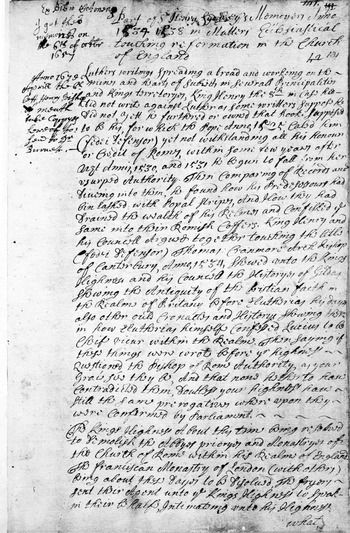
This act of generosity was to have consequences over three centuries and more, since Robert was to make very particular use of his literary inheritance. Over the next few years, he augmented his father's collections on the blank pages of the old books in his own distinctive hand, and also created new notebooks of his own. But in contrast to his father's careful accumulation, the new material was precisely that: new, elaborate, extensive forgeries of documents, ostensibly dating from the century and a half before his own time, interspersed with what material he chose to gather from printed historical sources available to him, Archbishop Ussher's works included, to provide a spurious air of authenticity for his creations (see Figure 1). He never attempted to disguise his hand with any archaisms, always presenting his interpolations as a transcript from some older document. Robert had a genuine feel for the past, and an eclectic knowledge of it worthy of his father. No evidence has been found that he attended a university, which, given Britain's troubled decade of the 1650s, is perhaps unsurprising; his father probably educated him, and introduced him to the fascination of history, with fatal results. His father had also secured him an appropriately archival position, custos brevium and chirographer in the Irish Court of Common Pleas in 1660, according Robert yet more access to documents of antiquity.Footnote 10
British Library MS Additional 4797, fo. 131r: notices of Henry VIII's reign in Robert Ware's hand: a melange of misdated or misplaced historical fragments back to Gildas, ending with a spurious anecdote about the London Franciscans. A note at top left mendaciously dates copying to 1657, with below a further memorandum (apparently in a different hand) to use Henry Jones, bishop of Meath, as an intermediary to Gilbert Burnet.

Thanks to his father's belated generosity, Robert was not poor, and in the years immediately after his father's death, was frequently a creditor for large sums in the Irish statute staple books, never a debtor: either these were transactions resulting from his father's financial settlement, or he was using resultant capital for money-lending.Footnote 11 His house in Dublin was sufficiently grand to attract the attention of no less a person than Richard Butler, earl of Arran, son of the long-term lord lieutenant of Ireland, James duke of Ormond. As military governor of Dublin, in 1678 Arran sought to lease the property, very conveniently placed next to his father's official residence in the castle; his subsequent lease would prove somewhat awkward when Robert Ware became ranged politically against the Castle establishment, as we will discover.Footnote 12 What evidence Ware has bequeathed gives the impression of a powerful and driven personality, acutely conscious of the disadvantaged place which accident of birth had awarded him in his family. Tellingly, in one of the title-pages which he constructed for a volume of his father's doctored papers, he strikes out ‘second’ in his first draft ‘put together out of Sr. James Wares Manuscripts by his second son Robert Ware Esqr.’.Footnote 13 It would have been understandable if he brooded on the contrast between his own specialist historical knowledge and the fact that his elder brother, Sir James's heir, could trade on their father's reputation with much less talent than Robert to justify his advantage. When in 1667, Lord Lieutenant Ormond was discussing with the archbishop of Canterbury what should happen to the office of auditor-general of Ireland, vacant by the death of Sir James, the duke spoke with indulgent contempt of the heir, James Ware, who held its reversion: he ‘has little other merit then that of his father to plead for him, and that was so emminent in his way that his sonns defects ought to bee borne with in consideration of him’.Footnote 14
Certainly, Robert adored his native city, and took enormous pride in Dublin's beauty and historic buildings, though with puritan preciseness, he criticized the hedonism and materialism of its present inhabitants. It has been said by the compiler of a comprehensive finding-list of his father's extant collections that Robert's unpublished manuscript ‘History and antiquities of Dublin’ is his most ‘respectable’ work, but in view of what follows, everything from the hand of Robert Ware must be under suspicion.Footnote 15 In particular, his prefatory remarks in his Dublin history might provoke hollow laughter:
My scope is only to comply with those inducements which have been often vehemently urged unto me for the publishing in the best method I can such observations of my deceased father Sir James Ware kt, and other particulars of moment relating to the city of Dublin since the conquest of Ireland as I find in the several volumes of these manuscripts which he was pleased to bequeath unto me as a legacy of great price and for the regulation and conduct of myself in this undertaking I shall look up no other pole, nor have any other scope than the impartial representation of truth out of authentic memorials compiled with the secure warranty of faithful dealing.Footnote 16
Despite this ringing protestation, the reality of Robert's history of Dublin is already characteristic of his other work. It ignores most of his father's genuine medieval collections in favour of material on the sixteenth and seventeenth centuries, including some beguilingly specific and detailed but also hair-raisingly inaccurate or unverifiable material from all dates. Some of the history sounds as if it is meant to tease the reader with absurdity, the sort of cheerfully wild exaggeration which was to become so characteristic of Dublin's literary tradition. One cannot imagine that Robert Ware was being entirely serious when he affected not to know that the dedication to Christ Church in the nomenclature of the cathedral so close to his home is equivalent to Holy Trinity; instead, he solemnly stated that it was actually a corruption of ‘Chrite Church’, in allusion to a rich merchant called Crite who had helped in the building's restoration.Footnote 17 There is a playful, celebratory character to such Joycean stuff, but the playfulness was soon to turn ugly.
The character of Ware's forgeries is extraordinary. I well remember my first real acquaintance with it in 1997, in the form of two transcripts among the Tanner papers in the Bodleian Library: two fragments apparently from the history of the Irish church under Edward VI. They provoked contrasting emotions in me: astonishment and excitement at these sudden shafts of light on a very obscure aspect of the Reformation, with vivid dialogue between Archbishop Dowdall and Lord Deputy Croft, plus equally highly coloured letters between the two – but also unease, a feeling that it was all too good to be true, and some puzzlement at the seventeenth-century cast of the literary style. Luckily, I decided to leave the texts alone and not to make use of them.Footnote 18 With hindsight, I see that I had already encountered and been deceived by two much more influential forgeries. But what strikes anyone reading the originals of any of the forgeries in London, Oxford, or elsewhere, is their sheer leaden relentlessness and repetitiveness: drafts, redrafts, extra copies, plus the constant obsessive authentication of the supposed transcripts: ‘Ex Bib. Cottonens. I got thes memories on the 6th of October 1657’, or ‘Ex Bib. Cottonens. July 7th 1658’ – suggesting the work of a conscientious copyist, copying (crucially) during Sir James Ware's lifetime.Footnote 19 So both the supposed original and supposed copy vie for the reader's credulous attention, in an audacious parody of the seventeenth century's new enthusiasm for primary source manuscript verification.
Ware's productivity on the basis of his father's papers seems to have begun to take its finished or published form in 1678, when he was aged thirty-nine. It is to that year that he ascribes his unpublished Dublin history, but by now, there was more than local history, even on the scale which Ireland's capital demanded, to excite Ware. His opportunity to use (and indeed no doubt greatly expand) his literary creations for a specific political and religious cause derived from the atmosphere of hysteria which arose in the late 1670s, when members of the established episcopal churches suddenly felt their hard-won gains threatened by a monarchy which seemed ready to betray them to Roman Catholics and to use Protestant dissent as a means to that end. So the agitation to exclude James, duke of York, from succession to the throne reached a fever-pitch. It was fuelled by a bizarre character whose ability to lie on an heroic scale must have aroused Robert Ware's admiration and envy: Titus Oates, inventor of the Popish Plot which so transfixed the Atlantic Isles between 1678 and 1681. There is no positive evidence that Oates and Ware ever met, but the atmosphere created by Oates's fictions gave Ware his chance to poison English and Irish historiography.
At the beginning of the Popish Plot crisis, there appeared a small work of eight pages entitled Strange and remarkable prophesies and predictions of James Ussher: a tribute to the continuing dominance of the late archbishop's personality in the Ware circle.Footnote 20 The pamphlet's material was presented anonymously, but in its mode of distancing itself slightly from its supposed original material, while presenting a detailed and circumstantial narrative, it has all the hallmarks of a Robert Ware production. Its point of departure was a passage from Nicholas Bernard's biography of Ussher which described a sermon preached by the future archbishop in his twenty-second year in 1602, predicting the coming of civil war in 1641 on the basis of a passage in Ezekiel (the redactor for better effect in his pamphlet, tidied the sermon back to 1601).Footnote 21 Ussher's more recent – and more trustworthy – biographer, Alan Ford, gives credence to the original story, but the redactor's version of the sermon with the archbishop's rather vague predictions of Britain's mid-century calamities nevertheless only occupies a couple of pages before the remaining five. The compiler of the 1678 pamphlet had his own new material to present.Footnote 22
Introduced afresh by the editor, this new story told of the encounter between Ussher and a main narrator (not the editor) a year before the archbishop's death, in 1655. It is a detailed and circumstantial narrative by someone who claimed to have heard much of the material directly from Ussher himself, a mixture of written word and conversation. There is additional citation of named corroborative witnesses, one of them Ussher's daughter, the other the wife of Sir James Ware's colleague in the Irish exchequer, Chief Baron John Bysse. Hence already Robert Ware was exploiting the names of the great and the good in the previous two generations of his family and acquaintance, while posing (albeit anonymously) as a mere editor and compiler, a tactic that would become characteristic of his forgeries. In this account, Ussher did what any respectable Reformed Protestant theologian ought to do, first expounding with awe and humility the relationship between justification and sanctification, before solemnly warning of the likelihood of further persecution and massacres by papists, as part of their continued worldwide conspiracy against godliness. So it was the latter prophecy which really mattered in the pamphlet's seven pages: Ussher had been predicting the Popish Plot twenty years before it had supposedly taken shape. When various subsequent pirated and doctored versions of the Ussher prophecies were issued, it was usually this material, rather than that supplied by Bernard, which interested redactors.
The slim production which was the source of all subsequent versions was published at a crucial moment, its licence dated 16 November 1678. Only a month earlier, Titus Oates had delivered his sensational testimony to the English House of Commons. Ware's pamphlet proved a best-seller: Oxford libraries hold no fewer than eight copies of the 1678 editions alone, there was an immediate translation into Dutch apparently produced by the same publisher in London, a further edition was published in Cork in 1679, and the sequence of subsequent reprints did not end with the Exclusion Crisis, but proliferated up to the mid-nineteenth century, each addressing the latest manifestation of Romish malevolence.Footnote 23 Already in 1681 came the first tidied-up and shortened plagiarism of the text concentrating on the matter relevant to the moment.Footnote 24 The enthusiastic reception for the first of Ware's fictions evidently inspired him to subsequent forgeries which should have been much more straightforward to discredit, but which have proved remarkably enduring.
In 1679, Ware issued another slim eight-page quarto pamphlet: the first forgery of supposed older manuscripts which would later become his special genre, The examinations of Faithful Commin Dominican fryer, as Sir James Ware had them from the late Lord Primate Usher. This edition was furnished with Elizabethan literary pedigrees which would become familiar in his forgeries, from papers of ‘Lord Cecil’ (i.e. Sir William Cecil, later Lord Burghley), conveyed to the manuscript collections of Archbishop Ussher and then ‘my dear Father’ Sir James Ware. This account from 1567 described the activities of one ‘Faithful Commin’, a Dominican who had pretended to be ‘a Strict Protestant’ to sow discord in the Protestant Church of England. The material was wonderfully circumstantial, including verbatim cross-examinations of Commin by Matthew Parker and Queen Elizabeth herself. The fraudulent Dominican had gathered England's first independent Protestant congregation. It would all confirm to readers a great conspiracy between Romanists and Protestant dissenters of more than a century's duration, and Ware ended the sensational material by promising that there were ‘many other Memorandums in the same Book worth the Printing’. Evidently he was setting up the beginning of a rich stream of revelations for a horrified Protestant public.Footnote 25
Robert's forgeries, presenting the Popish Plot as part of a long design against Protestant Britain, with the Irish Rebellion of 1641 as prime exhibit, were only one aspect of his activity in promoting this fiction. What conspiracy existed, was in reality the work of people like himself, with his own role not insignificant. At the height of the Exclusion hysteria in summer 1680, Ware was in London, as an agent of Henry Jones, sometime vice-chancellor of Trinity College Dublin and now bishop of Meath (the most senior bishopric in the Church of Ireland after the archbishoprics, Meath carried with it a seat on the Irish privy council). A veteran Irish politician whose resourcefulness and adaptability served a ruthless commitment to advancing traditional Reformed Protestantism, Jones was central to the Irish dimension of the Popish Plot. Up to his death on 5 January 1682, the bishop was a close associate of Anthony Ashley Cooper, earl of Shaftesbury, and Arthur Capel, earl of Essex, in stoking the alarms of 1679–81. Jones was also one of the most active in maintaining momentum in the execution for treason of the hapless Catholic primate of Armagh, Oliver Plunket, against the duke of Ormond's dogged attempts as viceroy to lower the temperature of public excitement.Footnote 26 Ormond's strategy during the Popish Plot was of a piece with his consistent attempts to draw the fangs of the memory of 1641, in the interests of creating national harmony across the religious divide. The publication of Archbishop Ussher's supposed predictions about 1641 must thus have annoyed him sorely.Footnote 27
By contrast, Jones was only too conscious of the atrocities in the 1641 rising, having early in his career edited the considerably exaggerated account of the crisis, as ‘beyond all parallel of former ages, a most bloody and Antichristian combination and plot’. Presented to the English parliament in 1642, the depositions in his account were frequently reprinted to keep bitter memories alive, and the original manuscripts were punctiliously preserved after Jones's death, acquiring something of the same canonical status afforded to Sir James Ware's manuscripts. One of Jones's most celebrated sermons, preached in Christ Church Dublin in 1676, invoked the memory of 1641 in a fashion anticipating the Ussher prophecy pamphlet of 1678, and his sermon was duly reprinted in London in 1679, with a dedication to Essex, the Whig promoter of Popish Plot hysteria.Footnote 28 Moreover, Jones was yet another member of the Ussher/Ware circle. As well as being Archbishop Ussher's nephew, Jones married Sir James Ware's niece as his second wife, and was thus cousin by marriage to Robert Ware; for his part, Robert Ware married Elizabeth Piers, another cousin, and one of Jones's nieces.
It is therefore unsurprising to find Ware working for Jones in London in summer 1680, at the time when Archbishop Plunket's trial was beginning in Dundalk. Ware was in the company of another active Irish conspirator active with Shaftesbury and Essex, Colonel Roderick Mansell; the conspirators sought to implicate Ormond himself in allegations that Catholics were plotting to secure a French invasion of Ireland.Footnote 29 The fragments of Ware's letters to Jones are racy and gossipy, and Ormond's agent, who was trying to head off this plotting and who had intercepted these letters, referred to him familiarly as ‘Robin Ware’.Footnote 30 Here is a further echo of a conspirator given to high-spirited mischief. This incident is not the only evidence suggesting Henry Jones as the eminence grise behind the utilization of Ware's talents in both conspiracy and forgery; nor was it the end of Ware's dabblings in the Exclusion Crisis.
Through his crowded years of political activity, Ware greatly expanded the range of his historical fictions, first in partnership with an English clergyman, incumbent of Doddington in Cambridgeshire, John Nalson. Nalson's connection to Ware remains a puzzle, but amid the excitements of 1678–81, with Ware travelling regularly between Dublin and England, it hardly needs explanation. R. C. Richardson comments that ‘[w]ithout doubt Nalson was fixedly anchored in the tempestuous years around 1680’, which was equally true of Ware: a double case of cometh the hour, cometh the man.Footnote 31 Nalson was an ultra-royalist pamphleteer whose talents had been exploited by the Danby administration through the 1670s, yet in the early stages of the Exclusion Crisis, this was to prove no obstacle to collaboration with an Irishman who was linked to English Whigs. There were plenty of loyal subjects of King Charles who quickly came to hate Shaftesbury and his collaborators, yet who had no doubt through most of the Exclusion Crisis that the Popish Plot was a reality.Footnote 32 It was by no means impossible for a classic Anglican royalist and admirer of Archbishop Laud like Nalson to see an exotic Irish ally in a royalist episcopalian like Ware. Ware's idol was the very different Archbishop Ussher, but even Ussher was an object of suspicion to radical Whigs as a propagandist for jure divino monarchy.Footnote 33 Nalson would also know that the Ware family had been unbending in its royalist allegiance throughout Ireland's civil wars and had suffered accordingly. Both men were obsessed with the historical lessons of the 1640s, and both saw the rebels against Charles I as the enemies of liberty in his kingdoms. Now there was a new threat to liberty, and as the Exclusion Crisis took shape, it was not easy for royalists obsessed with 1641–2 to see exactly where the chief threat came from: puritans or papists.Footnote 34
Like so many Anglican royalists, the two propagandists were equally firm in their hatred of Roman Catholics and Protestant dissenters, including Presbyterians, and that shared animus was a firm basis for their unholy temporary collaboration. The year before the Popish Plot was announced, Nalson had published a hyper-royalist diatribe detecting ‘no great difference between those of the foundation of Loyola and Geneva’, something of a Cavalier commonplace at the time.Footnote 35 Now, in the summer of 1680, while Ware was busy plotting in London, this view was consolidated into the claim of an actual conspiracy of popery and dissent, as revealed in a hugely successful thirty-three-page collection largely consisting of Ware forgeries, published in London by Nalson and resonantly entitled Foxes and firebrands.Footnote 36
The title was a clever conceit, which was already a commonplace in Restoration royalist circles, much encouraged by conspiracy theories around the popish origins of the Great Fire of London.Footnote 37 The alliteration and resonant echo of Foxe's Book of martyrs was only the most superficial appeal. Its main point was its biblical allusion to the story of Samson sowing confusion among the Philistines by sending pairs of foxes with burning torches tied to their tails into Philistine farmlands (Judges 15:4–5), and it also satisfyingly lined up papists as cunning foxes and dissenters as headstrong firebrands. The work was sarcastically dedicated to the leading Presbyterians Richard Baxter and William Jenkins, and while not actually accusing them of being hidden papists, it certainly directed that accusation against Quakers and Fifth-Monarchy Men, with the aid of material which Nalson was not too squeamishly Tory to derive from Titus Oates's accusations. Besides the newly produced material in the pamphlet, there was the story of Faithful Commin taken directly from Ware's previous publication, as Nalson pointed out, providing its pedigree from William Cecil to Ussher to Sir James Ware, whose ‘son Robert Ware Esq. has obliged the Publick by the communication of them’.Footnote 38
In effect, this was a relaunch of Ware's 1679 pamphlet, which to judge by its minimal present-day survival, had not made a great impact, perhaps because it had only been published in Ireland. Now Ware's forgeries were being rebranded for the London market, with exciting extras, fulfilling the promise he made in his Commin pamphlet. To the treachery and duplicity of Faithful Commin was added the very similar and supposedly contemporary story of Thomas Heath, brother of Nicholas Heath (slightly curiously described as bishop of Rochester rather than taking notice of the culmination of his career as archbishop of York). Heath had, in a similar fashion to Commin, inveighed from the pulpit against set prayer, but examination by Bishop Guest of Rochester exposed him as a Jesuit. This made a fine prelude to material from the combined pens of Titus Oates and Robert Ware dated to the early seventeenth century, further demonstrating how the Jesuits planned this subversion of Protestants.
The collaboration between Nalson and Ware in 1680 proved fleeting; the differing nature of their passion for the established church must have driven a wedge between them. Nalson thereafter enthusiastically supported the royal ascendancy of Charles II's last years, no doubt encouraged by the revelation of what Whig radicalism might lead to in the Rye House Plot in 1683; the parson of Doddington shared in the crystallization of a ‘Tory’ group which was happy to embrace the label, and now knew more clearly whom it hated.Footnote 39 Notable was Nalson's publication in 1684 of an edition of the record of Charles I's trial ostentatiously dedicated to James, duke of York, including a diatribe against those who ‘should so violently endeavour to Exclude the Son from the Right of Succession, who so inhumanely and barbarously Excluded his Father from the Possession both of his Crown and his Life’. Nalson's introduction to the text further attempted to gratify his dedicatee by ridiculing those former supporters of the Commonwealth who attempted to excuse their own guilt by asserting ‘that the late King was murdered by the Papishes, as they call them’ – precisely the charge which Robert Ware had made in the Preface to the Reader in his first outing of Faithful Commin in 1679.Footnote 40 For Nalson there was to be no more talk of collusion between Romanists and dissenters; he exemplifies Jonathan Scott's aphoristic remark that ‘[f]rom 1678 to 1683 people remained convinced of an imminent threat to the church and government: in 1681 they changed their minds about where the greatest threat was coming from’.Footnote 41
Accordingly, Ware was obliged to maintain momentum without Nalson's help. The year 1681 proved to be his literary annus mirabilis, with three separate new works published in London or Dublin. The slimmest was a previously unknown Celtic prophetic text, ‘of late casually found, and drawn out of the Archives of Sir James Ware's rich and careful preserved Antiquities’. This rebuke by Gnatus, a hermit of true British religion, to popish Augustine of Canterbury soon after his landing in Kent was another supposed trophy from the Rochester archives, transmitted to the Wares in an Elizabethan transcription by a chaplain of Bishop Guest. As Ware poetically described it, the fragment ‘now breaks forth like a Star newly created in the firmament of Heaven, which draws all the World to look upon it with admiration’, with prophecies of events still to come, ‘depending on the behaviour of Nobles, and people practising and maintaining the true Religion against Idolatry’. The prophet had taken the trouble to inform Augustine of the coming Reformations of Edward VI and Elizabeth, while Ware authenticated his text with learned references to Bede and Lambarde's Perambulation of Kent, John Stow and Thomas Fuller among the supporting cast.Footnote 42
A further Dublin pamphlet of 1681 told the story of an Irish Franciscan friar and nephew of Archbishop Corwen of Dublin who supposedly converted to Protestantism in 1589. This was allegedly drawn from the papers of John Garvey, one of Ussher's predecessors as primate of Armagh, which was (as Ware put it on the title-page with delicious ambiguity, perhaps savouring the joke) ‘now entered amongst Sir James Ware's manuscripts’, a phrase he used on more than one occasion. Naturally, the pamphlet climaxed with reports of murderous plots among Elizabethan Irish Catholics.Footnote 43 Most ambitious was a publication in 1681 in Dublin and London editions (with a new London title-page specifically aimed at a general English market), which took Ware back to the reigns of Henry VIII, Edward VI, and Mary Tudor, consisting of a biography of George Browne, Reformation archbishop of Dublin, accompanied by a long sermon of Browne's against idolatry. Idolatry had quickly emerged as a favourite theme for Ware, underlining the gulf between his variety of Anglican royalism and that of English high churchmen, but to echo the Corwen material, his present work also contained the account of yet another murderous plot against Irish Protestants in Mary's reign which had been foiled. Transmission of some of the material was credited to Sir James Ware's mentor, the Trinity scholar Anthony Martin, Ussher's immediate successor and Jones's predecessor as bishop of Meath.Footnote 44
The background to Ware's publications in 1681 was his continued political activity, amid the efforts of Jones and his associates to keep alive the non-existent Irish side of the Popish Plot and contribute to Exclusion agitation. In September and October 1681, Ware took a pivotal role in gathering Irish material which might assist Shaftesbury's defence in his trial on capital charges of high treason, much to the fury of Ormond and Michael Boyle, Protestant archbishop of Armagh, who were still desperately trying to avoid an explosion of sectarian violence in Ireland. Monitoring Ware's visits in the Dublin Marshalsea prison to an English informer called William Smith, Ormond and Boyle found themselves trying to sort out a bewildering set of accusations and counter-accusations, particularly involving one Dr Theophilus Harrison, titular Protestant dean of Clonmacnoise Cathedral.
What Ormond and Boyle discovered was that it was Ware who was transmitting such material to Sir Robert Clayton, one of Shaftesbury's leading Whig associates in London. Its effect would be to show that Roman Catholics were trying to invent accusations against mainstream members of the Church of Ireland, like Harrison, that these royalist Protestants were in turn inventing a Popish Plot. The depositions would incidentally supply evidence implying that the Dublin administration was dangerously soft on Catholics, in order to vindicate Shaftesbury's three years of agitation.Footnote 45 Little more than a month after Clayton received and exploited the material which Ware had gathered in the Marshalsea, a sympathetic jury returned an ignoramus verdict in Shaftesbury's case. Archbishop Plunket had not been so lucky, having been executed on 11 July 1681.
It is this background of conspiracy against the Ormond administration that effectively rules out a tempting attribution of yet a fourth pamphlet to Ware, also published in 1681 in Dublin. Raymond Gillespie has suggested that Ware was the author of the anonymous The mischiefs and unreasonableness of endeavouring to deprive his majesty of the affections of his subjects. Certainly this effusion shared its printer Joseph Ray and publisher Samuel Helsham with The prophecy of Gnatus and its printer with The conversion of Philip Corwine.Footnote 46 There was, however, not much choice of printers in Dublin, and Ware's authorship of this piece is unlikely. The prose style is much more formal; there is none of the usual Ware accumulation of picturesque incidents or forged documents, no mention of Sir James Ware's collections, Roman conspiracy, or idolatry. Instead, there is a reasoned appeal to passive loyalism, not merely with no hint of papist conspiracy, but also with no allegations of conspiracy between papists and dissenters. Crucially, the resonant year 1641 is only mentioned in connection with the deplorable breakdown of English order at that time; the Irish rebellion is not mentioned at all. The writer goes out of his way to ridicule those who claim ‘that we are galloping to Mass as fast as we can’ or that ‘care has been taken by the Papists (who say they have Govern'd these three kingdoms these twenty years) that none should be preferr'd to any thing considerable but those who were for their purpose’.Footnote 47
Reading The mischiefs and unreasonableness, one conjectures that, far from being its author, Robert Ware was actually in the sights of a writer who speaks with sorrow of ‘the people, who are led and managed by these Discoverers’ and whose ‘Zeal for the Protestant Religion will make them hate all who they suspect design its subversion … rash and forward men who were for too violent counsels, and too close a prosecution of things as circumstances then were’. A pamphlet which spends a page praising the government and character of Ormond, including his ‘firmness to the Protestant religion, … most notorious to all who have heard of him’, and the assertion that the pope had called the duke ‘one of the most considerable and dangerous Enemies they had in Christendom’, does not sound as if it emanates from one of the Jones circle.Footnote 48 Moreover, it was being sold just by the main gate of Dublin Castle, from a printer who was official printer to the Irish executive and the corporation of Dublin.Footnote 49 And all this in a work dated 24 May 1681, only three weeks after Plunket's arraignment in Westminster Hall, as the agitation for his destruction was gathering momentum with the aid of Jones and Ware. In this moment of crisis, to make Robert Ware its author seems too illogical a double-game even for that master of lies; after all, what would have been the advantage for Ware in an anonymous encomium of the lord lieutenant? There was indeed to be a reconciliation between Ormond and Ware, but not yet.
The ‘authentic’ works of Ware continue consistent in the incendiary themes of earlier works. In the following year, 1682, he returned to Nalson's Foxes and firebrands, reprinting it from a Dublin press, but now enriched by his own second part of further material without any collaboration from Nalson. Both collections were separately prefaced by Ware, while he punctiliously acknowledged an author whom he referred to as ‘the learned Dr Henry Nalson’. Maybe the mistaken Christian name was just inadvertence, but the paranoid alert for in-jokes in Ware's œuvre might consider it a distancing device, or even a conflation of John Nalson with Ware's own patron, Henry Jones.Footnote 50 Ware also gloried in having
disobliged the two extreme factions in Religion, (the Papist and the Puritan) by exposing their Combinations for the ruine of the Protestant Faith which is by Law happily established and setled among us … I hope the Reader will look upon it as an argument of my candor and sincerity, that I do not studie to gratifie any party in Religion, but have rather invited their prejudices upon my self, by saying these things that are disobliging to them both.Footnote 51
It was at the beginning of the new second part that there appeared, as the very first primary source item, the forgery which has enjoyed the longest life among all Ware's creations, curiously separate in its supposed timeframe from, and earlier than, everything else in the collection: the supposed speech by Archbishop Thomas Cranmer at King Edward VI's coronation in 1547. As in the sermon of Archbishop George Browne, its major theme was the fight against idolatry, which Cranmer urged upon his young King Josiah. Otherwise, the materials ranged from the Elizabethan period to the era of the 1641 rising, taking in en route the duke of Buckingham's assassination of 1628 as a Jesuit plot, and including a letter from a Jesuit which made it clear that ‘that sovereign drug Arminianism’ was all part of the Society's grand design.Footnote 52
In 1683 came a new variant on the Fox theme: The hunting of the Romish fox, which added another layer of allusion to Foxes and firebrands, derived from Ware's antiquarian knowledge. Its title was a version of titles of a celebrated sequence of literary attacks from the 1540s, by the evangelical William Turner on the arch-defender of traditional religion, Bishop Stephen Gardiner. The title-theme had already been reused in a new work of the 1590s, and like that production, Ware's work had nothing to do with the original Tudor text; its entirely new content, original in every sense, cited a mixture of his usual fictional sources, ranging from Archbishop Cranmer to Archbishops Laud and Ussher.Footnote 53 But there was something new: the work is notable for its ostentatious (and I would argue in Ware's works, unprecedented) courting of Ormond, who, by this stage in his lieutenancy, had become an absentee in England. Ormond's name was emblazoned on the title-page via the work's publisher, who carried the title of the ducal bookbinder in Dublin, yet Ware's fulsome dedication to Ormond notably does not repeat any of the phraseology or sentiments of The mischiefs and unreasonableness.
This looks like a politic reconciliation of the former plotter against the Castle administration, now that Exclusion was a lost cause and his patron Henry Jones was dead. Admittedly, Ware was still causing trouble in March 1683 for Ormond's son and substitute in Dublin, Richard Butler, earl of Arran, but now in civic rather than national politics, and with a dissenter also in his sights. Ware was leading the opposition to a major building-project in his beloved city whose projector was using the Ormond name to further the scheme, ‘Ormond Market’ north of the Liffey, and it can only have exacerbated Ware's opposition that the chief promoter, amid many other improvement schemes, was a notorious Presbyterian, the lord mayor Sir Humphrey Jervis.Footnote 54 Arran reported to Ormond that the row over the Market's construction was only finally quelled after a noisy meeting of the city corporation on 19 March 1683. In view of Ware's frequent sneering deployment of the word ‘fanatic’ for Protestant dissenters, not least in the dedication of Hunting to Ormond, he would have been mortified by Arran's irritated private characterization of the Market scheme's opponents as ‘fanatics’, with ‘Robin Ware the busiest among the mutineers’.Footnote 55
The hunting of the Romish fox represents a peak in Ware's publications, and it is key to his self-perception and political outlook. It reveals him as the proponent of a ‘British Empire’, a phrase which he used without inhibition for the polity created by the Tudor and early Stuart Reformations, ‘after our pious Kings, with their learned Bishops and Clergy, had canonically purg'd and reform'd the Brittish Church from the Innovations and Superstitions of Rome’. In this, Ware was echoing a genuinely sixteenth-century anti-popish theme: the rhetoric of an ‘Empire of Great Britain’ dated to the last years of Henry VIII and the reign of Edward VI, when the prospect of a common Protestant state for the Atlantic archipelago had first seemed a real possibility. Yet the exact phrase Ware used, apparently a sixteenth-century coinage, came more naturally from an Irish than an English Protestant, and it would not enter into common use until the decades after the Act of Union of 1707.Footnote 56 Ware's concept of a ‘British Empire’ was for him, as the notion of a British church had been for Archbishop Ussher, a defence of his beloved episcopally ordered Church of Ireland, binding it into an archipelago-wide Protestant polity which looked beyond Roman usurpation to an earlier purity.
Once more, Ware made an elaborate show of irenicism to excuse his sectarian bile, addressing himself not only to Protestants but also to Roman Catholics, so that ‘my dear Countryman the Papist, who is zealous in the simplicity of his heart, may begin to suspect and examine the constitution of that Religion that supports it self by such disingenuous arts and unchristian methods’. And again there was that unblushing claim to authenticity, enriched by its purity from any taint of idolatry:
These Papers are not the product of a fictitious Romantick Brain, they contain no Legends, nor empty Fables, to entertain and amuse the credulous part of mankind; they are extracted out of faithful Records, and the Memoirs of the ablest Statemen of the last Age, and Sir James Ware's Manuscripts; or they have fallen within our own Ken and Observation, or have been handed down to us by conveyed sense, and can be proved as clearly as matters of Fact and things of that nature can. The Collector of these Remarks hath no private Interest to serve, he cries not up any Diana, because he lives by forging her Shrines; he only desires to undeceive his deluded Countrymen, to cement their Schisms, and unite 'em in God-like Love and Obedience, that they may live in the holy Communion of their National Church, which is most agreeable to the Catholick and Apostolick Doctrines and Constitutions.Footnote 57
The hunting of the Romish fox confidently anticipated more Ware publications, for at the end of the text, it advertised the imminent publication of his history of Dublin ‘in large Folio, with a good Character, containing above an Hundred Sheets and near Forty Copper Plates’. Specimen pages were offered and subscriptions sought.Footnote 58 But this was not to be; that work remained in manuscript, and there was a five-year hiatus in Ware's literary productivity, during which only reprints and adaptations appeared. This possibly resulted from catastrophes of James II's reign, which can only have confirmed Robert in his Manichean world-view. We have Ware's account of what happened, which, given all his other falsehoods, should be treated with caution, but evidently he became involved in the dramatic escalation of confrontation between Protestants and Catholics at James II's accession.Footnote 59 If we take at face value Ware's account (mediated through his grandson-by-marriage Walter Harris), the author of such bitter publications in the Exclusion Crisis was a marked man when James II sent Richard Talbot, earl of Tyrconnel, to govern Ireland in 1687. Ware fled to England on the day of Tyrconnel's arrival, his estates were ravaged as were those of many absentees, and he was not to return until after William of Orange's victory at the Boyne in 1690.
One reason to withhold complete credence from Ware's story of catastrophe is that he had actually parted company with his father's manuscripts apparently peaceably and by sale to James II's previous viceroy, the royal brother-in-law Henry Hyde, second earl of Clarendon. Having arrived in Ireland in 1685, Clarendon was also, according to Harris, responsible for advising Ware to flee in 1687. Clarendon took Ware's papers back to London and deposited them in an impeccably Anglican and Latitudinarian setting, the new public library of St Martin-in-the-Fields which had been founded in 1684 by the rector and future archbishop of Canterbury, Thomas Tenison. So most of Sir James's papers with their augmentations by Robert were out of harm's way – not least from any further harm which could be done to them by Robert Ware. There was a rough catalogue of them at that stage, but a much more careful inventory was undertaken by another scholar and future English bishop, Edmund Gibson. Their repose was to be shortlived; at some stage in the 1690s amid the tumultuous politics of the Williamite Revolution, a resentful Clarendon, now a pariah from William and Mary's court, repossessed most of them from the objectionably Williamite Tenison, and made his own plans for cataloguing. However, Clarendon sold all his great manuscript collection, just before his death, in 1709. Later, the Ware papers were sold again to James Brydges, duke of Chandos, and in the dispersal of Chandos's vast possessions, they were once more sold by auction in 1746. Some papers were bought by the nonjuring bibliophile bishop, Richard Rawlinson, and are now in the Bodleian Library. Others were bought by the leading antiquary Jeremiah Milles, dean of Exeter; they have ended up in the British Library.Footnote 60
Following this complicated history of transmission, it took William O'Sullivan's heroic efforts in the 1990s to provide a proper concordance of what Sir James had collected, and how it descended from Clarendon's purchase.Footnote 61 With the exception of some manuscripts now in Armagh Public Library, which were piecemeal purchases by Irish worthies from the Chandos sale, the Ware originals were fated to remain permanently in English exile. This fact may have helped obscure what Robert Ware had done to them – but there was another significant factor. Those manuscripts that had remained with Ware throughout his life were copies of his originals, made by Anthony Dopping, bishop of Meath, and another antiquary, John Madden, before Clarendon had removed the Ware manuscripts from Ireland. These duplicates ended up in Trinity College, Dublin, and were the basis for the eighteenth-century Irish publications of Sir James Ware's work, principally by Walter Harris, who married Robert Ware's granddaughter. That is significant, for once the manuscripts were copied, it became wellnigh impossible to distinguish between an interpolation by Robert Ware and genuine material compiled by his father.Footnote 62
Whatever Ware's sufferings in James II's reign, his productivity resumed after James's flight from England, but while the royal succession still remained unresolved for the archipelago as a whole by the continuing war in Ireland between the Jacobite and Williamite armies. Ware clearly felt that there was an urgent need for more falsehood. Two works appeared in London, the first in 1689, yet another instalment of Foxes and firebrands, which was explicitly presented as Ware's swansong, the Third and last part.Footnote 63 It is longer than the other two parts combined. After beginning in the reigns of Edward, Mary, and Elizabeth, with an intricate mixture of historical fact and imagined documents, most of the volume is concerned with seventeenth-century history, duly forged. Besides cross-references to the two earlier parts, the new Elizabethan material documents a supposed clash between Queen Elizabeth and Dean Alexander Nowell in St Paul's Cathedral, credited to two of Ware's favourite authorities, Sir Robert Cotton and Sir Henry Sidney.Footnote 64 Like the earlier Cranmer speech, this dialogue between queen and dean is particularly concerned with the perils of idolatry, which naturally good Queen Bess is portrayed as against.
Finally, at the beginning of 1690, came a short tract on the congenial and appropriately fictional subject of Pope Joan, pointing out in its dedication that it was a deliberate riposte to a Catholic refutation of the story of that apocryphal lady, published anonymously in Dublin in 1686. Ware's dedicatee was that now-triumphant Protestant champion Henry Compton, bishop of London, a fitting successor in Ware's esteem to Bishop Jones in ecclesiastical and political ruthlessness.Footnote 65 Appropriately after the valedictory tone of the last instalment of Foxes and firebrands, Ware now laid aside his own creativity and relied on the venerable fictions of others, including those of his equal in heroically extensive historical forgery from a previous century, Abbot Johannes Trithemius of Sponheim. This tract, uniquely among Robert's acknowledged works, contains no reference to Sir James's collections, and in contrast to Ware's deployment of the theme of ‘British Empire’ in 1683, his interest in Pope Joan was the last gasp of a Reformation theme in British anti-Catholicism, as the national hatred of popery moved on to new topoi.Footnote 66 So ended, apparently, the publishing career of Robert Ware, seven years before his death in his fifty-eighth year.
What was passing through Ware's mind when he created his huge mass of historical fiction? It was far greater in volume than any immediate polemical necessity demanded. His early years would have been spent hearing the names of Ussher and Sir Robert Cotton in family conversation, and with much talk doubtless of the heroic days of the early English Reformation, together with mealtime gossip from the slightly less heroic days of the early Irish Reformation, which frustratingly bequeathed no testimony in manuscript form. Moreover, Ware would have grown up with Sir James's manuscripts, pored over them, and thereby acquired an impressive (but by no means impeccable) degree of familiarity with a world of a century earlier. Perhaps Ware wished to outdo, or equal, his formidably learned father, and behind him the even more formidable Ussher, or maybe he just wanted to impress the scholarly society in which he lived, including such Trinity men as Henry Jones. One is reminded of another weaver of new ancient texts from a century later with a far more wretched fate than Ware's: Wordsworth's ‘marvellous boy’ of Bristol, Thomas Chatterton, brooding on the medieval archive of St Mary Redcliffe and thus inspired to express himself through the voice of an imaginary poet long-dead. Chatterton loved Bristol as Ware had loved Dublin, and their love may have been one of the factors in turning them from honesty or even sanity. Ware's activity seems as much pathological as criminal.Footnote 67
Ware's own publications perpetuated his forgeries in Ireland, but as the flames of sectarian hatred burned lower in England, they would no doubt have disappeared from view had they not been taken up by one of the most influential historians to project the Anglican narrative of English history into the future. The Rev. John Strype's voluminous publications became the conduit whereby certain of Ware's stories became fixed in the record. Since Strype's works were long regarded as authoritative, and were indeed more reliable in transmitting primary sources than many contemporary historians, these Ware forgeries gained a respectability which they might otherwise have quickly shed; some still remain with us. Hence Strype emerges as a key player in the Ware saga, because in this case, he suffered a rare lapse from his generally high evidential standards.Footnote 68
James II was safely exiled overseas when Strype's first biography, his Memorials of Thomas Cranmer, appeared in 1694, during Robert Ware's lifetime. Here, Strype included Ware's Cranmer coronation speech from the second part of Foxes and firebrands of 1681, ‘found among the inestimable Collections of Archbishop Usher; and though published of late years, yet I cannot but insert it here, tending so much to illustrate the memory of this great and good Archbishop’.Footnote 69 Interestingly, Strype placed the speech in the main body of his text, rather than summarizing it and including the whole text in the appended collection of primary sources, as was his normal practice with important documents. That was a precocious indicator that Ware's material would never be treated in quite the same way as Strype's primary source evidence from manuscripts; but the speech was too useful for his purposes to be ignored. The selections which Strype was subsequently to use from Ware revealed how closely Strype's outlook chimed with that of the Dublin Protestant elite: discreetly hostile to the successors and partisans of William Laud within the Church of England, but violently opposed to both Roman Catholicism and those Protestants who attacked episcopacy. It was a fatal correlation of sympathies which undermined Strype's ability to assess properly what he found in Foxes and firebrands. His use of this material was the one great exception to his proud claim in his Preface to the Reader in Cranmer, the first statement of the principle on which all his voluminous publications would be based:
And I do here protest once for all, that I have not inserted into this Book any one single Historical Passage out of mine own head, but such as I have either found in some credible published History, or in some old Book printed in those times, or the Prefaces and Epistles to them; or lastly, in some good MS. or other.Footnote 70
This avowal, ironically reminiscent of Ware's preface to his Dublin collections two decades earlier, was all too true of the rather mindless scissors-and-paste structure which characterizes Strype's works, but it is also mocked by the use Strype was now making of Ware, whose material had indeed been inserted in his publications out of his own head.
Strype evidently remained uneasy about including the Ware material in his volumes; he could see that it was outside the normal range of his primary sources, and not up to the standards set by the remarkable quantity of original manuscript material which he had built up by fair means or foul in his own home.Footnote 71 Although he does not say so, he must have known of a pioneering and substantial demolition of Ware's fictions, made in 1700, six years after the publication of Cranmer, as part of a debut treatise by that unusually independent-minded and clear-sighted young gentleman-philosopher Anthony Collins (1676–1729), Strype's fellow-resident in Essex.Footnote 72 Collins was not attacking Strype or his Cranmer, but the high church Tory controversialist, Dr John Scott (1639–95), who had used John Nalson's first part of Foxes and firebrands only four years after its publication, and had made the stories of Faithful Commin and Thomas Heath the culminating swipe in his two-part assault on Protestant dissent.Footnote 73 Collins enjoyed some extended fun at the expense of Scott's use of the pseudo-Elizabethan material, using both logic and his very considerable historical knowledge to dissect its improbabilities with well-informed relish. He was coldly sarcastic about the pedigrees of such a ‘Romance’, rounding it off with a crushing dismissal of Nalson:
a pretended Abstract, and that of a Relation of Matter of Fact more than a hundred Years Old (it were worth something to see it) and this communicated to the World, after I know not how many Descents. My Lord Burleighs, the Primates, Sir James Ware, and at last at the Second Hand, not by him that had this Relick, but by one who hath not given the World much Cause to be confident of the Truth of what he hath wrote.Footnote 74
It was an analysis that could not have been bettered. In the same passage, Collins triumphantly pointed out that Scott had only been borrowing from a yet more immediate adaptation of Foxes and firebrands. This was by no less a scholar than Edward Stillingfleet, then dean of St Paul's and so a senior colleague of Scott in London. In the preface to his celebrated appeal to moderate nonconformists against the threat of popery, The unreasonableness of separation (1681), Stillingfleet had cited the Commin and Heath stories from the Nalson/Ware collaboration, within a year of its publication. Collins elaborately extended his sarcasm from Scott to Stillingfleet, though he failed to point out Stillingfleet's most unfortunate faux pas. With misplaced erudition, the dean had criticized Ware's inadequate understanding of his sources, by cross-referencing the stories to references Stillingfleet had discovered for himself in Fuller's Church history, Peter Heylyn's Aerius redivivus, and Camden's Annals. These provided further information and a fresh perspective on three individuals whom Ware had inserted in his material as disguised papists – Hallingham, Coleman, and Benson. When Stillingfleet commented that the editor of Foxes and firebrands had misunderstood their role, and proceeded to clarify it from his trio of authors, it was he who was being duped: clearly Ware had borrowed the surnames of these popish conspirators from one of the three historians (and following their unanimous lead, he had not provided his characters with Christian names). So Stillingfleet's condescending critique only boosted the basic authenticity of Ware's account at the outset of his productivity.Footnote 75
In the wake of Collins's assault on Foxes and firebrands, but also in the face of many other criticisms, Strype felt it necessary in his preface to his biography of Archbishop Parker (1711) to set out at length a general ‘Declaration of my Impartiality and truth … against the Censure of some Parties, who, by reason of Prepossession, may not like some things they read here, not so agreable to their espoused Principles and Inclinations.’Footnote 76 He felt vindicated by the impressive list of manuscript sources which he had personally consulted, and the list (whose brevity was equally impressive) of manuscripts consulted only through the manuscript transcripts of others among his acquaintances. At the end of this list, however, uniquely, stood his use of material derived from a printed book: ‘the MSS in Ireland, sometimes belonging to the Learned Sir James Ware, Knight. Printed in two Books, called The Hunting of the Romish Fox, and, Foxes and Firebands [sic].’Footnote 77
Equally without any parallel among Strype's confident citations of his sources was the fact that, in the case of these works from Ware, he felt compelled to appeal to others to vouch for ‘the credit of the transcripts therein inserted’. It is this appeal which gives the first clue as to what had happened. Strype based his confidence not on any reference to Stillingfleet or Scott, but on extracts from a letter to him from ‘a very reverend and worthy Dean in Ireland’, Dr Theophilus Harrison, dean of Clonmacnoise Cathedral. Whilst this formulation might suggest the disinterested testimony of some august prelate of the Irish church, the truth was rather different. Strype did not reveal to the reader that he and Harrison had known each other and regularly corresponded over more than two decades; Harrison was in the habit of calling Strype his ‘Brother’, kept Strype in touch with Irish affairs, and, moreover, acted as Strype's agent in collecting subscriptions for his historical publications in Ireland.Footnote 78 It was in that context that, in spring 1709, Strype asked Harrison, in the course of a routine business letter about the Irish sales of Strype's Annals of the Reformation, for reassurance about the now deceased Robert Ware and Sir James Ware's papers. On 9 May, he was gratified to read Harrison's testimony:
I did not forget to speake to Mr Ware [i.e. Robert Ware's son], and he assures me that his grandfather had his collections from the persons you mention and from Sir Robert Cotton. I had the same account many years since from Dr Jones Bp of Meath deceased a man of great learning and a nephew of Primate Ushers, and indeed the s'd manuscripts are generally of good esteem among us.Footnote 79
Strype duly reproduced this paragraph, in his usual fashion in close paraphrase, in his Life of Parker published two years later; and his magisterial reputation seems thereafter to have eclipsed Collins's whistle-blowing on Foxes and firebrands, no doubt aided by the earlier support from Stillingfleet. The next effort to expose Ware would have to wait for more than a century and a half.
It is interesting that Dr Harrison called to witness that wily, but by then long-deceased, patron of Robert Ware, Bishop Henry Jones. This is not the only reason to recall the Irish end of the Popish Plot, because we have met the dean of Clonmacnoise before. In 1681, he had apparently been the victim of a Roman Catholic accusation that he had effectively helped to invent the Popish Plot: that same accusation which Robert Ware had transmitted across the Irish Sea to Sir Robert Clayton at the time of Shaftesbury's trial. It is impossible to say from the evidence whether or not Harrison colluded with Ware in that affair, but he had certainly known him at that time. Harrison, a Trinity College Dublin graduate and DD, who in 1681 had been resident in Dublin during that affair in some sort of pastoral capacity, was predictably an absentee from his supposed cathedral. Knowing the Church of Ireland, Strype would not have worried too much that for more than a century, Clonmacnoise Cathedral had been a roofless ruin without even the shadow of its own diocese, and that its ghostly Chapter consisted solely of Dean Harrison; the evanescence of Clonmacnoise seems appropriate to someone vouching for Robert Ware's respectability.Footnote 80 From 1696, Harrison was Rector of St John's, Dublin, the next parish to Robert Ware's home in St Werburgh's.Footnote 81 Like Ware, Harrison had suffered exile in England during the turbulent years of James II's reign (probably then spending time in Strype's own Essex parish of Low Leyton), and he had returned to find devastation in his parishes wrought by triumphant Roman Catholics.Footnote 82 He would have known of Ware's troubles in James II's time; Ware as Confessor for the Protestant faith would seem all the more convincing an historical source, and that consideration would still any doubts that the conscientious dean might have harboured.
For Strype, there was another equally important Irish voucher for Ware: his own much-loved cousin and Cambridge undergraduate contemporary, James Bonnell, an English-born civil servant who made his career in Ireland, in the financial departments of Irish government which had also long been an almost hereditary home for the Wares. Bonnell was a deeply pious Anglican who never quite made it to the priesthood, yet whose biography by an eighteenth-century archdeacon of Armagh has been described as ‘more a Book of Devotion, than Biography’.Footnote 83 Bonnell was also a good friend of Harrison, using him as a courier for correspondence with Strype at least as early as 1691, and he may indeed have been responsible for introducing them.Footnote 84 Four years before the dean gained the benefice of St John's, Dublin, Bonnell told Strype of having come across him ‘in Town t'other day very plump and jolly’.Footnote 85 Bonnell was buried in St John's church during Harrison's incumbency. He had been dead for more than a decade when Strype invoked Harrison to sponsor Ware's respectability; in any case Bonnell would not have cut such an impressive a figure of testimony with Strype's public as a dean, even an Irish dean.
In reality, Bonnell was as much an agent for the transmission of Ware to Strype as Harrison. Among Bonnell's many letters in Strype's correspondence are a number of references, beginning in 1691, to his sending Strype Ware publications or documents (among much perfectly genuine Irish historical material), confirming that he knew the man himself.Footnote 86 In one of his letters, Bonnell spoke of Ware's material on George Browne as ‘ramblingly put together by Robbin Ware, the son of the great Sir James Ware’; thus he knew Ware, but not especially well or with any great respect, just the right degree of acquaintance or lack of personal interest not to suspect any problem. Indeed, if there was a problem, it was simply Ware's scholarly mediocrity, not dishonesty, exactly as Stillingfleet had observed as early as 1681.Footnote 87 In none of Bonnell's references was there any hint of doubt about the content of Ware's publications; particularly because the agent who had obtained this material for Strype was Anthony Dopping, the scholarly and respected successor of Henry Jones as bishop of Meath. It will be remembered that Dopping was one of the antiquaries who had copied the Ware manuscripts before they had left Ireland.Footnote 88 Given this tangle of associations among Strype, Bonnell, and Harrison, it was not surprising that Strype was prepared to take the Ware material on trust.
Gilbert Burnet, an Anglican historian with a great deal more native wit and historical acuity than Strype, did not make the same mistake by allowing Ware wholesale into his historical publications. In the first instance, this was more by luck than judgement, because the first volume of Burnet's instantly successful History of the Reformation appeared in 1679, before Ware had publicly launched any forgeries of English history. But in the margin of one of Ware's concoctions in the British Library Ware manuscripts, stories from the days of Henry VIII through to Elizabeth, is a note in a hand which may or may not be Ware's: ‘Anno 1679 April the 6th lett Henry Bishop of Meath take coppyes hereof to send to Dr Burnett’ (see Figure 1).Footnote 89 This early attempt to draw Burnet into the circle of deceit during the Popish Plot (supplying further proof of Jones's centrality to the Ware forgery enterprise) did not succeed, either because Jones failed to follow it up, or because Burnet refused to become interested. The second volume of Burnet's History, published in 1681 with parliamentary acclaim proudly positioned opposite the title-page, could easily have drawn on the exciting documentation of the two Elizabethan supposed causes célèbres of Faithful Commin and Thomas Heath, newly made available in Foxes and firebrands; but Burnet held back. This was in line with the fact that, despite some wavering, Burnet had never been impressed by Titus Oates or the Popish Plot's existence, and had reassured King Charles II about his scepticism more than once.Footnote 90
Later, in the different crisis of the Glorious Revolution, when Roman Catholic political action seemed more real than in 1679–81, Burnet does seem to have weakened in his resolve to ignore Ware's abundant anti-Catholic material. In a sermon preached before the Commons on the exciting day of 31 January 1689, when parliament was giving thanks for the happy outcome of the convulsions in England, Burnet discussed the detail of the Elizabethan Settlement, saying ‘I my self have seen the Letters of the chief Bishops of the time, from which it appears that the Queen's Stiffness in maintaining some Ceremonies flowed not from their Councils, but from the Practices of some disguised Papists.’ This was in fact a reference to Ware forgeries.Footnote 91 Furthermore, there is one small later instance of Ware influencing Burnet, and that at second-hand through Strype, in revisions and additions to Burnet's History published as a new volume in 1714. By now, Strype had published his Annals of the Reformation (first edition 1709), and when Burnet first published the newly discovered letters from English Reformers preserved in Zürich, he added a little material drawn from Ware via Strype's Annals in his English translation of one of them from John Jewel. With his characteristic attention to sources, Burnet nevertheless allowed diligent readers to notice this by also publishing a faithful transcript of the Latin original of the letter from Bishop John Jewel to Peter Martyr Vermigli which lay behind the reference in the main text, and which naturally did not contain the Ware material. It was the indefatigable Victorian investigator T. E. Bridgett who noticed this single pollution of Burnet's historical text by Ware's forgeries.Footnote 92
Although Robert Ware died in 1697, there was evidently interest in extending his fictions further into print, using his father's good name as a cover. In 1704–5 there appeared simultaneously in Dublin and London a work purporting to publish Sir James's collections, but containing a significant number of characteristic forgeries from Robert. Dublin corporation subsidized the Dublin edition after its publication, at the request of the publisher, Matthew Gunne, which indicates that Robert Ware's stridency on behalf of his beloved city was not forgotten.Footnote 93 It is not certain who finally edited this material, though in his petition to the corporation, Gunne implied that it was himself. Gunne nevertheless presents the text as if edited by the late Robert Ware, including a reference in the first person to Ware's publication of material on George Browne in 1681 ‘about two years since’, while the London publisher was Awnsham Churchill, who had helped to bring out Ware's penultimate work in his life, the last version of Foxes and firebrands, in 1689.Footnote 94 Gunne's publication is also notable in beginning a false tradition that Robert Ware's grandmother, Mary Briden, was the daughter of a Kentish knight, rather than the daughter of Ambrose Briden, admittedly a leading burgess in the Suffolk town of Bury St Edmunds, but no more than a wealthy haberdasher with a keen interest in books. One detects a specimen of Robert Ware's efforts to reinforce his status as an esquire; a pointless endeavour in the son and grandson of a knight.Footnote 95
The responsible agent in 1704 was certainly not the next editor of the Ware manuscripts, Walter Harris, who was then only an eighteen-year-old undergraduate at Trinity College Dublin, and whose own initiative seems to have arisen from his dissatisfaction with the 1704–5 publication. Harris's much enlarged edition in 1739 of The whole works of Sir James Ware, with some important new illustrations of Ireland's medieval cathedrals, was one of the first-fruits of a prolific, if mediocre, publishing career in Irish history. His ambitious project was connected with his second marriage to Robert Ware's granddaughter, whose father supplied a portrait of Sir James for his frontispiece. Nevertheless it may be that the marriage arose from a previous interest: Harris tells the reader in his preface that his project began in his own attempts to correct the errors of the previous English edition. There was a further edition of Harris's work in 1764, still polluted by Robert Ware forgeries, as well as Harris's own more straightforward additions.Footnote 96
Although Harris lacked his predecessor's criminal flair, the history and status of his numerous additions to Sir James Ware's original text remains to be investigated, while he fully shared Robert Ware's hatred of the papacy and its current protégé the Stuart pretender, who had been ‘nurtured at Rome in all the bigotry and cruelty of that Church’.Footnote 97 One of Harris's polemical attacks on Irish Catholic contemporaries and their alleged distortion of the past was entitled Fiction unmasked. Footnote 98 This was an unwise claim, since in his historical magnum opus, Harris was, like Ware, prepared to distort the past by silence, in this case on account of disputes which still raged in the Ware family over that fatal entail made by Sir James in the mid-seventeenth century. In his biographical accounts of Sir James and Robert Ware, Harris omitted all mention either of the historian's second marriage or of the second marriage of Robert Ware's elder brother, which had produced issue affecting the entail.Footnote 99
In the sectarian tensions periodically renewed in Ireland into the nineteenth century, the preoccupations of Foxes and firebrands and Ware's other works from the prophecies of Ussher onwards continued to enjoy a broad appeal. One finds a lurid public example in the Irish parliamentary proposal of 1719–23 for the compulsory castration of Roman Catholic priests, eventually only rejected at the English privy council's insistence, in one of the more benevolent operations of Poynings Law. The idea originated in just such a proposal to geld Jesuits, attributed to George Villiers, duke of Buckingham, but confined to the second part of Foxes and firebrands.Footnote 100 Still in the nineteenth-century Church of Ireland, beleaguered by Catholic revival and for the first half of the century fighting to maintain its established status, Ware's obsesssions with perfidious papists and deluded dissenters struck a chord, and his budget of stories was repeatedly quarried.Footnote 101
By contrast, English historians encountered Robert Ware's forgeries mainly through the pages of Strype. Victorian editors, properly concerned to improve on Stuart and Georgian citation of primary sources to produce a greater standard of scholarly rigour, repeatedly came up against the buffers in trying to authenticate Strype's Ware fragments. Hence the Parker Society editor of Cranmer's whole works said in perplexity of the coronation speech ‘Dr Jenkyns was unable to meet with the original, search having been made in vain for it in Dublin … A farther search for it has also been made for the present edition, but equally without success.’Footnote 102 The editor of a new freestanding edition of Strype's Cranmer, who meticulously re-edited all Strype's primary sources from the originals, equally had to admit defeat, informing his readers ‘The original copy of this speech has never been met with. The text is corrected from the book, from which Strype quoted’ – in other words, Foxes and firebrands, in all its mendacious glory.Footnote 103 Ware would have been delighted at thus receiving the attentions of his only ever truly scholarly editor.
It was noticeable, however, that even among Strype's borrowings from Ware, English historians passed over much in silence. Interest began to fade in the stories of cunningly disguised Catholic fifth columnists like ‘Faithful Commin’, although polemical works like Rome's tactics by William Goode, a stridently evangelical dean of Ripon, would occasionally trot out the full panoply of Foxes and firebrands forgeries, with the aim of denouncing high church Anglicans as much as Rome.Footnote 104 The main twins to survive to the end of the century were Cranmer's coronation speech and the confrontation between Queen Elizabeth and Dean Nowell over his illustrated presentation prayer book. This latter encounter, which had been given a new airing in a biography of the dean in 1809,Footnote 105 was of interest in the perpetual skirmishes between ritualists and low churchmen about the role of images in church and the nature of the prayer book, while the former was a small contribution to filling a conspicuous gap in the English Reformation record: an entire absence of examples of any preaching from the archbishop who was the most prominent English Protestant of the century, and who was accordingly known to have preached important and prominent sermons at various stages of his public career. It was so tempting to reproduce the coronation sermon text, and therefore many did.
Ware's Victorian nemesis was a Roman Catholic priest, Fr Thomas E. Bridgett, a Derby man who had travelled to Rome from Unitarianism via high church Anglicanism, and who became a Redemptorist priest, working in Limerick and in England.Footnote 106 Bridgett was a thorough and conscientious historian. His life of Sir Thomas More has been deemed by Richard Marius as ‘the first and best of the modern biographies’, and Bridgett was devoted to the cause of correcting prejudiced Protestant accounts of Roman Catholic history.Footnote 107 What Bridgett lacked in flair, he made up in tenacity, and although he shows no signs of knowing that Anthony Collins had anticipated his work in 1700, his eighty-plus-page exposure of Ware, first published in the Tablet and then republished separately, is a fascinating piece of ruthless detective work which would greatly have satisfied his predecessor.Footnote 108 Bridgett investigated the publication history of Ware's pamphlets, and rightly identified Strype as the chief source of their material's infiltration into the mainstream historical record. He also noted a characteristic tic of Ware's forgeries which is a useful first clue in picking them up: invariably when Ware placed one of his creations in the pen of a Catholic, he would use the phrase ‘the mother Church’.Footnote 109
It did not suit most mainstream English historians in Bridgett's time to take notice of something published in an apparently polemical Roman Catholic context, first in the Tablet and then from a press with a recently converted Catholic proprietor, Kegan Paul (of the firm Kegan Paul, Trench, and Trübner). Nevertheless only a year after the republication, one obviously scholarly commentator outside the fairly marginal world of English Roman Catholicism took up the cudgels from Bridgett and published further material in the house journal of England's new scientific history, the English Historical Review.Footnote 110 He was George Frederick Warner (1845–1936), assistant keeper of manuscripts in the British Museum, who realized that one of the Grenville Manuscripts in his care (Additional 33746) was an entire manuscript by Robert Ware, an intricate combination of Morgan Godwin's Annals of England (published 1630 and 1675) and Ware's own material. The forgery which had drawn his attention was a highly coloured account of the destruction of St Thomas Becket's shrine at Canterbury in 1538 in the presence of Henry VIII and his privy council: a circumstance which was simply impossible and not corroborated elsewhere. Spurred by this fresh specimen of Ware's work, Warner encouraged Fr Bridgett to return to the hunt of ‘his special game’, but Bridgett apparently did nothing further. Warner was a private man whose stammer deterred him from public speaking, and so he was not likely to do much further to advertise Ware's perfidy, beyond those initial three pages among the EHR's Notes and Documents. Warner's detective work is nevertheless clearly apparent in the British Museum's catalogue entries for the Ware material in the Additional Manuscripts, which meticulously point out the spurious material, but outside the BM catalogues, once more the Irish forger sidled his way out of terminal exposure.Footnote 111
In the twentieth century, Irish and English historical interests increasingly diverged, yet Robert Ware continued to haunt and mislead historians on both sides of the Channel. The predominantly Catholic historiography of Ireland took more notice of Fr Bridgett than did the English; so an Irish historian and bibliographer, Philip Wilson, was spurred to a further demolition of Ware, after having been deceived by one of his forgeries. Ware still seemed capable of tainting even his adversaries with malpractice, since Wilson evidently used Bridgett's pioneering work in his exposé of the forger, but made no acknowledgement of the fact.Footnote 112 In any case, Wilson's restatement of the case against Ware failed to make an impact on English historians, perhaps because they were inattentive to bibliographical studies, or because Wilson's paper appeared amid Ireland's Home Rule crisis and in the last year of the First World War.
Soon after, one can observe the great Irish historian, Robert Dudley Edwards, coming to a horrified realization of how he had been deceived by Ware on the Irish Reformation, in a series of careful corrections to the Dictionary of national biography which Dudley Edwards submitted to the British Bulletin of the Institute of Historical Research in 1933. Yet it was easy to ignore this new condemnation of Ware in the small print at the back of the Bulletin and in an article whose title did not refer to its main subject; in any case, Dudley Edwards had only detected the Irish part of the Ware forgeries.Footnote 113 Ware fictions continued to beguile Irish historians in single fragments, because of their sheer diversity. One of Ware's forgeries about a controversy in 1587 about which grammar textbook to use in Dublin emerged into the daylight of Irish educational history in 1976 from one of the British Library Ware manuscripts.Footnote 114 Equally, Robert's tantalizing references to a manuscript of the death of the Celtic hero Cormac in the library of Sir Robert Cotton have unsurprisingly been among the Ware inventions which have excited anthologists of Irish literature in the last two decades.Footnote 115
England was secondary to Ireland in Ware's original work, but it has remained a last refuge for the active use of his material, even as the Irish mostly came to see through their compatriot. One pitfall for historians of the English Reformation, apart from their general neglect well into the twentieth century of sources without an Anglican provenance, was the fact that Fr Bridgett had not drawn attention to, or even mentioned, the two most spectacular and long-lasting forgeries from Ware to be found in Strype: Archbishop Cranmer's speech at Edward VI's coronation and Elizabeth I's encounter with Dean Alexander Nowell. The Nowell story is perhaps the more puzzling survival of the two, since it was self-evidently anomalous, precisely reversing the known religious stances of the two protagonists. The real Dean Nowell was an advanced Reformed Protestant who drew generously on John Calvin in his much-circulated catechism; in fact, in a genuine clash with Elizabeth, Nowell had landed himself in trouble in 1565 by preaching before the queen against images and idolatry. He would have been the last person to present her with an illustrated prayer book, while in her furious reaction to Nowell's sermon of 1565, Elizabeth had revealed herself, as on many other occasions, as a stubborn defender of visual images of the sacred: an awkward position in the iconophobic church of which she was supreme governor. What was she doing attacking images in a prayer book on the other occasion, and what was Dean Nowell doing putting them there? The incident seemed merely a proof of Elizabeth's feminine inconsistency, a cliché against which male historians would do well to guard themselves.
Another reason for the survival of both the Nowell and Cranmer forgeries was that in both, unusually in his creations, Ware had minimized the possibility of triangulation: he had not left any hostages to fortune in the form of extra characters whose movements might be traced elsewhere to disprove the fiction, and both dialogues were comparatively short. In the one, the conversation is entirely between the queen and the dean, and in the other, Cranmer is the only speaker before a silent king and congregation. Throughout the twentieth century and right up to the present, the Cranmer sermon has remained a firm favourite among historians, among whom, until very recently, I numbered myself, though with increasing unhappiness.Footnote 116 It chimed all too well with our rediscovery of the importance of iconophobia in the Tudor Reformation, and it seemed to provide the perfect example of the contemporary characterization of Edward VI as King Josiah which was indeed a common topos in authentic sources of the time.Footnote 117 The Nowell anecdote has received less attention, but has been adduced in evidence at least four times in the last four decades, and has found its way into Stanford Lehmberg's account of the dean in the current Oxford dictionary of national biography.Footnote 118 It is time to say goodbye to both these fictions, or rather to reassign them to their rightful place and importance as an influential product of the late seventeenth-century crisis of the Three Kingdoms.
Bridgett's tools for analysing Ware were set out in respect to his stories about the Marian bishops removed from their sees in the Church of England under Elizabeth, but they furnish a useful forensic armoury for judging all Ware's work and isolating the pollution that he has caused. Bridgett is worth quoting at length:
I reject as apocryphal certain histories of the deposed bishops. 1. Because they are in themselves improbable and out of harmony with the known character of the actors. 2. Because they are filled with impossibilities when compared with ascertained facts and dates. 3. Because, being of a public nature, they should have been chronicled by contemporaries, whereas they were unheard of until a century and a quarter after their supposed occurrence. 4. Because there is no record of them in any existing State Papers. 5. Because the ‘Memorials’ from which it is pretended that they have been derived do not exist and are not known to have existed. 6. Because the book which first records them is full of palpable forgeries, whereby these things also are rendered suspected; and 7, lastly, Because the purpose of their invention is clear, which is to throw odium on the Church and her bishops, as unscrupulous agents of Rome, ready to bully or to lie according to circumstances, but crushed by Protestant simplicity and truth, of which these books are a curious specimen.Footnote 119
There is a wider maxim to be observed in dealing with the Ware œuvre. None of the posthumously published works of Sir James Ware are fully trustworthy. No statement in them should be taken as a valid piece of historical evidence without checking the manuscript collections on which they are based, works printed in Sir James's lifetime, and also taking guidance from the manuscripts' existence in Sir James's original published catalogue of 1648. If Robert Ware intended this as revenge on his father, then the revenge has been the sweeter for being drawn out over three centuries.
APPENDIX: ROBERT WARE'S PUBLICATIONS AND DERIVATIVE MATERIAL IN HIS LIFETIME
1678
[R. Ware], Strange and remarkable prophesies and predictions of the holy, learned, and excellent James Ussher … (London, 1678; D. Wing, Short-title catalogue of books printed in England, Scotland, Ireland, Wales, and British America, and of English books printed in other countries, 1641–1700 (4 vols., 2nd edn, New York, NY, 1982–99) (Wing) U.225).
[R. Ware], Strange and remarkable prophesies (London, 1678; Wing U.225A). Another edn.
[R. Ware], Vreemde en aanmerkelijke voorzeggingen van de Heylige, Geleerde, en Uitstrekende Jacobus Usher, eertijts Aartsbisschop van Armagh, en Primaat van Yrlandt … geschreven door die gene welke het gehoort heeft uit de eige mondt van dese uitstekende man … Voor R.G. (London, 1678). Dutch translation of above.
1679
[R. Ware], Strange and remarkable prophesies and predictions of the holy learned, and excellent James Ussher … reprinted by William Smith … (Cork, 1679; Wing U.226). Another edn.
R. Ware, The examinations of Faithful Commin Dominican fryer (?Dublin, 1679; Wing W.847AC).
1680
J. Nalson, with R. Ware, Foxes and fire-brands (London, 1680; Wing N.102).
1681
J. Nalson, with R. Ware, Foxes and firebrands (London, 1682; Wing N.103). 2nd edn of 1680 work.
R. Ware, The prophecy of Gnatus a Brittish prophet (Dublin, 1681; Wing W.850A).
R. Ware, The conversion of Philip Corwine, a Franciscan fryar, to the reformation of the Protestant religion, anno 1589 (Dublin, 1681; Wing G.278).
[R. Ware], The reformation of the Church of Ireland, in the life and death of George Browne some time archbishop of Dublin (Dublin, 1681; Wing W.851).
[R. Ware], The reformation of the Church of Ireland (Dublin 1681; Wing W.851A). Another edn.
[R. Ware], Historical collections of the church in Ireland during the reigns of K. Henry VIII, Edward VI and Q. Mary (London, 1681; Wing W.848). London edn of previous.
[R. Ware], Strange and remarkable prophesies and predictions of the holy, learned, and excellent James Ussher … (no place of publication, 1681; Wing U.226). Another edn.
[Anon. and R. Ware], Bishop Usshers second prophesie which he delivered to his daughter on his sick-bed (London, 1681; Wing U.222). This publication is unlikely to be the work of Ware himself.
1682
R. Ware [and J. Nalson], Foxes and firebrands, or a specimen of the danger and harmony of popery and separation … the second edition. In two parts … (Dublin, 1682; Wing N.104).
R. Ware [and J. Nalson], Foxes and firebrands, or a specimen of the danger and harmony of popery and separation … the second edition. In two parts … (Dublin, 1682; Wing N.105). Another edn.
[R. Ware et al.], Prophecys concerning the return of popery into England, Scotland and Ireland by Arch-bishop Usher, Mr. Herbert, Dr. D. Pareus … (London, 1682; Wing P.3675). Ussher's prophecy is at pp. 1–3. Clearly not published for Ware.
1683
R. Ware, The hunting of the Romish fox, and the quenching of sectarian fire-brands (Dublin, 1683; Wing W.849).
1687
[R. Ware et al.], The prophecy of Bishop Usher: unto which is added two letters, one from Sir William Boswell (ambassador at the Hague) to the Most Reverend William Laud late archbishop of Canterbury. The other from the Reverend John Bramhall, bishop of Derry in Ireland, to the Most Reverend James Usher, late archbishop of Armah [sic] … (London, 1687; Wing U.209). Ussher prophetic material augmented from other Ware forgeries and shortened. Unlikely to have been published for Ware.
1688
[R. Ware et al.], The prophecy of Bishop Usher: unto which is added two letters touching the designs of the papists against King Charles the First … the second edition more corrected (London, 1688; Wing, U.210). 2nd edn of previous.
1689
R. Ware [and J. Nalson], Foxes and firebrands, or a specimen of the danger and harmony of popery and separation … the third and last part … (London, 1689; Wing W.847B).
[R. Ware et al.], Fulfilling of prophecies: or the prophecies … of … James Ussher … (London, 1689; Wing F.2259A).
1690
R. Ware, Pope Joan or, An account collected out of the Romish authors proved to be of the clergy and members of that church, before Luther left her DOCTRINE, and also of Romish authors, since Luther departed from Rome (London, 1690; Wing W.850).
[?G. Walker, with R. Ware et al.], The Protestant's crums of comfort (London, 1690; Wing W.342). Ussher's prophecy is at pp. 103–20. Unlikely to have been published for Ware.
[R. Ware et al.], A French prophecy, or, An admonition to the English (London, 1690; Wing F.2195). Ussher's prophecy, both augmented and much abbreviated, is at pp. 4. Unlikely to have been published for Ware.
1691
[R. Ware et al.], A French prophecy … (London, 1691; Wing F.2196). Another edn of previous; unlikely to have been published for Ware.