I. INTRODUCTION
The design and synthesis of porous materials remains important to scientific and technological fields owing to their wide range of applications, e.g., catalysts, catalyst support, molecular sieves, porous membrane and filters, gas sensors, drag carriers, electrodes, anode components of host-guest systems.Reference Duncan, Dermot and Walton1, Reference Davis2 Several methods have been developed to synthesize porous material with different pore sizes: macropore (>50 nm), mesopore (2–50 nm), and crystalline micropore (<2 nm). In the synthesis of porous metal structures, a template approach based on open (or closed) cell polymers is generally used. For example, precision investment casting is used to manufacture open-cell stochastic foams cast from Al-, Cu-, Mg-, and Zn-based alloys.Reference Korner and Singer3, Reference Banhart4 The process uses an open-cell polyurethane foam template that is burned out to produce a negative mold that is filled with molten metal. After solidification, the investment is removed by water spray or other mechanical means to leave behind the open-cell stochastic metal foam. Queheillalt et al.Reference Queheillalt, Katsumura and Wadley5 reported using the solid-state approach to produce open-cell stochastic metal foams from a nickel-based Ni–21Cr–9Mo–4Nb superalloy. This approach is based on transient liquid phase sintering of metal powders deposited on open-cell stochastic carbon foam templates. Other approaches to fabricating three-dimensionally porous metals include partial sintering of powdersReference Wen, Mabuchi, Yamada, Shimojima, Chino and Asahina6 or wiresReference Bram, Stiller, Buchkremer, Stover and Baur7 and sintering of powders around a temporary space-holding phase such as sodium chloride powder.Reference Chen, Li, Li, He and Hu8
The combustion synthesis process is also known to produce various inorganic materials with a porous structure. For example, Naplocha et al.Reference Naplocha and Granat9 reported the synthesis of a porous Ti–Al alloy using the combustion process for a Ti–Al powder mixture. An identical approach was used by Li et al.Reference Li, Rong, Li and Gjunter10 and Chu et al.Reference Chu, Chung, Lin and Wang11 to synthesize a porous Ti–Ni shape memory alloy. Won et al.Reference Won, Nersisyan, Shin and Lee12 and Nersisyan et al.Reference Nersisyan, Won, Won and Lee13 reported the synthesis of porous Si and SiC particles using the combustion reaction in Si + C and SiO2–Mg systems.
Among the porous metals, we have addressed to the synthesis of porous zirconium microspheres as a prospective material for the future application. Hollow Zr microspheres can be used to make superior high-strength light-weight structures, or the microspheres can be used as filler materials in plastics, in plastic foam compositions, in rubber and rubber compositions, and in metal compositions. This material can be also very promising for biosensing and drag delivery systems due to its light weight and high resistance to aggressive chemical media.
In this paper, we propose a method for obtaining porous zirconium microspheres through a combustion process using a ZrO2 + 2Mg redox mixture blended with variable amounts of an inorganic oxidant such as potassium chlorate (KClO3). Among the existing inorganic oxidants, potassium chlorate was chosen because it has low decomposition temperature (≥ 400 °C) and may provide high concentration of “easy” oxygen, leaving behind only water soluble KCl. This oxygen was assumed to interact with Mg and produce additional heat to support the reduction process of ZrO2 in the self-sustaining combustion mode. The proposed method has the following advantages: (i) it is template-free, and porous zirconium microspheres are obtained via reduction of ZrO2 in the presence of molten KCl formed after the decomposition of KClO3. The aforementioned ZrO2 reduction occurs on the molten Mg droplets, and porous hollow morphology may form due to interfacial forces. (ii) The route is one-step, rapid, and scalable because of the combustion synthesis approach.
II. EXPERIMENTAL
In this study, as-received zirconium oxide (purity 99.9%, particle size ∼0.5 μm; Grand Chemical & Material Co., Ltd., Daejeon, Korea), Mg powder (purity 98.5%, particle size 50–350 μm; Daejung Chemicals & Metals, Co., Ltd., Chungwon, Korea), and KClO3 (purity 99.5%, particle size after grinding ≤50 μm; Kanto Chemical Co., Ltd., Tokyo, Japan) were used as the zirconium source, reductant, and combustion aid, respectively.
We developed an attractive method for synthesizing zirconium microspheres with a multiporous structure by combustion of the ZrO2 + (2 + 3α)Mg + αKClO3 mixture (here, α is the mole number of KClO3 and it varied from 0.025 to 0.1). In a typical experiment, 184.5 g ZrO2 powder was thoroughly mixed with 75–86.7 g Mg and 4.59–18.3 g KClO3 using a ceramic mortar and/or ball-milling; the resulting mixture was hand-compacted into cylindrical samples of 25–30% relative densities (5.0 cm in diameter and 11–13 cm in height). Each sample was placed in a high-pressure reactor, and the reaction chamber was filled with Ar gas until the desired pressure of 2.0–2.5 MPa was reached. Detailed description of experimental apparatus is given in Ref. Reference Nersisyan, Won and Won14. The sample was ignited locally through the use of a resistivity-heated nickel–chromium wire. When ignition occurred, flame propagated through the solid to release energy into the solid sample as heat. The heat generated by the passage of the flame front converted the initial mixture into the final product. The combustion process was monitored by a thermocouple technique: two tungsten–rhenium thermocouples (W/Re-5 versus W/Re-20, 100 μm in diameter each) coated with a thin layer of Al2O3 were inserted into the reaction pellet for temperature–time profile measurements. The signals of thermocouples were collected using a data-acquisition system (GL200A; Graphtec Co., Yokohama, Japan). The parameters examined were combustion temperature (T c) and combustion wave velocity (U c). The combustion velocity was calculated as U c = l/t, where t is the time interval between temperature profiles and l is the distance between the thermocouples. After combustion, the burned sample was ground into a powder for acid leaching. Dilute HCl (10–15%) was used for all triturations. After treatment with acid, the remaining solids were always rinsed with distilled water and dried in vacuum.
We used the “THERMO” software to simulate the adiabatic combustion temperature (T ad) and concentration of equilibrium phases in the combustion wave.Reference Shiryaev15 The calculation of equilibrium characteristics was based on minimizing the thermodynamic potential of the system. The initial parameters (temperature and pressure) of the system were set to 25 °C and 2.5 MPa, respectively. The analysis was performed under a KClO3 concentration of 0–0.1 mol.
X-ray diffraction (XRD) patterns were recorded by using a Siemens D5000 system with monochromatized Cu Kα radiation (40 kv, 30 mA) at increments of 0.02° step size. N2-adsorption measurements were carried out by using a Micromeritics ASAP 2400 analyzer. The specific surface area was determined from the linear part of the BET plot (p/p 0 = 0.05–0.30). The micropore-size distribution (PSD) was calculated by using the adsorption branch of the N2 adsorption–desorption isotherm. Scanning electron microscopic (SEM) images of the samples were obtained using a JSM-5410 scanning electron microscope operating at 15 kV. SEM samples were dusted onto an adhesive conductive carbon disk attached to an aluminum mount and coated with Au prior to examination.
III. RESULTS AND DISCUSSION
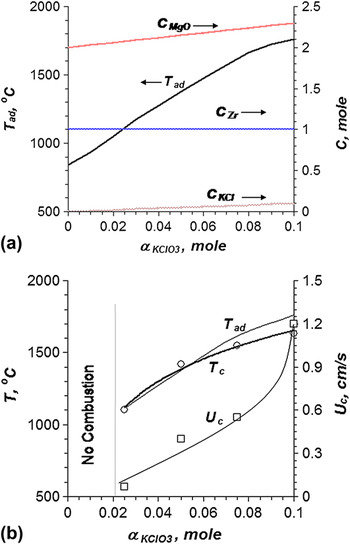
Figure 1(a) shows the adiabatic combustion temperature (T ad) and equilibrium phases for the ZrO2 + (2 + 3α)Mg + αKClO3 system as calculated using “THERMO.” The starting point (α = 0) in Fig. 1(a) corresponds to the ZrO2 + 2Mg binary mixture with no KClO3 added. The T ad calculated for this point was 843 °C, which is obviously too low to support self-propagation of the combustion process. As seen in the figure, the response of T ad to the KClO3 concentration was quite effective, i.e., the combustion temperature typically increased by about 100 °C for each 0.01 mol KClO3. Therefore, with 0.1 mol KClO3, the system temperature increased to 1765 °C. The analysis data show three phases in the combustion product: Zr, MgO, and KCl. Zr and MgO were solid, whereas KCl was always in the molten condition (T meltKCl = 770 °C). The thermodynamic analysis did not reveal KCl in the gas phase until α = 0.9. This was apparently due to high argon pressure (2.5 MPa), which suppressed the possible evaporation of KCl. Thus, thermodynamic analysis clearly showed that no undesirable phases could be formed by the proposed approach and that it is technologically feasible to synthesize zirconium powder under combustion mode. The experimental conditions were identical to those used for the thermodynamic analysis. The experimental results showed that the combustion process in the ZrO2 + (2 + 3α)Mg + αKClO3 system became self-sustaining when more than 0.02 mol KClO3 was used [Fig. 1(b)]. The minimum combustion temperature was recorded at α = 0.025 and the value was around 1100 °C. Starting from this point, the temperature slope showed a stable increasing tendency that reached 1630 °C at α = 0.1. When α was between 0.025 and 0.06 mol, the experimentally measured values of T c were in good agreement with T ad. However, above this point, T ad increased faster than T c. At α = 0.1, the difference between these two temperatures was ∼130 °C. A very dramatic increase in the combustion velocity from 0.07 to 1.2 cm/s (∼17 times) was recorded from the KClO3 concentration. This increase indirectly indicates that the reduction of KClO3 by Mg is the leading stage of the combustion process which is responsible for wave propagation speed.
(a) Thermodynamic analysis of ZrO2 + (2 + 3α)Mg + αKClO3 system upon α; (b) combustion parameters of ZrO2 + (2 + 3α)Mg + αKClO3 system upon α.

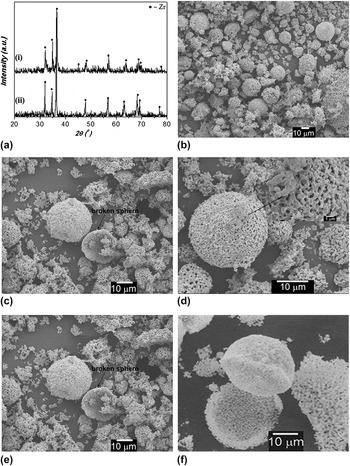
XRD patterns of the combustion products indicated the presence of the phases predicted by thermodynamic analysis, i.e., KCl, MgO, and Zr. Therefore, after acid leaching of the final products, pure-phase Zr was obtained. Figure 2(a) illustrates the XRD patterns of Zr samples prepared with (i) 0.025 and (ii) 0.05 mol KClO3. All XRD peaks matched pure-phase Zr. With increasing KClO3 concentration, the XRD peaks became sharper and more intense, indicating improved crystallinity of the particles.
(a) X-ray diffraction patterns of Zr powders synthesized with (i) 0.025 mol and (ii) 0.1 mol KClO3; (b–f) Scanning electron microscopic morphology of combustion-synthesized Zr particles: (b) general view, (c) porous Zr spheres, and (d) Zr spheres at higher magnification. Interconnected macroporous windows: (e, f) broken Zr spheres.

The morphology and structure of the Zr particles were further studied with SEM. Figure 2(b) shows a typical SEM image of the as-prepared Zr particles. As shown, an essential part of the particles are present in microsphere form. Note that the formation of zirconium microspheres was favored at 1400–1500 °C. Under the given temperature conditions, it was possible to synthesize the zirconium microspheres in the size range of 20–50 μm [Figs. 2(b) and 2(c)]. Furthermore, structural analysis suggested that the outer surfaces of the microspheres were rough, indicating that they were composed of a large number of loosely packed particles [Fig. 2(d)]. The pore size estimated from the micrograph was about ∼0.5–5 μm. Figure 2(e) shows a broken zirconium microsphere and its hollow nature. However, not all particles were hollow, as shown in Fig. 2(f). Here, two broken pieces of one particle clearly demonstrates that the particle was porous but not hollow inside. Note that zirconium microspheres are not mechanically strong and that during the purification, they can break easily.
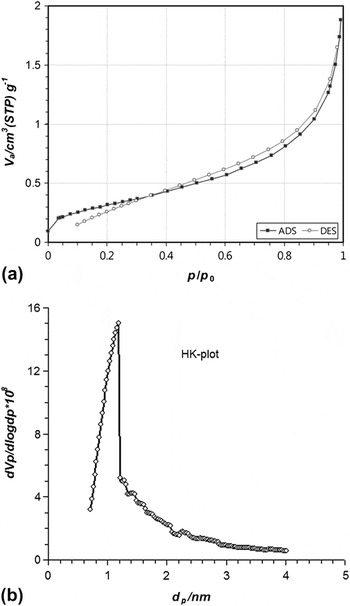
The surface area and porosity of the zirconium microspheres were investigated by using Brunauer–Emmett–Teller (BET) analysis and the nitrogen adsorption–desorption isotherm. Because the zirconium microspheres were composed of a large number of microparticles, a high surface area was not expected, which is also verified from results of the BET analysis. The BET specific surface area was 1.3743 m2/g. Figure 3(a) shows the adsorption/desorption isotherms of nitrogen measured at liquid-nitrogen temperature (77.3 K). Here, p/p 0 is relative pressure, and V a is volume of adsorbed and desorbed amount of N2. A hysteresis loop can be observed between the adsorption and desorption branch indicating the porous structure of zirconium microspheres. The zirconium microspheres showed a type II isotherm according to the IUPAC classification.Reference Gregg and Sing16 There were sharp increases at p/p 0 < 0.05 and p/p 0 > 0.9, as shown in Fig. 3(a). The inflection position at p/p 0 = 0.05–0.3 was due to the presence of primary mesopores, whereas the second increase at p/p 0 > 0.9 arose from capillary condensation with multilayer adsorption onto the inner surface. Also, the value of C (C = K1/KL, K1 is the equilibrium constant when single molecule adsorbed per vacant site and KL is the equilibrium constant to the saturated vapor liquid equilibrium) for the type II isotherm as calculated from BET was very large (54.09) in comparison to 1. Figure 3(b) shows the HK-pore volume–diameter distribution plots for N2 at 77.3 K. The plot revealed that the zirconium microspheres possessed porous structures with a size distribution of 1–4 nm, the average pore diameter (d p) of the zirconium was 1.19 nm, and the corresponding BET cumulative pore volume (dV p/d log d p) was 0.0028 cm3/g.
(a) N2 adsorption–desorption isotherm and (b) HK pore-size distribution plot of zirconium microspheres.

In the combustion process for the ZrO2 + 2Mg system, the KClO3 + 3Mg mixture acts as an additional heat source to enable the ZrO2 reduction process. The reaction of KClO3 with Mg is highly exothermic and can produce 443 kcal/mol of heat.Reference Weast17

This extra heat is consumed in heating the reaction pellet to start the reduction of ZrO2 with Mg. The ZrO2 reduction reaction usually starts after the melting of Mg and can be expressed as follows:

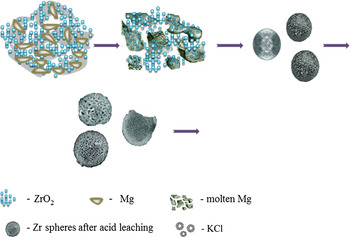
After reaction (2) starts, ∼23 kcal of additional heat is produced, and the reduction of ZrO2 particles occurs on the surface of molten Mg particles. At the same time, a shortage of Mg on the contact points with ZrO2 leads to the formation of a concentration gradient, and the liquid magnesium under the resultant tension forces continuously moves from the core to the shell; this results in partially hollow microspheres consisting of MgO and Zr particles and molten KCl. After the extraction of MgO particles and dissolution of KCl, these microspheres turn porous, and the pore size corresponds to the size of the extracted Mg particles. An illustrative sketch for the formation of such hollow microspheres is presented in Fig. 4.
Illustrative sketch of the formation of porous zirconium microspheres.

In this process, the combustion temperature is a key parameter in the formation of relatively strong microspheres. Our experiments indicated that the most favorable temperature interval for microsphere formation is 1400–1500 °C. Above and below this interval, the proportion of microspheres dramatically decreased. We think that below 1400 °C, the mobility of the Mg melt is low and cannot provide enough tension forces for sphere formation. Above 1500 °C, partial evaporation of KCl may decrease the mechanical strength of microspheres thereby making them weak and unstable during the processing. Therefore, in the optimized temperature interval, the melting of KCl may provide opportunities for particle–particle contacts and merging to increase the strength of the microspheres.
IV. CONCLUSIONS
This study shows that magnesiothermic reduction of ZrO2 under combustion mode is an effective way to explore the possibility of synthesizing porous zirconium microparticles. The low thermal heat of the ZrO2 + 2Mg reaction is not sufficient to carry out this reaction under combustion mode; therefore, 0.025–0.1 mol KClO3 was also added to the reaction mixture. Combustion temperatures between 1100 and 1600 °C were recorded for the given concentrations of KClO3. The samples were characterized by XRD, SEM, and N2 adsorption–desorption isotherm. The formation of zirconium microspheres was favored in the 1400–1500 °C temperature interval. Under the given temperature conditions, zirconium microspheres 20–50 μm in size were synthesized. Furthermore, structural analysis suggested that the zirconium spheres were porous with large macropores in the size range of ∼0.5–5 μm. Moreover, a small portion of micropores with an average diameter of 1.19 nm were also recorded on Zr particles. We believe this simple method can be extended to the synthesis of a wide range of porous materials.
ACKNOWLEDGMENTS
This work was supported by the Power Generation & Electricity Delivery of the Korea Institute of Energy Technology Evaluation and Planning and funded by the Ministry of Knowledge Economy, Korea, via Grant No. 2010T100100392