PSYCHOLOGICAL IMPACT OF DISASTERS
The impact of disasters on mental and physical health can be widespread. For example, Ironson et alReference Ironson, Wynings and Schneiderman1 found that 76% of the survivors of Hurricane Andrew in 1992 experienced at least 1 symptom cluster within the diagnostic criteria for Posttraumatic stress disorder (PTSD), and one-third of the sample experienced severe levels of PTSD symptomatology. In addition, several physiological measures indicative of reduced immune function were found in the victims of the disaster. For example, natural killer cell cytotoxicity was negatively associated with both damage and psychological variables (loss, intrusive thoughts, and PTSD).Reference Ironson, Wynings and Schneiderman1 Even after controlling for an individual's health before a disaster, there is evidence to suggest that an excess of mental and physical health problems exist among individuals who are exposed to a disaster.Reference Yzermans, Donker, Kerssens, Dirkzwager, Soeteman and ten Veen2
Disasters may have long-term psychological effects regardless of the cause of the disaster. For instance, Bland and colleaguesReference Bland, O’Leary, Farinaro, Jossa and Trevisan3 found elevated levels of psychological distress in individuals 7 years after an earthquake. Furthermore, in an examination of the 1995 sarin gas attack in the Tokyo subway, Ohbu and colleagues found that psychological distress persisted beyond the duration of physical problems.Reference Ohbu, Yamashina and Takasu4 There is evidence in the literature on terrorism-related disasters that the psychological effects outweigh physical problems by as little as 4 to 1 or as much as 50 to 1.Reference Demartino5
The impact of disasters is not limited to the immediate victims of these tragedies. About 50% of disaster workers are likely to develop significant distress symptoms.Reference Myers and Wee6 First responders to a disaster may have a variety of physical as well as cognitive, behavioral, and emotional reactions. These responses can range from mild, transient conditions such as changes in sleep to more persistent conditions that may lead to impaired functioning, which may result in a psychiatric condition such as major depression, PTSD, or substance use disorders.Reference Benedek, Fullerton and Ursano7
A known correlate for the development of psychiatric disorders is the level of exposure to the aftermath of mass fatality and other significant incidents. After the 1980 eruption of Mount St Helen’s, the psychiatric reactions of the victims of the tragedy were studied in the area affected by the disaster and in a control community. The most common disorders at the disaster site included depression, generalized anxiety, and posttraumatic stress reaction. Importantly, there was a progressive dose-response relation in the comparison of control, low-exposure, and high-exposure groups, with greater levels of exposure associated with more psychological impairment. Furthermore, this dose-response pattern occurred among both people who were grieving the loss of a loved one and people who experienced property loss.Reference Shore, Tatum and Vollmer8 Finally, psychological reactions to disasters tend to increase in severity when the disaster occurs without warning, causes sudden changes to a scene, creates serious injuries or fatalities, is of long duration, and disrupts social support systems.Reference Myers9 Reference Rodriguez and Kohn10
EMERGENCY MENTAL HEALTH PREPARATION
Negative mental health consequences resulting from a natural or human-made disaster, however, can be mitigated in part by careful preevent planning and coordination of emergency mental health (EMH) services, which can help to ensure rapid mobilization. For example, there is evidence that providing brief mental health care to individuals within the first few weeks postdisaster is associated with a reduction in morbidity over time.Reference Schreiber11 This rapid, brief intervention during the acute phase of the disaster is also associated with reduced costs to the individual.Reference Schreiber11 For rapid deployment to occur, proactive approaches to EMH services (in addition to all of the other response sectors) need to be used.
Researchers have suggested that these EMH services be in an integrated, multicomponent format.Reference Everly and Mitchell12 To work toward an integrated framework, Erie County, New York, maintains a Medical Reserve Corps branch known as the Specialized Medical Assistance Response Team (SMART).13 SMART is a public health response team with 489 individuals from across the 8 counties of western New York on its roster. The purpose of SMART is to provide volunteer personnel augmentation to emergency services and public health during public health incidents and other major events with public health implications in western New York.
Emergency mental health is only 1 component of SMART; other components include radiological, veterinary, mass fatality, pharmacy, dental, communications, and casualty collection point operations. SMART EMH morphed from the work of the Buffalo Metropolitan Medical Response System (MMRS) Mental Health Subcommittee. The MMRS is a federal initiative with the goal of assisting cities throughout the United States to be better prepared for incidents involving weapons of mass destruction. An EMH component is required by the MMRS, and this served as the impetus for Erie County to develop and implement comprehensive EMH response capacity under the SMART umbrella.
Emergency mental health team members are required to meet specific requirements including completion of core competency training that focuses on the unique needs of the population affected after critical incidents, and implementation of methods to meet those needs using crisis intervention and psychological first aid (PFA). Issues of cultural sensitivity, the impact of trauma on the brain, and self-care recommendations are important elements of the training.
This approach does not suggest that psychopathology is an immediate response to a disaster; instead the approach focuses on individuals' current needs and the provision of resources.Reference Kronenberg, Osofsky, Osofsky, Many, Hardy and Arey14 Reference Vernberg, Steinberg and Jacobs15 These resources include information on the status of disaster operations, coping techniques, practical assistance, as well as linkage with other services.Reference Kronenberg, Osofsky, Osofsky, Many, Hardy and Arey14 Reference Vernberg, Steinberg and Jacobs15 Emergency mental health team members are also required to complete training in the National Incident Management System (NIMS) and in the Incident Command System (ICS). NIMS/ICS create a common communication framework and organizational model to coordinate responses by a variety of agencies. In addition, team members are required to complete an online course on emergency response to terrorism through the National Fire Academy. Requiring EMH team members to complete these different training courses helps to ensure that the EMH team is prepared to collectively work with other sectors when disasters occur.
CONTINENTAL FLIGHT 3407
Based on information from a panel convened by the National Transportation Safety Board,Reference Babcock16 Continental Connection flight 3407, operated by Colgan Air, Inc, crashed at 10:17 PM Eastern Standard Time on February 12, 2009 in Clarence Center, NY. The flight was on an instrument approach to runway 23 at the Buffalo-Niagara International Airport, Cheektowaga. The flight originated at Liberty International Airport, Newark, NJ. Four flight crew members, 45 passengers, and 1 person on the ground were killed.
The Response
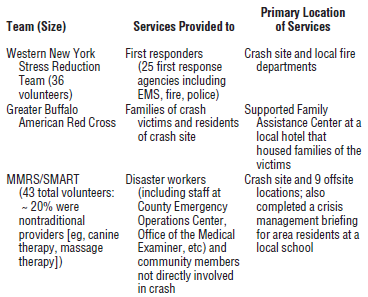
Three separate but coordinated disaster mental health teams were responsible for all behavioral mental health aspects of the response (Table 1). Each team was assigned to work with a different population. The first EMH team on the scene was the Western New York Stress Reduction Program (WNYSRP), which was assigned to provide services to first responders. The WNYSRP is a not-for-profit volunteer program that was formed to minimize the stress experienced by first responders (eg, emergency medical services, fire, police, other disaster response personnel). It is a regional program that provides services to 4 western New York counties. Services included individual crisis intervention, group crisis intervention, pastoral crisis intervention, and ongoing follow-up and referral for further assessment and/or care. In some cases, contact was made with immediate family members of the first responders. Members of the WNYSRP who provided these interventions had completed specialized training in critical incident stress management, which is a comprehensive, integrated, multicomponent approach to crisis/disaster intervention.Reference Everly and Mitchell17 It is a strategic intervention system with numerous tactical interventions.
Emergency Mental Health Teams Responding to the Crash

In total, 36 volunteers were involved in this aspect of the response. They provided individual and group crisis intervention services to 125 colleagues from 25 agencies involved in the response. The EMH responders included peer counselors, clergy/chaplaincy, and mental health professionals. The response began within hours of the crash, and efforts continued through May 2010.
The provision of group crisis intervention was an important component of the overall response to this population. Critical incident stress debriefings, a 7-phase process, were held offsite within 4 days of the crash. All of the volunteer firefighters were invited to attend, but participation was voluntary. The goals of the process included distress mitigation, facilitation of psychological normalization, stress management education, identification of external coping resources, and psychological triage and referral.Reference Mitchell18 This interactive process, which lasted approximately 2 hours per group, was conducted by a team consisting of a peer counselor (eg, firefighter/emergency medical services provider), a member of the chaplaincy/clergy, and a mental health counselor.
Consistent with the Aviation Disaster Family Assistance Act of 1996 (PL 104-264, Title VII–Family Assistance), the American Red Cross (ARC) coordinated all of the mental health services for the families of the victims of the crash. The Greater Buffalo chapter of the ARC established a family assistance center in conjunction with the airline. ARC personnel maintained a presence at the hotel where the families of the victims were housed for 10 days. Twenty-four-hour coverage was available during the first week postcrash. Using principles of PFA, the team provided services to the families of the victims in addition to the residents of the area immediately surrounding the crash site.
The primary objective of PFA is to limit distress and negative health behaviors.19 The core components of PFA include nonintrusively contacting and engaging with individuals, providing safety and comfort, gathering information, providing practical assistance, connecting individuals with social supports, providing information on coping, and linking individuals with collaborative services.Reference Vernberg, Steinberg and Jacobs15 Later, the ARC supported the families at the crash site during their structured group visit and conducted outreach to individuals at other locations. The ARC assisted families during briefings by the National Transportation Safety Board and the Erie County Office of the Medical Examiner. These briefings initially occurred 3 times per day, but eventually decreased to once daily. Conference call accommodations were made available to families who were out of town.
The MMRS/SMART EMH Sector was staffed by 43 volunteers. This team was activated within 10 hours of the crash. During the next 3 weeks, MMRS/SMART team members were deployed across 9 locations. An ongoing EMH presence was maintained at the county's Health Operations Center (HOC), as well as at the county's Emergency Operations Center (EOC). The main function of the HOC was to provide support to the Office of the Medical Examiner. The EOC, located off site, supported on-site operations in Clarence Center. MMRS/SMART consulted with multiple agencies to assess and implement interventions, assisted with a crisis management briefing for the town, and oversaw the management of a variety of mental health services including clergy/chaplaincy teams, canine therapy teams, disaster psychiatry outreach teams, massage therapy teams, and traditional mental health services (eg, services offered by counselors, psychiatric nurses, therapists, psychologists, psychiatrists).
In total, the team delivered 332 units of PFA; 183 follow-up contacts occurred through May 2010. A unit of PFA is described as any interaction after which the person is either less symptomatic or demonstrates a noticeable improvement in functioning/coping. Measurement of these units was obtained via the subjective comments of the recipient and his or her demonstration of enhanced performance after the intervention (eg, decreased irritability, improvement in mood).
Although EMH services traditionally focus on care provided to victims, first responders, and disaster workers, we recognized that the impact of the crash on the community was significant. In an effort to address the needs of the community, a crisis management briefing was conducted for local residents. The briefing had multiple objectives that included reducing the sense of chaos, providing leadership, providing coping resources, engendering cohesion and morale, reestablishing a sense of community, and providing psychological screening for individuals who may need additional assessment and follow-up.Reference Everly and Mitchell12
Consistent with federal guidelines for emergency response activities, operations followed the NIMS/ICS. MMRS/SMART was represented at command meetings despite a slight delay in the recognition of the need to integrate EMH into these meetings. The inclusion of MMRS/SMART into the command structure helped ensure that mental health was well integrated into a coordinated response effort. This inclusion was made possible by the MMRS/SMART sector leader, who attended command meetings, established event-specific mental health incident action plans, and offered updated reports on the implementation of the plan and needed revisions as the response evolved. All 3 psychological support teams—WNYSRP, ARC, and MMRS/SMART—maintained ongoing communication in an effort to ensure adequate coverage to all individuals while preventing duplication of services.
LESSONS LEARNED
What Succeeded
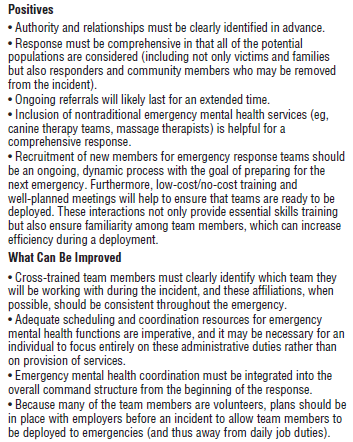
In evaluating the mental health response to the crash of flight 3407, several key successes emerged (Box). First, unlike other recent disasters (eg, Hurricane KatrinaReference Gheytanchi, Joseph and Gierlach20), the authority and relationships of EMH responders and agencies were clear. Each EMH team was assigned to a specific population, and leadership from all 3 teams communicated regularly by telephone or in person to ensure adequate coverage and nonduplication of services. Importantly, representation of the EMH component within the overall disaster command structure ensured that mental health needs were being addressed.
Box. Summary of Lessons Learned

As with other first responders, it is important to note that many team members are cross-trained and are members of multiple teams. For example, a responder may be an ARC team member and also a member of MMRS/SMART. Furthermore, individuals may play different roles on different teams (eg, a coordinator on one team and a team member on another). This can create confusion when a responder's role and/or affiliation are not clearly defined. For the EMH response to the crash of flight 3407, volunteers were asked to designate which single team they were working with for the incident and they were required to maintain membership with that team for the duration of the response. This requirement was implemented as a result of lessons learned from a previous disaster that suggested that cross-trained team members who work on multiple teams often created communication and coordination problems because it was not clear which team the individual was representing. This reinforces the importance of lessons learned exercises and is consistent with the principles of lessons learned systems.Reference Weber, Aha, Muñoz-Ávila and Breslow21
The second success that emerged from the evaluation of the EMH response was that the deployment of the EMH component was comprehensive as to whom services were made available and the location of the services. For instance, the ARC ensured that the families of victims (both local and distant) and the immediate neighbors of the crash site were offered services; the WNYSRP ensured that the mental health needs of the first wave of all of the first responders were addressed, and MMRS/SMART was responsible for all of the other onsite and offsite response personnel. In addition, the EMH teams ensured that resources were available across a variety of locations and not only at the actual crash site. Understanding that this work occurs in nontraditional settings and often involves informal contact is paramount. For example, EMH services for victims of Hurricane Katrina were provided in a variety of nontraditional venues such as ships that were used as temporary quarters.Reference Kronenberg, Osofsky, Osofsky, Many, Hardy and Arey14 With this in mind, the mental health component of MMRS/SMART was deployed across 9 locations, including the crash site, the Office of the Medical Examiner, the EOC, and the HOC.
The third success that emerged was the importance and availability of ongoing referral services. Team members continued fielding calls from families and responders for more than 1 year postdisaster. Consistent with the principles of PFA,Reference Vernberg, Steinberg and Jacobs15 the EMH component provided links to other services, practical assistance, and connection with social supports. The EMH component's responsibility does not provide for long-term counseling; rather, the focus is on mitigation of critical incident stress symptoms and return to adaptive functioning.Reference Everly and Mitchell12
The fourth success that emerged was the comfort provided by complimentary or alternative EMH services. Although the majority of the EMH response included traditional mental health providers (eg, counselors, psychiatric nurses, therapists, psychologists), these services were complemented by alternative approaches such as canine therapy teams and massage therapists. Some research is supportive of the use of alternative approaches such as canine therapy or massage therapists to complement traditional mental health approachesReference Barker and Dawson22 Reference Eggiman23 Reference Field24; however, these studies have not focused on disaster responses. For example, ChandlerReference Chandler25 found that dogs were useful as “cotherapists” when dealing with withdrawn and noncommunicative individuals in counseling or school settings. Kruger and colleaguesReference Kruger, Trachtenberg and Serpell26 found that animals were helpful in facilitating discussions among adolescents about emotionally powerful issues. Our anecdotal evidence was also supportive of the notion that the inclusion of alternative services can be of great comfort. For example, comments from those who interacted with the canine therapy teams were overwhelmingly positive, with 1 individual referring to them as “comfort dogs.”
The fifth success that emerged was that experience from previous deployments and ongoing planning, workshops, and training resulted in the EMH teams being well positioned to respond to this incident. Ongoing interactions helped increase communication and familiarity among all of the team members, thus allowing crisis response to operate more smoothly. This ongoing interaction was facilitated through meetings and low-cost/no-cost training opportunities offered at regular intervals. It is essential, however, not to overburden volunteers with excessively frequent meetings (eg, MMRS/SMART meets 6 times per year and offers training on a monthly basis).
Our proactive preevent recruitment and training approach was helpful, allowing for a rapid and robust deployment to multiple locations. To accomplish this, recruitment strategies for new members are discussed regularly. MMRS/SMART encourages members to take the initiative of suggesting new members to the team leader, who, in turn, can contact perspective team members to describe the team, the requirements, and the expectations. This personalized recruitment strategy has helped to expand the team by adding qualified individuals over time. In terms of planning for an EMH response, consideration must be given not only to the depth of providers (ie, having enough traditionally trained responders) but also the breadth of types of responders (eg, canine team members, massage therapists, members of the clergy). Furthermore, all of the members should be seamlessly integrated into the overall approach, thereby eliminating any distinctions between “traditional” and “nontraditional” responders.
What Needs to Be Improved
Although the overall EMH response was positive, there were several aspects that need to be addressed to improve performance (Box). First, given our cross-training and multiple team memberships, it is important that policies implemented for a response (eg, each person maintains affiliation with only 1 team during an event) are documented and automatically followed during future events.
Second, scheduling and coordination was a challenge because of limited resources. More specifically, our funding for EMH coordination was limited to only 1 full-time person, despite the extent of responsibilities inherent in and assigned to this function. In addition, there was a heavy reliance on volunteers who were specially trained behavioral health providers or members of the clergy/chaplaincy. These individuals needed to reactively and urgently obtain authorization from their employers before deployment to sites. A more proactive approach in advance of this event would have been beneficial.
Third, the EMH function was not initially represented during command briefings. For the first 24 hours of the operation, command staff made decisions relative to the mental health needs of the community without the benefit of a subject matter expert to provide consultation and direction. This resulted in a slight delay in the delivery of a comprehensive response to those affected by the disaster. Finally, the crash clearly demonstrated the need for a large cadre of specially trained EMH responders who have received prior approval for reassignment to disaster duties. The needs of the community were extensive, and resources were stretched considerably.
CONCLUSIONS
Although it is a gross understatement, the crash of flight 3407 was a tremendous loss for the families and friends of those on the aircraft and on the ground and for the community at large. However, predisaster planning and training and evaluations of previous responses helped to ensure a coordinated approach to providing mental health services to all of the individuals in need. It important to note that EMH services were offered to everyone (eg, families, responders) using both traditional responders (eg, therapists) and complimentary approaches (eg, canine therapy teams). By all accounts, this multifaceted approach appeared to be received well by the individuals who interacted with the EMH teams.
Disclaimer:
The views expressed in this article are solely those of the authors. They do not represent any local, state, or federal department or agency, nonprofit organization, or family members.
Author Disclosures: The author reports no conflicts of interest.
Acknowledgements We are grateful for the opportunity to have worked with the dedicated personnel who responded to the crash of Continental Airlines flight 3407 and to those affected by the event for teaching us about human strength and resilience. We especially thank David Bissonette, disaster coordinator for the Town of Clarence Center and Chief David Case of the Clarence Center Volunteer Fire Company, who directed the initial incident response and recovery. In addition, we express our profound respect, admiration, and thanks to the members of the EMH teams from the American Red Cross, Greater Buffalo Chapter, the Metropolitan Medical Response System/Specialized Medical Assistance Response Team, and the Western New York Stress Reduction Program. These volunteers have spent countless hours training and preparing for the event all of them hoped would never occur but did. We are proud to call you teammates, colleagues, and peers.