The relationship between institutions and economic performance is one of the most studied in political science. Central to these studies is how political institutions protect the property rights of investors, facilitating capital accumulation and economic growth.Footnote 1 Explaining how institutions affect the decisions of domestic investors is also useful in developing a deeper understanding of political institutions themselves, particularly how they operate, parameterize choices, and reflect domestic interests. Much of the literature on investor behavior focuses on democratic institutions, showing that variance in democratic protectionsFootnote 2 and constraints on executive policymaking discretionFootnote 3 are associated with lower risk and higher levels of investment.Footnote 4
Scholarship on the political economy of investment has tended to view authoritarian countries as anomalous to the relationship between institutions and investment, believing natural resources, domestic market size, labor costs, and infrastructure to be more influential. Recent work in political science, however, has begun to demonstrate that there is wide variation in the institutional architecture of authoritarian regimes, and that these differences have important implications for economic performanceFootnote 5 and domestic investment.Footnote 6
Among the robust findings are the correlations between the presence and number of parties in authoritarian legislatures and economic growth, which scholars have interpreted as evidence that parliaments provide opposition with a chance to voice their views, and limited policy-making authority, which in turn constrains executive decision-making and therefore the threat of expropriation.Footnote 7 Although the empirical relationship is robust, the micro-logic of the relationship between authoritarian legislatures and actual expropriation is both theoretically unsatisfying and empirically untested.
This article contributes to a literature on the political determinants of property rights institutions.Footnote 8 We demonstrate that authoritarian legislatures are insufficient for limiting expropriation of private investment by the state. Instead, we argue that the true benefit of authoritarian legislatures is their facilitation of stronger contracting institutions among private actors. In particular, they limit the ability of corporate insiders to exploit minority shareholders. Legislatures provide this benefit, we claim, because they are better suited for fostering negotiations and tradeoffs among private actors with different economic interests than they are at constraining dictators or party leaders. In short, we suggest that correlation between authoritarian legislatures and investment is not driven by protection of investors from expropriation by the state; rather, it operates through a formal forum that allows private actors to police themselves. Consistent with our argument, our empirical analysis reveals that the strength of authoritarian legislatures is associated with the strength of corporate governance rules and not expropriation risk.
Our theory and empirical findings contribute more broadly to debates on the relationship between institutions and economic growth. While numerous studies have identified institutions that protect investors from government predation, our project aims to disentangle the alternative mechanisms through which institutions can facilitate investment and growth.
Our article proceeds as follows. In the next section we provide a theoretical overview of the literature on authoritarian legislatures. The section after that discusses the literature on institutions and economic performance. Following North, we argue that property rights, which govern the relationship between private actors and the state, is only one of two critical institutions that effect the decisions of investors – the other is contracting institutions, which govern the relationships among private economic actors.Footnote 9 We highlight the importance of a particular set of contracting institutions – those that protect minority shareholders from the malfeasance of corporate insiders. The final section tests the two alternative mechanisms, revealing that the strength of authoritarian legislatures is associated with corporate governance rules (‘investor protections’) and not property rights institutions.
Authoritarian Assemblies and Economic Growth
The research on authoritarian institutions starts with the basic premise that nominally democratic institutions in authoritarian regimes matter. This premise may be surprising to casual observers, yet many authoritarian regimes spend a great deal of money and energy holding elections for national office, maintaining permanent legislatures, and erecting institutions for promotion and leadership selection. The great puzzle is what benefits such expensive institutions provide that could not be achieved more cheaply and expeditiously through other means. The null hypothesis for authoritarian institutions is that they are irrelevant and meant only to placate international and domestic audiences. If these seemingly democratic institutions were simply window dressing, however, then why would dictators lavish resources on them? In a rebuke to theorists such as Friedrich and Brzezinski,Footnote 10 who argue that such institutions are unimportant, Gandhi succinctly asks: ‘if legislatures are nothing but mere ornamentation, then why would some dictators “dress their windows?”’Footnote 11
The new literature on authoritarian institutions has provided one answer to this question by focusing on elections and assemblies as means to co-opt potential opposition.Footnote 12 According to the cooptation argument, rulers, especially in countries with fewer natural resources, need cooperation from broader swaths of society and will thus use elections and assemblies to give these groups a formal say in the policymaking process.Footnote 13 The elections may be used to incorporate elites, party members, or societal interests groups,Footnote 14 but critically these groups must be outside of the ruling inner circle. Gandhi and Przeworski summarize the cooptation argument in this manner: ‘Authoritarian rulers may need cooperation and may fear a threat from various segments of society. Cooperation can be induced and the threat can be reduced by sharing spoils or by making policy compromises’.Footnote 15 They conclude that legislatures are well suited for this role. Wright takes the argument further, by suggesting that military and single-party regimes tend to have fewer natural resources and are therefore more likely to require institutionalized forms of cooperation to achieve economic growth.Footnote 16 Thus, these rulers will establish ‘binding’ assemblies that will constrain them and allow them to make credible commitments to groups outside the winning coalition. A related alternative to the cooptation theory argues that the goal of institutions, such as strong parties and legislatures in authoritarian settings, is not about coopting potential opposition but instead providing a mechanism for power-sharing with regime supporters that allows collective action against a regime leader.Footnote 17 Wright concludes that binding assemblies in military and single-party regimes improve economic output by offering a credible commitment on national economic policies, ‘Thus, these dictators have a greater incentive to create a legislature that acts as a credible constraint on their power to expropriate’.Footnote 18
By contrast, non-binding assemblies in monarchies and personalist regimes tend to hinder economic performance. This argument echoes Boix, who finds evidence for the claim that authoritarian legislatures create additional veto points, which ensures investors that their outlays will not be expropriated.Footnote 19 Gandhi is more circumspect, but makes a similar claim, ‘when outside groups have access to decision making…they may be more willing to make costly and longer-term investments because these institutions constitute somewhat of a commitment that even if not entirely credible, is better than nothing.’Footnote 20 As evidence for their theories, all of the above authors offer robust correlations between binding authoritarian assemblies and private investment and economic growth.
The exact meaning of the word ‘binding’ in this context is critically important. In the cross-national empirics, scholars have usually employed a dichotomous coding for whether a state has a legislature or not. Wright's coding of ‘binding’ depends on what type of authoritarian regime hosts the assembly, not on the specific parliamentary rules.Footnote 21 Gandhi counts the number of opposition parties in the assembly to gauge the level of cooptation.Footnote 22 Importantly, the distinction means that our empirical analysis below cannot simply code whether a state has a legislature, but must also demonstrate variation in the ability of groups to effectively represent their interests within the legislature. As our theory particularly highlights the representation of different types of private actors, we find the Gandhi coding to more theoretically appropriate, as it provides a count of the actors (i.e., parties) that have the ability to use the forum to further their economic interests.
While cooptation theorists have strengthened their case with a plausible theory and robust evidence of correlations between binding assemblies (and multiple legislative parties) and investment and economic growth in authoritarian settings, little work has been done on rigorously establishing the micro-logic of these cross-national correlations. Most critically, the literature has yet to establish that assemblies in authoritarian regimes actually provide potential opposition with property rights protection.
As a first pass, it is useful to examine the well-known Property Rights Index, developed by the World Economic Forum and published in the Global Competitiveness Report to investigate whether property rights perceptions are stronger in countries with multiple parties in the legislature.Footnote 23 In fact, the average value of the index is actually lower in countries where there are multiple parties in the legislature (4.0) than in countries with single parties or no legislatures (4.7) – a difference-in-means that is significant at the 0.05 level. This should give us pause about accepting the conventional wisdom too readily. Of course, we are reluctant to draw conclusions from this simple test, as survey data introduce perception biases for which it is difficult to control when using blunt country averages. In the empirical section of this article, we seek to overcome these biases by using measures of specific institutions derived from risk insurance pricing models and an objective index of business regulation.
Without more systematic evidence, there is a strong possibility that the correlation between assemblies and economic growth may result from alternative causal mechanisms. To list just a few examples: Perhaps investors have no faith that an assembly will protect their property rights, but value the debates in the assembly for providing information about forthcoming regulatory and macroeconomic policies. Indeed, Boix and Svolik provide empirical evidence that authoritarian countries with legislatures do provide higher quality statistical data.Footnote 24 Thus, assemblies may increase investment by providing information and increasing the transparency of the policymaking process, without augmenting the policy influence of investors. Gandhi, to be fair, is well aware of this and other alternative explanations for the correlations she observes, noting ‘Another possibility is that institutions facilitate the flow of information between the regime and domestic groups so that resources are mobilized and allocated more efficiently. Lastly, it may be that because institutions provide a forum in which the demands of domestic groups can be made, those demands are not likely to be made in the street’.Footnote 25
Another threat to causal identification is unobserved heterogeneity among authoritarian regimes. Perhaps both assemblies and other attractive governance institutions result from the same constellation of interests of elite actors and are not causally related. In this case, we might see correlations between assemblies and economic performance that have nothing to do with better property rights.Footnote 26
Authoritarian Parliaments, Parties, and Varieties of Expropriation Risk
The most important limitation of the cooptation theory is its blunt theoretical discussion of property rights and investment risk. Because the work predominantly seeks to explain how authoritarians deal with opposition and supporters, it has developed orthogonally to the political economy work on political risk. As we noted above, scholars in the authoritarian literature have argued that parliaments are beneficial because they restrain authoritarian leaders from expropriation and, therefore, encourage domestic investment. But government expropriation is only one of a number of different types of risk that investors worry about when considering a new project; for instance, they also worry about changes in regulatory and tax policies, exchange rate fluctuations, and civil unrest.Footnote 27
Most importantly, however, we argue that domestic investors are intimately concerned with the strength of contracting institutions, or the set of policies that govern economic relations between private actors in the economy. Specifically, outside investors seek to constrain corporate insiders from extracting rents on invested capital that the insiders control.Footnote 28 That is, investors favor strong corporate governance regulations that protect against expropriation by corporate insiders, including managers and controlling shareholders. Expropriation can take several forms, including outright theft, executive overpayment, or more subtly through the sale of assets at below market prices, a process known as transfer pricing or asset stripping. The underlying risk is that corporate insiders use the profits of the firm for their own benefit, rather than returning them to outside investors.Footnote 29
Corporate governance regulations seek to prevent such expropriation. They are defined as ‘the set of processes, customs, policies, laws and institutions affecting the way people direct, administer, or control a corporation’.Footnote 30 They consist of extensive disclosure requirements that reveal transactions to minority shareholders, explicit provisions for shareholders to hold the director and board liable for negligence or breach of fiduciary responsibility, and the transparency of business documentation available to plaintiffs in the event of corporate governance adjudication.
A large literature provides compelling evidence that corporate governance regulations, often referred to as investor protections, are fundamental drivers of investment and economic growth. On the first link in the causal chain, Pagano and Volpin assert: ‘The amount of equity finance that external investors are willing to provide is affected by the degree of protection that they expect to receive from company law.’Footnote 31 Castro et al. demonstrate the relationship formally, illustrating how strong investor protection in an economy can encourage risk sharing among private economic actors, increasing demand for capital, and encouraging economic growth.Footnote 32 Empirical work provides evidence for the Castro et al. observation by demonstrating a correlation between indexes of rights of minority shareholders and the development of capital markets.Footnote 33 Building on this work, Haidar estimates that each one-unit change in investor protections increases growth in gross domestic product (GDP) by 0.26 percent, a statistically strong and substantially important finding in a fully-specified model.Footnote 34 Mitton examines the relationship at the firm level, and finds that firms with stronger corporate governance fared better during the Asian financial crisis.Footnote 35
In light of this large and growing emphasis on contracting institutions in general and investor protections in particular, we suggest an extension of the literature on authoritarian legislatures that distinguishes between different sources of investment risk. To that end, we draw on the work of North, who differentiated between property rights institutions and contracting institutions, and their effects on growth.Footnote 36 He defined these, respectively, as institutions that: (a) protect individuals from expropriation of property rights by the state; (b) provide the legal framework that will permit private contracts that facilitate economic transactions. In other words, private property institutions protect private citizens from expropriation by the government, while contracting institutions protect private citizens from malfeasance by one another. Much research examines the relationship between both of these institutions and long-term economic growth,Footnote 37 but we are not aware of any work examining variation in these institutions within authoritarian settings.
Strong theoretical and empirical evidence exists for the relationship between property rights, domestic investment, and growth.Footnote 38 In the political economy literature, Weingast famously emphasizes the importance of political institutions which generate a credible commitment that private property will not be seized by state authorities.Footnote 39 In development economics, De Soto argues that myriad businesses in developing countries remain informal because they are starved of critical resources, especially property rights and credit.Footnote 40 In particular, he predicts that, through the provision of land titles, entrepreneurs in the informal sector could be transformed into an important new source of economic growth in the developing world. Taking advantage of variation in land title distribution in Argentina, Galiani and Schargrodsky find convincing evidence for the De Soto hypothesis in terms of household investment.Footnote 41 Similar natural experimental approaches have been used to show that a one-time increase in property rights can bolster belief in the power and fairness of the market,Footnote 42 increase the number of hours dedicated to productive work,Footnote 43 and facilitate the movement from the gray economy to registered, formal businesses.Footnote 44
An equally rich literature, however, has explored the role of contracting institutions between private actors and economic growth, beginning with the seminal pieces of Coase, Williamson, and North and Weingast,Footnote 45 which have since been tested more extensively by operationalizing contracting institutions as the cost of contract enforcement and the overall level of confidence of citizens in legal institutions.Footnote 46 Evidence has also been found at the subnational level. Using variance in institutions across states in Mexico, Laeven and Woodruff find a significant relationship between better contracting institutions and higher levels of growth in firm size,Footnote 47 while Ardagna and Lusardi show that contracting institutions increase the share of entrepreneurs that identify themselves as growth-oriented.Footnote 48 This evidence suggests that investors distinguish between types of risk, and make investment decisions based on assessments of the quality of these institutions.
The 2011 Global Competitiveness Report (GCR) allows us to examine the importance of institutions governing the relations of private actors in the economy. After performing a survey of foreign and domestic investors round the world, the GCR weights the strength of sub-indices and individual indicators by their contribution to economic growth. The ‘Institutions Pillar’ derived from this analysis accounts for 25 percent of the ‘Basic Pillars Sub-Index’. Disaggregating the weighting further, public institutions, which protect property rights, account for 15 percent of the Institutions Pillar, compared to 25 percent for Private Institutions, which includes measures of corporate governance and investor protection. Corruption, government inefficiency, and security account for the rest of the Pillar.Footnote 49 The authors defend the strong weighting of corporate governance and investor protection this way:
The recent global financial crisis, along with numerous corporate scandals, has highlighted the relevance of accounting and reporting standards and transparency for preventing fraud and mismanagement, ensuring good governance, and maintaining investor and consumer confidence. An economy is well served by businesses that are run honestly, where managers abide by strong ethical practices in their dealings with the government, other firms, and the public at large. Private-sector transparency is indispensable to business, and can be brought about through the use of standards as well as auditing and accounting practices that ensure access to information in a timely manner.Footnote 50
Thus, whereas current work by cooptation theorists studying authoritarian institutions does not distinguish between these two types of risk (expropriation vs. contracting risk), there is ample reason to believe that authoritarian institutions do not affect each type of risk equally. For instance, because assemblies must co-exist among a variety of other authoritarian institutions and actors (i.e. parties, dictators, cabinet officials, police forces, judiciaries, party offices, and local government offices) the role of legislative delegates in limiting expropriation is strongly constrained. Debates about expropriation may take place in assemblies, but ultimately enforcement and implementation fall to other actors in the polity. With rare exceptions, authoritarian assemblies do not actually have the power to expropriate directly from investors – their primary role is the production of legislation and debate, which even then can be highly parameterized by the goals of the dictator or ruling party.Footnote 51 As we highlight below, expropriation infractions are generally committed by actors in the executive branch or by leaders at the subnational level. This is precisely the point made by Markus, who examines the development of property rights in Russia and Ukraine. While both states had grandiose legal commitments to property rights on the books, they had limited ability to enforce these rules subnationally.Footnote 52
To examine the determinants of the risk of government expropriation, we added questions to a 2011 survey by the Multilateral Investment Guarantee Agency's (MIGA) in an attempt to gauge risk perceptions of investors.Footnote 53 While we find that government expropriation is indeed rare – just 9 percent of investors in the survey experienced losses in the past three years due to nationalizations – it represents a catastrophic event for investors.Footnote 54 Further questioning in the survey reveals that 19 percent of investors divested or canceled future investments due to the threat of expropriation, and only 18 percent of investors noted that expropriation risk was not relevant to their decision making.Footnote 55
While it is clear that government expropriations are a real and salient threat, it is also clear that legislatures have very little impact on their prevalence. The largest percentage of respondents indicated that the executive was responsible for these risks (43 percent), while 23 percent answered national agencies or bureaucracies were actors most responsible for expropriations.Footnote 56 When asked a follow-up question on who these agencies report to, the largest percentage (43 percent) answered that these agencies are acting on behalf of the executive – not the legislature.Footnote 57
Of course, simply demonstrating that legislatures are not involved in expropriation is to win a shallow victory over a straw man version of the property rights mechanism. Cooptation theorists may argue that whether the legislature expropriates or not is irrelevant, the true benefit of a legislature is its ability to constrain the expropriation of other actors, police the actors who may be involved, reverse illegal government expropriation when it does happen, and credibly punish actors who expropriate. Unfortunately, there is very little evidence in the extant literature or even in careful studies of individual authoritarian regimes demonstrating that legislatures are duly empowered. The authoritarian institutions literature has emphasized that they provide opportunities for limited policy making and the public expression of delegate viewpoints, which – as Malesky and Schuler show through an analysis of delegate performance in Vietnamese query sessions – does take place.Footnote 58 Nevertheless, there is limited evidence for the credible commitment of policies in authoritarian legislatures. On the one hand, scholars have not provided systematic evidence that authoritarian parliaments are able to restrain the actions of state leaders, reverse activities they disagree with, or remove authoritarian leaders who violate the implied powersharing arrangement. As Brownlee has emphasized, party strength and internal party checks offer a far more credible check on executive actions.Footnote 59 In short, the link between authoritarian assemblies and restraint of state actors is weak both theoretically and empirically. Indeed, the MIGA evidence seems to indicate that foreign investors believe that authoritarian parliaments are more likely to increase the risk of expropriation (38 percent of respondents) than reduce it (1 percent of respondents).Footnote 60
On the other hand, there is theoretical motivation to believe that authoritarian parliaments can play an important role in governing economic relationships between private actors, which in turn could facilitate the social bargains required for the production of corporate governance regulation that protects investors. Indeed, Markus's surveys of firms in Russia and Ukraine, while profoundly rejecting the role of the state in protecting property rights, provide strong evidence that firms are able to secure their own property rights through strategic alliances with other non-market actors.Footnote 61 We see this as the most viable link between authoritarian institutions and investment.
Our argument draws upon insights from a growing literature on endogenous corporate governance regulation, which to date highlights how the distributional implications of reform lead to political conflict among contending social interests.Footnote 62 For instance, since investors tend to benefit from strong corporate governance institutions, a prominent argument suggests that minority shareholder protections reflect the influence of right-leaning political parties, who are more likely to count investors as one of their core constituencies.Footnote 63 Recent work has challenged this view, arguing that the Left will support improved contracting institutions such as minority shareholder protections to the extent that these institutions promote investment and thereby increase labor demand.Footnote 64
Other work examines alternative social divisions over the degree of minority shareholder protections. Rajan and Zingales and Perotti and Volpin highlight the interests of established (incumbent) firms, which they argue oppose investor protections since these reforms breed competition from aspiring market entrants.Footnote 65 The mechanism operates through the positive effects of corporate governance reform on capital market development, which allows entrepreneurs to enter the market and compete with incumbent firms. Rajan and Zingales contend that incumbent firms’ opposition weakens with openness to international trade and capital flows.Footnote 66 For Perotti and Volpin, the probability of improved investor protections increases with the level of political accountability, measured as the weight that politicians give the preferences of the general public.Footnote 67 Where accountability is low, insiders successfully block corporate governance reforms that improve investor protections. The inference is that democratic institutions improve the quality of corporate governance by increasing political accountability.Footnote 68
Alternative accounts stress the ways in which political institutions filter divergent interests over investor protections into corporate governance regulation. Pagano and Volpin analyze the effects of electoral institutions on the influence of a cross-class coalition of corporate insiders: blockholders, managers, and workers, who seek to inhibit investor protections for fear they could lead to takeover by outside investors. They argue that proportional representation (PR) systems will have weaker investor protection than plurality systems, since PR helps sustain the bargains that underlie the cross-class coalition of insider control.Footnote 69 Research by Tiberghien highlights the role of political entrepreneurs in staking out bargains between global investors and resistant domestic interests.Footnote 70 A key intervening variable in his analysis of corporate governance reform is the political autonomy of reform-minded policymakers. Kerner and Kucik argue that domestic political institutions and global competition for capital affect insider trading laws. They argue that institutions that promote economic voting pressure politicians to enact protections of minority shareholders.Footnote 71
Although these studies differ substantially in the emphasis they place on coalitional alignments, institutions, and political actors, they share a common insight: investor protections are unlikely when insiders control the political process. By contrast, corporate governance is likely to improve once the coalition of insiders breaks down, loses political power, or is forced to incorporate elements of a broader section of the population that benefits from a regulatory environment that promotes investment.
In translating these debates to the authoritarian literature, we argue that the existence of parliaments with multiple parties increases the likelihood that investor-friendly interests will be represented in the policymaking process, and that they will be able to negotiate directly with business leaders, who are also represented. In terms of designing policies, delegates representing the interests of private actors are more likely to be balanced, requiring the log-rolling that generates such protections. For instance, the Singaporean Parliament includes delegates, predominantly elected from regional constituencies, who hold concurrent positions in national business associations, large state and private manufacturing interests, both state-owned and privately-held banks, and large-scale financial investors.Footnote 72 Likewise, the Vietnamese National Assembly includes representatives from the Vietnam Chamber of Commerce and Industry (VCCI), the Vietnam Association of Financial Investors (VAFI), general directors of state and private companies, and representatives of state and private banking interests.
While the preferences of these actors over economic policies may differ, our view is that parliaments provide a forum for the types of bargains that make corporate governance reform likely. Financial investors benefit from minority shareholder protections, such as disclosure requirements and liability provisions. In exchange for supporting the trade and public investment policies that benefit manufacturing, financial interests may be able to win concessions to minority shareholder protections.
Central to our argument is the role of these legislatures, not in constraining the state, but in facilitating contract enforcement between private parties. While some private market actors wield political power that could be used to extract rents from minority shareholders, there is far more likely to be parity between private market actors than between private market actors and government officials. As a result, agreements worked out between such parties are more likely to protect the interests of both interlocutors. More importantly, however, these agreements are more likely to be implemented and enforceable, because they do not require the cooperation of authorities with more power than the legislators, such as party members, cabinet officials and subnational officials. These agreements are, to some extent, self-enforcing. Business leaders who violate the interests of minority shareholders will not be able to return to them for financing at later stages. In this light, the true benefit of a legislature is that it provides a forum that facilitates the negotiation, and a mechanism for formalizing the arrangements legally, which increases their visibility to actors outside elite circles. To be clear, we expect legislatures with multiple actors to strengthen investor protection provisions between private actors in the economy, not between private actors and state owned enterprises (SOEs).
The notion of a legislature with multiple parties as a forum for negotiation generates two downstream theoretical questions. First, why formalize these negotiations through legislation and official regulations? Why not just keep these as a private agreement between economic elites without extending the same minority protections to the rest of the population? This private contracting solution, of course, was the strategy adopted by the Russian and Ukrainian firms surveyed by Markus.Footnote 73
We argue that the formalization of these contracting rights through legislatures has a number of benefits to the authoritarian regime. First, as noted by numerous studies of institutions, formal institutions can reduce the transaction costs of negotiations.Footnote 74 Second, formal institutions allow for repeated interactions – states do not need to rebuild a forum for renegotiation each time contracting rights need to be amended.Footnote 75 Third, there are ‘naming and shaming’ possibilities available in legislative forums that do not exist elsewhere in authoritarian society. Without such a setting, an infringement of an individual minority shareholder's rights can occur in isolation, with only the transgressor and victim aware of the incident. The legislature allows injured parties (or their representatives) to report the transgressions to other investors and responsible government actors, who have the ability to act upon the information. Thus, the formalization of power of business groups and the protection of minority investors can be more efficiently accomplished through an authoritarian legislature. Furthermore, the establishment of investor protections caters to domestic and foreign investors without threatening the regime's hold on power.
Once investor protections are negotiated in the legislative forum, how do legislative institutions facilitate the enforcement of minority shareholder protections?Footnote 76 As we noted above, one of the most important features of the assembly is that it provides a forum for iterative negotiation, facilitating repeated discussions among parties and self-enforcement of agreements. Insiders who do not uphold their side of the bargain (for example, by expropriating profits) will find it more difficult to obtain further concessions (and financing) from minority investors in the future. Thus, the first line of protection for minority investors is self-enforcement, facilitated through the mandatory disclosure of accounting and financial statements as specified in the corporate governance legislation.
In some cases, however, self-enforcement may not be enough. Where corporate insiders violate the rights of investors, legal institutions such as courts can impact the efficacy of minority investor protections.Footnote 77 As Djankov et al. show, the most effective investor protection is generated by public institutions, and enforced among private actors through periodic disclosures and the ability to sue in the case of wrongdoing by corporate insiders.Footnote 78 In our empirical analysis we control for the quality and origins of the legal system, which allows us to isolate the impact of parties and legislatures on the generation of investor protections, given a particular endowment of legal quality. But we emphasize the critical nature of the relationship between legislatures which generate the legal framework and the courts that enforce it. Future work that reexamines the effect of legislatures on investment and economic growth should pursue the conditional relationship between legislatures and courts.
Nevertheless, even under conditions of poor legal quality, we believe that authoritarian leaders have an incentive to enforce contracting institutions such as the protections of minority investors, for reasons beyond their impact on economic growth.Footnote 79 Corporate governance institutions reduce investment risk for outside investors, lowering the cost of capital,Footnote 80 and inducing more firms to seek public financing through equity markets.Footnote 81 For example, Djankov et al. find that a two-standard deviation improvement in their index of corporate governance quality increases the ratio of stock market capitalization to GDP by 33 percent.Footnote 82 The reduced cost of capital helps a host of economic actors and specifically benefits authoritarian rulers looking to roll out expensive infrastructure or glamour projects or, for those more self-interested, raise money for their own business ventures or family concerns. In short, a lower cost of capital is a strong motivation for even purely self-interested authoritarian leaders to invest in enforcement mechanisms that uphold investor protection.Footnote 83
Comparative Examples of Authoritarian Assemblies and Investor Protection
To clarify how the relationship between authoritarian assemblies and investor protection works in practice we draw on a couple of examples. One compelling illustration of how an authoritarian parliament generates investor protection can be found in contemporary Malaysia. In the wake of the 1997 Asian Financial Crisis, corporate governance reform was an important policy initiative of a number of countries in the region, as the crisis exposed the dangers of poor disclosure requirements and weak investor protections.Footnote 84 In Malaysia, the impetus for reform brought by the financial crisis dovetailed with concerns raised by a series of high profile financial failures in the mid-1990s, such as Perwaja steel company, where minority shareholders were the primary victims of insider malfeasance.Footnote 85 Since that initial impetus, Malaysia has made major strides in reforming corporate governance, but these reforms were not enacted until after 2000.Footnote 86 Importantly, this timing coincides with the weakening of the monolithic power of the UMNO in the national assembly and the rise of opposition parties in the national legislature. The 1999 election was the first time, since its founding, that UMNO seats in parliament amounted to less than its allies in the Barisia National Coalition.Footnote 87 With a more diverse interests represented, opportunities emerged for deal making that had not existed under the zenith of UMNO power.
Consistent with our theory, the specific regulations approved by the Malaysian parliament were originally put forward by the Finance Committee on Corporate Governance (FCGG), a high level committee created by the National Assembly, consisting of senior government officials and heads of regulatory agencies, along with private companies, investor organizations, and professional business associations.Footnote 88 The FCGG allowed for debate among the different interests represented in its membership, and ultimately agreed upon a Code of Conduct to address disclosure and minority shareholder requirements.Footnote 89 After the Code of Conduct was published, the parliamentary representatives legislated many of its provisions, including listing requirements and a minority shareholder watchdog group.Footnote 90 The improvements were so impressive that CLSA Emerging Market Watch ranked Malaysia first (above Singapore) on its 2003 ranking of Laws and Rules for corporate governance.Footnote 91 Thus, the pattern of corporate governance reform is consistent with our argument on the role of authoritarian assemblies in facilitating negotiations among diverse private sector interests.
A second example can be found in Sri Lanka, a country that has recently enacted corporate governance reforms, including the Companies Act No. 7 of 2007.Footnote 92 Although the administrative capacity and implementation of investor protections has not been comprehensive, the direction is clearly towards enhancing the protection of private interests from corporate malfeasance.Footnote 93 This move towards stronger corporate governance, modeled after New Zealand's corporate governance laws, contrasts with the passage of ‘The Revival of Underperforming Enterprises and Underutilized Assets Act’.
This act was proposed in 2011 by Sri Lankan President Mahinda Rajapaksa, targeting thirty-seven ‘underperforming’ firms for expropriation. This legislation was sent to the National Assembly under a dubious ‘urgent’ provision, allowing limited debate of the law and a streamlined voting procedure. The Sri Lankan Supreme Court held that this urgent process did not violate the Constitution, essentially assuring the passage of the bill. Indeed, the bill passed along party lines on 9 November 2011, where the government party enjoyed a two-thirds majority in the national assembly.Footnote 94 While the exact motivation for this expropriation act is not directly observable, the majority of the affected investments are linked to opposition political figures and thus the bill provides some prima facie evidence for the inability of authoritarian legislature to protect foreign and domestic firms from expropriation.Footnote 95
Both of these examples highlight the role of national legislatures in the enacting corporate governance reforms. Yet, in both cases legislatures have little power over the government's ability to screen, regulate, and expropriate from foreign and domestic investors. In the next section we systematically test the relationship between authoritarian assemblies, corporate governance reform, and property rights protection in non-democracies.
Determinants of Expropriation Risk
Since we seek to differentiate between the risk of expropriation by governments (countered by property rights which result from vertical restraints on the state) and the risk of expropriation by corporate insiders (countered by investor protection which results from horizontal constraints on private actors), we model two distinct dependent variables.
To measure vertical property rights, we rely on a direct measure of country-level political risk from the political risk insurance industry, covering nearly the complete universe of autocratic regimes.Footnote 96 In particular, we use data from the Belgian political risk insurance agency (ONDD), which has been analyzed by Jensen, and Jensen and Young, to create a proxy for vertical property rights.Footnote 97 These data are representative of the political risk insurance ratings, as ONDD serves as a price leader in that industry.Footnote 98 The variable Property Protection represents the inverse of the original 2002 ONDD seven-point risk rating.Footnote 99 Countries rated as a 7 (Singapore) have the lowest levels of risk for a fifteen-year, forward looking insurance contact, and therefore are viewed as having the highest level of Property Protection; countries rated as a 1 (Iraq, Somalia, and Zimbabwe), which are considered uninsurable, have the weakest protection of vertical property rights.
Our second dependent variable, Investor Protection, from the Doing Business project, measures the risk of investor predation by private actors. Specifically, Investor Protection captures ‘the strength of minority shareholder protections against the misuse of corporate assets by directors for their personal gain.’Footnote 100 Minority shareholder protections have been shown to shield investors from insider predation, increasing the incentives for investment, and thereby contributing to the development of financial markets around the world.Footnote 101 The variable Investor Protection ranges from 0 to 10. We are forced to rely on data from 2006, the first year that Doing Business measured investor protection. Although our measure of investor protection is slightly more distant from our independent variables than our measure of property rights, we believe the test is reasonable for two reasons. First, authoritarian institutions change very slowly over time. Between 1990 and 2002, the bivariate correlation between number of legislative parties and a two-year lag of the same variable is 0.83. Thus, there is very little risk that we are overlooking critical changes in particular regimes. Second, the bias favors finding a stronger relationship between authoritarian legislatures and property rights, which is more proximate. Consequently, the analysis is biased against the alternative hypothesis we support.
Independent Variables
The objective of our analysis is to examine the effects of the assembly representation on the two types of market institutions in non-democracies. An ideal test of our argument linking assemblies to investor protections would involve coding all authoritarian assemblies based on the type and composition of delegates. We could then test whether assemblies that include representatives from different private market actors (particularly majority and minority investors) have better property rights. Unfortunately, fine-grained data on assembly representation exists in too few countries to allow for this analysis. As a result, we use the number of legislative parties as a proxy of the number of interests represented on the legislative floor. Fortunately, the proxy has the added benefit of being consistent with correlations discovered in the extant literature – more legislative parties in non-democratic assemblies are associated with greater investment and economic growth. As we noted above, our theory simply offers an alternative reading of this robust correlation. A downside of this strategy, however, is that it will tend to underestimate the role of diverse economic interests. As our examples from Singapore and Vietnam indicate, it is possible that different business interests can be represented even in single-party systems.
We begin by identifying the sample of non-democracies using the Hadenius and Teorell regime classifications.Footnote 102 To measure authoritarian institutions, we introduce data on authoritarian legislatures developed by Gandhi.Footnote 103 We rely on the variable Parties in Legislature, which is coded as follows: 0 = No legislature exists or there is a legislature but members are not allowed to belong to political parties; 1 = One political party holds all seats within the legislature; 2 = Two or more political parties hold seats within the legislature. Using Parties in Legislature, we generate two dummy variables. The variable Legislature equals 1 if a legislature exists (i.e., if Parties in Legislature equals 1 or 2), and 0 otherwise; and Multiple Parties equals 1 if two or more parties hold seats in the legislature (i.e., if Parties in Legislature equals 2), and 0 otherwise.
We estimate the following equation:
 $${{Y}_j}\,{\rm{ = }}\,\alpha \,{\rm{ + }}\,\beta {{I}_j}\, + \,{{C}_j}^{'} \sigma \, + \,{{\delta }_j}\, + \,{{{\epsilon}}_j},$$
where Yj represents our alternative dependent variables, Property Protection and Investor Protection in country j. The index I captures the two institutional measures outlined above (Legislature and Multiple Parties).Footnote 104 To account for heterogeneity across countries, our models include a series of control variables, represented by the vector Cj . Following Jensen, all models include the log of GDP/capita and regional dummy variables δj .Footnote 105 We probe the robustness of our main results to the inclusion of additional controls: GDP/capita growth, trade, the log of total population,Footnote 106 a dummy variable indicating that a country is an oil exporter, dummy variables for legal origin,Footnote 107 and a variable measuring the quality of the legal system (rule of law) from the World Bank Governance Matters dataset.Footnote 108 We estimate all of our models using ordinary least squares (OLS) and two-stage least squares.Footnote 109 The summary statistics and a correlation matrix appear in the online appendix (Tables A1 and A2, respectively).
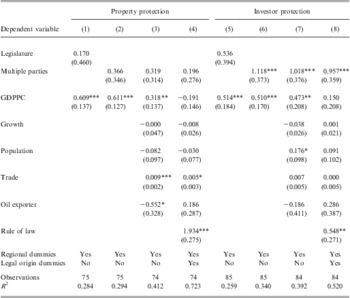
Table 1 reports the results of a series of models on the determinants of property and contracting rights in autocracies. All specifications include regional dummy variables to account for unobserved heterogeneity that may be associated with socio-cultural factors or the diffusion of institutions among neighbors. Regional fixed effects allow us to compare the impact of institutions within each regional setting. Columns 1–4 report our estimates of Property Protection. Our results indicate that our key independent variables, Legislature and Multiple Parties, have no impact on this form of expropriation risk. Consistent with the results reported in Jensen,Footnote 110 we find that trade openness is associated with better property rights. Not surprisingly, the rule of law index is also strongly correlated with property rights.
Authoritarian Institutions and Property Rights

Note: The table reports OLS estimates of the determinants of Property Protection and Investor Protection. All models include regional dummy variables. The variable Property Protection represents the ONDD political risk rating for expropriation/breach of contract risk. The variable Investor Protection is the Strength of Investor Protection Index, developed by the World Bank (see Doing Business 2012). A constant is estimated but not reported. Heteroskedasticity-robust standard errors are shown in parentheses. ***, **, and * indicate statistical significance levels of 1, 5, and 10 percent, respectively.
One potential criticism of our models of Property Protection is that the dependent variable solely captures perceptions of risk for foreign investors. Do these same results hold for domestic investors? To examine the robustness of these results we include alternative measures of property rights and expropriation risk from the Global Competitiveness Report,Footnote 111 the Heritage Foundation, and the Fraser Institute.Footnote 112 We present the results in Table A4 of the online appendix, yet our findings remain unchanged. There is no evidence that authoritarian legislatures affect expropriation risk or other measures of vertical property rights protections.
Columns 5–8 of Table 1 present identical specifications as above, but this time the dependent variable is Investor Protection within authoritarian countries, representing the alternative contracting mechanism. In contrast to the models of Property Protection, we find strong support for the view that multiple political parties are associated with the protection of minority shareholders in authoritarian regimes (Columns 6–8).
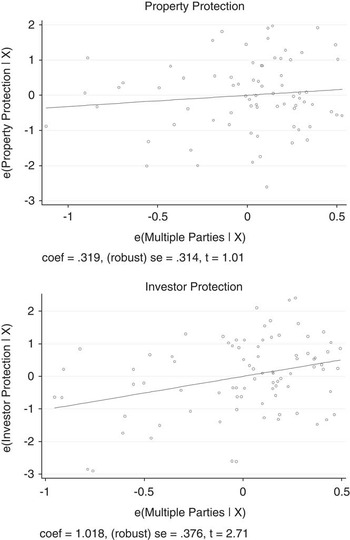
Figure 1 contrasts the results from Column 7 with the result from Column 3. In particular, the figure displays the partial regression plots for both dependent variables based on the results from Columns 3 and 7. The figure represents the relationship between the two dependent variables and Multiple Parties, holding fixed the set of economic control variables. The slope of the linear fit is identical to the estimated coefficient corresponding to Multiple Parties in Columns 3 and 7 of Table 1. We note that outliers do not drive the relationship between Multiple Parties and Investor Protection: the strongly positive correlation appears quite general across countries.
Multiple Parties and Property Rights (Partial Regression Plots) Note: Based on the models reported in Columns 3 and 7 of Table 1, which respectively regress Property Protection and Investor Protections on Multiple Parties and a vector of economic control variables, the figure displays the partial regression plots for both dependent variables.

The results in Columns 5–8 provide an important distinction between de jure and de facto institutions. In particular, the existence of a legislature alone is not robustly correlated with improved investor protections. Rather, the results indicate that investor protection is strongest where multiple parties actually exist within the legislature. The results hold after the inclusion of the economic controls (Column 7), and after the inclusion of ‘legal origin’ dummies and the rule of law in Column 8. This robust relationship between the existence of multiple parties and investor protections strongly corroborates our theoretical intuition that the main role of an authoritarian assembly is not to facilitate trade-offs with the authoritarian leadership (be that a dictator or a party), but rather to facilitate log-rolling among multiple private actors, who may have different economic interests.Footnote 113
Robustness
We test the robustness of our results to a two-stage procedure that addresses concerns about institutional endogeneity using data on the historical origins of multi-party authoritarian regimes. While simultaneity bias is not a concern, as it is highly unlikely that property rights generate authoritarian parliaments, unobserved heterogeneity (i.e., omitted variable bias) poses a very real threat to causal identification. Specifically, it is possible that underlying constellations of domestic actors are responsible for the creation of parliaments and protections against expropriation and breach of contract. Consequently, the correlation between the two variables would be spurious, resulting from the fact that powerful interests demanded both of these protections, rather than an actual causal relationship between the political and economic institutions. Indeed, Pepinsky's study of Malaysia and Indonesia demonstrates how different constellations of economic and ethnic actors underlying the strength of the chief executives (i.e. Mahatir and Suharto) led to radically different economic policy choices made in the face of the Asian Financial Crisis.Footnote 114 Most important for Pepinsky is that some of these actors were not represented in cabinets or legislatures; their influence resulted primarily from the financial support for the regime.
To address this concern, we rely on a quasi-experiment provided by the legacy of institutions in authoritarian regimes. In many countries, the parliaments and the number of parties represented in them were not created anew at the time a new authoritarian regime was founded; rather, they were inherited from the colonial pastFootnote 115 or bequeathed from a previous democratic or authoritarian episode.Footnote 116 Cambodia and East Timor offer the most obvious cases, where their parliament and electoral system were constructed under United Nations auspices after a multi-national intervention. During the dislocation caused by decolonization, war, or civil unrest that lead to regime transitions, many leaders have found it convenient to rely on the edifices of power from the past to establish order and begin re-building quickly.Footnote 117 Countries with inherited legislatures and opposition parties allow us to trace through the causal implications of a parliament more directly, as it cannot be the case that the parliament was selected by the same set of actors that had determined expropriation and investor protection policies.
To be sure, as Slater demonstrates, these inherited institutions can be packed, rigged, and circumvented by clever dictators, as was the case of Mahatir in Malaysia and has been more recently demonstrated by Hun Sen in Cambodia.Footnote 118 These dictators have been able to choose which institutions they prefer and will continue to support, which ones to do away with, and which ones to coopt to their own purposes. Although inherited institutions limit the choice set of authoritarian executives, they cannot constrain them entirely. This fact allows for a more nuanced set of predictions regarding the effects of authoritarian parliaments. Once we account for the legacy of inherited institutions, we are unlikely to observe a relationship between authoritarian parliaments and vertical restraints on state executives, who have too many tools at their disposal to circumvent them. However, the inherited parliaments and opposition parties are much more likely to lead to multiple interests being represented in the parliament, and will, therefore, be more likely to engender the trade-offs between non-state actors that result in horizontal checks on market actors. As long as these horizontal checks are neutral in their effect on leaders’ interests, they will be likely to survive and influence investors’ decisions.
To address unobserved heterogeneity in institutional selection, we introduce our theoretically grounded instrument in a two-stage procedure, where we first estimate the existence of the legislature and the number of parties in authoritarian legislatures, and then use the predicted value of these variables derived from historical legacy in the second stage. Essentially, this two-stage procedure alleviates the threat that legislatures were created simply to reflect the existing bargaining powers of actors in the polity. The variable Inherit, developed by Gandhi and Przeworski, is coded 2 if multiple parties are inherited, 1 if only the regime party existed, and 0 if all political parties were banned in the previous regime. Data correspond to 1996, which represents the final year in the Gandhi and Przeworski time series.Footnote 119 Our two-stage identification strategy employs Inherit as an instrument for Legislature and Multiple Parties.
Instrument validity requires that inherited institutions fulfill the exclusion criterion, which states that the instrument must be conditionally correlated with the independent variable, but must be uncorrelated with the error term in the second stage. In practice, this means that inherited institutions should have an effect on the number of parties represented in the legislature, but should not be independently correlated with the development of property rights or contracting institutions that develop in the new regime. The exclusion criterion would be violated, for instance, if elite divisions prior to the previous regimes’ collapse were responsible for both the number of parties and for future policies about contracting institutions. An especially problematic case would be one where these specific economic institutions defined elite divisions in the prior regime.
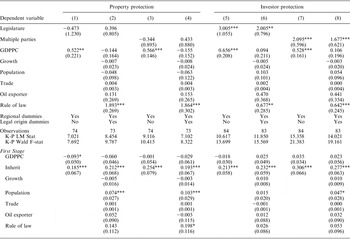
While an inspection of the cases in our dataset reveals this worry is not a threat, we also run several diagnostic tests to probe the validity of the instrument. First, we note that the first-stage estimates reported in Table 2 indicate that Inherit is strongly associated with Legislature and with Multiple Parties, significant at the 0.01 level. The results are also substantively large: holding the control variables at their means, results from a probit model indicate that the predicted probability that an authoritarian legislature will have multiple parties is 92 percent if multiple parties were inherited, compared to 63 percent where only the regime's party existed, and just 24 percent where no parties were allowed. In addition, the bivariate correlations between the variables are quite compelling. The bivariate correlations between inherit and multiple parties is 0.50 and statistically significant at the 0.05 level. The bivariate relationship between and inherit and investor protections is only 0.14 and not statistically different from zero.Footnote 120 Another reason to believe the exclusion restriction is upheld is the simple fact that the two-stage strategy recovers the same theoretical result as the OLS analysis – there is no relationship between multiple parties and property rights, but there is an association with contracting rights. This finding is at odds with the most likely threat to the exclusion restriction – that negotiations during regime transition affected both Inherit and Investor Protections. If previous political dynamics influenced which parties survived regime transition and the choice of economic institutions that would survive into the new state, it is extremely unlikely that the founders of the new regime would neglect property rights and only address contracting institutions during the initial negotiations.
Authoritarian Institutions and Property Rights (Robustness)

Note: The table reports two-stage least squares estimates of the determinants of Property Protection and Investor Protection. The variable Property Protection represents the ONDD political risk rating for expropriation/breach of contract risk. The variable Investor Protection is the Strength of Investor Protection Index, developed by the World Bank (see Doing Business 2012). A constant is estimated but not reported. Heteroskedasticity-robust standard errors are shown in parentheses. ***, **, and * indicate statistical significance levels of 1, 5, and 10 percent, respectively.
To probe the relevance of the instrument further, we test for underidentification. Since our models drop the i.i.d. assumption and estimate robust standard errors, the appropriate underidentification test relies on the Kleibergen-Paap LM statistic, a generalization of the Anderson canonical correlation test.Footnote 121 In the first stage, the Kleibergen-Paap LM statistic ranges between 7 and 15 and is always significant at the 99 percent level of confidence, and so we can reject the null that the equation is underidentified.
We conduct additional tests of weak identification, which occurs if the instrument (Inherit) is only weakly correlated with the main institutional variables. To test for weak identification, we report the Kleibergen-Paap Wald F-statistic, again the appropriate test under the assumption of non-i.i.d. errors. The K-P Wald F-statistic ranges between 13 and 21 in each of the Investor Protection models, far exceeding the rule of thumb cutoff of 10. In our tests of the effect of Multiple Parties on Investor Protections, we note that the estimated K-P Wald F-statistics also surpass the critical value for 5 percent Wald test.Footnote 122 These tests bolster our story that inherited parties do not have an independent effect, but influence the investor protections primarily through their role in generating a greater likelihood of multiple parties in the new regime.
Having confirmed the relevance of the instrument, we turn to the instrumental variables results, reported in Table 2. The results from these models confirm our previous findings. The first four columns of Table 2 model the determinants of Property Protection. In Columns 1 and 2, the main independent variable of interest is Legislature; Columns 3 and 4 introduce Multiple Parties. We begin in Column 1 with a parsimonious model, including only GDP per capita and the regional fixed effects as control variables. The coefficient corresponding to Legislature actually enters with a negative coefficient in this two stage model, albeit without statistical significance. In Column 2, we include our additional control variables, and Legislature remains statistically insignificant, this time with a positive sign. We conduct an identical set of tests in Columns 3 and 4, this time instrumenting for Multiple Parties. We find no statistically significant relationship between Multiple Parties and Property Protection. In sum, the results from our robustness tests, which attempt to address the potential endogeneity of authoritarian institutions, are not consistent with the view that legislatures and parties improve vertical property rights protections in autocracies.
To probe the positive relationship between these authoritarian institutions and investor protection more thoroughly, we run an identical set of robustness tests on the determinants of Investor Protections, and report the results in Columns 5–8 of Table 2. In contrast to our models of Property Protection, we find consistent support for the hypothesis that multiple parties in the legislature increase the protection of minority shareholder rights (Investor Protection). We also find a significantly positive relationship between the existence of a legislature and investor protection. The variable Legislature enters positive and significant in the parsimonious (Column 5) and fully specified models (Column 6). We also note that Multiple Parties retains a positive coefficient, significant at the 99 percent level of confidence in Columns 7 and 8. Thus, we conclude that the evidence is consistent with the hypothesis that parties in the legislature have a positive causal effect on the degree of investor protections in authoritarian regimes.
Conclusion
Scholars studying the relationship between institutions and investment have largely ignored the rich variation within authoritarian regimes. In this article we highlight the recent contributions in the study of authoritarian legislatures and test the theory of how ‘binding’ legislatures can reduce political risks for investors. Our empirical tests not only inform the literature on the relationship between investment and political regimes, they also provide a more direct causal test of an important stream of literature in comparative politics on the impact of authoritarian institutions on economic performance.
While we believe that the empirical correlation between authoritarian parliaments and investment/GDP growth is robust, we offer an amendment to the perceived causal logic that parliaments constrain executives and thereby reduce the risk of government expropriation. Authoritarian legislatures are by and large too weak to restrain the actions of the leadership, be they dictators, military juntas, or single-parties – the actors most likely to commit such expropriations. Moreover, they are very unlikely to punish or reverse such transgressions when they do take place.
Rather, we argue, the most important effect of authoritarian parliaments is to facilitate representation by multiple types of private economic actors, who are represented in the body. These actors have divergent economic interests, leading to policy trade-offs that facilitate improved corporate governance statutes that constrain the ability of corporate insiders to expropriate investors. In short, we argue that while authoritarian parliaments are unlikely to facilitate vertical checks on powerful state actors, they can enable private actors to check one another in the form of strengthened investor protection. Our argument, therefore, points to an alternative channel through which authoritarian legislatures contribute to investment and economic growth.
Using both political risk insurance ratings and objective measures of investor protection to test these hypotheses statistically, we find that authoritarian legislatures have very limited impact on property rights. Correlations between property rights and legislatures with multiple parties do not survive in models with a reasonable set of covariates or an identification strategy that exploits the inheritance of particular institutions. Survey evidence from MIGA provides additional confirmation that expropriation risk insurers, country analysts, and plant location consultants perceive these authoritarian legislatures as having very little impact on vertical expropriation risk.
By contrast, we find robust evidence that multiple parties in authoritarian parliaments generate better investor protection, as measured by the Doing Business project. This is an important contribution, as a long-lived and extensive literature has shown that such protections facilitate stock market development, domestic investment, and ultimately economic growth. Our findings clearly illustrate that authoritarian parliaments can improve economic performance by reducing investment risk. But the grabbing hand that they bind is not that of dictator or single party; it is the hand of the corporate insider seeking to exploit investors through the misuse of assets for personal gain.