Introduction
In the past two decades, there has been a worldwide increase in the number of natural disasters as well as the number of people affected. 1 From 2002 through 2011, natural disasters affected an annual average of 268 million people.Reference Guha-Sapir, Hoyois and Below 2 With regards to man-made disasters, namely conflicts, the number of people displaced reached an “18-year global high of 45.2 million people in 2012,” despite a decrease in the number of countries experiencing conflict. 1 In 2012 alone, the international humanitarian response from governments and private donors amounted to more than US $17 billion, despite suffering an eight percent decrease from the previous year.Reference Buston and Smith 3 The increase in the incidence of disasters is also accompanied by an increase in number of foreign medical teams (FMTs) deployed to countries affected by sudden onset disasters. 4 - Reference Bremer 6
However, in the wake of the 2010 Haiti earthquake, multiple reports and anecdotes started questioning the a priori positive contributions of such FMTs and even the intentions behind these aid efforts.Reference Van Hoving, Wallis, Docrat and De Vries 7 , Reference Gerdin, Wladis and von Schreeb 8 This brought on a renewed and strengthened interest towards accountability. Foreign medical teams are not the first or only humanitarian entities being criticized. Since the early 1990s, the global limelight was cast onto humanitarian organizations, in general, for their inadequacies in handling the 1994 Goma crisis post-Rwandan Genocide, as well as later on during the 2004 South-Asian tsunami.
In the greater picture of the humanitarian community, various nongovernmental organizations (NGOs) have produced their own “guidebooks” stating their views on accountability and ways to achieve it. The interest of the humanitarian community towards accountability is seen evidently in the huge increase in the number of “Quality and Accountability” initiatives and instruments that have emerged over the last decade (more than tripling from 42 to 147 from 2000 through 2012). 9
Despite such a remarkable development, to date, there is not a single accepted definition of accountability in the humanitarian context. On the contrary, the term accountability seems to represent a whole range of concepts and principles. Without a clear definition of accountability, it would be very difficult to assess critically the accountability of an organization and the assistance they provide. It is analogous to a race without declaring what the competition entails and without a finishing point (although it is not exactly a competition); anyone can claim to have finished the race at any point. How useful, then, is such a concept of accountability?
The purpose of this report was to explore and assess how the term accountability, and in particular, accountability towards aid recipients, in the humanitarian context is used and/or defined in the literature.
Method
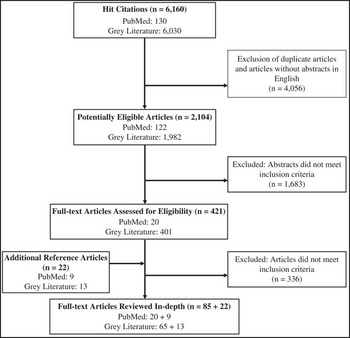
The electronic database PubMed (US National Library of Medicine, National Institutes of Health; Bethesda, Maryland USA) was searched for articles that discussed or provided a definition of accountability in the humanitarian context. Combinations of the keywords “disaster medicine,” “foreign medical team,” “internationality,” “relief work,” “altruism,” “humanitarianism,” “accountability,” “social responsibility,” and “liability” were used in the search. Only articles with abstracts in English were included. A total of 122 abstracts were identified and screened for relevance. Of this total, 20 articles were selected for in-depth analysis.
Grey literature was also included in the search strategy. Grey literature has been defined as any material produced by an organization where publishing is not its primary activity. 10
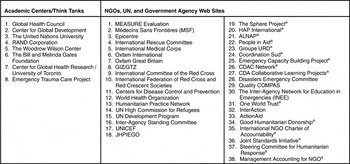
A pre-identified list (Table 1) of 46 major humanitarian organizations and initiatives, as well as “academic, government, and [NGOs] known to be conducting global health research or investigations as part of their work” was adapted from the Global Emergency Medicine Literature Review 2012.Reference Jacquet, Foran and Bartels 11 The web sites of these organizations were searched for articles, in English, that discussed or provided a definition of accountability in the humanitarian context. Through the grey literature search process, an additional 65 articles were found and reviewed. Thus, a total of 85 articles were reviewed (Figure 1).
Overview of Literature Review.

List of Grey Literature Adapted from Jacquet et alReference Jacquet, Foran and Bartels 11

Abbreviations: NGO, nongovernmental organization; UN, United Nations.
a Initiatives or bodies that focus on improving accountability as part of their work.
The articles were reviewed for formal definitions of accountability or what “being accountable” meant. The definitions were then analyzed qualitatively and coding categories were derived directly from the text data. Subsequently, themesReference Ziebland and McPherson 12 were identified from the coding categories using a framework analysis method based upon principles of grounded theory.Reference Ritchie, Spencer and O’Connor 13 , Reference Srivastava and Thomson 14 Summative content analysisReference Hsieh and Shannon 15 was also done using computer-assisted searches for word-usage frequencies among the definitions.
For the purposes of this discussion, the following terms have been defined as follows: a disaster is taken to mean “a serious disruption of the functioning of a community or a society causing widespread human, material, economic, or environmental losses which exceed the ability of the affected community or society to cope using its own resources;” 16 humanitarian assistance would be regarded as “aid to a stricken population that complies with the basic humanitarian principles of humanity, impartiality, and neutrality, 17 during, and in the aftermath of, emergencies;”Reference Buston and Smith 3 and humanitarian assistance is distinguished from development aid in that the former “is intended to be ‘short term’ in nature and provide for activities in the ‘immediate aftermath’ of a disaster.”Reference Buston and Smith 3
Results
Out of the 85 articles that were reviewed, a majority (65 articles) were grey literature, as opposed to articles published in peer-reviewed journals. Thirty-three articles provided definitions of accountability (Appendix 1; available online only), of which, 23 were organizational publications or articles that represented the views of the respective organization or initiative. These 23 articles represented 15 different organizations and initiatives, and of these, nine were initiatives that promoted accountability primarily as part of their work. There were no notable differences, in general, between the definitions provided by these initiatives and other organizations.
There were 16 humanitarian organizations and initiatives that produced instruments to measure, evaluate, or ensure accountability (Appendix 2; available online only). Of these 16 organizations and initiatives, nine had defined accountability formally. There were two main paradigms of how accountability, in general, had been interpreted: accountability as a “process” or “means” to achieve a certain set of goals or objectives, and accountability as a goal or objective in itself:
Accountability is the means used to hold persons/entities responsible for their actions. 17
World Health Organization (WHO; Geneva, Switzerland)
Accountability is the process through which an organization actively creates, and formally structures, balanced relationships with its diverse stakeholders… with a view to continuously improve the organization’s delivery against its mission.Reference Hammer and Lloyd 18
One World Trust (London, United Kingdom)
Accountability refers to organizations (or individuals) being held responsible to a particular group for the effects of their actions.Reference Cosgrave 19
Tsunami Evaluation Coalition (ALNAP; London, United Kingdom)
The most frequently used words in the definitions were “responsibility/responsible/responsibly” (occurring 23 times), “action” (occurring 20 times), and “account” (occurring 13 times):
Accountability for [Médecins Sans Frontières (MSF)] could be defined as a proactive process of deeper “engagement” with those who we define as our stakeholders, reporting the reasons for our choices, the results of our actions and the limits, challenges and dilemmas inherent in our work, based on our responsibilities as a medical and humanitarian organization in order to change and improve our response. 20
Médecins Sans Frontières (MSF; Geneva, Switzerland)
The principle of accountability requires that organizations and their staff fulfill and respect their legal and ethical responsibilities and use their power responsibly in humanitarian action. It is the process of taking account of, and being held accountable by, different stakeholders, primarily those who are affected by the exercise of power. 21
Joint Standards Initiative (HAP, Geneva, Switzerland; People in Aid, London, UK: The Sphere Project, Geneva, Switzerland)
Accountability means the ability to account for one’s actions whether favorable or unfavorable.Reference Birnbaum 22
Birnbaum ML
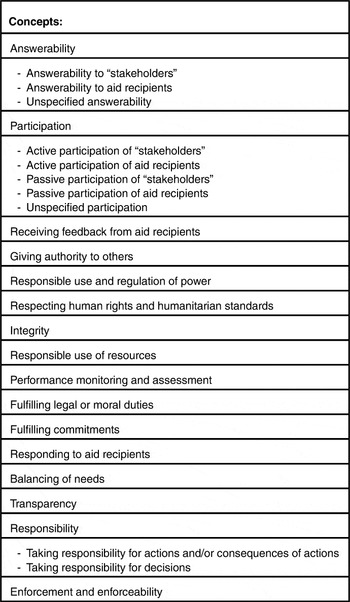
Common opinions of what accountability entails, based on word usage, were that: (a) it is in relation to the actions carried out; (b) there is a need for responsibilities to be fulfilled or taken; and (c) there is a need to provide an account of, or to account for, something – meaning “to answer for, to explain, or [to] justify.” 23 However, on further analysis of the definitions, a total of 16 different concepts (Table 2) were identified. Three of these concepts (“responsibility,” “answerability,” and “participation”) had within each of them further divergence of opinions.
Concepts of Accountability Identified from the Various Definitions

First, responsibility may have been taken for “actions” (and/or the consequences) or for “decisions,” which by implication could possibly include inaction:
Accountability has been defined not only as a means through which individuals and organizations are held responsible for their decisions and actions…Reference Blagescu 24
Blagescu M
Accountability is the means by which individuals and organizations report to a recognized authority, or authorities, and are held responsible for their actions. 25
Edwards M and Hulme D
Thus accountability involves... the responsibility to undertake certain actions (or forbear from taking actions) and the responsibility to provide an account of those actions.Reference Larose and Adams 26
Larose L and Adams J
However, there was a lack of substantiation as to how one takes responsibility and scant mention of having remedial measures or the enforceability of such measures, if any.
Second, organizations and individuals may choose to be answerable to different parties. Some organizations specified that they were accountable to the aid recipients, some used a more vague term of “stakeholders,” while others did not specify at all to whom they would account:
It is a process of… being held accountable by, different stakeholders, and primarily the people affected by authority or power. 27
Humanitarian Accountability Partnership (HAP) International (Geneva, Switzerland)
Accountability is the process through which an organization actively creates, and formally structures, balanced relationships with its diverse stakeholders, empowering these to hold it to account over its decisions, activities and impacts…Reference Hammer and Lloyd 18
One World Trust (London, United Kingdom)
Third, participation may involve different groups of people and at different levels. Some definitions spelled out an active participation, some a passive participation, while others simply mentioned participation. Likewise, participation may involve aid recipients specifically, “stakeholders” in general, or a non-specified group:
[A]ccountability means making sure that the women, men, and children affected by an emergency are involved in planning, implementing, and judging our response to their emergency too. 28
Emergency Capacity Building (ECB) Project (Bangladesh, Bolivia, Horn of Africa, Indonesia, and Niger)
Accountability for MSF could be defined as a proactive process of deeper "engagement" with those who we define as our stakeholders, reporting the reasons for our choices, the results of our actions and the limits, challenges and dilemmas inherent in our work… 20
Médecins Sans Frontières (MSF; Geneva, Switzerland)
The process by which an NGO holds itself openly responsible… in a way which shows it involving all concerned parties…Reference Slim 29
Slim H
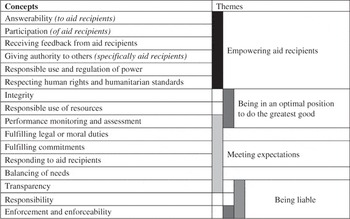
Specifically focusing on accountability towards aid recipients, four main themes (Table 3) were developed from the 16 concepts. Accountability towards aid recipients was about: empowering the aid recipients, being in an optimal position to do the greatest good, meeting expectations, and being liable.
Concepts and Themes Pertaining to Accountability to Aid Recipients, Identified from the Various Definitions

“Empowering aid recipients” was about treating the aid recipients not as vulnerable, helpless victims, but as equals who have the ability to decide how their lives should be rebuilt:
Accountability is understood as a means to challenge and correct the fundamental power disparity between aid provider and aid recipient. 30
Steering Committee for Humanitarian Response (Geneva, Switzerland)
“Being in an optimal position to do the greatest good” was about the intrinsic responsibilities of a humanitarian provider to have the necessary resources and capabilities to benefit the aid recipients:
[A]ccountability is about strengthening our capacity to save lives and alleviate suffering in a manner that affirms individual dignity…Reference Egeland 31
Egeland J
“Meeting expectations” involved first having clear objectives, second having the means to assess the progress, and third achieving these objectives:
The principle of accountability requires that organizations and their staff fulfil and respect their legal and ethical responsibilities and use their power responsibly in humanitarian action… 21
Joint Standards Initiative (HAP, Geneva, Switzerland; People in Aid, London, UK: The Sphere Project, Geneva, Switzerland)
“Being liable” was about showing the aid recipients that humanitarian providers are willing to admit mistakes and take remedial actions, but this liability need not necessarily be a legal one:
We can think of accountability as having two key components: answerability (the obligation of power-holders to justify their decisions and actions) and enforceability (the existence of mechanisms for punishing poor performance or abuse of power)…Reference de Renzio and Mulley 32
de Renzio P and Mulley S
The last theme of being liable, and in particular, the concept of enforcement/enforceability, received the least mention and emphasis among the four.
Discussion
There is a wide variation in the interpretation and understanding of accountability in the humanitarian context, as reflected in the literature. The English word “accountability” is derived from the Old French word “acont,” 33 which “connotes both computation and narration, both counting and telling.”Reference Borowiak 34 The Oxford English Dictionary, Third Edition, defines accountability as “the quality of being accountable; liability to account for and answer for one’s conduct, performance of duties, et [cetera]; responsibility.” 33 While it is not surprising that the definitions in the humanitarian context are different from a “standard” definition, due to the term’s tendency to take on highly context-specific meanings,Reference Beattie 35 it is, however, concerning to note the discordance among humanitarians.
The discordance may possibly mean that: (a) either the humanitarian community, in general, does not comprehend fully the concept of accountability; or (b) some humanitarians disagree with others on their understanding of accountability. Both instances would require the humanitarian community to engage in greater dialogues and to analyze formally what accountability truly means, or risk the multitude of accountability instruments becoming counter-productive.
Process Versus Goal
The difference between definitions that portrayed accountability as a process and those that do not may simply be semantic, but it also may highlight certain fundamental differences in the thought processes of these humanitarians. Organizations or individuals who defined accountability as a process possibly may place greater emphasis on the means to an end; or, they may, in actuality, have their reservations about accountability, and defining it as a process provides them with greater leeway in meeting expectations of accountability (simply because processes are inherently harder to assess than outcomes).
Complexity of Accountability
Admittedly, accountability is complex, both semantically and practically. The contemporary concept of accountability is a relatively recent development unique to the English language, from a word that simply meant providing a count or giving an account, to one that now spans multiple semantic fields.Reference Castiglione 36 The fact that accountability is not translated easily to other languagesReference Beattie 35 , Reference Castiglione 36 further contributes to the lack of understanding, especially in multicultural settings that many humanitarian organizations often work in.
Practically, two main issues stand out. First, how is, and can accountability even be, measured? Are there certain validated outcome indicators that measure accountability, or the lack thereof, specifically or sensitively? Other issues regarding accountability instruments include the relativity of accountability (ie, is someone either accountable or not accountable, or is there a gray area of being partially accountable) and adequacy of self-measurement/reporting (ie, who should measure an organization’s accountability), all of which warrant a greater discussion beyond the scope of this report. Second, the multiplicity of parties to be accountable to raises the issue of whom should humanitarian organizations be accountable to.
Accountability to Whom
Each party or stakeholder has “a very different level of leverage and power over an NGO” and can, thereby, potentially skew the power and accountability relationship.Reference Llyod and de las Casa 37 However, several authors have pointed out the importance of giving greater attention to accountability towards aid recipients, as it is this group of stakeholders that provide the basis of legitimacy for the organizations.Reference Blagescu, Casas and Lloyd 38 , Reference Bhattacharjee 39 And morally, it seems only right to do so too. Various international NGOs’ research also suggest that NGOs who work with a greater emphasis on aid recipients delivered aid of higher quality.Reference Bhattacharjee 39 , Reference Bonbright, Litovsky, Knight, MacCarthy, Mancini and Raynard 40
Accountability Towards Aid Recipients
The four main themes (Table 3) that broadly encompass the various views about accountability towards aid recipients show that there is a general thread of commonality shared by most. However, the lack of mention of having remedial measures, or the enforceability of such measures, is in stark contrast to several authors who cited enforcement to be an important part of accountability.Reference de Renzio and Mulley 32 , Reference Schedler 41 , Reference Davis 42 Current humanitarian accountability is largely a self-reporting and self-regulatory phenomenon where organizations rate their own accountability using their own checklists, or one of the many developed by other bodies/initiatives (Appendix 2; available online only). Thus, it is not entirely surprising that most definitions leave out enforcement.
Future Developments
Community-wide collaborations could be held to understand better various organizations’ rationale behind defining or understanding accountability the way they do, so as to achieve a common consensus on what accountability should be about in the humanitarian context. A next step would be to assess critically the “measurability” of accountability and how the community could go about ensuring accountability amongst all humanitarian providers. One possible approach would be to analyze the various accountability instruments currently available and identify the pertinent aspects that can be and should be assessed. An example is the Emergency Capacity Building Project’s development of a common humanitarian accountability framework.Reference Bhattacharjee 39 Another important aspect to focus on would be the clarification of whom humanitarian providers should be accountable to, as well as ways to implement and ensure the enforceability of remedial measures. These developments undoubtedly would require the concerted effort of the humanitarian community as a whole.
Study Limitations
There are a large number of humanitarian organizations currently working around the world, and it is inherently difficult to review exhaustively every single organization’s definition of accountability because of a lack of an official database or list of every single organization. This study only targeted larger humanitarian bodies with articles in English, and thus, may not completely represent the views of the entire humanitarian community. Only formal definitions of accountability, or what it means to be accountable, were reviewed, while the accountability instruments were not analyzed for the publishing organization’s possible understanding of accountability.
Conclusion
The concept of accountability is defined poorly in many humanitarian organizations. Humanitarian providers often refer to different concepts when talking about accountability in general. The lack of a common understanding partially is contributed by the semantic and practical complexities of the term. Focusing only on accountability towards aid recipients, four main themes arose from the various definitions: empowering aid recipients, being in an optimal position to do the greatest good, meeting expectations, and being liable. Although “responsibility” was a commonly mentioned concept, the theme of “being liable” still received the least emphasis. This was largely due to the lack of substantiation regarding the responsibilities, as well as the lack of mention of concepts such as “enforcement” and “enforceability,” which were regarded by scholars to be an integral part of accountability. Many other aspects of accountability, such as its “measurability” and by whom, similarly lack a common understanding and community-wide consensus.
The authors of this study hoped to provide a stepping-stone for the humanitarian community to re-examine collaboratively the concept of accountability in the humanitarian context, so as to translate it to actual improvements for the aid recipients.
Acknowledgements
The authors would like to acknowledge their fellow colleagues and friends at the Department of Public Health Sciences, Karolinska Institutet (Stockholm, Sweden), for their valuable opinions during discussions; A/Prof Fong Ngan Phoon for his kind assistance; and National University of Singapore (Singapore) and Karolinska Institutet for this wonderful opportunity.
Supplementary material
To view supplementary material for this article, please visit http://dx.doi.org/10.1017/S1049023X15000254.