Introduction
There are large differences when it comes to the organization and the level of prehospital care globally. Mobile Medical Teams (MMTs) are considered to be delivering the highest level of prehospital care because they are composed of an emergency physician and an emergency nurse. Reference van Schuppen and Bierens1,Reference van Schuppen and Bierens2 An MMT-based system is therefore also the most expensive system in terms of human resources. Reference Lerner, Garrison and Nichol3
Belgium has a national MMT system. The emergency physician and nurse who form the MMT also have specific tasks within the emergency department (ED), which they must leave once called away by the dispatch center. Reference Cattoor, Sabbe, Sermeus and Lippens4 In some regions, the organization of the prehospital system consists of a two-tiered (2T) Emergency Medical Services (EMS) system: an ambulance team and MMT. In other regions, there is a three-tiered system (3T) EMS system: an ambulance team, Paramedic Intervention Team (PIT), and MMT. A PIT is an ambulance team with an extra emergency nurse. The PITs have been introduced to reduce the response time compared to MMT response times and to decrease the number of departures of the MMT from the ED. With a national trend of increasing numbers of MMT interventions, and thus the out-sourcing of an emergency physician and emergency nurse from the ED to the MMT, the increasing lack of available human resources in the ED is becoming a problem. 5 Among the emergency staff, there is also a growing perception that the MMT is often over-qualified when required to deliver prehospital care (personal communication). 6–Reference Keldermans, Dhondt and Hubloue8
The current study aims to investigate, in two different regions with a 2T and 3T system, whether this perception is correct and whether using a PIT reduces the number of cases handled unnecessarily by the MMT. The overall intention is to better understand how human resources distribution can be optimized.
Setting
This study is a research collaboration between the EDs of the University Hospital Brussels (Brussels, Belgium) and two teaching hospitals in Aalst.
The University Hospital of Brussels is in the capital of Belgium, with a high density of inhabitants and a multicultural population. It has a 3T system. The total number of emergency physicians and emergency nurses working in the department is 37 and 76, respectively. Around 15 physicians and 15 nurses treat approximately 300 patients on average daily in the ED and deliver prehospital care in some eight MMT and five PIT interventions. The average duration of MMT and PIT interventions is 80 and 51 minutes, respectively, corresponding to a monthly total of 157 and 164 hours, respectively (based on activity monitored during the month of October 2019).
The two teaching hospitals in Aalst (ASZ Aalst and OLV Aalst) are in a provincial town. The hospitals alternate providing prehospital care fortnightly in a 2T system. The total number of emergency physicians and nurses working in the department is 14 and 36, respectively. Around four physicians and six nurses treat approximately 100 patients on average daily and deliver prehospital care in approximately seven MMT interventions. The average duration of an MMT intervention is 50 minutes, corresponding to 151 hours monthly (based on activity monitored during the month of October 2019).
The prehospital organizations in Brussels and Aalst are operated by different regional medical dispatch centers, using the same national emergency medical dispatch guidelines as triage tools. 9
Methods
To collect the data for this study, a registration form was specially developed and tested for comprehensibility and applicability during a two-month pilot study in a 2T region. The final registration form (Supplemental Material; available online only) included information on the composition of the MMT, the interventions carried out, and data to analyze the appropriateness of the interventions.
Prior to undertaking an intervention, the MMT members indicated on the form whether they believed that the MMT was the correctly qualified team for the intervention, based on the information available to them at that moment (Part 1 - Subjective Appreciation/Expected).
After the intervention, the MMT members completed the reality check, stating which team they believed would have been the correct one for the intervention. Options were MMT, PIT, ambulance team, or non-urgent transport (Part 2 - Subjective Appreciation/Reality Check).
All the therapeutic measures performed during the intervention were also recorded, enabling an objective assessment as to which team would have been best qualified to carry out the intervention (Part 3 - Objective Appreciation). These qualifications of the MMT, PIT, or ambulance team were identified by KD and SVB based on competencies, protocols, guidelines, and standard orders. Reference van Schuppen and Bierens1,Reference van Schuppen and Bierens2,10–12 When overlapping qualifications between ambulance crew, nurses, and physician were present, the lowest-qualified was considered as the most appropriately-qualified for the intervention. After identification of the qualifications, feedback was gathered from the physicians and nurses of the three participating EDs until full agreement on the list of objective qualifications of the MMT, PIT, and ambulances was achieved.
Part 1 and Part 2 of the forms were completed by each member of the MMT individually, before and after the intervention. No discussion between team members was permitted. Part 3, however, was completed as a team. Participation in the study was on a voluntary basis.
Data collection took place from October 1, 2019 through March 15, 2020.
The completed survey forms were deposited in a sealed box to which only the primary investigators (PIs – Aalst: KD; Brussels: SVB) had access.
It was decided in advance that patients under 16 years of age, pregnant patients, cancelled interventions, deaths on arrival, and interventions in the context of a disaster would be excluded because they were considered specific categories of interventions.
The data of Part 1 and Part 2, Part 1 and Part 3, as well as Part 2 and Part 3 of the survey were compared. The possible outcomes of the comparisons were defined as: a correctly-qualified team (the medical care provided necessitated the level of qualifications of an MMT) and an over-qualified team (the required medical care could have been administered by a less-qualified team than an MMT).
The data were entered manually in a spreadsheet (Microsoft Office Excel 2016; Microsoft Corp.; Redmond, Washington USA) by two secretaries from the ED in ASZ hospital and double-checked by the PIs for any mistakes.
Ethical approval was obtained from the Ethics Committees of the three hospitals involved: ethical approval numbers 2019-220 (Brussels), 2019/058 (OLV Aalst), and 09/19/CME/ASZ (ASZ Aalst).
Statistical Analysis
Descriptive statistics were provided in terms of absolute and relative frequencies. Missing values were reported in terms of absolute frequencies. Percentages were calculated based on the total number of completed answers. Differences between 2T and 3T regions were tested via the Chi-square test of independence. When differentiating between data obtained from physicians and nurses, multi-variable techniques of binary logistic regression, or ordinal logistic regression was used for binary, or ordinal dependent variables. The mixed effects binary logistic regression technique with a random intercept was used where data from a physician and nurse had been clustered per intervention.
Each analysis was corrected for multiple-testing using the Benjamini-Hochberg adjustment. Results were evaluated at α = 0.05 level to reach statistical significance (P < .05). Statistical analyses were performed using the statistical software RStudio version 1.1.463 running on R version 3.5.3 (R Foundation for Statistical Computing; Vienna, Austria).
Results
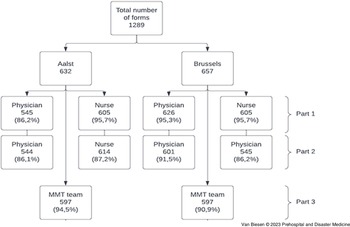
A total of 1,289 forms were collected for analysis (Figure 1).
Number of Forms Completed by the Different MMT Team Members for the Three Parts of the Questionnaire.
Note:
Part 1 – Subjective appreciation/expected - based on the independent assumptions by physicians and nurses before departure of the MMT.
Part 2 – Subjective appreciation/reality check - based on the independent reality check by physicians and nurses after the intervention of the MMT.
Part 3 – Objective appreciation - based on therapeutic measures performed by the MMT.
Abbreviation: MMT, Mobile Medical Team.

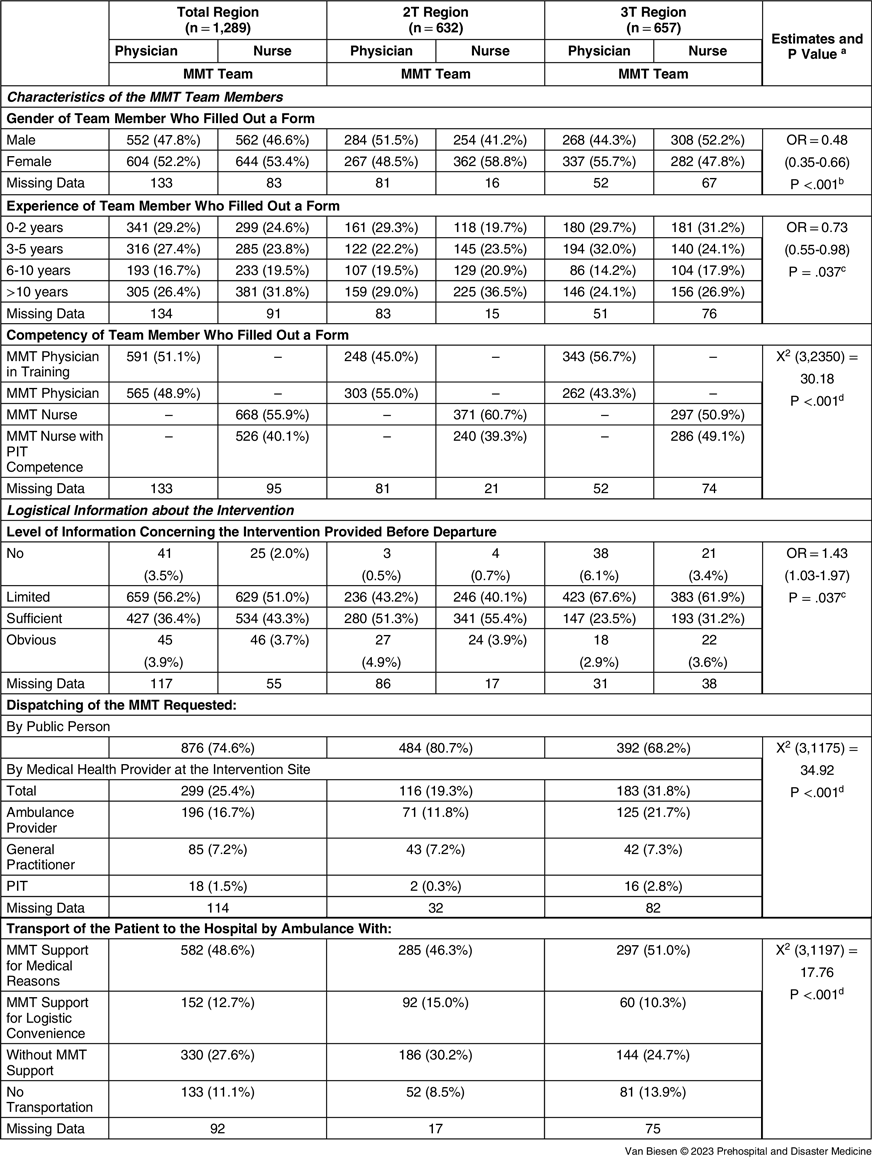
Table 1 showed that the two regions differed in terms of the profiles of the MMT team members, the level of information available prior to departure of the team to the call, the requesting person who asked for the dispatch, and the team that transported the patient to hospital.
Characteristics of the MMT Members and Logistical Information of the Interventions in the Total Region, in 2T Region, and in 3T Region

Abbreviations: OR, odds ratio; MMT, Mobile Medical Team; PIT, Paramedic Intervention Team.
a Adjusted P value according to Benjamini-Hochberg correction; P values were obtained for interaction effects between type of person (physicians and nurses) and hospital in which data was collected (2T region and 3T region).
b Binary logistic regression.
c Ordinal logistic regression.
d Chi-square test of independence.
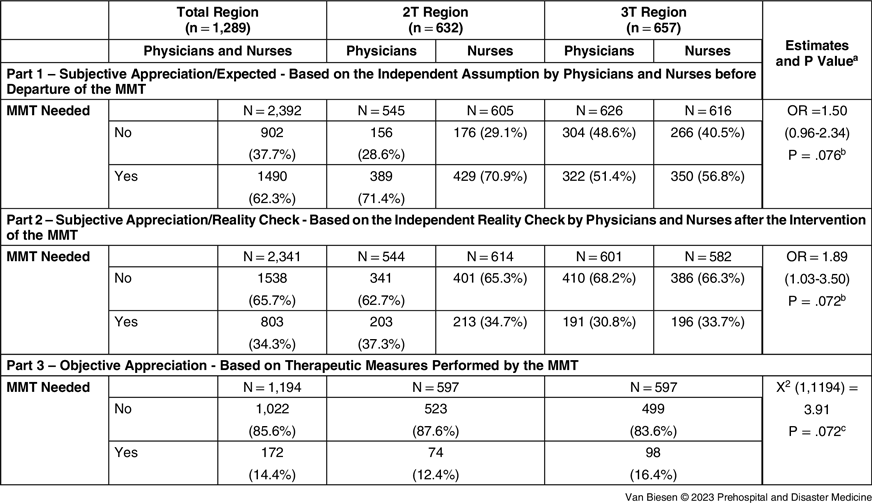
Table 2 showed that, prior to the intervention, 37.7% of all physicians and nurses believed that the MMT was over-qualified for the call. Brussels respondents (3T region) perceived the MMT to be over-qualified for the intervention more often than those in Aalst (2T region) did (OR = 0.25; 95%CI, 0.16-0.37). The interaction effect between the person rating the intervention and the region was not statistically significant (OR = 1.50; 95%CI, 0.96-2.34; P = .076).
Overview of Three Manner of Appreciation if the Mobile Medical Team (MMT) is the Most Appropriate Qualified Team

Note: n = number of total performed interventions; N = number of filled out forms.
Abbreviations: OR, odds ratio; MMT, Mobile Medical Team.
a Adjusted P value according to Benjamini-Hochberg correction; P values were obtained for interaction effect between type of person (physicians and nurses) and hospital in which data were collected (2T region and 3T region).
b Mixed binary logistic regression with a random intercept clustering each intervention.
c Chi-square test of independence.
Based on the reality-check completed after the intervention, 65.7% of physicians and nurses concluded that the MMT was over-qualified for the level of care required. Again, Brussels (3T region) concluded more often than Aalst (2T region) that an MMT was over-qualified for the intervention (OR = 0.44; 95%CI, 0.21-0.91). The interaction effect between the person rating the intervention and the region was not statistically significant (OR = 1.89; 95%CI, 1.03-3.50; P = .076).
Regarding the therapeutic measures carried out, the MMT was deemed over-qualified for these in 85.6% of interventions. There were no differences between the regions (OR = 1.39; 95%CI, 1.00-1.92; P = .072).
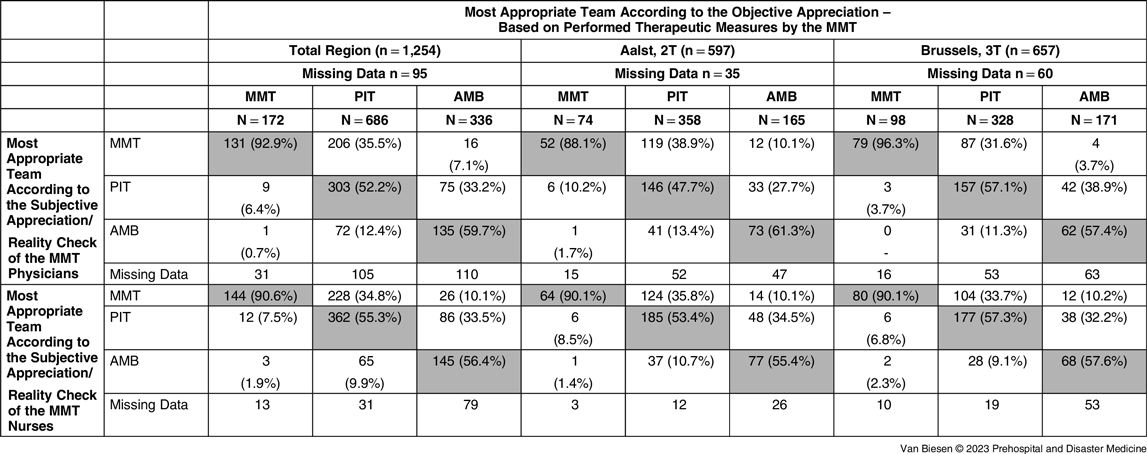
Table 3 showed the relationship between the subjective and objective qualifications of the most appropriate team, in the opinion of the MMT members, post-intervention, and therapeutic measures performed. Regarding the need for an MMT, there was an agreement of 92.9% (physicians) and 90.6% (nurses) between the subjective and objective qualification, respectively. For a PIT qualification, the agreement was 52.2% and 55.3%, respectively, whilst for ambulance interventions, the agreement was 59.7% and 56.4%, respectively. Overall, the data showed that physicians and nurses subjectively believed that an MMT or PIT was in fact needed more often than the objective measures showed.
Relationships between the Most Appropriate Team Based on Objective Data (Performed Therapeutic Measures) and Most Appropriate Team According to the Subjective Opinion of the MMT Members After the Intervention

Note: n = number of total performed interventions; N = number of filled out forms by physician, nurse after the intervention. Non-urgent medical transports and inconclusive information on therapeutic measures performed were excluded in the comparison.
Abbreviations: MMT, Mobile Medical Team; PIT, Paramedic Intervention Team; AMB, Ambulance Team.
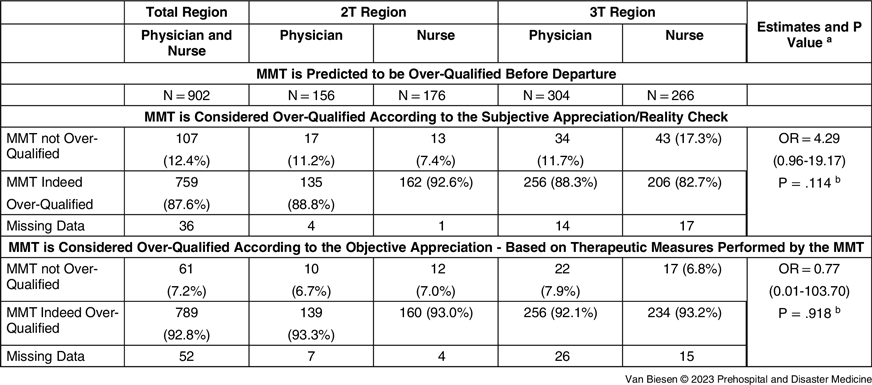
Table 4 showed the relationship between the predicted over-qualification of the MMT pre-departure, the subjective reality-check, and the objectively-performed therapeutic measures. Overall, 87.6% and 92.8% of the predictions pre-departure that the MMT was over-qualified were justified when compared to the subjective reality-check and objective therapeutic measures, respectively. There were no differences between physicians and nurses, nor between regions, when it came to subjective and objective correctness of the predictions (OR = 4.29; 95%CI, 0.96-19.17; P = .114 resp. OR = 0.77; 95%CI, 0.01-103.70; P = .918).
Relationships between the Predicted Over-Qualification of the MMT Before Departure and the Reality Check (Subjective Appreciation) and the Therapeutic Measures (Objective Appreciation) After the Intervention

Note: n = number of total performed interventions; N= number of filled out forms: by physician or nurse.
Abbreviations: OR, odds ratio; MMT, Mobile Medical Team.
a Adjusted P value according to Benjamini-Hochberg correction.
b P values were obtained by mixed effects binary logistic regression with a random intercept clustering each intervention.
Discussion
This study shows that MMTs in two regions in Belgium are very often over-qualified for the intervention to which they are dispatched. It should be noted that the two regions have different tiered systems and MMT compositions, as well as disparities in the amount of information available pre-departure, and they operate from distinct dispatch centers. These differences, however, resulted in identical observations in both regions, suggesting a national phenomenon. Based on the subjective experience of the MMT members, it is believed that an MMT is over-qualified for a given intervention in 65.7% of cases. When it comes to objective therapeutic measures, this figure rises to 85.6%. Both MMT physicians and nurses indicate that the MMT is over-qualified for a substantial percentage of the interventions.
A Belgian study conducted in 1995 already found that 54% of 819 interventions to which an MMT team was dispatched did not require the expertise of an MMT. Reference Calle, Houbrechts, Lagaert and Buylaert7 Another study, conducted in 2009 at University Hospital Brussels, concluded that the MMT had an added value in 45% of the interventions. Reference Keldermans, Dhondt and Hubloue8 It was based on these studies that the 3T system was introduced, with the expectation that a PIT would reduce the interventions by an MMT. In addition to the surcharge, the current study also shows that the inclusion of a PIT did not in fact lead to less interventions by an over-qualified MMT. This was observed in both the 2T and the 3T regions.
Another finding of this study is that in 37.7% of cases, the MMT was believed to be over-qualified for the intervention before even leaving the ED. This perception was reliable and proved to be correct in some 90% of the interventions when compared to the objective therapeutic measures that were performed. This is remarkable because approximately one-half of the interventions were initiated with only a limited amount of, or no information available, before the MMT left the hospital base (Table 1).
It has not been studied why the MMT is so often requested, without first considering that they may be over-qualified. One explanation might be the role of the medical dispatching centers. Dispatching in Belgium is performed by operators who are not required to have a medical background. They have a training of 620 hours which includes legal aspects, communication techniques and devices, local geography, internal procedures, as well as medical and fire regulations. The module on pathology is theoretical and is not considered a core content of the training. 13 Within the present study, the quality of the dispatching was not examined; studying this would be difficult and complex. Also, there is no consensus on acceptable rates of correct triage, or over-/under-triage in a dispatching system. Reference Mann, Schmidt and Cone14 A dispatch study from Switzerland suggests that employing medically-trained staff with prior hospital experience improves the efficiency of the medical dispatch. Reference Moser, Mettler and Fuchs15 The current study shows that MMT physicians and nurses, who are medically-trained and possess prehospital experience, have the capacity to predict the necessity, or not, of an intervention by an MMT in a more realistic way, even when faced with incomplete information. This observation at least suggests that there is room for improvement in the dispatch accuracy, for example by including more medical education in the training of dispatchers.
Another explanation for incorrect dispatching may be that the caller provides insufficient or incomplete information to the dispatcher. This aspect was not defined as an objective measure of this study, but may be considered a relevant topic for future studies.
This study was started due to a growing concern expressed about the large number of interventions by over-qualified MMTs and the impression that the introduction of a PIT did not reduce the problem. The increase in the number of MMT interventions in recent years 16 has resulted in more and more emergency physicians and nurses being called away from the ED, which in turn leads to frequent understaffing of the ED. This has culminated in a human resource and planning problem. Within the context of an over-burdened health system, an over-qualified MMT arriving on scene can create an atmosphere of annoyance, dissatisfaction, and stress. The MMT physicians and nurses are aware that they are abandoning an overcrowded ED to perform a time-consuming intervention which, ultimately, does not require the expertise of an MMT. This study provides an evidence-based confirmation of these impressions and concerns.
There have been three findings in this study that are also relevant regarding the efficient use of resources. The request by health care providers on the scene for secondary MMT-dispatch is high: 24.5% in the 3T region and 12.1% in the 2T region. The difference is largely explained by patients refusing transportation. Only an MMT physician has the legal authority to agree to not transport a patient. Reference Fraess-Phillips17 In addition, MMTs in both regions perform many non-essential procedures, such as setting up an IV line (even when not used), gathering blood samples (as a collegial act towards the receiving hospital), or administering non-urgent medication (to reassure the patient). Over-use of peripheral vascular access in regions where paramedics conduct prehospital care has been reported in another study. Reference Gonvers, Spichiger, Albrecht and Dami18 Finally, both the MMT and PIT perform many non-urgent interventions. It has also been recognized in other studies that non-urgent prehospital interventions have increased in all European countries. This increase can be attributed, for the most part, to the needs of senior patients, mental health issues, and non-life-threatening conditions. Reference Vuilleumier, Fiorentino, Dénéréaz and Spichiger19 These non-urgent interventions put yet more pressure on the human resources of the emergency prehospital services and EDs.
Limitations
The organization of the prehospital system and EDs in Belgium is distinct from most European countries. Therefore, similar studies conducted in other European countries may result in different rates regarding the perceived over-qualification of staff used, or conclusions.
Before the study started, it was recognized that there is a high degree of subjectivity in the opinion as to whether an MMT is the best-qualified team. For this reason, great efforts have been made, through extensive literature search and consensus processes, to define the therapeutic measures which ambulance crews, PITs, and MMTs are qualified to perform. It may be that the distinctions between the crews are more fluid than defined in this study. It is, however, not believed that this would significantly interfere with the conclusions of the study.
The added value of the MMT team is not only linked to therapeutic measures, but also to diagnostic competencies and clinical decision making. Reference van Schuppen and Bierens1,Reference van Schuppen and Bierens2 An open question in the survey form regarding any other added value of the MMT intervention was hardly answered and the little data which were provided did not allow for an analysis.
The study did not investigate why the MMT physician and nurse concluded which team would have been most appropriate. The inclusion of this question may have resulted in insightful information.
Conclusion
This study concluded that the involvement of MMT was unnecessary in over 90% of interventions in two very different regions of Belgium, due to the members of the team being over-qualified for the treatment administered. The MMT nurses and physicians were able to predict this in more than one-third of the cases prior to departure from the ED. The participation of a lower-qualified PIT did not, however, bring down the number of over-qualified MMT interventions. Further studies are needed to understand the reasons behind these conclusions. The observations from this study will nonetheless be useful to achieve more effective human resources’ deployment in emergency medicine departments.
Conflicts of interest/funding
The authors declare that they have no competing interests, and no funding was received.
Supplementary Material
To view supplementary material for this article, please visit https://doi.org/10.1017/S1049023X23006155