INTRODUCTION
Thyroid cancer is a relatively rare disease, with an incidence of 2 to 3 cases per 100,000 Swiss residents (Levi et al., Reference Levi, Randimbison and Te2002). Worldwide incidence rates have been increasing during recent decades (dal Maso et al., Reference dal Maso, Lise and Zambon2011; Davies et al., Reference Davies, Hennessy and Mills2006), and, if the current trend is maintained, thyroid cancer could become the fourth most common cancer by the year 2030 in the United States (Horn-Ross et al., Reference Horn-Ross, Lichtensztajn and Clarke2014). About 90% of all thyroid carcinomas involve a differentiated thyroid carcinoma (DTC), which carries an 10-year overall survival rate of 80–90% (Constant et al., Reference Constant, de Volder and Ivanoiu2001). Standard treatment for a DTC involves a total thyroidectomy, accompanied by lifelong dependence on substitution therapy with levothyroxine. Approximately 20% of patients develop local or locoregional recurrence, while ~13% will have distant metastases even decades after the initial diagnosis (Ladenson et al., Reference Ladenson, Braverman and Mazzaferri1997). Consequently, patients require long-term monitoring for persistent or recurrent disease.
In this context, partners play a key role in providing support (Manne, Reference Manne1998). It has been shown that couples often become closer after one member of the dyad has been diagnosed with cancer (Preau et al., Reference Preau, Bouhnik and Rey2011; Drabe et al., Reference Drabe, Wittmann and Zwahlen2013, Dorval et al., Reference Dorval, Guay and Mondor2005). In a previous study that our group conducted (Drabe et al., Reference Drabe, Wittmann and Zwahlen2013) among 209 patients with cancers of different types and stages (breast, intestinal, skin, leukemia, lung, lymphoma, liver, myeloma, and testicle) and their partners, 149 patients (71.3%) and 156 partners (74.6%) reported that the diagnosis had changed their relationships. Of these, 121 (57.9%) patients and 116 (55.5%) partners reported positive changes only, whereas just 8 patients (3.8%) and 18 partners (8.6%) indicated negative changes only. Such negative changes included the following: speaking to each other became more difficult, they experienced more conflicts, and they started to feel foreign to each other. A total of 20 patients (9.6%) and 22 partners (10.5%) reported having experienced both positive and negative changes. Observed negative relationship changes were systematically associated with increased psychological distress and a worse quality of life (QoL) in both patients and partners. In this context, it is astonishing that separation from a partner during the course of a cancer experience seems to be a rare phenomenon. For example, in a nationwide population-based Danish study of 46,303 persons aged 30–60 years, only 8% divorced during the first 20 years following diagnosis (Carlsen et al., Reference Carlsen, Dalton and Frederiksen2007). Furthermore, it has been shown that it is not the diagnosis of cancer per se that leads to divorce or relationship problems; rather, patients who divorce postdiagnosis are more likely to have had prior relationship problems (Holmberg et al., Reference Holmberg, Scott and Alexy2001; Taylor-Brown et al., Reference Taylor-Brown, Kilpatrick and Maunsell2000).
Emotional distance between members (Rolland, Reference Rolland1994) and communication difficulties within couples (Stead et al., Reference Stead, Fallowfield and Selby2007) can also be caused by changes in sexual activity after a diagnosis of cancer. It has been demonstrated that changes in sexuality often result from cancer treatment (Mercadante et al., Reference Mercadante, Vitrano and Catania2010). To date, no published studies have investigated whether or how the diagnosis and treatment of DTC can alter the frequency that couples engage in sexual activity. We have already demonstrated that DTC is associated with high levels of cancer-related fatigue, even years after the diagnosis was made (Drabe et al., Reference Drabe, Steinert and Moergeli2016). Moreover, patients often report that they likely waited longer than necessary to resume sexual activity after diagnosis and treatment for DTC due to fears of contaminating their partner with radioactivity. Hence, in the current study, we were also interested in examining sexual activity in thyroid cancer patients and their partners. Research in patients with cancer located at other body sites (i.e., non-thyroid) has revealed that sexual difficulties are associated with a lower quality of life and higher levels of distress (Greenfield et al., Reference Greenfield, Walters and Coleman2010; Milbury et al., Reference Milbury, Cohen and Jenkins2013; Traa et al., Reference Traa, De Vries and Roukema2012; Den Oudsten et al., Reference Den Oudsten, Van Heck and Van der Steeg2010) in patients, and that the frequency of sex impacts couples' relationships (Burns et al., Reference Burns, Costello and Ryan-Woolley2007). In one recently published cross-sectional study (Ussher et al., Reference Ussher, Perz and Gilbert2015) involving 657 cancer patients (64.7% breast cancer, 13.2% prostate, 6.8% gynecological, 5.6% hematological, 2.3% gastrointestinal, 1.5% neurological, 1.5% skin, 0.9% head and neck, 0.2% respiratory, and 0.4% other), frequency of sex was significantly reduced in both women and men after the cancer was diagnosed across all cancer types. More than 50% of all female patients and 41% of male patients reported that sex occurred never or rarely (less than once a month) after the cancer diagnosis. The perceived causes of sex frequency change included the physical consequences of cancer treatment, psychological factors, body image concerns, and relationship factors. Issues pertaining to sexual health are often mentioned by survivors of non-thyroid cancers when asked about their unmet needs (DeSimone et al., Reference DeSimone, Spriggs and Gass2014).
What happens in thyroid cancer cases might be different, given its generally favorable long-term prognosis and the brief course of anticancer treatment relative to the prolonged chemo- and radiation therapy often required for other malignancies. On the other hand, because of the good long-term prognosis, whatever impact thyroid cancer does have on relationships might last for many years, leading to some couples becoming separated or divorced, even leading to permanent estrangement. This last argument is supported by the abovementioned findings from the literature that changes in close relationships, as well as changes in sexual activity, have thus far been identified for all the cancer types examined.
The first purpose of our study was to examine the frequency and quality of perceived relationship changes (positive, negative, or mixed) in DTC patients and their partners. Second, we sought to identify any associations between these changes and sociodemographic and disease-related variables, as well as such outcomes as anxiety, depression, fatigue, and QoL. Another objective was to detect any changes in the frequency of sexual activity as well as any potential associations with the same sociodemographic, disease-related, and outcome variables noted above.
METHODS
Our study was approved by the ethics committees of the cantons of Zürich and Lucerne. All participants provided written informed consent prior to inclusion, either online or otherwise.
Participants
All 151 patients diagnosed and treated with surgery and radioactive iodine for DTC at the department of nuclear medicine in Zürich or Lucerne over the previous seven years and their partners were contacted by letter and asked to participate in our online study. Those who consented were sent two internet links: one to the study's online questionnaire for patients and the other to the questionnaire intended for partners. Those without internet access or not wanting to provide answers online were mailed a written questionnaire. Both procedures required that patients and partners provide informed consent prior to proceeding with the questionnaires.
The inclusion criteria for patients were as follows: that they had been treated for DTC within the previous seven years; that they were willing to provide information on their thyroid hormone levels; that they had sufficient knowledge of the German language to understand and answer all the questions; and that they were aged between 18 and 70 years. For partners, the inclusion criteria were a sufficient knowledge of German and aged between 18 and 70 years. We excluded patients and partners above 70 years of age, since we did not use specific tools to screen for or measure dementia, a confounder that typically adversely affects a person's attention and memory, and since the prevalence of dementia increases most notably after the age of 70 (4.1%).
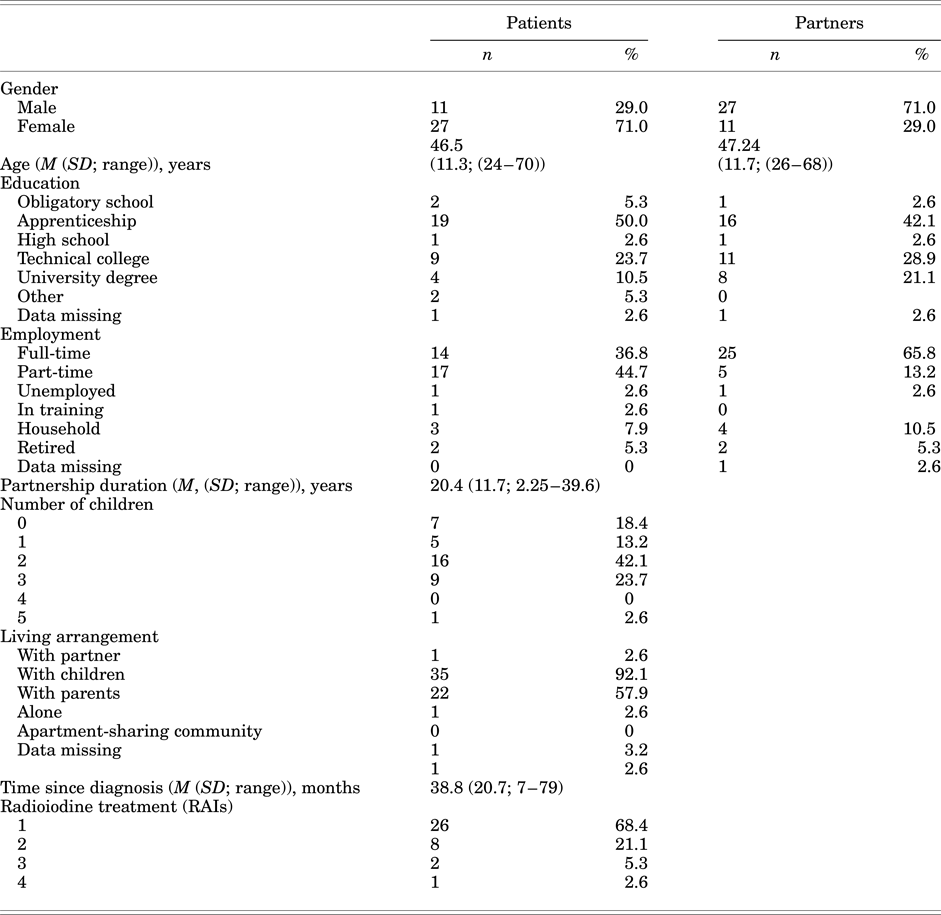
A total of 151 patients were contacted by mail. One letter was returned to us marked “addressee unknown,” 23 had to be excluded because of their age (>70 years), and 2 lacked sufficient proficiency in the German language. From the final 125 patients, 71 agreed to participate (56.8%). Of these, 62 were living in a close relationship (>6 months), but 2 were excluded because the patient's partner had changed during the period between the initial cancer diagnosis and our survey. Among the 60 remaining eligible patients, 39 partners (65%) agreed to participate and completed the questionnaires. One couple had to be excluded from the analysis due to incomplete data, leaving a final sample of 38 couples. The sociodemographic data and disease-related characteristics of the sample are summarized in Table 1. A total of 30 of the 38 couples were married, while 8 lived in long-term committed relationships. In no couple had the type of relationship changed since the diagnosis of thyroid cancer.
Sociodemographic characteristics of 38 couples

Measures
Standardized Questionnaires and Additional Questions (Online)
The Beck Anxiety Inventory (BAI) (Beck et al., Reference Beck, Epstein and Brown1988) was utilized to assess anxiety. This instrument was chosen because it has been shown to have better discriminative validity for depressive symptoms than other anxiety questionnaires (Margraf & Ehlers, Reference Margraf and Ehlers2007). With the German version, total scores ≥8 differentiate between patients with and without anxiety (sensitivity = 0.91, specificity = 0.92; Margraf & Ehlers, Reference Margraf and Ehlers2007). The values of Cronbach's alpha (α) in our sample were 0.95 for patients and 0.84 for partners.
The Beck Depression Inventory (Stockler et al., Reference Stockler, O'Connell and Nowak2007; Beck et al., Reference Beck, Ward and Mendelson1961) was used to assess depressive symptoms. BDI scores between 10 to 19 are considered consistent with mild, from 20 to 29 moderate, and 30–63 severe depression that requires observation and intervention. This tool is also widely used in cancer patients (Mystakidou et al., Reference Mystakidou, Tsilika and Parpa2007). The German version has been found to have good internal consistency and validity (Hautzinger, Reference Hautzinger1991). In our sample, the values of Cronbach's α were 0.88 for patients and 0.89 for partners.
The Brief Fatigue Inventory (BFI; Mendoza et al., Reference Mendoza, Wang and Cleeland1999) was utilized to measure fatigue in our patients. The scores on this brief screening questionnaire correlate strongly with those of the Functional Assessment of Cancer Therapy–Fatigue (FACT–F; Shafqat et al., Reference Shafqat, Einhorn and Hanna2005). A total score between 1 and 3 indicates mild fatigue, scores between 4 to 7 indicate moderate fatigue, and scores from 8 to 10 define severe fatigue that warrants observation and treatment. The internal consistency of the German version is high, with mean scores falling between 0.93 and 0.87 (Radbruch et al., Reference Radbruch, Sabatowski and Elsner2003). In our sample, the values of Cronbach's α were 0.94 for patients and 0.89 for partners.
The abbreviated version of the World Health Organization Quality of Life Questionnaire–100 (WHOQoL–QoL–BREF; WHOQoL Group, 1998) was employed to measure QoL in patients and partners, generating scores for physical health, psychological health, social relationships, and the individual's environment, with higher scores indicating a better QoL. It also includes two items on global QoL. WHOQoL–BREF domain scores have demonstrated good discriminant validity, content validity, and test–retest reliability, and the questionnaire is considered a valid and reliable measure for assessing QoL profiles in different populations, including patient samples (Skevington et al., Reference Skevington, Lotfy and O'Connell2004). In our sample, the values of Cronbach's α were 0.92 for patients and 0.88 for partners.
The Relationship Assessment Scale (Pellegriti et al., Reference Pellegriti, Frasca and Regalbuto2013) was developed by Hendrick et al. (Reference Hendrick, Dicke and Hendrick1998) to measure general relationship quality in individuals involved in an intimate relationship. The RAS includes seven items, each answered on a 5-point Likert-type scale. Sample items include “How well does your partner meet your needs?” (with response options ranging from 1 [poorly] to 5 [extremely well]) and “In general, how satisfied are you with your relationship?” (1 = unsatisfied, 5 = completely satisfied). Similar to the QoL instrument just described, higher scores indicate a better-quality relationship. The reliability of the RAS is moderate, averaging 0.87 across several studies (Graham et al., Reference Graham, Diebels and Barnow2011). In our sample, the values of Cronbach's α were 0.85 for patients and 0.82 for partners.
Perceptions of Relationship Change
To determine perceptions about relationship change, participants were asked the following: “Did the diagnosis of cancer change your relationship?” This question was derived from our clinical experience and had been developed for a previous study (Drabe et al., Reference Drabe, Wittmann and Zwahlen2013). If the answer was “yes,” subjects were asked to answer eight further items specifying the kinds of change they had perceived (e.g., “our feelings are stronger for each other”; “we spend more time together”; “our talks are more open”). These items were then designated as either positive (“our feelings are stronger for each other”; “we spend more time together”; “talks are more open”) or negative (“we withdraw from other people”; “talks are more difficult”; “we spend less time together”; “we came to feel more foreign to each other”; “we have more conflicts”) dyadic changes. These items were then analyzed as nominal variables (positive, negative, or both positive and negative) and tested to determine how many participants had experienced positive versus negative versus both kinds of relationship changes. Furthermore, participants were allowed to choose a category called “other changes” to designate changes not specifically addressed in the earlier items.
Perceptions of Intimacy Change
To determine whether the level of sexual activity had changed, participants were asked the following question: “How long [in days, weeks, months, years] did it take from the time you [or your partner] were discharged from hospital until you were sexually active with your partner again?” We also asked both patients and partners how often they had been sexually active with each other over the last year prior to the diagnosis (per day, week, month, year) and how often they were sexually active with their partner at present. This item was developed in the style of the Changes in Sexual Functioning Questionnaire (CSFQ–14) (Keller et al., Reference Keller, McGarvey and Clayton2006). If patients or partners reported less frequent sexual activity after DTC diagnosis and treatment, the questionnaire probed for the potential reasons.
Medical and Demographic Variables
Questions about medical status included items related to other cancer diagnoses and their treatment, the duration of time since thyroid cancer was initially diagnosed, and the treatments undergone postdiagnosis. Participants were also asked sociodemographic questions concerning their age and gender, level of education, household income, relationship duration, number of children, and living arrangements. In addition to these demographic questions, each patient's partner was asked whether they had ever had cancer themselves and, if so, when, what kind, and how it was treated.
Clinical Assessments
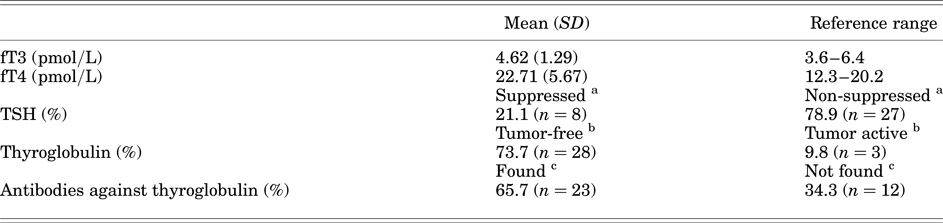
Patients' current hormonal status (fT3, fT4, TSH, thyroglobulin, antibodies against thyroglobulin) was examined by reviewing the laboratory results taken during their last routine clinical visit (if not more than one year previous) and was included in the data analysis as well. These characteristics are summarized in Table 2.
Hormonal characteristics of patients (n = 35)

a Suppressed = TSH < 0.01 mU/L; non-suppressed = TSH ≥ 0.01 mU/L.
b Tumor-free = thyroglobulin (<0.9 µg/L); tumor active = thyroglobulin (≥0.9 µg/L).
c Antibodies against thyroglobulin were measured in international units/ml. In all 23 patients where antibodies were found, the total value was in the reference range (<100).
Data Analysis
Descriptive statistics were utilized in order to characterize the patient and partner samples. The sample was further divided into three groups: for one analysis on the basis of reported relationship change (those reporting negative, those reporting positive, and those reporting either negative or mixed relationship changes), and for a second analysis into three groups based on reported changes in sexual activity (those reporting no change, as well as those reporting more and less sexual activity). Differences in the distribution of core outcome variables (BAI, BDI, level of fatigue, RQ, and QoL) as well as sociodemographic variables (age, sex, partnership duration in years, number of children) and disease-related variables (FT3, FT4, TSH, time since diagnosis in months, number of radioactive iodine treatments [RAIs]) between each of these group triads were identified using Kruskal–Wallis tests, where patients and partners were tested separately. Subsequently, pairwise multiple comparisons with adjusted p values were performed to identify significant differences between each pair of groups. A later power analysis was performed. Expecting a significant effect (Cohen's d = 0.8) regarding anxiety ratings on the BAI (Cohen, Reference Cohen1988) between those patients reporting no relationship change and those reporting negative or mixed changes, a sample size of 30 versus 15 patients would be needed for a power rating of 80% (group size = 2:1 according to Drabe et al. [2013], α = 0.05, one-tailed, supposing higher BAI scores in patients with negative or mixed changes). With about half as many patients, our study was certainly underpowered. All statistical calculations were performed using SPSS software (v. 21.0), and the two-sided threshold for statistical significance was set at p ≤ 0.05.
RESULTS
Perceptions of Relationship Change
Some 17 patients (44.7%) and 16 partners (42.1%) reported that the diagnosis of thyroid cancer had caused a change in their relationships (Table 3). Though most patients and partners selected relationship changes from among our list of eight options, 5 patients and 3 partners (8 of 76 subjects, 10.5%) contributed to the “other changes” category. These answers were also categorized as positive, negative, or neutral/indeterminate. Among the five patients who identified another type of relationship change, we considered three to be a positive change (e.g., “to let something unimportant, be unimportant”) and two negative (e.g., “rarely up to having sex”). Among the three partners who identified some other change, two were considered positive (e.g., “if my partner is on the move, he calls more often”) and one negative (e.g., “thoroughness has declined”).
Patient (n = 38) and partner (n = 38) perceptions of relationship change

Associations Between Perceived Relationship Changes and Sociodemographic, Disease-Related, and Outcome Variables
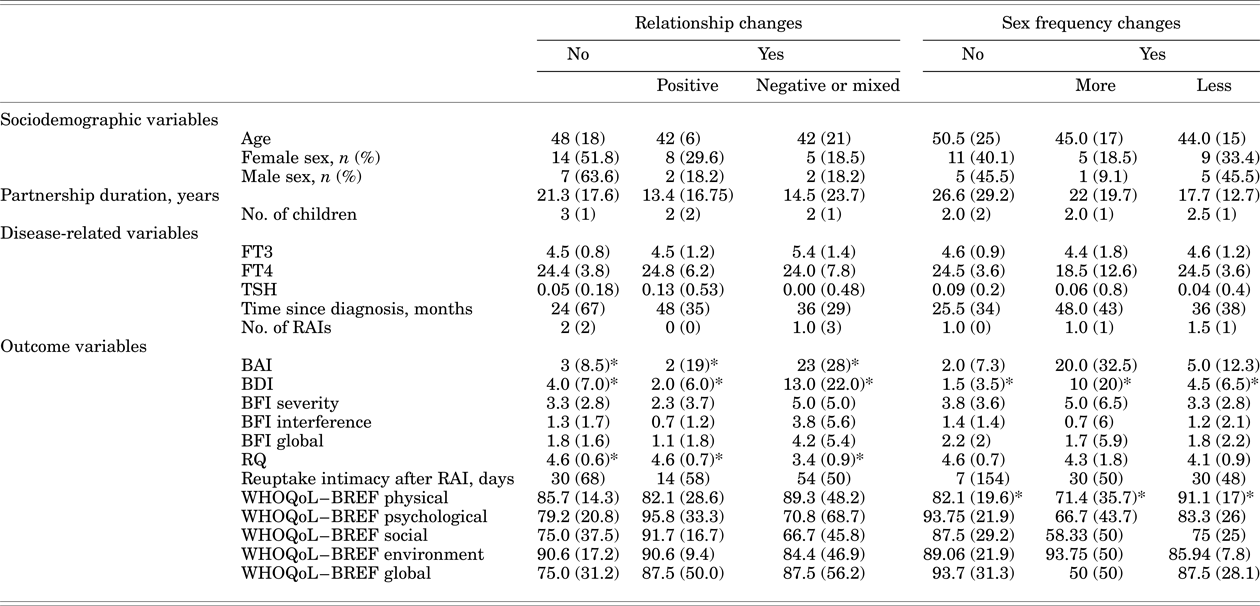
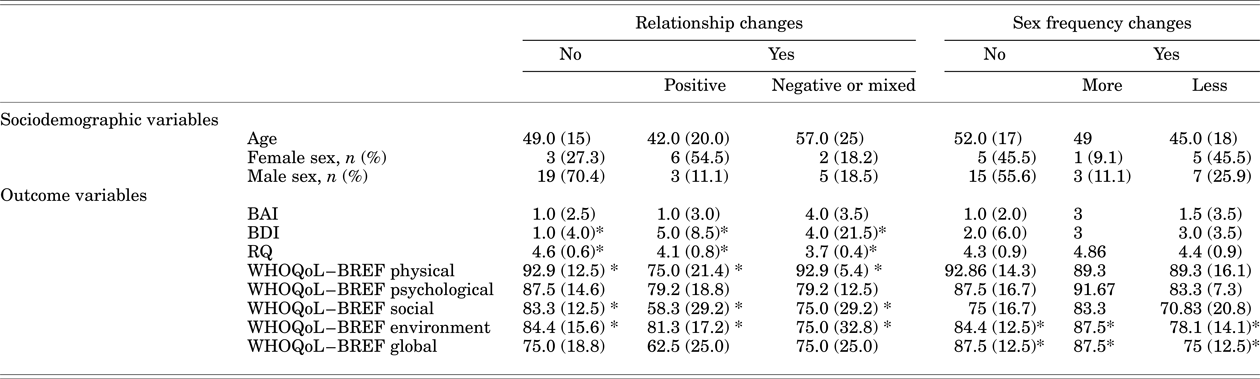
Comparisons between the three groups of patients subdivided by perception of relationship change (those reporting no, positive, and negative or mixed relationship changes) revealed significantly different mean scores for depression (Kruskal–Wallis H(2) = 7.93, p = 0.019), anxiety (H(2) = 7.02, p = 0.03), and RQ (H(2) = 11.11, p = 0.004), but not for global QoL (H(2) = 0.39, n.s.), nor for any of the QoL subscales, global fatigue (H(2) = 1.56, n.s.), the fatigue subscales for severity and interference, nor disease or sociodemographic characteristics (Table 4). In post-hoc pairwise comparisons, the perception of negative/mixed relationship changes was associated with higher anxiety (p = 0.028) and depression scores (p = 0.017), as well as with lower RQ scores (p = 0.003) than for the perception of no changes. This analysis was repeated for the partners (Table 5). Here the perception of negative/mixed relationship change was associated with higher depression scores (p = 0.012) but poorer RQ (p = 0.002) and environmental QoL scores (p = 0.016). Positive relationship changes were associated with lower social and physical QoL (p = 0.048, p = 0.005) and lower RQ scores (p = 0.034) than with the perception of no change. Otherwise, the three groups of partners (those reporting no, positive, and negative/mixed relationship changes) did not differ with respect to disease-related or sociodemographic characteristics, or in terms of level of anxiety, fatigue, or any of the QoL subscales.
Median and interquartile ranges of perceived changes of relationship and sexual activity with respect to sociodemographic, disease-related, and outcome variables in patients (N = 38)

* Significant difference between groups (Kruskal–Wallis test/pairwise multiple comparison with adjusted p value).
All data are presented as medians (interquartile range), except for the variable “sex.” There was no association between sex and relationship changes (Fisher's exact test, p = 0.886) as well as between sex and sex frequency changes (Fisher's exact test, p = 0.800).
BAI = Beck Anxiety Inventory; BDI = Beck Depression Inventory; BFI = Brief Fatigue Inventory; RAI = radioactive iodine treatment; RQ = relationship quality measured with the Relationship Assessment Scale; TSH = thyroid-stimulating hormone; WHOQoL–BREF = World Health Organization Quality of Life questionnaire.
Median and interquartile ranges of perceived relationship changes and sex frequency changes with respect to sociodemographic, disease-related, and outcome variables in partners (N = 38)
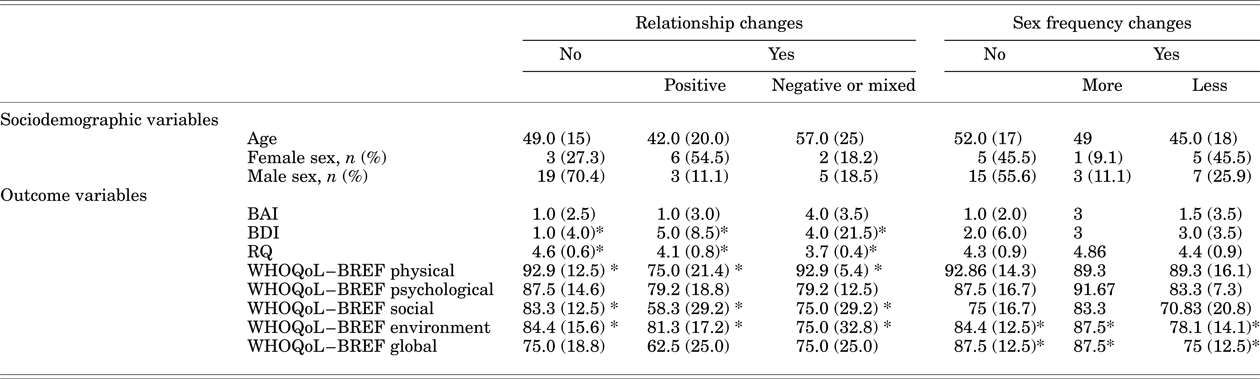
* Significant difference between groups (Kruskal–Wallis test/pairwise multiple comparison with adjusted p value).
All data are presented as medians (interquartile range), except for the variable “sex.” There was no association between sex and sex frequency changes (Fisher's exact test, p = 0.674), but there was a significant association between sex and relationship changes (Fisher's exact test, p = 0.012). Male partners tended to report no changes in a relationship more often than female partners, while female partners tended to perceive more positive relationship changes than male partners did.
BAI = Beck Anxiety Inventory; BDI = Beck Depression Inventory; BFI = Brief Fatigue Inventory; RQ = relationship quality measured with the Relationship Assessment Scale; WHOQoL–BREF = World Health Organization Quality of Life Questionnaire.
Perceptions of Sex Frequency Change
Patients reported that it took them a median of 14 days (mean = 42.3 days, range = 1 to 365, SD = 72.23) to resume sexual activity with their partner after being treated with radioactive iodine for DTC. Similar estimates were provided by partners (median = 14 days, mean = 52 days, range = 1–730; SD = 133.6). Roughly half of the patients and partners claimed that the frequency of their sexual activity did not change after radioactive iodine treatment (16 patients [42.1%] and 20 partners [52.6%]). Only 6 patients (15.8%) and 4 (10.5%) partners perceived an increase in sexual frequency, while 14 (36.8%) patients and 12 (31.6%) partners felt there had been a decline. The reasons that patients gave for any decline included decreased interest (n = 6 patients), relationship conflicts (n = 4), having young children/babies (n = 2), having a new partner (n = 1), an abortion made necessary by the DTC (n = 1), and some other reason (n = 1).
Associations Between Perceived Sex Frequency Changes and Sociodemographic, Disease-Related, and Outcome Variables
Comparisons between groups revealed significant differences between those patients reporting no change in the frequency of their sexual activity (relative to those reporting an increase and those indicating a decline in sexual frequency) with respect to depression (H(2) =11.92, p = 0.003) and physical QoL (H(2) = 6.32, p = 0.043). However, the groups were not different with respect to self-rated anxiety, fatigue, RQ, any of the other QoL domains, or any disease or sociodemographic characteristic (Table 4). In post-hoc pairwise comparisons, an increase in sexual activity was associated with higher depression scores (p = 0.013), as was the perception of decreased sexual activity (p = 0.014) relative to those reporting no changes. Furthermore, increased sexual activity was associated with lower physical QoL scores (p = 0.037) as opposed to decreased sexual activity. This analysis was repeated for the partners. The scores for anxiety, depression, RQ, and disease or sociodemographic characteristics (see Table 5) did not differ significantly among the three groups of partners, but a decline in sexual activity was associated with lower environmental (p = 0.023) and global QoL scores (p = 0.009) than in those who perceived no change.
DISCUSSION
Changes in terms of both the general relationship and frequency of sexual activity were often reported by DTC patients and their partners. Interestingly, relationship changes seemed to happen less often in thyroid cancer patients and their partners (44.7 and 42.1%, respectively) than in those with non-thyroid cancers and their partners (71.3 and 74.6%) (Drabe et al., Reference Drabe, Wittmann and Zwahlen2013). Only 26.3% of our DTC patients and 23.7% of their partners reported positive changes, which was clearly less than the 57.9% of patients and 55.5% of partners in our previous study or in the results published by Dorval and coworkers (2005), who, in a sample of breast cancer patients and partners, found that 42% of couples perceived that the cancer and its treatment had brought them closer together at 12 months postdiagnosis. In addition, negative/mixed relationship changes were reported in our sample less often in DTC patients and their partners (10.5 and 10.5%, respectively) than in patients and partners dealing with non-thyroid malignancies (13.4 and 19.1%), perhaps because DTC generally has such an excellent prognosis (Constant et al., Reference Constant, de Volder and Ivanoiu2001) compared to most other malignancies.
Perceived negative/mixed relationship changes were found to be associated with increased anxiety and depression and lower-quality relationships in patients, while in partners the perception of negative/mixed relationship changes was associated with increased depression, lower-quality relationships, and reduced environmental QoL. Positive relationship changes in partners but not in patients might have been a response to lower-quality relationships, as well as lower social and physical QoL scores, which was an entirely unexpected result for us. One explanation for this unanticipated finding is that positive relationship changes mean that partners spend more time together, communicate more openly, and perceive strengthened feelings about each other, even up to seven years postdiagnosis. This closeness might have been exhausting for partners over time and could therefore have led to higher levels of depression in those who perceived positive relationship changes. Another explanation is that the small sample size was influenced by outliers, thereby biasing our results.
An altered frequency of sexual activity postdiagnosis was commonly reported by both DTC patients and their partners. Only 15.8% of patients and 10.5% of partners perceived increased sexual activity, while 36.8% of patients and 31.6% of partners felt that there had been a decline. Those patients who reported being more sexually active than they were prediagnosis rated their physical QoL significantly lower and their depression significantly higher than patients who reported decreased sexual activity or no change—two additional highly unexpected findings that again might be errors caused by the small sample size. Another explanation is that the increase in sexual activity was perceived as problematic by patients, perhaps driven by feelings of guilt or by a perceived need to satisfy their partners despite feeling unwell themselves. A decline in sexual activity in partners was reported by those who also reported lower environmental and global QoL. Comparing our results with the literature, Ussher et al. (Reference Ussher, Perz and Gilbert2015) found that sexual activity declined significantly from pre- to postdiagnosis of cancer, both in men and women with either reproductive or nonreproductive cancers, and independent of age group, years since diagnosis, and duration of current relationship. Before the cancer was diagnosed, only 11.9% of women and 13.1% of men reported having sex less than once a month, as opposed to 52.5% of women and 41% of men postdiagnosis. Conversely, comparing those with a reproductive versus nonreproductive-type cancer, the former were significantly more likely to report that sex occurred never or rarely postdiagnosis (52.5%) than those with a nonreproductive cancer (32.5%). One should also take into account here that Ussher et al. (Reference Ussher, Perz and Gilbert2015) asked patients to report on how frequently they engaged in sexual activity, whether with their partner (e.g., sexual intercourse, oral sex) or through self-stimulation. We only asked patients and their partners about mutual sexual activities, specifically asking about changes in frequency since a DTC diagnosis and how long it took the couple to resume sexual contact with each other. This might help explain why we identified a lower rate of perceived frequency of sexual activity.
LIMITATIONS OF THE STUDY
Several methodological limitations of our study merit comment. First among these is the small sample size, which may have resulted in significant type II errors (failure to detect true intergroup differences and true intervariable associations), as well as occasional type I errors secondary to bias created by profound outliers (n.b.: this latter effect might explain our study's unexpected findings). The second limitation entails our data collection method, via online or written questionnaires, which did not allow us to probe more deeply in order to identify possible explanations for any of unexpected findings we encountered. Third, we employed a self-designed questionnaire to assess changes in the nature of close relationships. Our results are therefore only partially comparable to those of other studies. It is also obvious that the eight kinds of relationship change that we itemized represent but a limited selection of all the potential changes that might occur. We tried to overcome this problem by allowing patients and their partners to choose the category “other changes,” thus allowing them to specify what these changes were.
In addition, though our participation rates were higher than those in other studies that approached potential participants by mail without personal contact (Manne & Badr, Reference Manne and Badr2010), some 56.8% of our patients and 65.0% of their partners declined to participate, almost double the nonparticipation rate we expected a priori, thereby limiting both our sample size and the generalizability of our results. We also must acknowledge the possibility of sampling bias, since patients and partners who were not in good physical condition or were too depressed might have refused to participate. Such patients and partners would likely have reported higher degrees of depression and lower levels of quality of life, and this might be one reason for the unexpectedly low rate of patient depression we observed relative to normative data, as well as the relatively high reported levels of QoL.
A further shortcoming of our study was the cross-sectional survey design and the retrospective nature of both the patient- and partner-reported outcomes, which did not allow for any causal interpretation of the results. A longitudinal design would have been better suited to analyzing relationship and intimacy changes. Future prospective studies that examine these dynamics over time might be able to provide a better understanding of how relationship quality, changes in relationships, anxiety, depression, fatigue, and QoL are interrelated in couples dealing with DTC.
CLINICAL IMPLICATIONS AND FUTURE RESEARCH DIRECTIONS
Notwithstanding these limitations, it appears at least somewhat justified for us to draw the following conclusions. Thyroid cancer appears to have at least some impact on patient–partner relationships and sexual activity. A sizable percentage of patients and partners experience either negative or mixed (positive + negative) changes in their relationships, as well as a decline in the frequency of sexual activity. Both could be markers of increased anxiety and depression and lower relationship quality in DTC patients. Screening patients and their partners using a simple question—“Did the diagnosis of cancer change your relationship?”—might lead to earlier detection of couples who are potentially at risk and thus promote more timely psychosocial referrals. Future prospective studies could enlighten the links among anxiety, depression, relationship quality, and relationship and intimacy changes in patients diagnosed with DTC and their partners.
ACKNOWLEDGMENTS
We would like to thank Dr. Klaus Strobel for his help in collecting the data on patients' current hormone status at the department of nuclear medicine in Lucerne.
DISCLOSURES
N.B.-D., H.M., S.W., A.S., and J.J. hereby declare that they have no conflicts of interest to disclose. H.S. discloses travel, accommodations, and expenses paid for by Genzyme.