Introduction
The current digital era, booming over the last decade, has led to the adoption of digital technology by organizations, a widespread phenomenon in the corporate world (Nambisan, Zahra, & Luo, Reference Nambisan, Zahra and Luo2019), and has reshaped the competitive landscape of firms (Li, Chen, Yi, Mao, & Liao, Reference Li, Chen, Yi, Mao and Liao2019). Mastering digital technologies allows firms to stay competitive (Li, Yang, Jin, & Wang, Reference Ardito, Cerchione, Mazzola and Raguseo2022), for instance, through efficiency gains that automation and artificial intelligence generate, allowing firms to reduce labor costs and increase production accuracy. Similarly, the Internet of Things (IoT), cloud computing, and big data equip firms with improved inventory management capabilities and more effective quality management due to increased transparency in operations (Cappa, Oriani, Peruffo, & McCarthy, Reference Cappa, Oriani, Peruffo and McCarthy2021). Despite the operating benefits digital technologies may afford, they may be costly for firms to adopt because, in addition to financial outlays, technology adoption also requires learning, coordination, and, more broadly, capabilities upgrading (Mele, Capaldo, Secundo, & Corvello, Reference Mele, Capaldo, Secundo and Corvello2024).
Capabilities augmentation and digitalization are particularly relevant to emerging market firms (EMFs), which, for the past few decades, have strived to catch up with their developed world counterparts. Failing to adapt to the digitalized world can result in challenges, such as a deterioration of a firm’s core capabilities or the loss of voice in the focal industry (Verbeke & Hutzschenreuter, Reference Verbeke and Hutzschenreuter2021). Furthermore, many emerging economies have viewed Industry 4.0 as an opportunity to speed up the reforming of the world order in terms of national competitiveness (Jiang & Murmann, Reference Jiang and Murmann2022). Hence, the current wave of industrial revolution powered by digital technologies has posed challenges, as well as opportunities, for EMFs (Quinton, Canhoto, Molinillo, Pera, & Budhathoki, Reference Quinton, Canhoto, Molinillo, Pera and Budhathoki2018).
We have learned from existing literature that digitalization enables firms’ network-based advantages (Banalieva & Dhanaraj, Reference Banalieva and Dhanaraj2019); thus, firms can move beyond geographic boundaries to interact with a wider range of talents, customers, partners, and stakeholders (Kumar, Deodhar, & Zaheer, Reference Kumar, Deodhar and Zaheer2023; Lee, Kim, Choi, & Jiménez, Reference Lee, Kim, Choi and Jiménez2023; Li, Pan, Yang, & Tse, Reference Li, Pan, Yang and Tse2022), allowing digitalized firms to gain competitiveness and override some industry champions (Deng, Jean, & Sinkovics, Reference Deng, Jean and Sinkovics2018; Monaghan, Tippmann, & Coviello, Reference Monaghan, Tippmann and Coviello2020). However, the existing literature is based on internet-based service companies, many of which are born-digitals or born-globals leveraging digital platforms. We know less about how established (pre-digital era) manufacturing firms adapt to contemporary digital technologies (Alcácer, Cantwell, & Piscitello, Reference Alcácer, Cantwell and Piscitello2016; Eden, Reference Eden, van Tulder, Verbeke and Piscitello2018). We also lack knowledge about emerging market manufacturing firms’ competitiveness status in the current digital era when most general-purpose technologies (GPTs) still come from the developed world (Ma, Mao, & An, Reference Ma, Mao and An2022).
Digital transformation defined as ‘a change in how a firm employs digital technologies to develop a new digital business model that helps to create and appropriate more value for the firm’ (Verhoef, Broekhuizen, Bart, Bhattacharya, Dong, Fabian, & Haelein, Reference Verhoef, Broekhuizen, Bart, Bhattacharya, Dong, Fabian and Haenlein2021: 889), oftentimes requires that firms have the ability to change their business models and processes to exploit new technological knowledge (Gong, Yao, & Zan, Reference Gong, Yao and Zan2023). The current digital economy constitutes a high-velocity environment. Firms need to have the ability to rapidly integrate, build, and reconfigure internal and external competencies to adapt to abrupt changes in the external environment (Annarelli & Palombi, Reference Annarelli and Palombi2021), or even actively and purposefully approach and generate changes in order to stay competitive (Helfat et al., Reference Helfat, Finkelstein, Mitchell, Peteraf, Singh, Teece and Winter2009; Teece, Reference Teece2007). According to a review of the digital transformation literature by Mele et al. (Reference Mele, Capaldo, Secundo and Corvello2024), dynamic capabilities, referred to as the ‘higher-level competencies that determine the firm’s ability to address, and possibly shape, rapidly changing business environments’ (Teece, Reference Teece2012: 1395) are necessary to successfully implement digital transformation. Nevertheless, we are not informed from the current digitalization literature where knowledge-based dynamic capabilities come from for emerging market manufacturing firms’ digital transformation.
In this research, I thus intend to explore what kinds of firm activities might enable established manufacturing firms from emerging markets to upgrade capabilities and realize digital transformation and why some emerging market manufacturing firms are more likely than others to thrive in the current digital economy.
I employ the springboard perspective as an overarching framework to investigate whether internationalization can be an antecedent of the digital transformation of emerging market manufacturing firms. The springboard perspective argues that EMFs acquire knowledge to adapt to environmental dynamism through their participation in internationalization and eventually achieve capabilities upgrading within the organization (Li, Prashantham, Zhou, & Zhou, Reference Li, Prashantham, Zhou and Zhou2022; Luo & Tung, Reference Luo and Tung2007). I account for three modes by which EMFs serve international markets, namely exporting, industry linkages with foreign multinational enterprises (MNEs) at home, and market-seeking outward foreign direct investment (FDI) as antecedents of digital transformation. In particular, industry linkages with foreign MNEs at home refer to a domestic firm working with global flagship firms as a supplier (Wei & Liu, Reference Wei and Liu2006). Companies involved in internationalization tend to face stringent quality and supply chain management requirements (Li, Reference Li2010). Meanwhile, foreign MNEs also generate positive knowledge spillovers, which favor EMFs in seeking advanced technologies to address fast-changing customer demands (Zhou & Li, Reference Zhou and Li2008). Hence, serving foreign customers urges the formation of dynamic capabilities in a local firm (Vahlne & Ivarsson, Reference Vahlne and Ivarsson2014), which then facilitates digital transformation to better satisfy customer needs.
The contribution of this research is twofold. First, it suggests that internationalization may function as an antecedent of digitalization, which departs from the mainstream view of digitalization as an antecedent of internationalization. Most international business literature focuses on how the burgeoning digital economy changes internationalization performance (Denicolai, Zucchella, & Magnani, Reference Denicolai, Zucchella and Magnani2021), entry mode (Brouthers, Geisser, & Rothlauf, Reference Brouthers, Geisser and Rothlauf2016), speed of internationalization (Feliciano-Cestero, Ameen, Kotabe, Paul, & Signoret, Reference Feliciano-Cestero, Ameen, Kotabe, Paul and Signoret2023; Ojala, Evers, & Rialp, Reference Ojala, Evers and Rialp2018), and location choices (e.g., Chen, Shaheer, Yi, & Li, Reference Chen, Shaheer, Yi and Li2019; Stallkamp & Schotter, Reference Stallkamp and Schotter2021), using samples of born-digital firms and platform businesses. Nevertheless, less is known about how established manufacturing firms with prior internationalization experiences navigate the digital economy (Björkdahl, Reference Björkdahl2020; Ma et al., Reference Ma, Mao and An2022). In other words, this research is about the ‘going-digitals’ instead of the ‘born-digitals’.
A point of distinction of the current study from research on internet-based service companies is the focus on digital technologies such as blockchain, artificial intelligence, and IoT, rather than digital platforms through Information and Communications Technology (ICT), which represents the third instead of the fourth industrial revolution (UNCTAD, 2017). Literature has confused ICT with current digital technologies, which hinders investigating the updated phenomenon (e.g., Bergamaschi, Bettinelli, Lissana, & Picone, Reference Bergamaschi, Bettinelli, Lissana and Picone2021). Another point of distinction is that the current literature identifying internationalization as the outcome mainly relies on the virtual economy using born-digital samples but largely overlooks incumbent firms in the real economy. While the phenomenon of a virtual economy challenging the real economy is worth academic attention, the transformation of incumbent firms from the real economy is significant as established manufacturing firms are an inevitable component of the national and global economy, which the virtual economy is built upon. Therefore, this research is conducted in the context of established manufacturing companies whose competencies have been built long before but need to adapt to the current digital era.
Second, this research also contributes to broadening the generalizability of the springboard perspective. I propose that EMF’s competence augmentation goes beyond strategic asset seeking in outward internationalization. Inward internationalization also plays an important role in EMFs gaining competencies. By supplying foreign MNEs at home, EMFs absorb more advanced technologies from the foreign client or its global flagship network. In other words, inward internationalization is an important springboard act (Luo, Zhao, Wang, & Xi, Reference Luo, Zhao, Wang and Xi2011). Furthermore, the strategic asset-seeking argument uses the exogenous growth model, while market-seeking internationalization applies the endogenous growth model, where firms are urged to engage in deliberate self-improvement. I hypothesize that manufacturing firms undergo an evolutionary process in augmenting their capabilities and competence portfolio, in which internationalization builds to their dynamic capabilities in handling demanding customers and eventually leads to the transformation of companies when technology opportunities emerge. The inclusion of market-seeking internationalization contributes to a more general interpretation of the springboard perspective, as most internationalization activities have a market-seeking motive. I therefore argue that the generalizable springboard perspective considers the benefits of inward as well as outward internationalization, and both exogenous and endogenous growth paths in bringing EMFs to a new height in global competition.
The hypotheses are tested using manufacturing firm samples from China. According to OECD International Telecommunication Union data for 2020, China is the first runner-up after the US to have massive digital infrastructure coverage for the public in 2019, a circumstance that supports the digital transformation process in society. While China is competitive in digital platform B-2-C and C-2-C services, the country is not more advanced than the developed world in digital technologies’ application in the manufacturing sector (B-2-B) since the country still falls behind in creating more sophisticated GPTs related to digitalization (Kenney & Lewin, Reference Kenney and Lewin2022). Therefore, China provides a suitable context for us to explore pioneeringly whether learning and knowledge exposure during internationalization might contribute to local manufacturing firms’ adoption of digital technologies. Moreover, current studies on digital transformation largely rely on company cases. With China’s strong manufacturing base, a large empirical sample was gathered to help with the generalizability of findings.
Theoretical Background
Digital transformation of established (pre-digital) firms is defined as firms adopting digital technologies, such as artificial intelligence, cloud computing, blockchain, and the IoT to enable smart manufacturing which increases internal efficiency and adds value for customers through the change from analog to digital formats (Björkdahl, Reference Björkdahl2020). Due to the benefits brought by digital transformation, such as automatic mass customization to quickly respond to customer demand (Ziołkowska, Reference Ziółkowska2021), operating transparency, and more efficient quality management, as well as the role of knowledge management systems in corporate governance (Di Vaio, Palladino, Pezzi, & Kalisz, Reference Di Vaio, Palladino, Pezzi and Kalisz2021), manufacturing firms usher improved value creation (Denicolai, Zucchella, & Magnani, Reference Denicolai, Zucchella and Magnani2021). Companies thus view digital transformation as a source of future competitiveness (Kamalaldin, Linde, Sjödin, & Parida, Reference Kamalaldin, Linde, Sjödin and Parida2020). Nonetheless, firms need a certain level of knowledge readiness to incorporate digital technologies into the firm’s internal knowledge system (Ardito, Cerchione, Mazzola, & Raguseo, Reference Ardito, Cerchione, Mazzola and Raguseo2022). In other words, digital technologies, which consist of a complex knowledge system, require firms to adapt to constant learning and innovation (Sun, He, & Qian, Reference Sun, He and Qian2023).
A vast majority of literature on how companies carry out digital transformation emphasizes dynamic capabilities of the focal firm (e.g., Bilal, Zhao, Wu, Sohu, & Akhta, Reference Bilal, Zhao, Wu, Sohu and Akhta2024; Matarazzo, Penco, Profumo, & Quaglia, Reference Matarazzo, Penco, Profumo and Quaglia2021). Incumbent firms surviving volatile environments are usually equipped with capabilities that can sense and seize opportunities and transform existing resources and capabilities to strengthen strategic agility for rapid responses to external dynamism (Teece, Reference Teece2007). In the current trend of the digital economy, firms need capabilities to initiate internal changes to accommodate and adapt to external turbulence (Teece, Reference Teece2018). The changes firms might encounter include business models, business processes, organizational culture, market positioning, and relationships with the value chain partners.
Traditional industries need to build strong dynamic capabilities to rapidly create, implement, and transform business models to remain relevant in the emergent digital economy for sustained value creation (Achtenhagen, Melin, & Naldi, Reference Achtenhagen, Melin and Naldi2013; Karimi & Walter, Reference Karimi and Walter2015, Reference Karimi and Walter2016; Teece & Linden, Reference Teece and Linden2017; Velu, Reference Velu2017). Qin (Reference Qin2023) mentions that manufacturing firms need to change to a decentralization mode for their decision-making processes in order to let digital technologies penetrate the enterprise. Hutter, Brendgens, Gauster, and Matzler (Reference Hutter, Brendgens, Gauster and Matzler2023) further remind us that firms can experience internal disharmony during any major transition. Therefore, regular exercise and normalization of adaptation might cut down shocks to employees and their resistance to changes. Furthermore, businesses might experience changes in their relationship with customers and suppliers when adopting digital technologies and modifying business models, having to balance standardization and customization and satisfying both while generating good quality output (Lee et al., Reference Lee, Kim, Choi and Jiménez2023). Hence, being an agile organization is paramount to the success of digital transformation (Warner & Wäger, Reference Warner and Wäger2019).
More specifically, the dynamic capabilities that are particularly valuable for digital transformation are knowledge-based dynamic capabilities (Chang & Lin, Reference Chang and Lin2021). The business transformation in the digital era requires firms to combine digital assets and business resources to facilitate innovation in processes, products, and services, sustaining knowledge exchange, and knowledge creation to ensure future competitive advantages (Aghimien, Aigbavboa, & Matabane, Reference Aghimien, Aigbavboa and Matabane2023; Cordeiro, Puig, & Ruiz-Fernández, Reference Cordeiro, Puig and Ruiz-Fernández2023). In other words, knowledge creation and management are at the core of enterprise digital transformation (Deist, McDowell, & Bouncken, Reference Deist, McDowell and Bouncken2023; Dyba & De Marchi, Reference Dyba and De Marchi2022).
Through the literature review, we conclude that digital transformation is not a simple technological upgrade but requires a knowledge reconfiguration process (Li, Yang, Jin, & Wang, Reference Li, Yang, Jin and Wang2023). While government policies (Dutta, Kumar, Sindhwani, & Singh, Reference Dutta, Kumar, Sindhwani and Singh2020; Zhao, Zhao, Sun, & Xing, Reference Zhao, Zhao, Sun and Xing2024) and digital assets availability in the external environment (Ngo, Pham, & Nguyen, Reference Ngo, Pham and Nguyen2023) can facilitate the transformation process, internal drivers like knowledge-based dynamic capabilities play a center role (Verhoef et al., Reference Verhoef, Broekhuizen, Bart, Bhattacharya, Dong, Fabian and Haenlein2021). Furthermore, the current literature has an extensive focus on the technology and knowledge management aspect of digital transformation. We know less about the other business and managerial aspects of the process (Hu, Peng, Fang, & Chen, Reference Hu, Peng, Fang and Chen2022). For example, where do dynamic capabilities come from, especially for firms from an emerging economy where digital knowledge is still in its import phase (Jiang & Murmann, Reference Jiang and Murmann2022)? In the following theory section, I point out an important enabler of EMFs’ knowledge-based dynamic capabilities as well as an antecedent of their digital transformation – internationalization.
A General Theory of The Springboard Perspective
The springboard perspective offers insights into how internationalization increases the competencies of EMFs both globally and domestically (Luo & Tung, Reference Luo and Tung2007). Unlike most MNEs from the developed world, who tend to accumulate competencies at home before internationalization, EMFs gain competencies through internationalization (Luo & Child, Reference Luo and Child2015). As a main argument of the theory, the springboard perspective states that EMFs gain competencies through strategic asset-seeking FDI in advanced economies. Such a proposition has attracted empirical tests using merger and acquisition (M&A) data, making the original springboard perspective proprietary-asset-acquisition centered in theory development, neglecting equally important alternative internationalization activities such as inward internationalization and engaging in minimum discussion on internal digestion of the acquired knowledge.
EMFs studies employing the springboard perspective commonly argue that (1) EMFs engage in rapid and aggressive international expansion without possessing proprietary assets such as advanced technologies and managerial skills before internationalization (Cui, Meyer, & Hu, Reference Cui, Meyer and Hu2014; Deng, Reference Deng2009; Guillén & García-Canal, Reference Guillén and García-Canal2009; Li, Reference Li2010); (2) developed countries become preferred destinations of EMFs in the early stage of internationalization (Quer, Claver, & Rienda, Reference Quer, Claver and Rienda2012; Ramamurti, Reference Ramamurti2012); (3) EMFs actively engage in high commitment entry modes such as cross-border M&A to acquire critical proprietary asset (Gaffney, Karst, & Clampit, Reference Gaffney, Karst and Clampit2016; Gubbi, Aulakh, Ray, Sarkar, & Chittoor, Reference Gubbi, Aulakh, Ray, Sarkar and Chittoor2010; Gubbi & Elango, Reference Gubbi and Elango2016; Kedia, Gaffney, & Clampit, Reference Kedia, Gaffney and Clampit2012; Rui & Yip, Reference Rui and Yip2008).
Nevertheless, the empirical outcome of the springboard act is often mixed among these studies. Nair, Demirbag, and Mellahi (Reference Nair, Demirbag and Mellahi2016) and Ai and Tan (Reference Ai and Tan2017) point out that the success of strategic asset-seeking and reverse knowledge transfer from the subsidiary to the parent firm depends on the parent firms’ absorptive capability and the relevance of the acquired knowledge. Liu and Meyer (Reference Liu and Meyer2020) report that whether parent firms benefit from the acquired foreign assets depends on the parent firms’ collaborative HR policy. Kong, Ciabuschi, and Martín (Reference Kong, Ciabuschi and Martín2018) and Su, Kong, Ciabuschi, and Holm (Reference Su, Kong, Ciabuschi and Holm2020) indicate that organizational culture and institutional environment at home can affect the effectiveness of knowledge transfer in the post-springboard phase. In retrospect of the springboard perspective, Luo and Tung (Reference Luo and Tung2018) mention that integrating the acquired strategic assets into the corporate group depends on the parent firm’s ability to orchestrate resources and technological readiness. EMFs have critical bottlenecks in internalizing acquired technologies because of poor governance and accountability, lack of managerial competence and professional expertise, and weak technological and innovation capabilities (Buckley, Munjal, & Enderwick, Reference Buckley, Munjal, Enderwick and Forsans2016; De Beule, Elia, & Piscitello, Reference De Beule, Elia and Piscitello2014; Deng, Reference Deng2009; Gaffney et al., Reference Gaffney, Karst and Clampit2016). Only by resolving these bottlenecks can the acquired foreign assets offer concrete benefits to EMFs.
The reverse knowledge transfer complications revealed above are consistent with the prediction in the evolutionary perspective of knowledge development in MNEs. Kogut and Zander (Reference Kogut and Zander1992, Reference Kogut and Zander1993) argue that the knowledge acquiring a firm’s ability to generate and reconfigure knowledge is central to its global competitiveness. In other words, simply acquiring foreign assets will not lead to the desired outcome of capability upgrading. Firms need the ability to digest external knowledge and establish connections with in-house capabilities (Teece, Reference Teece1977). Jaffe, Trajtenberg, and Henderson (Reference Jaffe, Trajtenberg and Henderson1993) also explain that knowledge is context-specific and geographically bounded; therefore, transferring knowledge across organizational boundaries can be very difficult, if even possible.
Learning from past complications in strategic asset-seeking moves, I believe the springboard perspective needs to take into consideration a broader set of internationalization activities and the endogenous growth path of knowledge generation through ‘learning by doing’.
The general theory of the springboard perspective illustrated by Luo and Tung (Reference Luo and Tung2018) echoes the original springboard perspective by Luo and Tung (Reference Luo and Tung2007) in explaining how emerging-market MNEs leverage internationalization to overcome latecomer disadvantages in the global marketplace. Nevertheless, the general theory differs from the original one in two aspects. First, the general theory of the springboard perspective acknowledges the instrumental value of EMFs engaging in inward internationalization (e.g., industry linkages with foreign MNEs at home). In other words, knowledge acquisition can take place both domestically and abroad by working with technologically advanced clients. Second, the general theory of the springboard perspective takes into account both the exogenous and endogenous growth path as the springboard process.
Beyond Outward Internationalization – The Benefits of Inward Internationalization
Inward internationalization refers to firms serving international markets without ‘going abroad’ or collaborating with global players when the players, usually foreign MNEs, invest in the home country of the internationalization participating firm (Luo, Zhao, Wang, & Xi, Reference Luo and Witt2021). Inward internationalization is particularly relevant to the path an EMF takes to upgrade its capabilities. Unlike firms from developed and newly industrialized countries, EMFs usually engage in inward internationalization activities such as original equipment manufacturing before investing abroad (Luo & Huan, Reference Luo and Zhang2016).
Market-seeking inward internationalization activities observe a local firm becoming a supplier of a foreign MNE who tends to transfer technological and organizational skills to enable the local firms to meet the supply chain and quality standards of the foreign MNE (Hertenstein, Sutherland, & Anderson, Reference Hertenstein, Sutherland and Anderson2017). Hence, through inward internationalization, local firms have the opportunity to learn about upgraded technological and process management skills and develop unique capabilities and learning routines that are suitable for mastering advanced technologies (Luo & Witt, Reference Luo and Witt2021).
Additionally, inward internationalization allows local firms to accumulate considerable financial and operational assets, facilitating the subsequent upgrades when technology updates are available (Young, Huang, & McDermott, Reference Young, Huang and McDermott1996). Guthrie (Reference Guthrie2005) particularly documents that inward partnerships with developed country MNEs help integrate local firms into the internal network of their foreign partners, allowing the local firm to acquire new (to the organization) technologies and undertake capabilities upgrading in a speedy manner compared to its peers. The domestic cooperation between local and foreign partners fosters the network relationship of local firms and helps the locals to gain foreign market information and business advice while building referral trust and solidarity (Li, Yi, & Cui, Reference Li, Yi and Cui2017). From a relationship perspective, Zhu, Bathelt, and Zeng (Reference Zhu, Bathelt and Zeng2020) argue that network insidership offers many opportunities for local firms to learn about international technology, practices and standards, which are tacit knowledge used to be only open to internal players, due to the physical and psychic proximity to global flagship firms. Therefore, knowledge acquisition from inward internationalization enables the transformation of a local firm when it establishes links with incumbent foreign MNEs.
Beyond Exogenous Knowledge Acquisition – The Endogenous ‘Learning by Doing’ Path
Internationalization does not always provide ready-to-acquire strategic assets but always supplies learning opportunities to the participating firms. These learning opportunities do not exist at home when the market, institutions, and technologies are underdeveloped. Through serving international customers, MNEs evolve with their customer needs and technology trends. Therefore, the general theory of the springboard perspective argues that springboard acts include both strategic asset-seeking activities in a foreign location and opportunity-seeking activities when serving international markets. Opportunity-seeking activities are springboard acts because they enhance firms’ innovation and dynamic capabilities after handling more educated, demanding and diverse customers. Serving international markets thus allows EMFs to develop dynamic capabilities earlier than peers who stay home and later become forerunners in responding to market and technological changes and new capability upgrading opportunities.
More importantly, recent studies have found that direct knowledge acquisition is not always the most effective or efficient way to upgrade a firm’s competitiveness (Su et al., Reference Su, Kong, Ciabuschi and Holm2020). Other forms of internationalization, such as market-serving activities (Schaefer, Reference Schaefer2020) and collaborating with foreign MNEs at home (Hertenstein et al., Reference Hertenstein, Sutherland and Anderson2017), can offer equivalent learning benefits to EMFs. Knowledge generated from opportunity-seeking activities reflects an endogenous growth path. Neoclassic economics has informed us that knowledge can be and shall be endogenously generated. Through learning by doing, an organization can strengthen its knowledge base because, in this way, the knowledge is embedded in the organizational routine (Nelson & Winter, Reference Nelson and Winter1982). Capability enhancement is not always about acquiring external knowledge. Meanwhile, the organization learning theory argues that internationalization experience and knowledge related to capability enhancement cannot be easily acquired in open markets but requires routinization in the focal organization (Levitt & March, Reference Levitt and March1988).
The general theory of the springboard perspective is relevant in the age of Industry 4.0. Digital technologies are one of the most cutting-edge advancements in our global society. Meanwhile, digital scenarios such as cybersecurity are closely related to national security. Developed countries have been cautiously proving incoming investment deals related to digital technologies and other cutting-edge technologies (Anderson & Sutherland, Reference Anderson and Sutherland2015; Nolan, Reference Nolan2014). Furthermore, some EMFs from India and China have surpassed competitors in the application of digital technologies (Kenney & Lewin, Reference Kenney and Lewin2022). Therefore, directly seeking strategic assets might be neither viable nor necessary for digital capability enhancement. Internationalization is no longer to provide ready-to-use technologies but to offer incentives and relevant experiences for firms to actively adapt to the global digital economy.
To sum up, the general theory of the springboard perspective informs an alternative path of capability building through internationalization. It shares the original perspective that internationalization promotes home-based capability enhancement but deviates from the original perspective by including the endogenous and evolutionary development path. It assures the general benefits of participating in globalization, such that even though strategic assets are not available to acquire, being part of the global value chain allows firms to leapfrog in capability building. We summarize the major difference between the original and generalized springboard perspective in Table 1.
Comparison between the original and general theory of the springboard perspective

Hypotheses Development
Market-Seeking Internationalization and Digital Transformation
Serving international markets is a major motive of internationalization. In fact, internationalization is defined as the expansion by a firm through sales of its goods or services across the borders of global regions and countries into different geographical locations or markets. While market-seeking internationalization mainly exploits, rather than explores, capabilities, it furnishes new impetus, new visions, and new horizons for firms to engage in upgrading activities and be better prepared for future opportunities.
Luo and Tung (Reference Luo and Tung2018) point out that capturing opportunities to serve advanced markets and competing against established and powerful rivals are equally important to MNEs’ capability enhancement. Although not seeking advanced technologies directly, strategic entries in international markets are a springboard act that supplies EMFs with global visions and soft skills to identify technological trends. The feedback supplied by the foreign buyers might include newer technology recommendations, which function as a learning opportunity that might not be readily available or advanced enough if only operating domestically in emerging markets (Jiang & Murmann, Reference Jiang and Murmann2022; Ma et al., Reference Ma, Mao and An2022).
Additionally, internationalization also exposed EMFs with higher requirements, urging the transformation of the focal business in terms of product features, business model and operational processes. Digital technologies allowing direct engagement with stakeholders, including customers and employees, automation, network effects, flexibility, and scalability uncover new paths of solving buyer requests effectively and efficiently (Hennart, Reference Hennart2019; Nambisan et al., Reference Nambisan, Zahra and Luo2019).
We further articulate below how different forms of market-seeking internationalization contribute to EMF’s digital transformation. Exporting requires companies to have direct contact with customers and thus opens up opportunities for businesses to access new markets. Exporting firms are more likely to face a more diverse demand in international markets than firms serving a single domestic market (Kim & Cavusgil, Reference Kim and Cavusgil2020). Meanwhile, firms are also more likely to have more and stronger competitors, which push the firms to respond and act quickly to the technology trend and customer demand. The current digital technologies, for example, big data and cloud computing, allow firms to systematically collect consumer data to understand consumer tastes and trends within a reasonable timeframe and possibly less costly compared to regular market surveys. Adopting digital tools such as virtual reality and automated algorithms allows smart interaction with customers, such as viewing and trying virtual sample products and allowing the feedback loop, which enables efficient negotiation and enhanced responsiveness to customers (Laplume, Petersen, & Pearce, Reference Laplume, Petersen and Pearce2016).
Hypothesis 1a (H1a): Exporting firms, compared to purely domestic firms, are more likely to adopt digital transformation.
EMFs might also join the global value chain network to serve the international markets. Being a supplier of global flagship firms involves collaborations and partnerships and thus enables knowledge spillovers and knowledge transfer from advanced partners. On the one hand, the focal business might receive more stringent requirements for quality management, which encourages the use of more effective and efficient tools to monitor and report potential quality issues. Suppliers also usually have strict inventory and shipment timing requirements for cost-saving purposes; therefore, focal firms are compelled to adopt smarter ways to manage logistics with accuracy and transparency (Hsu, Thomas, Wang, & Wu, Reference Hsu, Thomas, Wang and Wu2019). Digital technologies such as IoT and blockchain play a crucial role in optimizing supply chain management, enabling a greater spread of productivity activities in more remote but cost-effective locations and fully automated factories (Strange & Zucchella, Reference Strange and Zucchella2017). On the other hand, local businesses oftentimes receive instruction or blueprints from foreign MNEs on how to perform a certain job to meet international standards, which tends to generate direct knowledge transfer from foreign MNEs to local businesses. Being a supplier to a foreign MNE also allows the local firms to join the supplier network and gain insider knowledge. Such a network allows companies to tap into business partners’ knowledge, resources, and innovative ideas (Capello & Faggian, Reference Capello and Faggian2005). The focal firm also has preferred access to conferences and trade fairs to decipher tacit knowledge, such as new technology trends, and understand the possible ways for adoption.
Hypothesis 1b (H1b): Firms engaging in industry backward linkages (being a supplier) with foreign MNEs at home, compared to purely domestic firms, are more likely to adopt digital transformation.
Market-seeking FDI faces the same challenges of diverse customers and competitive pressures as exporting businesses. Furthermore, serving international customers within their territories requires the compliance of local institutions, such as culture and laws. Digital tools help companies navigate complexities and streamline compliance efforts, such as data management and adhering to standards and regulations (Madan, Savani, & Katsikeas, Reference Madan, Savani and Katsikeas2023). Entering a new region to serve global customers also allows the focal firm to observe other local and foreign businesses and gain exposure to cutting-edge digital technologies, which can inspire the transformation of the focal business. Another long-held challenge for market-seeking FDI firms is to balance global standardization and local responsiveness when serving a large pool of global customers (Bartlett & Ghoshal, Reference Bartlett and Ghoshal1989). With digitally transferable designs, companies can adjust production with small modifications but still be able to achieve economies of scale for a certain batch of products. Hence, the balancing act between customization and standardization is largely mitigated (Nambisan & Luo, Reference Nambisan and Luo2022).
Hypothesis 1c (H1c): Firms engaging in outward FDI for a market-seeking motive, compared to purely domestic firms, are more likely to adopt digital transformation.
Dynamic Capabilities as a Mediator
Emerging markets significantly differ from advanced economies regarding economic and social factors, including consumer preferences and doing business (Amsden, Reference Amsden1992; Hobday, Reference Hobday1995). These differences make exporting an eye-opening experience (Bratti & Felice, Reference Bratti and Felice2012; Lileeva & Trefler, Reference Lileeva and Trefler2010; Salomon & Jin, Reference Salomon and Jin2008) to EMFs and thus enhance their capability to sense future opportunities.
Exporting firms are confronted with more diverse customer needs and technology trends than domestic firms. Part of this exposure is due to the active contribution of international buyers. Foreign importers may downstream customers’ requirements, competing products in the market, and transportation specifics with exporters for better costs and quality control (Wu, Sinkovics, Cavusgil, & Roath, Reference Wu, Sinkovics, Cavusgil and Roath2007). Nevertheless, this information can be generic as the foreign importers might simultaneously work with several potential exporters. It is unlikely that foreign buyers will purposefully and effectively customize information for one of its exporters because import and export are arm-length transactions without any equity commitment. Therefore, exporting firms must consistently adapt information and strategies and fit into their local operating context (Corredoira & McDermott, Reference Corredoira and McDermott2014). This extensive adaptation and combination of activities sharpen exporting firms’ skills in sensing external information, including market and technological trends (Xie & Li, Reference Xie and Li2017). The diverse sets of information from the international markets also activate an explicit cognitive investment in retrospective sense-making, which leads to the company actively engaging in changes that are perceived as the best fit for organizational development.
Hypothesis 2a (H2a): Exporting firms, compared to purely domestic firms, are more likely to build higher-level dynamic capabilities.
Backward linkages with foreign MNEs refer to EMFs as suppliers or original equipment manufacturers (OEMs) to foreign MNEs. Similar to foreign importers, foreign MNEs provide blueprints, managerial techniques, and international market information for emerging market OEM providers to follow the stringent requirements on quality, delivery time, and budget. What differs from exporting is that backward linkages with foreign MNEs are more likely to develop into a long-term partnership in which EMFs can enjoy knowledge transfer via industry linkages (Wei & Liu, Reference Wei and Liu2006). Fu, Sun, and Ghauri (Reference Fu, Sun and Ghauri2018) also argue that knowledge transfer can occur in arm-length markets such as customers and strategic alliance partners.
Besides direct knowledge transfer, the ability to maintain a network of partners also appears to be important for a firm’s long-term competitiveness (Zeng, Simpson, & Dang, Reference Zeng, Simpson and Dang2017). Being a supplier to flagship MNEs at home allows EMFs to tap into industry big players’ global manufacturing network. EMFs can learn about advanced operation methods via demonstration effects, such as visits to technologically sophisticated production lines (Hertenstein et al., Reference Hertenstein, Sutherland and Anderson2017). Alcacer and Oxley (Reference Alcacer and Oxley2014), Bratti and Felice (Reference Bratti and Felice2012), and Lileeva and Trefler (Reference Lileeva and Trefler2010) have shown that EMFs participating in the global value chain enable access to knowledge that is not available at home.
As a result of the industry linkages with foreign MNEs, EMFs move from the bottom of the smiling curve and gradually upgrade to perform more value-added activities such as premium product design and manufacturing. The company’s R&D supports these high-value-added activities, generating new patents and products.
Hypothesis 2b (H2b): Firms engaging in industry backward linkages (being a supplier) with foreign MNEs at home, compared to purely domestic firms, are more likely to build higher-level dynamic capabilities.
Countries vary in cultures (Kogut & Singh, Reference Kogut and Singh1988), technological development (Soete, Reference Soete1987), and the organization of industries, markets, and distribution channels (Porter, Reference Porter1990). In recent years, political events and protectionism have also added uncertainty to MNEs. Helfat and Peteraf (Reference Helfat and Peteraf2009) and Helfat and Winter (Reference Helfat and Winter2011) argue that dynamic capabilities are built when an organization faces a new environment and changing conditions. No matter how well-prepared an MNE is, it will still face unexpectancies.
Market-seeking FDI contributes to a firm’s dynamic capability building when the firm increases its international diversity. International diversity refers to a firm’s increased reliance on foreign markets for financial performance (Tallman & Li, Reference Tallman and Li1996; Zahra, Ireland, & Hitt, Reference Zahra, Ireland and Hitt2000). The more market-seeking FDI projects, especially if these projects are in different countries with various institutional environments, the more likely a firm to increase its portfolio of diverse experiences. Past experiences contribute to the firm’s ability to respond to changing environments with flexible solutions (Bowman & Hurry, Reference Bowman and Hurry1993). This variety also enhances a firm’s capability in the future to handle new situations and motivation to learn. As a result of the dynamic capability improvement, EMFs’ market-seeking activities in the host country can gradually switch from niche markets such as diaspora communities to more general markets or premium offerings to the existing market.
Hypothesis 2c (H2c): Firms engaging in outward FDI for a market-seeking motive, compared to purely domestic firms, are more likely to build higher-level dynamic capabilities.
Digital transformation is the event encompassing new (to the firm) digital tools adoption in the focal firm which can lead to profound changes in the firm’s daily operation (Majchrzak, Markus, & Wareham, Reference Majchrzak, Markus and Wareham2016). Matarazzo et al. (Reference Matarazzo, Penco, Profumo and Quaglia2021) argue that a firm’s dynamic capability, ‘the ability to integrate, build, and reconfigure internal and external competencies to address rapidly changing environments’ (Teece, Pisano, & Shuen, Reference Teece, Pisano and Shuen1997: 156) enables its digital transformation. Suppose a firm continuously adapts to external dynamism, for instance, accommodating diverse and fast-changing customer demand in the international markets. In that case, the chance of this firm introducing digital technologies into its normal operation is high.
Teece (Reference Teece2007, Reference Alcacer and Oxley2014) suggests that dynamic capabilities can be disaggregated into three connected capacities (sensing, seizing, and transforming) to facilitate changes in an organization. In the digitalization context, sensing denotes the focal firms having the ability and desire to follow technology trends (Day & Schoemaker, Reference Day and Schoemaker2016) so that they can identify technological opportunities timely. Seizing includes the development and management of advanced knowledge, which most of the population has not been acquitted with, to seize developmental opportunities sooner (Felsberger, Qaiser, Choudhary, & Reiner, Reference Felsberger, Qaiser, Choudhary and Reiner2022). The capability of transforming indicates a reconfiguration of existing organizational assets, including organizational structure, routines, management practices, talent pool, know-how and relationships, to prepare the organization to adopt digital technologies for new business models and operations (Zang, Sun, Wang, Wang, & Tian, Reference Zang, Sun, Wang, Wang and Tian2024). Dynamic capabilities’ immediate purpose is to alter the resource base of the firm, including knowledge-based resources such as the adoption of new knowledge in the organization (Eisenhardt & Martin, Reference Eisenhardt and Martin2000; Helfat & Peteraf, Reference Helfat and Peteraf2003; Zott, Reference Zollo and Winter2002). Digital transformation as the (intermediate) outcome of dynamic capabilities is a form of organizational change, ultimately aiming at closing up technology gaps to industry leaders and translating technological resources into enhanced value creation for the firm (Tortora, Chierici, Farina, Briamonte, & Tiscini, Reference Tortora, Chierici, Briamonte and Tiscini2021).
Hence, digital transformation, being the event of applying new technological tools, can be encouraged when focal firms go through the process of executing digital dynamic capabilities. Such a process becomes more natural and smoother when the firm has established organizational routines to accommodate changes so that digital technologies can be effectively and efficiently combined with physical operations for value creation and thus transform into a smart organization.
Hypothesis 3 (H3): Firms with higher-level dynamic capabilities are more likely to adopt digital transformation.
Considering H2 series and H3 together, we hypothesize the mediator role of dynamic capabilities, such that
Hypothesis 4a (H4a): Dynamic capabilities mediate the relationship between exporting and digital transformation.
Hypothesis 4b (H4b): Dynamic capabilities mediate the relationship between industry backward linkages with foreign MNEs at home and digital transformation.
Hypothesis 4c (H4c): Dynamic capabilities mediate the relationship between market-seeking outward FDI and digital transformation.
Methods
Sample Selection and Data Source
Since this study focuses on the digital transformation of established manufacturing firms in an emerging economy, I used a sample of firms from Fortune 500 industrial firms in China. To avoid randomness, I compiled a list that contains all Fortune 500 firms between 2005 and 2019. In total, 1486 Chinese industrial firms have ever entered the Chinese Fortune 500 list. I then eliminated firms that do not have publicly accessible annual reports as the digital transformation data largely depends on company annual reports, which leaves us with 710 firms. I acquired firm-level information, including financial performance, export revenue, firm size and age, innovation, etc., from the Census of Industrial Enterprises database (the Census database hereafter). After merging with the Census database for longitudinal information, the 710 firms formed an unbalanced panel dataset between 2013 and 2019. Outward FDI information of these 710 firms is acquired from the Chinese Outward FDI directory (the OFDI directory hereafter), published by the Ministry of Commerce of China. Out of the 710 samples, 173 firms are MNEs. Of the 710 firms, 501 have exporting activities, while 184 firms have ever supplied to foreign MNEs in China. I manually collected digital transformation information from company annual reports. Of the 710 firms, 109 have adopted digital technologies by the end of 2019.
Variables and Measurements
The dependent variable is digital transformation. I manually coded the status of each firm’s digital transformation from company annual reports. So far, most digital transformation studies, such as Vial (Reference Vial2019) and Matarazzo et al. (Reference Matarazzo, Penco, Profumo and Quaglia2021), are qualitative. I adopted the understanding of digital transformation from the description of these pioneer studies. A textual analysis of the general situation of operations and development strategy related to digitalization disclosed in company annual reports is conducted. Companies usually highlight their digitalization progress to entice clients and investors in the annual report summary. I first looked into the summary to get an overview of whether the company has adopted any digital technologies within the year. The firm could have either formed strategic alliances with a digital technology-providing firm or adopted self-developed digital technologies. I then manually searched keywords related to digital technologies (e.g., ‘digital*’, ‘artificial intelligence’, ‘cloud computing’, ‘blockchain’, and ‘IoT’) and ensure these keywords are linked to ‘adoption’ (and its synonym ‘application’, ‘acquisition’, and ‘employing’) within the focal company rather than a general discussion or a plan to adopt in the future. If an enterprise had adopted UNCTAD (2017) defined digital technologies such as artificial intelligence, cloud computing, blockchain and the IoT, digital transformation was deemed to have taken place (Harvard Business Review Analytic Services, 2017). Therefore, the variable digital transformation is coded as ‘1’ if both ‘digital technologies’ and ‘adoption’ are mentioned simultaneously and ‘0’ for no digital technologies adoption of that year.
Dynamic capability is the mediator, which is measured by R&D expenditure. Laaksonen and Peltoniemi (Reference Laaksonen and Peltoniemi2018) mention that, for financial databases, R&D expenditure is a good proxy for firms’ intention to increase capacity, learn about new technologies, and adapt to external changes in the environment. For the robustness of the results, I also used alternative measures of dynamic capabilities as the construct is complex. Zhou, Gao, and Zhao (Reference Zhou, Gao and Zhao2017) use ‘new product output’ to represent dynamic capabilities. High new product output signals a firm’s ability to change in dynamic environments (Winter, Reference Winter2003; Zollo & Winter, Reference Zollo and Winter2002). In my empirical setting, revenue generated from new products is an appropriate measure of dynamic capabilities for exporting firms and firms that supply foreign MNEs at home. Since my analysis is related to the knowledge-based dynamic capabilities, I also included patent count in filed applications as a proxy to firms’ knowledge-generating capabilities. All dynamic capabilities measures are adjusted by firm size.
For internationalization activities, I have three independent variables measuring international market-seeking activities, (1) exporting, (2) backward linkages with foreign MNEs, and (3) market-seeking outward FDI. Exporting is measured using export revenue of a given year.
I measure the extent to which an EMF’s industry has backward linkages with foreign MNEs at the metropolitan level, using the input–output (I-O) table approach as a proxy to the firm-level relationship. Backward linkages with a foreign business refer to the focal company is the upstream supplier of the foreign business, while forward linkages denote downstream customers (Wei & Liu, Reference Wei and Liu2006). The I-O table approach is widely used in the FDI spillover literature (e.g., Driffield, Munday, & Roberts, Reference Driffield, Munday and Roberts2002; Javorcik, Reference Javorcik2004). The formula I applied for backward linkages with foreign MNEs is  $\mathop \sum \limits_{i = 1}^n {{{\alpha }}_{xy}}foreign{\% _{industry{\text{ }}output\_x}}$, where
 ${{{\alpha }}_{xy}}$, obtained from the city-level I-O table, is the proportion of industry’s output supplied to industry x, where foreign% is the foreign share in industry x measured by how many industry outputs in industry x are by foreign firms in a given city. This measure is an appropriate substitute for firm-level linkages with foreign firms as city-level I-O data is fine-grained, and firms in our sample are all regional and national champions, which are the major source of foreign MNEs’ suppliers in the local context (Xia, Ma, Lu, & Yiu, Reference Xia, Ma, Lu and Yiu2014).
The coding of the market-seeking outward FDI (MA_OFDI) variable is based on managers’ self-reported business activities in the host country, data from the Ministry of Commerce OFDI directory. An outward FDI project is considered market-seeking if the subsidiary engages in the following activities: sales, promotion, adopt new distribution channels, and after-sales services (Dunning, Reference Dunning1993). I then counted how many market-seeking projects each firm conducts each year to construct the variable MA_OFDI project count.
To improve the accuracy of results, I controled for factors that might affect firms’ ability to adopt new technologies. I included firm performance using return on assets, firm age, and state ownership, which are identified as influencing factors of digital transformation pertaining to the Chinese context (Hu, Peng, Fang, & Chen, Reference Hu, Peng, Fang and Chen2022). I also controlled the city’s infrastructure for internet penetration (InternetUse_city) because the digital infrastructure in the environment can promote digital transformation in a society (Dutta, Kumar, Sindhwani, & Singh, Reference Dutta, Kumar, Sindhwani and Singh2020). The signature variable of the springboard perspective, subsidiary’s strategic asset-seeking action (SA_OFDI project count) is also controlled. Strategic asset-seeking actions include a research and development center establishment, seeking technology consultancy, or recruiting talents with special skills. I also incorporated dummy variables for industry at the two-digit level and year to control for fixed effects.
Empirical Techniques
I adopted Baron and Kenny’s (Reference Baron and Kenny1986) four steps in testing the mediator using linear regression methods. The first step is to test the relationship from the independent variable to the dependent variable without adding the mediator, namely from internationalization to digital transformation. The second step is to test the relationship from independent variable to mediator, from internationalization to dynamic capabilities. The third step is to regress the mediator to the dependent variable. The first three steps allow me to monitor the direct effects between variables. In the fourth step, I included both the independent variable and the mediator in the model at the same time to predict the dependent variable. The last step enables me to observe how the independent variable’s coefficient and the significance level change when the mediator is introduced to the model and vice versa in order to judge whether it is partial mediation, full mediation, or no mediation.
For the model of regressand being digital transformation, which is a binary variable, I used panel data probit regression to perform the maximum likelihood (ML) model. When dynamic capabilities is the regressand, I adopted the panel data linear regression. Hausman tests for both models are performed to determine whether firm-level fixed effect or random effect is more suitable for the prediction.
To minimize the endogeneity concern, I used the t − 1 value for all the independent and control variables to conduct panel data analysis. I also transformed variables with large numeric values to natural logarithms to maintain the linearity of the data.
Although the four steps offer a clear picture of how variables are related, they lack causal identification, so I introduced structural equation modeling (SEM) to further test and verify the findings in the four steps. In particular, ML estimation is adopted for my SEM model. According to Olsson, Foss, Troye and Howell (Reference Olsson, Foss, Troye and Howell2000), ML generates the optimal outcome in SEM when it comes to the dependent variable being dichotomous and thus nonnormally distributed. SEM, by including the unobserved impacts in the model, is also able to show the total effect, which includes both the direct effect and indirect effects identified in the four steps.
Results
Linear Regression Results
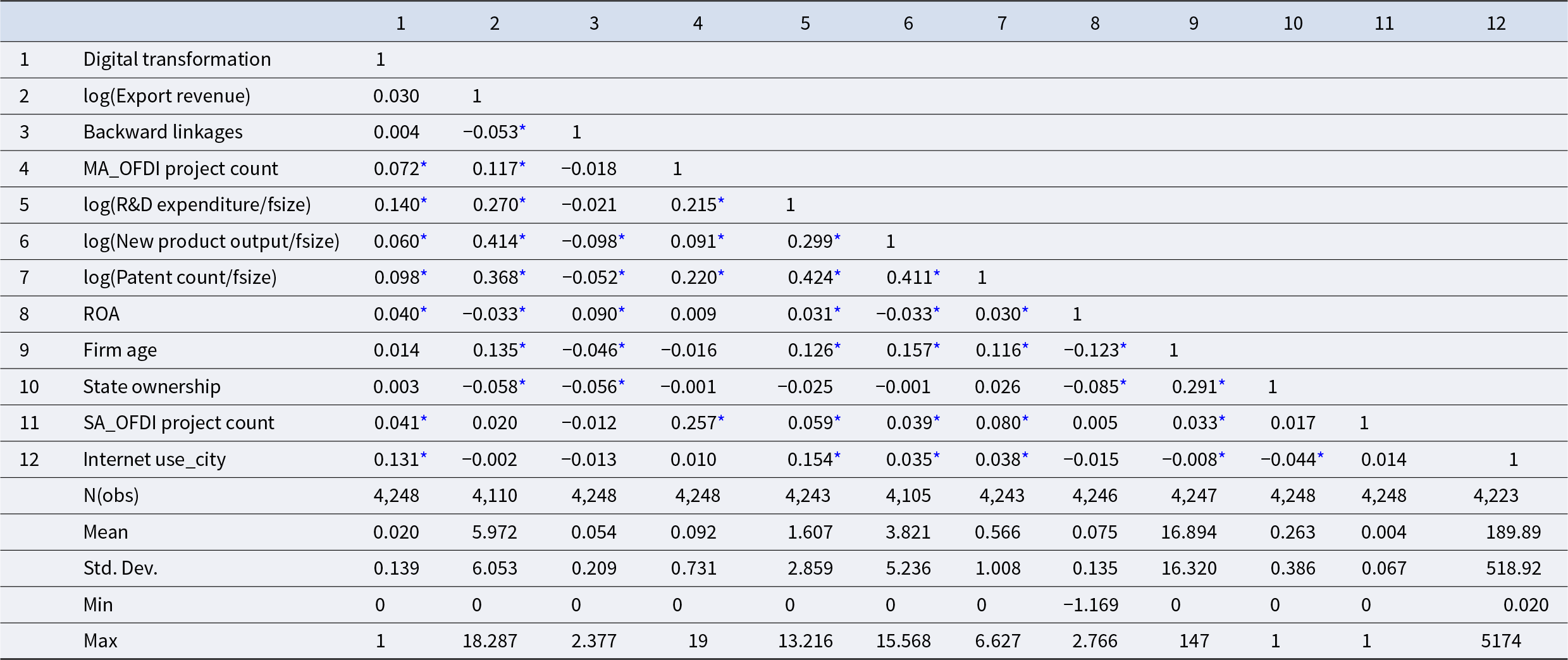
Table 2 presents descriptive statistics and a correlation matrix of the study. Besides patent count and R&D expenditure, I do not detect high correlations among variables. Nevertheless, patent count and R&D expenditure are alternative measures of the same construct, dynamic capabilities, so they will never enter the same equation. The variance inflation factor obtained in the full models are between 1.58 and 2.98, which do not exceed the rule of thumb value. Hence, the concern of multicollinearity in this study is minimized.
Descriptive statistics and correlation matrix

* Note: p ≤ 0.05.
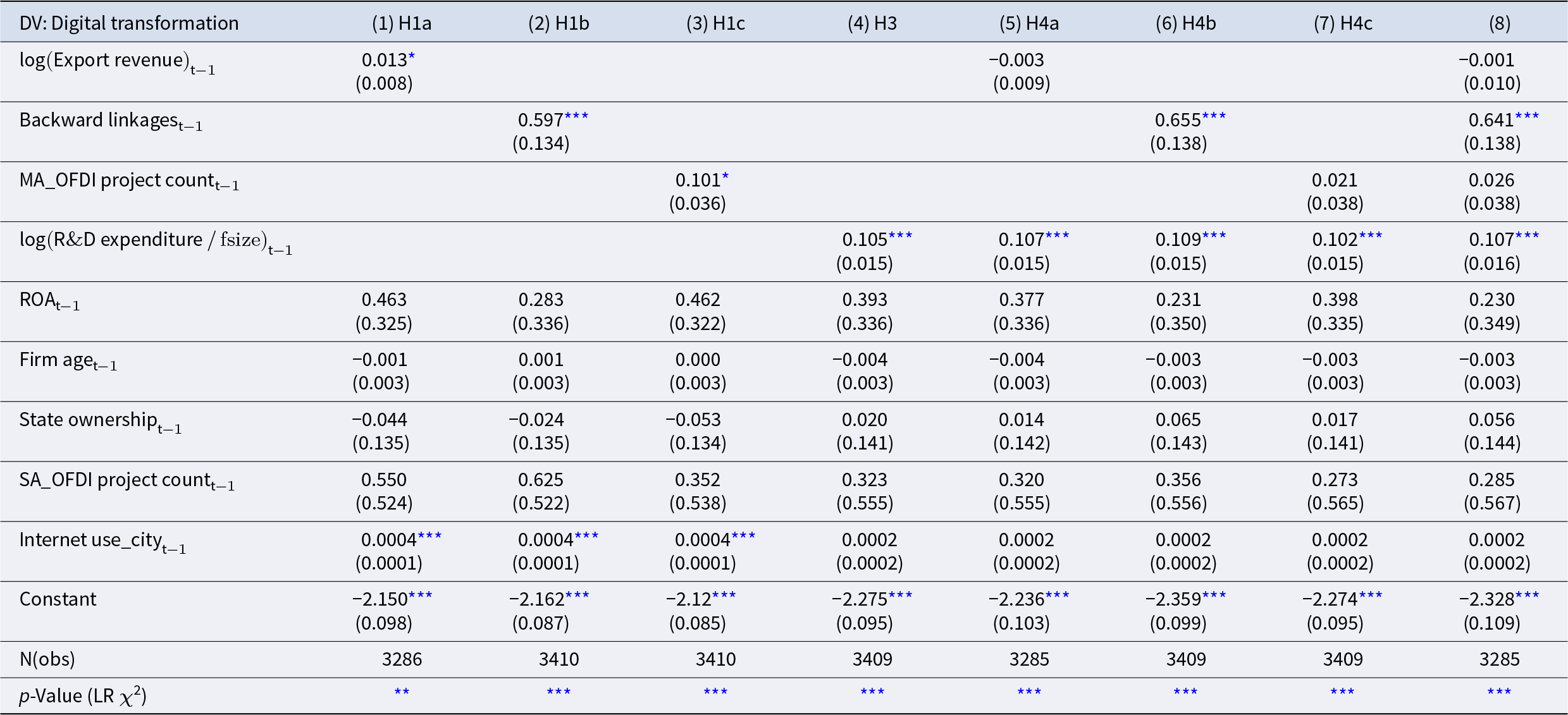
Table 3 reports the panel data probit model results using digital transformation as the dependent variable. According to the Hausman test, the random-effects model is more appropriate for the sample. I also compare model fit indexes, including the F-test for the fixed effect model and the Chi-square test for the random effect model, verifying random-effects model has a better goodness of fit. The independent variables and mediator are added in a sequence from models 1 to 3, allowing us to see the direct effects of internationalization and digital transformation. Models 4 to 7 add the mediator to each of the three internationalization measures, enabling us to observe how the direct effect changes when the mediator is introduced to the equation. Model 8 is the full model, including all variables.
The impact of internationalization on digital transformation (H1 series, H3, and H4 series)

* Notes: p ≤ 0.1; **p ≤ 0.05; ***p ≤ 0.01; Complying with innovation studies, we include t − 3 for R&D and find the results remain positive and significant 0.074*** (0.013).
H1 series predicts that internationalization activities have positive relationships with digital transformation. Model 1 in Table 3 shows that exporting has a positive and significant coefficient (p < 0.1). Similarly, models 2 and 3 present significantly positive coefficients of backward linkages (p < 0.01) and market-seeking OFDI (p < 0.1), respectively. Hence, the direct effects between internationalization and digital transformation in H1a, H1b, and H1c are supported.
H3 predicts dynamic capabilities as antecedents of digital transformation. Model 4 in Table 3 includes dynamic capabilities, measured by R&D expenditure adjusted by firm size, into the equation. Dynamic capabilities show a positive and significant coefficient (p < 0.01), increasing the likelihood of digital transformation by a factor of 0.072. Therefore, H3 is strongly supported. In model 5, dynamic capability as the mediator is added to the model with exporting. The results show that, when the mediator is introduced, exporting does not show a significant relationship with digital transformation. Internationalization via backward linkages, however, still presents a significantly positive coefficient (p < 0.01) in the model 6. Similar to the outcome of exporting, market-seeking OFDI exhibits a non-significant result in model 7. Model 8 includes all three types of internationalization activities and dynamic capabilities in the same model and yields a result with the same level of significance and sign as the hierarchical models. I, therefore, summarize that dynamic capabilities mediate the relationship between internationalization and digital transformation for exporting and market-seeking OFDI, but not for backward linkages. H4a and H4c are supported.
H2 series predict the direct effects of internationalization on dynamic capabilities. Similar to the regression results of digital transformation as the dependent variable, the Hausman test indicates that a random effect instead of a firm-level fixed effect model is more appropriate. All three types of internationalization activities show positive and significant impacts on dynamic capabilities according to Table 4. Hence, H2a, H2b, and H2c are supported. What is worth noticing is that backward linkages have marginal significance at the 0.1 level, indicating the relationship from backward linkages to dynamic capabilities is not as strong as other types of internationalization activities. A lack of significant impact from the independent variable to the mediator could mean a weak or no mediation effect.
The impact of internationalization on dynamic capabilities (H2 series)

* Notes: p ≤ 0.1; **p ≤ 0.05; ***p ≤ 0.01.
Furthermore, one interesting finding regarding the control variable strategic asset seeking is worth mentioning. For both the dependent variable being digital transformation and dynamic capabilities, strategic asset-seeking FDI does not show significance. In fact, strategic asset-seeking FDI shows a significantly negative coefficient in promoting patent count. These findings regarding strategic asset-seeking FDI indicate that, when market-seeking internationalization is present, strategic asset-seeking FDI is not a ‘must-have’ in augmenting the firm capabilities.
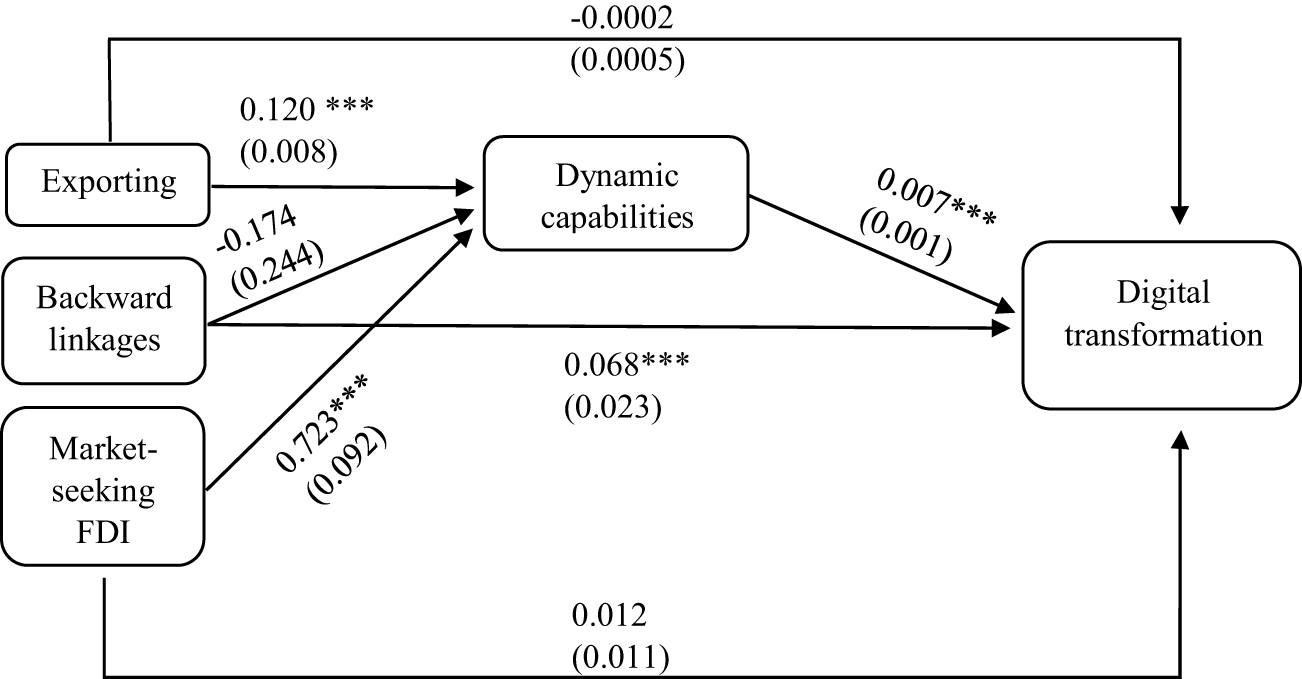
SEM Results
I further verify the mediation results using SEM path analysis shown in Table 5. The indirect effects (a*b) between internationalization and digital transformation are positive and significant for exporting (p < 0.01) and market-seeking OFDI (p < 0.01); meanwhile, the direct effects (c’) are not significant. Hence, dynamic capabilities completely mediate the relationship between internationalization and digital transformation for exporting and market-seeking OFDI. Conversely, for backward linkages, the direct effect (c’) is positive and significant (p < 0.01) while the indirect effect (a*b) is not. This indicates that dynamic capabilities do not mediate the relationship between backward linkages and digital transformation. Therefore, as it is shown in Figure 1, the findings using SEM are consistent with linear models, such that dynamic capabilities reveal full mediation on exporting (H4a) and market-seeking OFDI (H4c) but no mediation path for industry backward linkages (H4b). Moreover, using alternative dynamic capabilities measures in SEM, we find the same results in mediation type for each of the paths.
Mediation model

Mediation analysis using structural equation modeling (SEM)

* Notes: p ≤ 0.1; **p ≤ 0.05; ***p ≤ 0.01; Robust standard errors with 500 replications in bootstrapping; Alternative dynamic capabilities measures show the same results in mediation type for each of the paths.
Robustness Check
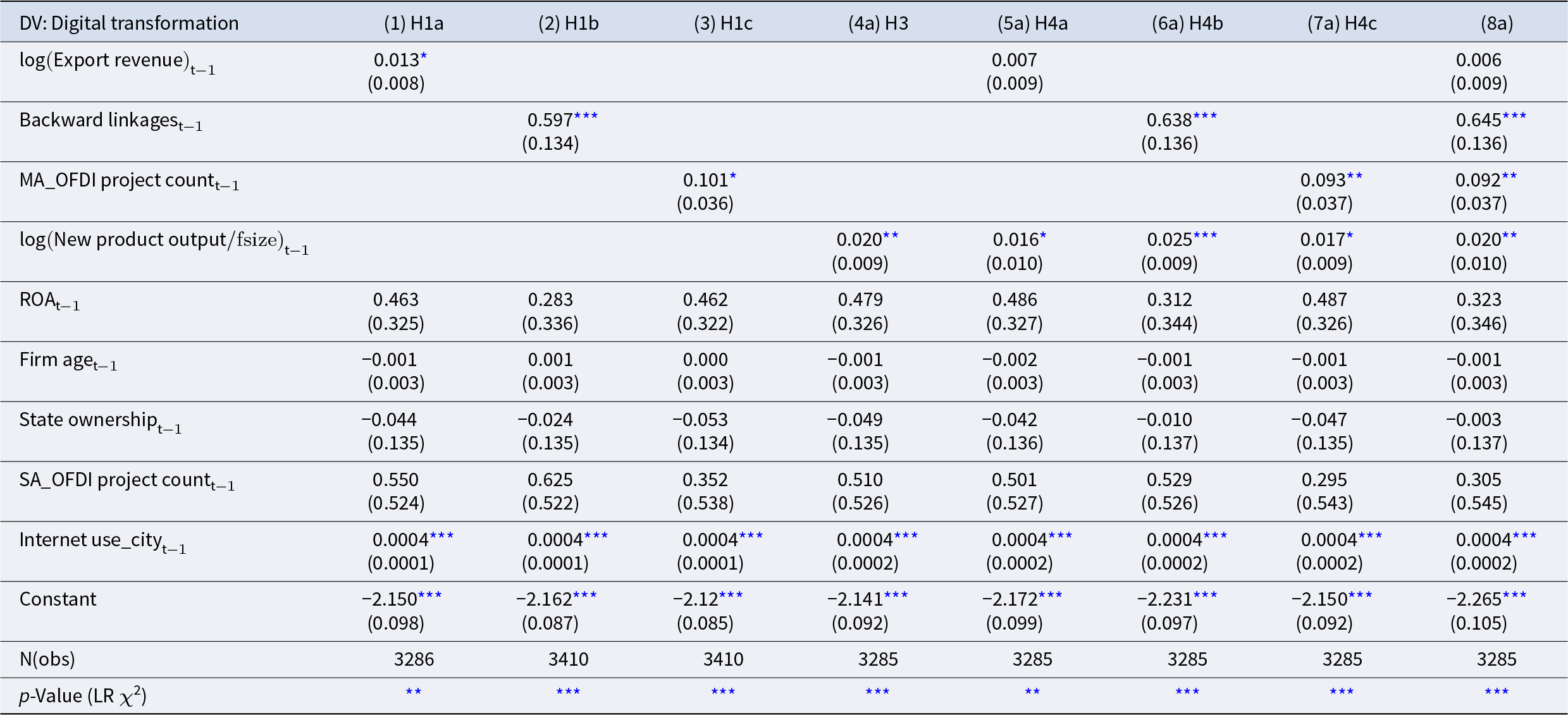
I use alternative measures to reflect dynamic capabilities, acknowledging the complexity of the construct. In particular, I use new product output and patent count as alternative measures. Table 6 presents the results of using alternative dynamic capabilities measures to test H1 series, H3 and H4 series using digital transformation as the dependent variable. When using either one of the alternative measures of dynamic capabilities, internationalization activities show the same level of significance and sign towards predicting digital transformation in direct effects. When either one of the measures is introduced to the model, the coefficients of exporting (model 5a and 5b), backward linkages (model 6a and 6b), and market-seeking OFDI (model 7a and 5b) show consistent results as in Table 3 using R&D expenditure as the dynamic capabilities measure.
Robustness check – H1 series, H3, and H4 series using alternative dynamic capabilities measures

* Notes: p ≤ 0.1; **p ≤ 0.05; ***p ≤ 0.01.
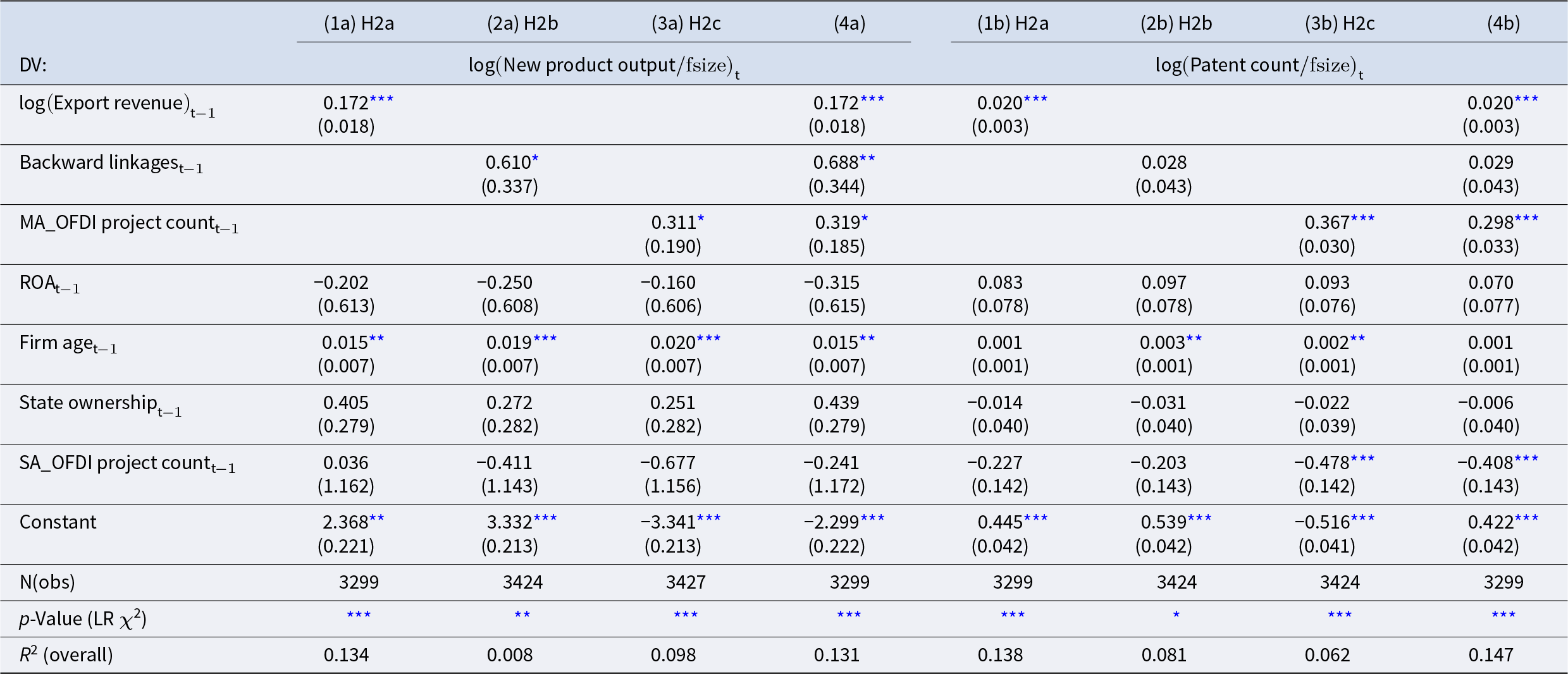
Table 7 conducts the robustness check for the H2 series using alternative dynamic capabilities measures. When using new product output in models 1a to 4a, I find the same consistent results as the main study in Table 4. I notice that, in model 2b, backward linkages are not significantly associated with dynamic capabilities building using patent count as the dynamic capabilities measure. However, this inconsistency echoes my findings regarding H4b, such that dynamic capabilities do not mediate the relationship between backward linkages and digital transformation.
Robustness check – internationalization on dynamic capabilities (H2 series) using alternative dynamic capabilities measures

* Notes: p ≤ 0.1; **p ≤ 0.05; ***p ≤ 0.01.
Furthermore, to alleviate the concerns of the reverse causality between internationalization and digital transformation, I conduct a robustness check using the Generalized Method of Moments (GMM) estimator. In the GMM models, I include the 1-year lag digital transformation outcome as an instrumental variable. Table 8 shows that the 1-year lag outcome variable is not significant, indicating that the sample is not a dynamic panel. Therefore, the previous year’s decision on digital transformation does not affect subsequent firm strategies. Combining the current GMM results with the SEM path analysis which also proves the proposed causal directions, I conclude that internationalization is the antecedent, rather than the outcome, of digital transformation in our sample. The diagnostic of the GMM model is tested by the Sargan and Arellano-Bond (AR) statistics. The Sargan test examines the exogeneity of the instrument variable with the null hypothesis being the instrument is exogenous. The results of the Sargan tests of the GMM models indicate that the null hypothesis is not rejected as all p-values are larger than 0.1, confirming that the instrument selected is not correlated with the error term and thus the model’s validity. The AR test verifies the autocorrelation condition in the GMM model. For autocorrelation of order 1, the null hypothesis of no autocorrelation is rejected but the null hypothesis for autocorrelation of order 2 is not rejected with p-values ranging between 0.52 and 0.93. Since I use 1-year lag of the dependent variable as the instrument, first-order correlation is required. Therefore, non-rejection of the null hypothesis in AR (2) supports the GMM model’s validity.
Robustness check – internationalization on digital transformation (H1 series) using GMM estimator

* Notes: p ≤ 0.1; **p ≤ 0.05; ***p ≤ 0.01.
Discussion
My findings largely support the general theory of the springboard perspective, such that internationalization facilitates firms to recognize the need to adapt to external changes and purposefully improve in-house capabilities, which is particularly important for firms from emerging markets to engage in major transformation to stay competitive. Firms appropriating international market opportunities can be more efficient in adapting to technological changes in the environment (Cui, Meyer, & Hu, Reference Cui, Meyer and Hu2014; Rui & Yip, Reference Rui and Yip2008). Compared to purely domestic firms, firms serving international markets are more likely to become the early responders to adopt digital technologies in the contemporary era when digital technologies are considered cutting-edge among all advances. More importantly, my findings point out the significance of the endogenous growth path leading to digital transformation, such that internationalizing firms go through the procedure of enhancing dynamic capabilities through active learning before incorporating a major change, digital transformation, in daily operation.
Regarding knowledge acquisition, the general theory of the springboard perspective offers two implications. First, knowledge acquisition can take place domestically via inward internationalization, namely through industry linkages with foreign MNEs at home. Second, market-seeking outward internationalization can be more impactful than the strategic asset-seeking counterpart in realizing transformation to adapt to the current digital era.
Among the three types of market-seeking internationalization activities, exporting and market-seeking outward FDI present the full mediation path via dynamic capabilities, while backward linkages show a direct path to digital transformation without relying on the influence of the mediator. I understand this as the value of knowledge spillovers in inward internationalization, facilitating the technological upgrade of local firms. Being a supplier to foreign MNEs allows local firms to receive ready-to-use knowledge-based resources to initiate the transformation. Hence, local suppliers might not be compelled to go through the deliberate learning process to reach the new height. What is worth noticing is that such ‘spoon feed’ mechanism has mixed findings as being a supplier to global flagship firms can result in capability lock-in – lack of motivation to upgrade, which has been documented in the literature of ‘capability lock-in’ in the smiling curve (Li, Li, & Shapiro, Reference Li, Li and Shapiro2012; Li, Sun, Huang, & Huang, Reference Li, Sun, Huang and Huang2020) and the middle-income trap regarding EMFs (Anand, McDermott, Mudambi, & Narula, Reference Anand, McDermott, Mudambi and Narula2021).
This research has the following policy implications. Managers with a global vision are more likely to lead the company with a successful ‘go digital’ experience. Internationalization is particularly important for EMFs as emerging markets are still catching up with the developed world in the GPTs relevant to digital transformation. Therefore, exposing a domestic business to foreign markets can facilitate the upgrading and transformation process. As for policymakers, we propose that an open economy in support of go-global shall advance a country’s firms’ competencies in the digital era faster than a closed economy.
Limitations and Future Research Directions
I acknowledge several limitations of this study and hope to point out future research directions accordingly. First, the findings might suffer from the generalizability issue since I use samples from a single country, although we are the pioneer in using large samples to test the digital transformation hypotheses. Upon more empirical evidence is available, future studies can combine and compare different country samples to further test the relationship between internationalization and digital transformation for go-digital firms. Future studies can also consider a wider selection of company types. I use Fortune 500 large manufacturing firms due to the limited evidence of digital transformation among small and medium-sized enterprises at the time of the study. Nevertheless, as time passes by, more firms with different characteristics might initiate digital transformation. Second, due to the dearth of empirical evidence on digital transformation, I use a dichotomous variable to represent companies’ development status related to digital transformation. Nevertheless, digital transformation and its antecedents (e.g., dynamic capabilities) are complex constructs that deserve further exploration of the steps and procedures; for example, we can gain more knowledge on firms’ digital transformation process by supplementing large samples with first-hand qualitative data and linking it to microfoundations. Third, the use of archival data disadvantages us in understanding details in terms of the digitalization-enabling dynamic capabilities. Future studies can attempt first-hand data to investigate the rich content regarding digital sensing, seizing, and transforming.
Conclusion
This article investigates how prior internationalization might stimulate EMFs’ digital transformation. I adopt the general theory of the springboard perspective, taking into consideration inward internationalization and market-seeking activities. My findings show that strategic asset-seeking OFDI is not the only springboard act. Other internationalization activities, including exporting, supplying global flagship firms and market-seeking OFDI, also strengthen the company’s competitive advantage. With the burgeoning of digital infrastructures at home and the protectionism of world leaders in digital technologies, EMFs’ path forward in Industry 4.0 is to serve international markets in various entry modes and adhere to the endogenous growth path.
Data availability statement
The data that support the findings of this study are available from the corresponding author, [YL], upon reasonable request.
Yuanyuan Li is an assistant professor of international business in the Department of Marketing, College of Business and Economics, California State University, Los Angeles. She received her PhD in management from Rutgers University. Her research focuses on strategies of emerging market multinational enterprises (EMNEs), technological innovation and institutions. She has published in Multinational Business Review, Small Business Economics, ZFW–Advances in Economic Geography, Transnational Corporations, and other outlets. She has also co-authored several book chapters published by Cognella Academic Publishing and Palgrave Macmillan.