An earthquake with a Richter scale magnitude of 8.1 occurred on April 25, 2015, in Nepal. The epicenter was located at Gorkha. As of May 13, 2015, the earthquake had killed at least 8219 people and injured an additional 17 866 people. The earthquake paralyzed 90% of the local health care system and social welfare institutions, and the United Nations Children's Fund stated that approximately 1.7 million children had lost their homes and loved ones and were facing the predicament of the lack of schools and medical treatment. 1
The Red Cross Society of China (RCSC) sent a medical team to Salyantar in Nepal (30 km away from the epicenter) to perform an international humanitarian relief mission; the medical team set up a field hospital in the affected area to perform medical assistance. To ensure maximal independence, the field hospital brought adequate medicines and auxiliary medical facilities. On May 6, 2015, the RCSC field hospital began to treat patients, and the first phase of assistance continued for 7 days. The hospital became a local comprehensive multidisciplinary medical center. This article summarizes the experiences and lessons in child rescue and treatment at the field hospital during this Nepal earthquake.
MATERIALS AND METHODS
Field Hospital Structure
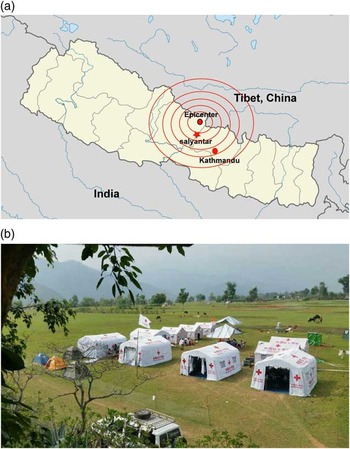
The field hospital was set up in a mountainous area 800 m above sea level and was constructed with inflatable tents (Figure 1). The medical rescue team sent by the RCSC was a Type 1 unit; according to the foreign medical team guideline issued by the World Health Organization,Reference Norton, Schreeb and Aitken 2 a Type 1 unit may perform triage and provide primary life support; initial surgical debridement and fracture basic management; outpatient daily treatment; therapeutic drugs for acute and chronic diseases; lab routine inspection, ultrasound diagnostic images, among other services. The hospital had six clinic areas, including internal medicine, surgery, orthopedics, pediatrics, obstetrics and gynecology, and auxiliary functions. The pediatrics clinic area had one examination bed and two observation and infusion beds.
Overview of Field Hospital Set Up by the Chinese Red Cross Medical Team. A. The field hospital was located in Salyantar, 30 km from the epicenter (shown as red star). B. Photograph of field hospital. The hospital had 6 clinic areas, including internal medicine, surgery, orthopedics, pediatrics, obstetrics and gynecology, and auxiliary functions.

Staff Composition
There were a total of 14 medical staff members, including 3 nurses, 1 ultrasound physician, 1 pharmacist, and 1 health and epidemic prevention professional. All medical staff members had obtained a medical practice certificate approved by the Nepalese government. The pediatrics group consisted of 1 pediatrician and 1 nurse. To maximize the utilization of the limited human resources, the orthopedic physician and surgeon also participated in the children’s rescue and treatment.
Medical Procedures
Children who were aged 18 years and younger were classified into the pediatric group. Each child patient was first examined for injury and was classified according to their major diagnostic symptoms into the pediatric, orthopedic, or surgical group. After the diagnosis and treatment were determined, the child patient took the prescription to the pharmacy. The medicine was distributed by a professional pharmacist, and the prescription was collected. No pediatric ward or night emergency ward was available.
Statistics
All the children who visited our hospital for diagnosis and treatment had an outpatient disease history form, the content of which included name, sex, age, address, hospital visiting method (walking, ambulance, or personal vehicle), chief complaint, diagnosis, and treatment suggestion. The form was collected by the professional pharmacist. The data and medical information for the present study were all obtained from this form.
RESULTS
During the first phase of the 7-day medical assistance by the RCSC field hospital, a total of 108 children were diagnosed and treated. Of these children, 59 (54.6%) were boys and 49 (45.4%) were girls; approximately 20 patients were diagnosed daily.
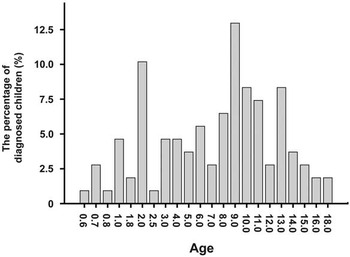
The youngest of the diagnosed children was 5 months old, and the oldest was 18 years old. Children aged 6 years and younger accounted for 40% of the total diagnosed pediatric patients, and children older than 6 years accounted for 60% of the total diagnosed pediatric patients. The percentage of diagnosed children in different age groups is shown in Figure 2.
Percentage of Diagnosed Children in Different Age Groups.

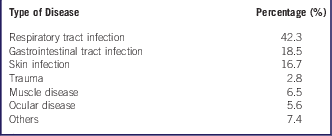
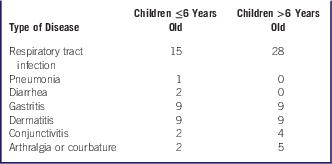
The earthquake-related traumas mainly required surgical dressing and debridement; these traumas accounted for 2.8% of total diagnoses for pediatric patients. No severe limb fractures or traumatic brain injuries were found. Infections of the respiratory tract, the gastrointestinal tract and the skin were the most common types of injury, accounting for 42.3%, 18.5%, and 16.7%, respectively, of the total treated patients. The composition ratios of the different types of diseases are shown in Table 1. An analysis of the common diseases in different age groups of children is shown in Table 2.
Composition Ratios of the Different Types of Disease in Total Diagnosed Child Patients

Types of Diseases Commonly Treated in Children of Different Age Groups

DISCUSSION
During this Nepal earthquake relief, the Red Cross Society of China dispatched a medical team to carry out work under the unified management and coordination of the Red Cross in Nepal. The main content of the rescue work was medical treatment, excluding site search and rescue. The first author of this article was mainly responsible for the medical treatment of children in the affected area. Compared with the 5 previous international disaster medical rescues in which the author participated with the China International Search and Rescue team, one of the prominent differences of this rescue was that all of the medical staff members of RCSC who performed this rescue in the earthquake-hit area had obtained a medical practice certificate approved by the government of the disaster-hit country. International Search and Rescue Advisory Group guidelines and methods clearly state that the medical staff members of the search and rescue team of any city must act within the scope of the medical practice defined by the medical practice qualifications obtained at the home country. 3 Therefore, the legality of the medical activities performed by the authors of this article in the disaster area was protected and recognized. The status and role of pediatricians in the medical rescue of international disasters is critically vital.Reference Wang, Sun and Miao 4
During the first phase, a total of 108 children were diagnosed and treated by the RCSC field hospital. Compared with medical rescues of similar types of international disasters in which the authors had participated previously, such as the earthquake that occurred in the North West Frontier province in Pakistan in 2005 and the Yogyakarta earthquake in Indonesia in 2006, the number of diagnosed children was significantly fewer.Reference Wang, Peng and Sun 5 The possible reasons may be that the field hospital was set up in a mountainous area whereas the people affected by the disaster were widely distributed, and the rescue and treatment could not be concentrated. Because of the unique geographic characteristics of the area, the primary method of visiting the hospital was by walking. Reaching the hospital for a diagnosis may have required up to 3 hours of walking, and an ambulance or personal vehicle was rarely available. Moreover, some victims of the disaster did not know the specific location of the RCSC field hospital or where to receive medical assistance. In addition, another possible reason for the low numbers was that severely injured children had been transferred to hospitals in the capital city or to local hospitals for treatment immediately after the disaster. Because the relatives of children with mild symptoms were busy searching for lost family members, drinking water, food, or shelter after the disaster, the treatment of these children was delayed.
The proportions of trauma types in our statistical results were different from those in previous literature reports. Xiang et alReference Xiang, Liu and Li 6 reported that in the 2008 Wenchuan earthquake, children’s traumas mainly manifested as osteoarticular injuries, which accounted for 81% of the total number of injuries in children with trauma. Traumas from that earthquake mainly included fractures in the limbs, pelvis, and spine, whereas craniocerebral trauma, thoracic trauma, and abdominal trauma were relatively rare. Alon et alReference Alon, Amit and Itzhac 7 reported that among the 272 children who were admitted and treated by the Israel field hospital in the 2010 Haiti earthquake, 57% displayed trauma that was directly caused by the earthquake. In the first 3 days after the hospital opened its doors, 80% of the pediatric patients had osteoarticular injuries, which were mainly fractures, open wounds, and crush injuries. Similar injuries were also observed in the 1999 Turkey earthquake.Reference Bulut, Fedakar and Akkose 8
Infectious diseases contributed the greatest number of disease cases in our statistical data, accounting for 77.5% of the total number of conditions diagnosed in pediatric patients. The RCSC field hospital opened its door on May 6, 2015. The first phase lasted for 7 days and encompassed the second to third weeks after the earthquake. In terms of the types of injuries and diseases of the children, the medical need changed from satisfying earthquake-related diseases to the rescue and treatment of relevant diseases that were induced by the environmental changes caused by the disaster. 9 During this stage, sanitary conditions, crowded shelters, and contaminated food and water were the major causes of infection, which was frequently found in the gastrointestinal tract, the skin, and the respiratory tract.Reference Ding, Fan and Yu 10 The study of the children’s disease profile in the earthquake found that a balance between earthquake-related diseases and non–earthquake-related disease was reached the second week after the disaster, whereas between the third and fourth weeks, non–earthquake-related diseases dominated. Guha-Sapir and van PanhuisReference Guha-Sapir and van Panhuis 11 reported that between the third and fourth weeks after the 2004 Indian Ocean tsunami, infectious diseases, mainly respiratory and gastrointestinal infections, accounted for 53% of the total number of diagnoses in children. Therefore, when experts develop a rescue plan and arrange the medical resources, they should consider the need to address non–disaster-related diseases.
Other types of diseases that we surveyed included epilepsy, anemia, malnutrition, cerebral palsy, delayed growth and development, and other chronic diseases; these diseases accounted for 7.4% of the total diagnoses in children. A possible explanation for this proportion was the relative decline of earthquake-related diseases; moreover, because of the paralysis of local medical institutions, regular treatment was interrupted. Thus, these patients came to our hospital for treatment.Reference Alon, Amit and Itzhac 7
The 108 children who came to our hospital for treatment encompassed all age groups; 44 children (41%) were younger than school age, and 64 children (59%) were school aged. The data in the present group show that the proportion of children at different ages was essentially identical to that of the non–earthquake-related disease profile. These data indicated that earthquakes can affect children in every age group, and children are one of the most vulnerable populations to earthquake injury.Reference Wang, Peng and Liu 12
A language barrier is one of the most common difficulties in the medical rescue of international disasters. The RCSC field hospital was placed in a mountainous area; even with the help of local volunteers, some important medical information and previous disease histories were still inevitably lost. The epidemiologic investigation of the children’s diseases after the disaster faced challenges, and diagnosis and treatment mainly relied on careful physical examination and auxiliary examinations by the rescue staff members. The assistance of volunteers is necessary in a rescue, but it cannot replace the loss of medical information.
In this rescue mission, the medical rescue team of RCSC lacked a professional anesthetist; therefore, the treatment of trauma was limited to debridement and dressing. Because of the lack of a well-equipped operation room and related equipment, surgical operations could not be completed independently in the field hospital. In addition, vaccination was another challenge faced by this rescue mission. For international disaster medical rescues, the type, quantity, transportation, and storage of vaccines is a project requiring in-depth study to prepare for scenarios in which we face similar disaster rescues in the future.
Funding
This work was supported by grants from Major Projects of the National Health and Family Planning Commission of China (201302003), Key Program of National Natural Science Foundation of China (71533008), Tianjin Natural Science Foundation of China (15JCYBJC28500), and Tianjin Key Technology Research and Development Program (12ZCZDSF00700). The funders had no role in study design, data collection and analysis, decision to publish, or preparation of the manuscript.