This article focuses on the production of English main and embedded clause questions as a means of investigating the role of the syntactic properties of the first language (L1) and the target language (second language [L2]) on the production of adult L2 speakers.
In English main clause questions, an auxiliary verb precedes the subject, as shown in (1)–(2), whereas in embedded clause questions, the relative order of the subject and the auxiliary is the same as in declarative clauses, as shown in (3)–(4):
(1) What are you eating?
(2) Are you eating pizza?Footnote 1
(3) Mary doesn't know what he is eating.
(4) Mary doesn't know if he is eating pizza.
The phenomenon in (1) and (2) is known in the early generative literature as subject–auxiliary inversion, which indicates that the relative surface order of the subject and the auxiliary is “inverted” compared to that of declarative clauses. In the more recent generative literature, the phenomenon in (1) and (2) is known as T-to-C movement, which refers to the (hypothesized) movement of a tense-bearing element from the head of the tense phrase (TP) to the head of the complementizer phrase (CP). For simplicity, we will refer to the phenomena in (1)–(2) as inversion and in (3)–(4) as noninversion.
Productions of main and embedded clause questions in which the relative order of the subject and the auxiliary is not targetlike (as in (5) and (6), respectively) will be referred to as inversion errors.
(5) *Why you are laughing?
(6) *Do you know what is she bringing?
Inversion errors in the speech of young children learning English as their L1 have been documented from the first days of modern developmental psycholinguistics (e.g., Brown, Reference Brown1968; Klima & Bellugi, Reference Klima, Bellugi, Lyons and Wales1966). This error is often long lasting, and children's performance is nonadultlike until age 5 or 6 (Ambridge, Rowland, Theakston, & Tomasello, Reference Ambridge, Rowland, Theakston and Tomasello2006; Thornton, Reference Thornton2008). The sources of these errors are controversial, and children's production of interrogative structures has been shown to be affected by a number of factors, among which are the presence of negation (Erreich, Reference Erreich1984; Guasti, Thornton, & Wexler, Reference Guasti, Thornton, Wexler, MacLaughlin and McEwen1995), the syntax of the question being produced (wh- vs. yes/no, see Bellugi, Reference Bellugi, Huxley and Ingram1971; Rowland & Pine, Reference Rowland and Pine2000), the type of auxiliary (Santelmann, Berk, Austin, Somashekar, & Lust, Reference Santelmann, Berk, Austin, Somashekar and Lust2002; Stromswold, Reference Stromswold1990) and wh-word present in the structure (de Villiers, Reference de Villiers, Maxfield and Plunkett1991; Stromswold, Reference Stromswold1990; Thornton, Reference Thornton2008), and the frequency of specific combinations of wh-words and auxiliaries in the adult input (Ambridge et al., Reference Ambridge, Rowland, Theakston and Tomasello2006).
Albeit far less studied, inversion errors in embedded clause questions have also been reported in the spontaneous speech of English-speaking children of about the same age (Stromswold, Reference Stromswold1990; but see Sarma, Reference Sarma1991, for a different finding in elicited production), perhaps indicating that children have trouble not with subject–auxiliary inversion or movement per se, but with the conditions under which inversion should and should not apply.
Persistent inversion errors in the production of English questions by child and adult L2 learners of English have also been reported in the literature, and a number of factors have been claimed to affect inversion rates in production and acceptability rates of inverted and noninverted questions. For example, it has been suggested that L2 learners’ inversion rates in main clause questions are affected by the syntax of their L1 (Jackson, Reference Jackson and Fisiak1981; McDonald, Reference McDonald2000; Spada & Lightbown, Reference Spada and Lightbown1999; Zobl, Reference Zobl, Gass and Selinker1992), the syntax of the question being produced (yes/no vs. wh-, Eckman, Moravcsik, & Wirth, Reference Eckman, Moravscik and Wirth1989; Pienemann, Johnston, & Brindley, Reference Pienemann, Johnston and Brindley1988), and the type of wh-word present in the structure (e.g., argument vs. adjunct; see Lee, Reference Lee2008). The individual contribution of these factors, however, has yet to be systematically investigated.
In this study, we investigate the extent to which inversion errors in the production of English questions by L2 speakers are a product of the syntax of their native language. In addition, we investigate the extent to which, on par with children acquiring an L1, L2 learners’ production is affected by properties of the target language, such as the structure of the question they are producing (wh- vs. yes/no) and the presence of individual wh-words.
THE ROLE OF L1 PROPERTIES: CHINESE VERSUS SPANISH
The first goal of this study was to investigate the extent to which L2 learners’ nontarget subject–auxiliary inversion patterns can be attributed to properties of their L1.
Conflicting findings in the literature have been reported with respect to the influence of L1 on L2 word order in production. Although some studies have reported an effect of L1 on word order (e.g., Zobl, Reference Zobl1982), others do not find this effect, but rather posit an effect of universal principles (Fathman & LoCoco, Reference Fathman, LoCoco, Dechert and Raupach1989; Rutherford, Reference Rutherford, Gass and Selinker1983; but see Odlin, Reference Odlin, VanPatten and Lee1990, for the opposite claim).
With respect to L1 effects on interrogative word order, in particular, Johnston's (Reference Johnston1985) seminal cross-sectional study of 16 adult L2 learners of English provided some evidence for the existence of L1-independent, fixed developmental stages in the acquisition of English questions. However, evidence that L2 learners might transfer L1 properties to their production of English main clause questions comes from Zobl's (Reference Zobl1979, Reference Zobl1995) and Spada and Lightbown's (Reference Spada and Lightbown1999) findings with L1 French L2 learners of English. These studies showed that noninverted questions were more likely to be accepted and produced when the subject was a full NP than when it was a pronoun. Inverted questions, however, were more likely to be produced and considered grammatical when the subject was a pronoun. Given that (stylistic) inversion in French is only possible with pronouns, this result suggested that L2 learners apply properties of French questions to English. However, in the absence of a comparison group (i.e., L2 speakers whose L1 properties differed from French and English) and in light of similar findings for the interlanguage grammar of a speaker whose L1 (Turkish) and L2 (German) do not display a word-order asymmetry for pronouns and full NPs (see Schwartz & Sprouse, Reference Suñer1994), this result cannot be unequivocally attributed to L1 transfer. Similarly, McDonald (Reference McDonald2000) found that L1 Vietnamese earlyFootnote 2 L2 acquirers of English had difficulty with aspects of English syntax that differ from Vietnamese, one of which is the syntax of main clause wh-questions, whereas early L1 Spanish learners’ performance was indistinguishable from that of native speakers, suggesting that structural similarities between the syntax of the L1 and the L2 have a significant effect on L2 mastery even for early acquirers.
At present, little is known about the acquisition of English embedded clause questions in general and the effect of L1 on word-order errors in these structures in particular. Nontarget word order in embedded clause questions has been reported for L2 adult learners of English with L1 backgrounds as different as Polish and Vietnamese (Johnston, Reference Johnston1985), Hebrew (Bley-Vroman, Reference Bley-Vroman1997), Indonesian, Korean, and Chinese (Mackey, Pienemann, & Doughty, Reference Mackey, Pienemann and Doughty1992), Chinese (Finegan, Reference Finegan1999), Spanish (Escutia, Reference Escutia2002), Russian (Markman, Reference Markman, Chang and Haynie2008), and Persian (Youhanaee, Reference Youhanaee2007), but these data are mainly based on anecdotal reports from very few speakers and productions, and the phenomenon has yet to be quantified. Although adult L2 learners and monolingual children learning English as their L1 have both been reported to produce inversion errors in English embedded clause questions, Argyri and Sorace (Reference Argyri and Sorace2007) found that 8-year-old English–Greek bilingual children were at ceiling in their production and acceptability judgments of English embedded what-questions, indicating that difficulties with word order in this structure might be confined to young children and late bilinguals/L2 learners.
In order to systematically explore the role of L1 transfer on English questions, we set out to study the production of main and embedded clause questions in intermediate/advanced L2 learners of English whose L1 was either Spanish or Chinese.Footnote 3 We chose to focus on intermediate/advanced learners because, Although most L2 acquisition frameworks assume some influence of the native language at initial stages of proficiency, the degree to which interlanguage grammars of more advanced learners are affected by L1 properties is less clearly understood.Footnote 4 In addition, given that embedded clauses are “a fairly good index of overall structural sophistication” (Johnston, Reference Johnston1985, p. 245), learners who could reliably produce such structures were needed.
We chose L1 Spanish and Chinese learners because these two languages differ from English and from each other in terms of the order in which subjects and verbs appear in questions. In Spanish main and embedded clause questions, the subject follows the main auxiliary (when present) and the main lexical verb; wh-elements, if present, are placed clause initially. This phenomenon has traditionally been analyzed in terms of subject–verb inversion, or T-to-C movement (Torrego, Reference Torrego1984; Zagona, Reference Zagona2000; see Rizzi, Reference Rizzi, Cinque and Salvi2001, 2006, for an analogous analysis of Italian interrogative structures).Footnote 5 However, Although inversion is obligatory with argument wh-words, as in (7), it has been argued to be optional in some adjunct wh-questions, as in (9) and (15) below (see Torrego, Reference Torrego1984, among othersFootnote 6), and in yes/no questions, as in (11) and (17). The details of competing syntactic proposals for word-order phenomena in Spanish (and Romance languages in general) are complex and controversial, but for the purposes of this paper two facts are crucial and well accepted: In Spanish interrogative clauses, the tense-bearing verbal element (the main auxiliary, when present, or the main lexical verb) can always precede the subject and there is no word-order asymmetry between main and embedded interrogative clauses. In contrast, in Chinese, the verb can never precede the subject, in either main, (8), (10), and (12), or embedded contexts, (14), (16), and (18); wh-elements, if present, appear in the same position as their non-wh counterpart (i.e., Chinese displays no overt wh-movement). The word-order patterns for Spanish and Chinese interrogative structures are summarized in the following:
Main Clause Questions:
Question Type: Wh-argument
Spanish word order: wh- + verb + subject
(7) ¿Qué (*Maria) comió Maria?
What (*Maria) ate Maria
What did Maria eat?
Chinese word order: subject + verb + wh-
(8) Bīng chīle (*Bīng) shénme?
Bing ate what
What did Bing eat?
Question Type: Wh-adjunct
Spanish word order: wh- + (subject) + verb + (subject)
(9) ¿Porqué (Maria) lloró (Maria)?
Why (Maria) cried Maria
Why did Maria cry?
Chinese word order: subject + verb + wh-
(10) Wèishénme Bīng kūle (*Bīng)?
Why Bing cried (*Bing)
Why did Bing cry?
Question Type: Yes/no
Spanish word order: (subject) + verb + (subject)
(11) ¿(Maria) Comió (Maria)?
(Maria) ate (Maria)
Did Mary eat?
Chinese word order: subject + verb
(12) Bīng chīle (*Bīng) ma?
Bing ate (*Bing) Q-particle
Did Bing eat?
Embedded Clause Questions:
Question Type: Wh-argument
Spanish word order: wh- + verb + subject
(13) Hector quiere saber qué (*Maria) comió Maria.
Hector wants to know what (*Maria) ate Maria
Hector wants to know what Maria ate.
Chinese word order: subject + verb + wh-
(14) Jiéxī xiăng zhīdào Bīng chīle shénme.
Jessie wants to know Bing ate (*Bing) what
Jessie wants to know what Bing ate.
Question Type: Wh-adjunct
Spanish word order: Wh- + (subject) + verb + (subject)
(15) Hector quiere saber porqué (Maria) lloró (Maria).
Hector wants to know why cried Maria
Hector wants to know why Maria cried.
Chinese word order: subject + verb + wh-
(16) Jiéxī xiǎng zhīdào wèishénme Bīng kūle (*Bīng).
Jessie wants to know why Bing cried (*Bing).
Jessie wants to know why Bing cried.
Question Type: Yes/no
Spanish word order: (subject) + verb + (subject)
(17) Hector quiere saber si (Maria) comió (Maria).
Hector wants to know if (Maria) ate Maria
Hector wants to know if Maria ate.
Chinese word order: subject + verb
(18) Jiéxī xiǎng zhidào Bīng
Bing chīle (*Bīng) ma?
Jessie wants to know Bing ate (*Bing) Q-particle
Jessie wants to know if Bing ate.
Theories of L2 acquisition make different predictions with respect to the acquisition of English questions by native speakers of Spanish or Chinese, given the different syntactic properties of these two languages exemplified above.
If L2 learners at intermediate/advanced levels of proficiency do not transfer properties of their native languages to their L2, no systematic differences in terms of word order are expected between the two experimental groups. This prediction is compatible with accounts that do not assume L1 transfer to L2 in general (e.g., see, Epstein, Flynn, & Martohardjono, Reference Epstein, Flynn and Martohardjono1996) and with accounts that do not assume L1 transfer of functional categories (see minimal trees hypothesis, Vainikka & Young-Scholten, Reference Vainikka, Young-Scholten, Hoekstra and Schwartz1994, Reference Vainikka and Young-Scholten1996; organic grammar, Vainikka & Young-Scholten, Reference Vainikka, Young-Scholten, Unsworth, Parodi, Sorace and Young-Scholten2005, Reference Vainikka and Young-Scholten2011) or feature strength (see valueless features hypothesis, Eubank, Reference Eubank1993, Reference Eubank1996).
In contrast, if L2 learners at intermediate/advanced levels of proficiency do transfer word-order properties from their L1 to their L2, the production profiles of native speakers of Spanish and Chinese should differ from each other. This prediction is, in very general terms, compatible with accounts that grant a role for L1 transfer throughout L2 development, whether ultimate attainment of L2 features not instantiated in the L1 is hypothesized to be possible with adequate exposure to positive evidence (see full transfer/full access hypothesis, Schwartz, Reference Schwartz1998; Schwartz and Sprouse, Reference Schwartz and Sprouse1996; feature assembly hypothesis, Lardiere, Reference Lardiere2007, Reference Lardiere, Liceras, Zobl and Goodluck2008, Reference Lardiere2009) or whether L2 grammars are hypothesized to be permanently constrained by the native language (see full transfer/no access hypothesis, Bley-Vroman, Reference Bley-Vroman1990; Schachter, Reference Schachter1990; representational deficit hypothesis, Hawkins, Reference Hawkins2003; Hawkins & Hattori, Reference Hawkins and Hattori2006; Tsimpli, Reference Tsimpli2003; Tsimpli & Dimitrakopoulou, Reference Tsimpli and Dimitrakopoulou2007). With respect to the direction of this difference between production profiles, L1 Spanish learners of English are expected to produce higher rates of targetlike main clause questions,Footnote 7 given that Spanish main clause questions resemble English ones in that the tense-bearing element can always precede the subject. With respect to embedded clause questions, in contrast, L1 Chinese learners are expected to produce higher rates of target noninverted structures than are L1 Spanish speakers, given that Chinese resembles English in only allowing declarative word order in embedded clause questions.
THE ROLE OF L2 PROPERTIES: SYNTACTIC STRUCTURE AND WH-WORDS
The second goal of this study was that of investigating the extent to which L2 learners’ nontarget inversion patterns are affected by properties of (some of the) linguistic elements of the target language, that is, syntactic structure (yes/no vs. wh-questions) and wh-words.
Syntactic structure (yes/no vs. Wh-questions)
The materials in this study prompted speakers to produce both yes/no and wh-questions. The reason for this was twofold: First, main yes/no questions without inversion are grammatical, albeit marked, in Standard EnglishFootnote 8; the existence of pragmatically governed contexts in which noninverted yes/no questions are grammatical in the L2 input might lead learners to hypothesize that inversion is optional in English yes/no questions.
Second, a number of studies in the L1 acquisition literature have found that inverted yes/no questions appear earlier than do inverted wh-questions in development (Klima & Bellugi, Reference Klima, Bellugi, Lyons and Wales1966) and that yes/no questions tend to be associated with higher accuracy and inversion rates than do wh-questions (Bellugi, Reference Bellugi, Huxley and Ingram1971; Klima & Bellugi, Reference Klima, Bellugi, Lyons and Wales1966; Kuczaj & Brannick, Reference Kuczaj and Brannick1979; Rowland, Reference Rowland2007). These findings have traditionally been attributed to either structural or saliency factors. For example, Bellugi (Reference Bellugi, Huxley and Ingram1971) famously proposed that the higher rates of noninversion errors found in wh-questions result from the fact that wh-questions involve two movement chains (one for the wh-element, one for the auxiliary) and are thus more complex than yes/no questions, which involve only one chain (for the moved auxiliary). In addition, Gleitman, Newport, and Gleitman (Reference Gleitman, Newport and Gleitman1984) noted that auxiliaries are particularly salient in yes/no questions because they appear in sentence-initial position and hence cannot be contracted, whereas in wh-questions auxiliaries are never sentence initial and are often contracted.
As for L2 acquisition of questions, a number of researchers (e.g., Pienemann & Johnston, Reference Pienemann, Johnston and Nunan1987; Youhanaee, Reference Youhanaee2007) have found that the acquisition of word order in yes/no questions precedes that in wh-questions. However, just as in the L1 literature, this result is controversial: Eckman et al. (Reference Eckman, Moravscik and Wirth1989) report the opposite finding, whereas White, Spada, Lightbown, and Ranta (Reference White, Spada, Lightbown and Ranta1991) found no significant differences in inversion rates between yes/no and wh-questions. Eckman et al. interpreted their results as evidence in favor of the hypothesis that interlanguage grammars respect linguistic universals, given the existence of an implicational universal according to which, if a language has verb–subject order in yes/no questions, it will also have it in wh-questions, but not vice versa (Greenberg, Reference Greenberg and Greenberg1963).
The findings concerning the existence of differences in terms of accuracy and inversion rates between yes/no and wh-questions in the L2 literature are inconclusive at best. This study aimed at contributing further experimental evidence to the debate by manipulating this factor within participants and items and by presenting our participants with a sizable number of tokens (16 per experimental condition).
We predicted that if L2 learners’ grammars are sensitive to properties of the target language, L1 Spanish and L1 Chinese learners should invert more in yes/no than in wh-questions, given the added complexity and the lack of saliency of the auxiliary in wh-structures. Conversely, if learners’ grammars are subject to the same constraints that result in a universal implicational relationship between wh-questions and yes/no questions, we might expect to replicate Eckman et al.'s (Reference Eckman, Moravscik and Wirth1989) finding that learners invert more in wh-questions than in yes/no questions.
In the present study, we also investigate the role of syntactic structure in embedded contexts. The reason is again twofold. Initial evidence for the existence of an asymmetry in L1 acquisition between yes/no and wh-questions in embedded contexts comes from Stromswold's (Reference Stromswold1990) study, which found that children overgeneralize inversion to embedded wh-questions, whereas the error is absent in yes/no contexts. Although the acquisition of embedded clause questions in L2 English has received scarce attention in the literature, it is worth noting that none of the sources that mention the existence of inversion errors in embedded interrogatives reports errors for yes/no structures. A similar asymmetry between yes/no and wh-contexts is present in nonstandard varieties of English (e.g., African American Vernacular English, Scottish English, Hiberno English, and Appalachian English, among others) that allow subject–auxiliary inversion in embedded contexts: although inversion in embedded wh-questions is always possible (see (19)), it is only available in embedded yes/no questions when the complementizer if is absent (Filppula, Reference Filppula1999; Green, Reference Green2002; Henry, Reference Henry1995; Labov, Reference Labov1972),Footnote 9 as the contrast between (20) and (21) shows:
(19) The police couldn't establish who had they beaten up. (McCloskey, Reference McCloskey, Zanuttini, Campos, Herburger and Portner1992, p. 16)
(20) I wondered had they read the book. (Henry, Reference Henry1995, p. 110)
(21) *I wondered if had they read the book. (Henry, Reference Henry1995, p. 110)
(22) I wondered if they had read the book. (Henry, Reference Henry1995, p. 110)
One explanation put forth in the literature (e.g., Filppula, Reference Filppula1999) is that in embedded wh-questions the head of the CP is not filled by any overt element, whereas in embedded yes/no questions this position is filled by if. Given that the CP is arguably the goal of the movement of the tensed auxiliary, this movement is blocked when it is filled by if, making inversion in embedded yes/no questions impossible.
We predicted that, if embedded inversion in L2 learners’ grammars is to be considered a learner phenomenon, subject to the same constraints as L1 acquisition and dialectal variation, it should occur in the production of both L1 Chinese and L1 Spanish learners and should be restricted to wh-contexts.
Wh-Words
The materials in this study prompted speakers to produce wh-questions in which the wh-word was either an argument or an adjunct because previous research has shown that the type of wh-word has an effect on the L1 and L2 acquisition of English interrogatives.
A number of studies focusing on the L1 acquisition of English main clause questions have found that most argument wh-words (e.g., what, who) tend to be acquired earlier than some adjunct wh-words (e.g., why, when) and are associated with higher accuracy (e.g., Sarma, Reference Sarma1991; Stromswold, Reference Stromswold1990): What is generally the first wh-word to be used correctly (Bloom, Merkin, & Wooten, Reference Bloom, Merkin and Wooten1982), whereas why, which is acquired later, is associated with exceptionally low inversion rates (e.g., Berk, Reference Berk, Beachley, Brown and Conlin2003, de Villiers, Reference de Villiers, Maxfield and Plunkett1991; Labov & Labov, Reference Labov, Labov, Campbell and Smith1978; Rowland & Pine, Reference Rowland and Pine2000; Thornton, Reference Thornton, Brugos, Micciulla and Smith2004, Reference Thornton2008).Footnote 10 Some researchers attribute these findings to the particular semantics of why (e.g., Kay, Reference Kay1980) and its similarity to how come (Berk, Reference Berk, Beachley, Brown and Conlin2003), which does not trigger inversion. Although why might require a more complex answer than other wh-elements, it is unclear how this accounts in a direct way for differences in inversion rates. That is, it is unclear how semantic complexity interferes with a syntactic operation such as subject–auxiliary inversion. In addition, if learners initially assume that why behaves like how come, one would expect their inversion rates in learners’ productions to overlap, that is, they should never invert or invert to a similar extent, contrary to fact (Kuczaj & Brannick, Reference Kuczaj and Brannick1979; Stromswold, Reference Stromswold1990). In a different vein, Thornton (Reference Thornton2008) proposed that why in English child grammar behaves like its adult Italian counterpart, perché. Footnote 11 As opposed to other wh-words, both elements are compatible with contrastive focus elements, can be followed by topic phrases, and do not consistently require inversion. Following Rizzi (Reference Rizzi, Cinque and Salvi2001), Thornton proposes that, in child English, why can be optionally base generated in the specifier of an interrogative phrase. The interrogative phrase is located higher than CP in the structure and is endowed with a [+wh] interrogative feature, thus blocking movement of the [+wh] auxiliary to C. Alternatively, why can also be base generated in TP and move to the specifier of the focus phrase, thus requiring T-to-C movement of the auxiliary.
In the L2 literature, there is some initial evidence pointing to the existence of an asymmetry between argument and adjunct wh-words. Haznedar (Reference Haznedar2003) studied the acquisition of inversion in the spontaneous production of a Turkish-speaking child learning English at age 4 and found inversion rates to be higher for what, who, and where than for which, how, and why. With respect to the order of appearance of different wh-elements, children learning English as an L2 seem to acquire arguments what and who before adjuncts why and when (Felix, Reference Felix1976; Lightbown, Reference Lightbown and Paradis1978; Park, Reference Park2000), whereas the status of where and how is less clear. Spada and Lightbown (Reference Spada and Lightbown1999) investigated the acquisition of English questions by L1 French child L2 learners of English for different wh-words via a series of tasks (oral production, a scrambled questions task, and a preference task). In the scrambled questions task, percentages of inversion were similar for what and where and lower for when and how. In the preference task, participants accepted ungrammatical–noninverted what and why questions more often than grammatical ones, although they did not seem to show a clear preference in the case of where and when questions.
Finally, Lee (Reference Lee2008) conducted a grammaticality judgment study with adult L1 Korean L2 learners of English to see whether, in line with findings for children learning English as their L1, English L2 learners’ inversion rates would be influenced by the argument–adjunct status of wh-words. What and who were used as arguments and how and why as adjuncts. No argument–adjunct asymmetry was found for inverted questions, whereas a crucial asymmetry for the learners was found in noninverted questions; specifically, noninverted adjunct questions were considered more acceptable than noninverted argument questions.
As we have seen above, the L1 literature has shown that children tend to produce more inversion errors in main adjunct questions, and in why-questions in particular; this topic has received less attention in the L2 literature, which is based mainly on acceptability judgment tasks or production data from a small number of children. Our study was designed to contrast the production of argument and adjunct wh-questions in two groups of adult speakers whose L1s differ from English and from each other in relevant ways. We predicted that, if inversion errors in L2 learners’ grammars are affected by the same factors that affect L1 acquisition, both L1 Spanish and L1 Chinese learners should display higher inversion rates for arguments than for adjuncts, in main and possibly in embedded clause questions.
In summary, the existent literature suffers from a number of shortcomings. First, experimental data on L2 acquisition of English questions in which learners’ L1s differ from each other and from English in terms of word order is sparse. Second, existing data on L2 production of main clause questions and the role of different wh-words on inversion come primarily from children (e.g., Haznedar, Reference Haznedar2003; Spada & Lightbown, Reference Spada and Lightbown1999) and focus on emergence rather than mastery of English interrogative syntax (e.g., Pienemann et al., Reference Pienemann, Johnston and Brindley1988). Third, previous work finds conflicting results with respect to the relationship between L2 acquisition of yes/no and wh-questions, perhaps owing to differences in population (adults vs. children, different L1s) and data collection (e.g., spontaneous production, elicited production, scrambled word tasks, preference tasks).
The present study aims at clarifying the role of these different factors by providing quantitative data from different syntactic structures and from speakers whose L1s differ from English and from each other in terms of word order in main and embedded questions, keeping the experimental protocol and the coding scheme constant.
We predicted that, if inversion errors in L2 learners are mainly due to L1 transfer of word order, L1 Spanish learners will be more accurate than L1 Chinese learners in main questions, whereas L1 Chinese learners will be more accurate than L1 Spanish learners in embedded questions. However, if inversion patterns in L2 learners are instead better understood as a learner phenomenon, L1 Chinese and L1 Spanish learners’ production profiles should not differ significantly from each other and should resemble the patterns seen in L1 acquisition and dialectal variation. Under this hypothesis, we expected L2 learners to show particular difficulties with inversion in main wh-questions (particularly adjunct why-questions) and to produce structurally constrained inversion in embedded wh-contexts (e.g., only in the absence of an overt complementizer).
CURRENT STUDY
Method
Participants
L2 participants and native speaker controls were recruited through online and paper advertising, personal contacts, and the Introduction to Psychology subject pool at Queens College, City University of New York, which allowed for language background screening. Participants either received course credit or were compensated $10 for their participation.
A total of 88 participants were tested. Six participants were excluded because of experimenter error, software malfunctioning, or data loss; 2 additional participants were excluded because they arrived in the United States around age 6 and considered themselves dominant in English. Data from a total of 80 participants (16 English native speakers, 32 Chinese native speakers, and 32 Spanish speakersFootnote 12) were analyzed.
L2 participants were judged to be intermediate/advanced with respect to their English proficiency. Proficiency was assessed through the oral comprehension portion of the Michigan Test of English Language Proficiency (MTELP) designed to assess listening proficiency.
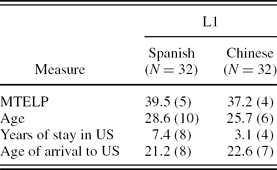
Table 1 provides a summary of participants’ proficiency scores, age, age of arrival, and length of stay in an English-speaking country. Spanish and Chinese participants did not differ in terms of age and age of arrival, t (62) = 1.4, p = .17, and t (62) = 0.76, p = .45, respectively, but they differed in terms of length of stay in the United States, t (62) = 2.7, p = .009, and, marginally, in terms of English proficiency, t (62) = 1.9, p = .06, as measured by the MTELP. On average, L1 Spanish speakers had spent more years in the United States and scored higher on the MTELP.
Second language learners’ average (standard deviation) MTELP scores and other measures
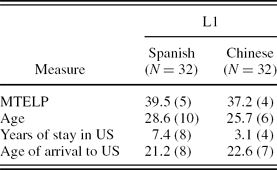
Note: MTELP, Michigan Test of English Language Proficiency.
Materials
The study consisted of a computerized elicitation task, administered through E-Prime software (Psychology Software Tools, Inc.). In order to elicit main clause questions (Part 1), participants were told that they needed to help a shy student ask his teacher some questions. In items intended to elicit yes/no questions, a prompt such as “Maybe Gloria called Jim. Ask Miss Brainy.” appeared written in a speech bubble on the screen. Participants were instructed to advance to the next screen after reading the prompt. The second screen showed a teacher in front of a blackboard, and participants were instructed to produce a question aloud; they were not able to return to the previous screen to revisit the prompt, so their questions would be constructed in the absence of the noninverted declarative prompt. In the final screen, the teacher provided a written answer to the participant's question. Items eliciting wh-questions followed the same general format, differing only in the prompt (e.g., “Gloria called Jim. Ask Miss Brainy why.”). Screenshot examples of slides aimed at eliciting main yes/no and wh-questions are provided in Appendix A.
In order to elicit embedded clause questions (Part 2), participants were introduced to a new character, Sarah, who was curious about the questions that Phil asked. The first screen showed Phil asking his teacher a question written in a speech bubble. Participants were asked to read the question aloud. The second screen showed Sarah asking either “What did Phil not know?” or “What did Phil want to know?” in a speech bubble. The participant's task was to produce an embedded clause question in response to Sarah's question (e.g., “Phil wanted to know where John had gone.”). As in the main clause questions task, participants were not able to return to the previous screen once they had advanced to the next so as to reduce the likelihood of a direct quotation of the prompt. They were also instructed to produce “complete sentences,” that is, to always start their answers with either “Phil wanted to know . . .” or “Phil didn't know. . . .” Screenshot examples of slides aimed at eliciting embedded yes/no and wh-questions are provided in Appendix B. Participants always completed Part 1 before Part 2, because main questions, which were the focus of Part 1, were used in Part 2 as prompts to elicit embedded questions.
The fully within factor was question type (yes/no vs. wh-); type of wh-word was a within-subjects but a between-items factor.Footnote 13 Four types of wh-words were elicited: arguments what and who and adjuncts why and where.Footnote 14 Each participant was presented with a total of 32 experimental prompts (16 yes/no and 16 wh-questions: 4 who, 4 what, 4 where, and 4 why). Filler items were not included, because pilot testing indicated that the experimental session was fairly long (about 50 min to 1 hr) and participants’ debriefing responses indicated that they were not aware of the experimental focus.Footnote 15 To investigate whether lack of fillers caused speakers to adopt a metalinguistic response strategy and was the source of learning effects within the experiment, we compared the inversion rates produced in the first and second halves of the each of the two studies. Inversion errors did not differ significantly between the first and the second half in either study, t 1 (63) = 1.6, p = .12, t 2 (31) = 1.8, p = .09; t 1 (63) = 0.87, p = .39, t 2 (31) = 0.85, p = .4, for main and embedded clause questions, respectively.
In one fourth of the prompts, the subject was in second person (e.g., your brother). This was to ensure that, in Part 2, participants were producing authentic embedded clause questions and not quotative questions (e.g., She wanted to know “Where are you going?”). Productions were thus only considered as “target” if the second person possessive pronoun in the prompt was transformed into a third person possessive pronoun. So, for example, if the question in the prompt was: “What is your husband cooking?” the target response would be “Phil wanted to know what her/Miss Brainy's husband was cooking,” whereas a response like “Phil wanted to know what your husband was cooking” would be considered nontarget.
Experimental items were pseudorandomized so that no more than two consecutive experimental sentences shared any of the features relevant to the investigation (i.e., yes/no or wh-type questions). To control for order effects, two additional lists in which the order of the experimental items was reversed were created. Examples of experimental materials for main and embedded clause questions are given in Appendix C and D, respectively.
Procedure
After reading and signing the consent forms, participants were seated in front of a computer. The experimenter guided the participant through the six practice items and provided clarifications, but did not provide corrective feedback. After the practice session, the experimenter turned on a digital recorder and left the room. Participants were given the option of taking a break between Part 1 and Part 2. At the end of this experimental session, a questionnaire on biographical data, language background, and language use was administered. Nonnative participants were also administered the oral comprehension portion of the MTELP. The study took approximately 50–55 min.
Transcription and coding
The authors transcribed and coded participants’ responses. A subset (30%) of the responses was transcribed independently by each of the authors, and no major disagreements were found. Coding was performed independently. Intercoder agreement was high (>96%), and disagreements were resolved by discussion.
Each production was coded as either correct (nativelike) or incorrect (nonnativelike) with respect to word order, verbal morphology, and presence of target lexical items (e.g., subject and wh-element). For ease of comparison with previous studies in the literature, we followed Ambridge et al.'s (Reference Ambridge, Rowland, Theakston and Tomasello2006) coding scheme. Incorrect questions were coded in four further categories. Examples of errors are given below for both main and embedded clause questions.
Subject–auxiliary inversion errors:
(23) Why your brother fired Mark?
(24) Phil wanted to know what is Ms. Brainy's brother drinking for dinner.
Double tense/double auxiliary errors:
(25) Who did the boss complimented?
(26) Phil want to know who did her husband hired.
Omitted auxiliary/morphology errors:
(27) Why you call Jim?
(28) Phil want to know who the math teacher helping now.
Other errors: Other errors included questions that differed in type from the target (yes/no instead of wh-question, and vice versa), subject wh-questions instead of object wh-questions, productions that differed from the target in the lexical items used, and questions without a subject. Embedded clause questions in which a second person pronoun in the prompt failed to be substituted with a third person pronoun were also included in this category:
(29) Phil didn't know where your brother forgot his keys.
(30) Phil wanted to know where does your brother wash his clothes.
This latter type of production was rare (88% accuracy overall), indicating that, in general, participants understood and were able to perform the task. In some instances (5% for main and 6% for embedded clause questions), learners produced more than one response for a trial. In these cases, we counted the second response, because the first one was either not a complete response, and as such could not be scored, as in (31), or it was judged to be a clear attempt to correct the first response, as in (32):
(31) Why . . . why Mrs Brainy's brother . . . Why did Mrs Brainy's brother fired Mark?
(32) What did the teacher bought—I mean . . .—what did the teacher buy?
Results
Two sets of analyses were performed on all data: the first set of analyses used arcsine transformed mean percentage correct (inverted) productions as the dependent variable. This was calculated by dividing the number of correct responses by the total number of productions. The second set of analyses used arcsine transformed mean inversion rates as the dependent variable, and this was calculated by dividing the number of correct responses by inverted and noninverted responses only; productions that provided no evidence one way or the other with respect to inversion or that contained errors unrelated to subject–auxiliary inversion (i.e., auxiliary omission, different structure, morphological errors, etc.) were thus excluded from this second set of analyses.
Part 1 (main clause questions)
English native speakers produced 100% target inverted main clause questions and were thus excluded from further analyses.
Two 2 (L1: Spanish vs. Chinese) × 2 (Syntactic Structure: Wh- vs. Yes/no) mixed-design analyses of variance (ANOVAs) with accuracy and inversion rates as respective dependent variables showed significant effects of L1 and syntactic structure, for accuracy: F 1 (1, 62) = 5.9, p = .02; F 2 (1, 31) = 30.3, p < .0001, F 1 (1, 62) = 39.6, p < .0001; F 2 (1, 31) = 20.4, p < .0001, for L1 and syntactic structure, respectively; for inversion: F 1 (1, 62) = 4.6, p = .04; F 2 (1, 31) = 25.2, p < .0001; F 1 (1, 62) = 36.2, p < .0001; F 2 (1, 31) = 32.5, p < .0001, for L1 and syntactic structure, respectively. L1 Chinese speakers produced higher rates of targetlike and inverted responses than L1 Spanish speakers and that yes/no questions were associated with higher accuracy and inversion rates than wh-questions. There was no interaction between L1 and syntactic structure, for accuracy: all Fs < 1; for inversion: F 1 < 1; F 2 (1, 31) = 2.2, p = .15.
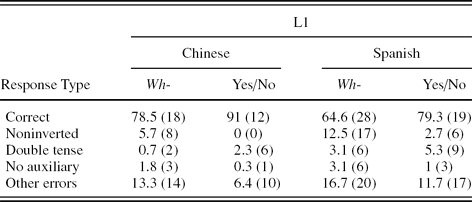
Table 2 reports the raw number and percentage of productions in each coding category by syntactic structure for L1 Chinese and L1 Spanish learners.
Main clause questions: Mean (standard deviation) percentage productions by first language (L1), syntactic structure, and coding category

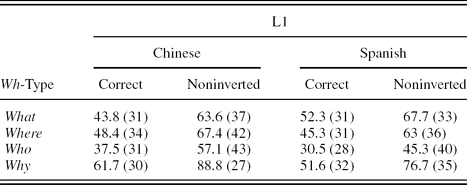
In order to investigate the effect of wh-words on learners’ production of main questions, two 2 (L1: Spanish vs. Chinese) × 4 (Wh-word) mixed-design ANOVAs with accuracy and inversion rates as respective dependent variables showed significant effects of wh-word, for accuracy: F 1 (3, 186) = 4.1, p = .008; F 2 (3, 28) = 3.8, p = .02; for inversion: F 1 (3, 168) = 12.2, p < .0001; F 2 (3, 28) = 14.6, p = .001, and no interaction between wh-type and L1, for accuracy: F 1 (3, 186) = 2.5, p = .06; F2 (3, 28) = 1.7, p = .2; for inversion: all Fs < 1.
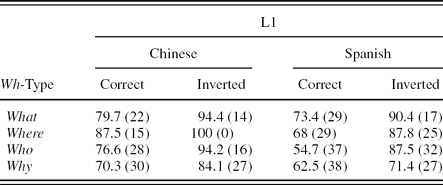
The raw number of inverted responses along with percentage correct and percentage inversion by wh-word and L1 are reported in Table 3.
Main clause questions: Mean (standard deviation) percentage correct and inverted productions by first language (L1) and wh-word
Pairwise comparisons were carried out to explore the effect of individual wh-elements on correct and inverted responses. Bonferroni correction was applied to prevent Type I error inflation. The first set of analyses (performed on percentage correct) revealed a marginally significant difference between what and who (p = .07) and where and who (p = .06), both in the subject and item analyses, with who being associated with fewer correct responses. The second set of analyses (performed on percentage inversion), showed a significant difference between why and all other wh-elements, subject means: what versus why (p < .0001), where versus why (p < .0001), who versus why (p = .04); item means: what versus why (p = .004), where versus why (p < .0001), and who versus why (p = .001), with why being associated with lower inversion rates. This is the only case in which the percentage correct and percentage inversion analyses revealed a different pattern of responses. The reason for this difference is likely to be due to the high number of “other error” responses with who (18.8% for L1 Chinese and 31.3% for L1 Spanish) and the relative low number of “other error” responses with why (12.5% for Chinese and 7% for Spanish). It is worth noting that most “other error” responses with who were subject questions in place of nonsubject questions (e.g., Who saw Sarah for brunch? instead of the target Who did Sarah see for brunch?). This might be because who is exclusively used for human referents, and learners have a preference to assign an agent/subject role to the [+animate +human] sentence-initial wh-word. This pattern would follow the canonical sentence bias found for child learners of English (Bever, Reference Bever and Hayes1970), according to which children have the tendency to interpret sentences with the surface order noun–verb–noun as agent–action–object sequences. The analysis on inversion rates shows that, once “other error” responses were removed, the difference between who and other wh-words disappeared (who vs. what, p = .22; who vs. where, p = .17).
Part 2 (embedded clause questions)
English native speakers produced only 1 inverted structure and 14 other responsesFootnote 16over a total of 1,378 embedded clause questions and were excluded from further analyses.
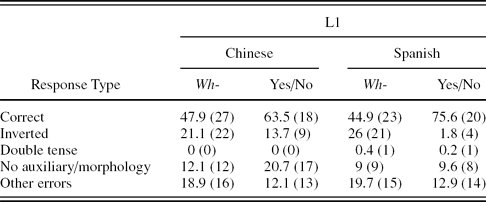
Two 2 (L1: Spanish vs. Chinese) × 2 (Syntactic Structure: Wh- vs. Yes/no) mixed-design ANOVAs with accuracy and noninversion rates as respective dependent variables showed no effect of L1 and a significant effect of syntactic structure, for accuracy: F 1 < 1; F 2 (1, 31) = 2.9, p = .09; F 1 (1, 62) = 66.7, p < .0001; F 2 (1, 31) = 105.6, p < .0001, for L1 and syntactic structure, respectively; for noninversion: all Fs < 1; F 1 (1, 62) = 133.7, p < .0001; F 2 (1, 31) = 139.6, p < .0001, for L1 and syntactic structure, respectively. Yes/no questions were associated with higher accuracy and noninversion rates than wh-questions. Moreover, a significant interaction between L1 and syntactic structure, for accuracy: F 1 (1, 62) = 10.6, p = .002; F 2 (1, 31) = 9.9, p = .004; for noninversion: F 1 (1, 62) = 3.9, p = .052; F 2 (1, 31) = 7.7, p = .009. L1 Spanish speakers produced significantly higher rates of targetlike responses than L1 Chinese speakers in the yes/no condition, t 1 (62) = 2.5, p = .01; t 2 (31) = 3.6, p = .001, but not in the wh-condition, t 1 = 0.86; t 2 (31) = 1.5, p = .10. In particular, Chinese speakers produced more auxiliary and morphology omission errors than L1 Spanish speakers in embedded yes/no questions, for accuracy: t 1 (62) = 3.3, p = .002; t 2 (31) = 5.7, p < .0001; for noninversion: t 1 (62) = 1, ns; t 2 (31) = 2.3, p = .03, but not embedded wh-questions, for accuracy: t 1 (62) = 1.1, p = .3; t 2 (31) = 1.7, p = .9; for noninversion: t 1 (31) = 1.3, p = .2; t 2 (31) = 1.8, p = .08. Table 4 reports the raw number and percentage of productions in each coding category by syntactic structure for L1 Chinese and L1 Spanish learners.
Embedded clause questions: Mean (standard deviation) percentage productions by first language (L1), syntactic structure, and coding category
In sum, on average, yes/no questions were associated with higher rates of correct noninverted productions than were wh-questions. Spanish speakers and Chinese speakers did not differ in terms of their overall accuracy and noninversion rates. However, L1 Spanish speakers produced on average higher rates of targetlike responses than did L1 Chinese speakers in the yes/no condition. In contrast, L1 Spanish speakers did not differ from L1 Chinese speakers in terms of rates of targetlike responses in the wh-condition. Table 4 reports the raw numbers and percentages of productions in each category by syntactic structure for L1 Spanish and L1 Chinese learners.
Two 2 (L1: Spanish vs. Chinese) × 4 (Wh-type) mixed-design ANOVAs with accuracy and noninversion rates as respective dependent variables investigated the effect of wh-word on learners’ production of embedded questions. A significant effect of wh-type emerged, for accuracy: F 1 (3, 186) = 11.9, p < .0001; F 2 (3, 28) = 7.7, p = .001; for noninversion: F 1 (3, 186) = 11.7, p < .0001; F 2 (3, 28) = 6.7, p = .001, and no interaction between wh-type and L1, for accuracy: F 1 (3, 186) = 1.9, p = .13; F 2 (3, 28) = 1.8, p = .16; for noninversion: F 1 (3, 186) = 1.6, p = .2; F 2 (3, 28) = 1.4, p = .3.
Pairwise comparisons were carried out to explore the effect of individual wh-elements on correct and noninverted rates. Bonferroni correction was applied to prevent Type I error inflation. The first set of analyses (performed on overall percentage correct) revealed a significant difference between who and what and who and why, analysis on subject means: what versus who (p < .0001) and why versus who (p < .0001); analysis on item means: what versus who (p = .04) and why versus who (p < .0001). Who was associated with lower rates of targetlike responses. The second set of analyses (performed on noninversion rates) showed a significant difference between why and all other wh-elements, analysis on subject means: what versus why (p = .001), where versus why (p = .002), and who versus why (p = .001); analysis on item means: why versus what (p = .01), why versus where (p = .02), and why versus who (p = .002), with why being consistently associated with lower inversion rates. This difference between the two analyses is likely to be because who was associated with higher rates of “other error” responses. Once responses that were uninformative with respect to inversion were excluded, the effect of who disappeared and the effect of why emerged, as the second set of analyses shows. The raw numbers of correct responses along with percentage correct and percentage noninversion by wh-word and by L1 are reported in Table 5.Footnote 17
Embedded clause questions: Mean (standard deviation) percentage correct and noninverted productions by first language (L1) and wh-word
GENERAL DISCUSSION
The purpose of this study was to investigate the role of L1 and L2 properties on the production of English questions by L2 learners. To do this, we administered an elicited production study to intermediate/advanced L2 learners of English whose native languages differed from each other and from English in relevant ways, prompting learners to produce main and embedded yes/no and wh-questions. Our main findings can be summarized as follows:
Part 1: Main clause questions
• A significant effect of L1 was found, with L1 Chinese learners producing on average higher rates of targetlike inverted responses than L1 Spanish learners.
• A significant effect of syntactic structure was found, with learners producing on average higher rates of targetlike inverted structures in yes/no than in wh-questions.
• A significant effect of wh-word was found, with why-questions being associated on average with lower inversion rates than other wh-elements.
Part 2: Embedded clause questions
• L1 did not have a significant effect; L1 Chinese and L1 Spanish learners produced comparable rates of targetlike noninverted responses.
• A significant effect of syntactic structure was found, with learners producing on average higher rates of targetlike noninverted responses in yes/no than in wh-questions.
• A significant effect of wh-word was found, with why-questions being associated with higher rates of targetlike noninverted responses than other wh-questions.
In the following section, we discuss our findings in more detail in light of previous research and the questions that were raised at the outset.
The role of L1 properties: Chinese versus Spanish
Part 1 showed that L1 Chinese learners were in general more accurate than L1 Spanish learners at producing targetlike inverted main clause questions. This difference is not likely to stem from differences in proficiency, age of acquisition, or length of exposure to English, given that the two groups did not differ in terms of age of acquisition and that L1 Spanish speakers’ proficiency scores (as measured by the MTELP) and length of stay in the United States were on average higher than those of L1 Chinese speakers. This difference is also unlikely to stem from dialectal differences among Spanish speakers for two reasons. First, only four L1 Spanish speakers were native speakers of Caribbean Spanish varieties (see Note 12) in which subject–verb inversion in questions is dispreferred (Suñer, Reference Suñer1994; Toribio, Reference Toribio2000). Three of them never produced inversion errors. Second, although inversion is dispreferred in these dialects, it is nonetheless grammatical, whereas in Chinese it is never grammatical.
This result is unexpected under hypotheses of L2 acquisition with and without a role for L1 transfer because the latter predict no significant L1 effect on inversion rates, whereas the former predict the opposite direction of the effect, given that Chinese lacks inversion in questions altogether, whereas Spanish allows subject–verb inversion in all questions. Although this result is problematic, it might be possible to account for it by hypothesizing that properties that are present in learners’ L1s but require restructuring (subject–verb inversion in L1 Spanish) are more difficult to acquire than those that are entirely absent in the L1, which might be particularly salient due to a “surprise effect” (Kleinmann, Reference Kleinmann1977). In other words, it might be that superficial similarities between the L1 (subject–verb inversion in Spanish, in this case) and the L2 (subject–auxiliary inversion in English) obscure the fact that the L2 pattern is different from that of L1 and that the L2 pattern needs to be acquired (Oller & Ziahosseiny, Reference Oller and Ziahosseiny1970; Ringbom, Reference Ringbom1987).
In Part 2 we found that L1 Chinese and L1 Spanish learners’ accuracy and noninversion rates for embedded wh-questions were comparable. In contrast, L1 Chinese learners produced slightly higher rates of inversion errors than did L1 Spanish speakers and higher rates of morphology omission errors in embedded yes/no questions. This latter pattern might be a result of L1 transfer, because Chinese, unlike Spanish, has no inflectional morphology (for differences between these two L1 groups in terms of processing of English morphology, see Rehak & Juffs, Reference Rehak, Juffs, Granena, Koeth, Lee-Ellis, Lukyanchenko, Prieto Botana and Rhoades2011; for a discussion of one advanced Chinese speaker's omission of tense morphology, see Lardiere, Reference Lardiere1998), although it is unclear why these morphology omission errors would increase from wh- to yes/no contexts (12% vs. 21%, respectively, see Table 4).
Taken together, the general findings of this investigation are compatible with no-transfer accounts and with transfer accounts that do not posit L1 transfer at intermediate/advanced stages of L2 acquisition.Footnote 18 However, these results are unexpected under the view that transfer continues (or increases) in later phases of acquisition, given that Spanish allows subject–verb inversion in embedded clause questions and Chinese lacks inversion in questions altogether. Although it is clear that null effects should be interpreted with caution, the existence of a null effect in the context of two significant main effects in the same study (syntactic structure and wh-word) argues against a transfer interpretation of embedded inversion errors in L2 learners’ production.
The occurrence of inversion errors in embedded wh-questions in the speech of both L1 Spanish and L1 Chinese speakers, together with the existence of this type of production in the speech of children learning English as their L1 (Stromswold, Reference Stromswold1990) and adult native speakers of non-Standard English varieties, suggests that inversion in embedded questions is not a product of L1 transfer but possibly the result of structurally constrained overgeneralization of inversion from main to embedded clauses. If this is true, we might expect that elements that are associated with higher (targetlike) inversion rates in main questions will be associated with higher (nontargetlike) inversion rates in embedded clause questions, and vice versa. This prediction is borne out in our data in the significant correlation between inversion rates in main and embedded questions across wh-words (r = .45, p = .01).
The role of L2 properties: Syntactic structure
In both studies, we found higher accuracy rates in yes/no than in wh-questions. The findings from Part 1 are in line with other findings from the L2 literature (Pienemann & Johnston, Reference Pienemann, Johnston and Nunan1987; Spada & Lightbown, Reference Spada and Lightbown1999), showing that subject–auxiliary inversion emerges and becomes productive in yes/no questions earlier than in wh-questions (Stage 4 vs. Stage 5). In order to compare our results with this research, we grouped our learners based on whether they acquired inversion in both, one, or neither of the two structures (see Appendix D). Mastery of inversion was operationalized by using both 80% (Cancino, Rosansky, & Schumann, Reference Cancino, Rosansky and Shumann1975; Irwin & Weston, Reference Irwin and Weston1975) and 90% inversion as a cutoff (Brown, Cazden, & Bellugi, Reference Brown, Cazden, Bellugi, Ferguson and Slobin1973; Eckman et al., Reference Eckman, Moravscik and Wirth1989). We found that learners who have acquired inversion in wh-questions have also acquired it in yes/no questions. There are no exceptions to this generalization when using the 80% criterion, and there is one exception using the 90% criterion. Conversely, there are 13 and 18 participants who have not acquired inversion in wh-questions but who have acquired it in yes/no questions according to the 80% and 90% inversion criteria, respectively.
This result contrasts sharply with what Eckman et al. (Reference Eckman, Moravscik and Wirth1989) found. They observed the opposite implicational relationship (i.e., whenever learners have acquired inversion in yes/no questions, they have also acquired it in wh-questions), which is particularly surprising considering that noninverted yes/no questions (e.g., She likes it?) are present in the native input whereas noninverted wh-questions are not (e.g., *What she likes?). The sharp contrast between the present results and those reported by Eckman et al. (Reference Eckman, Moravscik and Wirth1989) might result from differences in the protocols used to elicit questions in the two studies. In Eckman et al.'s (Reference Eckman, Moravscik and Wirth1989) study, participants saw a series of drawings constituting a story and had to guess the story by asking questions; this type of context might have met the pragmatic conditions for noninversion in yes/no questions, given that participants might have been trying to confirm their own guesses (see Note 8). In the present study, the context did not meet such pragmatic conditions, a fact that is supported by the 100% inversion rate in native English controls’ productions. It should also be noted that in Eckman et al.'s (Reference Eckman, Moravscik and Wirth1989) study, yes/no questions were elicited before wh-questions,Footnote 19 so practice effects might account for the difference in inversion rates. Conversely, yes/no and wh-questions were interspersed in this study.
That L2 learners, independent of their L1, inverted at higher rates with main clause yes/no than with wh-questions does not follow from the syntactic properties of learners’ native languages; as we have shown above, Chinese does not use different syntax in the two structures, and Spanish allows noninversion to occur more freely with yes/no than with wh-questions. This finding is consistent with results from L1 acquisition research on English questions that attribute inversion errors in wh-questions to reduced saliency of the auxiliary (Gleitman et al., Reference Gleitman, Newport and Gleitman1984) or to higher structural complexity (Klima & Bellugi, Reference Klima, Bellugi, Lyons and Wales1966) and is thus consistent with claims that L2 acquisition, at least in this area of the grammar, is similar to L1 acquisition in terms of developmental stages and in terms of the hypotheses that learners entertain.
In Part 2 we found that learners were also more accurate with yes/no questions than with wh-questions. This result is in line with our initial predictions based on structural considerations and data from L1 acquisition (Stromswold, Reference Stromswold1990) and dialectal variation (Filppula, Reference Filppula1999; Green, Reference Green2002; Henry, Reference Henry1995; Labov, Reference Labov1972; McCloskey, Reference McCloskey, Zanuttini, Campos, Herburger and Portner2006). As has been hypothesized for these varieties of English, we propose that embedded inversion in L2 grammars cannot take place owing to the presence of an overt complementizer if in the position targeted by inverted auxiliaries. As an initial indication of the fact that inversion and the presence of a complementizer are intimately connected, it is perhaps informative that, although participants in this study virtually always produced a complementizer in embedded yes/no questions, inversion occurred when a complementizer was not present (7/8 contexts), and a complementizer was absent whenever inversion occurred (7/7). We take this as an initial indication that inversion errors are structurally constrained.
The role of L2 properties: Wh-words
In Part 1 and Part 2, a why-effect emerged: why-questions were uniformly associated with lower inversion rates than were other wh-elements; that is, why was associated with low inversion and accuracy rates in main clause questions and low inversion and high accuracy rates in embedded clause questions.
The results from Part 1 follow a well-established pattern in child English (Berk, Reference Berk, Beachley, Brown and Conlin2003; de Villiers, Reference de Villiers, Maxfield and Plunkett1991; Labov & Labov, Reference Labov, Labov, Campbell and Smith1978; Rowland & Pine, Reference Rowland and Pine2000; Thornton, Reference Thornton2008). However, this result is only partially in line with the findings from the most in-depth L2 study on the effect of wh-words in the recent L2 literature (Lee, Reference Lee2008). In that study, Lee found an argument–adjunct asymmetry with ungrammatical noninverted adjunct questions being judged as more acceptable than noninverted argument questions. Our results from Part 1 indicate that the existence of an asymmetry between why and other wh-words, and not between arguments and adjuncts. At this point, it is not possible to determine whether this difference reflects an asymmetry between production and acceptability judgment tasks, an L1 effect (L1 Korean in Lee's study, L1 Chinese and Spanish in our study), or a wh-word effect (Lee used why and how, and the present experiment used adjuncts why and where).
Note that the existence of a why-effect in adult learners of English undermines explanations attributing low rates of inversion with why in child English to difficulties with its conceptual complexity, given that, among other things, these speakers have the conceptual abilities to ask all types of complex wh-questions in their L1s (see Bloom et al., Reference Bloom, Merkin and Wooten1982; Clancy, Reference Clancy1989; Park, Reference Park2000, for similar arguments). Difficulties with why are instead compatible with L1 acquisition and crosslinguistic research attributing why's behavior to its particular syntactic properties. For example, Thornton (Reference Thornton2008), based on Rizzi (Reference Rizzi, Cinque and Salvi2001), proposed that in child English, why is base generated in a dedicated position in the structure (the specifier of interrogative phrase) already endowed with an interrogative feature, blocking the movement of the [+interrogative] auxiliary to the left periphery.Footnote 20
In summary, the results of the present study show that accuracy and inversion patterns in intermediate/advanced L2 learners differ from those of adult native speakers, with nontarget productions occurring at nontrivial rates in main and embedded clause questions, respectively. More important, the results of the present study suggest that the influence of learners’ native language is not the main factor affecting inversion errors.
In contrast, we found that L1 Spanish and L1 Chinese learners of English are similar to one another in that both are more accurate at producing yes/no than wh-questions in main and embedded clauses alike, and they display particularly low inversion rates when producing main and embedded why-questions. These findings are in line with child English acquisition data and suggest that learners’ grammars are sensitive to fine-grained linguistic properties of the language they are acquiring.
Although the present study confirms the existence of structural factors affecting accuracy and inversion rates in English adult learners independent of native language (Spanish vs. Chinese), we leave open the crucial question of exactly what properties of the English input and grammatical system cause these difficulties.
APPENDIX A
Protocol for main yes/no questions:
APPENDIX B
Protocol for embedded yes/no questions:
APPENDIX C
The following are examples of main clause question prompts.
Practice items:
Someone is yelling upstairs. Ask Miss Brainy who.
Someone usually plays the piano next door. Ask Miss Brainy who.
Maybe Miss Brainy's son is painting a picture. Ask her.
Maybe Miss Brainy's husband usually drives her home. Ask her.
Experimental items:
Maybe Gloria called Jim for advice. Ask Miss Brainy.
Maybe Miss Brainy's friends have invited her to dinner. Ask her.
The boss has complimented somebody. Ask Miss Brainy who.
The student read something. Ask Miss Brainy what.
Miss Brainy's brother fired Mark. Ask Miss Brainy why.
Juan teaches Spanish somewhere. Ask Miss Brainy where.
APPENDIX D
The following are examples of embedded clause question prompts.
Practice items:
Who is yelling upstairs?
Who usually plays the piano next door?
Is your son painting a picture?
Does your husband usually drive you home?
Experimental items:
Did Gloria call Jim for advice?
Have your friends invited you to dinner?
Who has the boss complimented?
What did the student read?
Why did your brother fire Mark?
Where does Juan teach Spanish?
APPENDIX E
Summary of mastery data for main clause questions at the 80% and 90% accuracy thresholds