


The aetiology of eating disorders is unclear. Genetic, socio-cultural and psychological factors are involved, but how and to what extent the factors interact is not yet understood. Despite this complexity (Reference Weich, Twigg and LewisWeich et al, 2006), establishing a link between degree of urbanisation and a disorder provides clues to understanding its aetiology. For several other mental disorders such a link is well established (Reference Sundquist, Frank and SundquistSundquist et al, 2004). In 1995 it was first reported that bulimia nervosa is associated with urban life (Reference Hoek, Bartelds and BosveldHoek et al, 1995). Our study extends this research by adding data collected a decade later. The main question was whether degree of urbanisation constitutes a potential environmental risk factor for eating disorders.
METHOD
In The Netherlands the Continuous Morbidity Registration Sentinel Stations, a network of general practitioners coordinated by the Netherlands Institute for Health Services Research (NIVEL), recorded the number of newly diagnosed cases of eating disorders (anorexia nervosa and bulimia nervosa) in their practices during the periods 1985–1989 and 1995–1999. This network, comprising on average 63 general practitioners, served an annual patient load in both periods of about 1% of the Dutch population. In both periods the population studied was representative of the total Dutch population. For each possible new case of an eating disorder the general practitioner filled out an information sheet, on the basis of which the research team made the final diagnosis. During both study periods the same method was used, the same case-finding information was provided to the general practitioners and the same author (H.W.H.) made the final diagnosis based on DSM–IV criteria (American Psychiatric Association, 1994).
Statistical analysis
The population under study was divided into three urbanisation levels according to the typology used by the Dutch National Institute of Statistics: rural areas (20% or more of the population are involved in agrarian labour), large cities (more than 100 000 inhabitants) and urbanised areas (all other areas). The age-adjusted incidence rate ratios for estimating the effect of living in areas with different degrees of urbanisation on the incidence of anorexia nervosa and bulimia nervosa were calculated by Poisson regression analysis (Reference Frome and CheckowayFrome & Checkoway, 1985) with the use of Stata version 9 for Windows.
RESULTS
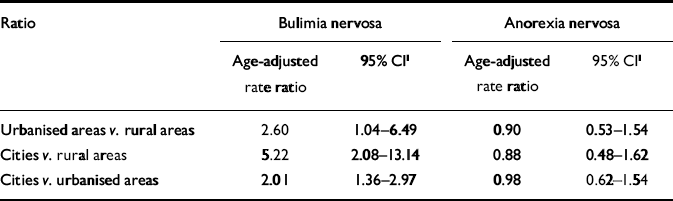
During the two periods a total of 113 patients with anorexia nervosa (107 females and 6 males) and 110 patients with bulimia nervosa (107 females and 3 males) were newly diagnosed. Because there were so few male patients, all further analyses were restricted to data from female patients. The mean age at detection among the latter patients with anorexia nervosa was 22 years (s.d.=8.1, median 20, range 8–57) and among those with bulimia nervosa it was 27 years (s.d.=8.2, median 25, range 13–55). The incidence rate per year per 100 000 women-years (age 5–64 years) for anorexia nervosa was 17.4 (95% CI 8.6–23.6) in rural areas, 20.2 (95% CI 15.6–24.9) in urbanised areas and 11.5 (95% CI 6.2–16.8) in large cities. Bulimia nervosa showed an incidence rate of 7.0 (95% CI 1.4–12.6) in rural areas, 16.7 (95% CI 12.5–20.9) in urbanised areas and 25.5 (95% CI 17.7–33.5) in large cities. Table 1 compares the age-adjusted incidence rate ratios of the three urbanisation categories. When the two study periods were analysed separately no time effect was found in the association between urbanisation and incidence.
Age-adjusted incidence rate ratio of bulimia and anorexia nervosa by degree of urbanisation in female patients during 1985-1989 and 1995-1999
| Ratio | Bulimia nervosa | Anorexia nervosa | ||
|---|---|---|---|---|
| Age-adjusted rate ratio | 95% CI1 | Age-adjusted rate ratio | 95% CI1 | |
| Urbanised areas v. rural areas | 2.60 | 1.04-6.49 | 0.90 | 0.53-1.54 |
| Cities v. rural areas | 5.22 | 2.08-13.14 | 0.88 | 0.48-1.62 |
| Cities v. urbanised areas | 2.01 | 1.36-2.97 | 0.98 | 0.62-1.54 |
DISCUSSION
The main finding of the study was the association of bulimia nervosa incidence with degree of urbanisation in a dose–response fashion. The incidence of bulimia nervosa was almost two and a half times higher in urbanised areas than in rural areas and five times higher in large cities than in rural areas. This is in contrast to the incidence of anorexia nervosa, which showed no association. We conclude that urban life is a potential environmental risk factor for bulimia nervosa but not for anorexia nervosa.
Anorexia nervosa and bulimia nervosa are thought to be closely related disorders and many indications support this view. For example, core features of both disorders concern disturbed eating behaviours, patients tend to migrate between diagnostic categories of eating disorders (Reference Fairburn and HarrisonFairburn & Harrison, 2003) and familial aetiological factors appear to be shared by anorexia nervosa and bulimia nervosa (Reference Strober, Freeman and LampertStrober et al, 2000). However, living in a large city seems to be strongly associated with the development of bulimia nervosa whereas this is not the case in anorexia nervosa. The dose–response relationship of urbanisation and bulimia nervosa incidence suggests causality. Another indication of the strong environmental influence on the incidence rate of bulimia nervosa is the unstable pattern of the incidence rate over time, as evidenced by the sudden and sharp rise in the incidence of bulimia nervosa since the 1980s (Reference Soundy, Lucas and SumanSoundy et al, 1995), the relative rarity of bulimia nervosa before 1970 (Reference Kendler, Maclean and NealeKendler et al, 1991) and the failure to find conclusive evidence of the existence of bulimia nervosa in history (Reference Keel and KlumpKeel & Klump, 2003). Such fluctuations in the incidence rate pattern cannot be caused by changing genetic factors because the time scale is too limited.
How can we explain the results? The two main hypotheses are ‘migration’ and ‘opportunity’. In the migration hypothesis it is presumed that adolescents tend to migrate to urban areas, where Dutch educational facilities are principally located. These adolescents might already have developed bulimic symptoms but are ‘detected’ in the study in the more urbanised areas at an older age. The development of bulimia nervosa would then be independent of living in a large city. However, in the analyses we adjusted for age differences in order to correct this possible effect and the association of urbanisation on the incidence of bulimia nervosa remained. In the opportunity hypothesis the higher incidence of bulimia nervosa in large cities is explained by the ability to obtain large amounts of food inconspicuously (Reference Keel and KlumpKeel & Klump, 2003). Furthermore, the relative anonymity in large cities makes it easier to engage in secretive behaviour (Reference Hoek, Bartelds and BosveldHoek et al, 1995). Apart from the opportunity hypothesis, other intra- and interpersonal factors may possibly account for the findings. The interaction of these factors with social aspects of residential areas (such as social cohesion, interpersonal trust and informal social control) might also be of importance as they can have an effect on mental health (Reference Drukker, Kaplan and FeronDrukker et al, 2003). Further research is needed to elucidate the relationship of bulimia nervosa and urban life. In further studies the residential history of participants should be taken into account along with the time of onset of the bulimic symptoms.
Strengths and limitations of the study
This study used a registry at primary care level. Therefore, we were able to study a broad patient group, including patients who had never received treatment for their eating disorder. Obtaining data from this level of care is a strength of the study, since only a small and selected proportion of people with eating disorders – mainly patients with anorexia nervosa – are treated by mental health services (Reference HoekHoek, 2006). A limitation of the study is that we were only aware of the detection date of the disorder, which is not necessarily the same as time of onset. This is also true for the degree of urbanisation; this is only known at time of detection.
Acknowledgements
This research was funded by the Netherlands Ministry of Health. The authors thank the participating general practitioners for their efforts in collecting the data.




eLetters
No eLetters have been published for this article.