Introduction
Cedrela P.Browne is a genus of economically important hardwood timber trees in the Neotropics. It is distributed from Mexico through Central and South America to northern Argentina. The latest systematic treatment by Pennington & Muellner (Reference Pennington and Muellner2010) comprises 17 species. These occur in seasonally deciduous or evergreen rain forests. Cedrela is closely related to the genus Toona (Endl.) M.Roem. which occupies similar habitats throughout the Indo-Australian Archipelago and China. Cedrela and Toona together form the monophyletic group of Cedreleae within Meliaceae subfamily Swietenioideae (Muellner et al., Reference Muellner, Samuel, Johnson, Cheek, Pennington and Chase2003). Although morphologically very similar, Cedrela and Toona differ in the structure of the androgynophore, the seed wing, and the point of attachment of the seed on the central columella of the fruit (Pennington & Muellner, Reference Pennington and Muellner2010). Species distinctions in Cedrela are based on a combination of six morphological characters, viz.: number of leaflet pairs, amount and type of leaf indumentum, leaflet size, shape and venation, degree of union of sepals, adnation of the petal margins, and size of the capsule (Pennington & Muellner, Reference Pennington and Muellner2010). We here describe a new species of Cedrela from Costa Rica and Panama which is distinct in most of these morphological traits. Molecular analyses also confirm that Cedrela ngobe represents a new species which is distinct from other species of Cedrela, with a close relationship to the Andean C. nebulosa T.D.Penn. & A.Daza, C. saltensis Zapater & del Castillo and another genetic entity here designated C. aff. odorata L. from Central and northern South America (Koecke et al., Reference Koecke, Muellner-Riehl, Pennington, Schorr and Schnitzler2013). Cedrela aff. odorata and C. ngobe are sympatrically distributed along the seasonal Pacific side of Central Panama to southern Costa Rica. In order to test for suitable climatic niches and for better estimation of an IUCN criterion, we perform climatic niche modelling of the new species, Cedrela ngobe.
Cuticular analyses are sometimes useful for identifying genus or species specific traits in addition to morphological characters. Stomatal architecture and type of indumentum can be taxon specific. Moreover, epidermal and cuticular traits may be preserved in fossil cuticles of carbonised leaves. Identification of fossils thus often depends on the identification of micro-characters. Leaf epidermal characters are therefore presented here together with the formal species description.
Species Description
Cedrela ngobe Köcke, T.D.Penn. & Muellner, sp. nov.
A speciebus aliis foliis 6–7-jugis, infra breviter puberulis, petalis 6–6.5 mm longis, capsula 4–6 cm longa differt. – Type: Panama, Comarca Ngöbe-Buglé, foothills of Cerro Guánico, A.V. Köcke, O. Cáceres, H. Wessels & M. Piepenbring 180409/02 (holo K; iso FR, PMA, UCH). Fig. 1.
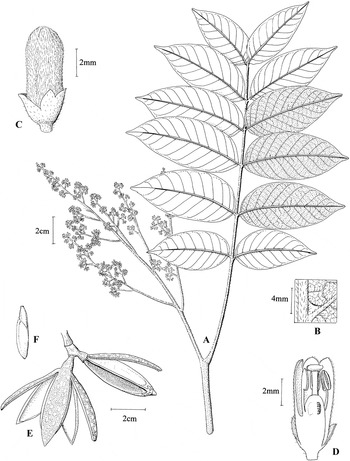
Cedrela ngobe Köcke, T.D.Penn. & Muellner. A, leaf and inflorescence; B, detail of leaf undersurface; C, flower; D, cross section of a male flower; E, capsules; F, seed (A–D, Köcke et al. 180409/02; E–F, Köcke et al. 180409/01).

Young branches 4–5 mm diam., smooth, pale buff, with some elongate lenticels, glabrous. Leaves (petiole + rhachis) 40–50 cm long, leaflets opposite, 6–7 pairs, 8 × 4 – 13 × 5 cm, ovate (apical pair), oblong-elliptic (middle pairs) or elliptic (basal pair), apex acuminate, base asymmetric, rounded on one side, acute to obtuse on the other, chartaceous, subglabrous above, minutely puberulous on the midrib and secondary veins below, domatia present in the axils of secondary veins below; venation eucamptodromous, midrib not raised or sunken on the upper surface, secondaries (8–)12–14 pairs, ascending, slightly arcuate, parallel or slightly convergent, tertiaries mostly oblique and parallel. Petiole c.10 cm long, finely and sparsely puberulous; petiolule c.1 mm long. Inflorescence terminal, plant flowering when in leaf, 12–24 cm long, a broadly pyramidal panicle, lowest lateral branches up to 14 cm long, the ultimate branches often cymose, sparsely puberulous; pedicel 0.5–1 mm long. Calyx 2–3 mm long, cup-shaped, irregularly and shallowly lobed and split down one side to near the base, sparsely puberulous outside. Petals 6–6.5 mm long, 1–1.25 mm broad, narrowly oblong, apex acute to obtuse, adnate to the androgynophore in the lower half, margins adnate for most of their length, pale tomentose outside, indumentum sparser inside. Staminal filaments (free portion), male: 1.5–2 mm long, glabrous, anthers c.1 mm long, glabrous; female: filaments shorter, with smaller, shrunken anthers and no pollen, lower part of filaments fused to the androgynophore 1–1.5 mm long. Ovary borne at the top of the androgynophore, c.2 mm long, glabrous, female: loculi 5, each with 10–11 ovules in 2 rows, style c.2 mm long, with thick discoid style-head; male: pistillode longer and more slender with 5 small locules and vestigial ovules, style 2–3 mm long. Capsule pendulous, 4–6 × c.2.5 cm, ellipsoid, apex and base rounded, dark brown with pale lenticels, valves woody, 2–3 mm thick, columella 5-winged, seed attachment area 5–6 mm long. Seed 2.2–3.2 cm long (including the wing), brown.
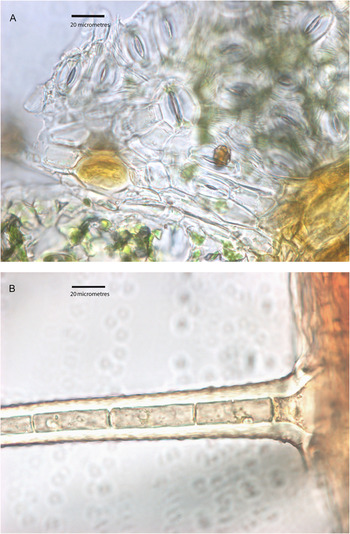
Leaf epidermal characters (Fig. 2). Epidermal cells of adaxial and abaxial leaf sides polygonal with straight to slightly undulated anticlines. Cuticle striate. Stomata on abaxial leaf sides, agglomerated on and along the leaf veins, oval-shaped, anomocytic, 13–20 μm long. Aperture spindle-shaped with slender I-pieces at the poles. Abaxial leaf surface densely covered with simple multicellular hairs.
Leaf epidermal characters of Cedrela ngobe. A. Stomata along vein on lower leaf side. B. Base of a multicellular trichome.

Field characters and phenology. Tree to 30 m tall, 50 cm dbh, bole cylindrical, bark whitish grey, regularly longitudinally fissured. Deciduous, leafless at the beginning of the dry season (end of December), in full leaf at the end of the dry/early wet season (in April). The flower colour varies from creamish white to green or yellow. Sterile specimens, especially from sucker shoots, have much larger leaves with more numerous leaflets. Cut surfaces and crushed leaves have a strong onion-like odour (pers. obs. A.V.K.). Annotations on herbarium vouchers describe it as foul, bitter or garlic-like. Flowering at the end of the dry season and early wet season (April to June), leaves present at flowering time; fruit maturing during the dry season.
Vernacular name and uses. Cedro de Sabana. The timber is used for furniture.
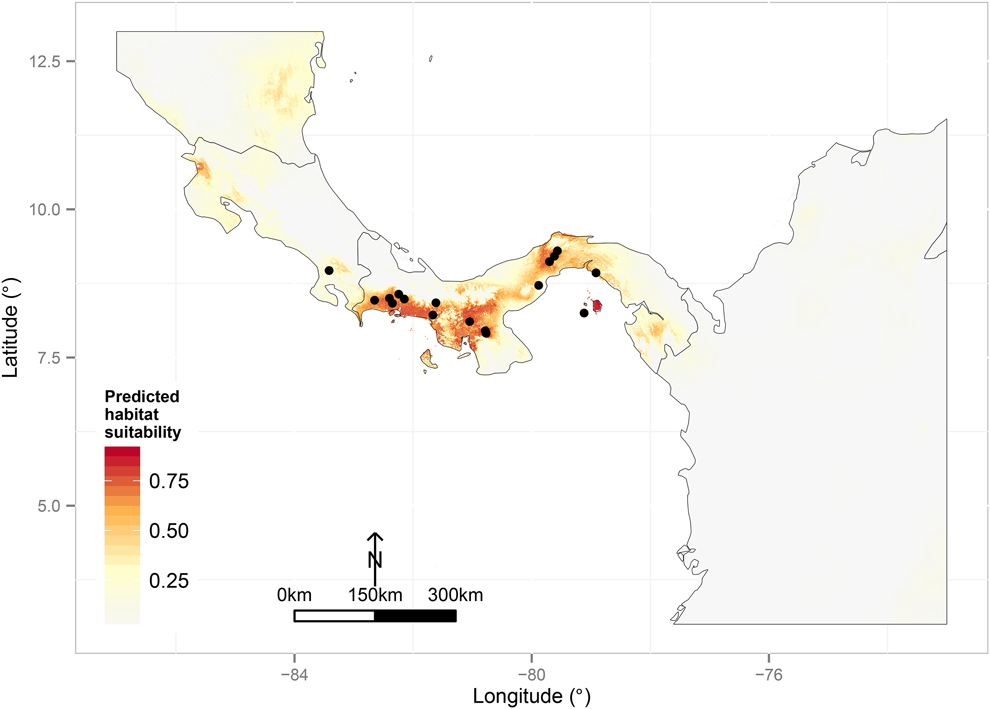
Distribution and ecology. Extending from southeastern Costa Rica throughout the southern Pacific (seasonal) side of Panama to the Canal Zone and on the San José Islands of the Perlas Archipelago in the Gulf of Panama (Fig. 3). It is a common species of (primary) semideciduous lowland forest (0–400 m).
Map of distribution and climatic niche suitability of Cedrela ngobe. The value of each grid cell represents the mean (average value) of the 10 models. The colour scale indicates the predicted suitability: low = 0 (light yellow), high = 1 (dark red).
Etymology. The new species is named in honour of an indigenous group of people in Panamá, the Ngöbe, who, living in their traditional way within the Panamanian Comarca Ngöbe-Buglé, have contributed to preserving primary forest in Central and Western Panama.
Climatic niche modelling. To estimate the accuracy of the distribution map and detect potential areas of occurrence, we performed maximum entropy modelling of the geographic distribution using the program Maxent (v.3.3.3k; Phillips & Dudík, Reference Phillips and Dudík2008) based on the collection sites of 17 individuals of the new species and 19 climatic variables (Bioclim; Hijmans et al., Reference Hijmans, Cameron, Parra, Jones and Jarvis2005). We used climatic layers with a resolution of 30s (c.1 km2). The Maxent analyses were performed using 10 replicates. The average test AUC (Area Under the receiver operating Curve) values of the models were above 0.9. Results from the maximum entropy modelling (as indicated by the colour gradient in Fig. 3) show that climatically suitable habitats of Cedrela ngobe are only located in southern Costa Rica and throughout Panama within comparatively small scattered areas.
Specimens examined. Costa Rica. Puntarenas, Rio Grande de Terraba, vicinity of La Presa, about 3 miles above Palmar, Allen 5280 (A). Around Alhajuela, Pittier 3729 (NY-01239674).
Panama. Chiriquí, Ngöbe-Buglé: Nole Duime, Comunidad, de Llano Nopo, Cáceres 4003 (FR); along the interamerican highway between Chiriquí village and David, next to the bridge crossing Río Chiriquí, Köcke et al. 180409/01 (FR, K), M. Piepenbring & O. Cáceres 5195 (UCH). Ngöbe-Buglé, foothills of Cerro Guánico, Köcke et al. 180409/02 (FR, K, PMA, UCH); road to Gualaca, close to Bella Vista, Köcke et al. 220409/01 (FR, K); Los Algarrobos, Munoz 22 (MO-2901926); SE of La Tranca in pasture beside cliffs near Rio Caldera, Schmalzel 1560 (MO-5755198), (MO-5755199); pasture along road between David and El Hato, Stern & Chambers 103 (NY-01239675); Herrera, 10 mi S of Ocu, Tyson et al. 2827 (MO-1817269); vicinity of Ocu, Allen 4082 (MO-1600383); Panama, Canal Zone, Blum 680 (MO-1817743); between Santa Cruz and entrance to pipeline road, near Gamboa, near Canal zone, Croat 38307 (MO-2388650); Canal Zone, Madden forest, Gentry 2068 (MO-2692676); mouth of Rio Pasiga, Gentry 2205B (MO-2301774); Old Panama, Getek 3588 (MO-1138432); Arraiján, near the city, Lao 104 (FHO-00004467); on road to Cerro Campana, Lazor 5799 (MO-2593115); Perlas Archipelago, Gulf of Panama, San Jose Isl., Johnston 323 (MO-1590779); Veraguas, El Embalsadero, 8 miles west of Santiago, Tyson 6077 (MO-1973862); S of Santa Fe, Nee 8056 (FHO-00004477).
Colombia. La Guajira, Via La Paz a Manaure, Cuadros & Gentry 3432 (MO-4007754).
Phylogenetic relationships. Molecular phylogenetics as well as network analyses based on the nuclear internal transcribed spacer (ITS) region and the plastid psbA-trnH region also confirm that Cedrela ngobe represents a new species which is genetically distinct from other species of Cedrela (Cavers et al., Reference Cavers, Telford, Arenal Cruz, Pérez Castañeda, Valencia, Navarro, Buonamici, Lowe and Vendramin2013; Koecke et al., Reference Koecke, Muellner-Riehl, Pennington, Schorr and Schnitzler2013). Phylogenetic relationships show a close affinity to the Andean Cedrela nebulosa, C. saltensis and another genetic entity of Cedrela which is designated as C. aff. odorata from Central and northern South America (Koecke et al., Reference Koecke, Muellner-Riehl, Pennington, Schorr and Schnitzler2013). This corroborates previous phylogenetic and phylogeographic analyses, which uncovered the distinctness of some genetic entities within the broad species complex of Cedrela odorata sensu lato (Muellner et al., Reference Muellner, Pennington and Chase2009; Cavers et al., Reference Cavers, Telford, Arenal Cruz, Pérez Castañeda, Valencia, Navarro, Buonamici, Lowe and Vendramin2013; Koecke et al., Reference Koecke, Muellner-Riehl, Pennington, Schorr and Schnitzler2013). From the current perspective, these entities comprise the newly described Cedrela ngobe, C. cubensis Bisse (from Cuba and the Cayman Islands), C. odorata sensu stricto (basically from northern Central America with some occurrences in South America), and C. aff. odorata (from southern Central and South America).
Notes. Sterile specimens of Cedrela ngobe were formerly associated with C. fissilis Vell. on account of the leaf indumentum, but the recent collection of flowering and fruiting specimens from Panama shows that it is morphologically distinct from this and all other species. The combination of characters that defines Cedrela ngobe is 6–7 pairs of subsessile leaflets, the lower surface of the leaflets puberulous on the midrib and secondary veins, petals 6–6.5 mm long, and capsule 4–6 cm long. Cedrela fissilis, which is not native in Central America, is clearly separable by its more numerous leaflets (10–17 pairs), longer petals (8–10.5 mm long), and much larger fruit (7–11 cm long). The sympatric Cedrela aff. odorata differs in the subglabrous lower leaflet surface, generally longer petals and distinct phenology (C. ngobe flowers at the end of the dry season and early wet season, C. aff. odorata at the end of the wet season and early dry season). Another species occurring in Panama is Cedrela tonduzii C.DC., but this is clearly distinct in its more numerous, larger leaflets (mostly 8–12 pairs, 14–20.5 cm long), longer petals (8.5–10 mm long) and distinct ecology (wet montane forest at 1000–2500 m elevation).
Conservation assessment. Cedrela ngobe is threatened by deforestation throughout southwestern and central Panama. Chiriquí and Veraguas provinces are among the most productive areas of crops and livestock farming and have thus undergone more extensive deforestation than other regions in Panama since the second half of the 20th century (Kaimowitz, Reference Kaimowitz1996). Comarca Ngöbe-Buglé has experienced the greatest decline in forest cover since 1992 (ANAM, 2003; Parker et al., Reference Parker, Carrión and Sasmudio2004), and we predict that Cedrela ngobe will suffer further decline. Its distribution is fragmented; single trees sometimes occur as remnants of previously forested areas along streets and pastures. The largest extent of predicted climatic niche suitability covers the lowland areas of Chiriquí province, Veraguas province, and southern regions of Comarca Ngöbe-Buglé. To the east, potentially suitable habitats for Cedrela ngobe are found in the province of Panamá and on the Las Perlas Archipelago. Its occurrence further east could not be confirmed, except for one questionable herbarium specimen from Colombia. The total area of occupancy of Cedrela ngobe is therefore estimated to be less than 2000 km2 and has probably undergone a population size reduction of ≥ 30% within the last decades, thereby meeting the IUCN criteria listed under A and B for Vulnerable (VU).
Acknowledgements
We thank the directors, curators and staff of A, FHO, FR, JE, K, MNHN, MO, NY, OXF, PMA and UCH for loan of specimens, or allowing the revision of herbarium material during our visits. The ANAM (Panama) kindly provided collection and export permits to Valerie Köcke. We are much indebted to Hauke Wessels (Hanau) and Meike Piepenbring (Universidad Autónoma de Chiriquí, Panama and Goethe University, Frankfurt M., Germany) and Daniel Cáceres (UCH) for help in the field and to Rosemary Wise, Department of Plant Sciences, Oxford, for producing the beautiful drawings. We thank Gaelle Bocksberger and Meike Piepenbring for helpful comments, and Caroline Pannell and an anonymous reviewer for comments and suggestions on an earlier version of this manuscript. Financial support was provided by the German Science Foundation (DFG) to A. N. Muellner-Riehl and T. D. Pennington (grant no. MU 2934/1-1), and the Research funding programme ‘LOEWE − Landes-Offensive zur Entwicklung Wissenschaftlich-ökonomischer Exzellenz’ of Hesse’s Ministry of Higher Education, Research, and the Arts.