Introduction
The high and unprecedented levels of ionizing radiation (IR) exposure in some workers represent a major scientific and health problem (Picano, Vañó, Domenici, Bottai, & Thierry-Chef, Reference Picano, Vañó, Domenici, Bottai and Thierry-Chef2012; Picano et al., Reference Picano, Vañó, Rehani, Cuocolo, Mont, Bodi and Badano2014). Medical radiation from X-rays and nuclear medicine is the largest man-made source of radiation exposure in Western countries, accounting for a mean effective dose of 3.0 mSv per capita per year, similar to the radiological exposure of 150 chest X-rays (Mettler et al., Reference Mettler, Thomadsen, Bhargavan, Gilley, Gray, Lipoti and Mahesh2008; Picano, Reference Picano2004). Approximately 30 million workers are professionally exposed to radiation, and of these, the interventional fluoroscopists (cardiologists and radiologists) are among the most exposed. In fact, their annual exposure is equivalent to 5 mSv per year that would lead to a projected lifetime cancer risk of 1 in 100 after 20 to 30 years of work (Klein et al., Reference Klein, Miller, Balter, Laskey, Haines, Norbash, Mauro and Goldstein2009; Picano & Vañó, Reference Picano and Vañó2012; Vañó, Gonzalez, Fernandez, Alfonso, & Macaya, 1998; Vañó, González, Guibelalde, Fernandez, & Ten, 2006). This explains the increasing interest of scientific community on (cancer and non-cancer, including brain) effects of radiation exposure. The effects can be clustered in low dose effects (<100 mSv), generally reached with acute medical diagnostic exposures; moderate dose effects (100–1000 mSv), reached with chronic repetitive or cumulative professional fractionated exposures, for instance in interventional cardiologists and radiologists; and, finally, high dose (>1 Sv or 1 Gy) exposures, of particular interest in radiotherapy (Marazziti et al., Reference Marazziti, Baroni, Catena-Dell’Osso, Schiavi, Ceresoli, Conversano, Dell’Osso and Picano2012; Picano et al., Reference Picano, Vañó, Domenici, Bottai and Thierry-Chef2012). Currently, the majority of the data are those regarding radiotherapy dose range and the moderate dose range, as, for example, in the life span study of the atomic bomb survivors, while just a little information is available on the moderate-to-low dose range, that probably is where we need them most (Marazziti et al., Reference Marazziti, Baroni, Catena-Dell’Osso, Schiavi, Ceresoli, Conversano, Dell’Osso and Picano2012). Therefore, there is a great need for exploring what and if low/moderate doses may provoke any dangerous effect, especially on the brain, which is now recognized as one of the main dose-limiting organs in radiotherapy (Loganovsky, Perchuk, & Marazziti, Reference Loganovsky, Perchuk and Marazziti2015; Tofilon & Fike, Reference Tofilon and Fike2000) and a target organ with high cumulative exposures for interventional cardiology staff.
Cranial irradiation in humans suggests a recognized increased risk for eye lens cataract (for doses higher than 0.5 to 2 Gy, reached by almost 50% of interventional cardiologists), neurovascular atherosclerosis (for doses higher than 500 mSv or 0.5 Gy), and brain cancer (Marazziti et al., Reference Marazziti, Baroni, Catena-Dell’Osso, Schiavi, Ceresoli, Conversano, Dell’Osso and Picano2012). The effects of radiation on cognitive functions, especially in the low-to-intermediate dose range, are less clear. This separation is conceptually and clinically essential, since the radiotherapy doses are in excess of 2 Gy, corresponding to a dose risk equivalent of 100,000 chest X-rays, and produce (deliberately, in case of therapeutic applications) tissue “burning”—although a burn with no pain and no heat. With occupational or diagnostic exposures, cumulative doses may vary widely, but generally remain below 500 mSv or 0.5 Gy, which correspond to 25,000 chest X-rays, a “warming” dose which usually has no acute detectable effects but may provoke long-lasting consequences. Cognitive, psychological and psychiatric effects have been well described with radiotherapy doses. However, they remain ill-defined with low-to-moderate doses, usually found with occupational exposures and which may also be acutely reached with some special diagnostic or interventional procedures, such as perfusion head CT scan or interventional neuroradiology procedures (Picano et al., Reference Picano, Vañó, Domenici, Bottai and Thierry-Chef2012; Picano & Vañó, Reference Picano and Vañó2012). Given the high number of exposed workers and the high and rising number of interventional radiology and CT procedures, totaling millions each year, this subject becomes of key scientific and health relevance.
Therefore, the aim of the present study was to assess and compare the scores of a battery of neuropsychological tests in professional staff (cardiologists, technicians, and nurses) working in the cardiac catheterization laboratory, and in a similar and matched group of healthy control participants to explore and detect possible cognitive impairments suggestive of underlying brain damage.
Participants and Methods
Participants
Eighty-three participants (52 men, 31 women) between 27 and 64 years of age (mean±SD: 45.1±8.6), all interventional cardiologists, technicians, and nurses who had been working in catheterization laboratory (exposed group, EG) for a period raging between 2 and 35 years (mean±SD: 14.2±22.2), were included (Table 1). They were selected from a group of cardiologists, technicians, and nurses who were attending two consecutive annual meetings of Italian interventional cardiologists (GISE, Gruppo Italiano Studi Emodinamica, Genoa, October 2011 and October 2012). The EG group was compared with a group of medical doctors, nurses, and technicians belonging to other disciplines (Psychiatry, Neurology, Gynecology, Psychology, and Physiotherapy), matched for age, gender, and educational level (non exposed group, nEG, 52 men, 31 women; mean age±SD: 43.9±8.9 years). By selection criteria, no participants of the two groups had a history of neurological or psychiatric disorders or drug abuse, or took regularly psychotropic drugs, as assessed by trained psychiatrists, by a specific 1-hr long interview. In addition, they were not suffering from severe and/or chronic medical illness. The research was conducted in accordance with the Helsinki Declaration. All participants gave informed consent to the study that was approved by the Ethics Committee of the University of Pisa.
Characteristics of the sample

EG=exposed group; nEG=non exposed group.
The present study is part of the Healthy Cath Lab project (Picano et al., Reference Picano, Vañó, Domenici, Bottai and Thierry-Chef2012) coordinated by the Istituto di Fisiologia Clinica, CNR of Pisa, and GISE scientific society.
Methods
Estimation of Radiation Exposure for EG
For each EG participant, radiation exposure was estimated by an index of cumulative radiological score (RS) calculated as volume of activity (<100 procedures/year=1; 101–200=2; >200=3) and the number of years of exposure. Obtained RS was reduced by 50% in case of second nurse or technician, since typically average annual dose of nurses is almost half of the dose received by physicians (Picano & Vañó, Reference Picano and Vañó2012; Vañó et al., Reference Vañó, González, Guibelalde, Fernandez and Ten1998, Reference Vañó, Gonzalez, Fernandez, Alfonso and Macaya2006).
Neuropsychological Examination
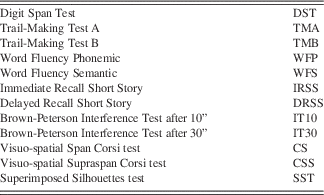
The neuropsychological assessment was carried out in a single session of approximately 1 h. Each participant was sitting and relaxing in a room at a constant temperature (20°C) and was required to perform the tests included in the battery called “Esame Neuropsicologico Breve” (ENB) (Mondini, Mapelli, Vestri, Arcara, & Bisiacchi, Reference Mondini, Mapelli, Vestri, Arcara and Bisiacchi2011) that includes a readapted version of the Token test, Digit span test, Trail-making test, Word phonemic fluency, Immediate and delayed recall of a short story, Brown-Peterson Interference Test, Clock drawing test, Verbal abstraction test, and Praxia test. In addition we used, the Word semantic fluency test (WSF) (Spinnler & Tognoni, Reference Spinnler and Tognoni1987), the visuo-spatial Corsi test (CS) (Barletta-Rodolfi, Gasparini, & Ghidoni, Reference Barletta-Rodolfi, Gasparini and Ghidoni2011), the visuo-spatial supraspan Corsi test (CSS) (Barletta-Rodolfi et al., Reference Barletta-Rodolfi, Gasparini and Ghidoni2011; Mammarella, Toso, Pazzaglia, & Cornoldi. Reference Mammarella, Toso, Pazzaglia and Cornoldi2008), and the Modified Card Sorting Test (MCST) (Caffara, Vezzadini, Dieci, Zonato, & Venneri, Reference Caffarra, Vezzadini, Dieci, Zonato and Venneri2004; Nelson, Reference Nelson1976) (Table 2).
-
- “Token Test” to assess subtle receptive language dysfunction (De Renzi & Vignoli, Reference De Renzi and Vignoli1962). The participant is asked to accomplish the examiner’s request, that is, touch a red circle and a green square, of a total of 10 tokens (5 large circles, 5 large squares) of 5 colors (blue, green, yellow, white, and red).
-
- “Digit Span Test” to evaluate verbal short-term memory. The examiner reads a list of random numbers at the rate of one per second. The test begins with three numbers increased until the participant makes two mistakes in the same length span. At the end of the sequence, he or she is asked to recall the items in order. Performance score is defined as the longest string of numbers correctly recalled.
-
- “Trail-making Test” (TM) to measure visual attention. The participant has to connect the dots of consecutive targets spread on a sheet of paper as quickly as possible. The test is divided in two trials, called A and B: in the first case all the targets are numbers (1, 2, 3, … 25), while in the form B (TMB) numbers and letters (1, A, 2, B, etc.) are used to assess shifted and divided attention. Performance score is defined as the time taken to complete the forms.
-
- “Word Fluency” phonemic (WFP) and semantic tests (WFS) to evaluate the lexical access. In the WFP, the participant has to say as many words as possible beginning with the letter “C, P, S” within 1 min for each. Personal and city names are not accepted. Performance score is defined as the number of words overall correctly reported. In the WFS, the participant has to say as many words as possible from the category of the animals within 1 min. Performance score is defined as the number of correct elements reported.
-
- “Immediate Recall” (IRSS) and “Delayed Recall” (DRSS) of a short story have been used for verbal anterograde memory evaluation. The examiner reads a short story that the subject must recall immediately after its presentation. Soon after, the examiner reads the short story once more and after a 5 min interval, during which the subject is engaged in another non-verbal test, the subject is asked to recall the story. Performance scores are defined as the number of informative units reported respectively for the immediate recall and for the delayed recall.
-
- “Brown-Peterson Interference Test” (IT). Its aim is to interfere with sub-vocal repetition of material for a verbal short-term memory. After the presentation of a visual stimulus represented by a trigram of consonants (e.g., MBW), the subject has to count by two starting from a random number until the examiner stops him or her after 10 (IT10) or after 30 (IT30) s, and then the subject has to recall the last presented trigram. Performance score is obtained by summing the number of elements reported. Only the element recalled in the right sequence is considered correct.
-
- “Clock Drawing Test” to estimate constructive praxia, such as planning, visuo-spatial ability, motor programming and executing, abstraction together with concentration, and response inhibition abilities. The subject is asked to draw a clock reading (2:45). Errors in clock drawing are classified according to the following categories: omissions, perseverations, rotations, misplacements, distortions, substitutions, and additions. Score is defined as the number of elements correctly reported.
-
- “Verbal Abstraction Test” to evaluate the logical reasoning to extract verbal abstract concepts, in particular the ability to merge the generic terms that combine the meaning of two words (e.g., bread and milk).
-
- “Praxia Test” to assess the ability of performing voluntary movements. Participant is asked to perform a movement, for example “brush your teeth,” or carrying out movements of the hands on demand. Score is obtained by summing the number of actions correctly reported.
-
- “Visuo-spatial Span Corsi Test” (CS) to evaluate visuo-spatial short-term memory. The examiner taps a sequence of up to nine identical spatially separated blocks. The sequence starts simply by using three blocks, but it becomes more complex until the subject’s performance impairs. Performance score is defined as the sequence of number blocks correctly recalled.
-
- “Visuo-spatial Supraspan Corsi Test” (CSS) to assess visuo-spatial learning memory. The examiner taps a sequence of eight identical separated blocks up to 20 times. After each presentation, the subject has to try to reproduce the complete sequence. The sequence learning is accepted when the subject reproduces the correct string for three consecutive times. Performance score is defined as the number of repetitions needed to reproduce the correct string for the first time.
-
- “Superimposed Silhouettes Test” (SST) to assess visuognosic skills, such as the ability to perceptually group together perceptual elements in the visual field filtering random visual noise. Subject is faced with a figure containing several superimposed objects. He or she has to indicate and name all the perceived figures. Performance score is defined as the number of correct figures indicated and named.
-
- “Modified Card Sorting Test” to assess strategic planning, organized searching, using environmental feedback to shift cognitive sets, directing behavior toward achieving a goal, and modulating impulsive responses, that is, executive functions. This test uses a deck of 48 cards that contains 4 stimulus cards that differ in terms of color, quantity, and shape. Participants are faced to four master cards (one yellow circle, two blue triangles, three green crosses, four red stars) and are asked to put the cards under one of the master cards according to a category. They have an exclusive “yes” or “no” feedback from the examiner about correctness of their response. After recognition of the three categories, the subject is requested to recognize them once more in the same previous order. Performance score is defined as the overall correct number of recognized categories.
Battery of tests used for the neuropsychological assessment of invasive cardiology personnel (EG) and control participants (nEG)

Statistical Analyses
Regression analysis was carried out for RS and each of the following tests: Digit Span, TMA, TMB, IT10, IT30, WFP, WFS, IRSS, DRSS, CS, CSS, and SST.
Before applying inferential statistical analyses, the possible intergroup differences of age and years of education were analyzed by analysis of variance analysis of variance.
Ceiling effect was obtained for the following tests: Token test, Praxia test, Clock drawing test, Abstraction and Modified Card Sorting Test, so that, in these cases, no inferential statistical analyses could be performed. A two-way analysis of covariance covaring for “age” and “years of education” was carried out for the following tests: Digit Span, TMA, TMB, IT10, IT30, WFP, WFS, IRSS, DRSS, CS, CSS, SST with “group” (EG vs. nEG) and “gender” (women vs. men) as intergroup factors. Data are presented as mean±standard deviation (SD).
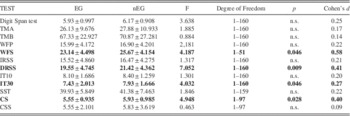
To evaluate the effect size for each dependent measure, Cohen’s d analysis was applied (Table 3).
Total scores of EG and nEG on some neuropsychological tests (statistical differences are reported in bold)

EG=exposed group; nEG=non exposed group; TMA=Trial Making test, part A; TMB=Trial Making test, part B; WFP=Word Phonemic Fluency Test; WSF=Word Semantic Fluency test; IRSS=Immediate Recall; DRSS=Delayed Recall; IT10=Brown-Peterson Interference Test, after 10 seconds; IT30=Brown-Peterson Interference Test, after 30 seconds; SST=Superimposed Silhouettes Test; CS=Visuo-spatial Span Corsi Test; CSS=Visuo-spatial Supraspan Corsi test.
Results
The results showed that women were younger (41.8±9.3 vs. 46.1±9.2 years; F (1,162)=8.564; p=.004) and had a lower educational level (17.1±3.6 vs. 18.7±3.6 vs. F (1,162)=7.782; p=.006) than men. The interaction “gender” and “years of education” was significant (F (1,162)=6,551; p=.011). Tukey test was used as a post hoc analysis, indicating that EG women had less “years of education” than EG men (16.55±3.52 vs. 19.58±3.05; p=.001), as they were mainly nurses.
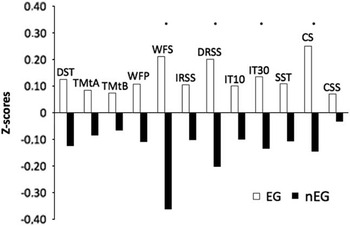
When comparing the neuropsychological test scores between the two groups, significant differences were detected mainly at the level of memory performances. In particular, the delayed recall (DRSS), a parameter assessing verbal long-term memory, was significantly lower in EG than in the control group (19.55±4.75 vs. 21.42±4.36; F (1,160)=7.052; p=.009) (Table 3). Furthermore, it should be noted that 10 of the total of 83 EG participants scored below the cutoff point, and only one of the control group. In addition, the EG participants showed a lower ability than the nEG participants even in the recalling of the right sequence of a presented trigram just after the time limit of the short-term memory. In this case, too, there was a preponderance of scores below the normality in the EG group (14 vs. 59) (Figure 1).
The Z-scores of the mean test performances of exposed (EG) and non-exposed (nEG) participants. Significant differences are marked by the asterisk. Digit Span: Digit Span Test; IRSS: Immediate Recall; DRSS: Delayed Recall; IT10: Brown-Peterson Interference Test, after 10 s; IT30: Brown-Peterson Interference Test, after 30 seconds; TMA: Trail-making Test form A; TMB: Trail-making Test form B; WFP: Word Phonemic Fluency Test; WSF: Word Semantic Fluency Test; SST: Superimposed Silhouettes Test; CS: Visuo-spatial Span Corsi Test; CSS: Visuo-spatial Supraspan Corsi test.

The same was true for visual short-term memory (CS: mean±SD: 5.55±0.94 vs. 5.93±0.99; F (1, 97)=4.95; p=.028) and short-term memory, when the verbal subvocal recall is suppressed (IT30: 7.43±2.01 vs. 7.93±1.67; F (1, 160)=4.032; p=.046). In addition, the semantic lexical access abilities, as evaluated by the semantic tests (WFS), were significantly lower in EG, as compared with nEG (23.14±4.50 vs. 26.67±4.15; F (1,51)=4.187; p=.046). No differences were found on CSS evaluating visual long-term memory, that is, visual learning when required to reproduce a spatial sequence of separated blocks, nor in other parameters (language comprehension, verbal short-term memory, selective and/or shifted and divided visual attention, praxic, visuognosia, strategic planning and organized searching, extract verbal and non-verbal concepts).
The RS (mean±SD) was 24.4±20.5 (range between 0.5 and 96). No correlation with age of participants or length of exposure was found.
Discussion
Data on the brain effects on occupational or accidental exposures to IR are limited, fragmentary, and somewhat conflicting, although of great potential interest, as it involves several individuals, not only atomic bomb survivors, Chernobyl blast, and nuclear power plant workers, but also an increasing rate of professionals in medical fields (biologists, radiology technicians, radiologists and imaging practitioners, veterinarians). Interventional cardiologists are among those most intensive IR users within medicine, as they routinely use cardiac catheterization, with a low awareness of doses and risks (Häusler, Czarwinski, & Brix, Reference Häusler, Czarwinski and Brix2009; Kim et al., Reference Kim, Miller, Balter, Kleinerman, Linet, Kwon and Simon2008; Klein et al., Reference Klein, Miller, Balter, Laskey, Haines, Norbash, Mauro and Goldstein2009; Picano & Vañó, Reference Picano and Vañó2012; Roguin, Goldstein, & Bar, Reference Roguin, Goldstein and Bar2012; Roguin, Goldstein, Bar, & Goldstein, Reference Roguin, Goldstein, Bar and Goldstein2013; Vañó et al., Reference Vañó, González, Guibelalde, Fernandez and Ten1998, Reference Vañó, Gonzalez, Fernandez, Alfonso and Macaya2006). Given the current paucity of information on this topic and the widely described sensitivity of brain structures to IR damage, the present study aimed at exploring and comparing the scores of a battery of neuropsychological tests assessing different cognitive functions (i.e., language dysfunction, anterograde memory, short-term memory, lexical access, constructional and ideo-motor praxia, and some aspect of working memory) in interventional cardiology personnel, including cardiologists, technicians, and nurses (EG), and in a matched group of control participants recruited among other medical disciplines with no IR exposure (nEG).
The main finding of this study would indicate that EG had lower memory performances as compared with nEG. In particular, they scored significantly lower on the DRSS, a parameter evaluating verbal long-term memory (recall) after the examiner reads a short story. It is well known that memory is modulated by hippocampal circuits (Cipollotti & Bird, Reference Cipolotti and Bird2006; Scoville & Milner, Reference Scoville and Milner1957) and that the left hemisphere is mainly involved in the processing of verbal material (Frisk & Milner, Reference Frisk and Milner1990; Henry & Crawford, Reference Henry and Crawford2004; Willment & Golby, Reference Willment and Golby2013).
Besides this finding, the EG group scored lower than the nEG group also on the WFS evaluating the lexical access by using a semantic strategy, but they were similar when using the phonemic WFP. Both tests require frontal lobe integrity; however, it is puzzling that patients with temporal lobe damage showed a lower deficit on the WFP, but a larger on the WFS (for review, see Henry & Crawford, Reference Henry and Crawford2004). In addition, EG participants performed lower than nEG on the CS assessing visual short-term memory, namely reproducing a single tapped sequence of spatially separated blocks soon after its presentation. Of interest, the posterior hippocampus has been shown to contribute significantly to topographical orientation, as well as formation and use of cognitive maps (Iaria, Petrides, Dagher, Pike, & Bohbot, Reference Iaria, Petrides, Dagher, Pike and Bohbot2003; Iaria, Chen, Guariglia, Ptito, & Petrides, Reference Iaria, Chen, Guariglia, Ptito and Petrides2007; Nyberg, Reference Nyberg2005). Nevertheless, no differences were found on CSS evaluating visual long-term memory, that is, visual learning when the participants were asked to reproduce a spatial sequence of separated blocks. It should be noted that all the participants scored above the cutoff on both WFS and CS tests.
Finally, no difference was detected when comparing language comprehension, verbal short-term memory, selective and/or shifted and divided visual attention, praxic, visuognosia, strategic planning and organized searching, and extract verbal and non-verbal concepts.
Taken together, these findings would suggest a significant reduction in memory abilities in interventional cardiology staff involving mainly verbal long-term memory and verbal fluency. These performances have been generally attributed to left hemisphere abilities. No right hemisphere skills were different across groups, that is, long-term visuo-spatial memory or constructive praxia. Therefore, we would highlight, although with the cautions due to the limitation of a relatively precise measure of exposure, that the observed verbal vs. visual intergroup differences would match with the asymmetric exposure of the EG brain to fluoroscopy which is much higher (twice) on the left than on the right hemisphere. According to us, this is the first report of such disturbances in this kind of participants. Previously, memory impairments were described only in whole-brain irradiated individuals for brain tumors (Roguin, Goldstein, & Bar, Reference Roguin, Goldstein and Bar2012; Roguin, Goldstein, Bar, & Goldstein, Reference Roguin, Goldstein, Bar and Goldstein2013). The intergroup differences may perhaps be attributed to a brain damage involving the left temporal lobe structures, as no differences were found when comparing spatial long-term memory and other abilities that are supposed to be regulated mainly by the right hemisphere (Willment & Golby, Reference Willment and Golby2013).
Such disturbances may be related to the already reported changes in hippocampal neurogenesis in particular in the dentate subgranular zone (Warrington et al., Reference Warrington, Ashpole, Csiszar, Lee, Ungvari and Sonntag2013), or to imbalance of glutamate receptors in hippocampal CA1 field (Achanta, Fuss, & Martinez, Reference Achanta, Fuss and Martinez2009), or cerebrovascular rarefaction (Silasi et al., Reference Silasi, Diaz-Heijtz, Besplug, Rodriguez-Juarez, Titov, Kolb and Kovalchuk2004). Relevant to this study, IR damage has been proven in animal models with memory impairment and reduced hippocampal neurogenesis (Warrington et al., Reference Warrington, Ashpole, Csiszar, Lee, Ungvari and Sonntag2013).
We would suggest with caution that routine assessment of neurocognitive functions might be helpful to detect early signs of brain aging in interventional cardiologists, although it is impossible to say—due to the limitations in the current study design that was retrospective and preliminary—if this effect is linked directly to radiation exposure and/ or to prolonged stressful condition of professional life in the catheterization laboratory and/or other environmental factors (such as work in limited and crowded environment) which are known to negatively affect brain plasticity (Borghini, Gianicolo, Picano, & Andreassi, Reference Borghini, Gianicolo, Picano and Andreassi2013; Scali, Baroncelli, Cenni, Sale, & Maffei, Reference Scali, Baroncelli, Cenni, Sale and Maffei2012).
In conclusion, our study shows that interventional cardiology personnel (cardiologists, technicians, and nurses) working in the cardiac catheterization laboratory exposed to IR for a period ranging between 2 and 35 years may show disturbances of some cognitive functions, in particular verbal long-term memory. Further investigation using more specific measures for time and amount of IR exposition could indicate the possible direct relationship between IR and cognitive decline. However, the results of this study highlight the fact that there is a great need of increasing awareness of IR-related problems among cardiologists and, more generally, among medical professionals. If the risk of orthopedic and cancer problems has long been noted, that of brain aging is neglected and underestimated, or even clouded by approximations (Marazziti et al., Reference Marazziti, Baroni, Catena-Dell’Osso, Schiavi, Ceresoli, Conversano, Dell’Osso and Picano2012; Picano et al., Reference Picano, Vañó, Domenici, Bottai and Thierry-Chef2012). Indeed, it has been suggested that IR risk for cancer and, possibly, additional ill-defined non-cancer risk, including atherosclerotic, cardiovascular, cerebrovascular, and neurodegenerative effects (Borghini et al., Reference Borghini, Gianicolo, Picano and Andreassi2013; Loganovsky et al., Reference Loganovsky, Havenaar, Tintle, Guey, Kotov and Bromet2008; Tonacci et al., Reference Tonacci, Baldus, Corda, Piccaluga, Andreassi, Cremonesi, Guagliumi and Picano2014). Studies of brain irradiation in animals and humans provide evidence of apoptosis, neuro-inflammation, loss of oligo-dendrocytes precursors and myelin sheaths, and irreversible damage to the neural stem compartment with long-term impairment of adult neurogenesis that, in most of the cases, seem to be irreversible.
A great effort should be advocated to minimize operator IR exposure (Karadag et al., Reference Karadag, Ikitimur, Durmaz, Avci, Cakmak, Cosansu and Ongen2013; Picano et al., Reference Picano, Vañó, Rehani, Cuocolo, Mont, Bodi and Badano2014) and to prevent their brain disturbances that might progress toward the most severe forms of neurodegeneration. We should make every effort to move from the currently evidence-poor to an evidence-rich milieu, possibly by combining accurate assessment of organ brain dose during professional life with direct assessment of brain function through neurophysiological, electrophysiological, and neuroimaging biomarkers. In the meantime, a careful policy of increased awareness, dose optimization, and targeted head protection is certainly a wise and convenient policy for all health professionals working in the cardiac catheterization laboratory.
Acknowledgment
The authors thank the “Società Italiana di Cardiologia Intensiva” (GISE) for efforts in participant recruitment and project implementing, prof. Sara Mondini and her group for the data relative to the control group performances, and Dr. Giacomo Handjaras for his suggestions relative to data analysis. The authors have no conflicts of interest to declare.