Introduction
Lysmatidae Dana, 1852 is currently comprised of five genera (Exhippolysmata Stebbing, 1915, Ligur Sarato, 1885, Lysmata Risso, 1816, Lysmatella Borradaile, 1915 and Mimocaris Nobili, 1903), of which Lysmata is the most speciose with 50 valid species (Prakash and Baeza, Reference Prakash and Baeza2017; De Grave and Anker, Reference De Grave and Anker2018; Wang and Sha, Reference Wang and Sha2018; Ashrafi et al., Reference Ashrafi, Baeza and Ďuriš2021; Guéron et al., Reference Guéron, Almeida, Aguilar, Ogburn, Prakash and Baeza2022). These shrimps are widely distributed from tropical to temperate regions and exhibit a wide diversity of social systems (e.g. pair-living, small groups or aggregations), mating systems (monogamous vs non-monogamous) and lifestyles (facultative or obligatory symbiosis, or free-living) (Bauer, Reference Bauer2000; Baeza, Reference Baeza2010a, Reference Baeza2013; Baeza et al., Reference Baeza, Guéron, Simpson and Ambrosio2016). Due to their beauty, bright coloration, ability to clean fish from parasites and controlling aquarium pests, shrimps belonging to the genus Lysmata are among the most desired marine invertebrates by aquarists worldwide and, thus, have been traded extensively over the last few decades (Calado et al., Reference Calado, Araújo, Narciso, Lin and Rhyne2003; Baeza and Behringer, Reference Baeza and Behringer2017; Rhyne et al., Reference Rhyne, Tlusty, Szczebak and Holmberg2017; Vaughan et al., Reference Vaughan, Grutter, Costello and Hutson2017, Reference Vaughan, Grutter, Ferguson, Jones and Hutson2018; Barton et al., Reference Barton, Humphrey, Bourne and Hutson2020).
Earlier molecular analyses suggested three subclades within Lysmata, which are represented by species with different sizes and shapes of the accessory branch in the dorsolateral antennular flagellum: (1) short, (2) long and (3) short/unguiform/absent (i.e. variable shape) (Baeza, Reference Baeza2010b; Fiedler et al., Reference Fiedler, Rhyne, Segawa, Aotsuka and Schizas2010). Although paraphyly is observed among clades within Lysmata and it is evidenced by the homoplasy of the short accessory branch, the lineage containing only species bearing a long accessory branch is monophyletic (Baeza, Reference Baeza2010b; Fiedler et al., Reference Fiedler, Rhyne, Segawa, Aotsuka and Schizas2010). Currently, 14 species of Lysmata are known to possess a long accessory branch with more than two articles (hereafter long-branch species), namely L. argentopunctata Wicksten, Reference Wicksten2000, L. chica Wicksten, Reference Wicksten2000, L. galapagensis Schmitt, 1904, L. holthuisi Anker, Baeza and De Grave, Reference Anker, Baeza and De Grave2009, L. intermedia (Kingsley, 1878), L. jundalini Rhyne, Calado and dos Santos, Reference Rhyne, Calado and dos Santos2012, L. malagasy Ashrafi, Baeza and Duriz, Reference Ashrafi, Baeza and Ďuriš2021, L. moorei Rathbun, Reference Rathbun1901, L. napoleoni De Grave and Anker, Reference De Grave and Anker2018, L. nilita Dohrn and Holthuis, Reference Dohrn and Holthuis1950, L. seticaudata Risso, 1816, L. ternatensis De Man, 1902, L. trisetacea (Heller, 1861) and L. zacae Armstrong, Reference Armstrong1941.
Historically, L. intermedia and L. moorei were the only two long-branch species inhabiting the southwestern Atlantic (Christoffersen, Reference Christoffersen1980, Reference Christoffersen and Young1998; Ramos-Porto et al., Reference Ramos-Porto, Carvalho and Botter-Carvalho1995; Coelho Filho, Reference Coelho Filho2006; Almeida et al., Reference Almeida, Guerrazzi and Coelho2007; Santos et al., Reference Santos, Soledade and Almeida2012; Barros-Alves et al., Reference Barros-Alves, Alves, Silva, Guimarães and Hirose2015, Reference Barros-Alves, Alves, Hirose and Cobo2016; Pachelle et al., Reference Pachelle, Anker, Mendes and Bezerra2016, Reference Pachelle, Carvalho, Alves and Anker2020). Recently, an individual collected along the coast of Espírito Santo, southeastern Brazil, was tentatively identified as L. jundalini after detailed morphological analysis, which increases the number of long-branch species in the region (Pachelle et al., Reference Pachelle, Carvalho, Alves and Anker2020). Between 2017 and 2019, we collected several shrimps belonging to the genus Lysmata among rocks close to sandstone reefs in Suape Bay and Praia dos Carneiros, Pernambuco, Brazil, that resemble L. jundalini in most taxonomic characters, but diverged in colour pattern. Additionally, molecular analysis confirmed that our specimens were genetically dissimilar to L. jundalini sensu stricto (see ‘Discussion’). Thus, we described herein a new species of Lysmata from the southwestern Atlantic, which is closely related to L. jundalini, based on molecular, morphological and colour pattern data.
Materials and methods
Specimens were collected along the sandstone reefs of Praia dos Carneiros (8°41′39.06″S 35°4′27.93″W) and Suape Bay (8°21′54.89″S 34°56′51.38″W), Pernambuco, northeastern Brazil, using artificial refuge structures (ARSs) following the methodology of Bochini et al. (Reference Bochini, Cunha, Terossi and Almeida2020). ARSs consisted of cube-shaped structures (25 × 25 × 25 cm3) made of plastic mesh filled with sets of polyvinyl chloride tubes of different diameters and sets of three shade nets tied together. These artificial structures work as ‘attractors’ for some benthic species and were placed in crevices at depths varying between 3 and 5 m using scuba diving.
The reef of Praia dos Carneiros is located within the largest federal marine conservation area in Brazil (Costa dos Corais Environmental Protection Area – ICMBio; http://www.icmbio.gov.br/apacostadoscorais). The Suape Bay reef is in a highly impacted area close to the Suape Industrial Port Complex – the most important port complex in northeastern Brazil.
After collection, shrimps were brought to the laboratory, where they were anaesthetized on ice, photographed and fixed in 70% ethanol. Drawings and measurements of the specimens were made with a camera lucida mounted on a Leica M50 stereomicroscope and Leica DME microscope. All shrimp carapace lengths were measured in millimetres from the post-orbital angle to the posterior margin of the carapace (pocl, mm). Due to protandric hermaphroditism reported in many species of Lysmata (see Baeza, Reference Baeza and Leonard2018), individuals were classified solely as ovigerous (ov.) or non-ovigerous (non-ov.). Type material is deposited at Museu de Oceanografia Professor Petrônio Alves Coelho of Universidade Federal de Pernambuco (MOUFPE), Recife, Brazil and Coleção de Crustáceos do Departamento de Zoologia da Universidade Federal do Rio Grande do Sul (DZ/UFRGS), Porto Alegre, Brazil.
DNA sample preparation, extraction and sequencing
We dissected a small piece of pleonal muscle tissue and extracted total genomic DNA using the Qiagen DNeasy® Blood and Tissue Kit (Cat. No. 69504) following the manufacturer's protocol. Polymerase chain reaction (PCR) was used to amplify target regions of the mtDNA 16S rRNA gene (~557 bp; Schubart et al., Reference Schubart, Neigel and Felder2000) with specific primers, 16L2 (5′-TGCCTGTTTATCAAAAACAT-3′) and 1472 (5′-AGATAGAAACCAACCTGG3′; Schubart et al., Reference Schubart, Neigel and Felder2000; Baeza et al., Reference Baeza, Schubart, Zillner, Fuentes and Bauer2009). PCR products were purified using an ExoSAP-IT kit and sequenced with ABI Big Dye Terminator Mix (Applied Biosystems, Waltham, USA) on an ABI Prism 3100 Genetic Analyzer (Applied Biosystems automatic sequencer). All sequences were confirmed by sequencing both strands and a consensus sequence for the two strands was obtained using the computer program Bioedit v.7.2.5 (Hall, Reference Hall2005) with ClustalW alignment (Thompson et al., Reference Thompson, Higgins and Gibson1994). All new sequences were submitted to GenBank.
Phylogenetic analysis
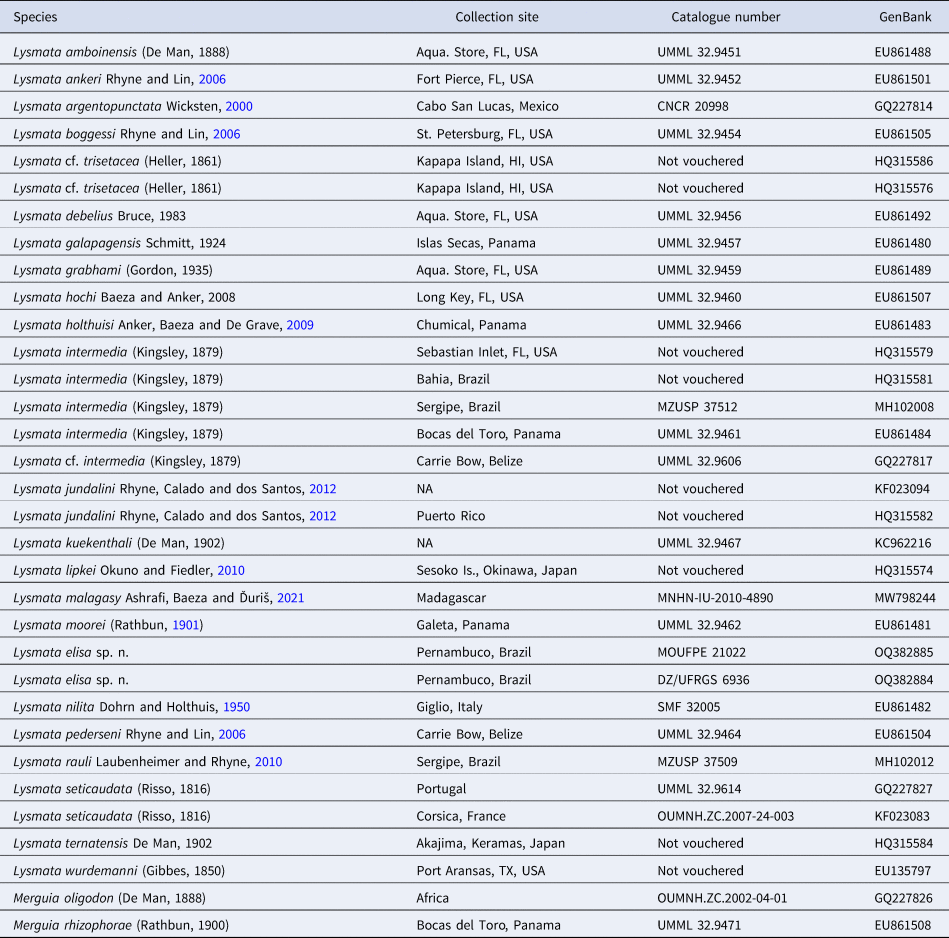
To examine the genetic dissimilarity between our newly collected specimens and other closely and distantly related species of Lysmata, we constructed a molecular phylogeny using fragments of the mtDNA 16S rRNA gene. In total, 31 sequences of species belonging to all previously recognized groups within Lysmata (e.g. short branch, long branch and variable branch shape [Baeza, Reference Baeza2010b; Fiedler et al., Reference Fiedler, Rhyne, Segawa, Aotsuka and Schizas2010]) were used, two of which were generated by us and 29 were obtained from GenBank (Table 1). We included sequences from all long-branch species already sequenced (11 out of 14 described species). In addition, sequences of Merguia rhizophorae Rathbun, 1900 and Merguia oligodon De Man, 1888, also obtained from GenBank, were included in the analyses as outgroups (Table 1).
Lysmata species and other caridean shrimps used for phylogenetic reconstruction using mitochondrial 16S RNA marker

Catalogue numbers, Museum or collection: CNCR, Colección de Crustáceos, Instituto de Biología, Departamento de Zoología, Universidad Nacional Autónoma de México, México; DZ/UFRGS, Coleção de Crustáceos do Departamento de Zoologia da Universidade Federal do Rio Grande do Sul, Porto Alegre, Brazil; MOUFPE, Museu de Oceanografia Professor Petrônio Alves Coelho of Universidade Federal de Pernambuco, Recife, Brazil; MNHN, Museum National d'Histoire Naturelle, Paris, France; MZUSP, Museum of Zoology of the University of São Paulo, São Paulo, Brazil; OUMNH.ZC, Oxford University Museum of Natural History, Zoological Collection, Oxford, England; SMF, Senckenberg Museum, Frankfurt, Germany; UMML, University of Miami Marine Laboratories, Rosenstiel School of Marine Science, University of Miami, Miami, Florida, USA. Abbreviation: NA, not available.
We performed the initial sequence alignment using MUSCLE as implemented in MEGA X (Kumar et al., Reference Kumar, Stecher, Li, Knyaz and Tamura2018). The aligned sequences contained multiple indels or ‘islands’ and were considered ambiguous. Therefore, we used the program GBlocks v0.91b (Castresana, Reference Castresana2000) with the less stringent setup to identify and omit highly divergent and misaligned positions of the mtDNA 16S rRNA gene. The resulting alignment consisted of 425 bp. Aligned sequences were analysed with the program jModelTest 2 (Darriba et al., Reference Darriba, Taboada, Doallo and Posada2012), which compares different models of nucleotide substitution in a hierarchical hypothesis testing framework to select a model that best fits the data. The optimal model found by jModelTest 2 (selected by the Akaike information criterion) was TrN + G. The parameters calculated were as follows: assumed nucleotide frequencies: A = 0.3384, C = 0.0926, G = 0.2039, T = 0.3652; replacement rate matrix with replacement: A − C = 1.0000, A − G = 7.2896, A − T = 1.0000, C − G = 1.0000, C − T = 10.4018, G − T = 1.0000; rates for variable locations assumed to follow a gamma distribution (G) with shape parameter = 0.4260. This model was used in the web server IQ-TREE (Trifinopoulos et al., Reference Trifinopoulos, Nguyen, von Haeseler and Minh2016, http://iqtree.cibiv.univie.ac.at) for maximum-likelihood (ML) analysis. The robustness of the ML tree topologies was evaluated by bootstrapping the observed data 2000 times. Additionally, we calculated pairwise genetic distances (intra- and interspecific) between sequences using the TrN model using MEGA X (Kumar et al., Reference Kumar, Stecher, Li, Knyaz and Tamura2018).
Results
Taxonomy
Order DECAPODA Latreille, 1802
Infraorder CARIDEA Dana, 1852a
Family LYSMATIDAE Dana, 1852b
Lysmata Risso, 1816
Lysmata elisa sp. n. urn:lsid:zoobank.org:act:FCD33BD2-83D5-4DEA-BD16-4F921EB9D230
(Figures 1–4)
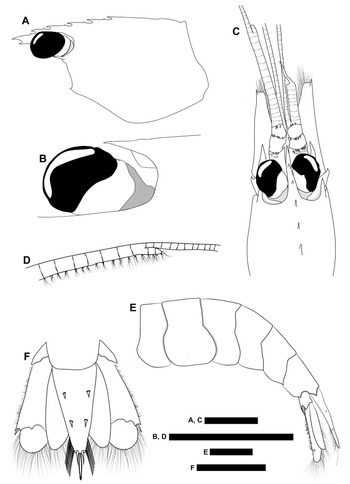
Lysmata elisa sp. n., holotype (MOUFPE 21022): (A) carapace, lateral view; (B) intraorbital region, dorsolateral view; (C) frontal region, dorsal view; (D) dorsolateral antennular flagellum and accessory branch, lateral view; (E) pleon and telson, lateral view; (F) telson, dorsal view. Scale bars: A–F, 2 mm.

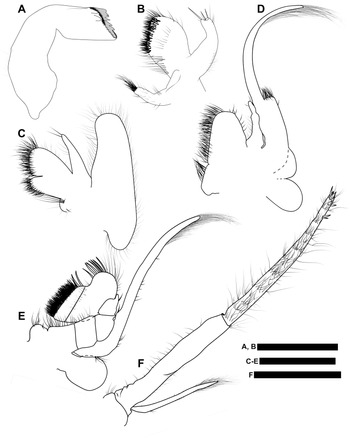
Lysmata elisa sp. n., paratype (MOUFPE 21023; carapace lenght: 3.91 mm): (A) right mandible, ventral view; (B) right maxillula; (C) right maxilla; (D) left first maxilliped; (E) right second maxilliped; (F) right third maxilliped. Scale bars: A–E, 1 mm; F, 2 mm.

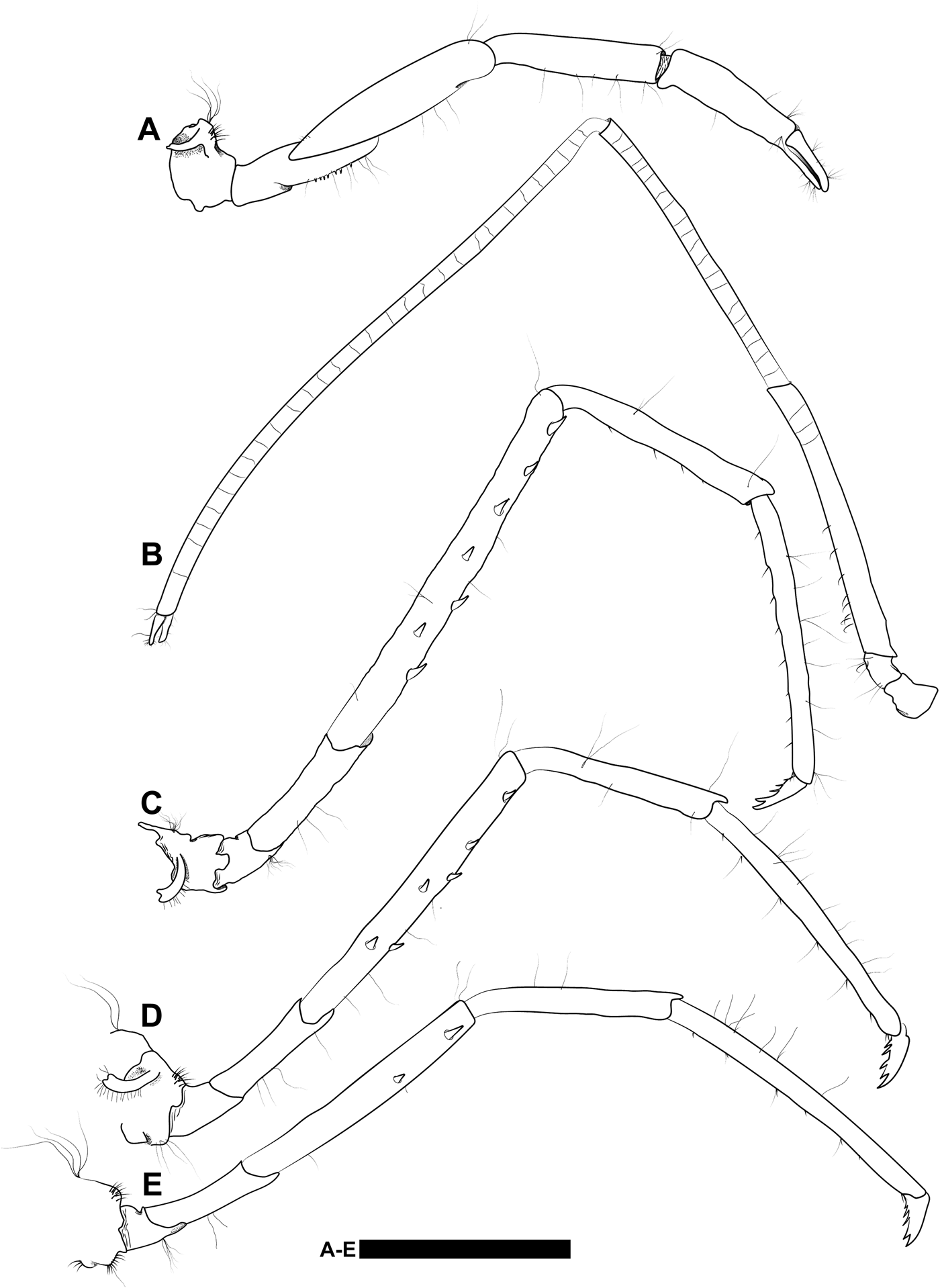
Lysmata elisa sp. n., paratype (MOUFPE 21024; carapace lenght: 4.33 mm): (A) first pereiopod, lateral view; (B) second pereiopod, lateral view; (C) third pereiopod, lateral view; (D) fourth pereiopod, lateral view; (E) fifth pereiopod, lateral view. Scale bars: A–E, 2 mm.

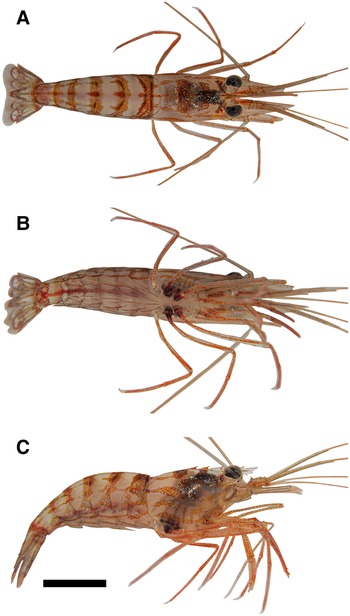
Live colour pattern of Lysmata elisa sp. n., paratype (DZ/UFRGS 6940): (A) dorsal view; (B) ventral view; (C) lateral view. Scale bar: 5 mm.

(?) Lysmata cf. jundalini – Pachelle et al., Reference Pachelle, Carvalho, Alves and Anker2020: 68, Figure 8.
Type material
Brazil, Pernambuco, Cabo de Santo Agostinho, Suape Bay. Holotype: ov. specimen (pocl 4.18 mm), MOUFPE 21022, GenBank 16S gene (OQ382885), depth 3–5 m, collectors G. L. Bochini, G. O. Soledade, P. Santos, R. Guéron and A. O. Almeida, 26/X/2018. Paratypes: one non-ov. specimen (pocl 4.75 mm), DZ/UFRGS 6936, GenBank 16S gene (OQ382884), same collection data as for holotype, 26/VI/2018; four non-ov. specimens (pocl 3.07, 3.91, 3.98, 4.16 mm), MOUFPE 21023, same collection data as for holotype, 26/VI/2018; seven non-ov. specimens (pocl 3.49, 3.93, 4.33, 4.36, 4.40, 4.94, 5.21 mm), MOUFPE 21024, same collection data as for holotype, 16/VIII/2019; one non-ov. specimen (pocl 5.20 mm), DZ/UFRGS 6940, same depth data as for holotype, collectors R. Guéron, W. M. Nascimento, K. Pasinatto and P. H. Paixão, 09/IX/2022.
Brazil, Pernambuco, Tamandaré, Praia dos Carneiros. Paratype: one non-ov. specimen (pocl 3.84 mm), MOUFPE 21025 depth 3–5 m, collectors G. L. Bochini, G. O. Soledade, P. Santos, R. Guéron and A. O. Almeida, 04/IV/2018.
Etymology
The species is named in honour of Maria Elisa Guéron, Rodrigo Guéron's grandmother.
Ecology
All specimens of Lysmata elisa sp. n. were collected using ARSs installed on sandstone reefs (beachrock) between 3 and 5 m. They are probably free-living, not associating with other organisms.
Type locality
Brazil, Pernambuco, Cabo de Santo Agostinho, Suape Bay.
Distribution
Currently known only from the type locality, Suape Bay and Praia dos Carneiros, both localities situated on the state of Pernambuco coast, northeastern Brazil.
Description
Rostrum (Figure 1A, C) straight, about 0.56 times as long as carapace, reaching half of the second article of the antennular peduncle; dorsal margin bearing five teeth evenly distributed with single seta between each tooth, third tooth close to post-orbital margin, fourth and fifth teeth situated on carapace posterior to post-orbital margin; ventral margin bearing two teeth, second tooth covered by the cornea. Carapace (Figure 1A, C) smooth, with rounded posteroventral margin; pterygostomial angle with minute and acute tooth; antennal tooth strong, slightly separated from ventral orbital angle, not reaching middle of cornea; intraorbital process (Figure 1B) triangular shaped in dorsolateral view, 1.53 times as wide as it is high, with rounded tip, no setation observed.
Antennular peduncle (Figure 1C) 0.63 times as long as scaphocerite, first article 2.96 times as long as second article, second article 1.21 times as long as third article; all three articles bearing groups of spinules on distodorsal margin. Stylocerite (Figure 1C) overreaching first article of antennular peduncle. Dorsolateral antennular flagellum long; accessory branch (Figure 1C, D) with two free articles, fused portion with 18 articles, free portion 0.08 times as long as fused portion. Scaphocerite 3.38 times as long as it is wide; scaphocerite distolateral tooth overreaching distal margin of blade.
Pleon smooth (Figure 1E); first three pleonites with margins ventrally rounded; fourth pleonite angulated postero-ventrally with subtle posterolateral tooth; fifth pleonite with well-developed, distally projecting posterolateral tooth; sixth with acute posteroventral tooth and pair of posterior teeth on each side of telson.
Telson (Figure 1F) 1.52 times as long as sixth pleonite, 2.32 times as long as it is wide, tapering posteriorly; lateral margins of telson with numerous long plumose setae on distal half; dorsal surface with two pairs of spines, first pair at 0.33 and second at 0.63 of telson length; posterior margin with three pairs of spiniform setae: one pair of short and stout setae in the outermost position, one pair of long, stout and posteriorly acute setae, and one pair of long plumose setae in the innermost position. Uropod (Figure 1E, F) with protopodite 0.38 times as long as exopod in lateral view, posterolateral lobe with strong tooth bearing four long setae on margin; exopod with diaeresis bearing two strong teeth laterally, separated by slender and longer setae in between; endopod subequal to exopod length.
Mandible (Figure 2A) without palp and incisor process, molar process well-developed bearing five marginal teeth. Maxillula (Figure 2B) with curved palp shallowly bilobed distally, left lobe bearing one terminal strong and long plumose seta and eight marginal plumose setae that extend to distolateral margin of the right lobe, outer basolateral margin of palp bearing row of plumose setae; upper endite bearing several long plumose setae in both lateral margins, strong serrate setae densely gathered on distomesial margin, row of scattered long plumose setae on mesial region; lower endite sub similar when compared to palp bearing scattered long plumose setae in both lateral margins, strong and long serrate setae densely gathered terminally. Maxilla (Figure 2C) with slender palp, bearing two terminal strong and long plumose setae and row of four plumose setae on lateral margin; upper endite deeply bilobed, distomesial margin bearing strong and long serrate setae densely gathered; lower endite rounded, feebly developed, bearing very long plumose setae distally; scaphognathite well developed, distal margin entirely covered with plumose setae.
First maxilliped (Figure 2D) with basal endite shallowly bilobed, distal margin entirely covered with plumose setae densely gathered, inner distolateral margin with scattered plumose setae, dorsomesial region with rows of plumose setae; endopod overreaching distal margin of caridean lobe bearing row of scattered long plumose setae on basolateral margin and three long plumose setae on distal margin; epipod deeply bilobed; exopod well-developed, distinctly curved, bearing several long plumose setae on distal half; caridean lobe small, not distinctly separated from flagellum, with dense plumose setae terminally. Second maxilliped (Figure 2E) with coxa short with long spiniform setae on inner lateral mesial margin; basis with plumose setae on mesial margin; endopod stout; ischium subquadrate with plumose setae on mesial margin; merus without apparent setaetion; carpus short, with one distodorsal robust plumose seta; propodus longer than wide, with anterior margin broadly rounded, distolateral margin with numerous long plumose setae; dactylar segment bearing rows of robust serrate setae on distal margin; exopod well-developed, slightly curved, bearing several long plumose setae on distal half; epipod medially rounded. Third maxilliped (Figure 2F) with long endopod, overreaching scaphocerite, ultimate segment with six distal and two subdistal spines; penultimate segment about 0.53 times as long as ultimate segment; exopod about 0.80 times as long as antepenultimate segment of endopod, bearing long plumose setae on distal half, eight short and simple setae on mediolateral margin, and tuff of plumose setae near base.
First pereiopod (Figure 3A) with simple chela, overreaching scaphocerite by length of fingers when extended; ischium with row of seven (left) and eight (right) spinules and scattered setae on ventrolateral margin; merus with row of hook-like setae on dorsal margin, 1.10 times as long as carpus; carpus 4.84 times as long as it is high; chela 1.15 times as long as carpus, palm 1.87 times as long as dactylus, chela 4.74 times as long as it is high; fingers conspicuously gaping when closed, tip tapering. Second pereiopod (Figure 3B) with ischium with seven (left) and eight (right) scattered hook-like setae on ventral margin; merus with 17 (left) and 16 (right) articles, 1.13 times as long as ischium; carpus with 29 articles in both left and right sides, 2.05 times as long as merus; chela small, with palm 2.16 times as long as fingers.
Third to fifth pereiopods (Figure 3C–E) are similar, decreasing in length from third to fifth. Third pereiopod (Figure 3C) with ischium unarmed; merus with seven stout spines in both left and right sides, 2.46 times as long as ischium; carpus with two (left) and five (right) spiniform setae, 0.56 times as long as merus; propodus with nine (left) and eight (right) spiniform setae on ventromesial margin and pair of spines on ventrodistal margin, 1.31 as long as carpus; dactylus biunguiculate, terminal unguis longer than ventral, flexor margin bearing three spines on left and right sides. Fourth pereiopod (Figure 3D) with ischium unarmed; merus with seven stout spines, 2.01 times as long as ischium; carpus with two spiniform setae, 0.65 times as long as merus; propodus with seven spiniform setae on ventromesial margin and pair of spines on ventrodistal margin, 1.33 as long as carpus; dactylus biunguiculate, terminal unguis longer than ventral one, flexor margin bearing three spines on left and right sides. Fifth pereiopod (Figure 3E) with unarmed ischium; merus with two stout spines in both left and right sides, 2.21 times as long as ischium; carpus unarmed, 0.69 times as long as merus; propodus with eight spiniform setae on ventromesial margin and pair of spines on ventrodistal margin, 1.64 as long as carpus; dactylus biunguiculate, terminal unguis longer than ventral, flexor margin bearing three spines on left and right sides.
Colour in life
Colour pattern description is based on the paratype (voucher number DZ/UFRGS 6940; Figure 4A–C) approximately 72 h after being brought to the laboratory from the field. Body semi-translucent with thin longitudinal stripes formed by the combination of dense red and yellowish dots. Dorsal carapace with inverted trident, oriented posteriorly, lateral region with less evident oblique stripes. Pleon with nine (three dorsal and six lateral) thin longitudinal stripes that may be either continuous or discontinuous; dorsal stripes parallel that converge on the distal margin of the sixth pleonite; evident gaping of chromatophores between the stripes that are interrupted by transversal bands on the transition between each pleonite. Base of eyestalk with two broad longitudinal red bands running from base to proximal margin of cornea. Pereiopods semi-translucent with red spots that may vary from few or very dense; coxa of third and fourth pereiopod with conspicuous dark blue spot, barely reaching the coxa of fifth pereiopod. Protopodite of uropods with semi-translucent base, while the distal half region is bright red (Figure 4A–C).
Morphological variation
Rostral formula (dorsal + post-orbital/ventral teeth) varies little in L. elisa sp. n.: 2 + 3/2; 3 + 2/2; 3 + 2/3; 3 + 3/2; and 3 + 3/3; rostrum length ranges from the proximal margin of the second article to beyond half of the third article of the antennular peduncle. Ratio of fused vs free portion of the dorsolateral antennular flagellum varies between 0.05 and 0.21, with a mean value of about 0.12; accessory branch articles vary between 2 and 5, whereas fused portion articulation varies between 11 and 25. The number of spines in the ultimate segment of the third maxilliped varies between 7 and 10; ratio of penultimate vs ultimate segment varies between 0.44 and 0.53.
Ratios of the first pereiopod also vary; length of merus vs carpus varies between 1.03 and 1.95; carpal length vs height varies between 4.38 and 6.23; lenght of palm vs dactylus varies between 1.82 and 2.52; length of chela vs carpus varies between 0.91 and 1.59; length of dactylus vs chela varies between 0.28 and 0.37; chela length vs height varies between 4.55 and 5.30. The number of hook-like setae on the ischium of the second pereiopod varies between 3 and 8; meral and carpal articles of the second pereiopod vary between 12–23 and 24–31, respectively. The number of meral and carpal articles also varies between left and right sides, with a considerable difference between meri (1–6), while the difference between carpi is smaller (1–2). The number of spines of the merus of the third, fourth and fifth pereiopod varies between 5–10, 4–8 and 1–3, respectively. The number of spines also varies between left and right sides: 1–3 on third, and 1 on fourth and fifth pereiopods. The number of spiniform setae of the propodus of third, fourth and fifth pereiopod varies between 6–10, 5–8 and 6–9, respectively, with an additional pair of distal spiniform setae always present. The number of spines also varies between left and right sides: 1–3 on third, 1 on fourth and 1–2 on fifth pereiopods. The number of spines on the flexor margin of dactylus varies between 3 and 4.
Phylogenetic analysis
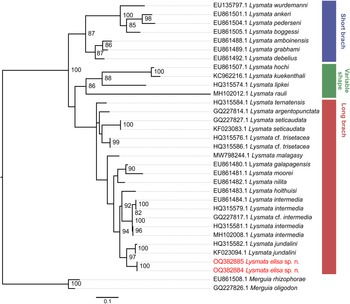
The ML analysis placed the new species within the ‘long-branch’ clade of Lysmata (Figure 5), recognized by earlier studies (Baeza, Reference Baeza2010b; Fiedler et al., Reference Fiedler, Rhyne, Segawa, Aotsuka and Schizas2010). The two sequences of L. elisa sp. n. from Suape Bay are identical (genetic distance = 0.000). L. elisa sp. n. is sister (ML = 97) to L. jundalini, represented in our study by two specimens, one collected in Puerto Rico (the species' type locality) and a second specimen from an unknown locality. Genetic distance between L. elisa sp. n and L. jundalini varied between 0.070 and 0.079. Additionally, our molecular analysis showed that the clade L. elisa sp. n. + L. jundalini is sister to a well-supported (ML = 94) clade composed of L. intermedia and L. holthuisi (Figure 5). Genetic distance between L. elisa sp. n. and L. intermedia varied between 0.095 and 0.101 and was 0.124 between L. elisa sp. n. and L. holthuisi. These values are higher than or similar to interspecific distances observed in the present study for other pairs of morphologically similar sister species based on the 16S gene, including L. ankeri Rhyne and Lin, 2006 vs L. pederseni Rhyne and Lin, 2006 (0.078), L. grabhami (Gordon, 1935) vs L. amboinensis (De Man, 1888) (0.052) and L. hochi Baeza and Anker, 2008 vs L. kuekenthali (De Man, 1902) (0.047).
Phylogenetic tree obtained from ML analysis of the partial mtDNA 16S rRNA gene for Lysmata and Merguia shrimps. Numbers near the branches represent approximate likelihood-ratio test and bootstrap values obtained from ML in the webserver W-IQ-TREE (Trifinopoulos et al., Reference Trifinopoulos, Nguyen, von Haeseler and Minh2016; http://iqtree.cibiv.univie.ac.at/). Low node values (⩽60) were removed from the final topology. Names in red indicate the sequences of the species described in the present study.

Discussion
In this study, we describe a new species of Lysmata from Brazil (Pernambuco) based on integrative systematic data. This new species is close (based on morphology, genetics, and colour pattern) to the eastern Pacific L. holthuisi, and both western Atlantic L. intermedia and L. jundalini. Lysmata intermedia was described from USA (Florida) and has been extensively recorded along the Brazilian coast (Ceará to São Paulo; Christoffersen, Reference Christoffersen1980; Ramos-Porto et al., Reference Ramos-Porto, Carvalho and Botter-Carvalho1995; Almeida et al., Reference Almeida, Guerrazzi and Coelho2007; Santos et al., Reference Santos, Soledade and Almeida2012; Barros-Alves et al., Reference Barros-Alves, Alves, Silva, Guimarães and Hirose2015, Reference Barros-Alves, Alves, Hirose and Cobo2016; Pachelle et al., Reference Pachelle, Anker, Mendes and Bezerra2016, Reference Pachelle, Carvalho, Alves and Anker2020). Lysmata jundalini was described from Puerto Rico and first recorded off the Brazilian coast (Couves Island, São Paulo) in 2018 after reanalysis of material previously identified as L. cf. intermedia (Terossi et al., Reference Terossi, Almeida, Buranelli, Castilho, Costa, Zara and Mantelatto2018). This same material was analysed again by Pachelle et al. (Reference Pachelle, Carvalho, Alves and Anker2020) and identified as L. intermedia. However, it is noteworthy to mention that the latter authors tentatively identified a separate individual as L. jundalini, which was collected at 15 m depth in Guarapari, Espírito Santo State, southeastern Brazil. The authors commented that there is no record of the specimen's colour pattern, although Pachelle et al. (Reference Pachelle, Carvalho, Alves and Anker2020: 71) stated that the individual ‘corresponds to L. jundalini in most taxonomically important morphological characters, including the number of subdivisions in the fused portion of the lateral antennular flagellum and the relatively longer first pereiopod carpus’. We did not have access to this material; thus, we cannot determine whether this material represents L. elisa sp. n., L. jundalini, or a different species. Continued sampling is warranted to resolve the occurrence of L. jundalini in the southwestern Atlantic.
Lysmata elisa sp. n. resembles L. holthuisi, L. intermedia and L. jundalini by the number of rostral teeth (5–6 dorsal and 2–3 ventral) and length (reaching from proximal margin of the second to beyond half of the third antennular article), number of meral (12–23) and carpal (24–31) articles of the second pair of pereiopods and meral (5–10) and propodal (6–10) armature of the third pair of pereiopods. Nevertheless, the new species can be distinguished from the other three by the pterygostomial tooth being minute in the new species vs well-developed in the others (D'Udekem D'Acoz, Reference D'Udekem D'Acoz2000; Anker et al., Reference Anker, Baeza and De Grave2009; Rhyne et al., Reference Rhyne, Calado and dos Santos2012). This character is also useful for distinguishing L. holthuisi from L. argentopunctata and L. chica, both of which present a minute pterygostomial tooth (Anker et al., Reference Anker, Baeza and De Grave2009). Other specific characters are discussed below for each species.
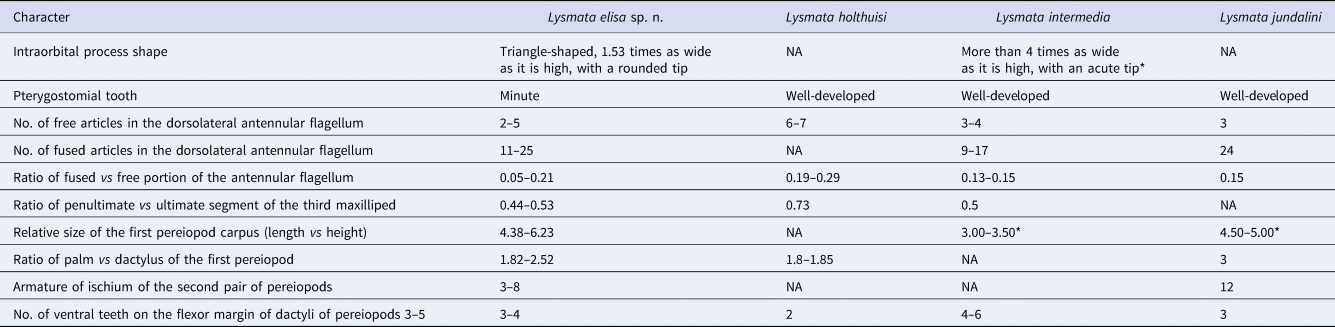
The main characters that distinguish the new species from L. holthuisi are the number of free articles of the dorsolateral antennular flagellum (2–5 vs 6–7 in L. holthuisi), number of ventral teeth on the flexor margin of dactyli of pereiopods 3–5 (3–4 vs 2 in L. holthuisi), ratio of penultimate vs ultimate segment of the third maxilliped (0.44–0.53 vs 0.73 in L. holthuisi) and armature of the fourth pleonite (posterolateral tooth present vs absent) (Anker et al., Reference Anker, Baeza and De Grave2009; present study; see Table 2). Morphologically, L. elisa sp. n. can be separated from its sister species L. jundalini by the palm vs dactylus ratio of the first pereiopod (1.82–2.52 vs 3 in L. jundalini), and the armature of ischium of the second pair of pereiopods (3–8 hook-like setae vs 12 in L. jundalini) (Rhyne et al., Reference Rhyne, Calado and dos Santos2012; present study; see Table 2). New morphological characters, such as the relative size of the first pereiopod carpus and the number of fused articles in the antennular flagellum were proposed by Pachelle et al. (Reference Pachelle, Carvalho, Alves and Anker2020) to differentiate L. intermedia from L. jundalini. Only the former is useful to distinguish L. elisa sp. n. from L. intermedia due to an overlap in the number of articles in the fused portion of the antennular flagellum (Table 2). In L. elisa sp. n., the carpus is 4.38–6.23 times as long as it is high, while in L. intermedia it is 3.00–3.50 times as long as it is high (Pachelle et al., Reference Pachelle, Carvalho, Alves and Anker2020; present study; see Table 2). Pachelle et al. (Reference Pachelle, Carvalho, Alves and Anker2020) also showed that the intraorbital process shape is taxonomically informative in Lysmata. In the new species, the intraorbital process is triangle-shaped, 1.53 times as wide as it is high, with a rounded tip, while in L. intermedia it is more than four times as wide as it is high, with an acute tip (see Figure 7C in Pachelle et al., Reference Pachelle, Carvalho, Alves and Anker2020).
Important characters to delimit the four species belonging to the L. intermedia species complex

The morphological data of L. jundalini and L. holthuisi were retrieved from their respective original descriptions (Rhyne et al., Reference Rhyne, Calado and dos Santos2012 and Anker et al., Reference Anker, Baeza and De Grave2009, respectively), while data of L. intermedia were retrieved from its redescription published by D'Udekem D'Acoz (Reference D'Udekem D'Acoz2000). The data followed by an asterisk were retrieved from Pachelle et al. (Reference Pachelle, Carvalho, Alves and Anker2020). Abbreviation: NA, not available.
Species of the L. intermedia complex can also be separated by their colour in life, as can species of the L. wurdemanni (Gibbes, 1850) and L. vittata (Stimpson, 1860) complex, and the sister species L. amboinensis and L. grabhami (Rhyne and Lin, Reference Rhyne and Lin2006; Baeza, Reference Baeza2010b; Baeza and Behringer, Reference Baeza and Behringer2017; Aguilar et al., Reference Aguilar, Prakash, Ogburn, Lohan, MacDonald, Driskell, Ahyong, Leray, McIlroy, Tuckey and Baeza2022; Guéron et al., Reference Guéron, Almeida, Aguilar, Ogburn, Prakash and Baeza2022). Lysmata elisa sp. n. can be distinguished from L. holthuisi by the absence of a dense cover of chromatophores between the longitudinal stripes along the entire pleon, absence of a mediodorsal V-shaped band crossing the most-posterior post-rostral tooth and absence of a conspicuous coloured accessory branch of lateral flagellum, which is bright yellow in the latter species (all characteristics present in L. holthuisi; see Figure 4 in Anker et al., Reference Anker, Baeza and De Grave2009). In L. jundalini, the left and right dorsal stripes, adjacent to the central stripe, do not reach the distal margin of the sixth pleonite, while in L. elisa sp. n. the three dorsal stripes (central + adjacent) converge at the distal margin of the sixth pleonite forming a transverse band that extends to the proximal margin of the tail fan (see Figure 4 in Rhyne et al., Reference Rhyne, Calado and dos Santos2012 and Figure 10 in Pachelle et al., Reference Pachelle, Carvalho, Alves and Anker2020). Another diagnostic feature in L. jundalini is the brilliant orange coloration on the dorsal region of its pereiopods 3–5, which is reddish in the new species. Lysmata elisa sp. n. can be distinguished from L. intermedia by the presence of a conspicuous dark blue spot on the coxa of fourth pereiopod, which spreads to the coxa of the third pereiopod (absent in L. intermedia). This same character is used to distinguish L. jundalini from L. intermedia (Rhyne et al., Reference Rhyne, Calado and dos Santos2012). Also, L. intermedia presents thin longitudinal stripes with a dense cover of chromatophores between them which goes parallelly from the proximal margin of the pleon to the distal margin of the telson, without converging (see Figure 5 in Rhyne et al., Reference Rhyne, Calado and dos Santos2012 and Figure 9 in Pachelle et al., Reference Pachelle, Anker, Mendes and Bezerra2016).
Five species of the long-branch group can be readily distinguished from L. elisa n. sp. by the number of fused (11–25), free articles (2–5) and/or the ratio between length of free and fused portion of the dorsolateral antennular flagellum (0.05–0.21): L. argentopunctata (13–15 fused and 13–17 free, ratio 0.5; Wicksten, Reference Wicksten2000; Anker et al., Reference Anker, Baeza and De Grave2009), L. moorei (8–13 fused and 7–16 free, no data on ratio; Rathbun, Reference Rathbun1901; Pachelle et al., Reference Pachelle, Carvalho, Alves and Anker2020), L. napoleoni (6–9 fused and 10–13 free, ratio 1.1–2.2; De Grave and Anker, Reference De Grave and Anker2018), L. seticaudata (20–38 fused and 8–15 free, ratio 0.5–0.6; Dohrn and Holthuis, Reference Dohrn and Holthuis1950), L. ternatensis (no data on fused and 10–18 free, no data on ratio; Chace, Reference Chace1997; Madhavan et al., Reference Madhavan, Purushothaman, Akash, Bharathi, Jose, Dhinakaran, Ravi, Kumar and Lal2019) and L. trisetacea (no data on fused and 7–10 free, no data on ratio; Chace, Reference Chace1997; Wicksten, Reference Wicksten2000).
An additional set of characters is also useful for differentiating the new species from the five listed above; specifically, the absence of a pterygostomial tooth (present in the new species), and carpal articles in the second pereiopod that distinguish L. moorei (17) and L. trisetacea (19–24) from L. elisa sp. n. (24–31) (Rathbun, Reference Rathbun1901; Chace, Reference Chace1997). Lysmata elisa sp. n. also differs from L. moorei by the shape of the intraorbital process, which is more than 6 times as wide as it is high in the latter vs 1.53 times in the former (see Figure 13C in Pachelle et al., Reference Pachelle, Carvalho, Alves and Anker2020). The fourth pleonite with the posterolateral angle rounded of L. napoleoni, L. seticaudata and L. ternatensis (Chace, Reference Chace1997; D'Udekem D'Acoz, Reference D'Udekem D'Acoz2000; De Grave and Anker, Reference De Grave and Anker2018) also distinguishes from L. elisa sp. n., which possesses a pointed posterolateral angle.
Other species of the long-branch group may possess a similar number of articles in the free portion of the accessory branch (3–6) to that reported herein for L. elisa sp. n. However, other sets of characters are important to distinguish them. For instance, the new species may be distinguished from L. malagasy by possessing 11–25 articles in the fused portion of the antenular flagella (vs 8–9), a subtle posterolateral tooth on fourth pleonite (vs absent), merus and carpus of the second pereiopod with 12–23 and 24–31 articles, respectively (vs 8 and 23) and propodus of the third pereiopod bearing 6–9 spiniform setae (vs 16) (Ashrafi et al., Reference Ashrafi, Baeza and Ďuriš2021). Lysmata chica and L. galapagensis present a smaller number of articles in the fused portion of the antennular flagella (10–11 and 6–13, respectively) and in the merus of the second pereiopod (10–13 and 7–9, respectively) compared to the new species (Wicksten, Reference Wicksten2000). Additionally, L. galapagensis presents no pterygostomial tooth on the anteroventral margin of the carapace (Wicksten, Reference Wicksten2000). Lysmata nilita from the Mediterranean Sea resembles L. elisa sp. n. by the number of fused and free portion of the antennular flagellum; nevertheless they may be separated by the ratio of free vs fused portion of the antennular flagellum (0.20–0.33 in L. nilita vs 0.05–0.21 in L. elisa sp. n.) and the number of carpal articles in the second pereiopod (30–35 in L. nilita vs 24–31 in L. elisa sp. n.) (Dohrn and Holthuis, Reference Dohrn and Holthuis1950).
In the present study, we considered L. zacae as a long-branch species morphologically different than L. elisa sp. n. Despite neither L. zacae's original description, nor its redescription explicitly state the number of accessory branch articles (Armstrong, Reference Armstrong1941; Okuno, Reference Okuno1996), the latter author stated that this species possesses a ‘dorsal antennular flagellum distinctly biramous’, while Chace (Reference Chace1997) placed it in the group of species with ‘distinct accessory branch of 3–16 articles’. The new species may be readily distinguished from L. zacae by the number of rostral ventral teeth (2–3 in L. elisa sp. n. vs 4 in L. zacae), presence of pterygostomial tooth (vs absent), antennular peduncle 0.63 times as long as scaphocerite (vs almost as long as scaphocerite), stylocerite overreaching first article of antennular peduncle (vs stylocerite short, reaching the proximal third of first article of antennular peduncle) and the number of carpal articles in the second pereiopod (24–31 in L. elisa sp. n. vs 34–38 in L. zacae) (Armstrong, Reference Armstrong1941; Okuno, Reference Okuno1996).
Lysmata elisa sp. n. is easily distinguished from two other exotic/invasive congeneric in the southwestern Atlantic, L. lipkei Okuno and Fiedler, Reference Okuno, Fiedler, Fransen, De Grave and Ng2010 and L. rauli Laubenheimer and Rhyne, Reference Laubenheimer and Rhyne2010 and from the putatively amphi-Atlantic L. uncicornis Holthuis and Maurin, Reference Holthuis and Maurin1952. While the new species exhibits a long accessory branch in the dorsolateral flagellum, the other three species above possess one article in the accessory branch in the dorsolateral flagellum (Holthuis and Maurin, Reference Holthuis and Maurin1952; Laubenheimer and Rhyne, Reference Laubenheimer and Rhyne2010; Okuno and Fiedler, Reference Okuno, Fiedler, Fransen, De Grave and Ng2010). Additionally, the new species may be differentiated from L. lipkei and L. rauli by the number of meral articles in the second pereiopod (12–23 vs 23–27 in L. lipkei and 5–11 in L. rauli; Laubenheimer and Rhyne, Reference Laubenheimer and Rhyne2010; Okuno and Fiedler, Reference Okuno, Fiedler, Fransen, De Grave and Ng2010; Guéron et al., Reference Guéron, Almeida, Aguilar, Ogburn, Prakash and Baeza2022), and from L. uncicornis by the shape of the fourth pleonite (posterolateral margin angle pointed vs posterolateral angle rounded in L. uncicornis; Holthuis and Maurin, Reference Holthuis and Maurin1952; Giraldes et al., Reference Giraldes, Macedo, Brandão, Baeza and Freire2018 as L. arvoredensis Giraldes, Macedo, Brandão, Baeza and Freire, 2018).
Molecular analysis supports our morphological and colour pattern findings, which separate L. elisa sp. n. as a distinctive and well-supported lineage different than (sister to) L. jundalini. It is worth mentioning that one of the sequences of L. jundalini is from the type locality, Puerto Rico (Fiedler et al., Reference Fiedler, Rhyne, Segawa, Aotsuka and Schizas2010). The L. elisa sp. n. + L. jundalini clade is sister to a second well-supported clade containing L. intermedia and L. holthuisi (Figure 5). All the four species above belong to the L. intermedia species complex (Rhyne et al., Reference Rhyne, Calado and dos Santos2012). The genetic distances between L. elisa sp. n. and L. jundalini varied between 0.070 and 0.079. The minimum genetic distances between L. elisa sp. n. and the other two species of the L. intermedia complex are 0.095 (L. intermedia) and 0.124 (L. holthuisi). These values are higher than or similar to interspecific distances observed in the present study for other pairs of morphologically similar sister species (see ‘Results’).
Conclusion
Lysmata elisa sp. n. represents the 51st species belonging to Lysmata described worldwide and the number of species currently recorded in the southwestern Atlantic increases to 12. The new species belongs to the so-called ‘long-branch’ clade sensu Fiedler et al. (Reference Fiedler, Rhyne, Segawa, Aotsuka and Schizas2010), which contains now 15 species described worldwide possessing a dorsolateral antennular flagellum with a long and multi-articulated accessory branch.
Our results reinforce the importance of refining biodiversity data through the application of integrative taxonomic approaches (i.e. combining morphological data with other data sources) to expand knowledge of local and global biodiversity. In earlier studies, integrative taxonomy proved to be an effective tool in resolving taxonomic confusions previously caused by morphological similarity between different taxa and the discovery of species not yet known, especially in peppermint shrimp (Rhyne and Lin, Reference Rhyne and Lin2006; Baeza and Prakash, Reference Baeza and Prakash2019; Aguilar et al., Reference Aguilar, Prakash, Ogburn, Lohan, MacDonald, Driskell, Ahyong, Leray, McIlroy, Tuckey and Baeza2022; Guéron et al., Reference Guéron, Almeida, Aguilar, Ogburn, Prakash and Baeza2022). The biodiversity of this group of shrimps deserves special attention, as they are intensively exploited in the aquarium trade (Baeza and Behringer, Reference Baeza and Behringer2017). Despite its popularity, the difficulty of accurately identifying shrimps belonging to Lysmata is often documented in the literature, even for specialists (Rhyne and Lin, Reference Rhyne and Lin2006; Soledade et al., Reference Soledade, Baeza, Boehs, Simões, Santos, Costa and Almeida2013; Baeza and Behringer, Reference Baeza and Behringer2017). This problem, which is also observed in other groups of animals, may cause impacts on conservation and protection of Lysmata shrimps, which have the risk of being overexploited.
Finally, the discovery of the new species together with data from L. intermedia and L. holthuisi may shed light on biogeographic events (e.g. closure of Panama isthmus and Amazon River plume) responsible for diversification of marine organisms distributed along the tropical eastern Pacific and western Atlantic. Therefore, the L. intermedia complex represents a study model that may be used for future phylogeographic studies of marine taxa.
Data
Data are available on request from the authors.
Acknowledgements
R. G. thanks Dr. Bruno de Lima Preto (Instituto Federal do Espírito Santo) and Dr. Jesser Fidelis de Souza Filho (Universidade Federal de Pernambuco) for providing space in their respective laboratories for the analysis of specimens. The authors thank Isaac Freitas, Mr. Manuel (Seu Neco), Hélder and all students of the Laboratory of Crustacean Biology (LBC) of the Universidade Federal de Pernambuco for all the help during collection. The authors also thank the two anonymous reviewers for comments that have substantially improved the manuscript. All samplings in this study were conducted according to applicable state and federal laws, license Nos. 58697-1 and 72882-2 MMA/IBAMA/SISBIO.
Author's contribution
Research conception and design: R. G., G. L. B. and A. O. A.; research conducted: R. G., G. L. B. and A. O. A.; acquisition of data: R. G., G. L. B., M. T. and A. O. A.; analysis and interpretation of data: R. G., J. A. B., G. L. B., M. T. and A. O. A.; preparation of figures/illustrations: R. G.; writing – original draft: R. G.; writing – critical review and editing: R. G., J. A. B., G. L. B., M. T. and A. O. A.
Financial support
This work was supported by the Coordenação de Aperfeiçoamento de Pessoal de Nível Superior – Brazil (CAPES) (R. G., grant number 88887.374573/2019-00); the Conselho de Desenvolvimento Científico e Tecnológico – Brazil (CNPq) (G. L. B., grant number DCR – 300067/2018-6; M. T., grant numbers Research Grant 421193/2018-2 and PQ 311340/2021-0; A. O. A., grant number PQ 304235/2019-9); the Fundação de Amparo à Ciência e Tecnologia do Estado de Pernambuco (FACEPE) (G. L. B., grant number APQ-0196-2.04/16); the Linnean Society of London (R. G.) and the Systematics Association (R. G.).
Competing interests
The authors declare none.