Physical activity is a basic need in children. Their perceptual and motor experiences determine their physical and motor development and also affect their emotional, psychosocial, and cognitive development.Reference Bjarnason-Wehrens, Dordel and Schickendantz 1 , Reference Dordel, Bjarnason-Wehrens and Lawrenz 2
In the majority of children with congenital heart disease, there is a delay in motor development compared with healthy peers.Reference Bjarnason-Wehrens, Dordel and Schickendantz 1 – Reference Mooren, Winter and Neumann-Wedekindt 9 The reason for a reduced motor development is manifold. The severity of disease including long-standing cyanosis in early childhood,Reference Stieh, Kramer, Harding and Fischer 7 , Reference Schmitz, Dordel and Bott 8 time on the intensive care unit,Reference Limperopoulos, Majnemer and Shevell 5 duration of circulatory arrest, and age at surgeryReference Limperopoulos, Majnemer and Shevell 5 , Reference Schmitz, Dordel and Bott 8 , Reference Bellinger, Jonas and Rappaport 10 , Reference Bellinger, Wypij and Kuban 11 are known risk factors. In addition, a reduced daily activity,Reference Müller, Christov, Schreiber, Hess and Hager 12 – Reference Müller, Hess and Hager 15 often advised by physicians and enhanced by parental overprotection,Reference Bjarnason-Wehrens, Dordel and Schickendantz 1 , Reference Müller, Christov, Schreiber, Hess and Hager 12 , Reference Utens, Verhulst and Erdman 16 contribute to this phenomenon. If left untreated, these motor deficits usually persist into adulthood.Reference Limperopoulos, Majnemer and Shevell 5 , Reference Losse, Henderson, Elliman, Hall, Knight and Jongmans 6 , Reference Bellinger, Jonas and Rappaport 10 , Reference Bellinger, Wypij and Kuban 11
However, optimal rehabilitative, social, and environmental support might improve the children's motor competence and prevent health problems later in life. Until now, only pilot studies with few participants have been published, which have shown that motor training improves motor abilityReference Dordel, Bjarnason-Wehrens and Lawrenz 2 , Reference Mooren, Winter and Neumann-Wedekindt 9 and quality of life in children with congenital heart disease.Reference Moons, Barrea and Suys 17
However, a training of several times a week is not achievable in most cases primarily because of logistical problems. Thus, this study addresses the feasibility and effectiveness of a simple playful motor training once a week to improve motor ability in children with congenital heart disease within a period of 3 months.
Patients and methods
Study design
From April, 2007 to July, 2011, we recruited 4–6-year-old preschool children with various types of congenital heart disease for a supervised motor training at the Department of Preventive and Rehabilitative Sports Medicine of our University. Before inclusion, a detailed medical examination was performed by a paediatric cardiologist including physical examination, resting and ambulatory electrocardiogram, and echocardiography. The detailed exclusion criteria for the safety of the study are published online (see Supplementary Materials).
After inclusion, all patients performed a baseline test to assess motor developmental abilities. Then, the children participated in a special training programme aimed at motor ability improvement. After 3 months and at least 12 sessions, the children underwent the motor development assessment again.
The study was prospectively designed and in accordance with the declaration of Helsinki (revision 2007). The study protocol was approved by the local ethics board (project number 1730/07). All patients’ parents gave written informed consent.
Motor development assessment
Motor ability was quantified with the MOT 4–6 from Zimmer et al.Reference Zimmer and Volkamer 18 This test is designed to assess motor deficits in preschool children and is reliable in the age group of 4–6 years. There are 18 different exercise tasks that address several domains of motor skills such as agility, coordination, reaction, jumping power, balance, as well as speed and control of motion. Each task, except the first one, is rated with zero, one, or two points according to predefined landmarks for that single task. All task points are summed up to a score that is transformed to a motor ability index (motor quotient) according to the corresponding reference value for boys and girls in half-year age groups.Reference Zimmer and Volkamer 18 A motor quotient of 100 resembles the expected reference value with a standard deviation of 15.
Full test time with prearrangement takes about 30 min. All tests were conducted by the same examiner in our institution.
Intervention programme
Children were trained in small groups by a sport scientist once per week for 60 min in a playful manner. The aim of the exercise programme was to improve motor ability in a playful manner. Parents were not allowed to stay in the gym during the session.
The programme started with a short gathering where children reported on their health status in the previous week. Afterwards, the trainer introduced a motto of the session with a short story and started with a playful warm-up. The main part with the aim to enhance motor competence contained several obstacles that had to be passed either alone or in the group. For example, when the topic of the session was “jungle”, the adventurer (child) had to get over a river (swing on a rope), cross a canyon on a small bridge (balancing on a bar), and pick bananas from a tree (climbing wall bars).
Data analyses
Owing to the fact that data were skewed, all descriptive data are expressed in median values and interquartile ranges (Quartile 1; Quartile 3). Non-parametric Wilcoxon signed-rank test was performed to compare the motor ability at baseline with that after intervention.
All analyses were performed using PASW 18.0 software (SPSS Incorporation, Chicago, Illinois, United States of America). p-values <0.05 were considered significant.
Results
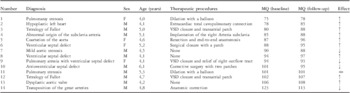
From April, 2007 to July, 2010, 14 children with various types of congenital heart disease could be recruited from our outpatient department (Table 1).
Study subjects and MOT 4–6 results from baseline and follow-up testing.

F = female; M = male; MOT = motor developmental test; MQ = motor quotient; VSD = ventricular septal defect
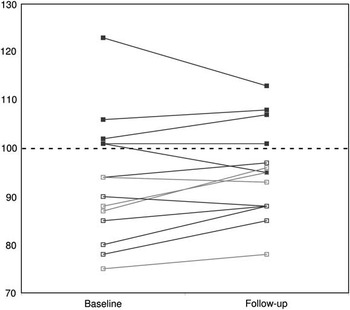
Median motor quotient at baseline was 92.0 (83.75, 101.25). Of the 14 patients, 9 were below the reference value of 100. After the training programme, motor quotient increased slightly to 95.0 (88.0, 102.5) but failed to reach statistical significance in the whole group (p = 0.141; Fig 1).
Changes in motor quotient in children at baseline and follow-up testing. Boys are depicted in blue and girls in red. The dashed line represents the normal motor development.

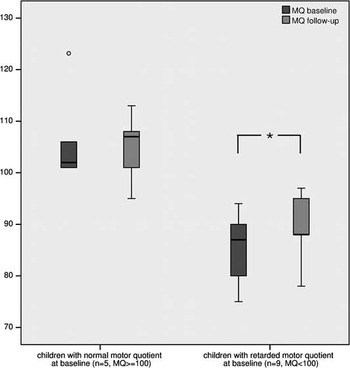
In a subgroup analysis of the nine children with a less than normal motor development at baseline (motor quotient lower 100), there was an increase in motor ability in seven of the nine children. In the whole subgroup, motor quotient increased significantly (p = 0.020) about 5% from 87.0 (79.0, 92.0) to 88.0 (86.5, 95.5) after 3 months of motor training (Fig 2).
Motor quotient in children at baseline and follow-up testing according to subgroups. MQ = motor quotient. *Children with a less than normal motor development show an increase in motor ability after 3 months of motor training (Wilcoxon signed-rank test, p = .020).

Discussion
This study showed that even a short intervention programme of 60 min once per week improves the motor ability of children with congenital heart disease and a retarded motor development within 3 months. However, motor training once a week was too low to lead to an improvement in the whole study group of children with congenital heart disease.
There is consensus that motor development is often delayed and impaired in children with congenital heart disease.Reference Dordel, Bjarnason-Wehrens and Lawrenz 2 – Reference Hovels-Gurich, Seghaye, Dabritz, Messmer and von Bernuth 4 , Reference Losse, Henderson, Elliman, Hall, Knight and Jongmans 6 – Reference Bellinger, Wypij and Kuban 11 , Reference Unverdorben, Singer and Zrägler 19 Bjarnason-Wehrens et alReference Bjarnason-Wehrens, Dordel and Schickendantz 1 revealed 59% of 194 tested children with various types of congenital heart disease to have moderate to severe deficits in gross motor skills. Almost one-third (32%) had severe deficits. In the healthy peers, 78% had a normal or better than normal motor development. In contrast to Bjarnason-Wehrens et al,Reference Bjarnason-Wehrens, Dordel and Schickendantz 1 only four (29%) of our children were slightly impaired in their motor development, that is, a motor quotient lower 85. The other 10 (71%) presented at least a normal motor development at baseline. This superior motor result is probably a bias of our patient recruitment as our patients’ parents were motivated to let their children participate in this sport programme. Probably, they were also more liberal to allow their children to indulge in normal sport activities in daily life and were less “overprotective”.
The role of this “overprotection” is very important. In the study of Bjarnason-Wehrens et al,Reference Bjarnason-Wehrens, Dordel and Schickendantz 1 the authors outline that even patients without haemodynamic burden show impairment in motor development. Unverdorben et alReference Unverdorben, Singer and Zrägler 19 demonstrated that children with congenital heart disease who were refrained from physical exercise had a higher motor impairment than children who participate in normal sport activities. However, the harm of overprotection, especially in those children with simple defects without residuals, could be avoided by improving the awareness of the parents regarding the cardiac defect of their children. Currently, there still is a tremendous lack of information regarding daily exercise and competitive activities, as well as the education of their potential benefits in patients with congenital heart disease.Reference Swan and Hillis 20
With regard to motor training in congenital heart disease, there have only been two pilot studiesReference Dordel, Bjarnason-Wehrens and Lawrenz 2 , Reference Mooren, Winter and Neumann-Wedekindt 9 in school-aged children. Dordel et alReference Dordel, Bjarnason-Wehrens and Lawrenz 2 were the first to report an improvement in motor ability in 31 children with various types of congenital heart disease after 8 months of a psychomotor training. In their study, playful training once a week for 75 min was sufficient to increase motor ability significantly. Moreover, the effect holds true for all subgroups (mild or no sequels – severe sequels, age younger ten – ten years or older, cyanotic – acyanotic). Another intervention study performed by Mooren et alReference Mooren, Winter and Neumann-Wedekindt 9 showed the same effect in the short-term outcome. Their swim training for 45 min once per week increased motor ability significantly within 3 months of intervention in 10 patients with congenital heart disease. However, in both investigations children had an impaired motor ability at baseline. This is in contrast to our study group where most of the children had a normal motor development, and improvements were seen only in those with a reduced motor development. Thus, we cannot generalise that training once per week is enough to reach an increase in the whole group of patients with congenital heart disease. From our point of view, motor training once a week seems to be too low to reach an improvement in motor ability. Nevertheless, a positive effect of this low-dose exercise training is seen in those patients with a delay in their motor competence. Therefore, it is important to initiate further exercise programmes to evaluate whether a low-dose intervention programme has a positive effect in a larger group of children with congenital heart disease.
Conclusions
Children with congenital heart disease should be screened for a diminished motor development as early as possible in the clinical follow-up routine. Even when only slightly retarded, a participation in a special motor training programme should be aspired after sound check-up by a paediatric cardiologist. These programmes should, however, be performed at least twice per week to improve motor ability. This will hopefully facilitate a normal social integration and school sport participation. Moreover, more education from medical doctors regarding the potential benefit of exercise is needed. Children and their families should be encouraged to an active lifestyle and to participate in leisure sport to avoid overprotection. Prospective studies with a randomised controlled design in a larger, probably multi-centre cohort are needed to confirm these conclusions.
Acknowledgement
This study was supported by grants from the “Deutsche Herzstiftung e.V.”, “Wilhelmine Holzapfel Stiftung” of the Landeshauptstadt München, and the “Landes—Arbeitsgemeinschaft für kardiologische Prävention und Rehabilitation und Prävention in Bayern”. There was no conflict of interest.
Supplementary Materials
For supplementary material referred to in this article, please visit http://dx.doi.org/doi:10.1017/S1047951112001941