In an article published in 1963 in the journal Aerial Ways (Vozdushnye puti),Footnote 1 the Russian émigré composer Arthur Lourié (1891–1966) reflected on three poets he had come to know at Anna Akhmatova's Fontanka HouseFootnote 2 in St Petersburg in the 1910s and 1920s. The article, ‘Children's Paradise’ (Detskii rai), is eclectic and escapist: Lourié begins with an epigraph from Gerard de Nerval (1808–55)Footnote 3 and a quote from Kierkegaard about the search for expression, and he imagines his subjects in a Dantean paradise accessible only to children or, in the case of these poets, ‘grown children’.Footnote 4 Lourié recalls members of Akhmatova's circle joking about a patch of mould on the neighbouring house that resembled the running figure of Nerval, the first of Lourié’s ‘grown children’ and the least embedded in Silver Age culture. The second is futurist poet Velimir Khlebnikov (1885–1922), whom he likens to a well-mannered iurodivyi, or ‘holy fool’.Footnote 5 Lourié, once a mainstay at the famed Brodiachaia sobaka (Stray Dog) cabaret and the co-author of a futurist manifesto, had composed incidental music for Khlebnikov's short drama Oshibka smerti (Death's Error)Footnote 6 in 1917 and maintained his admiration for him.Footnote 7
Figuring most prominently in Lourié’s brief article is Osip Mandelshtam (1891–1938), whose aesthetic programme, we will see, resonates powerfully with the composer's own. What makes Mandelshtam remarkable, in Lourié’s formulation, is his ability to construct order from the concrete details of daily life (what Mandelshtam called ‘domestic utensils’Footnote 8) and from history itself. As he stages this ‘children's paradise’, filling it with spirits, Lourié is engaging with history in a way that Mandelshtam would have found familiar. Mandelshtam's widow writes in her memoir:
Both M and Akhmatova had the astonishing ability of somehow bridging time and space when reading the work of dead poets. Such reading is anachronistic by nature, but they entered into a personal relationship with the author in question: it was a kind of conversation with someone long since departed. From the way in which he greeted his favorite poets of antiquity in the Inferno, M suspected that Dante also had the very same ability.Footnote 9
For Lourié, this sort of anachronistic paradiso may have been a matter of personal necessity; living in Princeton, New Jersey, with the sun setting on his career, these staged conversations were his only interaction with the life he once knew among the artistic elite of Revolutionary Petersburg. Indeed, the farther he got from his Petersburg youth, the more Lourié dwelt upon it, as his diaries from his American years,Footnote 10 alongside published works, such as ‘Children's Paradise’, demonstrate.
But the stakes were higher – he was not simply lost in memory, but also sketching a poetics based on it. In the course of summoning his lost interlocutors, Lourié offers us a meditation on the workings of music and memory: ‘As memory constructs [stroit] form in music’, he writes, ‘so history constructed [stroila] form in the poetry of Mandel'shtam.’Footnote 11 Lourié’s use of the verb stroit’ (to construct) displays an architectural sensibility that recasts music and poetry, the so-called temporal arts, in spatial terms.Footnote 12 His axiom also places memory in a paradoxical role: it is through time that memory is formed, but it is also in memory that time may be escaped. As an émigré leading a life multiply-interrupted, the idea of stopping time was alluring for Lourié, and Simon Morrison has written of the ‘time-travelling’ quality of his final works.Footnote 13 ‘Children's Paradise’ provides entry to a side of Lourié’s aesthetics that helps explain this quality. Lourié, like Mandelshtam, thought art could create a memorial space that existed outside of time; this was a belief that would at once guide his compositional practice and serve as a coping strategy for life in emigration.
No work exemplifies this practice more vividly than Lourié’s song cycle Recollection of Petersburg (Vospominanie o Peterburge), alternately titled The Slender Lyre (Uzkaia lira). Lourié’s ‘Children's Paradise’ article frames his biography: fin de siècle Petersburg and 1960s Princeton. Recollection, meanwhile, fills in the interior, tracing the path of Lourié’s exile in both space and time from the Fontanka House, first to Europe upon his defection from the Soviet Union, then to the United States where, as an ethnic Jew, he fled the Second World War. He composed the cycle in fits and starts along this path between 1920 and 1941 in Moscow, Wiesbaden, Berlin, Paris, and New York. Like ‘Children's Paradise’, Recollection stages anachronistic dialogues between a variety of poets. Two of them he knew personally – Akhmatova and Alexander Blok – and he surrounds them with Pushkin, Lermontov, and Tiutchev.
Recollection is unique because as its poetic content fixes on memory, separation, and the overcoming of time, its long gestation period makes it a testament to the literal passage of time. For a composer who advocated a number of different aesthetic positions from decade to decade, Recollection allows us to trace a line of continuity across Lourié’s various incarnations as he passes through them. Since the recent upsurge in scholarly interest in him, Lourié has been called to witness on behalf of a host of modernist trends, including Symbolism, Russian Futurism, Eurasianism, neoclasssicism, and neo-Thomism.Footnote 14 Klára Móricz has characterized these trends as ‘extremes’ whose ‘extremeness exposed them as masks hiding first the immature and then the disillusioned face of Lourié’.Footnote 15 Rather than attempting to peer behind these supposed ‘masks’, I argue that Lourié’s ability to accumulate styles and ideas is itself a fundamental tenet of his aesthetics. In Recollection, his early, Scriabin-esque style coexists next to his later, neoclassical style. What a nearly career-spanning work like this shows us is that Lourié never chose to disavow the things of the past, as masks to be cast aside, but rather to piece them together, embracing extremes without trying to reconcile them.
Acmeism, a short-lived poetic movement with Mandelshtam and Akhmatova at its centre, offers a compelling and overlooked framework for such a strategy. Acmeism is often defined in opposition to Symbolism in contemporaneous manifestos and secondary scholarship;Footnote 16 whereas Symbolism emphasized depth and flux, Acmeism opted for surfaces and segmentation. Furthermore, whereas Symbolism considered music to be the art form par excellence, Acmeism replaced it with architecture.Footnote 17 For this reason, Symbolism has often served as an alluring, if misleading, explanation for the creative processes of composers such as Lourié, leaving the possibilities offered by Acmeism largely under-appreciated. Móricz has adumbrated certain Acmeist influences and tendencies in Lourié’s work,Footnote 18 and I wish to explore this affinity in greater depth, because, more so than Lourié’s other modernisms, Acmeism, with its ‘yearning for world culture’, tolerates the kind of aesthetic tensions that characterize his career.Footnote 19 At work in Recollection is a process that does not compete with Symbolist poetics but includes them as a brick in a larger construction. Long after the Acmeist movement died out, its way of engaging with the past continued to inform Lourié’s work.
Recollection is a work preoccupied with memory, and the sounds and voices of memory surface throughout the cycle, resembling and recalling one another, musically or verbally. In ‘Children's paradise’, Lourié writes: ‘Most necessary of all for Mandelshtam was repeatability; for him it seemed that a “most beautiful moment” having flashed by, must be repeated again and again’,Footnote 20 and this virtue is at work in the cycle, as well. In assessing musical memory in Maurice Ravel's music, Michael Puri describes three types of memorial ‘content’. The first is ‘historical’, and concerns music that ‘recognizably belongs to the past’. The second is ‘contextual’, in that some aspect of the music refers back to previous moments within a given score. The third is the way in which music responds to the ‘thematics of memory’ in an attached text, the ‘association’ between a lyric dealing with memory, for example, and the ‘musical moment’ that accompanies it.Footnote 21 The latter two are particularly relevant in Recollection, and these types of memorial content often coincide, as Lourié supports recurring poetic fragments, often sounds or voices recalled, with recurring motivic and textural means.
As Puri writes, the transformation and timing of repeated content may serve as ‘indices for a remembering subject’, and it is in these aspects that Recollection is most complex.Footnote 22 As we will see, the ‘most beautiful moments’, as Lourié reanimates them, appear in changing garb, but seldom ‘develop’ in the typical, musicological sense of the term. Benedict Taylor has analysed a similar quality in nineteenth- and early twentieth-century Russian symphonic music, describing it as a ‘“spatial” musical conception’.Footnote 23 Tchaikovsky, for example, employs a ‘spreading out’ of ‘general, gestural connections’ rather than the ‘process of continual motivic growth’ one might find in Beethoven's music.Footnote 24 Lourié is of a different generation from Taylor's subjects, and Recollection does not have the same temporal generic expectations as a symphony would, yet there is a spatial quality to Lourié’s repetitions, as well. As melodic and verbal fragments reappear, he often sets them apart through unexpected shifts in key, tempo, or texture that are more suggestive of changes in distance or perspective than teleological processes.Footnote 25 Furthermore, these moments activate a number of intertextual correspondences that operate independent of chronology and refer back to specific locations in Lourié’s Petersburg.
Mandelshtam's aesthetics, once again, resonate with Lourié’s project in Recollection. In a felicitous gloss of Henri Bergson's philosophy, Mandelshtam outlines a conception of time and space that captures this project well:
To preserve the principle of unity amidst the vortex of changes and the unceasing flood of phenomena, contemporary philosophy in the person of Bergson … offers us a theory of the system of phenomena. Bergson does not consider phenomena according to the way they submit to the law of temporal succession, but rather according to their spatial extension. He is interested exclusively in the internal connection among phenomena. He liberates this connection from time and considers it independently. Phenomena thus connected to one another form, as it were, as kind of fan whose folds can be opened up in time; however, this fan may also be closed up in a way intelligible to the human mind.Footnote 26
The changes Lourié experienced as an émigré amount to something of an ‘unceasing flood of phenomena’, and I argue that Recollection demonstrates his way of managing the accumulation of memory by considering it spatially. In applying a spatial conception of time, Lourié sought not only to preserve the voices of the past, but also to construct his own sort of ‘children's paradise’, a memorial space that existed outside of the flow of time.
The noise of time and music against chaos
Mandelshtam's idea of architecture as the exemplary art form has been well explored.Footnote 27 Though Mandelshtam's interest in music and sound is less often discussed, Beethoven and Bach are subjects of his poems, and his memoir, The Noise of Time (Shum vremeni), is full of sound. In the introduction to his translation of the work, Clarence Brown characterizes the ‘disjointed, elliptical style of these memoirs’ by ‘the faint but deliberate cacophony that arises from this jumbled juxtaposition of Finnish sleigh bells, strolling brass bands, the alpine chill of concerts by Hofmann and Kubelik, the wheezing of Yuly Matveich, and Vladimir Gippius's bellowing summons to the hack’, to name a few sounds encompassed by the multivalent shum of the title.Footnote 28 Each of these sounds are linked to concrete memories and identifiable sources; compare them to classic Russian Symbolist sounds, such as Blok's ‘world orchestra’Footnote 29 or the ominous ‘ooo’ of Andrei Belyi's Petersburg,Footnote 30 which emanate from mysterious sources if they move beyond metaphor to actual sound at all.
Brown's description of this as ‘faint but deliberate cacophony’ (emphasis added) is apt: Mandelshtam does not silence these sounds, but rather embeds them as sonic touch-points in his memoirs. Lourié was sensitive to this deliberateness, writing that ‘chaos led [Mandelshtam] into horror’, and he feared the ‘destruction of harmony’.Footnote 31 Lourié argues that Mandelshtam was able to marshal the chaos of history and daily detail into order, using the ‘music of numbers and figures, like those of Plato and the Pythagoreans’.Footnote 32 This language recalls the image of Johann Sebastian Bach in Mandelshtam's 1913 poem ‘Bach’ (Bakh). The composer seeks not inspiration, but ‘proof’ (dokazatel'stvo) as he fashions harmony from the disparate sounds surrounding him:
Lourié would come to share Mandelshtam's Acmeist aversion to formlessness and with it his fear of chaos. In a later musing, Profanation et sanctification du temps, Lourié writes: ‘Music is totally free from chaos; in fact music is a defense against it.’Footnote 34 Gone are the Dionysian ecstasies of music that the Russian Symbolists appropriated from Nietzsche;Footnote 35 music here is ‘an affirmation’.Footnote 36 The various sounds of memory in Recollection, too, might raise the spectre of chaos as they follow Lourié’s emigration westward. Yet his philosophy of music as a defence against chaos indicates the sounds of memory in Recollection are affirmed, but do not overwhelm. These sounds represent Lourié’s own sort of ‘proof’, as in Mandelshtam's poem, aural artefacts subject to the rational, remembering mind of the composer.
Lourié never finished Recollection, and the six songs that were completed were not performed until 2010.Footnote 37 Today, two separate manuscripts have survived, one in the New York Public Library, containing the first four songs, and a second at the Paul Sacher Foundation in Basel, containing two more completed songs, as well as work plans and a few sketches for three additional songs. In its gradual and piecemeal composition, as well as the intimate content of many of the songs, Recollection resembles a diary as much as a performable artistic work. It is also a valuable witness to Russian fin de siècle culture, and as Lourié preserves the voices of his poets, dialogues and external connections arise that encourage active interpretation. Long languishing in the archive, Recollection is reminiscent of Mandelshtam's idea of a poem as a message in a bottle, as laid out in ‘On the Addressee’.Footnote 38 The compilation and setting of these texts, the connections and dialogues, all show that Lourié was engaged in a hermeneutic process like Mandelshtam envisioned. By tuning my analysis to these connections and dialogues I will continue the process invited by Lourié’s message in a bottle.
Horizontal expansion: memories of voices and the voice of memory
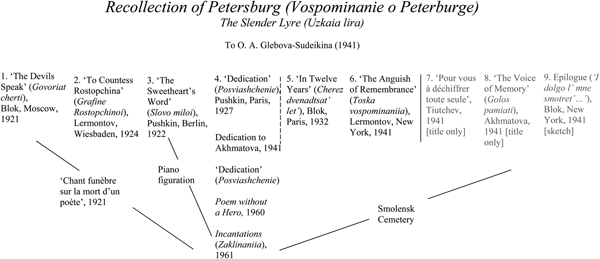
Throughout the course of Lourié’s exile, Recollection grew in two directions. The first direction, which I will call its ‘horizontal expansion’, is the addition of new songs to the cycle. I represent these songs horizontally to convey a sense of chronology, as the cycle's horizontal expansion corresponds to the timeline of Lourié’s life. Each horizontal addition to the cycle was discrete, demarcated by a new date in the manuscript(s), and often correlating to a new stop along Lourié’s path of exile. Each new song adds more memories, more voices, yet each also draws out themes latent in the preceding songs along the horizontal axis. I describe the second direction as ‘vertical expansion’. Recollection continually accumulated connections outside itself: to Lourié’s biography, as well as those of Akhmatova and Blok, to Akhmatova's Poem without a Hero (Poema bez geroia), and to Lourié’s other works. I arrange these external referents along a vertical axis because they do not behave chronologically; they are related to Recollection not through contiguity but through commonality – commonality in their function as dedications, their musical material, and in their specific memories. As Carolyn Abbate writes, ‘An irreversible syntagmatic progress through time … brings with it potentially infinite implications, references, associations, which hover paradigmatically and timelessly above each gesture and above the sequence as a whole.’Footnote 39 In Recollection, the horizontal axis represents both the syntagmatic process of musical time and the passage of actual time in Lourié’s life; its vertical axis represents his efforts to escape time.
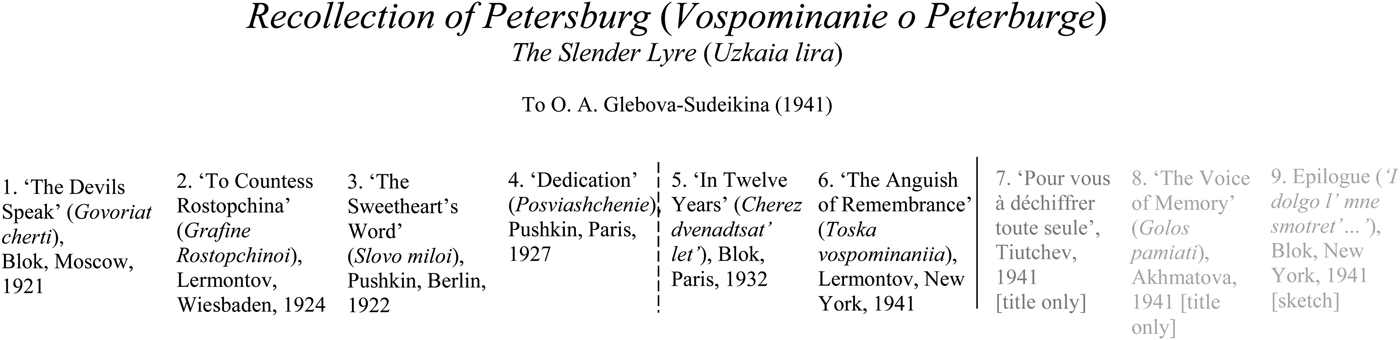
The original horizontal scope of the cycle charts Lourié’s migration across three countries and contains poetry from both Russia's Golden Age (Pushkin and Lermontov) and its Silver Age (Blok). The first text set is Blok's ‘The Devils Speak’ (Govoriat cherti), which Lourié completed in January 1921 in Moscow. Lourié added the first of two Pushkin settings, ‘The Sweetheart's Word’ (Slovo miloi), in Berlin in 1922. In Wiesbaden in 1924, Lourié added his setting of Lermontov's ‘To Countess Rostopchina’ (Grafine Rostopchinoi), and, though written after, placed it before ‘The Sweetheart's Word’. The first incarnation of the cycle concludes with a second Pushkin setting, ‘Dedication’ (Posviashchenie), from Poltava, written in Paris and dated Noel, 1927. The manuscript containing these four songs is located in the New York Public Library, with a title page designating them simply as ‘four romances’.Footnote 40
The next horizontal expansion, found in a second manuscript at the Paul Sacher Foundation, comes in the form of another Blok poem, ‘In Twelve Years’ (Cherez dvenadtsat’ let), dated in Paris, 1932, and another Lermontov poem, which Lourié titles ‘The Anguish of Remembrance’ (Toska vospominaniia)Footnote 41 and dates New York, 1941.Footnote 42 Both of these texts fixate on memory and visions of past lovers. The manuscript at the Sacher Foundation also contains two extra-musical additions that help ground these themes in specificity. In this manuscript, Lourié dedicates Pushkin's ‘Dedication’ to Akhmatova and the cycle as a whole to Olga Glebova-Sudeikina. Lourié had lived with both Akhmatova and Glebova-Sudeikina for a time in the former's Fontanka House near the Summer Garden in St Petersburg,Footnote 43 which appears as the epicentre of Lourié’s recollections in ‘Children's Paradise’. Both Akhmatova and Glebova-Sudeikina appear frequently in Lourié’s American diary, including in a list of his contemporaries in St Petersburg alongside Blok, Mandelshtam, and – curiously, for a list of contemporaries – the Summer Garden and Tsarskoe selo, the suburb where Akhmatova grew up.Footnote 44
This biographical specificity is amplified in the next planned ‘horizontal’ expansion of the cycle. Although the second Lermontov setting was the last song completed, sketches indicate that Lourié intended to add three more: Tiutchev's ‘Pour vous à déchiffrer toute seule’, Akhmatova's ‘The Voice of Memory’ (Golos pamiati), and Blok's ‘And have I long looked with a smile…’ (I dolgo l’ mne smotret’ s ulybkoi), which Lourié titled ‘Epilogue’ and for which a sketch survives at the Sacher Foundation.Footnote 45 ‘The Voice of Memory’ is crucial in tying the thematics of memory to the lived past, as Akhmatova dedicates the poem to Glebova-Sudeikina, the dedicatee of Lourié’s cycle, and Akhmatova's mention of Tsarskoe selo in line 5 situates it within Lourié’s memorial landscape. Her reference to Tsarskoe selo, where Pushkin had famously attended the lyceum, has the additional effect of drawing her poem closer to the Pushkin settings that precede it.
While these associations certainly bring Akhmatova into focus, an ambiguity in Lourié’s work plan confuses things. In his outline of the projected songs,Footnote 46 Lourié attributes ‘The Voice of Memory’ not to Akhmatova but to Blok, and in parentheses scrawls in a line from another section of Blok's ‘In Twelve Years’: ‘Vse, chto pamiat’ sberech’’. The two lines to which this incipit belong read, in English: ‘All that memory attempts to preserve for me / Is lost in the mad years.’Footnote 47 Lourié knew his poets well; it is unlikely that this heading was a mistake. It is likely that he either planned to use a title from Akhmatova for Blok's text or planned to mark Akhmatova's text with an epigraph from Blok, indicating the central place both poets occupied in Lourié’s Petersburg ‘children's paradise’.
Figure 1 shows the cycle's ‘horizontal’ organization. The poetry Lourié selected teems with voices and sounds of memory. These embedded sonic memories again indicate a project similar to Mandelshtam's in The Noise of Time. Compare Brown's gloss of Mandelshtam, cited above, to Móricz's description of Recollection: ‘The whisper of the cherished “amen” in “Govoriat cherti,” the magic of the melancholy voice in “Slovo miloy,” the treacherous sound in “Grafine Rostopchinoi,” the voice of the dark muse in Poltava, and the familiar whispers in “Cherez dvenadtsat’ let” all add to the unobtrusive symphony of memory.’Footnote 48 Lourié gives each of these sounds special treatment, and my reading of the horizontal axis of Recollection will focus on a motivic fragment that recurs at several of these moments, as well as the shifts in texture, key, and tempo that set these recalled sounds apart, as if in a different memorial space. While Móricz, considering only those songs that were completed, writes that Recollection ‘ends in utter silence’, by considering the full span of Lourié’s message in a bottle, I will demonstrate that the sounds of memory refused to be silenced.
Recollection of Petersburg: horizontal axis.

‘The Devils Speak’ is unique within the cycle for a number of reasons. As the first song in the cycle, what Puri calls ‘contextual’ memory is limited; that is, there are no earlier songs within the cycle to which it may refer back.Footnote 49 Likewise, as the first song Lourié wrote, the composer's proximity to the lived past is much closer. In fact, he had not yet left Russia when he wrote the song, Blok was still alive, and the Petersburg chapter of Lourié’s life had not yet concluded. The poem itself reflects an orientation in the present, focusing not on memory, but on the impending moment, employing present tense and the imperative mood. As the title indicates, the words of the poem are the words of ‘the devils’, speaking to the reader with words of temptation. The devils’ exhortations climax with the first of the ‘heard sounds’ in Recollection:
The embedded ‘amen’, set aside in quotation marks, is at once an evocation of direct speech, and an invitation to the reader or listener to join in its utterance.
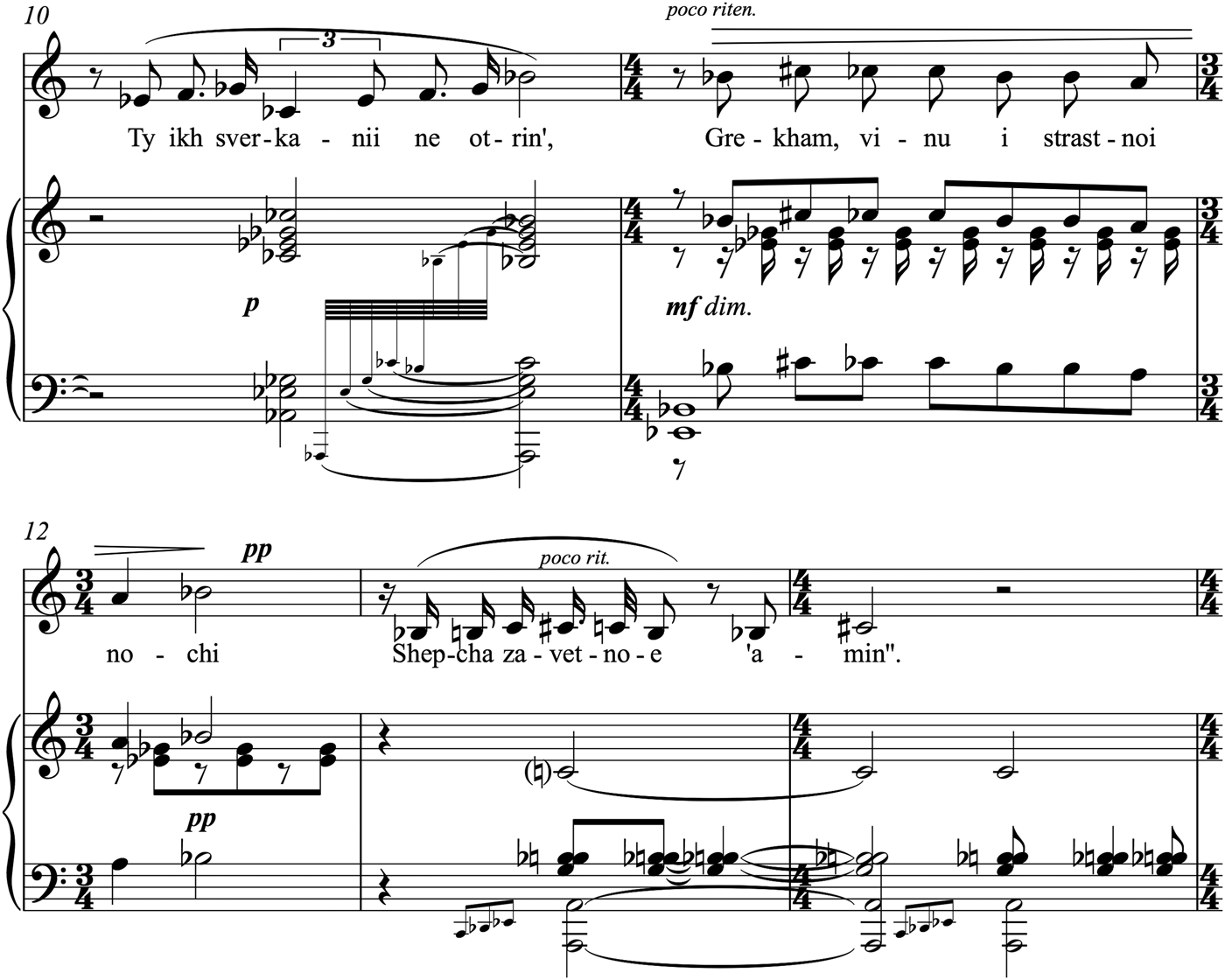
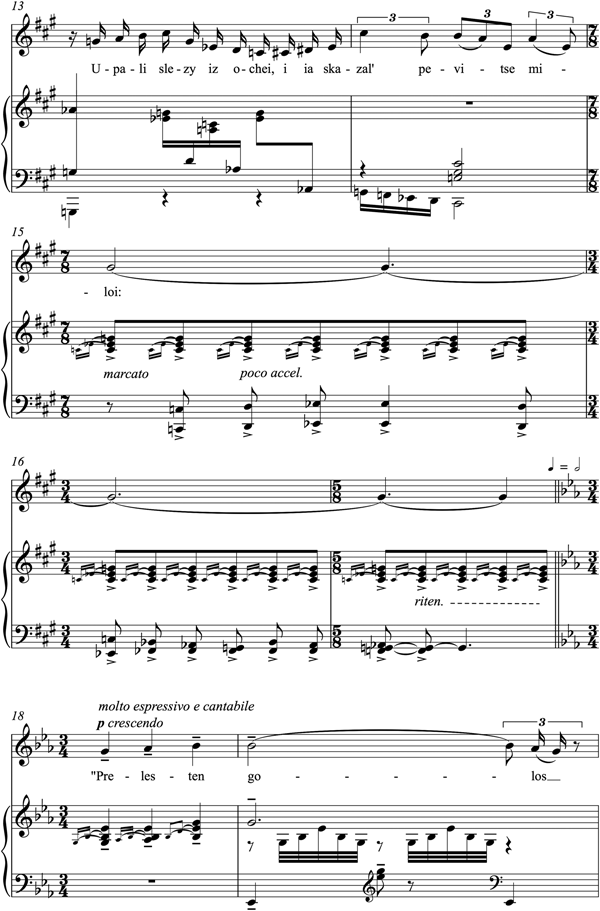
In setting this poem, Lourié answers this call, bringing forward the ‘cherished “amen”’ in a musical approximation of Blok's quotation marks. For the two stanzas prior to this moment, Lourié uses a musical ‘cut and paste’ technique: the piano part accompanying the first stanza is made up of two almost identical two-bar units, and the second stanza is accompanied by a completely new, repeating two-bar unit. Each line of text in the first two stanzas receives exactly one bar. The third stanza, which contains the ‘amen’, is the first stanza in which no bars repeat, creating more of a feeling of momentum, and Lourié gives the text more space to breath, using six bars for this four-line stanza. Harmonically, the song adheres loosely to an octatonic (tone–semitone) collection with added chromatic pitches, and there is no clear harmonic scheme for most of the song. The bars leading up to ‘amen’ (Example 1), however, provide a brief sense of directionality. An A♭ minor seventh chord in b. 10 moves upward a perfect fifth to an E♭ minor chord in bars 11–12, establishing an expectation of a return to A♭ on ‘amen’ in bar 13. Instead, the line is given over a bass motion of a tritone (E♭–A♮), and the glimpse of triadic harmony collapses inward in a cluster beneath the whispered word in bars 13–14.
‘The Devils Speak’, bb. 10–14.

Furthermore, in the preceding line (bb. 11–12), the vocal melody is doubled by the right hand of the piano; the accompaniment drops out on the first beat of the next bar, and when it returns, the voice has broken free of it. The melodic fragment to which ‘amen’ is set, an ascending augmented second, floats eerily above the accompaniment, its concluding c♯1 clashing against the c♮1 beneath it. Lourié slows the tempo down and brings the dynamic down to pianissimo, drawing the listener's ear in to hear the whispered word. After this moment, the voice gets a rare two-beat rest before the right hand of the piano joins it in unison again. The texture clears out significantly, in contrast to the busy, even cluttered accompaniment in the preceding stanzas, and the strategy of repeating segments does not return, making the moment of heard sound at once a memorable fragment and a fold in the overall design of the song.
As the first song in the collection, ‘The Devils Speak’ establishes much of the content that will return in the following songs, activating the processes of memory. The ‘amen’ motive will return, as will certain poetic motives, and Lourié’s manipulation of texture will become more prominent in subsequent moments of recollection. The first song stands out within the cycle, however, both in the temporal immediacy of the poetry and in its general musical style. Its harmonic language is redolent of Scriabin, and the accompaniment is often jagged in its rhythms, cutting a stark contrast against the relatively tonal works that follow. Indeed, ‘The Devils Speak’ resonates more with Symbolist aesthetics than with those of Acmeism; the ‘cherished “amen”’ (zavetnoe ‘amin’’) can also be translated as a ‘secret “amen”’, and its conspicuous setting brings it in line with what Morrison calls a ‘musical symbol’, which ‘oscillates between temporal and narrative layers: the past and present (and future), the natural and supernatural, the internal and external, the real (realia) and more real (realiora)’.Footnote 51 The mystical overtones here are precisely the lack of clarity and stability that Mandelshtam decries in ‘Morning of Acmeism’.Footnote 52 However, as Lourié builds out this cycle, its Symbolist beginnings shift in their significance. The musical language of ‘The Devils Speak’ becomes yet another recollection, and the contrast in style demonstrates Lourié’s interest in preserving the past. Even the ‘amen’ motive, when it returns, will appear less as a mystical symbol, and more as an artefact of the past.
The text set in Lermontov's ‘To Countess Rostopchina’ (Example 2) introduces the theme of separation that will become more prominent in the ensuing songs. Again, sound plays a crucial role in the thematics of the song; the ‘treacherous sound’, which Móricz highlights above, occurs at the end of the first of two stanzas in Lermontov's poem:
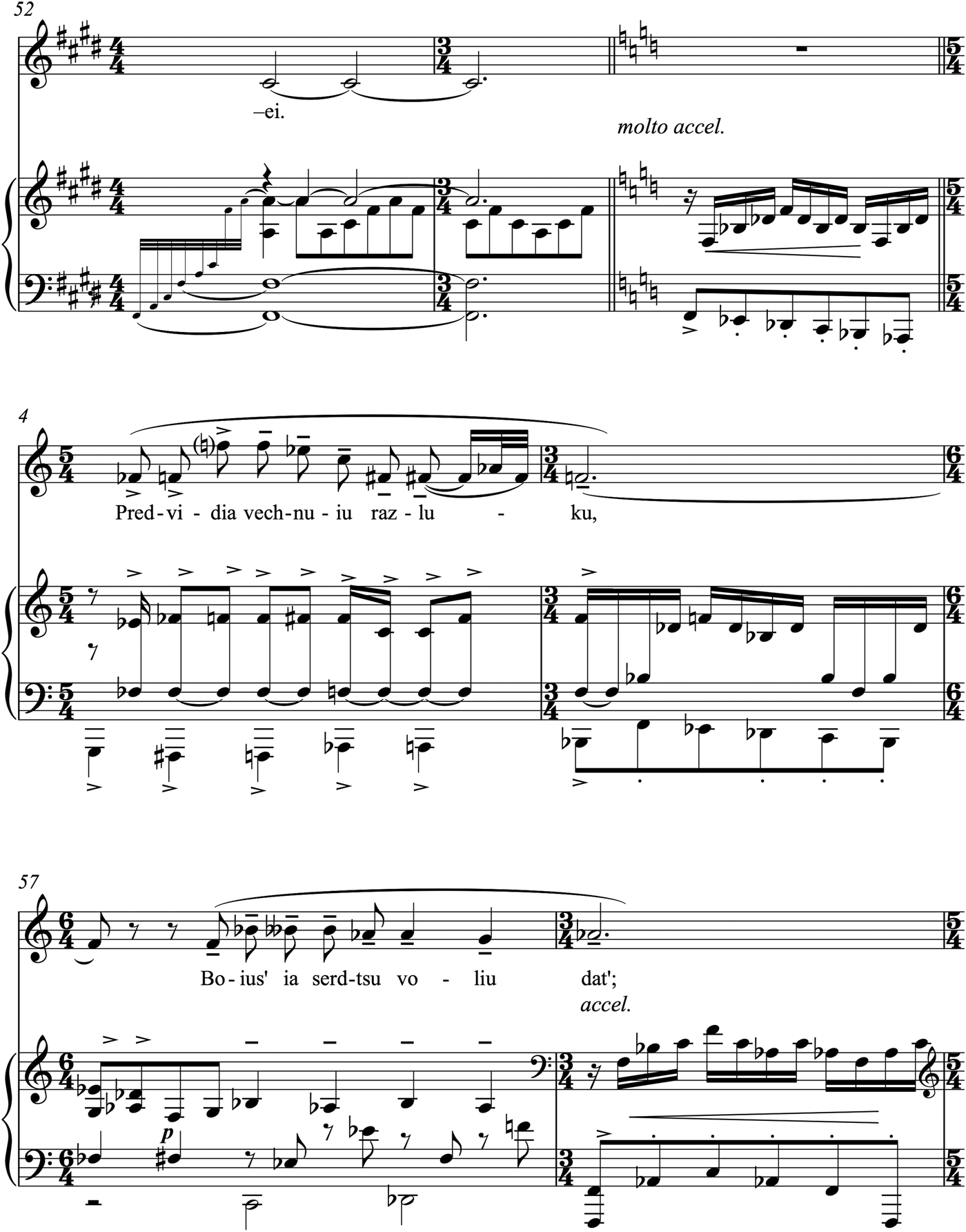
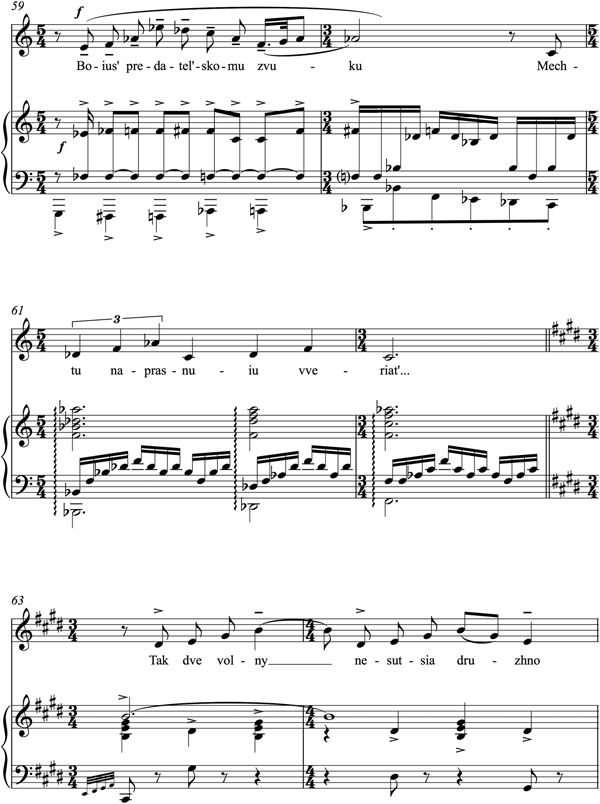
Lourié marks ‘zvuku [sound]’ with a fragment enharmonically equivalent to the ‘amen’ in ‘The Devils Speak’, an ascending minor third, filled in this time (bb. 59–60). It is underpinned by dissonant minor ninths that create the same sort of friction that accompanies the ‘amen’ in Blok's text. The motivic concordance is subtle, but Lourié sets this moment apart through a sudden shift in key and tempo. In a song otherwise dominated by C♯ minor, an abrupt shift to B♭ minor, accentuated by a molto accelerando sets this stanza apart (b. 53), as if in a different space, before shifting its key again just as abruptly (b. 63), this time to the relative major of the original key.
‘To Countess Rostopchina’, bb. 52–8.

‘To Countess Rostopchina,’ bb. 59–64.

The sounds Lourié highlights motivically and texturally in the first two songs suggest different temporalities: in ‘The Devils Speak’, the whispered ‘amen’ is refers to an impending, immediate ‘night of passion’; in ‘To Countess Rostopchina’, the ‘treacherous sound’ foreshadows ‘eternal separation’. Both are framed by the title of the work as recollections. ‘The Sweetheart's Word’ places such sounds firmly in the past and makes explicit the memorial processes in which the cycle is engaged. The speaker in the poem, in past tense, recalls hearing ‘Lila’ singing at the keyboard; behind this memory, however, lies the voice of a past love still more charming than Lila's. The narrator also recalls speaking directly to Lila in the final three lines of the poem, bringing the number of voices to three. By setting the poem to music, Lourié recalls Lila's performance, and we are brought into the narrator's triple recollection.
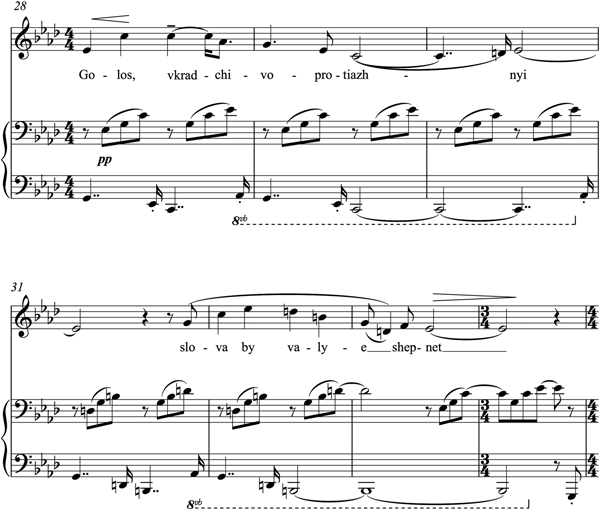
The shift to direct speech is underscored by a shift in texture (Example 3), drawing attention to the fact that this is a song about the memory of song. As the narrator turns from his recollection of Lila's voice at the keyboard to the memory of his sweetheart behind it, we hear this recalled keyboard dramatically interrupted in bar 15, as a sustained C♯ minor triad is supplanted by a C minor triad. The ensuing three bars are almost cinematic as they draw us into the final frame of recollection in the song, set off by quotation marks; the right hand is hypnotic in its repeating, marcato quavers over changing time signatures, giving a sense of suspended time. The voice holds a g♯1, a remnant of the previous key, above a g♮1 in the right hand throughout bars 15–17. The tempo and key signature change as the texture melts away into a repeating figuration. The new texture is perhaps closer to the ‘midnight lyre’ (polunoshchnaia lira) to which Lila's voice is comparedFootnote 55 than to her keyboard, distinctive in its shimmering demisemiquavers that repeat as the song draws to a close. After a few moments of buoyant E♭ major (bb. 18–21), the key turns to C minor as the speaker in the poem turns from the memory of Lila to the memory of the beloved behind it (bb. 22–7). We are in a tonal space remote from the F♯ minor in which the song began and in a separate memorial space, as well.
‘The Sweetheart's Word’, bb. 13–19.

‘The Sweetheart's Word’, bb. 20–7.

The final word of the poem, in which the speaker again recalls Lila's song, is set to a rising minor third, an echo of the motive animating the sounds of the previous two songs. When this motive returns here, fulfilling Mandelshtam's virtue of repeatability, it accompanies a sound that is wholly in the past, distinguishing it as a ‘reanimation’. As Puri writes, ‘when reanimation becomes part of a narrative, it often creates a vertiginous effect that results from the contradiction between two simultaneous tempora: the regressive time of the narrative and the progressive time of narration’.Footnote 56 Even within the first three songs along the ‘horizontal’ axis of Recollection, the temporalities suggested by the poetry and motivic repetition are multiple. The way Lourié couches the embedded sounds in ‘To Countess Rostopchina’, interrupting the form of the song as it unfolds, and in ‘The Sweetheart's Word’, in which the song's progress is frozen altogether, again suggests Mandelshtam's metaphor of a fan: time can be collapsed and rearranged at the artist's discretion.
The first incarnation of Recollection, captured in the New York Public Library manuscript, closes with a setting of the opening dedication of Pushkin's Poltava, dated 1927. The complex relationship between time, space, and sound in the cycle is highlighted by Lourié’s choice of poetry here. Pushkin questions whether the ‘voice of the dark muse’ or his own dedication will reach the ears of his addressee. The poem goes on to hope that the sounds of memory will stand in where the voice of the muse falls short:
It is hardly a coincidence that here, just as in ‘To Countess Rostopchina’, ‘sound’ (zvuku/zvuki) and ‘separation’ (razluku/razluki) are rhymed with one another, as the two counterbalance one another. Pushkin treats aural memories not as ephemera, but as treasured artefacts, much in the same way that Lourié does throughout the cycle. Furthermore, the narrator in the poem – from the vantage point of the present – gives such recollections an interpersonal charge to speak across distance, both temporal and spatial.Footnote 58 Lourié’s choice to end the cycle with a dedication, one that begins Pushkin's text, is worth noting; along the horizontal axis of Recollection, it leaves an open ending, and Lourié would indeed pick up where he left off in a few years. As we will see, it also opens up the vertical axis of the cycle. In the Sacher Foundation manuscript, Lourié dedicates this song to Akhmatova; following the example of the poem, he entrusts to the sounds of memory the ability to bridge time and space.
‘In Twelve Years’ and the passage of time
The second Blok poem in the cycle, ‘In Twelve Years’,Footnote 59 set in 1931 and included in the Sacher Foundation manuscript, provides an interesting test case for how the actual passage of time affected the ‘horizontal’ growth of Recollection. Lourié’s choice of the poem was fitting: in keeping with the title, he set it almost twelve years after the first Blok poem, although Blok had in fact written ‘The Devils Speak’ six years later. Familiar poetic motives from ‘The Devils Speak’ reappear in ‘In Twelve Years’: passion (strastnoi/strasti), and whispered words (shepcha/shepnet). Charged with decadence in 1921, these words are cool and retrospective in 1931, thanks to Lourié’s reordering. Yet they flicker with recollection. The subject of the poem is supposed to be ‘old and peaceful’ (star i miren), but the speaker asks: ‘Or is the young genius of first passion / Still not separated from your soul[?]’Footnote 60 The final of the three quatrains Lourié sets makes the desire to conjure the past clear:
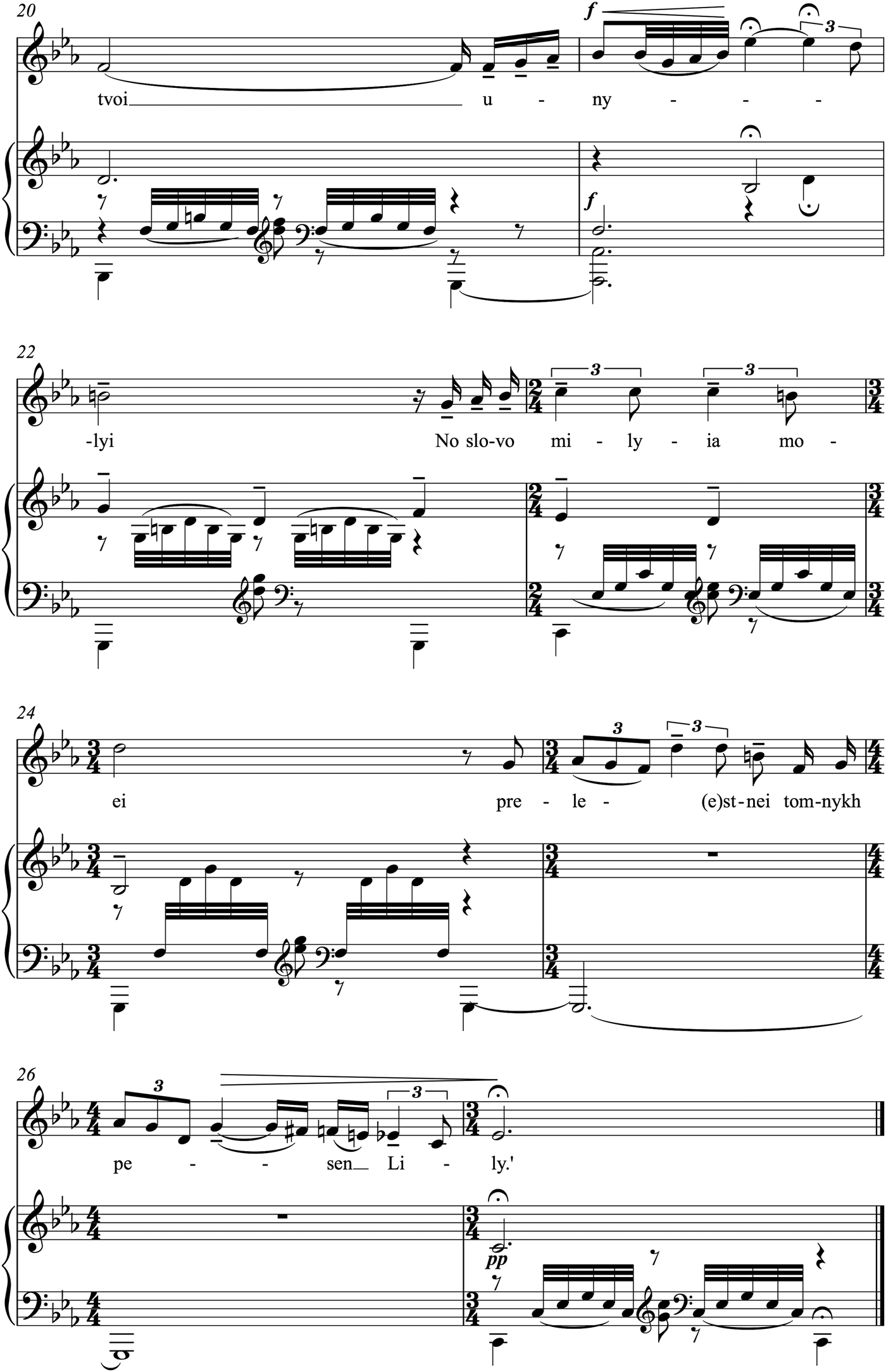
Most striking about the return of Blok's images is the transformed musical language in which they are clothed (Example 4). Whereas the voice in ‘The Devils Speak’ anxiously pulsates over unpredictable, rhythmic accompaniment, and the harmonic material is octatonic with added chromaticism, the consistent accompanimental texture and largely consonant, tonal writing of ‘In Twelve Years’ is as smooth as the ‘lake-like surface’ (ozerynaia glad’) with which the poem begins.
‘In Twelve Years’ bb. 28–34.

This more conventionally lyrical musical language responds to the retrospective point of view in Blok's poem. It also charts a change in Lourié’s overall stylistic vocabulary. By the late 1920s, Lourié’s musical (and polemical) language had made a hard pivot towards neoclassicism, and this transparent, tonal writing is in keeping with his new aesthetic. The shift in perspective between these two Blok settings thus reflects the passage of real as well as poetic time, and Lourié’s own musical development finds a parallel in the tone of the poetic voices. A curious temporal effect also arises from the juxtaposition between the musical styles of these two Blok settings: the neoclassical style of ‘In Twelve Years’ evokes a musical past well before that of the song it recalls, with its clear tonality and double dotted bass. The more the cycle grows along its ‘horizontal axis’, the more involved in the past it becomes.
‘The Voice of Memory’ and the ‘Dark Muse’
Each of the songs in Recollection contains memories of voices, and several focus on the voice of a lost love. ‘The Anguish of Remembrance’, dated 1941 in the Sacher Foundation manuscript does so in a very similar way to ‘The Sweetheart's Word’. In this poem by Lermontov, the speaker hears through a voice in the present the ‘long-dead laughter’ of the flame of his youth.Footnote 62 Meanwhile, ‘Dedication’ inserts into the mix the ‘voice of the dark muse’,Footnote 63 which hovers over the collection. The penultimate song Lourié planned to set, Akhmatova's ‘The Voice of Memory’, further complicates the way in which these voices mingle. Akhmatova's poem, dedicated to Glebova-Sudeikina, comes in the form of a dialogue: the voice of memory churns up specific recollections in the form of questions, asking what the poetic ‘you’ sees – a seagull on the blue tablecloth, the Florentine gardens, Tsarskoe selo? The final couplet responds, ‘No, I see only the wall’ (Net, ia vizhu stenu tol'ko).Footnote 64 The interlocking dedications in the cycle suggest that this dialogue might be interpreted as one between Akhmatova and Glebova-Sudeikina, Akhmatova and Lourié, or simply between the remembering subject and an internal voice of memory.
Since Recollection functions much like a diary, it is appropriate to check these dialogues against Lourié’s biography. Akhmatova had been the love of Lourié’s youth, and he had lived with her and Glebova-Sudeikina in the Fontanka House. According to his autumnal paramour in Princeton, Irina Graham, Lourié would always seek Akhmatova's image in other women;Footnote 65 it is hard not to associate this tendency with the poetry of ‘The Sweetheart's Word’ and ‘The Anguish of Remembrance’. In 1963, Lourié wrote to Akhmatova of his continued devotion to her: ‘All your photographs look at me all day long. I embrace and kiss you tenderly.’ It seems Lourié did regard her as something of a muse, which is further suggested by another of Lourié’s works, a 1919 setting of three Akhmatova poems, which he titled ‘The Voice of the Muse’ (Golos muzy). He also seemed to think of his own exile in terms of Akhmatova's choice to remain in the Soviet Union, as in the same letter, he refers to her poem ‘Anno Domini’, written in 1922, the year he emigrated: ‘You foresaw everything forty years ago: “foreign bread smells of wormwood.”’Footnote 66 These images of separation and exile resonate palpably with those found in ‘To Countess Rostopchina’ and ‘Dedication’.
If Lourié’s muse was Akhmatova, however, it was not the Akhmatova of real life, but the Akhmatova of memory. In Blok's ‘In Twelve Years’, the phrase ‘as before’ (kak prezhde) speaks volumes; in a letter to Salomeya Andronikova, Lourié writes: ‘Anna is now 73 years old. And yet I remember her, when she was 23. Half a century has gone by, and to me it seems like it was yesterday. I see her exactly as she once was. Yes, and all of us.’.Footnote 67 To borrow a phrase from Walter Benjamin, ‘memory has acted not as the source but as the Muse’.Footnote 68 There is no conflict then, between the dedications to Glebova-Sudeikina and Akhmatova, and to parse out which of the hovering voices of the memory and the muse belong to whom would be irrelevant: each are rather a synecdoche for the life Lourié had left behind. The voice of memory, growing ever more resonant in Lourié’s distance from Petersburg, became his primary muse in emigration.
Another voice, however, remains unaccounted for. This is the voice of the subject, who responds to the ‘Voice of Memory’ in Akhmatova's poem, speaks to Lila in ‘The Sweetheart's Word’, and enters into dialogue with memory most prominently in ‘In Twelve Years’. If Akhmatova is a personification of memory, Lourié’s muse, Blok seems to stand in for Lourié at times, entering into dialogue with the voice of memory, and replicating Lourié’s own experience. The ambiguity of Lourié’s plans for ‘The Voice of Memory’ exemplifies this point. In the section of Blok's ‘In Twelve Years’ indicated by the incipit, a first love is compared to a ‘priceless coffer tied up / Crosswise with a scarlet ribbon’, and the speaker describes the spectre of a past lover visiting him while alone in his chamber.Footnote 69 This at once reminds us of ‘Dedication’, in which the last words of the beloved are a treasure or relic, and of Lourié alone with Akmatova's photograph's imagining her as she once was. Blok's voice takes on further importance for the framing of the cycle with Lourié’s planned epilogue. The text is a short, unfinished Blok poem from 1909:
To recall Nadezhda Mandelstham's memoir, Mandelshtam, Akhmatova, and Dante each brought dead poets to life, placing them into dialogue in a memorial space, be it paradise or inferno. Lourié, too, does this in ‘Children's Paradise’. Recollection is a musical analogue to these projects, and Blok's poetry in this epilogue gives Lourié the words to describe it: ‘again with music, I live’. Lourié here is not only bringing poets from his frozen memory of Petersburg into dialogue with one another, revitalizing their voices, but also using these voices as a conduit through which he may engage in dialogue with his own past, with memory as his muse.
Vertical expansion of the cycle: intertextual dedications
Recollection, considered along its horizontal axis, appears at once as an intimate journal and as a Mandelshtamian message in a bottle. The status of several of the poems as dedications casts the coordinates of this memorial matrix outward and form the ‘vertical’ axis of the cycle. Of the nine texts set or projected to be set in the cycle, five of them – Lermontov's ‘To Countess Rostopchina’, Tiutchev's ‘A pour vous à déchiffrer toute seule’, Pushkin's ‘Dedication’, Akhmatova's ‘The Voice of Memory’, and Blok's ‘In Twelve Years’ – are specifically marked by their poets as dedications, laden with the task of communicating to their dedicatees across spatial or temporal boundaries. The imperative of the voice of memory to overcome the separation Lourié felt from Petersburg in emigration (a ‘changing fate’, as in Pushkin's ‘Dedication’) points outward from Recollection and activates a network of intertextual connections.
These are the sort of ‘internal connections among phenomena’ imagined by Mandelshtam in his gloss of Bergson – they are not subject to chronology, and they multiply as Recollection expands. The interlocking dedications to Akhmatova and Glebova-Sudeikina prove crucial for our understanding of the ‘horizontal’ axis of the cycle, and the cycle expands ‘vertically’ through dedications, as well, extending from Pushkin's ‘Dedication’. In the Sacher Foundation manuscript, Lourié dedicated this song to Akhmatova. There is a hint of uncanniness to this dedication, as it highlights a connection among phenomena that certainly does not submit to the law of temporal succession. Akhmatova had just written the opening dedication to Poem without a Hero in 1940. Theories abound about the many ghosts inhabiting Akhmatova's Poem, and Lourié, no less, is speculated to be one of Akhmatova's addressees.Footnote 71 Lourié could not have known about Akhmatova's Poem at that time, however; he had just settled in New York and had not yet established a line of communication with her. The Poem was not published in full until 1960, when it appeared in Aerial Ways, the same emigre journal that would publish Lourié’s ‘Children's Paradise’ article three years later.
The resonances between Lourié’s and Akhmatova's near simultaneous dedications are worth pondering, for Lourié realized them in a subsequent, miniature song cycle. Incantations (Zaklinaniia) for solo voice and piano accompaniment was one of Lourié’s last works, and in it he selects and rearranges four short segments from Akhmatova's Poem.Footnote 72 The final selection is Akhmatova's opening ‘Dedication’. Like the first iteration of Recollection, Lourié’s Incantations concludes with a dedication that is found at the beginning of its source text, a marked arrangement that makes visible the composer's hand in rearranging the narrative trajectory. The recurrence of these outward facing dedications at the ends of cycles gives the sense of a beginning to each ending, upholding the Acmeist values of repetition and return.Footnote 73 This quality draws the two cycles together, creating an axis of intertextual dedications.
The memorial frame extending from the Pushkin–Akhmatova pillar
These recursive dedications along a Pushkin–Akhmatova axis (a notion Akhmatova would have surely enjoyed) form a pillar, both textual and sonorous, that extends a memorial frame around the rest of Recollection and its related texts. Pushkin's and Akhmatova's dedications, as already noted, are linked by similarity in title, function, and structural apposition, as well as by Lourié’s dedication of his setting of Pushkin's ‘Dedication’ to Akhmatova. Paradigmatic associations hover over ‘The Sweetheart's Word’, which directly precedes ‘Dedication’, as well. As described above, ‘The Sweetheart's Word’ concludes in a memorial space set apart from the rest of the song by key, tempo, and texture, with a fixed arpeggio figure repeating in the final few measures and hanging in the air afterward with a fermata. The upward, short-long minor third which had previously animated the sounds of memory in ‘The Devils Speak’ and ‘To Countess Rostopchina’ is also used for the final word of ‘The Sweetheart's Word’.
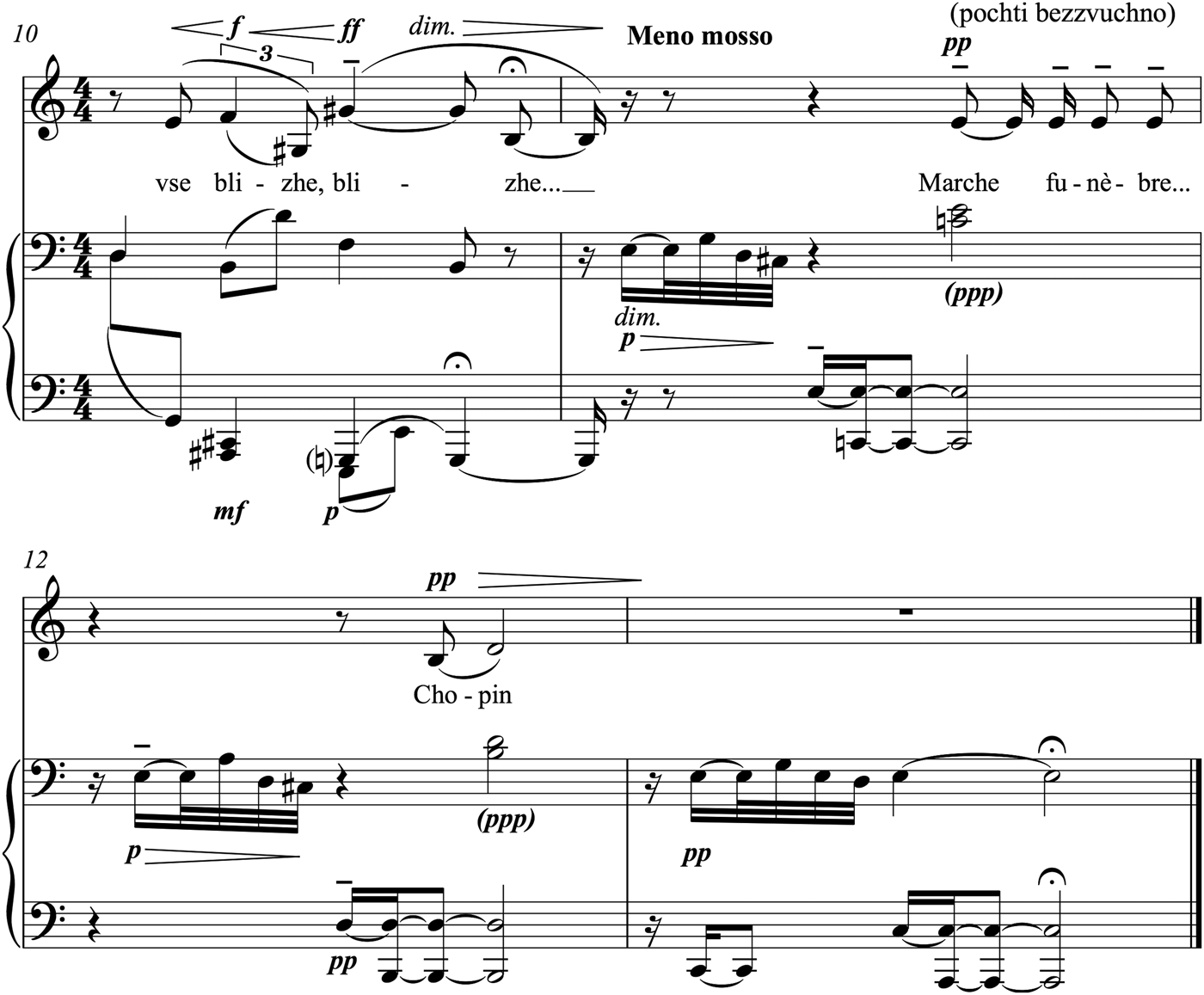
The textural change and repeating figuration that conclude ‘The Sweetheart's Word’ gain a special charge when considered in light of Lourié’s setting of Akhmatova's ‘Dedication’ in Incantations. As in ‘The Sweetheart's Word’, the music responds to the poetic evocation of heard sound with a change in texture, as seen in Example 5. Beneath Akhmatova's words ‘Marche funèbre… Chopin’, Lourié places a demisemiquaver figure that resembles the arpeggio that ends ‘The Sweetheart's Word’. He also employs the same process of repeating a set figuration of rhythm and contour at different pitch levels for the final bars of each song. The final iteration in each is constrained to the same middle to low register, maintains a low dynamic level (‘almost inaudible’, (pochti bezzvuchno) Lourié writes in the Akhmatova setting), and hangs in the air afterwards in a fermata. The heard sounds which these figurations accompany – the recalled words of the narrator and the sweetheart in Pushkin's poem and the funeral march in Akhmatova's – are also set similarly, a short–long ascending melodic minor third (b. 12).
‘Fifth Incantation’ bb. 10–13Footnote 74

The motivic connection between all these settings form the sort of ‘fan of phenomena’ that Mandelshtam describes, stretching outward from the vertical axis of dedications. The site of memory located in Akhmatova's ‘Dedication’ allows us to close this fan. In her ‘Prose about the Poem’, Akhmatova tells us that these verses are meant to commemorate Vsevolod Kniazev, with a nod to Blok. Akhmatova describes the scene:
The second scene, which the projector of memory has snatched from the darkness of the past, is of Olga and me after Blok's funeral looking for Vsevolod's grave in the Smolensk Cemetery (where he was buried in 1913). ‘It's somewhere by the wall’, Olga said, but we could not find it. For some reason I will remember that moment forever.Footnote 75
The Olga to whom she refers is, of course, Glebova-Sudeikina, the dedicatee of Recollection and ‘The Voice of Memory’. Furthermore, Akhmatova's ‘Dedication’ describes a return to the very scene of ‘The Voice of Memory’. Akhmatova had written ‘The Voice of Memory’ in 1913 in response to Kniazev's suicide, following his affair with Glebova-Sudeikina.Footnote 76 In ‘The Voice of Memory’, Akhmatova writes: ‘What do you see, dimly visible on the wall, / In this hour when late dusk is in the sky?’Footnote 77 Set in relief against Akhmatova's later recollections, this wall could indeed be that of the Smolensk Cemetery.
Akhmatova's return to the cemetery and her memories of Glebova-Sudeikina and Kniazev extend a line to the penultimate song of Recollection. The reason for her return, meanwhile, and the funeral march she hears there, link this site to the Blok poems that bookend Recollection. The memory of Blok's funeral seems to have been particularly vivid for Lourié. According to Irina Graham, Lourié carried the lid of Blok's open casket to the Smolensk Cemetery in the funeral procession, which he attended with Akhmatova.Footnote 78 He was deeply affected by Blok's death and claimed in a 1921 speech that ‘the Russian Revolution ended with the death of Blok’.Footnote 79 He also commemorated his hero musically at the time, setting a poem Akhmatova wrote in honour of Blok, ‘Today is the Nameday of our Lady of Smolensk’ (A Smolenskaiia nynche imeninnitsa), and titling the work ‘Chant funèbre sur la mort d'un poète’. Figure 2 shows graphically the lines cast from the Pushkin-Akhmatova pillar to both ends of the cycle. Although Lourié’s dialogue with Akhmatova through dedications is one of the focal points of Recollection, Blok is deeply involved in their connections. The alternate title of the cycle, The Slender Lyre, is itself taken from a Blok poem, ‘In the Snow’ (V snegakh), from the cycle ‘Snow Mask’ (Snezhnaia maska), which Lourié had intended to convert to a ballet libretto with Akhmatova in the early 1920s.Footnote 80 In the 1941 version of the cycle, Lourié also included an epigraph from Blok's poem, ‘I was abashed and joyful…’ (Ia byl smushchennyi i veselyi), which reads: ‘Music has transfigured / And seared your face’.Footnote 81 It seems that Lourié was using music to transfigure the memories he had of Akhmatova, Glebova-Sudeikina, and most of all, his life with them in the Fontanka House. The more Recollection grew ‘horizontally’, registering the passage of musical and actual time, the more preoccupied it became with memory and separation. The ‘vertical’ flashes of intertextual and biographical connections allow us to reconstruct Lourié’s memorial space. It is situated among the Fontanka House, Tsarskoe selo, and Smolensk Cemetery and populated by Akhmatova, Glebova-Sudeikina, and Blok – all frozen in time.
Recollection of Petersburg: horizontal and vertical axes.

Conclusion: managing the memory of the émigré artist
Throughout this discussion, I have characterized Recollection alternatively as a message in a bottle, a diary, and a journal, in addition to the traditional idea of a song cycle as a script for musical performance. The Russian title, Vospominanie, can also be translated as ‘memoir’, a literary genre distinct from a journal or diary. It is worth lingering on these distinctions, as they provide insight into how Lourié’s experience of time in emigration is modelled in Recollection.
The Symbolist poet Zinaida Gippius, an older contemporary of Lourié, provides an illuminating differentiation between the genres of journal and memoir in her Blue Book (Siniaia kniga):
A journal [dnevnik] is not an orderly ‘narrative about life’ wherein one describes today already knowing what tomorrow will hold, already knowing how it all turns out. A Journal represents the very flow of life … ‘Memoirs’ [vospominanie] can provide an image of time, but only a Journal can show time in its duration.Footnote 82
Like Mandelshtam's idea of the ‘system of phenomena’, Bergson's thought looms large behind this characterization. Fink has shown that, although Bergson was important to both Symbolists and Acmeists, they made very different uses of his conception of time. Symbolist writers such as Gippius found in Bergson an idea of the ‘dynamic flux of time’.Footnote 83 Acmeist Mandelshtam, as seen in the above-cited passages, read Bergson quite differently, taking phenomena out of time and thrusting them out into space, as the metaphor of a folding fan suggests. Mandelshtam's own memoir, The Noise of Time, as discussed above, provides ‘images of time’, as Gippius might say, which are grounded in the specific sounds of the past.
In Recollection, Lourié’s project resembles Mandelshtam's; each song from ‘The Sweetheart's Word’ onwards is retrospective and captures an ‘image of time’. As he changes the order of songs and places dedications in conspicuous positions, we see Lourié interrupting the ‘flow of life’, and the spatial effects he uses within songs further this cause. In his prose writings we hear not only of Mandelshtam's fear of chaos, but also hints of Lourié’s own. Recall his formulation that music is a defence against chaos; in another fragment, he adds, ‘but a musician is always threatened by chaos’.Footnote 84 By looking backward, he attempted to use music as an affirmation of his experience, constructing his ‘children's paradise’ and halting the flow of time.
However, Lourié’s comment that ‘a musician is always threatened by chaos’ speaks to some tension in the composition of the cycle and the conception of time it represents. True, Lourié’s title designates it as a memoir, and he attempts to reorder the voices of the past. Nevertheless, Lourié did not know what tomorrow would hold, and the cycle is less of an ‘orderly narrative about life’ than he might have wished. That is, although he is continually looking backward, the composition of the cycle in fits and starts over two decades repeatedly shifts the vantage point of these recollections. As an artist, Lourié was seeking to escape time into a memorial space, surrounding himself with the sounds of the past, yet as he engaged in this process over the years, he himself was very much subject to the flow of time. Recollection is ultimately a journal of several, discreet memoirs, caught between the passage of time and an aesthetics that attempts to stop it.