1. Introduction
Cognitive science has studied cognitive processes such as decision-making principally in humans. This practice differs radically from those found in biology where researchers commonly study phenomena of interest in model organisms. One reason for the difference might be that only one species exhibits the phenomenon. That is the case for some cognitive activities, such as language use. But other cognitive activities, including decision-making, are performed by many if not all living organisms. In this article we explore what would be gained if cognitive science and other disciplines interested in cognition, including philosophy, adopted the practice of biologists and looked to model organisms.
Philosophers of science have begun the task of characterizing the use of model organisms in biology, addressing such issues as the importance of similarity of model organisms to the explanatory target of the research (Weber Reference Weber2005, chap. 6; Weisberg Reference Weisberg2013; Levy and Currie Reference Levy and Currie2014; Ankeny and Leonelli Reference Ankeny and Leonelli2020).Footnote 1 There is one objective of model-organism research that has not been emphasized so far: the quest to identify less complicated organisms in which the phenomenon of interest can still be identified so as to reveal the core features of the relevant mechanisms. This is the motivation for the recent interest in studying sleep not just in fruit flies but also in jellyfish and worms. Our objective is to investigate the potential benefits of adopting this strategy of investigating less complicated organisms in studying cognitive phenomena, such as decision-making.
We start with decision-making in organisms without neurons. Although many think neurons are essential in any organism capable of making decisions, biologists studying behavior in both bacteria and plants describe them as making decisions and have made considerable progress in characterizing the relevant mechanisms. In section 2, we provide one example of decision-making in bacteria and use that in section 3 to motivate a general conceptual framing of decision-making in terms of control mechanisms. In section 4, we turn to decision-making in invertebrates, including jellyfish, worms, and leeches, in which (1) a host of distributed mechanisms have been identified and (2) chemicals that function as neuromodulators play important roles. In section 5, we consider two vertebrate model organisms, the lamprey and the cat. Together these model organisms point to a subcortical structure, the basal ganglia, as critical to much decision-making in vertebrates, including us. In the conclusion, we consider what might be differences between human decision-making and that found in these different model organisms and how these differences might be bridged.
2. Model Organisms that Make Decisions without Neurons
Biologists studying bacteria have identified many alternative behaviors that bacteria can choose upon evaluation of internal and external conditions. For example, the decision to form fruiting bodies and produce spores in Myxococcus xanthus requires the collaboration of other bacteria and is only appropriate under specific conditions (Muñoz-Dorado et al. Reference Muñoz-Dorado, Marcos-Torres, García-Bravo, Moraleda-Muñoz and Pérez2016).
Here, we focus on one well-known activity performed in individual bacteria—the selection of locomotion direction in E. coli. E. coli moves using flagella controlled by a motor that rotates either counterclockwise (projecting the bacterium forward) or clockwise (allowing it to tumble and thereby orient in a different direction). To select between these behaviors, E. coli relies on five types of transmembrane proteins located at one pole. They detect the concentration of various chemicals and the intracellular energy status and initiate a process that phosphorylates or dephosphorylates the chemotaxis protein CheY. CheY then binds to the motor and determines its direction of rotation (Falke and Piasta Reference Falke and Piasta2014). These transmembrane proteins are modified in relation to previous responses in order to evaluate whether the concentration of attractants and repellents is increasing or decreasing.
The reason biologists refer to this activity as decision-making is that it includes an evaluation process—the bacterium receives stimuli about multiple nutrients and toxins and must select just one action. Although relatively simple, these transmembrane proteins are highly adaptive, not just adapting to stimuli over five orders of magnitude and past interactions but adjusting responses in relation to the presence of other bacteria by altering the number of different receptors (Sourjik and Wingreen Reference Sourjik and Wingreen2012). The mechanism also allows for individual differences—with differing numbers of each type of receptor, individual bacteria make different decisions whether to move forward or tumble.
3. Decision-Making and Control Mechanisms
One reason many theorists resist applying cognitive vocabulary to simpler organisms, especially those without neurons, is that their behavior is thought to be just the product of reflexes. Yet, many microbiologists treat the selection of locomotion in E. coli as a decision-making process. Part of the reason is that alternative actions are available for the bacterium to select. But it is not enough that the organism selects randomly. Decision-making requires the organism to evaluate alternatives and select between them using the information collected. This is what control mechanisms do: they draw on measurements, evaluate them, and act on evaluations by selecting between alternatives. This characterization of control provides a skeletal perspective on decision-making, one that makes clear why even organisms without neurons are productively characterized as making decisions.
The various activities of living systems (metabolism, growth, locomotion, reproduction, etc.) are performed by production mechanisms. The new mechanists have described how scientists in the life sciences develop explanations by identifying the production mechanism responsible for a given phenomenon and decomposing it into its parts, operations, and organization (Machamer, Darden, and Craver Reference Machamer, Darden and Craver2000; Bechtel and Abrahamsen Reference Bechtel and Abrahamsen2005). They have, however, largely failed to consider the mechanisms as situated in organisms (for an exception, see Bechtel Reference Bechtel2019). As emphasized by philosophers who have focused on the autonomy of living organisms (Moreno and Mossio Reference Moreno and Mossio2015), biological mechanisms must be built and maintained by an organism (through the operation of other mechanisms). That is, biological mechanisms must exhibit organizational closure, in which “not only the very existence and activity of the constituents [mechanisms] depend on the network of processes of transformation that they realize but, in addition, they collectively promote the conditions of their own existence through their interaction with the environment” (Bich Reference Bich, Bertolaso, Caianiello and Serrelli2018, 125; see also Varela Reference Varela1979). Here we focus on the second requirement—that production mechanisms serve to maintain the organism. For them to do this, the organisms must control and coordinate production mechanisms so that they function in ways appropriate given the organism’s internal state and environmental conditions. Otherwise, these mechanisms will operate whenever their start-up conditions are realized, whether doing so benefits or harms the organism. Therefore, control mechanisms must (1) collect information about external and internal conditions to evaluate the appropriate operations of the production mechanisms and (2) on the basis of the evaluation, modify these mechanism’s flexible parts and activities.
To understand the uniqueness of biological control mechanisms, it helps to contrast them with human-made control mechanisms. A thermostat, for example, measures the temperature and sends a command to the furnace to alter its functioning. The thermostat performs an evaluation: Are the input conditions appropriate for turning on the furnace? The thermostat, however, is not part of an autonomous system that produces and maintains it and whose existence is affected by the operations of this mechanism. Moreover, it is under the control of the external human user who sets the desired temperature. In an autonomous biological system, in contrast, the decision made by a control mechanism affects the existence of the system that harbors it; in turn, the target state of the control mechanism is set collectively by the components of the system. Given the importance of appropriately controlling production mechanisms to keep the organism alive, it is not surprising that every organism has assembled an enormous number of control mechanisms over its evolution. Typically, as we emphasize below, these are not organized hierarchically, as in many human-designed control systems, but heterarchically (McCulloch Reference McCulloch1945; Pattee Reference Pattee1991; Winning and Bechtel Reference Winning and Bechtel2018).
In section 2, we offered just one example of decision-making in bacteria; there are a host of others that could flesh out the skeletal account of decision-making. However, we turn to considering how organisms with neurons use them to make decisions.
4. Model Invertebrate Animals that Make Decisions Using Neurons
When cognitive scientists describe decision-making mechanisms, they describe neural systems in the brain. Neurons, however, figure in decision-making in organisms without a centralized brain, and these organisms too provide productive model organisms. In this section, we briefly introduce three invertebrate model organisms in which to study decision-making. Studying these model organisms brings to light two features of decision mechanisms often ignored in the studies of human decision-making: their distributed, heterarchical structure and their significant reliance on neuromodulators.
We start with jellyfish, members of the phylum of Cnidarians, which many biologists view as reflective of organisms with neurons before the evolution of bilateral organisms. A distinctive feature of jellyfish is the occurrence of a network of sensory and ganglion neurons situated next to contractile epithelial cells constituting the bell. These have been characterized as constituting the skin brain (Holland Reference Holland2003; Keijzer, van Duijn, and Lyon Reference Keijzer, Duijn and Lyon2013), which controls coordinated contractions required for swimming. The activity in the skin brain is, in turn, controlled by inner ring neurons around the bell, which serve to generate a coherent rhythm. Although the skin brain and inner ring neurons already play control roles, their role is primarily to coordinate patterns of activity in contractile tissue. As with pattern generators in bilateral organisms, alternative behaviors are generated by other control mechanisms operating on them. Thus, to identify decision-making in jellyfish, we need to focus on how pattern-generating neurons respond to neural inputs that provide information elicited from sensors.
In Aglantha digitale, 14 distinct neural control mechanisms have been identified as providing inputs on the basis of which the jellyfish decides which behavior to pursue by modulating the operations of the inner ring neurons (Mackie Reference Mackie2004; Satterlie Reference Satterlie2018). Aglantha has the capacity to generate two distinct modes of swimming, slow and escape. Slow swimming relies on the default operation of the inner ring and skin brain neurons. Escape swimming, involving stronger muscle contractions, is initiated by neural signals from the tentacles. But this is not the only input that alters behavior. When eating, Aglantha briefly inhibits swimming. Mackie, Meech, and Spencer (Reference Mackie, Meech and Spencer2012) investigated this circuitry in another Cnidarian species, Polyorchis penicillatus, and established that when food is encountered, an electrical pulse is transmitted along a nerve plexus that inhibits the pacemaker ring neurons. Moreover, this was only one of four circuits that sufficed to inhibit swimming, each of which figures in different decisions. As this case illustrates, the decision-making mechanisms form a distributed, heterarchical structure, instead of a neat hierarchical structure of sensation-cognition-action often assumed in human studies.
Moreover, when researchers study decision mechanisms, they often view them as electrical systems—electrical pulses are transmitted along dendrites and axons, with chemical transmitters limited to the synapse. But in fact, neurons in all animals, including jellyfish, also employ neuropeptides and volume transmitters (e.g., dopamine and serotonin) that are released by neurons and other cells and diffuse through the organism, affecting other neurons that have receptors for them. These chemicals often function as neuromodulators that radically transform the decision made by a given neural circuit. This is well illustrated in the nematode worm C. elegans, the only organism for which we have a nearly complete map of all of its neurons and their connectivity (White et al. Reference White, Southgate, Thomson and Brenner1986; for a more recent update, see Varshney et al. Reference Varshney, Chen, Paniagua, Hall and Chklovskii2011). This has rendered C. elegans a model organism for determining circuits involved in making decisions about different behaviors.
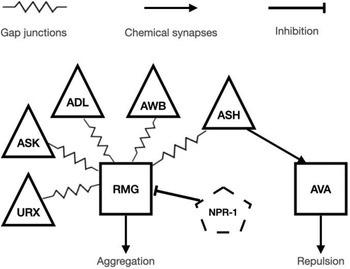
The circuitry alone is insufficient to understand decisions, as circuits generate different responses depending on which neuromodulators (registering different conditions in the organism) are present. For example, as shown in figure 1, ASH generates repulsion through a chemical synapse to AVA, a command interneuron. However, ASH as well as four other neurons can, through gap junctions with another command interneuron, RMG, generate repulsion when RMG is inhibited by the neuropeptide receptor NRP-1. Bargmann (Reference Bargmann2012) concludes from this and other findings that “information flow through C. elegans circuits depends on neuromodulatory states” (461).
Circuit in C. elegans in which whether ASH generates repulsion or aggregation is modulated by the action of neuropeptide receptor NPR-1 on interneuron RMG.

Finally, another invertebrate organism employed to study decision-making is the medicinal leech (Hirudo verbena), which must decide between two modes of locomotion, swimming or crawling. This decision is not made in a centralized brain but by 21 individual ganglia along its body, each containing approximately 400 neurons. The overall choice of the leech results from the interaction of these distributed ganglia, not through any centralized command. To study how each ganglion decides, Briggman, Abarbanel, and Kristan (Reference Briggman, Abarbanel and Kristan2005) employed sensory stimuli that were equally likely to elicit either response and recorded activities from neurons in an exposed ganglion. They determined that decisions arose through a dynamical interaction between a subset of these neurons that gave rise to attractor dynamics—once spontaneous activity fell into the attractor for one activity, it would activate the pattern generator for that activity. Yet, as in C. elegans, neuromodulators, such as serotonin and dopamine synthesized by other control mechanisms, influence the probability of each behavior, with serotonin increasing the likelihood of swimming and dopamine of crawling (Crisp and Mesce Reference Crisp and Mesce2006; Puhl and Mesce Reference Puhl and Mesce2008). The decision circuitry is also altered by activities such as feeding, which blocks sensory circuits from sending inputs to the decision system, resulting in the leech remaining stationary (Gaudry and Kristan Reference Gaudry and Kristan2009).
We have briefly introduced three invertebrates that use neurons in making decisions. Each provides insights into the types of mechanisms employed in animal decision-making. Together they reveal decision-making mechanisms that are highly distributed. Moreover, while the wiring of these circuits is suggestive of how they process information, the actual functioning of the circuits is modulated by chemical signals that encode information about the state of the organism and the environment.
5. Vertebrate Model Organisms for Decision-Making
One might assume that while decision-making is highly distributed and modulated by chemical signals in invertebrates, it is taken over by the central brain in vertebrates, and indeed by the most distinctive part of the human brain, the cerebral cortex. While the cerebral cortex does play a critical role in encoding information relevant to human decision-making, it is only one component in a much larger, distributed, and heterarchically organized system. For example, the hypothalamus, relying heavily on signaling involving peptides and amines, plays a crucial role in many decisions related to ubiquitous animal activities such as eating, sleeping, and reproducing. Here we focus on the basal ganglia, a network of subcortical ganglia, to demonstrate how the two features identified in invertebrate decision mechanisms, distributed processing and chemical modulation, remain relevant in other vertebrate decision-making.
The lamprey, which is phylogenetically the most distant vertebrate from humans, is a model organism that has provided important insights into the mammalian nervous system. The lamprey and humans share the same basic neural architecture (Stephenson-Jones et al. Reference Stephenson-Jones, Ericsson, Robertson and Grillner2012). Although lacking a cerebral cortex, the lamprey does contain a small pallium, a region that expanded over phylogeny to give rise to the mammalian neocortex, hippocampus, and amygdala. An important feature, found in the lamprey and preserved in all vertebrates, are neuronal loops between the pallium, thalamus, and basal ganglia.
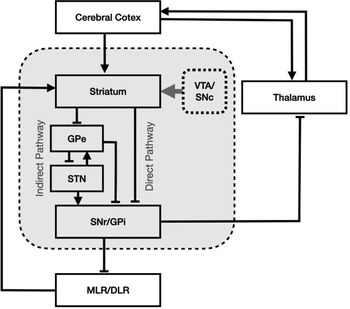
The architecture of the basal ganglia is fundamentally the same in all vertebrates (fig. 2), although the vocabulary used to designate the different nuclei varies. The striatum constitutes the input region. It receives inputs from multiple brain regions, including not only the pallium/neocortex but also mesencephalic and diencephalic locomotor regions (MLR/DLR) that sequence commands sent to central pattern generators in the brainstem and spinal cord to enable locomotion. The substantia nigra pars reticulata (SNr) and the globus pallidus internus (GPi) constitute the output regions. By default, neurons in these areas send inhibitory signals to their targets, including the same areas from which the input was received, giving rise to the loops on which we focus. Whether the output back to the originating areas is actually inhibitory is determined by two pathways between the striatum and the output regions. The indirect pathway, in which the globus pallidus externa (GPe) and the subthalamic nucleus (STN) serve as intermediates, acts to enhance the inhibition. In contrast, activity along the direct pathway inhibits the output regions, thereby reducing their inhibitory effect. Adjacent regions in the pallium/neocortex and in the MLR/DLR project to adjacent regions in the striatum and give rise to a competition between nearby direct or indirect pathways, selecting one target for reduced inhibition.
Major structures and pathways involving the basal ganglia. See text for details.

As a result of the loops back to the regions from which inputs originated, the basal ganglia serve to allow some processing to continue while processing in nearby areas is suppressed. The basal ganglia thus are involved in the activity of evaluating and selecting between alternatives—making decisions. The architecture of the basal ganglia, however, suggests it is only one part of a distributed decision system. It lacks the computational resources to itself evaluate different options. Rather, the striatum receives evaluative signals for competing options from across the brain. Through the two pathways, the basal ganglia facilitate competition between the alternatives so that one of the competitors is evaluated more positively (Ashby, Turner, and Horvitz Reference Ashby, Turner and Horvitz2010). The basal ganglia are thus one component in a distributed, heterarchical decision-making system.
The importance of the basal ganglia in decision-making is illustrated by the results of mid-twentieth-century research on decorticate cats (cats in which projections from the cortex and other brain areas to motor control areas are destroyed). If both the basal ganglia and cortex were cut off from lower brain areas, the cats could still perform individual behaviors when elicited by appropriate electrical stimulation, but they could not initiate the actions in response to their current contexts. When the basal ganglia were also spared, decerebrate cats performed many locomotor and other behaviors of ordinary cats (Bard and Macht Reference Bard and Macht1958; Whelan Reference Whelan1996). They ate and drank, responded to stimuli, groomed themselves, moved about in their environment, and made the decisions necessary to maintain themselves in the relatively protected environment of the laboratory. In these animals the evaluations were presumably provided by the motor command areas or other areas such as the thalamus that initiated competition in the basal ganglia that resulted in making decisions.
As in the invertebrate examples, neuromodulators affect decision-making in the basal ganglia. For example, dopamine plays a critical role. Synthesized by neurons originating in the ventral tegmental area (VTA) and the substantia nigra pars compactus (SNc), it diffuses broadly to bind different types of receptors on striatal neurons projecting along the direct and indirect pathways. Higher levels of tonic dopamine up-regulate the striatal neurons in the direct pathway while down-regulating those in the indirect pathway, shifting the balance of explorative versus exploitative behaviors toward exploitation (and vice versa; Hills et al. Reference Hills, Todd, Lazer, Redish and Couzin2015). Dopamine is also thought to function as a reward prediction error signal in reinforcement learning, which enables the organism to learn to select the best action, on average, for a given context. Finally, reduced dopamine level in Parkinson’s patients contributes to disabilities in decision-making in both motor and more cognitive domains, such as maintaining and updating working memory (Ashby et al. Reference Ashby, Turner and Horvitz2010).
In short, even when we turn to decision-making in vertebrates, we find model organisms, such as the lamprey and the cat, to be instructive in investigating decision-making. An important insight they provide is that a subcortical structure, the basal ganglia, figures importantly in decision-making but does so as part of distributed decision-making mechanisms and significantly implicates neuromodulators.
6. Conclusion: Model Organisms for Studying Decision-Making in Cognitive Science?
At the outset, we contrasted cognitive science with biological disciplines in not studying phenomena such as decision-making more extensively in model organisms. Part of the motivation for using model organisms is that they offer simpler versions of the mechanism responsible for a phenomenon. We have offered a few examples of such organisms and discussed insights they can provide for understanding decision-making. A point not yet emphasized in the model organism literature in philosophy is that researchers also expect differences between model organisms and the target organism. Indeed, there is at least one glaring difference between decision-making in the model organisms we discussed and in humans: some human decisions involve conscious representation and evaluation of alternatives, including elaborate reasoning about the alternatives. Some may see this difference as so significant that it negates any value of looking to model organisms to study decision-making. We conclude with some considerations as to why, despite this difference, studying decision-making in model organisms is still useful.
A first consideration is that there are a host of decisions humans make every day that do not involve conscious deliberation. These decisions affect much of our behavior. By conceiving decision-making within the context of control mechanisms, we can recognize that other organisms make these decisions as well, and how they do so may provide insights into how we make these decisions. Further, how model organisms make these decisions may also offer insights into our conscious decision-making. One distinctive feature of conscious human decision-making is that we sometimes make decisions on the basis of explicitly represented evaluative norms. Moreover, we take these norms to be ones we choose. How do these norms operate? Decision-making, even in bacteria and invertebrate animals, relies on evaluative norms such as preference between different sources of nutrients or between repellents and attractants. These norms are embodied in the organization of the decision-making mechanisms (e.g., the type and number of receptors in bacteria and the circuitry, electrical and chemical, in C. elegans). Likewise, our consciously selected norms may be realized in the organization of the decision-making mechanisms operative in us. They may include loops between frontal regions of the neocortex, thought to be critical for the neural processing involving in high-level reasoning, and the basal ganglia (for one relevant discussion, see Huang Reference Huang2017). Moreover, model organisms may provide insights into the processes through which we select norms—they may depend on the same type of chemical, highly distributed, heterarchically organized decision mechanisms found in model organisms. That is, in selecting evaluative norms for ourselves, we may rely on those already embodied in us as a result of evolution and development. These possibilities suggest ways in which model organisms such as we have considered may be relevant in understanding even distinctively human decision-making.