I. INTRODUCTION
Schiff bases are organic compounds where its common structural feature is an imine group, which is generally represented as R-CH=N-R′ where R and R′ correspond to groups such as alkyl, aryl, cyclo alkyl, or heterocyclic groups (Das and Linert, Reference Das and Linert2016). These organics compounds are used in multiple applications ranging from analytical detection (Ghosh et al., Reference Ghosh, Kumar, Mukhopadhyay and Banerjee2016; Shabbir et al., Reference Shabbir, Akhter, Ahmad, Ahmed, Ismail, Mirza, McKee and Bolte2016), biological activities (Rosu et al., Reference Rosu, Pahontu, Maxim, Georgescu, Stanica and Gulea2011; Zoubi, Reference Zoubi2013), and inorganic chemical processes (Pioquinto-Mendoza et al., Reference Pioquinto-Mendoza, Rosas-Ortiz, Reyes-Martínez, Conelly-Espinosa, Toscano, Germán-Acacio, Avila-Sorrosa, Baldovino-Pantaleón and Morales-Morales2015).
Schiff bases structures were introduced initially by Hugo Schiff in 1861 (Schiff, Reference Schiff1869), and since then multiple variations in the peripheral structure of the azomethine group (−C=N−) have been proposed, observing its multifunctionality. The biological activity of Schiff bases has been explained by the ability of the nitrogen atom to form hydrogen bonds with active centres of cells, or malignant malformations, leading to its application in antifungal (Abo-Aly et al., Reference Abo-Aly, Salem, Sayed and Abdel Aziz2015), antibacterial (Mondal et al., Reference Mondal, Mandal, Mondal and Sinha2015), and anticancer activity (Amer et al., Reference Amer, El-Wakiel and El-Ghamry2013).
In the field of catalysis, Schiff bases have been used as organic ligands in the formation of coordination complexes with many transition metals in different oxidation states (Gupta and Sutar, Reference Gupta and Sutar2008), such as V(IV) (Alsalim et al., Reference Alsalim, Hadi, Ali, Abbo and Titinchi2013), Ti(IV) (De Rosa et al., Reference De Rosa, Lamberti, Pellecchia, Scettri, Villano and Soriente2006), Re(V) (Grzegorczyk et al., Reference Grzegorczyk, Kapturkiewicz, Sanjuan-Szklarz and Nowacki2014), Mo(VI) (Wang et al., Reference Wang, Daran, Poli and Agustin2016), Mn(III) (Sarkar et al., Reference Sarkar, Bhaumik and Chattopadhyay2016), and they have been extensively investigated as an effective catalysts for oxidation processes. In this context, particular attention has been given to manganese complexes with Schiff base Salen ligands (N,N′-bis(salicylidene)ethylenediamine) (Valyaev et al., Reference Valyaev, Lavigne and Lugan2016), which function as catalysts in asymmetric organic synthesis (Xia et al., Reference Xia, Ge, Ye, Liu and Su2005) and asymmetric epoxidation of unfunctionalized olefins (Chen et al., Reference Chen, Cheng, Jia, Wang, Wei, Zhang, Yao, Tang and Wu2012).
Manganese–Salen complexes have demonstrated their synthetic utility in oxidation reaction through some examples, such as the asymmetric epoxidation of cis-cinnamates as a key step to obtain the side chain of Taxol (Jacobsen et al., Reference Jacobsen, Deng, Furukawa and Martínez1994), used as an anticancer drug, or in the synthesis of intermediates to obtain Diltiazem which is a powerful drug used in the treatment of hypertension, angina pectoris, and some treatments for cardiac dysrhythmia (Bell et al., Reference Bell, Davies, Finney, Geen, Kincey and Mann1996). In this work, we report results on the molecular characterization (Fourier transform infrared and nuclear magnetic resonance [NMR]) and X-ray powder diffraction (XRPD) data for the compound N 1 ,N 2-di(2-hydroxy)benzilidenebencen-1,2-di-imine, as a special ligand for many interesting applications of Schiff base compounds.
II. EXPERIMENTAL
A. Synthesis
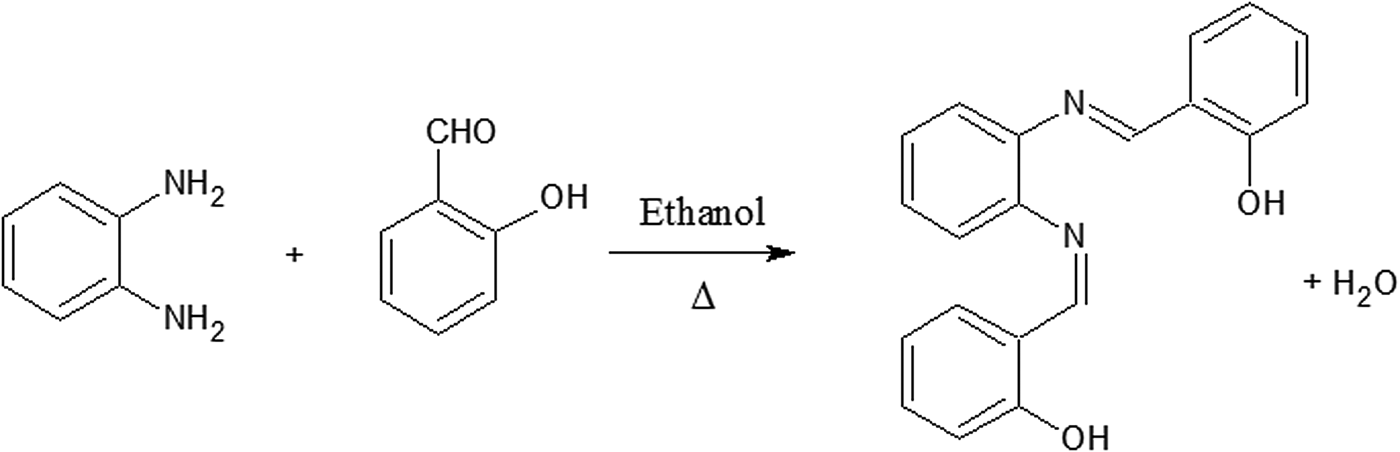
All materials were commercial and were used without further purification unless otherwise noted. All solvents were thoroughly degassed prior to use. 1,2-phenylenediamine (1.4 mmol, 0.16 g) was dissolved with warming in the minimum volume of anhydrous ethanol and was slowly stirred at 25 °C for 1 h. After that 2-hydroxybenzaldehyde (2.8 mmol, 0.342 g) was added into the solution and the mixture was stirred for 8 h at reflux temperature resulting in the precipitation of an orange solid which was filtered and washed with ethyl ether. The title compound (C20H16N2O2) was purified by crystallization in methanol. Its synthesis is shown in Figure 1. The yield was 81.6%; the melting point is 167 °C; the measured density is 1.255 g/cm3, which was taken by the flotation method in an aqueous solution of potassium iodine. ATR-IR; ν: 3053 (O-H); 1610 (C=N); 1396 (C-O). 1H-NMR (400 MHz, CDCl3, Me4Si); showed δ (ppm) = 13.02 (s, 2H, OH), 8.64 (s, 2H, HC=N), 7.44–7.32 (m, 6H; aromatic), 7.26–7.21 (m, 2H; aromatic), 7.05 (d, J = 8.2 Hz, 2H; aromatic), 6.92 (td, J = 7.5, 1.1 Hz, 2H; aromatic).
Synthesis of N 1,N 2-di(2-hydroxy)benzylidenebenzene-1,2-di-imine.

B. Powder data collection
A small amount of the N 1,N 2-di(2-hydroxy)bencylidenbenzene-1,2-di-imine was gently ground in a mortar and sieved to a grain size less than 38 µm. The specimen was mounted on a polymethyl methacrylate (PMMA) specimen holder. The XRPD pattern was recorded with a D8 ADVANCE BRUKER diffractometer operating in Bragg–Brentano geometry equipped with a Cu-target X-ray tube (40 kV and 30 mA), a nickel filter and a 1-dimensional LynxEye detector. A divergence slit of 0.6 mm and primary and secondary soller slits of 2.5° were used. The scan range was 2° to 70° 2θ with a step size of 0.01526° and a count time of 2 s per step. The data were collected at room temperature (298 K).
Powder analytical software was used to subtracting the background (Sonnerveld and Visser, Reference Sonneveld and Visser1975), smoothing (Savitzky and Golay, Reference Saviztky and Golay1964), and stripping off the Kα 2 component (Rachinger, Reference Rachinger1948) and the second derivative method was used to determine the position and intensities of the diffraction maxima from each reflection.
III. RESULTS AND DISCUSSION
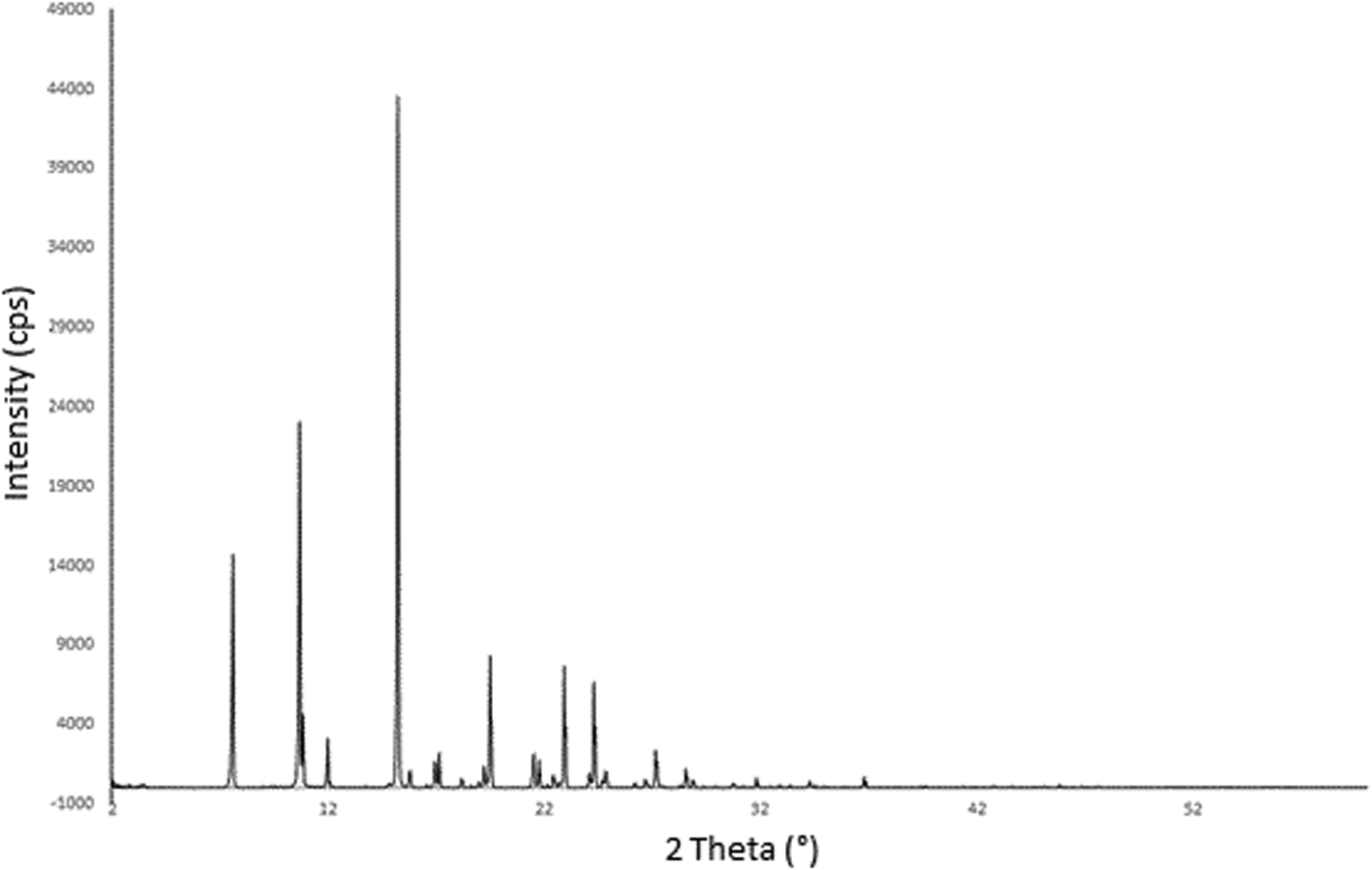
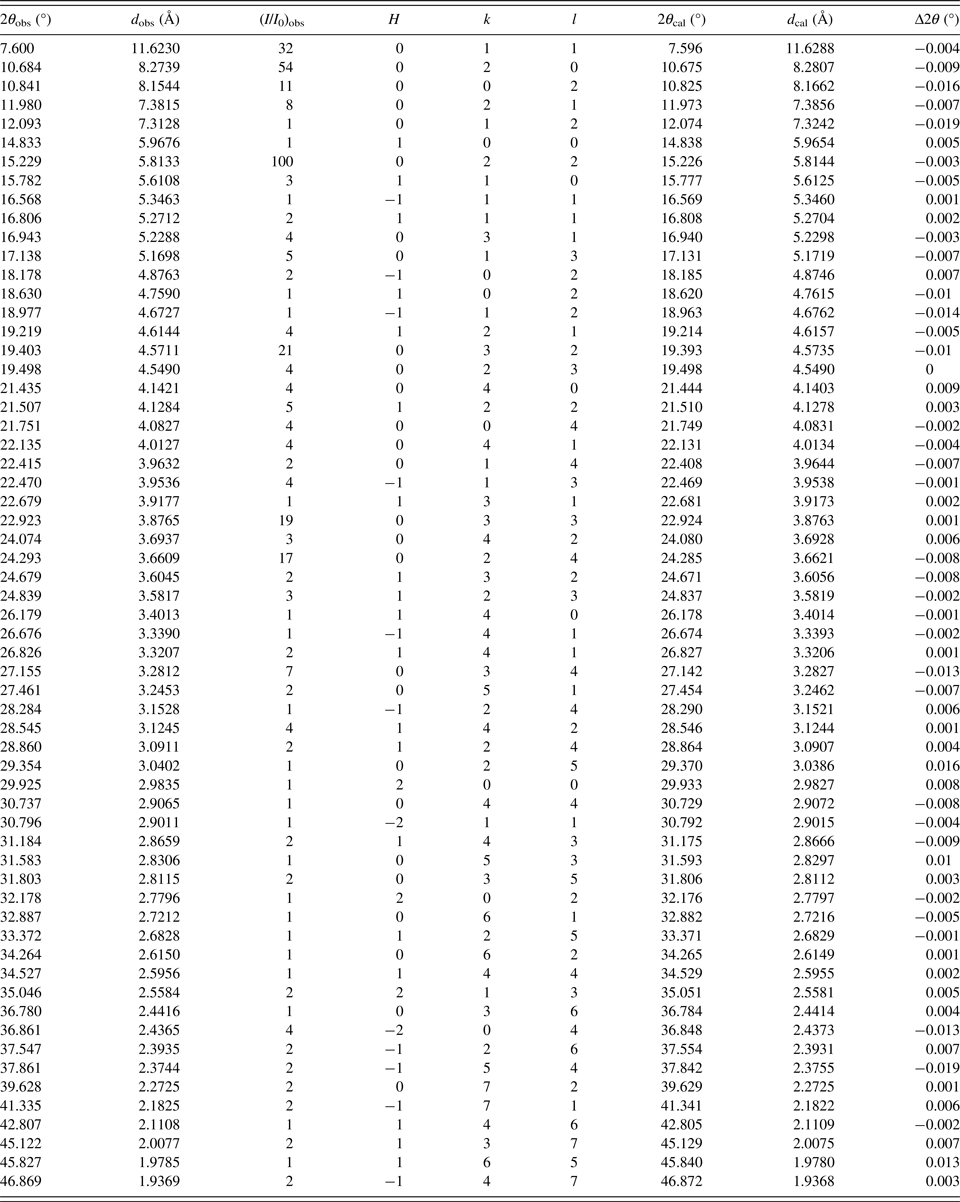
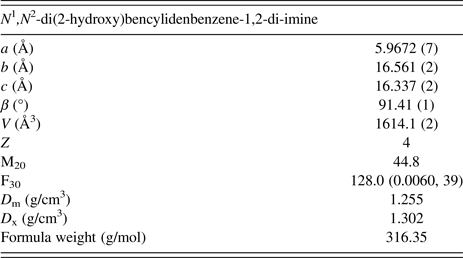
The X-ray powder pattern of the compound N 1 ,N 2-di(2-hydroxy)bencylidenbenzene-1,2-di-imine is shown in Figure 2. XRPD data for the compound are given in the Table I. All reflections were indexed using the DICVOL14 program (Boultif and Louër, Reference Boultif and Loüer2004) on a monoclinic unit cell. The space group, P21/c (No. 14), estimated by the program CHEKCELL (Laugier and Bochu, Reference Laugier and Bochu2002) was compatible with the systematic absences and with the crystal density. The unit-cell parameters of the title compound were refined with the program NBS*AIDS83 software (Miguell et al., Reference Miguell, Hubberd and Stalick1981). Its crystal data, X-ray density and figures of merit M20 (de Wolff, Reference de Wolff1968) and F20 (Smith and Snyder, 1979) are compiled in the Table II (see online supplementary material). In the powder diffraction pattern is observed an amorphous halo around 10° 2θ corresponding to the contribution from the sample holder (PMMA) which was subtracted by DIFFRAC.EVALUATION (EVA) software.
X-ray powder diffraction pattern of the compound N 1,N 2-di(2-hydroxy)benzylidenebenzene-1,2-di-imine. The background has been subtracted.

X-ray powder diffraction data of N 1 ,N 2-di(2-hydroxy)bencylidenbenzene-1,2-di-imine, C20H16N2O2.

Crystallographic parameters for the compound N 1 ,N 2-di(2-hydroxy)bencylidenbenzene-1,2-di-imine, C20H16N2O2.

SUPPLEMENTARY MATERIAL
The supplementary material for this article can be found at https://doi.org/10.1017/S0885715618000027.
ACKNOWLEDGEMENTS
The authors would like to thank Centro de Investigaciones of Universidad Santo Tomás (Bucaramanga-Colombia) for their support with the project approved in the VII internal call of research projects and the Laboratorio de Rayos-X, PTG of Vicerrectoría de Investigaciones, Universidad Industrial de Santander (Bucaramanga-Colombia) for data collection.