Introduction
The cement industry generates 8% of global anthropic CO2 emissions. About 60% of these emissions come from the decarbonization of limestone in the clinkerization process, which also requires high calcination temperatures, thus increasing operating costs and environmental impact (Antoni, Reference Antoni2013). Meanwhile, cement production is growing significantly in parallel with the development of nations. Global production is expected to reach 5 billion tons by 2030, with emerging countries such as India and China accounting for >80% of this increase (Scrivener, Reference Scrivener2014). Supplementary cementitious materials (SCMs) are materials that have pozzolanic activity or cementing capacity (ASTM C1709-18). This is due to binding properties acquired by the SCM after being finely divided, activated, and mixed under suitable humidity conditions (Vásquez et al., Reference Vásquez, Carmona and Tobón2020). Therefore, SCM is important for decreasing CO2 emissions due to the reduction of the clinker/cement factor (clinker decreases in the blended cement by 25–35%), and with it, the associated energy consumption. Some SCMs are also circular economic strategies for the use of industrial waste (Lothenbach et al., Reference Lothenbach, Scrivener and Hooton2011; Scrivener, Reference Scrivener2014; Scrivener et al., Reference Scrivener, Martirena, Bishnoi and Maity2018; Rodríguez et al., Reference Rodríguez, Frías and Tobón2021).
On the other hand, the SCMs used most are fly ash and ground blast-furnace slag (>80%), but their low abundance and availability have impeded wider use (Scrivener et al., Reference Scrivener, Martirena, Bishnoi and Maity2018). Meanwhile, clays are the most abundant and widely distributed material on the Earth's crust, being especially plentiful in tropical regions where climatic factors have played an important role in the weathering process of parent rocks. For these reasons, the use of calcined clays as an SCM has been investigated.
Most of the investigations are about kaolinitic clays or type 1:1 clays (Kakali et al., Reference Kakali, Perraki, Tsivilis and Badogiannis2001; Shvarzman et al., Reference Shvarzman, Kovler, Schamban, Grader and Shter2002; Samet et al., Reference Samet, Mnif and Chaabouni2007; Tironi et al., Reference Tironi, Castellano, Bonavetti, Trezza, Scian and Irassar2014a, Reference Tironi, Trezza, Scian and Irassar2014b; Yanguatin et al., Reference Yanguatin, Tobón and Ramírez2017; Sunitrová & Trník, Reference Sunitrová and Trník2018; Roy et al., Reference Roy, Chatterjee and Aiyer2020), which have a high degree of purity and kaolinite (>50%). But their wide use in industries such as ceramics, refractories, paints, cosmetics, and paper, among others, raises the cost of pure metakaolin to 2–3 times the cost of Portland cement, affecting its use as an SCM (Scrivener et al., Reference Scrivener, Martirena, Bishnoi and Maity2018). Consequently, low-grade kaolinitic clays (<50%), which are mixed with significant amounts of 2:1 type clays, have been studied recently as possible SCMs (He et al., Reference He, Osbaeck and Makovicky1995; Alujas et al., Reference Alujas, Fernández, Quintana, Scrivener and Martirena2015; Irassar et al., Reference Irassar, Bonavetti, Castellano, Trezza, Rahhal and Córdoba2019; Yanguatin et al., Reference Yanguatin, Ramírez, Tironi and Tobón2019; Córdoba et al., Reference Córdoba, Zito, Sposito, Rahhal, Tironi and Thienel2020a, Reference Córdoba, Zito, Tironi, Rahhal, Irassar and Bishnoi2020b; Marchetti et al., Reference Marchetti, Rahhal, Pavlík, Pavlíková and Irassar2020; Rakhimova et al., Reference Rakhimova, Rakhimov, Bikmukhametov, Morozov, Eskin and Lygina2020; Rodríguez & Tobón, Reference Rodríguez and Tobón2020; Cardinaud et al., Reference Cardinaud, Rozière, Martinage, Loukili, Barnes-Davin and Paris2021; Dixit et al., Reference Dixit, Du and Pang2021; Rodríguez et al., Reference Rodríguez, Frías and Tobón2021). However, the relative weights of the physical, chemical, and mineralogical variables that control its performance as an SCM have yet to be defined clearly; the relationship among those variables and the genesis of low-grade kaolinitic clays also not clear.
Thus, the main aim of the current research was to establish the relationships among geological characteristics such as genesis, lithology, physical, chemical, and mineralogical aspects, alteration, and weathering degree as a function of the depth of the low-grade clay deposit, and the influence of all these variables on the thermal activation of clays and their performance as SCMs. For these reasons, field studies and laboratory tests were carried out to discover these relationships and establish the most influential variables for development as pozzolanic material; this is in contrast to most research about clays calcined for use as SCMs, where they do not take into account the provenance of raw material.
Finally, the main hypotheses were that: (1) clays from intermediate-composition rocks, with greater alteration, weathering, and degree of structural disorder, may be more susceptible to thermal activation; and (2) low-grade kaolinitic clays derived from metamorphic parent rocks can be activated at low temperatures and used successfully as an SCM.
Materials and Methods
Raw Materials
Raw clay came from the weathering of paragneiss and ortho-amphibolite metamorphic rocks (Fig. 1). Vásquez et al. (Reference Vásquez, Carmona and Tobón2020) reported that the raw clays were from a region of Magdalena Medio between the Cocorná and Jetudo geological faults in the antioquian municipalities of Puerto Triunfo and Sonsón, Colombia.
Location and local geology of the clayey soil under study. The main lithologies correspond to amphibolite (pink color) and gneiss (purple color)

Experimental Research
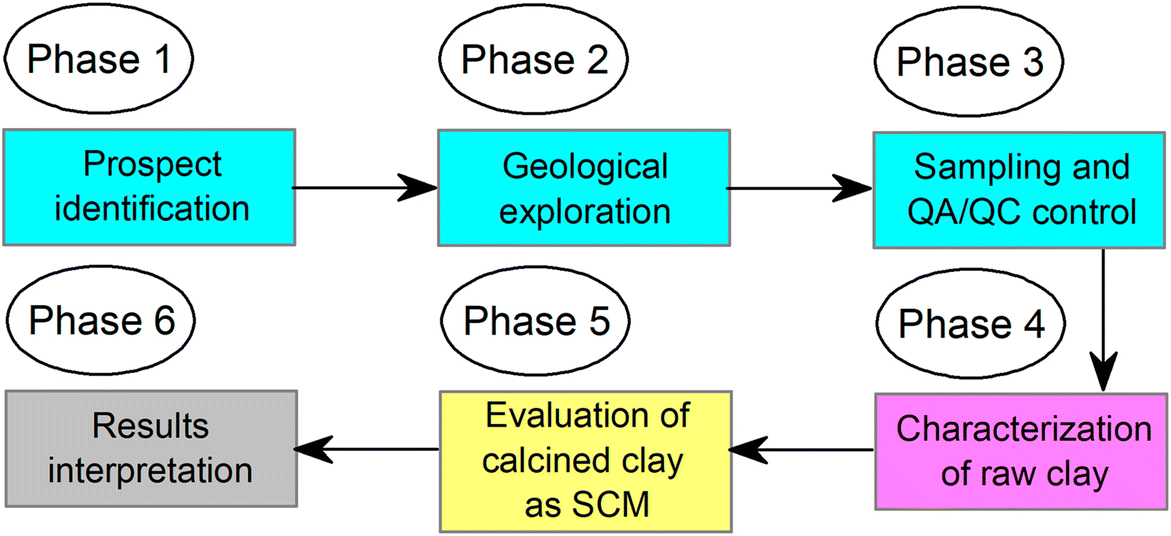
The methodology used is summarized in six phases (Fig. 2). In phases one and two, surface and subsurface geological prospecting and exploration were conducted, classifying the metamorphic rocks according to the Subcommission on the Systematics of Metamorphic Rocks (SCMR) (Schmid et al., Reference Schmid, Fettes, Harte, Davis, Desmons, Meyer-Marsilius and Siivola2004) and the weathering profiles according to their parent rock as proposed by Little (Reference Little1969). The first fresh rock was reached after 1,352.35 m of deep-well drilling, using a Duralite T800 drill (Duralite Diamond Drills Colombia S.A.S., La Ceja, Colombia) under the wire-line diamond drilling method with recovery core in HQ diameter (USGS, 2019), 72 m of manual well drilling with a hand auger and helical screw, and trenching exploration between 8 and 10 m depth, equivalent to 75.35 m. Additionally, thin-section petrography and electrical resistivity tomographies were performed according to the methods described by Vásquez et al. (Reference Vásquez, Carmona and Tobón2020) using ABEM Terrameter LS equipment (Guideline Geo Americas Inc., Summerville, South Carolina, USA) and the chemical composition and pH of the water points (springs, piezometers, and streams) were measured with HACH® multiparametric equipment (Hach Colombia S.A.S., Bogotá D.C., Colombia).
Main phases of the experimental methodology

The sampling (phase three) with diamond drilling and hand auger techniques was carried out every 3 m, seeking similar characteristics in color, texture, and horizons of the weathering profile; while trenching was selective in areas where the weathering profile had the greatest accumulation of oxides (due to its color change). In addition, to avoid contamination, reduce losses, and ensure reliability, QA/QC control was performed using diamond drill cores (Plouffe et al., Reference Plouffe, McClenaghan, Paulen, McMartin, Campbell, Spirito, Paulen and McClenaghan2013).
Characterization Techniques
Raw clay samples were physically, chemically, and mineralogically characterized by X-ray fluorescence (XRF), X-ray diffraction (XRD), specific surface area (SSA) analysis by the Brunauer-Emmett-Teller (BET) method, granulometric analysis, Fourier-transform infrared spectroscopy (FTIR), and color measurements by CIE L* a* b* colorimetric coordinates (phase four of Fig. 2).
The chemical composition by XRF was carried out on fused glass beads using Zetium equipment from Malvern Panalytical (Malvern, UK). The XRD tests were performed on pressed pellets in a Malvern Panalytical aCubiX3 diffractometer, with an X accelerator detector, copper anode, sweep angle of 6–70°2θ, step of 0.015°2θ, and an accumulation time of 0.5 s/step. For interpretation and quantification, the HighScore Plus (XRD analysis software of Malvern Panalytical) and calibration curve standards of Vásquez et al. (Reference Vásquez, Carmona and Tobón2020) were used.
For determination of SSA, a Micromeritics brand Gemini V pore size analyzer with nitrogen was used (Micromeritics Instrument Corporation, Norcross, Georgia, USA). The raw clay samples were degassed to a constant mass before being measured by the equipment.
For FTIR measurements, a Perkin Elmer Spectrum Two insstrument (PerkinElmer Inc., Waltham, Massachusetts, USA) was used on samples mixed with dry KBr, over the wavenumber range 4,000–400 cm–1. Subsequently, the kaolinite order/disorder degree, P0, of the raw clay was determined, as was done by Kakali et al. (Reference Kakali, Perraki, Tsivilis and Badogiannis2001) and Tironi (Reference Tironi2013). Finally, the color was measured using an X-Rite CAPSURE colorimeter (X-Rite, Grand Rapids, Michigan, USA) with 45°/0° measurement geometry, an independent LED light source in three directions, 25 LEDs (8× visible wavelengths, 1× UV), a 1.8 s measurement duration, and a 2.4–8.0 mm measuring range with four different color auto-detectors.
Performance Evaluation as SCM
Raw clay samples were calcined at 650, 750, and 850°C with a heating rate of 20°C/min and a residence time of 30 min (phase five of Fig. 2). The susceptibility to thermal activation was assessed through structural and mineralogical changes in the XRD patterns and FTIR spectra of the raw and calcined clay samples.
The performance was evaluated through the Strength Activity Index (SAI) in calcined clay/cement mortars (20/80 wt.%) under the standards ASTM C109/C109M-02, ASTM C1709-18, ASTM C311-18, and ASTM C618-19 (ASTM Committee, 2002, 2018a, 2018b, 2019). The results were contrasted with chemical pozzolanic Frattini tests, where the Spanish standard UNE EN 196-5 was used in raw and calcined clay samples with the same ratio (20/80 wt.%) but under saturated conditions at 28 curing days and 40°C (AENOR, 2011).
The Frattini test is a quantitative chemical analysis of the titration type that involves determination of the amount of Ca(OH)2 present in the aqueous solution produced by cement hydration, and comparing it to the amount of Ca(OH)2 required to obtain a saturated aqueous solution with the same alkalinity as the first (AENOR, 2011; Tironi, Reference Tironi2013). When the concentration of Ca(OH)2 in aqueous solution is lower than in the saturated aqueous solution, the material has pozzolanic activity (Tironi, Reference Tironi2013). This decrease in aqueous solution is due to the fact that Ca(OH)2 reacts with reactive phases of the pozzolanic material to form hydration products such as C-S-H gels, which mainly provide binder and mechanical properties on the pozzolanic material/cement system. On the other hand, the greater the distance in height between a concentration point (CaO, OH-) in the aqueous solution and the saturation curve, the greater the pozzolanic activity of the material, due to the fact that less Ca2+ is present in the aqueous solution. However, this test is sensitive to the chemical characteristics of the pozzolanic material used (Tironi, Reference Tironi2013).
Finally, much data was built with the results of exploration campaigns, characterization of the raw and calcined clays, and evaluation of their development as SCMs. Multivariate analysis, based on means and standard deviations, were used to determine the most relevant variables that represented the physical, chemical, and mineralogical behavior of the clay deposit.
Results and Discussion
Lithological Provenance of Multicomponent Raw Clay
The main lithological units in the study area (Fig. 1) were amphibolite (Pza) and gneiss (Pzni); however, to a lesser extent, also present were sedimentary deposits and tonalite intrusions (Kit) in the form of dikes, which were important for their contribution of kaolinite due to their greater weathering degree. Likewise, the area presented a large number of faults with the main strike directions of N10–20W and N10–20E, and dip angles greater than 55°, which indicated high brittle deformation and generated open spaces in the rock mass. This facilitated the infiltration and transport of meteoric water and fluids to deeper levels, which leached and altered the minerals of the surrounding rocks into kaolinite and goethite.
Vásquez et al. (Reference Vásquez, Carmona and Tobón2020) suggested that the low-grade kaolinitic multicomponent raw clay came from the weathering of parental rocks of metamorphic origin: (1) paragneiss composed of quartz, biotite, feldspar, muscovite, chlorite, garnet, epidote, and tourmaline, and (2) ortho-amphibolite composed of hornblende and plagioclase. They suffered argilization and sericitization, which altered their primary minerals to clay minerals types 1:1 and 2:1 (kaolinite, illite, and vermiculite), sericite, and iron (oxyhydr)oxides such as goethite and goethite enriched in aluminum. The sericite and clay contents were 50% and 20% for the ortho-amphibolite raw clay samples and 40% and 26% for the paragneiss samples, respectively.
Behavior of Chemical Variables
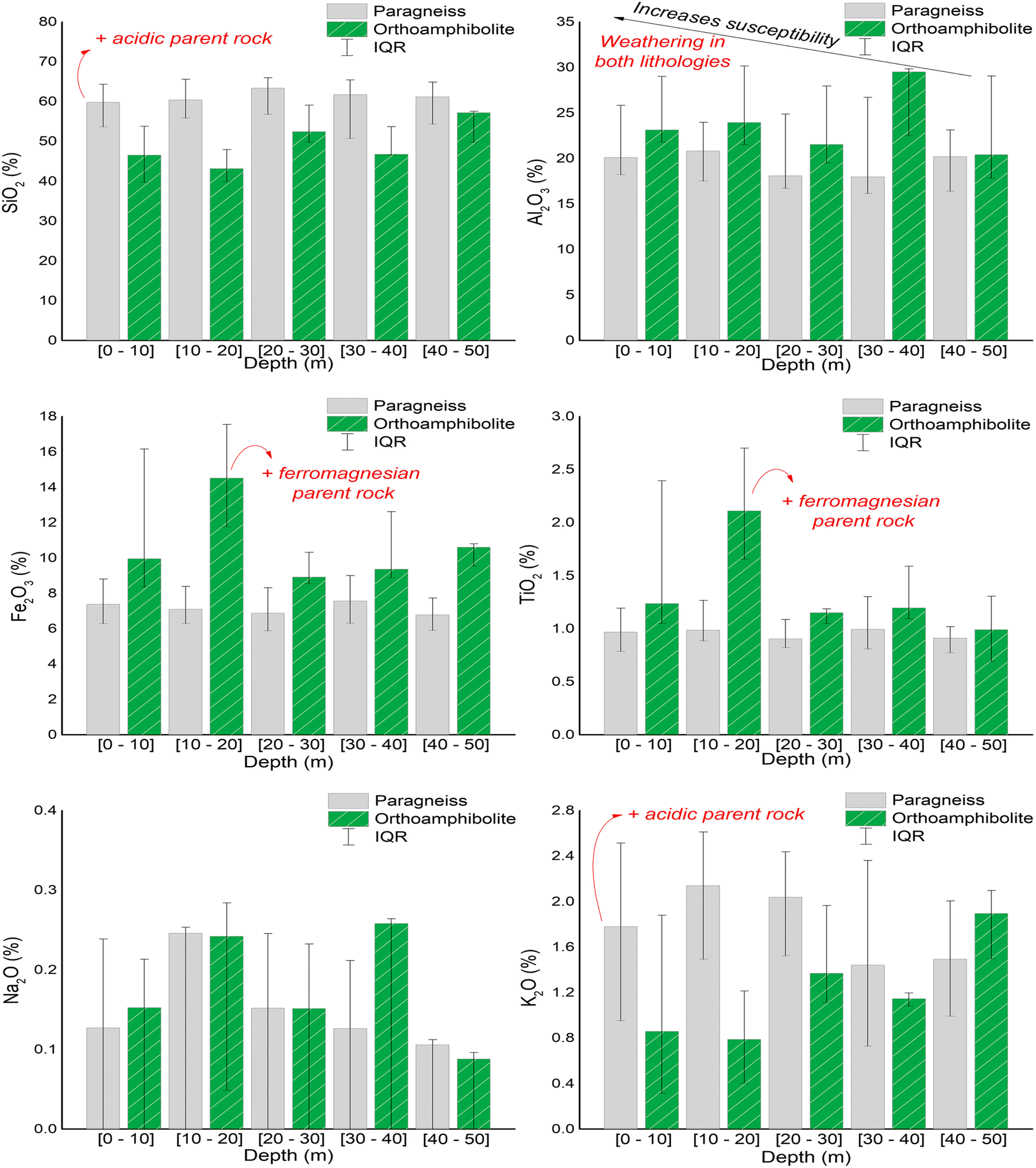
The chemical composition of the raw clay was related to the lithology of the parent rock (Fig. 3; Supplemental Material 1) with the acidic paragneiss contributing potassium oxide and silica to the clay composite, while the intermediate composition of ortho-amphibolite contributed alumina, iron, and titanium oxides, due to their more basic character.
Behavior of the chemical variables as a function of the depth of the deposit. Bars correspond to median, and IQR to Interquartile Range

Median values were considered because they are a measure of a central tendency less affected by atypical values compared to the mean; exploratory statistical analysis of the data revealed that most cases had asymmetric distributions. Based on these analyses, large quantities of silica, alumina, iron, and titanium oxides (listed in descending proportion order) were found in both clays as a result of the weathering and alteration processes. However, when both clays were compared, the silica (60–65%) and potassium oxide (1.5–2.5%) in the paragneiss raw clay exhibited the greatest values compared to the values of these oxides in ortho-amphibolite raw clay, and, in turn, the latter obtained the highest values of alumina (20–30%), iron oxide (8–15%), and titanium (1.0–2.5%), due to its ferromagnesian composition. Furthermore, both chemical composition (Fig. 3) and loss on ignition (LOI) reported by Vásquez et al. (Reference Vásquez, Carmona and Tobón2020) confirmed that the raw clay from the first 50 m of deposit fulfilled satisfactorily the chemical requirements of pozzolanic material established in the ASTM standard C618-19 (SiO2 + Al2O3 + Fe2O3 > 70%, SO3 < 4%, and LOI < 10%).
On the other hand, in the first 30 m of depth, values of alumina and silica increased by the action of exogenic factors in the weathering, such as the intense rainfall (4150 mm/y) which acted on the deposit and which removed alkaline elements and enriched alumina, silica, iron, and titanium oxides. In addition, with the physicochemical samplings carried out, cations of the Mg2+ and Ca2+ type and anions of HCO3– and SO4 2– type were identified, which indicated intense leaching in the deposit and caused the decrease of the neutral to slightly acidic pH values in the sampling points of springs (5.8–7.0), piezometers (5.8–6.4), and streams (6.8–7.0), which promoted a faster ion exchange and transformed the primary minerals into alteration minerals.
Behavior of Mineralogical Variables
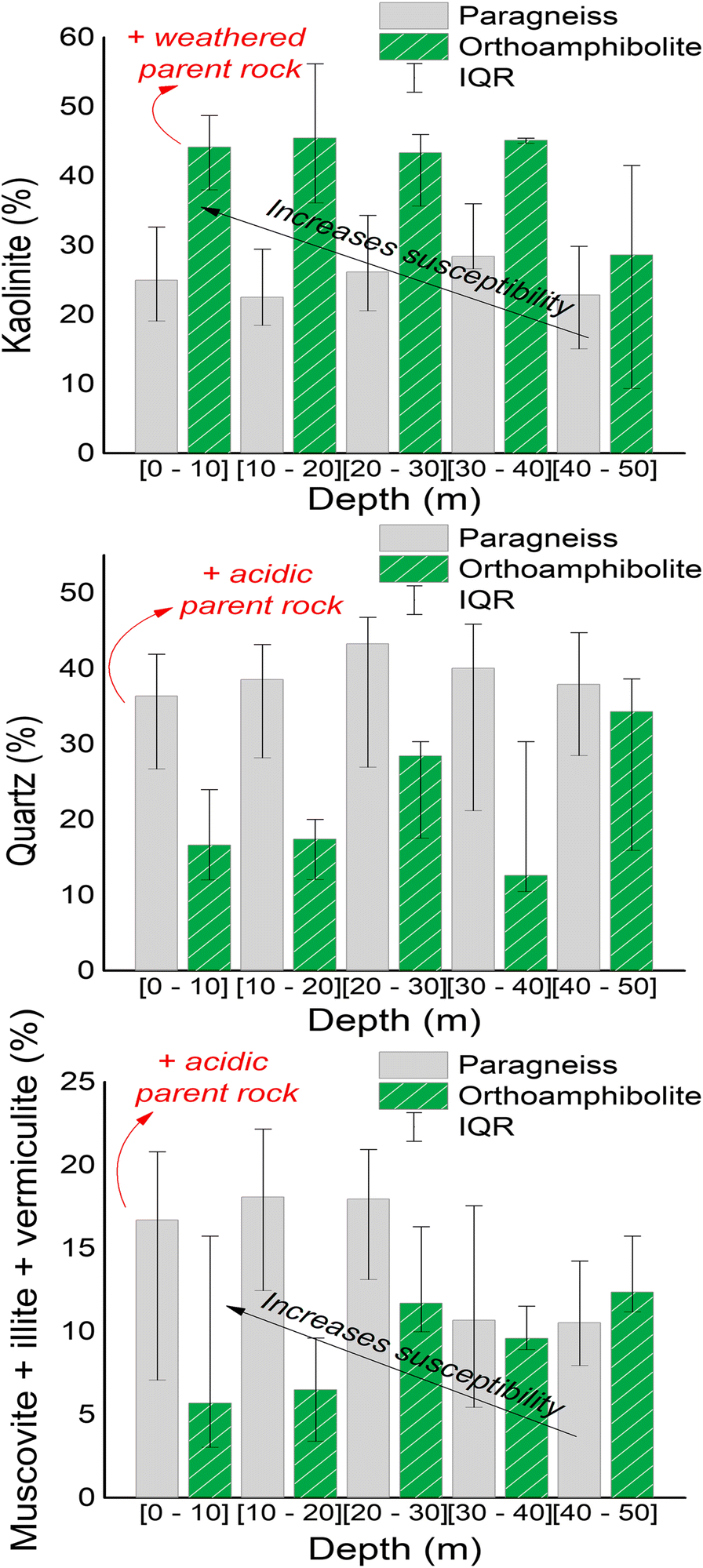
Because raw paragneiss clay has a more acidic composition, it contains more quartz (35–45%) and mica (muscovite) + type 2:1 clays (illite+vermiculite) (10–20%) (Fig. 4; Supplemental Material 1). Kaolinite and muscovite+illite+vermiculite increased in the first 40 and 30 m of the deposit, respectively, with kaolinite being the main mineral of the ortho-amphibolite raw clay, with a content of 28–48%, which was also related to the chemistry and genetics of the parent rock of this clay. Thus, a relationship was found with the Bowen's reaction series, where quartz, potassium feldspar (K-feldspar), and micas (muscovite) are the most thermodynamically stable minerals with the greatest abundance at the surface levels of the Earth's crust.
Behavior of mineralogical variables as a function of depth of the deposit. Bars correspond to median, and IQR to Interquartile Range

Moreover, quartz tended to stable values in the weathering profile (as happened in the paragneiss raw clay), while the concentration of mica (muscovite) + type 2:1 clays and kaolinite was related directly to the weathering intensity, kaolinite being a product of an intense transformation of primary minerals (feldspars, plagioclases, and micas as biotite). This was in agreement with the results of Dapena (Reference Dapena1978) and García and Suárez (Reference García and Suárez2003).
In addition, according to Alvarado et al. (Reference Alvarado, Mata and Chinchilla2014) kaolinitic clays are the last to form, so their content increases at the most superficial levels where weathering is more intense, while illite clays are the result of less weathering, so their content decreases at the most superficial levels and a transformation of the illite into vermiculite or montmorillonite can occur. This explains why the ortho-amphibolite raw clay had the higher kaolinite and the lower mica (muscovite) + type 2:1 clay contents than the paragneiss raw clay, which meant that the ortho-amphibolite raw clay was more affected by the weathering process.
Behavior of Physical Variables
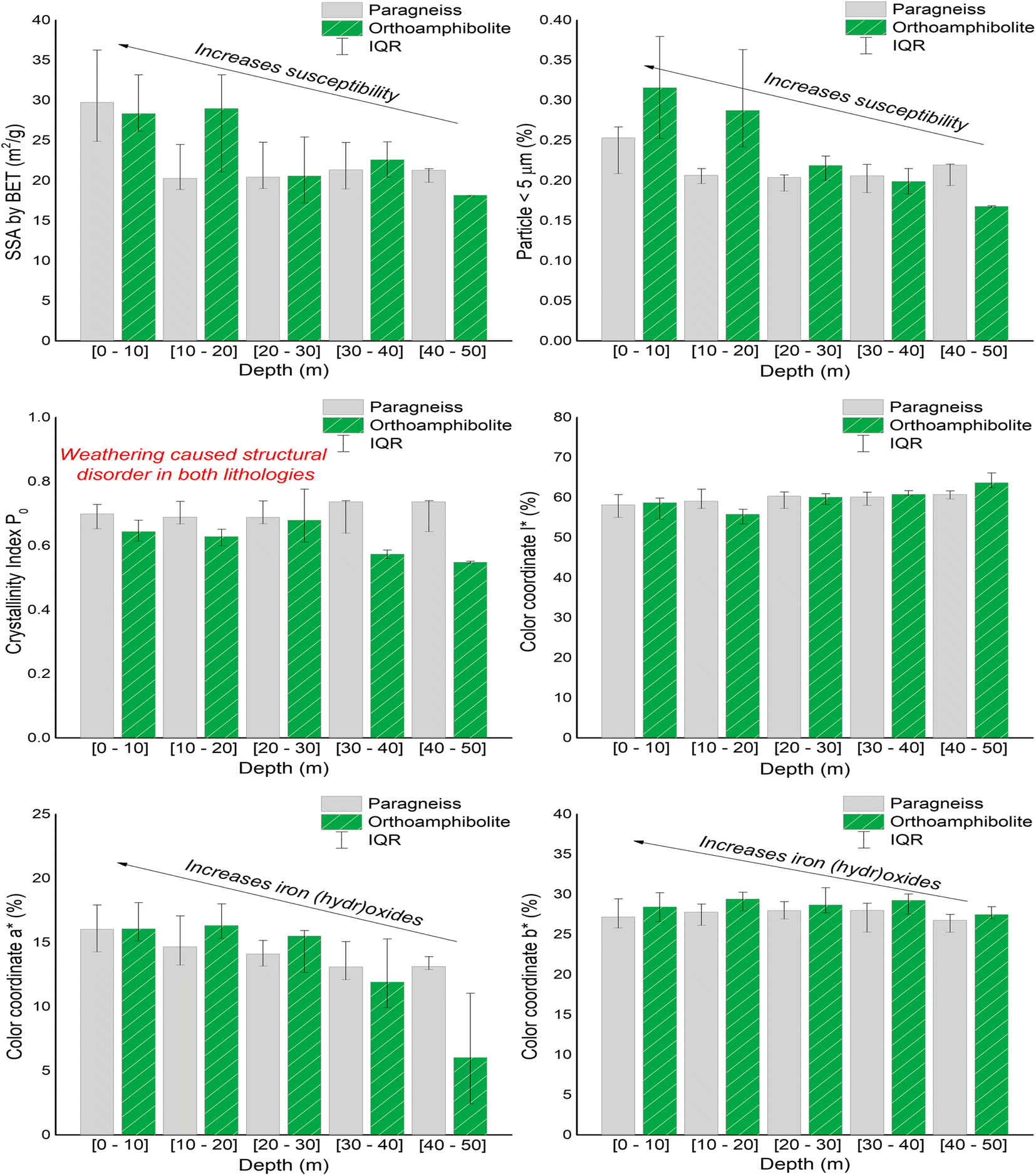
In general, the SSA of particles of <5 μm (commercial size of clay but corresponding to fine silt and clay sizes) and degree of order/disorder, P0, calculated by FTIR, increased at surface levels of the deposit (Fig. 5; Supplemental Material 1).
Behavior of the physical variables as a function of the depth of the deposit. P0: degree of order/disorder calculated by FTIR. L* coordinate: lightness. a* coordinate: red to green. b* coordinate: blue to yellow. Bars correspond to median, and IQR to Interquartile Range

From Tironi (Reference Tironi2013), the degree order/disorder of kaolinite can be determined by utilizing P0, considering that the structure is ordered if P0 > 1 or disordered if P0 < 1. In addition, the lower the P0, the more disordered the structure is, but care must be taken because the measurement is affected by the vibration of the OH– illitic groups around the 3625 cm–1 band. Thus, the P0 of the two raw clays was between 0.5 and 0.8, which indicated a slight structural disorder in the kaolinite due to the weathering suffered by the parent rocks.
So, while the formation of the raw clay occurred in the first meters of the deposit, the particle size tended to decrease, and, therefore, the SSA increased, which made the number of particles which were <5 μm greater at those points where the weathering was stronger, similar to that mentioned by Alvarado et al. (Reference Alvarado, Mata and Chinchilla2014). Thus, a direct relationship between SSA and the areas of greatest weathering was found.
Besides this, ortho-amphibolite raw clay was more weathered, which made it more susceptible to thermal activation and a better candidate for use as an SCM. This was reflected in the smaller P0 (0.5–0.7) and larger SSA (28–30 m2/g) values found in the first 20 m of the deposit, compared to paragneiss (~0.7; 20–30 m2/g).
On the other hand, colorimetric coordinates a* and b* increased at the most superficial levels, while the opposite occurred in the L* coordinate. This meant that the raw clay in the first 30 m had more reddish hues (+a*, +b*) and was duller due to the iron (oxyhydr)oxides accumulating near the surface, especially in the ortho-amphibolite raw clay due to its greater iron content.
Alteration and Weathering Degree of the Clay Deposit
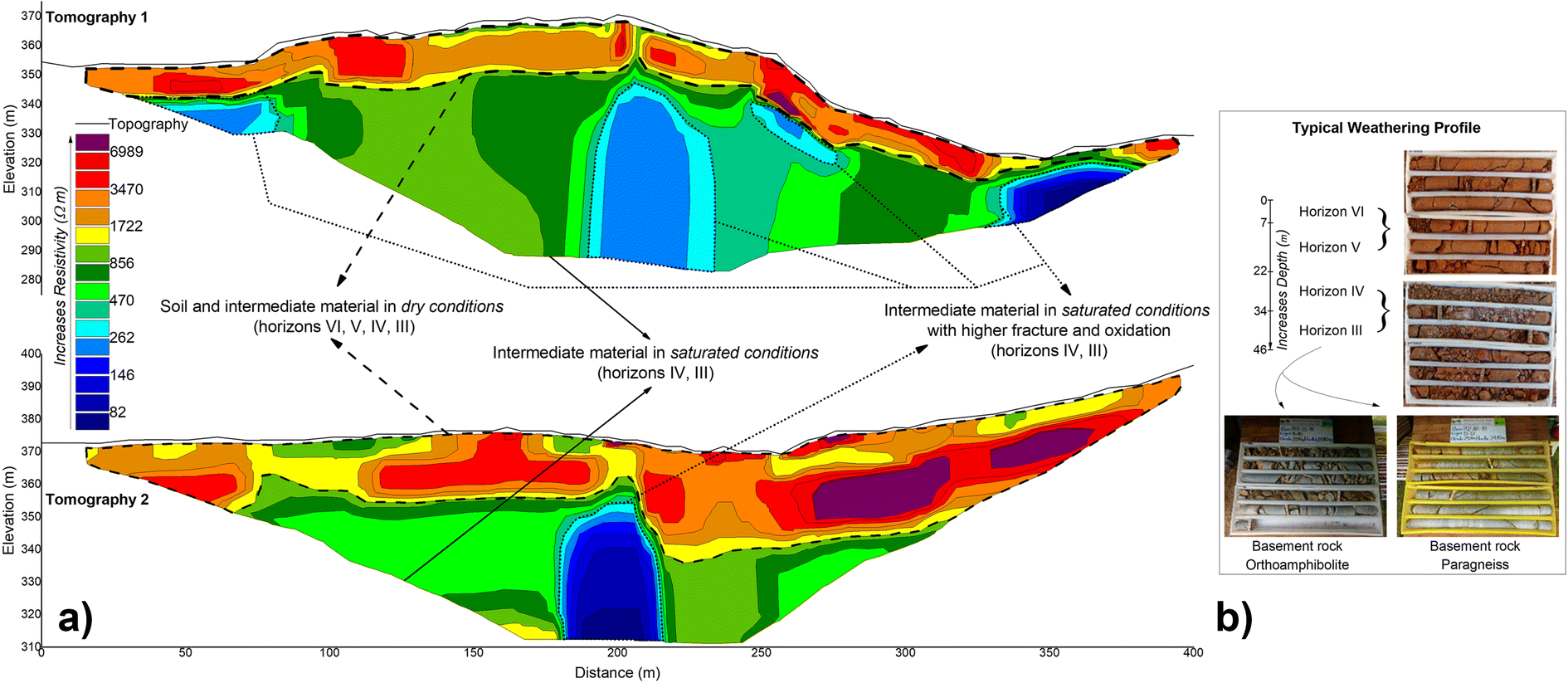
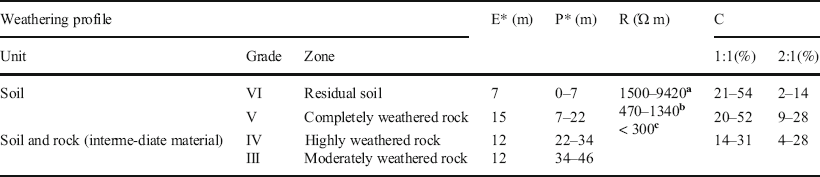
In the present work, the use of electrical resistivity tomographies was highlighted as a geophysical exploration technique (green lines in Fig. 1), which, together with the perforations, allowed the establishment of the ranges and the average thicknesses of each of the horizons of the weathering profile, using the classification criteria of Dearman (Reference Dearman1974) and Little (Reference Little1969). It permitted the determination of the range of electrical resistivity, its depth, the characteristics of the medium (dry or saturated conditions), and the type of clay according to depth, for each horizon, allowing the natural conditions of the deposit to be related to the SCM development of the calcined clay as a function of depth. The results of this technique (geological interpretations and contents of clay minerals for each horizon of the weathering profile) are shown in Fig. 6 and Table 1.
Electrical resistivity tomography (1–2) and typical weathering profile of the studied clay deposit. a The geological interpretation is indicated by the respective solid and dotted black arrows. b The average thickness and depth of each horizon in the weathering profile is shown according to the scale of the tomographies

Characteristics of the typical weathering profile of the low-grade kaolinitic multicomponent raw clay deposit

E*, P*: average values of thickness and depth range for each horizon.
R: electrical resistivity. C: clay content type 1:1 and 2:1.
a: soil and intermediate material unit under dry conditions
b: intermediate material unit under saturated conditions
c: intermediate material unit under saturated conditions with higher fracture and oxidation
From tomographies 1 and 2, three main zones were established (Fig. 6a): (1) bluish colors for regions whose resistivities were lower, <300 Ώ m, associated with the greater presence of water and fracturing of the medium, (2) greenish colors with intermediate resistivities between 300–1300 Ώ m, which indicated saturation, but less intense fracturing than in the previous zone, and (3) yellowish/reddish/violet colors with much higher resistivities, 1300–10000 Ώ m, associated with dry conditions (without saturation).
On the contrary, the typical weathering profile for the deposit was established from logging during the drilling campaigns (Fig. 6b), which showed three main regions: (1) a first very clayey region (horizons V–VI), with a pronounced earthy and plastic texture, and raw clays characterized by their reddish hues; (2) a second intermediate region (horizons IV–III) where rock and soil materials coexist, highlighting that the reddish hues of the soil were accompanied by whitish hues of the rock, which made the region brighter than the previous one; and (3) a very fractured third region with a grayish hue (horizon III), in which the basement rock of the deposit was observed. In this region, the ortho-amphibolite was more weathered by the greater presence of rock fragments; it had more reddish hues and had greater fracturing of the drill core, while in the paragneiss the opposite occurred; there was even discoloration in some of its fragments.
With these results, a geological interpretation of the deposit was constructed (solid and dotted arrow lines in Fig. 6a), and average thicknesses were established for the first horizons of the weathering profile (Table 1). The deposit presented soil units (horizons V–VI) of 22 m and intermediate material units (horizons III–IV) of 24 m, which indicated that ~46 m of potential material was present in situ to be used as pozzolanic material after its thermal activation. Furthermore, with increasing depth the quantity of type 1:1 clay, such as kaolinite, decreased, while the mica (muscovite) and type 2:1 clays (illite and vermiculite), increased. This was, therefore, a potential deposit of raw material from low-grade kaolinitic multicomponent clay which was highly fractured and weathered in the first 50 m of depth.
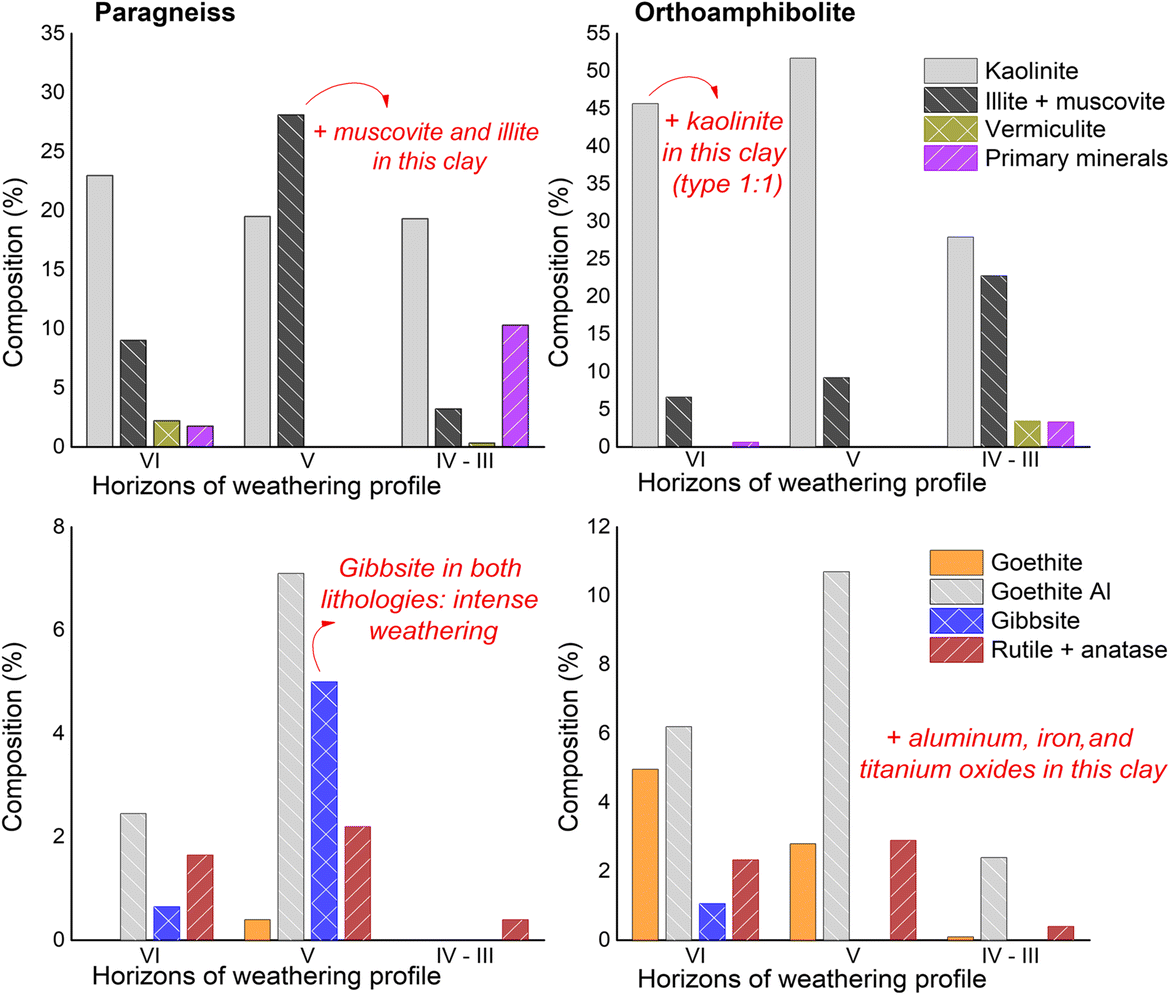
Analysis by lithology and horizons of the weathering profile (Fig. 7; Supplemental Material 1) revealed that the behaviors were similar to those of kaolinite, illite, vermiculite, and muscovite concerning depth (Fig. 4). However, when it came to relating clay minerals with their primary minerals such as K-feldspar (microcline), Na-plagioclase (albite), micas (biotite), and chlorites (clinochlore), an inverse relationship was found; i.e. in the deeper horizons (III–IV), primary minerals increased because they were closer to the parent rocks and, consequently, kaolinite decreased. In addition, the paragneiss raw clay had a larger amount of primary minerals, which indicated less intense weathering, less kaolinite (20–25%), and more muscovite + illite (10–30%), with a drastic fall of the latter to values close to zero.
Mineralogical behavior in the weathering profile of the deposit. Upper part: Average ratio between primary and clay minerals. Lower: Variation of minerals rich in aluminum, iron, and titanium oxides. Weathering profile was classificated according to the guidelines of Little (Reference Little1969) and Dearman (Reference Dearman1974)

Likewise, aluminum minerals such as gibbsite and goethite enriched in aluminum (Fig. 7) had a direct relationship with the degree of alteration of the deposit; these minerals were accumulated in the most superficial horizons (V–VI). Intense washing and leaching of the silica and alkaline elements occurred in the deposit, similar to that found by Besoain (Reference Besoain1985). In addition, goethite and titanium minerals (rutile and anatase) behaved similarly to aluminum minerals. This will be useful for future research into the degree of alteration of other clay deposits and their suitability as pozzolanic materials.
On the contrary, the degree of alteration of the deposit obtained from the geological exploration campaign was related to that obtained through the Chemical Index of Alteration (CIA) proposed by Nesbitt and Young (Reference Nesbitt and Young1982, Reference Nesbitt and Young1984, Reference Nesbitt and Young1989) to determine the degree of alteration of feldspar from compositional measurements of oxides by the following equation (Eq. 1):

Nesbitt and Young (Reference Nesbitt and Young1982) stated that CIA ≈ 50% corresponds to Na-plagioclase (albite), Ca-plagioclase (anorthite), or K-feldspar without alteration; CIA between 30–45% corresponds to fresh basalts; and CIA between 45 and 55% to granites and granodiorites. It is from these values (>55%) that the primary minerals are altered and they are transformed into clay minerals. For illites and montmorillonites, the CIA is 75–85%, while for kaolinites and chlorites, it is close to 100%.
The average CIA of the raw clay is presented together with the weathering profile and the depth of the clay deposit in Fig. 8 (left side; Supplemental Material 1). A direct relationship was observed between the CIA and the horizons of the weathering profile, which indicated intense weathering in the first 50 m (CIA > 80%). This made the entire deposit suitable for activation as a pozzolanic material. Also, the degree of alteration increased in superficial horizons where the kaolinite content was greater, with a CIA >90%.
Relationships among Chemical Index of Alteration (CIA), loss on ignition (LOI), weathering profile (horizons VI, V, IV, II), and depth of the deposit by lithological group. The vertical lines correspond to the average thickness of the horizons. Weathering profile was classified according to the guidelines of Little (Reference Little1969) and Dearman (Reference Dearman1974)

Thus, the results were consistent with each other, because the CIA in the multicomponent raw clay increased with the kaolinite content and decreased with the amount of 2:1 clays and mica (muscovite). However, an obvious lithological differentiation occurred in the CIA. This confirmed that the ortho-amphibolite raw clay was more altered and weathered than the paragneiss raw clay (by its higher CIA), which made it more susceptible to thermal activation.
A direct relationship was also observed between CIA and LOI, similar to that stated by Aristizábal et al. (Reference Aristizábal, Roser and Yokota2005) for hillslope deposits and bedrock sources in the Aburrá Valley, but differentiated by lithology (Fig. 8 right side; Supplemental Material 1). The authors stated that with these measurements, CIA can also be known, and for fresh rock, LOI is <3% with CIA being 40–50%. With this in mind, LOI increased with the degree of alteration of the deposit; i.e. CIA close to 100% in superficial horizons. Thus, all raw clay samples obtained a LOI of >7%, which indicated a significant alteration and weathering of the clay deposit, confirming once again the susceptibility of the clay deposit for use as an SCM. Furthermore, LOI values were higher and steeper in the ortho-amphibolite raw clay, which confirmed its greater alteration and weathering degree.
Thermal Activation of the Low-Grade Kaolinitic Multicomponent Raw Clay
The XRD patterns and FTIR spectra of the raw and calcined clay samples from the horizons of the weathering profile of the clay deposit (Figs. 9, 10, 11; Supplemental Material 2) revealed, in general, that the degree of alteration decreased with depth, as did the reflection of the kaolinite, gibbsite, goethite, hematite, and anatase, especially in the patterns for the ortho-amphibolite raw clay, which contains more of these minerals. However, the opposite occurred in muscovite, illite, and vermiculite, which were more prevalent in the paragneiss raw clay as reflected by more intense XRD peaks from these minerals in the XRD patterns.
XRD patterns of the calcined clay at temperatures of 650, 750, and 850°C for the various horizons in the weathering profile (see Supplemental Material 2 for the tabulated raw data). RT: room temperature. Q: quartz, K: kaolinite, M: muscovite, I: illite, V: vermiculite, Gh: goethite, Gi: gibbsite, H: hematite, A: anatase

FTIR spectra of the paragneiss clay calcined at temperatures of 650, 750, and 850°C for the various horizons in the weathering profile. RT: room temperature

FTIR spectra of ortho-amphibolite clay calcined at temperatures of 650, 750, and 850°C for the various horizons in the weathering profile. RT: room temperature

The following observations were made about the effect of calcination. (1) A significant increase was observed in the intensity and widths of the 8.88 and 34.88°2θ muscovite reflections, and the 20.03, 35.02, and 24.30°2θ illite reflections with temperature, particularly at 850°C and in horizons IV–III, indicating a structural order (no total dehydroxylation under the studied temperatures) similar to that recorded by Alujas et al. (Reference Alujas, Fernández, Quintana, Scrivener and Martirena2015), where total dehydroxylation occurs around 900°C. (2) At all temperatures, the 12.30 and 24.85°2θ reflections of kaolinite, the 21.24 and 35.00°2θ reflections of goethite, and the 17.80°2θ reflection of gibbsite collapsed completely, indicating that total dehydroxylation of these minerals occurred at temperatures below 650°C, similar to that found by Alujas et al. (Reference Alujas, Fernández, Quintana, Scrivener and Martirena2015), where the total dehydroxylation of kaolinite occurred at 600°C and of goethite and gibbsite at 350°C. (3) The intensity and width of the 33.28 and 35.74°2θ hematite reflections and of the 25.35°2θ anatase reflection increased with temperature, which was associated with the crystallization phenomena of minerals such as hematite (iron oxide) above 650°C and the total dehydroxylation of goethite (iron oxyhydroxide) around 350°C.
On the other hand, FTIR spectra showed bands of six functional groups (Figs. 10 and 11): a vibration band at 528 cm–1 from Si–O–Al (VI) of kaolinite (where VI indicates Al in octahedral coordination), vibration bands at 747 and 789 cm–1 of Si–O–Al (IV) of kaolinite (where IV indicates Al in tetrahedral coordination), a deformation vibration band at 910 cm–1 of Al–OH of kaolinite, elongation vibration bands at 1000 and 1026 cm–1 of Si–O of kaolinite, a bending vibration band at 1640 cm–1 of H–O–H of water molecules adsorbed by 2:1 clays such as montmorillonite (Madejová, Reference Madejová2003), and stretching bands at 3621, 3655, 3669, and 3695 cm–1 of the hydroxyl groups.
The transmittances of the raw clay samples (at room temperature – RT) for the functional group Si–O–Al (VI) were between 20 and 60% (absorbance between 1.6 and 0.5), which indicated greater structural order in the multicomponent raw clay due to the octahedral coordination of aluminum in the kaolinite; hence the need to thermally activate the raw clay to ensure pozzolanic reactivity. However, the small amount of Si–O–Al (IV) (transmittance between 75 and 90%, absorbance between 0.3 and 0.1) in both lithologies reflected a certain degree of structural disorder in the kaolinite of the raw clay, produced by the weathering suffered in the clay deposit, which made it suitable for thermal activation.
Likewise, FTIR spectra of calcined clay samples confirmed what was discussed from the XRD patterns: total dehydroxylation in kaolinite at temperatures ≥650°C, given that OH and Al–OH bands of kaolinite disappeared. Furthermore, above 650°C, the transmittance of the Si–O–Al (VI) band decreased dramatically, indicating lower coordination of aluminum and, consequently, more structural disorder in the calcined clay. Therefore, clays of the deposit showed structural disorder by thermal treatment, due to total dehydroxylation of kaolinite at 650°C and partially of illite at 850°C (confirmed by XRD); so, these calcined clays were candidates for evaluation as SCMs by means of pozzolanic activity measurements such as SAI and Frattini.
Evaluation of the Pozzolanic Activity of Multicomponent Calcined Clay
The Strength Activity Index (SAI) at 28 curing days for the first 50 m of the clay deposit is shown in Fig. 12 (left side; Supplemental Material 1). Pozzolanic activity decreased with depth at the three calcination temperatures, due mainly to the degree of weathering, which was greater at superficial levels. This corroborated the suggestion that the greater the degree of weathering, the greater the SAI, as asserted by Dapena (Reference Dapena1978) and García and Suárez (Reference García and Suárez2003).
SAI results at 28 curing days as a function of calcination temperature and depth (left), and behavior of the kaolinite/(muscovite+illite+vermiculite) ratio of the raw clay derived from ortho-amphibolite with the depth of the deposit (right). Bars correspond to median, and IQR to Interquartile Range

Regardless of the lithology of the parent rock and the temperature of calcination, the calcined clay of the first 50 m of the deposit fulfilled satisfactorily the requirements for pozzolanic material, because SAI was between 85 and 110%, which was higher than the threshold value of 75% established by ASTM C 311-18.
Considering the mineralogy in the ortho-amphibolite raw clay (Fig. 4), a relationship was found among SAI, kaolinite and mica (muscovite) + type 2:1 clay minerals (illite + vermiculite) (Fig. 12 right side; Supplemental Material 1). At shallower levels, where weathering was more intense, the development of calcined clay as an SCM increased to values close to 100% SAI and even exceeded this value at 650 and 750°C, which reflected a net gain in mechanical strength at these temperatures. This was due to the higher kaolinite and aluminum oxide content at this depth, which, when thermally activated, caused the clay structure to disorder, resulting in more metakaolin and more pozzolanic clay. This may also be due to greater SSA of particles and structural disorder degree of kaolinite in these superficial levels in the raw state, which can decrease activation energy, facilitate destruction of OH bonds in kaolinite, and make it more reactive. Conversely, with increasing depth, mechanical development decreased because mica (muscovite) + type 2:1 clay minerals (illite + vermiculite) content increased and SSA decreased, which meant the kaolinite/(muscovite+illite+vermiculite) ratio fell to values close to 2. Thus, SAI was affected by the kaolinite/(muscovite+illite+vermiculite) ratio, P0 index, and SSA of particles, especially at surface levels.
On the contrary, SAI increased with temperatures up to 750°C, with better mechanical development at the higher end. Then, at 850°C, mechanical development dropped sharply, which was even lower than the value obtained at 650°C. According to Tironi et al. (Reference Tironi, Trezza, Scian and Irassar2012), Fernández et al. (Reference Fernández, Alba and Torres2013), and Danner et al. (Reference Danner, Norden and Justnes2018), structural break-down and dehydroxylation cause structural disorder in clay minerals, increasing their pozzolanic reactivity and development as SCMs. Kaolinitic or 1:1 type clays are completely dehydroxylated between 500 and 600°C, while in 2:1 type clays, such as illite, vermiculite, or montmorillonite, dehydroxylation occurs at higher temperatures (800–1000°C). Thus, the calcined clay had the greatest pozzolanic activity at 750°C, which was a value within the range found in the literature (600–1000°C) (Alujas et al., Reference Alujas, Fernández, Quintana, Scrivener and Martirena2015; Yanguatin et al., Reference Yanguatin, Ramírez, Tironi and Tobón2019; Córdoba et al., Reference Córdoba, Zito, Sposito, Rahhal, Tironi and Thienel2020a, Reference Córdoba, Zito, Tironi, Rahhal, Irassar and Bishnoi2020b; Rakhimova et al., Reference Rakhimova, Rakhimov, Bikmukhametov, Morozov, Eskin and Lygina2020; Rodríguez & Tobón, Reference Rodríguez and Tobón2020; Rodríguez et al., Reference Rodríguez, Frías and Tobón2021; Sposito et al., Reference Sposito, Maier, Beuntner and Thienel2022) and was a product of its mineralogical multicomponents (the optimum temperature of activation was higher than 1:1 type clay and lower than 2:1 type).
The reduction in the SAI at 850°C may be caused by particle agglomeration or early crystallization of non-reactive phases such as spinel, due to the large amount of iron and titanium oxides. However, studies at higher temperatures are necessary for effective confirmation, as are complementary studies such as SEM and PSD.
The physical test of pozzolanicity (SAI) was contrasted with the chemical test of pozzolanicity and the Frattini test (Fig. 13; Supplemental Material 1), which discriminated by lithology and by the horizon of the weathering profile for a better understanding of the pozzolanic activity.
Frattini test at 28 curing days of the clay mortars from the paragneiss (left) and ortho-amphibolite (right) weathering profiles calcined at temperatures of 650, 750, and 850°C. RT: room temperature

Chemical test results (Fig. 13) revealed a similar trend between Frattini and SAI results; in other words, multicomponent clays only had pozzolanic activity when they were calcined, with better results in the first horizons of the weathering profile (VI and V) and at 650 and 750°C, this latter temperature being better because of its greater distance in height with respect to the lime saturation curve. Likewise, the trend of a decrease in pozzolanic activity at 850°C was maintained (displacement vector with a tendency to the region above the lime saturation curve), as happened in SAI. For these reasons, Frattini was also affected by mineralogy (kaolinite/(muscovite+illite+vermiculite) ratio), chemical composition (aluminium oxide), weathering (CIA and horizons), crystallinity (P0), and physical variables (SSA).
On the other hand, Frattini results showed no pozzolanicity in samples of horizons IV–III/ortho-amphibolite and horizon V/paragneiss calcined at 650 and 750°C, which were contrary to what was determinated by SAI. This was possibly due to the muscovite + illite content in the raw clays of these horizons (28 and 23%, respectively), which was higher than other horizons (Fig. 7). The illite content of the clay must be optimal because its presence can cause an effect similar to that of the filling system (no chemical interaction between cement and this calcined clay). According to Fernández et al. (Reference Fernández, Martirena and Scrivener2011), the layered structure of illite is largely preserved during dehydroxylation so the octahedral Al and tetrahedral Si do not react easily with Ca2+ ions released during cement hydration, resulting in less C-S-H gel formation and lower mechanical strength. SAI is very sensitive to this type of physical interaction. When the type 2:1 clay minerals are treated at low temperatures, they are not fully activated. Consequently, they do not have their full chemical interaction with the cement. This is evidenced in Fig. 13 when, upon reaching the maximum temperature (850°C), the points of each of these materials were located on the saturation curve or slightly below it. The interaction of these materials with the cement, then, was probably more physical than chemical, which is why their pozzolanic effect was seen in SAI but not in Frattini.
For the reasons stated above, regardless of lithology, weathering horizon profile, or calcination temperature (650, 750, or 850°C), the mica (muscovite) + type 2:1 clay minerals (illite + vermiculite) content of multicomponent calcined clay must not exceed 9% in order to be used as an SCM; or its calcination temperature must be >850°C when it exceeds this value, taking lithology and weathering horizon profile into account (the greater content of type 2:1 clay minerals raised the activation temperature of the sample and decreased its pozzolanic activity).
Conclusions
In the present study, low-grade calcined clays were evaluated as supplementary cementitious material (SCM), taking into account their origin, degree of alteration, mineralogy, soil profile horizon, and activation temperature. From the analysis of the results the following conclusions can be highlighted:
The clay deposits evaluated presented high degrees of alteration and weathering with CIA values >80% and up to 50 m of depth in the weathering profile, as is common in tropical regions. These were thermally activated successfully at relatively low temperatures. This means that the use of calcined clay derived from metamorphic parent rocks of intermediate composition could be promising as SCMs.
A clear correspondence was found among CIA, mineralogy, and the soil weathering profile (depth). CIA increased with kaolinite content (1:1 type structures) and decreased with increasing mica (muscovite) + 2:1 type clay minerals (illite, vermiculite). The CIA decreased with depth.
The accumulation of kaolinite and iron and aluminum (oxyhydr)oxides in the most superficial horizons of weathering profiles indicated climatic environments of intense precipitation as found in this tropical region. Parent rocks containing significant amounts of K-feldspar (microcline), Na-plagioclase (albite), micas (biotite), and chlorites (clinochlore) influenced this accumulation.
By monitoring mineralogical variables, knowing the conditions and intensities of alteration and weathering that transform the rock mass into soil or raw clay is possible. This requires relating the alteration minerals (kaolinite, vermiculite, and illite) to the primary minerals (microcline, albite, biotite, and clinochlore). As a result, an inverse relationship was discovered between these two groups along the weathering profile studied, which was more noticeable in paragneiss raw clay, which was less weathered as indicated by the larger amount of primary minerals (2–10%) and smaller amount of kaolinite (20–25%), goethite (<1%), goethite enriched in aluminum (<7%), and rutile and anatase (<2%), especially in the deeper horizons (IV–III). That is, the degree of alteration clearly marked the difference between the two lithologies (ortho-amphibolite and paragneiss) thanks to their original mineralogical differences.
From the lithological point of view, and according to the degree of alteration, the weathering was more intense in ortho-amphibolite than in paragneiss. Because the mineralogical composition of ortho-amphibolite was less acidic, it contained a greater proportion of basic minerals that were altered into clay minerals and clay-size materials such as kaolinite (28–54%), goethite (<5%), and goethite enriched in aluminum (2–11%). This also resulted in greater specific surface area and degree of structural disorder in kaolinite, as a product of the intense leaching of the medium. Because of its greater susceptibility to thermal activation, the clay from ortho-amphibolite was a better candidate to serve as an SCM.
Regarding calcination, the optimal range of thermal activation of the clays was >650°C but <850°C, with a tentative optimum temperature of 750°C, depending on its multicomponent composition and its kaolinitic degree. Furthermore, the structural disorder of the calcined clay caused by the total dehydroxylation of the gibbsite, goethite, and kaolinite at temperatures below 650°C and by the partial dehydroxylation of the illite at the temperatures studied had a significant impact on pozzolanic activity.
On the other hand, the susceptibility to thermal activation of multicomponent raw clay increased with degree of alteration and decreased with depth because of an increase in the number of Si–O–Al (IV) moieties from 80% in horizon VI to 88% in horizons IV–III of the paragneiss raw clay, and from 78 to 79% in that of ortho-amphibolite, which indicated less aluminum in tetrahedral coordination in the kaolinite found in the deepest and least weathered horizons of the weathering profile.
Physical tests of pozzolanicity revealed that all calcined clays studied belonging to the first 50 m of the deposit were suitable as pozzolanic materials, far exceeding the threshold value established by the ASTM C311-18 standard. However, some deeper horizons of weathering profiles such as horizons IV–III/ortho-amphibolite and horizon V/paragneiss only exhibited pozzolanic activity when they were calcined at 850°C due to greater mica (muscovite) + 2:1 type clay minerals (illite, vermiculite) contents (≫9%), which was evidenced by chemical tests for pozzolanicity (Frattini test).
The SAI increased with the kaolinite/(muscovite+illite+vermiculite) ratio, SSA, P0, and degree of alteration (either by CIA or by weathering profile), which were related to the depth of the clay deposit.
Finally, the geological origin of raw clay was established, as well as the genesis and the physical, chemical, and mineralogical conditions of the low-grade clay deposit. These results made it possible: (1) to know the state of the deposit caused by weathering and chemical alteration, through field studies such as electrical resistivity tomographies tests; (2) to classify the horizons of the weathering profile; (3) to compare this classification with the CIA index; and (4) to understand the influence of the clay thermal activation and its performance as an SCM. So, the use of these calcined clays of metamorphic parent rocks in the cement or construction industry is feasible, especially those of intermediate composition or those with a multicomponent character that does not exceed 9% mica (muscovite) + 2:1 type clay minerals (illite, vermiculite) and when activated at a temperature of ≤750°C.
Supplementary Information
The online version contains supplementary material available at https://doi.org/10.1007/s42860-022-00184-7.
Acknowledgments
The authors are grateful to the Cement and Building Materials Research Group (CEMATCO) of the School of Mines and the Department of Materials and Minerals of Universidad Nacional de Colombia.
Authors' Contributions
Authors whose names appear on the submission have contributed sufficiently to the scientific work and therefore share collective responsibility and accountability for the results.
Funding
The authors declare that they have no known competing financial interests or personal relationships that could have appeared to influence the work reported in this paper.
Availability of Data and Materials
All data generated or analysed during this study are included in the supplementary information files. Data of Figures are presented in the attached supplementary material in PDF format named “Supplemental Material 1” and spreadsheets named " Supplemental Material 2".
Declarations
Ethics Approval and Consent to Participate
• The manuscript has not been submitted to more than one journal for simultaneous consideration.
• The manuscript has not been published previously (partly or in full).
• The manuscript has not been split into several parts to increase the number of submissions nor submitted to various journals or to one journal over time.
• No data have been fabricated or manipulated (including images) to support conclusions.
• No data, text, or theories by others are presented as if they were the authors’ own. Proper acknowledgement of previous studies has been given.
Consent for Publication
All Authors declare consent to submit this work, as well as the consent of responsible authorities at the institute/organization where the work has been carried out.
Competing Interests
The authors declare that they have no conflict of interest.