Introduction
Researchers estimate that between 20 and 30 per cent of community-dwelling individuals over the age of 65 years fall at least once each year (Shumway-Cook et al., Reference Shumway-Cook, Ciol, Hoffman, Dudgeon, Yorkston and Chan2009; Sibley, Voth, Munce, Straus, & Jaglal, Reference Sibley, Voth, Munce, Straus and Jaglal2014; Speechley & Tinetti, Reference Speechley and Tinetti1991). Consequences of falls include lacerations, fractures, head injuries, and death (Speechley & Tinetti, Reference Speechley and Tinetti1991). Even in the absence of significant injury, falls can have negative psychological effects on the life of the individual, leading to restricted activity, increased dependency on others, and decreased social interaction (Howland et al., Reference Howland, Peterson, Levin, Fried, Porodon and Bak1993; Howland et al., Reference Howland, Lachman, Peterson, Cote, Kasten and Jette1998). The impact of falls on older adults’ health, quality of life, and the health care systems that support them is substantial. In 2009-2010, more than 250,000 Canadian older adults reported a fall-related injury, resulting in 78,330 hospitalizations, 2,619 deaths, and estimated health care costs of $3.4 billion (Canadian dollars) (Parachute, 2015; Public Health Agency of Canada, 2014).
In 2012-2013, falls in adults over the age of 65 resulted in 235,355 emergency department visits and 84,828 hospitalizations in Canada. (Canadian Institute for Health Information, 2014). In the province of British Columbia, Canada, approximately 19 per cent of all emergency department visits by persons older than age 70 are fall-related (Woolcott, Khan, Mitrovic, Anis, & Marra, Reference Woolcott, Khan, Mitrovic, Anis and Marra2011), and fall-related injuries resulted in hospital costs of $415 million and total health care costs of $1.2 billion in 2010. (British Columbia Injury Research and Prevention Unit, 2015). Similar impacts have been observed in the United Kingdom (Scuffman, Chaplin, & Legood, Reference Scuffman, Chaplin and Legood2003), Australia (Hendrie, Hall, Arena, & Legge, Reference Hendrie, Hall, Arena and Legge2004), and the United States, with unintentional falls in the United States resulting in 662,037 hospitalizations and 21,649 deaths in 2010, at an estimated health care cost of $26 billion (U.S. dollars) (Centers for Disease Control and Prevention, 2014).
Effectiveness of Fall Prevention Interventions
The most recent Cochrane Review of interventions for preventing falls in older people living in the community (Gillespie et al., Reference Gillespie, Robertson, Gillespie, Sherington, Gates, Clemson and Lamb2012) and the Centers for Disease Control and Prevention Compendium of Falls Prevention Programs (Stevens & Burns, Reference Stevens and Burns2015) concluded that there is evidence for the effectiveness of many different approaches to fall prevention. Evidence appears to be most consistent for group- or home-based exercise programs (Barnett, Smith, Lord, Williams, & Baumand, Reference Barnett, Smith, Lord, Williams and Baumand2003; Campbell et al., Reference Campbell, Robertson, Gardner, Norton, Tilyard and Buchnew1997; Clemson et al., Reference Clemson, Fiatarone Singh, Bundy, Cumming, Manollaras, O’Loughlin and Black2012; Kemmler, von Stengel, Engelke, Haberle, & Kalender, Reference Kemmler, von Stengel, Engelke, Haberle and Kalender2010; Liu-Ambrose et al., Reference Liu-Ambrose, Davis, Hsu, Gomez, Vertes, Marra and Dian2015), interventions for the visually impaired (Campbell et al., Reference Campbell, Robertson, La Grow, Kerse, Sanderson, Jacobs and Hale2005), and home safety interventions (Cumming et al., Reference Cumming, Thomas, Szonyi, Salked, O’Neill, Westbury and Frampton1999; Pighills, Torgerson, Sheldon, Drummond, & Bland, Reference Pighills, Torgerson, Sheldon, Drummond and Bland2011). All three of these intervention approaches reduce the risk of falls (i.e., the number of people falling or “fallers”) as well as the rate of falls (i.e., the number of falls over time). Tai chi has shown to be effective in reducing both the rate of falls and the risk of falling in two recent systematic reviews and meta-analyses (Del-Pino-Casado, Obrero-Gaitan, & Lomas-Vega, Reference Del-Pino-Casado, Obrero-Gaitan and Lomas-Vega2016; Huang, Feng, Li, & Lv, Reference Huang, Feng, Li and Lv2017). However, multifactorial interventions that integrate assessment and individualized intervention appear to reduce the rate of falls but not the risk of falling (Close et al., Reference Close, Ellis, Hooper, Glucksman, Jackson and Swift1999; Logan et al., Reference Logan, Coupland, Gladman, Sahota, Stoner-Hobbs, Robertson and Avery2010; Palvanen et al., Reference Palvanen, Kannus, Piirtola, Niemi, Parkkari and Jarvinen2014).
The role of vitamin D supplementation for the prevention of falls and fractures is still not well understood and appears to be related to dose of vitamin D, baseline vitamin D status of individuals, and associated calcium intake (Ringe, Reference Ringe2012; Shuler, Schlierf, & Wingate, Reference Shuler, Schlierf and Wingate2014). A once-a-year, high-dose vitamin D supplementation resulted in increased falls and fractures (Sanders et al., Reference Sanders, Stuart, Williamson, Simpson, Kotowicz, Young and Nicholson2010), whereas daily intake of 800 international units or higher of vitamin D has been associated with decreased falls and fractures in a number of studies (Bischoff-Ferrari et al., Reference Bischoff-Ferrari, Dawson-Hughes, Staehelin, Orav, Stuck, Theiler and Henschkowski2009; Murad et al., Reference Murad, Elamin, Elnour, Elamin, Alkatib, Fatourechi and Montori2011).
Implementation of evidence-based fall prevention interventions in clinical practice can be challenging, particularly when general populations do not match the select populations in randomized controlled trials. Potential barriers to implementation include (a) lack of access to fall prevention assessment and intervention; (b) lack of resources to implement recommendations; (c) maintaining adherence to recommendations; and (d) evidence of cost-effectiveness. Evidence from an Australian trial showed good uptake of recommendations but not a reduction in falls (Whitehead, Wundke, Crotty, & Finucane, Reference Whitehead, Wundke, Crotty and Finucane2003). Similar indeterminate findings have been reported in the Netherlands in a large pre-post–design study (Wijlhuizen, Du Bois, Van Dommelen, & Hopman-Rock, Reference Wijlhuizen, Du Bois, Van Dommelen and Hopman-Rock2007) and in a randomized control trial in the United Kingdom (Conroy et al., Reference Conroy, Kendrick, Harwood, Gladman, Coupland, Sach and Masud2010). However, other studies using multifactorial fall prevention clinic models have shown fall rate reductions (Hill, Moore, Dorevitch, & Day, Reference Hill, Moore, Dorevitch and Day2008) as well as a reduction in the rate of injurious falls (Moore et al., Reference Moore, Williams, Ragsdale, LoGerfo, Goss, Schreuder and Phelan2010).
Despite the large body of evidence that fall prevention initiatives can prevent falls, access to fall risk assessment and evidence-based intervention is limited. Even when older adults present to the emergency department with a fall-related injury, fall risk assessment and management is rarely initiated as part of the treatment plan. For example, of 54 older adults presenting to a tertiary care urban emergency department in Canada with injuries related to a fall, only two (3.7%) received fall prevention interventions in follow-up (Donaldson et al., Reference Donaldson, Khan, Davis, Salter, Buchanan, McKnight and McKay2005; Salter et al., Reference Salter, Khan, Donaldson, Davis, Buchanan, Abu-Laban and McKay2006).
Fall Prevention Resources in the Fraser Health Authority, British Columbia
Older adults in the Fraser Health Authority in British Columbia had limited access to fall prevention assessment and treatment recommendations prior to 2007. Family physicians did not have the time to adequately complete the multifactorial assessment needed to address fall prevention in their offices. There were only six geriatric clinics prior to 2007 (for a population of 1.6 million) with the majority of referrals related to cognitive impairment and limited time devoted to comprehensive fall prevention assessment and treatment (administrative data from Fraser Health Authority).
To address this gap, in 2007 Fraser Health Authority developed the Fall Prevention Mobile Clinic (FPMC), a clinic that travels from community to community bringing services directly to older adults, close to where they live. The FPMC provides multifactorial fall risk assessment and individualized treatment plans on the basis of evidence-based recommendations. The clinic addresses the issue of long-term adherence of fall prevention recommendations by working closely with community organizations to provide education, to link with local exercise programs and community services, and to plan safer living environments.
A pilot implementation of the multidisciplinary intervention took place from September 2007 to March 2008. During the 6-month pilot, 380 older adults participated in 20 FPMCs held across the Fraser Health Authority. Participant satisfaction with the pilot program was high. In order to determine the feasibility of supporting the clinic on a sustained basis, we undertook a costing exercise (see Appendix A; costs are reported in Canadian dollars). Briefly, to run 20 full-day clinics, serving 380 older adults, estimates were $23,970 for ongoing operating costs (equivalent to $63 per person or $1,200 per full-day clinic) and $16,530 for start-up costs. These cost estimates assume the in-kind contribution of space to run the clinic in each community. Our objective in this FPMC study was to determine if this novel model of delivering fall prevention interventions would lead to improved uptake of clinic recommendations, improved mobility measures, and a reduction in falls in community-dwelling older adults.
Methods
Study Design
We conducted this before-and-after study, focused on a single group, from October 2009 to October 2012 in the geographic area of the Fraser Health Authority, which provides health care to approximately 1.6 million people in British Columbia (Fraser Health Authority, 2014). We recruited participants from a convenience sample of older adults attending the FPMC.
Participants had to be age 65 or older, currently using a mobility aid, and/or self-reported to have had at least one fall in the previous six months. These inclusion criteria have been shown to be correlated with a high risk of future falls (Tinetti, Doucette, Claus, & Marottoli, Reference Tinetti, Doucette, Claus and Marottoli1995). Participants also had to be living independently in their own home, in a seniors’ residence, or in a Fraser Health Authority assisted living facility where assistance with self-care is provided in a congregate living arrangement (Fraser Health Authority, 2015). Individuals were excluded if they were unable to provide informed consent or cooperate with study assessments due to cognitive impairment or insufficient English language skills. The study was approved by the Fraser Health Authority Research Ethics Board (FHREB 2009-062).
Intervention
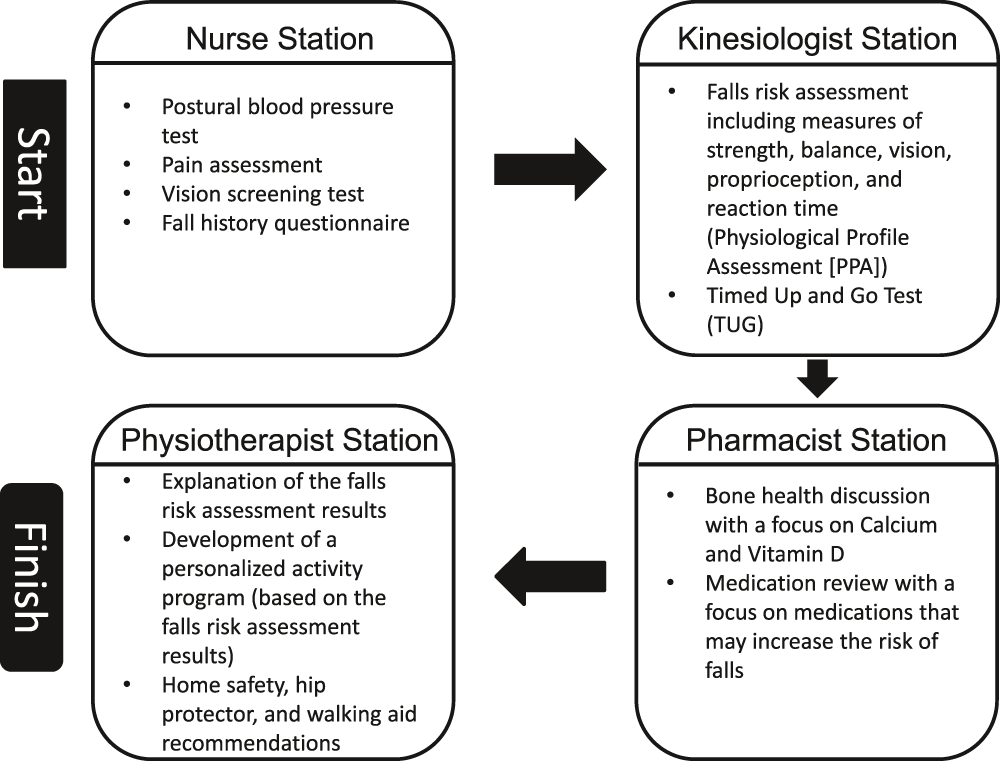
The FPMC provides an individualized, multidisciplinary fall risk assessment and fall prevention plan to at-risk older adults. In addition to referrals from health professionals, older adults or their family members were permitted to self-refer after attending a fall prevention presentation delivered in communities by FPMC staff. FPMCs were set up in locations where seniors already gathered (e.g., seniors’ centres, faith-based temples/churches, community centres, and assisted living facilities). Community sponsor organizations provided space, volunteers, refreshments, and advertising. Prior to attending the clinic, we mailed a baseline questionnaire to participants. Participants were instructed to bring the completed questionnaire to registration. We provided additional copies at registration if participants had lost the questionnaire. The clinic was organized to see 17 older adults per day. After completing registration, each participant rotated through four assessment stations led by a nurse, a kinesiologist, a pharmacist, and a physiotherapist. Evidence-based risk factors for falls were assessed, with a standardized form listing potential recommendations, at each station. Details of the clinic flow and procedures are described in Figure 1. Appendix B provides the nurse, pharmacist, and physiotherapist assessment and treatment recommendation forms.
Fall Prevention Mobile Clinic. Flow of participants through the different stations

At the kinesiologist station, objective measurements of physiologic function and mobility were evaluated with two validated performance-based measurement tools: the Timed Up and Go (TUG) (Whitney, Lord, & Close, Reference Whitney, Lord and Close2005), and the Physiological Profile Assessment-Short Form (PPA-SF) (Lord, Menz, & Tiedemann, Reference Lord, Menz and Tiedemann2003) (see the “Study Outcomes” section for further details). The physiotherapist determined exercise, hip protector, and mobility aid recommendations from the TUG and PPA-SF score results.
We compiled an individualized summary of each participant’s assessment and treatment recommendations on the basis of each station’s assessment forms. A member of the clinic staff reviewed the summary with the participant at the end of the clinic. We mailed a copy of the participant’s individualized assessment and treatment recommendations to their family physician. Participants took home a copy of the individualized summary and instructed to make an appointment with their family physician to discuss their assessments and recommended actions.
Assessment and Follow-up
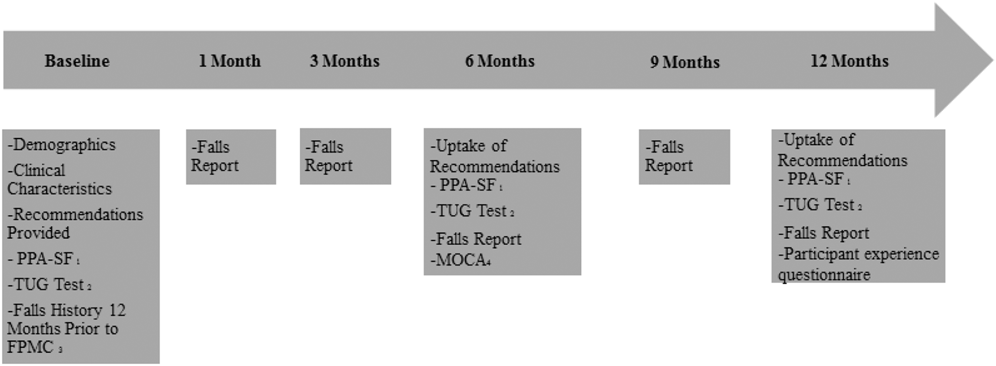
Assessment and follow-up timelines are presented in Figure 2. We used the baseline questionnaire to collect demographic and clinical characteristics, including the presence of co-morbid health conditions (e.g., kidney disease, arthritis, osteoporosis, liver disease, high blood pressure, asthma, emphysema/chronic bronchitis, heart problems, stroke, Parkinson’s, diabetes, and joint replacement surgery). In addition, we collected information regarding past falls and related injuries over the 12 months prior to participants’ attending the clinic.
Assessment and follow-up of participants over the 12 months of the study
1–Physiological Profile Assessment – Short Form
2–Timed Up and Go Test
3–Fall Prevention Mobile Clinic
4–Montreal Cognitive Assessment Tool

At the end of the clinic visit, we gave study participants fall diary calendars to take home and fill out on a daily basis. We interviewed all study participants at 1, 3, 6, 9, and 12 months to report any falls and associated injuries that may have occurred, and the study coordinator completed a falls report form. The 6-month and 12-month assessments were done in person; all other participant contact was completed over the telephone. At the 6-month and 12-month in-person follow-up visits, study coordinators collected information on falls, uptake of recommendations made to each participant, and repeated TUG and PPA-SF tests. Study participants were screened for cognitive function at the 6-month visit using the brief Montreal Cognitive Assessment (MoCA) screening tool because research suggests that multifactorial fall prevention programs are less effective in people with cognitive impairment (Shaw et al., Reference Shaw, Bond, Richardson, Dawson, Steen, McKeith and Kenny2003). We selected the MoCA because it is a widely validated screening tool (e.g., sensitivity, specificity, test-retest reliability, and internal consistency), especially for mild cognitive impairment (Nasreddine et al., Reference Nasreddine, Phillips, Bedirian, Charbonneau, Whitehead, Collin and Chertkow2005). Higher scores on the MoCA indicate better cognitive function. We conducted the MoCA assessment at the 6-month mark rather than at baseline as it was not part of the routine clinic processes and was a study-driven measurement.
Study Outcomes
Uptake of Recommendations
At the 6-month and 12-month in-person follow-up visits, study coordinators used the participant’s individualized set of recommendations to determine uptake for each individual. Most of the recommendations required “yes” or “no” answers. The vitamin D and calcium recommendations were considered “yes” if the participant was taking the recommended dosage at the time of the assessment visit. The home exercise recommendation was considered “yes” if they were doing at least one of the recommended exercises two or more times per week at the time of assessment. We calculated the “uptake of recommendations” outcome by dividing the number of recommendations completed by the total number of recommendations prescribed (i.e., a participant-specific denominator), and describing it as a percentage.
Change in Fall Risk
We assessed changes in fall risk after participants attended the FPMC with repeated measurements of the TUG and PPA-SF (baseline, 6 months, and 12 months). The TUG test measures the time that a person takes to rise from a chair, walk three metres, turn around, walk back to the chair, and sit down. A time over 15 seconds is associated with an increased risk of falling in community-dwelling older adults (Whitney et al., Reference Whitney, Lord and Close2005), with a fall prediction rate of 87 per cent (Shumway-Cook, Brauers, & Woolacott, Reference Shumway-Cook, Brauers and Woolacott2000). A systematic review of the psychometric properties of the TUG suggests that the test has good validity, is moderately associated with other physical performance measures, and can discriminate between fallers and non-fallers (Hofheinz & Schusterschitz, Reference Hofheinz and Schusterschitz2010; Rydwik, Bergland, Forsen, & Frandin, Reference Rydwik, Bergland, Forsen and Frandin2011; Shumway-Cook et al., Reference Shumway-Cook, Brauers and Woolacott2000).
The PPA-SF provides a breakdown of specific impairments in vision, peripheral sensation, muscle strength, reaction time, and balance that may be affecting a person’s fall risk. We scored these impairments using a computer program provided with the instrument, and the composite score has a 75 per cent predictive accuracy for falls in older adults within a 12-month period (Lord & Castell, Reference Lord and Castell1994; Lord, Clark, & Webster, Reference Lord, Clark and Webster1991; Lord, Ward, & Williams, Reference Lord, Ward and Williams1994). Validity studies for the PPA-SF have demonstrated intra-rater and inter-rater correlation coefficients of 0.55 and 0.69 respectively (Sampaio et al., Reference Sampaio, Rosa, Godoy, Pereira, Hicks, Lord and Pereira2014). Higher PPA-SF scores indicate a higher risk of falling over the following 12 months. The PPA-SF score along with the person’s age can be used to categorize the individualized risk of having another fall over the next 12 months as being “very low”, “low”, “mild”, “moderate”, “marked”, or “very marked” (Lord et al., Reference Lord, Menz and Tiedemann2003).
Falls Before and After Attending the FPMC
Information about falls over the past 12 months was self-reported in the baseline questionnaire at each FPMC. Participants recorded prospective data through daily calendar entries and reported to FPMC staff by either telephone (1, 3, 9 months) or in-person follow-up (6 and 12 months). Staff used a standardized fall reporting form to indicate if the falls were injurious and/or required medical attention. A fall was defined as “an event which results in a person coming to rest inadvertently on the ground or floor or other lower level” (World Health Organization, 2007, p. 1). Using a standardized verbal script at the time participants were given the fall calendars, we excluded falls related to medical issues, such as seizure or stroke, a motor vehicle accident, or risky behaviour (e.g., roof repair).
Participant Experience with FPMC
We assessed participants’ experience with the FPMC at the 12-month follow-up visit using a questionnaire our research team had developed (see Appendix C).
Sampling Method and Statistical Analysis
We invited a convenience sample to participate, which consisted of those individuals who fulfilled the study inclusion criteria during the time frame of the demonstration project. We used descriptive statistics to summarize participant demographic and clinical characteristics, the number and type of recommendations made to participants, and the proportion of recommendations participants took up over time. With attrition analyses, using chi-square and independent t-tests, we compared those who completed at least one follow-up visit with those who dropped out after the baseline assessment. We used multiple linear regression to investigate demographic and clinical characteristics associated with uptake of recommendations.
We measured changes in fall risk (at 6 months and 12 months compared to baseline) by means of repeated PPA-SF and TUG assessments, and calculated the percentage change in PPA-SF and TUG from baseline to 12 months for all participants completing 12 months of follow-up. We investigated the longitudinal relationships of PPA-SF and TUG with fixed effects and co-variates via a linear mixed effects analysis. The assessment month (i.e., baseline, 6 months, and 12 months) was entered as a within-subjects repeated measure. We specified the intercept as a random effect and estimated parameters with maximum likelihood. We assessed several correlation structures – including compound symmetry, unstructured, and first-order autoregressive – for each model and outcome measure. We selected the appropriate correlation structure with Schwarz’s Bayesian Criterion (BIC).
To examine changes in falls and resulting injuries, we compared the 12 months prior to participating in the FPMC and the 12 months after participating in the FPMC using McNemar’s test for paired data. In addition, we calculated percentage of change for all statistically significant differences. The associations between falls and uptake of recommendations were explored using chi-square tests. We calculated a fall incident rate for the study sample using a “time to first fall recorded” for each of the 361 participants included in the data analysis. We obtained “time to first fall” data from the fall reports that the research staff had completed at 1-, 3-, 6-, 9-, and 12-month follow-up visits (either by phone or in person). We analysed data from the participant experience questionnaire with descriptive statistics.
All analyses were conducted with the use of IBM’s Statistical Package for the Social Sciences (SPSS version 21).
Results
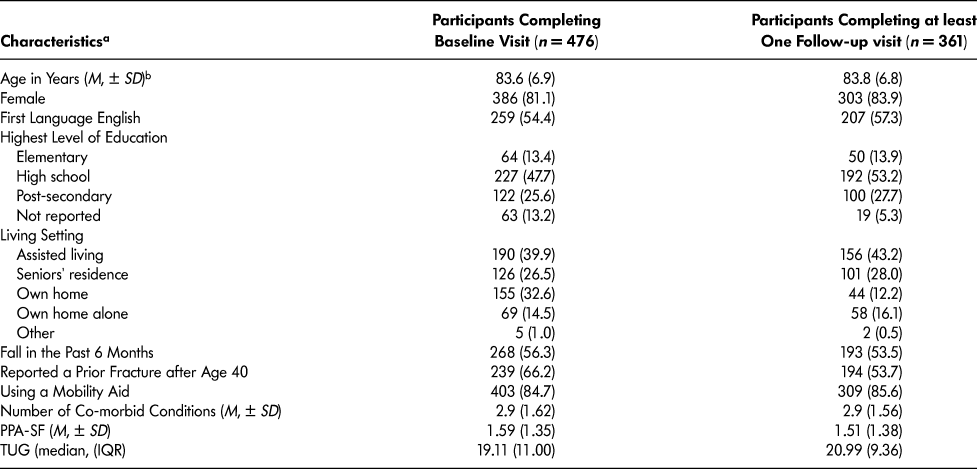
A total of 476 clinic participants consented to enter the study. Demographic and clinical characteristics of participants are reported in Table 1. Briefly, the mean age of participants at baseline was 83.6 (SD = 6.1) years, 81.1 per cent were female, and 84.7 per cent of participants reported the use of a walking aid. Just over half the sample (56.3%) reported a fall in the past 6 months and two-thirds (66.2%) reported a fall-related fracture after the age of 40. Mean baseline PPA-SF was 1.59 (SD = 1.35) suggestive of moderate risk of falling. The median baseline TUG score of 19.11 (IQR = 11.0) was suggestive of an increased fall risk.
Baseline demographic and clinical characteristics of study participants

Note. IQR = Interquartile range; M = mean; PPA-SF = Physiologic Profile Assessment – Short Form; SD = standard deviation; TUG = Timed Up and Go. A small number of the study subjects had missing data on one or more variable.
a n (%) unless otherwise specified.
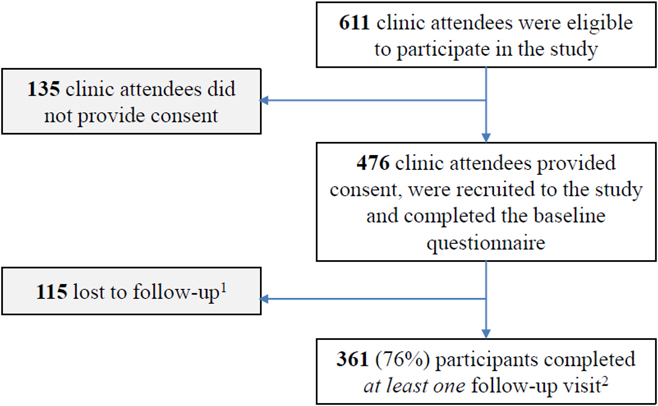
Of the 476 participants at baseline, 361 (76%) completed either the 6-month, 12-month, or both 6- and 12-month follow-up visits and were included in the analysis (Figure 3). There were 115 participants who enrolled in the study but did not complete either the 6- or 12-month follow-up visits (including 17 participants [15%] who died before the 6-month follow-up). When compared with the 361 participants included in the analysis, these 115 participants were more likely to be male (28% compared with 16% [χ 2(1, 476) = 7.87, p = .005]); to be living alone (22% compared with 12% [χ 2(1, 474) = 6.560, p = .010]); to have a higher fall risk (PPA-SF score of 1.83 compared with a score of 1.51 [t (474) = 2.10, p = .029]); and to report a fall in the past 6 months (65% compared with 54% [χ 2(1, 476) = 4.90, p = .027]). The MoCA was completed at 6 months by 316 (88%) of the 361 participants who completed at least one follow-up visit. The mean MoCA score was 21.41 (SD = 4.81) suggestive of mild cognitive impairment.
Study recruitment and retention numbers
Note. 1 Reasons for follow-up losses: 18 = poor health (physical or cognitive) of themselves or family members, 17 = passed away, 15 = unable to contact/schedule, 19 = no show or cancelled, 14 = other (moved/transportation issues). 2 A disaggregated breakdown of follow-up rates at 6-month and 12-month follow-up is as follows: 293 (62%) participants completed the 6-month follow-up visit; 284 (60%) participants completed the 12-month follow-up; and 216 (45%) participants completed both the 6-month and 12-month follow-up visits.

Participant Recommendations
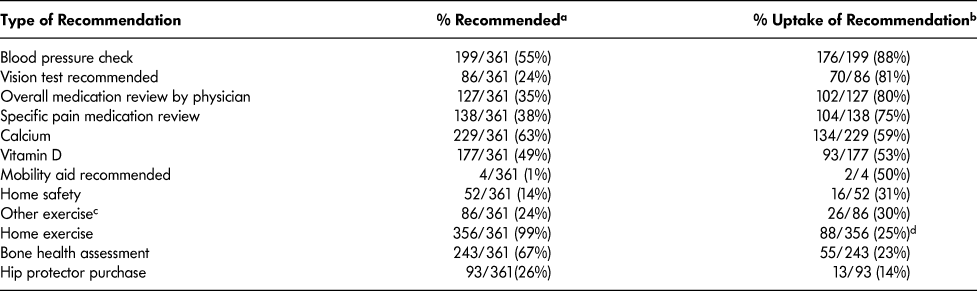
The most commonly recommended interventions were at-home exercises (99%), bone health assessment (67%), changes in calcium intake (63%), blood pressure checks (55%), and changes in vitamin D intake (49%) (Table 2). The five recommendations most commonly acted upon were blood pressure checks (88%), vision tests (81%), overall medication reviews (80%), pain medication review (75%), and calcium review (59%) (Table 2). The two least-acted-upon recommendations were bone health recommendations and hip protector purchase. Overall, 7 per cent of the sample did not complete any of the recommendations at their last follow-up visit.
Summary of recommendations and uptake at last follow-up visit (either 6 or 12 months; n = 361)

Note. a % Recommended = the proportion of study participants who had this type of recommendation given to them. b % Uptake of recommendation = the proportion of study participants given the recommendation who acted on it. c Referred to a community exercise program. d Uptake defined as doing at least one recommended exercise at least 2 times per week.
The mean number of recommendations provided to the 361 participants followed up was 4.97 (SD = 1.60), and the mean percentage uptake of recommendations was 48.8 per cent (SD = 25.7). We conducted multiple linear regression analysis to determine the association between uptake of recommendations with demographic and clinical characteristics (i.e., gender, age, number of co-morbidities, baseline TUG and PPA-SF scores, baseline number of falls in the previous 12 months, and MoCA). The results of the regression indicated that the seven predictors explained only 5.2 per cent of the variance (F[7,299] = 2.326, p = .012). Of all the predictors, only the MoCA was significantly and positively associated with uptake of recommendations (β = 10.62, p = .001); participants with better cognitive status tended to have a higher uptake of recommendations.
We further explored the uptake of recommendations by using three different cut-offs: 75.6 per cent (273/361) of participants acted on 25 per cent or more of recommendations; 58.6 per cent (212/361) of participants acted on 50 per cent or more of recommendations; and 19.2 per cent (69/361) of participants acted on 75 per cent or more of recommendations. Uptake in each of these cut-offs was higher in those participants who completed both 6- and 12-month follow-up visits.
Changes in PPA-SF and TUG
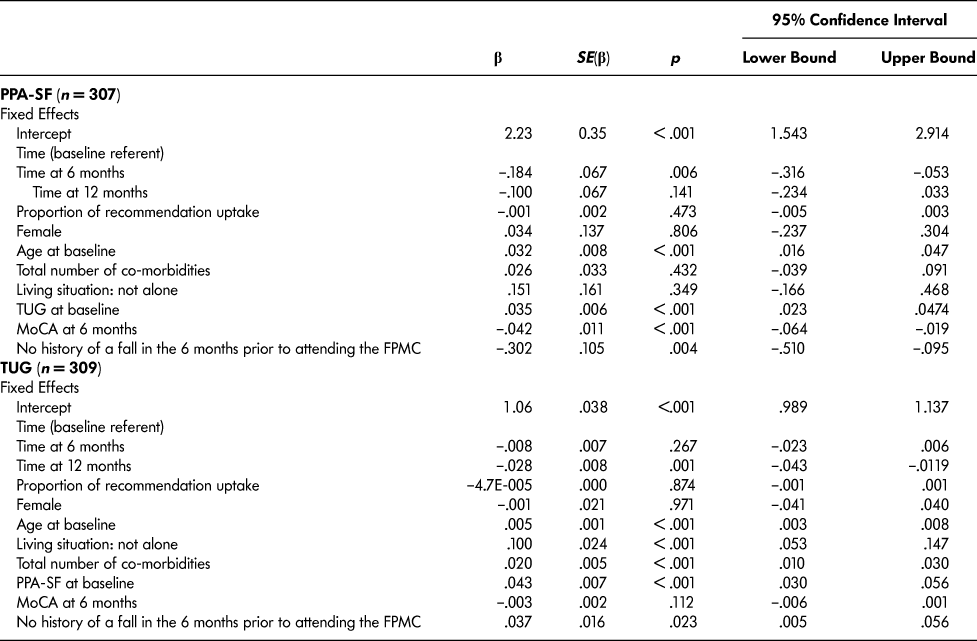
The mean PPA-SF score decreased from 1.44 at baseline to 1.33 at 12 months (change score of 0.12 or 8.3% decrease). The median TUG time decreased from 19.04 seconds at baseline to 17.45 seconds at 12 months (change of 1.66 seconds or 8.4% decrease). Table 3 summarizes the results from the mixed-effects modelling for PPA-SF and TUG. TUG values departed from normality and were log transformed to meet the normal distribution assumption.
Results from linear mixed effects analyses: PPA-SF and TUG

Note. FPMC = Fall Prevention Mobile Clinic; MoCA = Montreal Cognitive Assessment; PPA-SF = Physiologic Profile Assessment – Short Form; TUG = Timed Up and Go.
Compared with baseline, there was a decrease in PPA-SF scores at both 6 and 12 months after participation in the FPMC; the reduction was only statistically significant at the 6-month follow-up (p = .006; 95% CI[0.316, –0.053]; see Table 3). Participants who were older and had higher TUG scores at baseline had higher PPA-SF scores (higher risk of falling) over time, whereas those with higher MoCA scores at 6 months (better cognition) and had no history of falling 6 months prior to attending the FPMC had lower PPA-SF scores over time (Table 3).
For the mixed effects analyses of the TUG, there was a statistically significant decrease at 12-month follow-up (p = .001; 95% CI[–0.043, –0.012]; see Table 3) but not at 6-month follow-up. Participants who were older, had higher baseline PPA-SF, higher total number of co-morbidities at baseline, and no history of falling 6 months prior to attending the FPMC had higher TUG scores over time (Table 3). Furthermore, participants who lived alone had lower TUG scores over time (estimated marginal means for those living alone was 1.82 compared with 1.28 for those not living alone, p < .001). Neither the gender of the participants nor the percentage of uptake of recommendations was significantly related to changes in PPA-SF or to changes in TUG scores over time (see Table 3).
Change in Self-reported Falls at 12 Months
Table 4 reports details of self-reported falls for the 12 months before and after attending the FPMC (analyses comprise the 284 participants followed up at 12 months). There was a significant reduction in the number of participants reporting at least one fall in the 12 months post-clinic compared with the 12 months pre-clinic (p = .012). This represents a 14.1 per cent decrease in the risk of falling. Although there were small differences between the pre- and post-clinic results for the proportion of fallers reporting (1) more than one fall, (2) an injurious fall, or (3) a fall needing medical attention, these differences were not statistically significant (see Table 4).
Self-reported falls for the 12 months before and after attending the Fall Prevention Mobile Clinic (n = 284)

Note. SD = standard deviation; IQR = interquartile range.
a Associations explored using McNemar’s test. b Injuries reported: 18% bruising; 15% fractures; 4% cuts requiring stitches; 1% concussion; 60% other including cuts, scrapes, sprains, and strains. c A small number of participants had missing data on falls with injuries and falls requiring medical attention. d Mean and median number of falls were not calculated 12 months prior to the clinic due to poor participant recall around the number of times they had fallen. Number of falls 12 months after clinic was collected prospectively.
Factors associated with falls during the study were further explored. Those reporting at least one fall during the 12-month period after FPMC attendance had higher PPA-SF scores at baseline compared with those not reporting a fall: PPA-SF of 1.65 (SD = 1.37) for fallers compared with 1.23 (SD = 1.33) for non-fallers (t[282] = –2.607, p = .010). There were no associations with gender, age, number of co-morbidities, or the number of recommendations made at baseline and falling during the 12 months post-clinic. Falling during the 12 months post-clinic was not associated with uptake of recommendations in those participants taking up 50 per cent or more of recommendations (χ 2[1, 283] = 2.277, p = .131), nor with participants taking up 75 per cent or more of recommendations (χ 2[1, 283] = 0.611, p = .434).
The rate of falls for all 361 study participants during the 12 months after attending the FPMC was 6.08 falls per 100-person-months (95% CI[5.26, 6.99]). The rate is based on 189 new first events/3,109 person-time.
Participant Experience with FPMC
Sixty-six per cent (240/361) of participants completed the participant experience questionnaire (Appendix C). The majority of respondents (90%) felt that they benefitted from participation in the FPMC. The most important benefit reported was information and awareness of a fall prevention measure that they could undertake to reduce their risk of falling. Forty per cent of all participants reported that the exercise recommendation was the most challenging to complete. The top three reasons for not following through on exercise recommendations were (a) lack of motivation (i.e., “laziness”, “unable to fit into their schedule”, “forgetfulness”, “lack of discipline”), (b) pain, and (c) physical limitations such as “shortness of breath”, “fatigue”, “bad knees”, or “fear of falling” and “poor balance”.
Discussion
The results of this study suggest that older adults at risk for falling will act on fall prevention recommendations and show improved mobility with a reduced risk of falling after attending an FPMC. These benefits were seen (a) in the presence of mild cognitive impairment, (b) in a very elderly population (mean age > 80years), and (c) in a population at high risk for falling at baseline.
Mean uptake of recommendations was 48.8 per cent overall. The lifestyle changes involved in instituting a regular exercise program (25% uptake for home and 30% for community exercise) and implementing home safety improvements (31% uptake) appeared to be more challenging for participants compared with visiting the family doctor for changes in medication (80% uptake), vision assessment (81% uptake), and blood pressure monitoring (88% uptake). Uptake of bone health recommendations to receive assessment and/or treatment for osteoporosis was low (23%) despite a high proportion of participants reporting a history of a prior fracture. We used multiple linear regression to explore the association of a number of socio-demographic variables with uptake of recommendations. The variance explained by our model was small although significant; only cognitive function was associated with higher uptake of recommendations highlighting the need for further research to identify factors contributing to higher uptake of fall prevention recommendations.
The mean uptake of recommendations (48.8%) was lower than that reported in a study with the most comparable type of multifactorial intervention (Hill et al., Reference Hill, Moore, Dorevitch and Day2008). Hill et al. (Reference Hill, Moore, Dorevitch and Day2008) reported a mean adherence score of 74.3 per cent (SD = 23.4) and trends for uptake of specific recommendations similar to ours, with the lowest adherence for exercise recommendations (52.8%) and the highest adherence for medical interventions (73.9%).
We demonstrated small improvements in both the PPA-SF and TUG scores. The changes in PPA-SF over time were statistically significant at 6 months but not at 12 months. However, the magnitude of change over 12 months of follow-up (0.12) has been reported as “small” in an earlier study with similar magnitudes of change of PPA-SF by Stephen Lord, the developer of the PPA-SF (Lord et al., Reference Lord, Tiedemann, Chapman, Munro, Murray and Sherrington2005). There is currently no accepted minimum, clinically significant difference for the PPA-SF (S. Lord, personal communication, June 23, 2017) The 8.4 per cent decrease in median TUG time at 12-month follow-up was similar to the 7 per cent decrease in mean TUG time reported by Hill et al. (Reference Hill, Moore, Dorevitch and Day2008) and the 10.5 per cent decrease in mean TUG time seen in an intensive exercise program implemented in community centres for seniors (Fuzhong, Harmer, & Fitzgerald, Reference Fuzhong, Harmer and Fitzgerald2016).
We hypothesize several reasons for the small improvements observed in our study, despite low uptake of exercise recommendations. First, patients may have been doing exercise “more than 2 times per week” (minimum required to be considered positive uptake) early on after attending the clinic but had stopped by the time of the 6- or 12-month follow-up. Second, the community engagement (connecting with community resources and activities) that was an integral part of the FPMC may have stimulated increased physical activity by participants that was not measured in our study, as we did not record overall physical activity levels. Finally, the uptake of the pain medication review recommendation was high (75%) and may have led to increases in overall physical activity that were not recorded in our assessment tools.
In this high-risk elderly population, it is expected that mobility and physiologic measures such as the TUG and PPA-SF would continue to decline as people age (Lord & Ward, Reference Lord and Ward1994). Even maintaining TUG and PPA-SF scores over time could be seen as a success of an intervention. Higher uptake of recommendations and lower PPA-SF scores over time were associated with higher MoCA scores suggesting that more cognitively intact individuals would be more likely to benefit from the FPMC.
The FPMC was effective in decreasing the number of fallers in this elderly and high-risk population from 64.8 per cent in the 12 months prior to attending the FPMC to 55.6 per cent, resulting in a 14.2 per cent risk reduction that was statistically significant. Our risk reduction is small compared with that found by Hill et al. (Reference Hill, Moore, Dorevitch and Day2008), who reported a 52 per cent risk reduction in number of fallers at 6 months, but higher than results reported in a number of studies with low-intensity, one-time interventions similar to ours (Conroy et al., Reference Conroy, Kendrick, Harwood, Gladman, Coupland, Sach and Masud2010; Moore et al., Reference Moore, Williams, Ragsdale, LoGerfo, Goss, Schreuder and Phelan2010; Wijlhuizen et al., Reference Wijlhuizen, Du Bois, Van Dommelen and Hopman-Rock2007). Our results compare favourably to a 20 per cent risk reduction in the number of fallers in a meta-analysis of tai chi randomized control trials (Huang et al., Reference Huang, Feng, Li and Lv2017), and a 10 per cent risk reduction of fall rates in a meta-analysis of multifactorial interventions (Choi & Hector, Reference Choi and Hector2012). Although the benefits seen in this study are modest, they suggest that a minimally intensive, one-time FPMC visit can maintain and slightly improve fall risk and mobility.
As with all studies, there are limitations, and a degree of caution is necessary when considering the generalizability of the findings. The before-and-after single cohort study design cannot fully attribute any changes in outcome measures to the FPMC intervention; confounding factors, such as changes in the health care environment over the timeline of the study, could have contributed to our positive results. Uptake of recommendations may have been biased by the way that recommendation uptake was recorded. Recommendations that were expected to be ongoing (such as vitamin D intake, twice weekly exercises, and calcium intake) were only recorded as positive if they were being done at the time of assessment. This may have underestimated uptake of ongoing recommendations. Uptake of recommendations was self-reported and therefore may have been over-reported due to the social desirability to report a positive uptake of recommendations (Fisher, Reference Fisher1993). However, one study assessing the influence of social desirability bias on self-reported outcomes concluded that change scores were not biased by social desirability (Nolte, Elsworth, & Osborne, Reference Nolte, Elsworth and Osborne2013). The validity of our self-reported outcomes could have been strengthened by using a social desirability scale such as the Marlow-Crowne Social Desirability Scale (Barger, Reference Barger2002).
Fall data was also collected through self-report, which is limited in its accuracy but is commonly used in fall prevention studies as the only viable method of collecting fall information in a community setting (Conroy et al., Reference Conroy, Kendrick, Harwood, Gladman, Coupland, Sach and Masud2010; Fitzharris, Day, Lord, Gordon, & Fildes, Reference Fitzharris, Day, Lord, Gordon and Fildes2010; Hill et al., Reference Hill, Moore, Dorevitch and Day2008; Lord et al., Reference Lord, Tiedemann, Chapman, Munro, Murray and Sherrington2005). Studies examining the validity of fall reporting suggest that self-report tends to underestimate falls (Lord, Sherrington, & Menz, Reference Lord, Sherrington and Menz2000) and people tend to deny falls, easily blame other factors for their fall, and not count many falls as a “real” fall (Cumming, Reference Cumming2000). In addition, the fall data was collected retrospectively for the pre-intervention time period compared with prospective data collection in the post-intervention time period. In a head-to-head comparison of 12-month recall versus prospective monthly fall calendar reports, Sanders, Hayles, Kotowicz, and Nicholson (Reference Sanders, Hayles, Kotowicz and Nicholson2009) found that 23 per cent of participants asked to recall falls over the previous 12 months did not recall a fall that they had previously reported on their monthly calendars. Therefore, the 14.2 per cent decrease in number of people reporting at least one fall may be an underestimate of the effect of the FPMC.
A further limitation is that cognitive assessment with the MoCA was done at 6 months rather than at baseline, limiting our understanding of the cognitive status of those study participants who dropped out of the study before 6 months of follow-up. However, the MoCA was completed in a high proportion of study participants included in the analysis (88%). Lastly, a large proportion of our study participants did not complete either the 6- or 12-month follow-up visits (24%), reflecting the frailty of the population under study (e.g., 15% dying before the 6-month follow-up visit). This loss to follow up may limit the generalizability of our results to healthier and more cognitively intact individuals.
The results of our study highlighted areas that could be strengthened in a mobile fall prevention clinic model to make it more effective. One study looking at the health care providers’ perspective (Fortinsky et al., Reference Fortinsky, Iannuzzi-Sucich, Baker, Gottschalk, King, Brown and Tinetti2004) found that patient compliance was the most commonly reported barrier to implementation of recommendations. Compliance with recommendations could be supported by developing action plans that are less prescriptive and more collaboratively developed in partnership with the client, their family/caregiver support, and primary care providers. Improving access to and adherence to evidence-based fall prevention interventions in real-life clinical practice, in high-risk individuals, continues to be an area requiring more research.
Conclusions
A novel mobile fall prevention clinic can increase access to fall prevention initiatives and lead to decreases in fall risk and falls over a 12-month period in older adults at high risk for falls. This type of clinic can be adapted to any health care system and engages entire communities in the process of keeping older adults safe by decreasing their falls risk.
Supplementary Material
To view supplementary material for this article, please visit https://doi.org/10.1017/S0714980818000284