INTRODUCTION
The meaning of a verb is generally assumed to be internally structured, and is often represented as a set of semantic components combined in a certain configuration (Levin & Rappaport Hovav, Reference Levin and Rappaport Hovav1995; Pinker, Reference Pinker1989; Talmy, Reference Talmy and Shopen1985). Across languages, there is variation in how this information is systematically ‘packaged’ in verbs and verb-related constructions (Talmy, Reference Talmy and Shopen1985, Reference Talmy2000). To learn the meaning of verbs, children have to determine which semantic elements play a role in their meanings, and to discover the patterns by which they are typically combined in the language they are acquiring (Behrens, Reference Behrens1998; Bowerman, Reference Bowerman1994; Wittek, Reference Wittek1999, Reference Wittek2002). In other words, they must identify which meaning components are ‘conflated’ in a verb's semantic representation, and which are expressed by other means, such as with particles or prepositional phrases.
Previous studies have revealed that children often misinterpret the meanings of verbs with complex semantics, such as state-change verbs (e.g. Gentner, Reference Gentner1978; Gropen, Pinker, Hollander & Goldberg, Reference Gropen, Pinker, Hollander and Goldberg1991; Wittek, Reference Wittek1999, Reference Wittek2002). In a study of the acquisition of common cooking verbs, Gentner (Reference Gentner1978) observed that English-speaking children between five and seven years old were able to correctly associate three manner verbs, stir, beat, and shake, with the appropriate manner, but they tended to interpret the state-change verb mix as if it specified only a certain manner of motion, not a particular end state. Gentner concluded that English-speaking children have more difficulty acquiring meaning components relevant to changes of state than those relevant to the manner in which an action is performed (they have a ‘Manner Bias’). She claimed that English-speaking children tend to ignore the result meaning in state-change verbs. In a related finding, Gropen and colleagues (1991) demonstrated that children roughly four to six years old treat the state-change verb fill as if it specified only a particular action, pouring. This action may, but need not, lead to the end state of something being full. Tomasello (Reference Tomasello1992) also noted many early errors (‘packaging errors’, in his terms) with state-change verbs in his daughter's speech, such as the child's use of the words clean, cook, and fix not to refer to objects going from dirty to clean, uncooked to cooked, or broken to fixed, but rather to designate the characteristic action involved: wiping with a cloth, stirring in a pot, and hammering something.
Such misinterpretations of verb meanings do not seem to stem from children's failure to perceive and conceptualize the end state of state-change events. For example, in languages that encode end state with particles, such as English, children use particles (e.g. off) to express state change before the age of two (Bowerman, Reference Bowerman1994; Bowerman & Choi, Reference Bowerman, Choi, Bowerman and Levinson2001; Tomasello, Reference Tomasello1992). Further, Slobin (Reference Slobin and Slobin1985) observes that children first apply case markers such as accusative and ergative case only to the arguments of transitive verbs that encode instances of what he calls the ‘Manipulative Activity Scene’, a situation in which an agent brings about a physical and perceptible change of state in a patient by means of direct manipulation. Slobin (Reference Slobin and Slobin1985) also states that children's first tense/aspect markers emphasize the contrast between process and result. In other words, learners are attracted by state changes and affected objects.
In a study of German-speaking children's understanding of state-change verbs, Wittek (Reference Wittek1999, Reference Wittek2002) found that children did not, in fact, totally ignore the state-change meaning in state-change verbs, but treated it as only optional rather than entailed (the ‘Weak Endstate’ hypothesis). For example, they often interpreted verbs such as pflücken ‘pick’ and abpflücken ‘pick off’ to mean ‘do an action with the intention to cause something to come off’. Behrend (Reference Behrend1990) also explored the importance of actions, results, and instruments in verb concepts in children. In a series of elicited production and comprehension experiments, he showed that English children (mean ages of 3, 5, and 7 years) were least willing to use a novel verb to label an event in which the result has been changed from the training events, and this tendency increased with age. Behrend thus proposed that children might have a ‘result verb bias’ that constrained their initial hypotheses about the meaning of a novel verb.
There seems, then, to be a paradox: children show early sensitivity to the end state of state-change events and may even show a ‘result’ bias in interpreting a new verb, but they have difficulty in correctly understanding the state-change meaning of state-change verbs. This mismatch between children's perception, the ‘result’ bias in the inference of verb meanings, and their understanding of the linguistic encoding of state-change events, suggests that they do not yet know what semantic information is encoded in state-change verbs. How should we interpret these findings in a broader cross-linguistic perspective? Do children universally prefer to disregard or downplay the state-change component of a state-change verb's meaning, even when their language encodes state change differently from English or German?
In Mandarin, state change can be consistently encoded with resultative verb compounds (RVCs), as illustrated in (1):
-
(1) a1yi2 zhai1-xia4 le ping2guo3.Footnote 1
Auntie do.picking-descend pfv apple
‘Auntie picked the apple (off).’
In (1), the Mandarin counterpart of the English state-change verb pick or the verb–particle construction pick off is the resultative verb compound zhai1-xia4 ‘do.picking.action-descend’. This consists of two verbs, zhai1 ‘do.picking.action’ and xia4 ‘descend’. Each verb of an RVC encodes one aspect of a causal event, the first verb (V1) specifying the causal action, and the second verb (V2) the result. It is the V2 that confirms the realization of a caused state change: V1 (i.e. the simplex action verb) is moot about the possible state change, or at best only implies it (as I try to convey with glosses such as ‘do.picking’). This is illustrated in (2), which – unlike its English counterpart – is perfectly grammatical:
-
(2) a1yi2 zhai1 le ping2guo3, ke3shi4 mei2 zhai1-xia4.
Auntie do.picking pfv apple but not do.picking-descend
‘Auntie picked the apple, but didn't pick it off.’
More generally, Mandarin contrasts typologically with English in its typical lexicalization of state change (Talmy, Reference Talmy2000). English has many monomorphemic action verbs (e.g. pick, break) that entail the fulfillment of a state change. If speakers want to express implied fulfillment or moot fulfillment, they must use an additional form, for example the progressive aspect (she was picking the apple) or the conative construction (She picked at the apple). Mandarin shows the opposite pattern: monomorphemic action verbs do not in themselves entail state change and an additional form must be added to encode this meaning (Talmy, Reference Talmy2000) (see also Pederson, Reference Pederson, Bowerman and Brown2007, for a more general consideration of languages of this type).
Mandarin RVCs are accomplishment or achievement verbs which denote telic events (Tai, Reference Tai, Testen, Mishra and Drogo1984), and they frequently occur with the perfective aspect marker le. When le is used with a verb that encodes an event with a clear boundary (like an RVC), it signals the completion of the event. But when the verb encodes an event with no clear boundary, le simply signals the termination of the action. The interaction between le and the Aktionsart of the verb is illustrated in sentence (1): the use of the perfective aspect marker le with zhai1-xia4 ‘do.picking.action-descend’ indicates that the state change has occurred – the apple has come off. But le with the atelic action verb zhai1 ‘do.picking.action’ as in (2) indicates only that the picking action has been performed, regardless of whether the apple has come off. In sum, le only signifies termination, not state change. State change is entailed only with verbs with certain Aktionsart properties (Chao, Reference Chao1968; Li & Thompson, Reference Li and Thompson1981).
Given the systematic differences in semantic encoding of state-change meaning, it is important to explore how language specificity shapes children's acquisition of verb meanings and how this acquisition trajectory sheds light on semantic acquisition cross-linguistically. This study, in particular, addresses two specific questions: What meaning do Mandarin-learning children assign to RVCs, and how do they interpret the meaning of the component verbs, especially, the action verbs (V1) of RVCs? Since Mandarin RVCs represent a fairly transparent way to encode cause and result in two separate verbs, it is hypothesized that Mandarin-learning children may figure out the state-change meaning entailed in an RVC more easily than children learning a language that encodes state change in a more opaque manner.
CURRENT STUDY
To explore Mandarin-learning children's knowledge of RVCs, an experiment was conducted with children of different ages and a group of adult native speakers of Mandarin in Guangzhou, P. R. China. For ease of explanation, the description of the participants follows that of the stimuli below.
Stimuli
This study adopted the stimulus set that was designed and created by Wittek (Reference Wittek1999, Reference Wittek2002) for her study of German-speaking children's learning of state-change verbs. It consists of sixteen target video clips, four control clips, and two warm-up clips, each about 50 seconds long. The target clips depict an actor manipulating an object in a certain way. Eight clips (state-change events) show a state-change event: ‘wake someone’, ‘extinguish candle’, ‘break plate’, ‘crack nut’, ‘kill animal’, ‘pick apple’, ‘fill cup’, and ‘close door’. The other eight clips (no-state-change events) show the same causal actions, but the associated state change does not come about. Take the ‘wake someone’ event, for example:
State-change event:
A man is sleeping at a table. A woman comes in and holds a ringing alarm clock near his head, causing him to wake up. The man yawns and stretches his arms.
No-state-change event:
A man is sleeping at a table. A woman comes in and holds a ringing alarm clock near his head, but the man does not wake up.
The sixteen target clips were further arranged into two films. Each film contained half of the state-change clips and half of the no-state-change clips with the control and the warm-up clips (i.e. 14 clips in total for each film). The state-change and no-state-change clips were non-pairs, i.e. no clips showed the same action with a state change and without a state change in each film; for example, ‘wake someone’ (state-change event) and ‘do the waking action but the other does not wake up’ (no-state-change event) were in different films. The order of the presentation of the clips in each film was randomized and each participant was randomly assigned to watch one of the films.
The two warm-up clips were designed to familiarize participants with the task. The four control items were included to make the stimuli more diverse and to allow the experimenter to identify children with a general ‘yes’ bias. Half the control items required a ‘yes’ answer and half a ‘no’ answer. For example, for a video clip showing a woman fixing a toy car, the child was expected to say ‘no’ to a question about whether the woman had washed the car. A detailed description of the video scenes is presented in ‘Appendix 1’.
Participants
The participants were recruited from two kindergartens in Guangzhou: Guangzhou Blue-sky Kindergarten and the Kindergarten of the South China Agricultural University. Four groups of children participated, with mean ages of 2;6 (range 2;5–2;9), 3;6 (3;5–3;8), 4;6 (4;3–4;7), and 6;1 (5;4–6;10), as well as a group of adults (mean age 31); there were ten participants in each age group. This study included very young children at around 2;6 for two reasons. First, in order to discover children's early semantic knowledge and its development, we need to examine the earliest possible age. Second, Mandarin-speaking children have been found to understand the combinatorial nature of verb compounds very early, by around age 2;6, and they were able to use and create verb compounds productively by separating and combining verbs of action and result (Chen, Reference Chen, Clark and Kelly2006, Reference Chen2008). That suggests that children do not treat an RVC as just one unanalyzed chunk, which makes the study of children's attribution of meaning component possible as young as 2;6. Two children aged 2;6 and one aged 3;6 were excluded from the analysis because they failed to give correct responses to any of the four control items, and another aged 2;6 was excluded because she did not respond to the warm-up items. These children were replaced with children of the same age who succeeded on all the control items and warm-up items. So the total of ten children in each age group includes only children who showed no ‘yes’ bias.
Procedure
The task is in essence a truth-value judgment task, but it was designed for use with young children. Following Wittek's procedure, I tested each child individually in a separate room in the kindergarten. Sessions took about fifteen to twenty minutes. The child was invited to play a game with a toy puppy, who was said to be silly but eager to learn the child's language. I first invited the child to make friends with the puppy by shaking its paw and patting it. Then I asked the child whether he or she (henceforth ‘she’) would like to help the puppy learn the child's language. All the children agreed.
To put the child at ease and to familiarize her with the task procedure, I first had the toy puppy perform two warm-up actions and try to describe them. I supplied the puppy's voice throughout the experiment. For each of these actions, the child had to determine whether the puppy had described it correctly. For example, the puppy waved its foreleg and referred to this as “waving”:
-
(3) wo3 xiang3 zhe4 shi4 zhao1 shou3. wo3 zai4 zhao1 shou3. dui4
I think this is wave hand I prog wave hand right
bu2 dui4 a?
not right qp
‘I think this is called “waving hand”. I am waving my hand.
Right or not?’
Or the puppy lay down on the experimenter's lap and referred to this as “jumping”:
-
(4) wo3 xiang3 zhe4 shi4 ‘tiao4’. xian4zai4 wo3 zai4 tiao4, dui4
I think this is jump now I prog jump right
bu2 dui4 a?
not right qp
‘I think this is called “jump”. Now I am jumping, right or not?’
The child was also asked to act out the referent actions in the warm-up trials with her own body – ‘waving hand’ for (3) and ‘jumping’ for (4). If the child had made an incorrect judgment – saying ‘yes’ to (4), for example – she was again asked, after she had acted out the referent action, whether the puppy had indeed performed the referent action. All the children correctly acted out the referent actions in the warm-up trials, and – if they had previously made an incorrect judgment about the puppy – they now made correct judgments.
Each of the eight target trials started with a still picture of the video clip. The experimenter pointed out the objects in the picture and mentioned their names if the child did not recognize them. Then the puppy would predict what was going to happen before the actor performed the action in the clip. The prediction always included an RVC which specified that the end state associated with the action would be achieved. For the ‘picking apple’ clip, for example, the puppy would predict:
-
(5) wo3 xiang3 a1yi2 yao4 zhai1-xia4 ping2guo3.
I think auntie will do.picking.action-descend apple
‘I think auntie will pick the apple.’
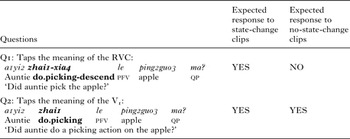
After the child watched the video clip, she was asked to judge whether the puppy had predicted correctly and then to answer two further questions, one designed to tap her understanding of the RVC (the RVC question) and the other her understanding of the first verb (V1) alone (the V1 question). Table 1 shows the two questions and their expected answers for the state-change and no-state-change versions of ‘picking an apple’.
Sample questions and expected responses to state-change and no-state-change video clips

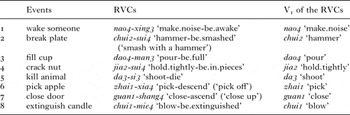
The eight target RVCs are shown in Table 2, along with the state-change/no-state-change clips with which they were paired. The V1 of each of the RVCs is also listed in Table 2.
RVCs tested in the current study

To ensure that children of around age 2;6 (my youngest age group) knew all the component verbs of the RVCs, i.e. the V1s and the V2s individually, I checked the uses of these verbs in the speech of the children in the CHILDES (CHIld Language Data Exchange System) Beijing corpus (MacWhinney, Reference MacWhinney2000; Tardif, Reference Tardif1993, Reference Tardif1996) and the Fang corpus (Min, Reference Min1994). Both corpora contain pinyin (the official system of transcribing Mandarin into the Roman alphabet in P. R. China) transcriptions of the longitudinally sampled natural speech of the target children and their family members and caregivers. The pinyin transcriptions are in a format compatible with CHAT (i.e. Codes for the Human Analysis of Transcripts), the standard transcription system for CHILDES. The CHILDES Beijing Mandarin corpus contains data from ten children between the mean ages of 1;9 and 2;2. The Fang corpus covers five children over a wider age range: 0;11 to 3;5. All the target verbs were found to have occurred in the daily vocabulary of most of the children sampled. For example, the verb kai1 ‘open’ was produced by all ten children in the Beijing corpus (token frequency 172) and the first use of kai1 ‘open’ appeared around 1;9–2;2; the verb guan1 ‘close’ was produced by eight children in the Beijing corpus (token frequency 42), and the first use of guan1 appeared around 1;9. Note that the English counterpart of jia2 ‘hold.tightly’ may not be in the everyday vocabulary of young English learners, but jia2 is a common verb for Mandarin children, probably because it is used for the action of grasping and holding food with chopsticks. The corpus searches indirectly confirm that the target verbs are probably in the knowledge of the Mandarin-learning children at the age of 2;6 or above, as the children in the two corpora were able to produce most of them at even younger ages. Additional evidence of the knowledge of the target verbs comes from two separate studies of elicited descriptions of state-change events that all the children in the current study also participated (Chen, Reference Chen2008). The elicitation studies included a wider range of events and all the children were able to produce most of the target verbs or their synonyms.
RESULTS AND DISCUSSION
Interpretation of RVCs
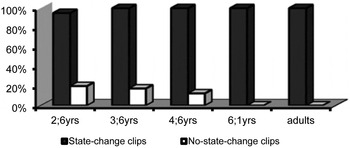
This section presents the participants' interpretations of the RVCs, i.e. their responses to the question that asks about the meaning of RVCs (the RVC questions), such as, ‘Did auntie pick the apple?’ A ‘yes’ response to a state-change clip means that the child correctly interprets the RVC as entailing a state change. A ‘yes’ response to a no-state-change clip, in contrast, means that the child incorrectly thinks that the RVC applies to the scene even though the state change does not come about. (Recall that children with a general ‘yes’ bias had been excluded.) Figure 1 shows the percentage of ‘yes’ responses broken down by age.
Percentage of ‘yes’ responses to Q1: interpretation of an RVC, by age.

Figure 1 reveals that all age groups gave nearly 100% ‘yes’ responses to the state-change clips, accepting RVCs as descriptions of these clips, while to the no-state-change clips they gave ‘no’ responses 80–100% of the time, rejecting RVCs when the state change did not occur. The youngest three age groups (2;6, 3;6, and 4;6) gave some inappropriate ‘yes’ responses (e.g. 20% for those aged 2;6), but this gradually dropped off with increasing age.
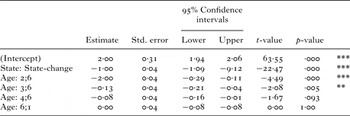
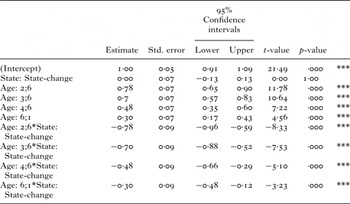
I ran a logistic regression model to evaluate the effects of the two predictor variables, age (2;6, 3;6, 4;6, 6;1, and adults) and state (i.e. state-change versus no-state-change) on the choice of response (i.e. ‘yes’ versus ‘no’) to the RVC question. The results in Table 3 show a significant effect of state (β = –1·00, t-value = –22·47, p < ·001) and age – the children aged 2;6- and 3;6 differ significantly from those aged 4;6- and 6;1 and the adults (2;6: β = –2·00, t-value = –4·49, p < ·00; 3;6: β = –0·13, t-value = –0·08, p < ·005). The results suggest that the two older children's groups and the adults were similar in their responses to the question about the meaning of an RVC: they were sensitive to whether a certain result was achieved and knew from about 4;6 that the state-change meaning is critical to an RVC. If no state change occurs, it is not appropriate to use an RVC even if an action has taken place that might be expected to lead to this state change.
Effects of age and state-change condition on the choice of ‘yes’ versus ‘no’ at ages 2;6, 3;6, 4;6, 6;1, and adults

Interpretation of action verbs (V1 of an RVC)
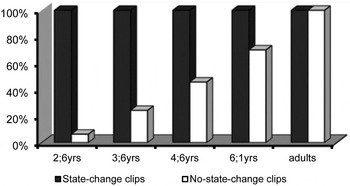
We have just seen that the children clearly understand the state-change meaning of an RVC. But what do they understand about the role of the component verbs within the RVC? As discussed earlier, Mandarin monomorphemic action verbs (V1 of an RVC, e.g. zhai1 ‘do.picking’ in zhai1-xia4 ‘do.picking-descend’) do not in themselves entail a state change; the state-change meaning comes from the addition of the second verb. Do children know that the V1s do not entail a state-change meaning? In this section, I analyzed the responses to the V1 question, i.e. the question that taps the meaning of the first verb of an RVC, e.g. a1yi zhai1 le ping2guo3 ma? ‘Auntie do.picking PFV apple?’ (‘did auntie do a picking action on the apple?’). Figure 2 presents the percentage of ‘yes’ responses to these questions from all the participant groups.
Percentage of ‘yes’ responses to Q2: interpretation of V1s, by age.

A ‘yes’ answer was expected regardless of whether the state change had occurred, since the V1 of an RVC encodes only the action. On the state-change clips the children's responses were very similar to those of the adults: they said ‘yes’ nearly 100% of the time. But on the no-state-change clips their responses were very different. The adults gave the expected ‘yes’ responses 100% of the time, recognizing that the action denoted by V1 had taken place even though the associated result had not come about. The children, in contrast, very often said ‘no’, apparently thinking that for a V1 to be used felicitously the result also had to have taken place. In other words, the children incorrectly treated V1 as entailing a state change.
I again ran a logistic regression model to evaluate the effects of the two predictor variables, age (2;6, 3;6, 4;6, 6;1, and adults) and state (i.e. state-change vs. no-state-change) on the choice of response (i.e. ‘yes’ versus ‘no’) to the V1 question.
The results show a significant effect of the predictor variable AGE (see Table 4) – all the children differ significantly from the adults in their responses to the meaning of V1 (2;6: β = 0·78, t-value = 11·78, p < ·001); three-year-olds: β = 0·70, t-value = 10·64, p < ·001; four-year-olds: β = 0·48, t-value = 7·22, p < ·001; 6;1: β = 0·30, t-value = 4·56, p < ·001). Pairwise comparisons between the child groups suggest that the youngest two age groups (2;6 and 3;6) do not differ significantly from each other, but they differ significantly from the older children's groups (4;6 and 6;1), who do not differ significantly from each other. The children also differ significantly from the adults in their responses to the state-change versus no-state-change clips (2;6: β = –0·78, t-value = –8·33, p < ·001; 3;6: β = –0·70, t-value = –7·53, p < ·001; 4;6: β = –0·48, t-value = –5·10, p < ·001; 6;1: β = –0·30, t-value = –3·23, p < ·001). This result suggests that if the state change does not come about, the children tend to give significantly more ‘no’ responses to the V1 question than the adults, i.e. rejecting the use of an action verb as if it entails a state change. In other words, the children's groups seem to treat questions tapping the interpretation of the V1 and the RVC very similarly: when no state change is realized, they reject not only the use of the RVC, but also the use of the action verb, V1, as if they entail a state change.
Effects of age and state-change condition on the choice of ‘yes’ versus ‘no’ at ages 2;6, 3;6, 4;6, 6;1, and adults regarding the meaning of V1

Analysis of the misinterpreted V1s broken down by clip
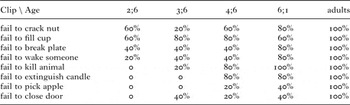
We have just seen that learners of Mandarin tend to interpret action verbs as state-change verbs, but is this true across the board, or do they treat different V1s differently? To find this out, I compared their responses to the V1 question across the eight no-state-change clips. In other words, I included clip as an independent variable in addition to age and state-change condition. Table 5 shows the proportions of ‘yes’ responses given to the interpretation of V1, broken down by video clip.
Percentage of ‘yes’ responses to the V1 question for the no-state-change clips, by age and clip

The adults gave uniform ‘yes’ responses to all the clips, but the children responded differently to different verbs. In general, they gave more ‘yes’ responses to the first six verbs: jia2 ‘hold.tightly’, dao4 ‘pour’, chui2 ‘hammer’, nao4 ‘make.noise’, da3 ‘shoot’, and chui1 ‘blow’, and fewer to the two remaining verbs, guan1 ‘do.closing’, and zhai1 ‘do.picking’. The youngest children, aged 2;6, for example, gave some correct ‘yes’ responses to jia2, dao4, chui2, and nao4, but not to da3, guan1, zhai1, and chui1. This suggests that the children did not treat all the action verbs indiscriminately as entailing a state change, and they were sensitive to the strength of the implicature of state-change meaning in the verbs.
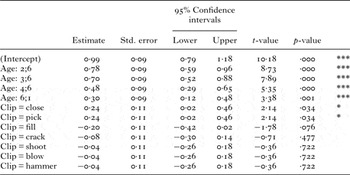
To see whether the responses to each clip differ significantly across the age groups, I conducted a logistic regression analysis that included the individual clips as a second independent variable in addition to age (the independent variable state-change condition is now irrelevant, since only the no-state-change clips are analyzed).
The results show significant effects of both age and clip on the responses to the V1 question for the no-state-change clips, with no significant interactions between age and clip (F = 1·11, p = ·335). All the children differ from the adults in giving significantly fewer correct ‘yes’ responses to the V1 question (see Table 6) (e.g. 2;6: β = 0·78, t-value = 8·73, p < ·001; 6;1: β = 0·30, t-value = 3·38, p ⩽ ·001). Pairwise comparisons between groups further show that the children aged 2;6 differ significantly from those aged 4;6- and 6;1, and that those aged 3;6 differ significantly from those aged 6;1. The results also reveal that two of the clips, ‘close door’ and ‘pick apple’, receive significantly fewer correct ‘yes’ responses than the clip ‘wake someone’ (β = 0·24, t-value = 2·14, p < ·05). Pairwise comparisons between all the clips further indicate that these two clips differ significantly from each of the remaining six clips. Though no significant difference was found between the remaining six clips, the ‘fill cup’ (p = ·076) and the ‘crack nut’ clips (p = ·477) received more correct ‘yes’ responses than the other four clips (p = ·722) based on the p-value. The logistic regression analysis confirms the observation that the children did not treat all the V1s as equally entailing a state change. Rather, they were remarkably sensitive to the strength of implicature of state change in different verbs: verbs like guan1 ‘close’ and zhai1 ‘do.picking’ are more likely to be treated as entailing a state change than the other six verbs; and the verbs dao4 ‘pour’ and chui2 ‘hammer’ tend to be treated as more likely to imply a state change than the remaining four verbs.
Effects of age and individual clips on the choice of ‘yes’ versus ‘no’ for the no-state-change clips at ages 2;6, 3;6, 4;6, 6;1, and adults regarding the meaning of V1

Where does children's sensitivity to the strength of implicature of state change come from? A possible source is the adult usage of the verbs. Three of the adult native Mandarin-speaking participants commented that they would assume that guan1 ‘close’, chui1 ‘blow’, da3 ‘shoot’, and zhai1 ‘do.picking’ strongly imply the associated state change unless this is explicitly canceled. Thus, if someone says only wo3 guan1 le men2 ‘I do.closing PFV door’ (‘I did closing of the door’), they would assume that the door ends up closed unless the speaker adds something like dan4shi4 men2 mei2 guan1-shang4 ‘but door not close-up’ (‘but the door did not close’). Such intuitive comments support Tai's (Reference Tai, Testen, Mishra and Drogo1984) observation that the strength of the implicature of state change varies across Mandarin action verbs: he notes, for example, that the verb sha1 ‘do.killing.action’ has an implicature stronger than that of many other action verbs. To further investigate if Mandarin action verbs indeed vary in the strength of implicature in state change, an independent semantic rating survey was conducted with adult native speakers of Mandarin.
Semantic rating survey
Participants. The participants of the semantic rating survey were 100 adult native speakers of Mandarin. Only 84 participants completed all the questions in the survey, and incomplete surveys were thus excluded in the current analysis. All the participants were college students in a university in China. The mean age of the participants was 19·5 (age range 18–23). All the participants speak mainly standard Mandarin (pu3tong1hua4) daily.
Stimuli. The rating task included the eight sentences that contained the target actions verbs tested in the previous study (i.e. guan1 ‘do.closing’, zhai1 ‘do.picking’, jia2 ‘hold.tightly’, dao4 ‘pour’, chui2 ‘hammer’, nao4 ‘make.noise’, da3 ‘shoot’, and chui1 ‘blow’). Each target sentence was composed of two clauses, the first clause stating someone did an action, and the second clause stating that the intended result did not occur. For example, zhang1san1 zhai1 le shu4 shang4 de ping2guo3, ke3shi4 ping2guo3 hai2 zai4 shu4 shang4 ‘Zhang1san picked the apple on the tree, but the apple was still on the tree’. Acceptance of this sentence suggests that the resultant state change is not crucial to the meaning of the target verb and can thus be canceled. The complete list of target sentences are presented in ‘Appendix 2’. Three warm-up sentences and seven control sentences were also included to ensure that participants understood the rating task and did not show a bias to accept or reject all the test sentences equally. The rating survey was conducted via qualtrics.com online, and the order of the test sentences for each participant was randomized by the Qualtrics software.
Procedure. The participants were asked to read each sentence carefully and rate them on a five-point scale one by one, 1 being ‘completely acceptable’, 2 ‘acceptable’, 3 ‘unsure’, 4 ‘unacceptable’, and 5 ‘completely unacceptable’. Before they started the rating task, each participant first completed a brief background survey. The background survey gathered information about their age, gender, level of education, and language background.
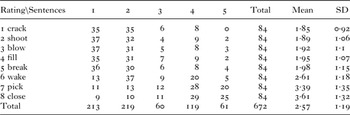
Analysis and results. The rating score for each target sentence by each participant was recorded and analyzed. The total number of responses is 672 (84 subjects × 8 target sentences). The frequency counts of the ratings, the means, and the standard deviations (SD) for each target sentence are summarized in Table 7. The overall rate of acceptance of the target sentences is 64·29% (= 432/672), which suggests that Mandarin speakers tend to accept the cancelation of a resultant state change even though a causal action has occurred. In other words, they generally treat the action verbs as not entailing a state change.
Frequency counts, means, and standard deviations of the rating of each target sentence in the semantic rating survey

note: For convenience of illustration, the target sentences are represented with the target verbs in their approximate English counterparts.
A one-way ANOVA was conducted to find out if the eight target sentences differed significantly based on the participants' rating scores. The result shows a significant effect of sentence (df = 7, F = 33·06, p < ·001). The post-hoc comparisons reveal that the ‘pick apple’ and ‘close door’ sentences received significantly higher rejection scores than each of the remaining six sentences (p < ·001 in each pairwise comparison). In other words, the verbs zhai1 ‘do.picking’ and guan1 ‘close’ were more likely to be associated with a strong state-change implicature – if the result state did not occur, participants tend to rate the sentence as unacceptable. The ‘wake someone’ sentence, i.e. the verb nao4 ‘make.noise’, received significantly higher rejections than the ‘crack nut’ sentence, i.e. the verb chui2 ‘hammer’ (p < ·05), and the remaining four sentences (p < ·00), and a significantly lower rejection than zhai1 ‘do.picking’ (p < ·001) and guan1 ‘close’ (p < ·001). This suggests that the verb nao4 ‘make.noise’ is considered to have a weaker implicature of state change than zhai1 ‘do.picking’ and guan1 ‘close’, but a stronger implicature of state change than the other five verbs. The remaining five verbs show no significant difference in the participants' rating scores. The eight verbs tested in this survey can then be summarized schematically in a continuum from strong to weak state-change implicature verbs (the symbol ‘ > ’ indicates the strength of state-change implicature: verbs to the left have a stronger state-change implicature than those to the right): zhai1 ‘do.picking’/guan1 ‘close’ > nao4 ‘make.noise’ > chui2 ‘hammer’/dao4 ‘pour’/jia2 ‘hold.tightly’/da3 ‘shoot’/chui1 ‘blow’. The semantic rating survey confirms the existence of variations in the strength of state-change implicature in action verbs in Mandarin, and the two verbs guan1 ‘close’ and zhai1 ‘do.picking’ are treated as more likely to entail a state change than the other six verbs. This pattern is consistent with my previous analysis of the children's data.
GENERAL DISCUSSION AND CONCLUSION
The current study has examined Mandarin learners’ interpretation of the state-change verbs, i.e. RVCs, and the information packaging inside the RVCs. RVCs typically encode a caused state change with two separate verbs: someone does something (V1), which brings about change of state in a patient (V2). In English translation, the V1 would often seem to inherently entail a state change (e.g. ‘break’, ‘close’, ‘kill’), but in Mandarin the verb does not specify a state change, or at best only pragmatically implicates it. To confirm that a state change actually came about as a result of the action specified by V1, the speaker must add a V2 such as sui4 ‘be.in.pieces’, guan1 ‘be.closed’, or si3 ‘be.dead’.
My study reveals that Mandarin children differ from learners of English and German in their interpretation of state-change verbs. Learners of English and German have difficulties in learning the entailed state-change meaning in state-change verbs, and often incorrectly treat them (e.g. pflücken ‘pick’) as only optional (the ‘Manner’ bias: Gentner, Reference Gentner1978; or the ‘Weak Endstate’ hypothesis: Wittek, Reference Wittek1999, Reference Wittek2002). Mandarin children, in comparison, have less difficulty figuring out that a state-change meaning is crucial to the RVCs: from at least age 2;6 they accept the use of an RVC only if a state change is realized.
The morphologically and semantically complex nature of RVCs does not seem to hinder them from attaining a correct interpretation of the state-change meaning. But when I zoom in on children's interpretation of the V1 of an RVC, I discovered an intriguing misconception: in striking contrast to learners of English and German, who fail to grasp that verbs like ‘break’ and ‘kill’ entail a state change, learners of Mandarin fail to grasp that such verb do not entail a state change – that is, they incorrectly treat V1s as if these verbs – just like the RVC – do entail a state change! This interpretation is rather persistent, and is found even among children as old as six years.
How do we explain this cross-linguistic variation in the acquisition of the state-change meaning in predicates? The perceptual salience of either manner or result, e.g. the Manner Bias Hypothesis (Gentner, Reference Gentner1978) and the Weak Endstate Hypothesis (Wittek, Reference Wittek1999, Reference Wittek2002), do not explain the acquisition of the entailed state-change meaning in RVCs in Mandarin children. In languages that allow verb–particle constructions, such as English, longitudinal studies have shown that children are able to use particles alone (e.g. off) to express state change before the age of two (Bowerman, Reference Bowerman1994; Bowerman & Choi, Reference Bowerman, Choi, Bowerman and Levinson2001; Tomasello, Reference Tomasello1992), and English learners also produce verb–particle constructions productively with few errors around age 2;8 (Snyder, Reference Snyder, Danis, Mesh and Sung2011). This suggests that children are able to attend to the result of a state-change event and express them with language-appropriate forms.
A unified account is needed to explain both the ease in understanding the entailed state-change meaning in RVCs and the difficulty in ‘unlearning’ the misattribution of state-change meaning to the V1 of an RVC. I propose that the learning problems that children must solve in learning the semantic organization of state change are linked to the language-specific form–meaning mapping in expressing state change, i.e. the way the verbs of the target language characteristically package information. In figuring out the language-specific semantic system, a child is influenced by a number of factors in the target language and language use in the input, which includes the consistency, transparency, and frequency of the particular form–meaning mapping.
In Mandarin, causal action and state change are each encoded with a separate verb in an RVC consistently and frequently (Chen, Reference Chen2008). This represents a fairly transparent form–meaning mapping in comparison to English and German monomorphemic state-change verbs. The rigid word order in an RVC may also have helped the learning – the result verb always occurs after the action verb, and the final position of the result verb in an RVC could be quite salient to Mandarin learners. The frequent and consistent one-to-one mapping of action and result verbs may have helped Mandarin children to attend to the state change meaning in an RVC from an early age. In her discussion of children's lexical development, Clark (Reference Clark1993) proposed three very general principles that affect the process of learning constructional regularities on the basis of the input: Transparency of Meaning, Simplicity of Form, and Productivity in Use. Clark focused on children's lexical innovations in production, but these general learning principles may be extended to comprehension of verbal semantics as well. The principle of Transparency of Meaning suggests that forms that are transparent tend to be learned earlier than those that are opaque to the child. The principle of Simplicity of Form states that the simpler a construction is, the easier it is to learn. Productivity in Use suggests that learners will utilize the most productive option in the language with the appropriate meaning.
Transparency in form–meaning mapping per se, however, does not guarantee an easy acquisition of state-change predicates. Wittek (Reference Wittek1999, Reference Wittek2002) explicitly examined the effect of transparency, and in a series of experiments compared four- and five-year-old German children's interpretation of state-change predicates that differed in the transparency of state-change meaning encoding, i.e. transparent verb–particle constructions with the light verb make (e.g. wachmachen ‘make awake’), verb–particle constructions with specific action verb (e.g. wachklingeln ‘awake-ring’), and opaque monomorphemic wecken ‘wake’. She found that German children did not perform better on the transparent verb–particle constructions than on the opaque monomorphemic state-change verbs. In other words, complex predicates that display the state-change meaning on the surface form did not draw more of the children's attention to the state change. Only when the state-change particle is in a syntactically salient position (e.g. sentence-final position) did the children show better understanding of the state-change meaning in the verb–particle constructions.
The early acquisition of the state-change meaning in Mandarin RVCs can be viewed as the joint influence of transparent, consistent, productive form–meaning mapping, and possibly the positional salience of the result verbs in Mandarin RVCs. This language-specific learning is also revealed by the finding that Mandarin children have great difficulty in unpacking the semantic distribution of state change in an RVC. Intriguingly, Mandarin-learning children's misattribution of a state-change meaning to V1 is not uniformly strong across all the V1s. The verbs that children are most likely to treat incorrectly as entailing a state change are those that, for adults, have a relatively strong – although still defeasible – state-change implicature (such as guan1 ‘do a closing action’). Verbs that for adults have a weaker state-change implicature (e.g. chui2 ‘to hammer’), children tend to treat correctly as entailing only an action. Mandarin children's sensitivity to the strength of the state-change implicature may reflect the subtle semantic distinctions that native Mandarin-speaking adults make between implied-state-change verbs, which is supported by the semantic rating survey study with adult native speakers of Mandarin.
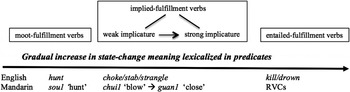
The existence of a continuum in the lexicalization of state change in a language is not unique to Mandarin. Based on his analysis of English verbs, Talmy (Reference Talmy2000) claimed that the implicature associated with implied-fulfillment verbs follows a cline. For example, the verbs in the sentences He choked/stabbed/strangled/drowned him show an increasingly strong implicature of the realization of the state change from alive to dead: choke and stab imply death only weakly; strangle entails death for some speakers but not for others; and drown clearly entails death and is therefore termed an ‘attained fulfillment verb’ by Talmy. Mandarin monomorphemic action verbs (i.e. V1 of an RVC) either do not encode any state change (moot-fulfillment verbs) or only imply a state change (i.e. implied fulfillment), and implied-state-change verbs also vary in the strength of implicature. The typology of state-change lexicaliztion in predicates can be schematized as in Figure 3.
A schematic illustration the typology of state-change lexicalization with examples from English and Mandarin.

This cline in the lexicalization of state change nicely predicts the acquisition in Mandarin: learners of Mandarin understand that the state change is entailed in RVCs (entailed fulfillment verbs) and they learn that weak-state-change-implicature verbs (e.g. chui2 ‘hammer’) do not entail a state change earlier than strong-state-change-implicature verbs (e.g. guan1 ‘close’, zhai1 ‘pick’).
To conclude, children acquiring different languages are faced with different lexicalization puzzles, and this cross-linguistic variation leads to different learning patterns. It seems easy for Mandarin-speaking children to learn that RVCs entail a state-change meaning, but they have trouble determining exactly where the state-change meaning is encoded: in V1, V2, or the RVC. Multiple factors may have contributed to the acquisition: transparency and consistency in form–meaning mapping, morphosyntactic saliency of the semantic components, and adult usage of the predicates. This acquisition process is long and gradual (i.e. by or beyond age six), during which children are remarkably sensitive to the strength of the state-change implicature. This sensitivity predicts the varied trajectory of the acquisition of individual verbs – verbs with stronger state-change implicature are likely to be learned later than those with weaker state-change implicature. The acquisition of individual verb semantics could possibly be item-based. For example, the verbs guan1 ‘close’ and zhai1 ‘do.picking’ are consistently rated as strong state-change implicature verbs, whereas the other verbs tested in the current study vary in the rating of the strength of state-change implicature (though mostly not to a significant level). Future studies are needed to explore wider semantic domains of state change to examine the possible item-based learning. This study overall supports usage-based learning approaches that stress the dynamic properties of learners' linguistic knowledge influenced by usage factors such as frequency and consistency of regularities of form–meaning mapping, and provides insights into the process of how children get into the typological semantic packaging of information in the target language (e.g. the ‘typological bootstrapping’ hypothesis; Slobin & Bowerman, Reference Slobin and Bowerman2007).
APPENDIX 1: Events tested in the experiment
Descriptions of the scenes used in the experiment that tested children's interpretation of the RVCs and their V1s.

APPENDIX 2: Target sentences in the semantic rating survey
(Target sentences in Chinese characters with English translation)