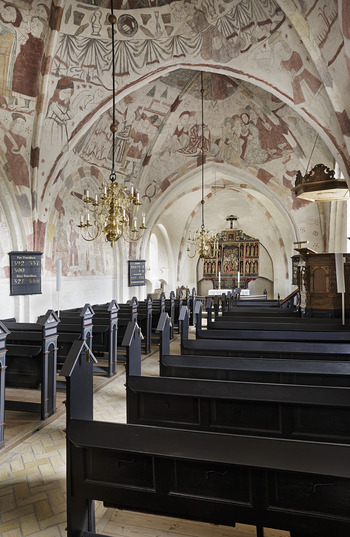
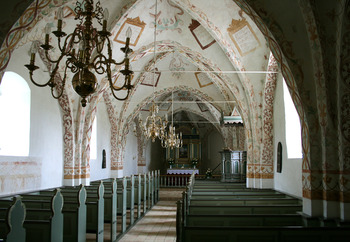
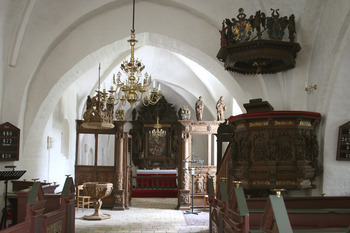
Church buildings are a fascinating site of investigation for anyone who wants to understand how the Protestant reformations of the sixteenth century affected religious imaginings and beliefs on levels ranging from learned theology to everyday, practical concerns. Through church interiors, we are still able to glimpse how these early, tumultuous upheavals affected thinking about sanctity and salvation among not only learned theologians but also common parishioners. While we have a huge corpus of religious writing from the sixteenth century dealing with the transformation of rituals and religious thinking, churches show us how these concepts came to be expressed or utilized when shaped into furnishings and fittings for church interiors. Texts give us the reasoning and vocabulary of the reformers, but by looking at how church interiors were furnished and structured, we close in on how the reformers expressed their ideas when it came to actually giving form or body to their visions of a new church free of the “popery” they reacted against. In other words, through church furnishings, we gain insights into aspects of the Reformation world that only surfaced when ideas were expressed in art, architecture, and decoration and thus cannot be gained through texts alone. The physical church also illustrates how Protestant communities severed their ties—or at least some of them—to the church in Rome and how the new rituals affected everything from altarpieces and crucifixes to murals and seating arrangements. Yet it is also far from easy to identify the direct results of the new religious imaginings of the first decades after the Reformation because later centuries have obscured the earliest developments. Furniture has been replaced (perhaps several times), elements are missing, and most importantly, it can be difficult to determine what remained from the period preceding the break with Rome (fig. 1). Despite these challenges, an examination of early Lutheran Church interiors in Denmark provides a glimpse at how the earliest reformers communicated new religious beliefs and ideals to a broader lay audience through the physical space of their churches.Footnote 1
The interior of Bellinge Church on the island of Funen with pre- and post-Reformation decorations and furnishings side by side. Photograph by Arnold Mikkelsen, The National Museum of Denmark.

I. A Few General Remarks About the Changes in Churches After the Reformation
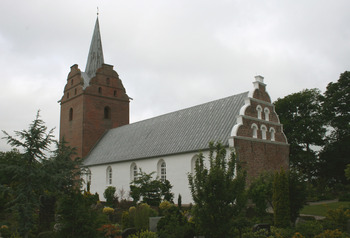
A retelling of the political events in Danish Reformation history will be passed over here, but a few things should be made clear from the outset.Footnote 2 When it came to regular parishes, only about a dozen new churches came into being between 1536 and roughly 1600. The transformation of ecclesiastical spaces after the Reformation was thus a question of adjusting medieval structures to meet the demands of the evangelical faith. However, the few new churches built cannot be said to radically differ from their pre-Reformation counterparts (fig. 2). Architecture was clearly not a part of the vision for a new church in Denmark—at least no architectural ideals came as a part of the initial Reformation. It is only during the eighteenth century that completely new modes of Lutheran architecture began to be manifested.Footnote 3 Accordingly, the alteration of existing church spaces was the primary duty of reformers facing the task of redefining how church interiors could best be furnished in order to accommodate the new liturgical practices.
Visby Church in North Schleswig, Jutland. Rebuilt and finished around 1590. Photograph by the author.

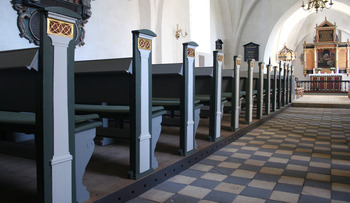
Examining this task, we can identify three factors as the governing forces in the reformers’ thinking when it came to the furnishing of churches. These factors are well-known to anyone who has worked with Lutheran theology and church spaces, but they are important for this article, and thus will be briefly summarized. First and foremost is the fact that the laity, which previously only had participated in the Eucharist irregularly (mostly during Holy Week), now did so as a part of regular Sunday worship.Footnote 4 This alone sparked radical new thinking as to how the chancel area should be furnished and how the altar, which was retained, should be decorated. Secondly, the status of the sermon was elevated into something crucial, almost sacramental, for the service because it was precisely through the preached word that the church was to prepare and teach the congregation the importance of receiving the sacrament and what this meant for the daily lives of the parishioners when they left the church building after service.Footnote 5 The pulpit from which the pastor would address his congregation thus received acute attention, and where no pulpits were present prior to the Reformation, they were soon installed and old stools or ambos were replaced with new chairs. Thirdly, pews or seats gradually became a priority in order to emphasize the fact that the congregation gathered to concentrate on and hear God's word preached. The seats thus gave a new, firm structure to each individual's position in the nave and ensured that everybody was more or less facing the preacher. To this end, benches for members of the congregation from the highest to the lowest status in the parish were set up, replaced, or reordered after 1536. This undertaking, which was most likely one of the first tangible changes that began to take place in the churches during the decades following the Reformation, can to some extent still be traced today. The inserted benches were usually of a very simple construction: one end of the seat rested in a fixture on the wall while the other was placed in a bench end. The seats themselves have been widely replaced, but we still find a very large number of bench ends dating from very close to the Reformation preserved, such those from Sønderby on Funen produced after 1537 (fig. 3). But we should not be led to assume that all churches had benches inserted in the nave during the first decades after the Reformation. The process was undoubtedly long and tedious. In a churchwarden's account from the town parish of Saint Budolf in Aalborg in northern Jutland, dating from 1579, it is noted that it is the responsibility of the parish clerks to remove the stools and rocks that the parishioners carried into the church to sit on and left behind.Footnote 6 It would therefore seem as if the late medieval tradition of supplying one's own chair was still predominant in the decades following the Reformation. I shall not discuss pews any further here, but they should be kept in mind as an important component of the things I am to address over the following pages.
The pews from Sønderby on the island of Funen, produced and installed in 1537—one year after the Reformation. Note the combination of Renaissance forms and late Gothic blind tracery on the bench ends. Photograph by the author.

Of course, neither the sermon nor lay participation in communion were elements invented by the reformers. The priority that these things received after the Reformation, however, changed the structure if not the fabric of the church interior and thereby created a new ritual space that in some respects looked strikingly different from the late medieval room of the fifteenth and early sixteenth centuries. The effect was, in essence, that the attention of the churchgoer was focused on a few select focal points or ceremonial hotspots in the church whereupon all ritual attention rested. The altar and pulpit were the essential components in this, determining the positioning of everything else in the building. It also seems relevant, therefore, to consider the centralization of the church interior, the locking of the parishioners’ gaze in one direction, as an expression of the “normative centering” (normative Zentrierung) which Berndt Hamm has introduced.Footnote 7 The concept, Hamm argues, basically presents a means to describe the reorientation of religion—or indeed all aspects of social institutions—during the early modern period toward more well-defined core elements of the subject matter in question (for example, sola fides, sola scriptura). In our context, this would mean the gathering of objects in the church identified by the reformers as critical (font, pulpit, and altar) into one central space in order to clarify and strengthen the message these conveyed. While it is perhaps unnecessary to agree with Hamm entirely, his normative centering does appear to be a fruitful way to describe the (re)establishing and disciplining of the centralized reading of the church interior following the Reformation. The Reformation, in other words, oriented the churchgoers’ eyes and consciousness during the service toward those elements most crucial to the Lutheran faith: the word and sacrament. Baptism, of course, also played into this, and we shall return to that topic below.
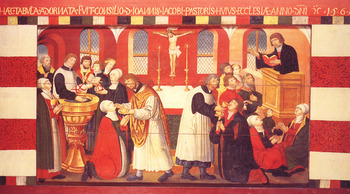
This reorientation of focus posed a challenge. On the one hand, the Church as an institution wanted to visually celebrate both the Eucharist and preaching as activities of the highest importance and to communicate this knowledge to the congregation. On the other hand, the Church wished to avoid staging the objects—the altar with its decorations and the pulpit—in a manner such that they could be understood as akin to the Papal Church's understanding of the same furnishings, for example, the notion that church furnishings could possess sacredness in themselves due to their connection with the liturgy.Footnote 8 A visual balance was thus required which both glorified the ritual proceedings and highlighted their meaning to the congregation without elevating either the pulpit or the altar into more than mere practical installations. One instance where this problem was visually addressed was in an almost iconic representation of the path to Christ found on the altar frontal from Torslunde Church on Zealand, painted in 1561 (fig. 4).Footnote 9 Baptism, pulpit, and altar are here gathered into a charged, ritual nucleus with Christ as the center around which the activities of the congregation are fixed. The intriguing frontal from Torslunde is a sole depiction without any known parallels; it was obviously easier to abolish or remove than to find new, fitting representations. However, due to the Lutheran emphasis on the word, inscriptions became the primary tool utilized by the young evangelical church to ensure that what was put up inside the churches was understood in the right way.Footnote 10 And it is precisely this relationship between form and text that will be a recurring topic of the following, as it is within the tension between text and matter that we see what the early Lutheran Church was striving to establish in parish churches across the Danish kingdom.
The famous altar frontal from Torslunde Church on Zealand, 1561. The frontal is now on display in The National Museum of Denmark. Photograph in the Antikvarisk-Topografisk Arkiv, The National Museum of Denmark.

II. The Critical Attitude Toward Materiality
Before we head into the main topic, it is perhaps fitting to dwell a bit further on the critical attitude toward materials and liturgical items during the early Reformation period. The Protestant reformations of the sixteenth century brought with them a massive critique of the employment of and trust in material representations ranging from liturgical vessels and the altar block itself to the very church building as a whole. Everything was questioned and carefully scrutinized. Along with this critique of the material, a similar critique of visible ceremonial or liturgical actions mounted rapidly. To show, to display, or to act became crucial components in the discussion of what constituted the “true Church” and how this Church could, if at all, be sensed by man.
One place where this critique became fully expressed was in an intriguing comparison between “the Church of the Pope” (the Catholic Church) and “the true Church of Christ” (the Protestant Church) formulated by Luther in 1530 under the heading “One finds these things in the Church of the Pope” (In der kirchen des Bapsts findet man diese Stucke).Footnote 11 The inventory of the hallmarks of the “true Church” is brief, but the list concerning the “Church of the Pope” is a fascinating view into the liturgical ceremonies as Luther experienced or remembered them. It touches upon small topics such as individual pieces of liturgical equipment, the chalice for instance or private prayers, and large topics and features, like processions during Holy Week and the Liturgy of Hours. At first, Luther presents these matters in the order of the church calendar, but gradually the list dissolves into an almost stream-of-consciousness-like rendition. Two themes are particularly striking: first, the preoccupation with the ceremonial items and the use of objects in liturgy, and second, the strong emphasis on movement and motions. There are comparatively few specific references to concrete theological questions. The list is, therefore, not to be understood solely as a polemical attack but also as a textual or mental reconstruction of a church and its content—both the performed and the material. This explains why Luther lists features which he otherwise held in regard together with items like candles, to which he paid only limited attention. The inventory is an expression of how the reformer, with dismay, envisioned the contemporary church building as it appeared “in use” more than its theology, which he had parted with. The church described by Luther was a church of outwardly expressed actions and gestures, freely employing matter to represent the sacred. Luther deliberately, of course, fails to elaborate on the meaning behind these items and practices in order to stress their status as empty or meaningless to him. The list evokes an idea of the functioning of church spaces and it demonstrates the compartmentalization of the late medieval church interior into stations defined by matter (furnishings and altars) and motions (rites and ceremonies). That is to say, through this list, we are to understand how the perception of the church interior was shaped and defined by objects and certain materials (like precious metals and gems) and how these objects and materials enabled the beholder to catch glimpses of the divine realm.
Following Luther's relaxed attitude to such elements, the Lutherans in Denmark and elsewhere retained a number of objects in their service. This attitude, however, also led to a certain degree of diversity in the explanations of why, for instance, candles were used on the altar or whether or not it pleased God that churches were built. While rarely discussed with firm conclusions, such issues continued to crop up in theological writings of the sixteenth and seventeenth centuries. On the one hand, Lutherans wished to retain contact with the past through some of the ceremonial practices employed by the Catholic Church. On the other hand, they wished to clearly demarcate themselves from the Catholic Church without losing this sense of tradition.
It was commonly accepted among sixteenth-century Lutherans that matter and artifacts could, to a certain extent, manifest and illustrate invisible qualities, but it was repeatedly stressed that the power to understand Christ and the scripture rested inside the individual. The external was always secondary to the internal. While these subjects had been debated since the church fathers, the discussions had rarely been as decisive as they proved to be in the sixteenth century. John Calvin could thus, in his Institutio religionis Christianae in 1559, express critique of the physical, tangible church by paraphrasing the fourth-century theologian Hilary of Poitiers, denouncing the Christian church's love for “brickwork” and stressing that it is wrong to believe that God is best worshipped under roof and in buildings. “Now I shall point out how dangerous is their [the Catholics’] desire to have the form of the church judged by some sort of vain pomp,” Calvin warns.Footnote 12 As said, the critique of the tangible, visible church became prominent during the upheavals of the Reformation, in which the followers of Luther also initially came to reject the church building and all its components as a whole. A small book from 1530, entitled Een lidhen Indgangh udj Schriffthen (A Brief Introduction to Scripture) and published by Danish printer Hans Vingaard, states: “The true Christian church from scripture is not the house of timber and stone which we built here on earth, like our blind leaders the Papists and Pharisees have told us, out of greed and gluttony.”Footnote 13 Instead, the author states, the true church is “the assembly of all faithful humans who have gathered in the Holy Spirit, in one teaching, in one faith, in one love, as one group”Footnote 14 —a wording in complete accordance with the phrasing found in the Confessio Augustana of 1530. The early Lutheran reformers ascribed no intrinsic sacred or holy qualities to the church building as such; what mattered was the very act of assembling. By gathering in the name of Christ, the place of meeting became sacrosanct—a liturgical space blessed by the presence of the Holy Spirit.Footnote 15
Especially during the first decades after the Reformation, thoughts like these were strong and clearly tinged with the hostile rhetoric of the confrontations with the church in Rome. Within this theologically belligerent atmosphere, the inclination to add new church furnishings was apparently limited. In fact, it took almost a century for the Lutheran Church to get comfortable with the idea of material lavishness. Danish Lutheran theologian Niels Heldvad wrote in 1622 with clear pride and pleasure about the gold and silver that adorned the churches built by the monarch, interpreting the costly materials as expressions of dedication to God and a willingness to sacrifice. Heldvad thus describes the palace chapel at KronborgFootnote 16 in the following terms: “A temple and house of God . . . of alabaster and porphyry, exceedingly costly and striking to see. The altar and the table, which is decorated with beautiful paintings, is nobly gilded with pure silver. The pulpit is richly made and decorated in the same way with pure silver. . . . The organ is wonderfully decorated with gold and silver.”Footnote 17 Or, if we turn to the evocative consecration sermon celebrating the inauguration of the Trinity Church in the town of Kristianstad in Scania (then part of Denmark, now a part of Sweden), in 1628, the ceremony seems drenched in beautiful objects and splendor, with standard bearers and clergy in rich robes in the sparkling new church interior.Footnote 18 The furnishings of the seventeenth century were, in other words, by no means characterized by restraint or modesty, but often rather the opposite. The Baroque clearly found its expression in the Danish churches with its fondness for rich and plenteous objects and visually imposing furnishing. But it took decades to reach that stage. Thus, while it is important to emphasize the material critique within Lutheran theology—especially since this was crucial to Luther—it is equally important to remember that, in the reception of Luther's writings, theology and church interiors to some extent parted ways after 1600. At least the verbatim interpretation of the early Lutheran theologians’ distrust of the object more or less disappeared by the beginning of the seventeenth century. Gregory Dix has called it “an accident” that Puritan and Protestant strands in theology coincided in time, and while the notion of the accidental perhaps goes too far in undermining the innovative momentum in Protestant theology, Dix has a point.Footnote 19 The critique of matter was mounting throughout the late Middle Ages and became a full-blown discussion in the Reformation, but it never came to be manifested completely within the Lutheran Church in Denmark, as the pleasure in the ornate slowly returned. Puritanism remained a theoretical strain of thought that only emerged full-fledged in the late eighteenth century. Nevertheless, this reluctance prevailed during a few decades of the sixteenth century when the wish for reform was carried by an idealistic belief in the power of the evangelical message, leading reformers and their followers to invest in church furnishings that had very little resemblance of their pre-Reformation counterparts. It is to this brief period of restraint and attempt at renewal that we will now turn our focus in order to understand what these Lutheran visionaries wished to establish.
III. On Images
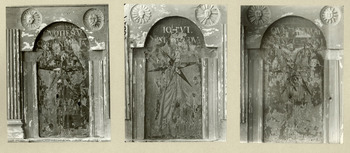
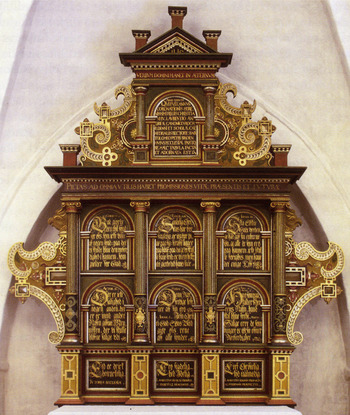
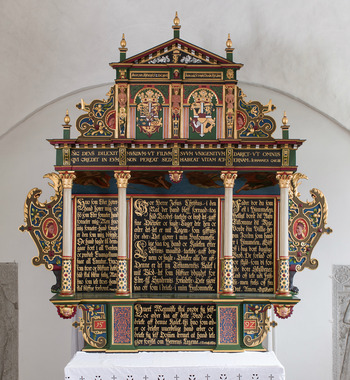
Given the critical attitude toward the display of objects and veneration through matter, it is especially relevant to address the issue of images in the churches in order to understand what forces shaped church interiors of the latter sixteenth century. In the decades following the Danish Reformation, churches continued to be decorated with images and retables—as did churches all over the Lutheran sphere. As stated above, a period of initial reluctance or uncertainty toward decorative features, and especially images, can be discerned. From circa 1550 and up until 1600, however, a substantial number of churches received new wall paintings, and new retables were also inserted throughout the realm. This process is very well illustrated by the altar frontal from the little rural parish church of Vallekilde on the island of Zealand (fig. 5). This frontal, which was created between 1550 and 1575, was originally intended to have a purely ornamental decoration of star-shaped intarsia patterns, but, around 1575, they were painted over with a depiction of Christ on the cross, flanked by John and Mary. Around 1600, inscriptions were added to these images, most likely in order to match the new altarpiece of the church from 1598—a retable using ornate writing as its primary mode of decoration (fig. 6). On a single piece of furnishing, we thus find the entire process documented, from restraint in the use of images to their return and elaboration through writing.Footnote 20 These renewals confirm the by now common knowledge that the Lutheran Reformation can hardly be considered iconoclastic—at least in comparison to the hostility toward images expressed, for instance, by contemporary Calvinists. And even within this confessional context, the questions of image use and representation should be asked carefully.Footnote 21 Whitewashed interiors without adornments were, in other words, not something that automatically followed the Reformation. At least this was the case in the Danish kingdom, where the great purging of churches was something that followed, more than anything else, the Puritan tastes of the late eighteenth century.
Altar frontal from Vallekilde Church on Zealand, dating from 1550–1575. It was originally intended to only have a purely ornamental decoration of star-shaped intarsia patterns. Around 1575 they were painted over with a depiction of Christ on the cross flanked by John and Mary, and ca. 1600 inscriptions were added to these images. Photograph of the three panels on the frontal prior to the conservation in 1949 in Antikvarisk-Topografisk Arkiv, The National Museum of Denmark.

The text retable from Vallekilde Church on Zealand, put on the altar in 1598. Photograph by Niels Elswing, Antikvarisk-Topografisk Arkiv, The National Museum of Denmark.

In order to convey a sense of the amount of material that serves as a backdrop for the conclusions presented here, a brief overview of the situation in Denmark is in order. Roughly sixty painted wall decorations produced after the Reformation have survived. The majority of these were painted around the middle of the sixteenth century, with the number dropping toward 1600, and a small number from the seventeenth century. To this, we can add circa 400 known new altarpieces produced and installed before 1600 and a huge number of still extant pulpits—999 to be exact. Furthermore, we can refer to the numerous bench ends with decorations as well as altar frontals and, of course, epitaphs.Footnote 22 It is on the basis of these features that we can draw some broad, tentative conclusions in the following pages. But before we turn to the decorations themselves, a few words are necessary concerning Danish theologians’ attitude toward images.
In general, it can be noted that most of the Lutheran theologians of the first decades following the Reformation clearly expressed a negative attitude toward the use of pictures in churches.Footnote 23 Some expressed a directly hostile attitude, while the majority simply did not acknowledge any beneficial qualities in pictorial art when employed in churches. A typical opinion was that voiced by Superintendent Niels Palladius, brother of the Peder Palladius, mentioned several times over the next pages, in his 1557 book, Commonefactio de vera invocatione dei, et de vitandis idolis (Admonition on the True Invocation of God, and on the Duty to Avoid Idols): “The true ornament of the Christian churches is the sacred office itself of God's words, and the administration of the sacraments and pious ceremonies to whom they are joined, not logs, a wooden nose or eye, painted and fashioned faces.”Footnote 24 In that sense, many of the Danish theologians took up a position of a somewhat more radical nature than that which was expressed by Martin Luther himself, and we can note how this gained emphasis during the 1570s, most likely influenced by the advance of reformed thinking in Germany during the same period.Footnote 25 One notes, however, that the role of images as didactic tools was as much present in the debate as was a deep mistrust of the nature of imagery. Jens Skielderup, superintendent in Bergen in Norway, who, broadly speaking, was in line with Luther's view on images, remarked in his little book against idolatry from 1572 that, if it is deemed necessary, local congregations may have pictures with motifs from the Old and New Testament on the church walls, but the only depictions to be tolerated as altar decorations are the Last Supper or a crucifix—and even this, the crucified Christ, is only to be considered as something halfway decent or passable.Footnote 26 As we shall see below, Luther's recommendations from 1530 of letting the Last Supper furbish the altar along with the words of institution are almost forgotten or mentioned only rarely in the discussions of the Danish theologians, amongst whom Skielderup is to be counted, who clearly prefer something non-pictorial to adorn their houses of worship.Footnote 27 Jens Skielderup does, nonetheless, stress writing as a particularly fitting ornament for the churches, and in doing so, he, like Luther, emphasizes the idea of the written word employed as a decorative feature.
While this love of the written word and reluctance toward imagery prevailed among theologians of the later sixteenth century, they did not succeed in transforming all parish churches in this image. In fact, while many churches were affected in one way or another by these lines of thinking, it was only in a few select places that these thoughts manifested themselves in all parts of the building. Nevertheless, these ideas had an impact and can be traced across different types of furniture, helping us to reconstruct the ideals under which the evangelical theologians operated during the decades following the Reformation. It is to this which we now turn.
IV. The Altar and Images on the Altar
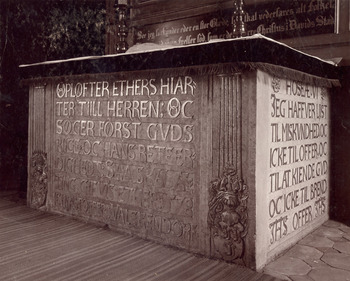
The altar undoubtedly proved difficult for the reformers, and the early Lutherans had to navigate carefully when dealing with both the altars as such and their adornments. They had to find a form that could embrace the fact that they wanted to preserve the altar block as a memorial of Christ's sacrifice on the cross, but at the same time emphasize that they no longer saw the altar as the place where the church presented their offerings in gratitude and continuously, each Mass, witnessed the self-sacrifice of Christ. So it had been prior to the Reformation, where the holy or even sacramental status of the altar was emphasized and glorified through both rich visual and liturgical veneration.Footnote 28 We find the new attitude to this issue explicitly explained on the altar erected in 1578 in Svindinge Church on the island of Funen (fig. 7). This sandstone altar is covered by very large inscriptions on the front and the sides:
[Front] Raise your hearts to the lord: and first seek God's kingdom and his justice: then all things shall be given to you / 1578 / Christoffer Walckendorff [the donor]
[South side] Hosea VI / I wish loving-kindness and not sacrifice and to know God not burnt offering / jhs
[North side] Psalm LI / A remorseful spirit is the sacrifice that pleases God / God does not refuse a sorrowful and regretful heartFootnote 29
The altar from Svindinge Church on southern Funen, dating from 1578. Photograph by Kristian Hude, 1910, The National Museum of Denmark.

Here we more or less find the new attitude toward the role of the altar—that it is not a place of sacrifice—addressed in a nutshell: faith is the only thing that pleases God, all else is burnt offering without meaning and benefit. This reasoning, of course, tied in with the doctrine of justification by faith alone, whereby all attempts at securing one's salvation through actions and good deeds, such as making pious donations, in principle lost their value. In this way, the entire pre-Reformation system of offering was cut short. Nevertheless, the Lutherans retained the old high altar in its place and continued to distribute the Eucharist from the altar, whereby it was still, at least visually, a striking component in the communion ritual.Footnote 30 The altar thus became the place where the congregation expressed their gratitude to Christ and the space in front of which the congregation would join their Lord during that elusive moment of communion. While not holy, the altar should still be treated with respect. Peder Palladius, the first superintendent on Zealand, expressed this in his visitation handbook from the 1540s by stating: “The altar should always be covered in clean cloth. Just as each one of you wishes to have a clean cloth on the table on Sundays and other feast days. How much more should not the table where we receive the body and blood of Jesus Christ be clean, and the churchwardens must always wash the appliances or liturgical vestments used at this high altar.”Footnote 31 And a bit further on:
These two candles represent something very special, or else they would not be lit, because there shines such a wonderful light above our heads, the bright sun, and it shines so well, that we could thread needles in here if necessary. Therefore we need not mock God by lighting candles, unless they carry a meaning: The first candle on the altar burns to the glory and honor of the body of Jesus Christ, and the second burns to the glory and honor of his blessed blood.Footnote 32
The quote brings to mind the altar depicted on the frontal from Torslund (fig. 4). The sense of homeliness in Palladius's argument is typical of his writings in general, but it is also an expression of the paradoxical status the altar had during the second part of the sixteenth century. The altar was venerated but not considered holy; it was clearly invested with more meaning than a mere table but still addressed as something almost inconsequential. Precisely this attitude to the altar is characteristic of this period in which the memories of the side altars from pre-Reformation days were still vibrant. To quote Palladius once more, he states: “Like each church has enough in one pulpit, so has each church no need for more than one altar, and God help it that you, Christian folk, will remember to treat it in the right way. There is no longer need for other altars in the churches, despite the fact that the papists want to preserve them, so that they could stand there and await new times, where all the canard and robbery could be reinstated.”Footnote 33 Lutherans in Denmark retained the altar in the chancel, contrary to Calvin's followers, but removed all side altars from the churches. Visually, however, they had to distance themselves from previous practices, and tried to articulate the altar in a new way, so it was understood that the altar itself was only a symbol. A great uncertainty as to the proper motifs and contents of the new altar decorations can accordingly be traced across the Lutheran world where the Cranach workshop had presented one template in Saxony. Though this template never gained a foothold in Denmark, the painting on the Torslunde frontal, for instance, was based on a print from the Cranach workshop.Footnote 34 Nevertheless, the Danish reformers chose a different path. This can be clearly illustrated through a selection of churches where some altarpieces are preserved from the first decades after the Reformation belonging to the type of so-called text retables, or “catechism retables” as they were known in older research. That is, altarpieces on which text is the dominant or essential element in the overall visual impression.
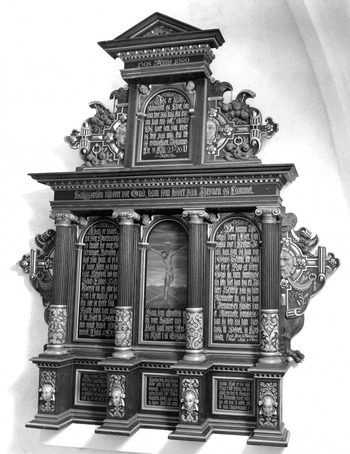
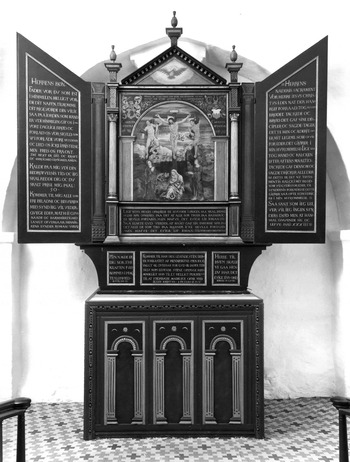
The most striking type, representing the hardliners approach, can be found in Sigersted on Zealand, dating from 1596, where we see a retable whose decoration is based solely on text written in ornate calligraphy (fig. 8), and we could also refer back to the previously mentioned piece from Vallekilde Church (fig. 6). While numerous, such pieces never gained the same popularity as the retables which combined a depiction of the Last Supper or Christ on the cross with words from the Gospel on the wings—a model which Luther himself described and thus, at least unofficially, approved for use in evangelical churches. In his commentary on Psalm 111 from 1530 he wrote: “Whoever is inclined to put pictures on the altar ought to have the Lord's Supper of Christ painted, with these two verses written around it in golden letters.”Footnote 35
Text retable from Sigersted on Zealand, dating from 1596. Photograph by the author.

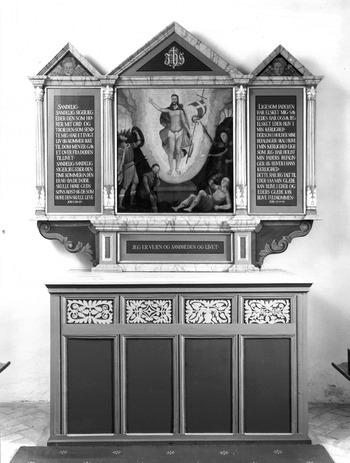
The altarpiece from Lydum Church in western Jutland (fig. 9), donated to the church by nobleman Christen Wind in 1581, is a good example of the type, though its actual shape is without any obvious parallels within the region. In the central field, the Crucifixion is shown flanked by inscriptions on the wings with the Lord's Prayer and the words of institution. Another example, more representative of the of altarpieces from the period in general, is the small, tightly composed piece from Næsbjerg Church, also in western Jutland (fig. 10), which has lost most of its original paint, but with a decoration in the center field which more or less stems from 1587. Here we see a representation of the Resurrection, with the victorious Christ wrapped in divine light, simultaneously speaking and making a blessing gesture. In all likelihood, this image interacted with the writings on the wings, just as it does now with the new inscriptions painted in 1952.
The retable from Lydum Church in western Jutland, donated to the church by Christen Vind in 1581. Photogaph by Niels Elswing, Antikvarisk-Topografisk Arkiv, The National Museum of Denmark.

The retable from Næsbjerg Church in western Jutland, installed on the altar in 1587. Photograph by Niels Elswing, Antikvarisk-Topografisk Arkiv, The National Museum of Denmark.

Despite differences in composition, these altarpieces basically express the same idea and use the same visualization strategy. In Lydum, the sacrifice on the cross is displayed as a gift to humanity, flanked by the texts through which the congregation was to come to understand this. In Næsbjerg, the same strategy is at work, only here we see the Resurrection, the ultimate reward. These pieces thus function to retain the meaning of the sacrament and as heuristic text images that allow the churchgoer to internalize the meaning with their own eyes. Furthermore, these text retables can be understood as examples of a merger of matter and theology that did not threaten the cautious balance prevailing at the time. They visually employed the Gospel word as a mode of decoration, at once honoring it by putting it on the altar and also enabling the congregation to see (if not read) the Word, thus impressing them through eye and intellect.Footnote 36 However, this is a subtle approach to art and it is a telling fact that, as the Lutheran Church secured its position and found greater self-confidence, seventeenth-century retables such as these quickly went out of fashion, giving place to altar decorations of a design very similar to both the pre-Reformation and contemporary Catholic types.
V. The Pulpit: The Word as the Path to Salvation
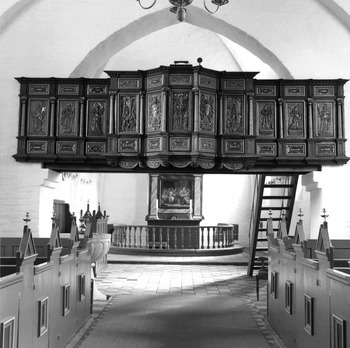
Altar and pulpit are conceptually tightly intertwined in the Lutheran Church. Being both liturgically and dogmatically connected, it is no wonder that we at times encounter these two pieces of furniture built into each other—a phenomenon which in Denmark belongs to the eighteenth century but which occurred much earlier in other parts of the Lutheran world.Footnote 37 For Martin Luther and the first reformers, the preached word was the primary way to reach Christ. This thinking had a direct impact on the furnishings of the church interiors. The predominate impulse for the early Lutheran reformers was to commission and install a regular pulpit in the southeastern corner of the nave, the conventional placing of the pulpit in Danish churches. Peder Palladius, the superintendent we have already touched upon, explains this in his visitation notes from the 1540s by stating that the pulpit signifies and manifests the spirit of Christ.Footnote 38 The superintendent furthermore writes: “The pulpit must not be an ambo or some other fabrication on the floor, but be erected well in the south side of the church, to celebrate and honor God's blessed word, and so that every man in the church can look his parish minister in the eye no matter where he is placed in the church, and so that no man blocks another's view, so that you all can hear and understand what concerns your salvation.”Footnote 39 The meaning invested into the pulpit is clear, but the hermeneutical connection between the preached word (pulpit) and the Eucharist (altar) could be stressed much more poignantly—as it indeed often was done during the brief period of our focus, the late sixteenth century. Throughout the Danish kingdom, we can record the presence of a new type of pulpit belonging to the group of so-called gallery pulpits, which are basically traditional pulpits integrated into an elevated podium placed in front of the chancel arch and reached by the pastor by means of a steep ladder (fig. 11).Footnote 40 Most of these gallery pulpits, installed during the last decades of the 1500s and the early 1600s, were quickly taken down again; by the middle of the seventeenth century, many had been converted into conventional pulpits. The reason for their quick dismantling was undoubtedly practical: they simply took up too much space in the nave. Poor accessibility to the podium could also have been a factor making traditional pulpits much more appealing to the pastors. Nevertheless, a few specimens are still extant and can be found in the churches of Ulfborg and Thise in northern Jutland, as well as in the church of Kropp in Scania, where we get an impression of how these installations dominated the interior space of the nave. In our context, it is essential that the pulpit physically became inserted between the congregation and the altar. When sitting in the church, facing the east, and hearing the sermon, the parishioners would simultaneously have both the preaching pastor and the partially revealed altar in sight through the chancel arch behind the gallery. And when the congregation took communion, they would literally go underneath the pulpit to reach the altar: that salvation was through the word could hardly be illustrated more obviously. The gallery pulpit was clearly developed from the medieval tradition for small and large liturgical galleries, but the gallery pulpit as such should still be considered an invention of the early Lutheran Church, inspired directly by the new role accredited to the status of the preached word.Footnote 41 These galleries, in other words, are an expression of a particular Lutheran ideal, a part of the vision of how to impress the Reformation's message to the congregation.
The gallery pulpit in Tise Church in northern Jutland, erected sometime during the last two decades of the sixteenth century. Photograph by E. Roing Holm, Antikvarisk-Topografisk Arkiv, The National Museum of Denmark.

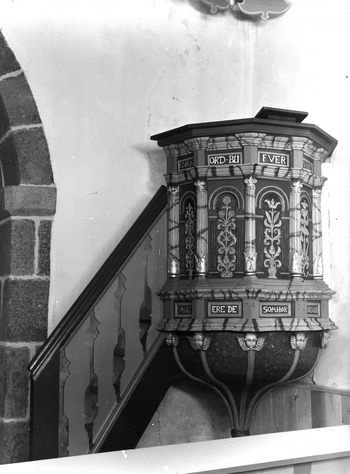
Indeed, a closer look at the pulpits from the period underscores just this function. The two most popular inscriptions on the pulpits from the second half of the 1500s are “Blessed are those who hear the word of God and preserve it” (Luke 11:28) and “The word of the Lord endureth forever” (1 Peter 1:25)—inscriptions found, for example, on the chairs in Ho and Kvong (fig. 12) near the town of Ribe in Jutland, both dating from 1587.Footnote 42 These texts can be understood as simple references to the pulpit as a place for the preaching ministry. But their meaning runs deeper than that; the messages identify one of the key tenets of Lutheran evangelical thinking as it was expressed in the first years after the Reformation. It made clear that it is through the preached word alone that salvation is achieved and, as expressed by the second quote from Peter, that everything apart from God's word is perishable. Or, to put it another way, no matter what the congregation might do, it is only the Bible that is able to establish a constant link to the afterlife.
The pulpit from Kvong Church in western Jutland, installed in 1587. Photograph in the Antikvarisk-Topografisk Arkiv, The National Museum of Denmark.

These two quotes did not retain their great popularity after 1600, when new texts were added to the repertoire and, to a certain extent, came to replace those mentioned above. Indeed, by following the development of the inscriptions on the pulpits, we get a sense of the growing self-assurance of the Church, no longer touched by the critical acuteness of the sixteenth century where the evangelical reformation was much more volatile.Footnote 43 The gallery pulpits and the pulpit inscriptions, like those from Ho and Kvong, thus gives us a glimpse into one of the ways the Church and the role of the church in the community was understood during the first decades after the Reformation.
VI. The Shock of the New
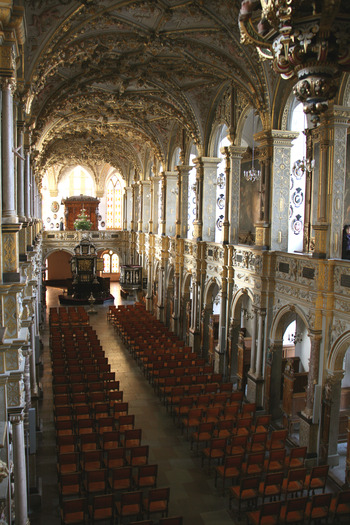
How can we interpret all of this? While keeping the small studies presented above in mind, we must now return to the initial ambition of this article and ask how all of this affected church interiors of the late sixteenth century. As already mentioned, we cannot generalize on this and say that these changes always transformed the church interior into something new. Yet, it still seems possible to argue that, in the places where the Reformation's ideals were taken to heart and followed up closely, things did indeed change radically—not only in the use and understanding of the churches but also visually. What thus should be taken from these studies is basically the radical new aesthetic that, in Denmark as elsewhere within the Lutheran sphere, grew out of the Reformation.Footnote 44 It is easy to lose track of the actual changes taking place in the churches because so much of these were a reshuffling of the existing furnishings with only a few new additions. When looking at those few church interiors of the sixteenth century that indeed were completely transformed, however, it becomes clear that, when the means and the will coincided, the Lutheran church interior did indeed become something very different. Furthermore, these new interiors followed a clearly defined aesthetic developed in correspondence with the beliefs and optimism of the early evangelical theology. The prime mover promulgating these ideals was the Crown—in particular Frederik II (1559–1588) and his successor Christian IV (1588–1648). The best extant example of this is the palace chapel in Frederiksborg Castle, finished in 1617, where texts and lavish architecture unite Renaissance splendor and Lutheran thinking. The inspiration for this style came directly from the princely chapels of Saxony (fig. 13).Footnote 45 This royal approach to church furnishing resounded like an echo into the upper strata of society, and from there further into parishes throughout the realm. A select number of houses of worship in the possession of the men closest to the king thus followed the monarch's choice of decorations according to the pattern he had set in his palace chapels. In these places, a radical break—in line with what has been discussed concerning altars and pulpits—can be documented. The result was a turn away from traditional styles and strategies behind church decorations which had been employed since the Middle Ages. In these churches (fig. 14), images were not a crucial part of the ornamentation. Rather, the word in the shape of embellished calligraphy was the dominant visual feature.
The magnificent palace chapel of Frederiksborg Castle on the island of Zealand, built between 1608 and 1617 by King Christian IV. Photograph by the author.

The interior of the rural parish church of Tøstrup in eastern Jutland, with inscriptions in Latin and Danish written in the vaults, painted in 1582. Photograph by the author.

By furnishing and decorating his palace chapels in the style of the German chapels, the king was able to display himself as a true Lutheran monarch and a protector of the Reformation, and by modeling their churches on those of the king, the Danish nobility were able to not only express their religious convictions but also show their allegiance to the monarch. In that sense, faith and political power intermingled, and to some degree made the reformers’ vision for proper church adornments into an elitist expression. This could also go some way to show why these distinct decorations remained within a closed circle of the highest members of society and never became wholly approximated in ordinary parish churches without close ties to the inner circle of power. Church interiors, such as Tøstrup in East Jutland and Svindinge on Funen, stand out as expressions of a privileged culture not necessarily meant to be disseminated into the broad public. This demonstrates the dangers of holding too firmly to the notion that the textual decorations examined in this article had the education of the peasantry as their primary purpose. In desisting from the use of images and relying solely on the written word, it was possible for the king and his close circle to demonstrate their deep understanding of the evangelical message and show that they did not need spiritual crutches (like pictures) in order to understand God's word. Further, by utilizing text as the dominant vehicle for communication, they were able to point to the exact passages from scripture, for instance, where their evangelical identity was most clearly portrayed.
However, as we have seen, one of the few features which came to transcend this exclusive social sphere early on was the text retable. Knowing that these objects likely only played a rare part in the direct educational tasks of the parish clerk and could only serve to help ministers lacking liturgical books to a limited extent, retables are best understood along the lines of the large-scale church decorations of the monarch and his men.Footnote 46 They express core ideas in Lutheran theology and serve to signal the local communities’ allegiance to the Reformation and the king. Given the interest shown by the nobility and high-ranking clergy in donating such retables to rural churches, it seems feasible to interpret these altarpieces as a relatively cheap or manageable way to express sympathies with and consent to the ideology of the monarch and his church. Thus, without extensive remodeling or having the entire church rebuilt, a locally produced altarpiece with quotes from Luther's Small Catechism, for instance, and adorned with the king's monogram on the top piece could be understood to express exactly the same ideas as an entire large royal chapel.
It is difficult to estimate the period of time in which text as a decorative feature could be understood to have the connotations implied here. The trend was still alive in 1617, when Frederiksborg Castle and palace chapel were finished. However, as we have also seen, major shifts in the attitude toward images, and indeed materiality in general, took place during the first part of the seventeenth century. The church furnishing of the so-called period of Lutheran orthodoxy openly embraced images and material splendor on a level not seen during the previous century, and by then the trends discussed here apparently had little attraction. Material richness became part of the stylistic vocabulary of church art and architecture, and while writing remained an important feature, images and sculptures gradually reclaimed their position as dominant visual components of the church interiors.
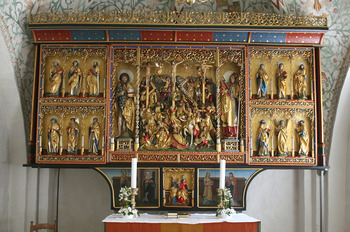
The use of the Word as the primary vehicle in new decorative schemes clearly came with specific understandings about worship and the role of the church interior, but this ornamental writing was always framed, and this framing must be considered in order to fully appreciate the impact these word-decorations held when at their peak of popularity. It has thus often been noted how the Reformation and Renaissance trends coincide in northern Europe and it is argued that these trends become hard to separate, implying that it is difficult to say what affected the one and the other.Footnote 47 And indeed it can be difficult to discern. Nevertheless, the dramatic, rapid transition of styles from the sprawling late Gothic tracery and croquets to the stern, tight composition of the early Renaissance is strikingly clear, and it seems fair to say that such a distinct change of style had not happened for centuries in Danish churches (fig. 15–16). Without a doubt the initial experience of the new furnishings, with all their trappings from antique architecture, would have produced a strong, if not also slightly alien, impression. At least, this is what we must believe when trying to understand how such a drastic change in the stylistic vocabulary would affect the contemporary churchgoer during the late 1500s.
The impressive pentaptych from Løjt in North Schleswig, Jutland, by inscription dating from 1520. Photograph by the author.

The retable from Marslev Church on the island of Funen, dating from 1592. Photograph by Arnold Mikkelsen, Antikvarisk-Topografisk Arkiv, The National Museum of Denmark.

While the question of fashion was certainly also a factor, the above discussion of the use of ornate writing in church decoration reveals the deliberate way in which the elite, particularly, used this specific type of decoration to express their role and allegiance. The style of the early Renaissance, embraced wholeheartedly by the young Lutheran Church, can similarly be understood as carrying specific connotations that the reformers wanted to convey to the churchgoers as well as themselves. By employing this style, with all its allusions to antiquity, the reformers (or those who ordered the new church furnishings) embedded themselves firmly within the circles of the humanists with all that came with this in regards to references to learnedness, Bible studies, and, first and foremost, a direct contact with the early church and the biblical universe. The architecture of the churches thus almost exclusively remained frozen in the late Gothic style,Footnote 48 but in light of the choice to abandon the old Gothic interior of the churches and replace it with objects and fittings in the style of the Renaissance trends that were sweeping across northern Europe during the latter part of the sixteenth century, it seems fair to argue that the new style was chosen not only because it was in vogue, but because it connoted something.Footnote 49 It conveyed a message about a new start, a new Church, and a new regime. And it seems plausible that this fact contributed to the haste with which the new style gained popularity. By using it, one not only was in tune with the times, but also signaled to the churchgoer that proper evangelical Protestants worshipped here.
Interestingly, we can note how the Renaissance style was something which was shared by Protestants in general and Catholics alike, and thus not something particularly Lutheran. This is without a doubt to be credited to the prestige that all confessions attached to being in contact with the ancient church and the ideals made more or less commonplace by the humanists. Within a wider European context, in other words, this choice of style lost its specific connotations as it was absorbed into the shared stylistic vocabulary of art and architecture of the early modern period. For a period during the last decades of the sixteenth century, however, this was not so. Here the style must have been identified as something radical and new and thus a visual extension of the reformation process of the churches. Lutherans, Calvinists, and Catholics in northern Europe could all more or less utilize the same style within their respective confessional camps, and yet each read this new style as something which uniquely expressed their reform and renewal.
When thinking about the impact of the Reformation on the church interior, we therefore have to take this general change in style into serious consideration as something that quickly came to transform almost all types of furnishings. The new objects in the churches simply looked strikingly different, and this phenomenological experience of a new space with new rituals and new practices—albeit mostly in old houses—must have been one of the most immediate indications of change regarding church buildings and their furnishings after the Reformation. This sense of newness could not last and the style of the early Reformation also quickly lost its potency, gradually transforming into the rich vocabulary of the Baroque and Lutheran orthodoxy. Theologians of the seventeenth century saw the church building and the church decorations as heuristic tools supporting the message communicated from the pulpit. In that sense, Lutheran orthodoxy explored a side of the arts which had always existed within the Christian tradition, but at the same time enabled the possibility of reading materials and objects as representing or containing a meaning which transcended their function or formal appearance. Thus, we find a return of full-blown expressions of splendor. Gold and abundant decorations shroud the church interiors like rich draperies in such a manner as to seemingly state something concerning the relation between the richness of the church building and the evangelical faith (fig. 17).Footnote 50 Furthermore, these decorations and features are styled to target and engage the beholder, to lead the gaze skywards or to draw in the spectator—all of which has given rise to notions about the theatricality or performativity of Baroque art.
The Interior of Gunderslev Church on Zealand. Here the workshop of Abel Schrøder the Younger delivered the altarpiece, crucifix, chancel arch grille, and pulpit around the middle of the 1600s in rich Baroque style. Photograph by the author.

VII. The Comfort of the Old
With the possibility for radical change in the air during the last decades of the sixteenth century, we must ask ourselves why this change rarely involved whole church buildings and mostly appeared in the guise of individual pieces or scattered decorations. In 1997, Johann Michael Fritz published an anthology entitled Die bewahrende Kraft des Luthertums, a volume focusing on the quantity of pre-Reformation furnishings and liturgical equipment that remained, and has continued to remain, in Lutheran churches.Footnote 51 This perspective is indeed relevant to bring forth,Footnote 52 as it quickly becomes obvious to anyone working with church interiors that Lutheran churches often hold quite a lot of medieval furnishings and often contain items or furniture pieces that long ago disappeared from Catholic churches. Indeed, there seems to have been a certain attraction to retaining existing furnishings in Lutheran church spaces that runs counter to the situations described above.
On the one hand, there was a trend of radical renewal that brought a completely new aesthetic to the church interior. On the other hand, this trend was superseded by a far more cautious approach, which in the long run prevailed into the eighteenth century when new, radical visions again challenged old decorations and furnishings. Accordingly, it is easy to point out continuities across the confessional changes of the sixteenth century. And a closer look at the church interior in its composite character shows that it is misguided to generally envision the late medieval Catholic and early modern Lutheran church spaces as two fundamentally different rooms. Martin Luther pinpoints this fact in a letter from 1541 to the Chancellor of Saxony: “It is, praise God, so [hard] to recognize our churches in matters indifferent, that a layperson or a foreigner or Spaniard, who could not understand our sermons, were he to see our Mass, choir, organs, bells, pictures, etc., he would have to say, this was a true popish church with no distinction [to be made].”Footnote 53 In other words, to Luther the church interior was so similar to the Catholic interior that one would be unable to discern to which confession it belonged on the basis of the furnishing and ceremony of Mass. The statement is intriguing in so far as it once again reminds us of Luther's very open and tolerant attitude toward the material aspects of the Church. As we have seen, however, this attitude clashes with the many alterations of these material aspects that took place with reference to Luther's writings. Removing altarpieces from the side altars and placing them on the walls elsewhere in the church while the altars themselves were broken down, as superintendent Peder Palladius suggests in the 1540s, must unquestionably have greatly affected the impression of the church.Footnote 54 However, Luther wrote the letter in 1541, when it was not yet possible to identify any “Lutheran” or “Protestant tradition” and one could even argue that even the “Catholic” identity had not yet developed. The reception of the Reformation and the long process of translating the new theological thoughts into tangible, parochial everyday life had only just begun. Many doubts and conflicting views can be gleaned from the sources and these are a clear expression of the uncertainty and the difficulties that the evangelical clergy faced in envisioning ideals transformed into practice. In other words, Luther would hardly have been able to imagine the extent to which the thoughts he had sparked came to impact on the church interior despite his own conservative viewpoint.
Only one year after Luther wrote his above quoted letter, the evangelical church ordinance of Schleswig-Holstein was finished. In the introduction, King Christian III (1534–1559) defines the reason behind the ordinance as follows:
In order that we may not be unthankful for this unspeakable grace of God, and that we and our ancestral territories may not be found hereafter to be in such a deplorable state of unholy disorder, we have resolved with God's grace in collaboration with our councils and our territorial estates to issue a Christian Church Ordinance in accordance with God's Word and Christ's commandment, not to establish anything new—God prevent us from that.Footnote 55
The last line is striking: “Not to establish anything new—God prevent us from that.” Here we encounter the anxious concern to remain in contact with tradition, and to keep the Church recognizable. Yet, tradition, as it is presented here, is by no means to be seen as a direct expression of respect or veneration for the previous practices, but instead as an adherence to a notion of the early church and its virtues. The ordinance of Schleswig-Holstein does not attempt to retain contact with the pre-Reformation Church and its demands on space and ceremony in general, but to establish an allegiance with a glorified ancient past.
The conservative voices among the first generation of Lutheran reformers always emphasized this dimension of tradition and thereby ensured that features such as the altar, baptismal font, images, and church buildings were mostly retained. At the same time, these thoughts are to be considered against the radical, if not aggressive, drive from the group of theologians who sought to combat anything which seemed to belong to previous Catholic practices, thus attacking the material fabric of the Church and arguing for a dramatic reshaping of the church space. If voices such as these had been generally followed, the effect on the church interior would certainly have been profound. As it has been argued here, however, their success was apparently only moderate, in so far as they did not succeed in sweeping out all of the old and filling the churches with letters and fittings in classical style.
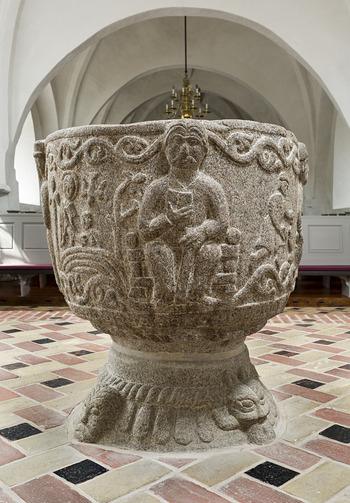
The baptismal font is an interesting object to bring into the discussion here as it contradicts the trends discussed above regarding both altarpieces and pulpits. Baptismal fonts were only rarely replaced in village churches, where the often-Romanesque granite font had been allowed to remain since the early Middle Ages, and where they often still remain today (fig. 18). Notably, this also holds true for those churches in which everything else had been remodeled. Undoubtedly, this is due to the fact that, while the actions and words during of baptismal rite were changed superficially by the Reformation, the role of baptism itself remained stable and was still interpreted as the formal entrance into the Church and the community of Christians at large.Footnote 56 The font was thus a central place in the congregation's collective memory because it, so to speak, tied all parishioners together and pointed backward through time to the construction of the very church building in which the font was standing. It was a kind of lifeline, linking the new Lutheran Church with the past as well as all the future generations that would be baptized in the bowl. Already Luther was conscious of the importance of the font as what we in a modern terminology would call a “lieu de mémoire” when, in his sermon on baptism from 1534, he expressed the hope that people in the future would understand and heed the font with the utmost respect precisely because of the abovementioned arguments.Footnote 57
The Romanesque baptismal font from Nørre Lyndelse Church on Funen. Photograph by Arnold Mikkelsen, The National Museum of Denmark.

When we therefore still see the medieval fonts in churches, it is the result of an active choice from the earliest time after the Reformation that aimed to keep the font rather than replace it with a new one, which like altarpieces could have been adorned with inscriptions that clearly underlined the Lutheran understanding of baptism. In that sense, the baptismal font becomes a symbol of the conservative trend embedded within Lutheran thinking and, as such, stands opposite that of the text retables, which represent the newness also contained in the evangelical church reform. These conservative and radical theological tendencies wrestled and the result was different from church to church. Each of them was shaped by different situations and means, making it very hard to define or describe a typical church interior. We can point out some overarching trends that may have influenced the churches in general, but when we look at the individual buildings, the impact becomes less apparent.
VIII. Concluding Remarks
We can, as initially mentioned, no longer today completely reconstruct the church interior as it was in the years immediately after the Reformation. The traces in each individual church are quite different, partly because posterity has blurred the impression by refurbishments and replacements. Nonetheless, it is possible to describe certain factors which shaped the interior space. The simple early Renaissance style that characterized the first furnishings and first painted ornaments was popular in Lutheran circles because it fused a new aesthetic with learned culture and humanism, both of which were trends that came together in the reformatory movements of the 1500s. The style signaled a different type of learning than the late Gothic style that had prevailed before the Reformation. Society moved on, however, and the church and the Renaissance idiom were transformed into Baroque sentiments, which fused with new opinions and meanings. And so it continues.
The preserved furniture from the last part of the 1500s is thus left to us today as rare relics from the early Lutheran Church universe—a universe we now see only in fragments. By putting these many fragments together, however, it becomes possible to reconstruct an ideal church interior, an exceedingly rare thing in its own time, but clearly something that at least some of the reformers strove for and attempted to realize in the parish churches. The impact of the Lutheran Reformation on church interiors in Denmark is a difficult question to answer; the Reformation had its impact on many levels and with varying degrees of force and success. Addressing the ideals presented in this essay, however, offers a vantage point from which the impulses spurring the many small changes we see in church interiors can be understood or interpreted. Only a few churches fully expressed the radical ideals of the day, but almost no church was left untouched by them in some way. The final location of each church interior on the spectrum between ideals and pragmatism differed, but perhaps this is of lesser importance, as long as we understand where both the ideals and conservative impulses came from and what they represented.