Introduction
Childhood sexual abuse (CSA) is a public health concern. Studies in developed countries have estimated that about 30% of girls and 15% of boys experience some form of sexual abuse during their childhood, while penetrative sexual abuse would range from 5–10% for girls and 1–5% for boys (Gilbert et al., Reference Gilbert, Widom, Browne, Fergusson, Webb and Janson2009).
Overall, clinical and community studies are consistent in suggesting that a history of CSA has a wide negative impact on mental and physical health. Adults who reported CSA are more likely to have negative mental health outcomes, such as depression (Molnar et al., Reference Molnar, Buka and Kessler2001; Barrett et al., Reference Barrett, Kamiya and Sullivan2014), post-traumatic stress disorder (Green et al., Reference Green2010), and anxiety disorder (Chen et al., Reference Chen2010). CSA has been also associated with negative perceptions of overall health (Chartier et al., Reference Chartier, Walker and Naimark2007), cardiovascular disease risk factors (Rich-Edwards et al., Reference Rich-Edwards2012), and higher somatization symptoms (Irish et al., Reference Irish, Kobayashi and Delahanty2010) such as gastrointestinal disorders, pain and pain disorders, pulmonary symptoms, and substance abuse and suicide attempts (Molnar et al., Reference Molnar, Buka and Kessler2001; Chen et al., Reference Chen2010). However, the association at population level is less clear and the long-term effects of CSA in older age groups have not been reported yet in a nationally representative study. To our knowledge, only three studies have used a nationally representative data to address the impact of CSA and health at population level. The first two studies were conducted by Goodwin and Stein (Reference Goodwin and Stein2004) and Molnar and colleagues (Reference Molnar, Buka and Kessler2001), and used the National Co-morbidity Survey, a population study with 8,098 participants in the United States. Goodwin and Stein (Reference Goodwin and Stein2004) reported an association between CSA and lung disease and cardiac disease among adults aged 15 to 54 years. Using the same data source, Molnar et al. (Reference Molnar, Buka and Kessler2001) found that those who reported CSA are more likely to experience lifetime depression, anxiety disorders, or substance abuse than those not reporting CSA (Molnar et al., Reference Molnar, Buka and Kessler2001). The third study (Najman et al., Reference Najman, Nguyen and Boyle2007) examined the association between CSA and subsequent health among 1,784 participants in the Australian National Study of Health, Intimacy and Social Relations. In this study, Nejman and colleagues (Reference Najman, Nguyen and Boyle2007) found that CSA was associated with lower mean value in almost all the areas of physical and mental health, as well as in social relationships and overall functioning measured by the 36-Item Short-Form Health Survey (SF-36) questionnaire. However, a wide range of objective and self-reported physical health measures were not included in these studies, and these are warranted. More recently, Rich-Edwards and colleagues (Reference Rich-Edwards2012), using the Nurses’ Health Study, found that physical and sexual abuse in childhood were prevalent risk for early adult cardiovascular disease in women.
It is known that children who experienced traumatic events or have a history of abuse and maltreatment have shown abnormalities in the regulation of the hypothalamic–pituitary–adrenal (HPA) axis – the main neuroendocrine stress response system (Rich-Edwards et al., Reference Rich-Edwards2012). The HPA dysregulation can increase susceptibility to developing autoimmune disease, mood disorders, chronic fatigue, obesity, fibromyalgia, and cardiovascular risk factors such as increased heart rate, postural hypotension, and glucose dysregulation (Guilliams and Edwards, Reference Guilliams and Edwards2010). The aim of this study is to examine the association between CSA and mental and physical health, especially with conditions related to HPA axis dysfunction, such as mood disorders (depression, anxiety, worry, loneliness, and quality of life), cardiovascular disorders (hypertension, pulse wave velocity, Body Mass Index (BMI), low-density lipoprotein (LDL), and total cholesterol), gastrointestinal disorders, pain disorders, and measures of frailty and functional mobility (grip strength and the timed-up-and-go (TUG)). In addition, we examined the impact of CSA on self-reported health, a wide range of self-reported and doctor-diagnosed disease and disorders and healthcare utilization. To our knowledge, this is the first study to report nationally representative data on CSA together with comprehensive information of childhood adversity, and objective measures of mental and physical health at older ages.
We found that CSA has a long-term impact on mental health (depressive symptoms, anxiety, worry, loneliness and quality of life), self-reported health, and several chronic diseases such as lung disease, arthritis, peptic ulcer, chronic pain, and cholesterol levels. Furthermore, those who reported CSA were more likely to report doctor and hospital visits than those without a history of CSA.
Methods
Study population
Data from the first wave of the Irish Longitudinal Study on Ageing (TILDA) was used. TILDA is a nationally representative dataset of 8,178 Irish adults aged 50 years and over.
The sampling frame is the Irish Geodirectory, a comprehensive listing of all residential addresses in Ireland compiled by the Irish Postal Service and Ordinance Survey Ireland. An initial, multi-stage probability sample of addresses was chosen using the RANSAM sampling procedure, developed by the Economic and Social Research Institute. All household residents aged 50 years and over and their spouses/partners (of any age) were eligible to participate in the study.
The fieldwork for Wave 1 was completed between late 2009 and mid-2011. There are three components of the study: (1) A home-based, computer-assisted personal interview (CAPI); (2) a self-completion questionnaire (SCQ); and (3) a health assessment carried out by nurses in one of the two health centers. In the event that respondents were unable or unwilling to attend a health center, they were offered a modified health assessment in their home. The overall response rate was 62% (N = 8,504). Of these, 85% returned the self-completion questionnaire (N = 7,191) and 72% participated in the health assessment (N = 5,897) – 5,036 (62%) underwent the health centre assessment. Venous blood was drawn in 5,865 participants (69%). Differences were minimal between the overall sample and the subgroup of people who completed the self-completion questionnaire and health assessment on age and gender variables. However, those who completed the SCQ and health assessment were more educated and reported better self-reported health.
In order to account for non-response to the self-completion questionnaire and health assessment, weights were used, which aimed at reducing any bias arising from differential non-response. Details on the calculations of weights are presented in the TILDA technical report. Full approval for the study was obtained from the institutional ethics committee, and all procedures adhered to the tenets of the Helsinki Declaration, 1983.
Measures
In examining the association between CSA and health, it is necessary to control for confounders, as CSA often co-occurs with other adverse childhood and family conditions, such as physical abuse, parental substance abuse problem, and marital disruption (Danese et al., Reference Danese, Pariante, Caspi, Taylor and Poulton2007). These adverse childhood conditions are also associated with negative impact on mental and physical health of children and young adults (Fergusson et al., Reference Fergusson, Horwood and Woodward2000). Therefore, if CSA is an independent factor for poor health outcomes, the association between CSA and health outcomes should still be significant after controlling for these confounders. Specifically, the model controls for demographic factors (gender, age, education, and marital status), childhood adversities (parental substance abuse problems, childhood physical abuse by parents and others), father's education (proxy for childhood socio-economic status), and behavioral factors (smoking status and alcohol problems).
Childhood sexual abuse
Respondents were asked the following two questions on CSA as part of a stressful life events inventory in the SCQ: (i) “Before you were 18 years old, were you ever sexually abused by either of your parents?,” and (ii) “Before you were 18 years old, were you ever sexually abused by anyone other than your parents?” For each event, respondents were asked to indicate whether the event occurred (“yes” or “no”), and the year in which the event occurred most recently. If participants responded “yes” to either of these questions, they were given 1 for the CSA dummy variable and zero (0) if they replied “no” or left items unanswered. The missing item response for these questions was below 2%. For the present study, the α-reliability coefficient was 0.79.
Mental health
Anxiety was assessed by the Hospital Anxiety Depression Scale – the anxiety subscale (HADS-A). Depressive symptoms were assessed by the 20-item Center for Epidemiologic Studies Depression Scale (CES-D). Worry was assessed by The Penn State Worry Questionnaire. Loneliness was assessed using five items from the University of California – Los Angeles (UCLA) scale. Quality of life was assessed by CASP-19, an index based on 19 Likert scale items spanning the following four theoretically derived dimensions of quality of life in early old age: control, autonomy, self-realization, and pleasure.
Self-reported health and doctor-diagnosed diseases
In the computer-assisted interview, participants were asked to rate their health as “poor,” “fair,” “good,” or “excellent.” They were also asked to report diseases or disorders previously diagnosed by a doctor, i.e. “Has a doctor ever told you that you have high blood pressure/angina/a heart attack/congestive heart failure/an abnormal heart rhythm/diabetes/a stroke/transient ischemic attack/chronic lung disease/asthma/arthritis/osteoporosis/cancer/Alzheimer's disease/stomach ulcers/varicose ulcers/liver damage?” Participants who reported pain were asked whether the pain was in the back, hips, knee, feet, mouth, or “all over the body.” If participants responded “yes” to either of these questions, they were given 1 for the CSA dummy variable and zero if they replied “no” or left items unanswered.
Objective physical health outcomes
Objective measures of physical health were assessed in the health assessment, and included measures of cardiovascular disease, frailty, and mobility. Hypertension is defined as systolic blood pressure (SBP) and diastolic blood pressure (DBP) ≥ 140/90 mmHg or SBP ≥ 140 (isolated systolic hypertension) or using hypertensive medication. Blood pressure was recorded as the average of two seated readings followed by one standing reading (OMRON™ digital automatic BP monitor, Hoofddorp, The Netherlands). Two readings of pulse wave velocity (speed of impulse from carotid to femoral artery) were recorded and the mean of these readings was calculated (Vicorder, Skidmore Medical Limited, Bristol, UK). Total cholesterol and LDL were taken by non-fasting samples. BMI was calculated by weight (in kilograms) divided by height (in meters squared). Weight was recorded once (SECA electronic floor scales, Birmingham, United Kingdom) and height was recorded once (SECA 240 wall-mounted measuring rod, Birmingham, United Kingdom). Grip strength was recorded from the mean of two measures of handgrip strength from the dominant hand (Baseline Hydraulic Hand dynamometer, Fabrication Enterprises Ltd., White Plains, New York, USA). For TUG measure, participants were timed standing up on an arm chair (seat height 46 cm), walking for three meters at normal pace, and returning back to chair.
Childhood adversity:
Data on the presence of other forms of childhood adversity were collected via the Stressful Life Events inventory. These variables included parental substance abuse, childhood physical abuse by parents, and physical abuse by others. Childhood physical abuse was ascertained from the following two questions: (i) “Before you were 18 years old, were you ever physically abused by either of your parents?,” and (ii) “Before you were 18 years old, were you ever physically abused by anyone other than your parents?” Parental substance abuse was asked in the following question: “Before you were 18 years old, did either of your parents drink or use drugs so often that it caused problems in the family? Father's education was used as a proxy for childhood socio-economic status.
Behavioral health
Smoking status was categorized as never smoked, current, or past smoker. The four-item CAGE (scale for identifying alcoholism on the basis of perceived need to cut down drinking; detecting other people's annoyance at own drinking habits; feeling guilty about drinking; and needing an eye-opener drink in the morning to get rid of a hangover) questionnaire was used to screen for excessive alcohol consumption – a score of 2 or greater indicates a drinking problem (sensitivity of 74% and specificity of 91%; Buchsbaum et al., Reference Buchsbaum, Buchanan, Centor, Schnoll and Lawton1991).
Healthcare utilization
Four types of healthcare utilization (number of visits in the past 12 months to general practitioner, emergency room, hospital out-patient use, and admission to hospital overnight) were combined as a single score for this variable.
Statistical methods
Ordinary least squares models for continuous outcomes, logistic regression for binary outcomes, and Poisson regression model for count outcome were used to examine the association between CSA and each health outcome.
Questions that require retrospective recall, such as CSA, may be subject to under-reporting bias or reporting selection bias. To test for the selection effect in reporting CSA, propensity score 1-to-1 matched (with no-replacement) was used as an additional method to examine the robustness of the regression model. The propensity score is defined as “the probability that a unit in the combined sample of treated and untreated units receives the treatment, given a set of observed variables” (Heinrich et al., Reference Heinrich, Maffioli and Vázquez2010). Successful matching can reduce bias introduced by systematic differences between those who reported and did not report CSA. A user-supplied routine in Stata, PSMATCH2, was used to perform the nearest neighbor propensity score matching (Leuven and Sianesi, Reference Leuven and Sianesi2003). Sampling weights and design effect adjustments were incorporated in the analysis.
Results
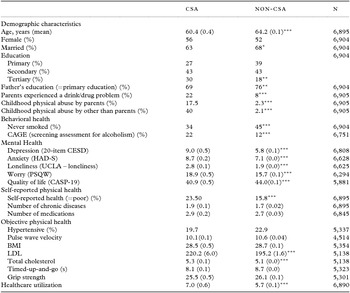
Estimated prevalence of CSA is reported in Table 1. The overall prevalence was 6.6%; higher for females (7.1% vs. 5.9%; p < 0.001). The prevalence of CSA declined by age group from 8.1% in those aged 50–64 years to 5.8% in those aged 65–74 years to 2.1% in those aged 75 years and over. Reported sexual abuse by people other than parents was more common than by parents. The prevalence of reported CSA in the current study was consistent with reported rates of 7% of severe abuse (i.e. attempt to penetrative abuse) among respondents aged 50 years and over in a sample of 3,000 adults aged 18 years and over in a different study in Ireland (McGee et al., Reference McGee, Garavan, Byrne, O’Higgins and Conroy2010), indicating that those reporting CSA in TILDA may have experienced a variety of severe forms of abuse.
Prevalence of childhood sexual abuse (CSA)

Note: Sample: 7,155, self-completion questionnaire (response rate 83%).
Descriptive statistics for all variables used in the analysis for CSA participants and those who did not report CSA are detailed in Table 2. Pearson χ 2 analysis was used to compare the distribution of CSA variable (CSA and non-CSA) across levels of related socio-economic, physical, and mental health variables. Almost all control variables differed for CSA cases. Those who reported CSA were more likely to be younger, less likely to be married, more likely to be divorced, and more likely to have a tertiary degree of education. The most notable differences were evident for childhood physical abuse. Physical abuse was much higher for CSA cases: 17% reported childhood physical abuse by parents (vs. 2.3%), and 40% reported childhood physical abuse by people other than parents (vs. 2.1%). Parental substance abuse was more frequent for CSA cases (22%) than non-CSA (8%). Turning to dependent variables, those who reported CSA had significantly higher mean scores on anxiety, depressive symptoms, worry, loneliness, and lower scores in quality of life, indicating negative mental health outcomes. They also reported poor self-reported health and had higher mean scores of the number of doctor-diagnosed chronic diseases and healthcare utilization. Statistically, significant difference was found in total cholesterol and LDL levels but not in hypertension, pulse wave velocity, BMI, TUG measure, and grip strength among those who reported CSA and not.
Descriptive statistics

Notes: *p < 0.05, **p < 0.01, ***p < 0.001.
Standard errors are in parentheses.
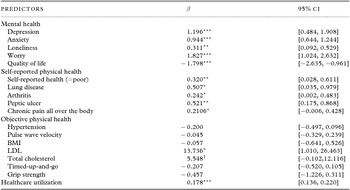
Table 3 presents regression analyses examining the association of CSA with mental health, self-reported health, doctor-diagnosed chronic diseases, total cholesterol, and LDL, controlling for aforementioned confounders. CSA had a significant negative impact on depressive symptoms (β = 1.196; 95% CI: 0.484, 1.908), anxiety (β = 0.944; 95% CI: 0.644, 1.244), loneliness (β = 0.311; 95% CI: 0.092, 0.529), worry (β = 1.827; 95% CI: 1.024, 2.632), and quality of life (β = −1.798; 95% CI: −2.635, −0.961). On self-reported health and doctor-diagnosed chronic diseases, coefficients were transformed in odds ratio and only statistically significant results are presented. A positive significant association was found between CSA and poor self-reported health (odds ratio (OR) = 1.38; 95% CI: 1.028, 1.843), lung disease (OR = 1.66; 95% CI: 1.035–2.662), arthritis (OR = 1.27; 95% CI: 1.002–1.620), peptic ulcer (OR = 1.68; 95% CI: 1.191–2.382), and chronic pain all over the body (OR = 1.23; 95% CI: 0.999–1.534). Since these measures were self-reported, one possible explanation of the observed association is that these conditions were mediated by depression and anxiety (Henningsen et al., Reference Henningsen, Zimmermann and Sattel2003). To test this hypothesis, we ran the logistic regression, including depression and anxiety covariates in the model adjusted for other covariates as detailed. Chronic pain all over the body and lung disease were not significant, while peptic ulcer (OR = 1.54, p < 0.01) and arthritis (OR = 1.26, p < 0.05) were significant for those who reported CSA. On objective measures of health, high levels of total cholesterol (β = 5.548; 95% CI: −0.102, 12.116) and LDL (β = 13.736; 95% CI: −1.010; 26.463) were associated with CSA. However, no statistically significant association was found between CSA and hypertension, pulse wave velocity, BMI, TUG measure, and grip strength.
Ordinary least square, logit, and Poisson regression for CSA as a predictor of health outcomes

Notes: Adjusted for gender, age, education, marital status, living alone, smoking, alcohol problems, parental substance use, childhood physical abuse by parents, childhood physical abuse by other than parents, and father's education (proxy for childhood socio-economic status).
†p < 0.1, *p < 0.05, **p < 0.01, ***p < 0.001.
Association between CSA and healthcare utilization was also observed. Those who reported CSA had on average 20% (p < 0.001) more visits to healthcare professionals compared with those who did not report CSA.
The likelihood ratio (LR) test and Wald test were performed for all the regressions in Table 3. The LR and Wald tests are commonly used to evaluate the difference between nested models. One model is considered nested in another if the first model can be generated by imposing restrictions on the parameters of the second. In a regression model, restricting the parameters to zero is accomplished by removing predictor variables from the model. For the current study, the results from the LR and Wald tests showed that adding family environment variables (i.e. parental substance abuse, childhood physical abuse by parents and others) as a predictor together (not just individually) resulted in a statistically significant improvement in model's fit. For example, for regression on depression, comparing the two models (with and without predictors of family environment), the test statistic was 52.433 and the associated p-value was very low (less than 0.001), showing that the full model fits better than the restricted model.
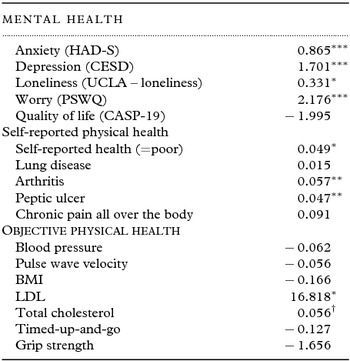
Results from the propensity matching analyses were similar to those from the ordinal least square, logistic, and regression models (Table 4), indicating that selection bias is minimal and did not influence the results.
PSM estimates (nearest neighbor)

Notes: †p < 0.1, *p < 0.05, **p < 0.01, ***p < 0.001.
Adjusted for gender, age, education, marital status, living alone, smoking, alcohol problem, parental substance use, childhood physical abuse by parents, childhood physical abuse by other than parents, and father's education (proxy for childhood socio-economic status).
Discussion
Childhood sexual abuse has long-term adverse effects that carry over into adulthood (Johnson, Reference Johnson2004; Barret et al. Reference Barrett, Kamiya and Sullivan2014). However, there are little nationally representative data on the long-term consequences of CSA, especially in later adult life (Romansa et al., Reference Romans, Belaise, Martin, Morris and Raffi2002; Kendall-Tackett, Reference Kendall-Tackett2009). To our knowledge, this is one of the few nationally representative studies examining the long-term impact of CSA and the first to report the effects of CSA in older age. We found that CSA was associated with depression, anxiety, worry, loneliness, and poor quality of life. The results of our study support previous findings of a strong relationship between CSA and mental health outcomes (Molnar et al., Reference Molnar, Buka and Kessler2001; Romans et al., Reference Romans, Belaise, Martin, Morris and Raffi2002). CSA was also associated with poor self-rated health, and several chronic diseases such as lung disease, arthritis, peptic ulcer, and chronic pain all over the body. These findings are consistent with the results from three population studies (Felitti et al., Reference Felitti1998; Goodwin and Stein, Reference Goodwin and Stein2004; Chartier et al., Reference Chartier, Walker and Naimark2007), suggesting that CSA might have some specificity to particular physical disorders instead of a range of physical health problems. CSA was also associated with cardiovascular disease risk factors such as high levels of total cholesterol and LDL. Further, those who reported CSA report more doctor and hospital visits than those without a history of CSA, which is also consistent with previous studies (Newman et al., Reference Newman2000; Chartier et al., Reference Chartier, Walker and Naimark2007).
Several possible mechanisms link CSA and health. Prior studies suggest that childhood abuse is associated with HPA axis dysregulation in adulthood, which can result in hypocorticolism (Cole and Putnam, Reference Cole and Putnam1992). Children with a history of CSA present higher levels of cortisol subsequent to the period of abuse and lower levels of cortisol by early adulthood. This has been proposed to represent an adaptive response to chronic stress (Trickett et al., Reference Trickett, Noll, Susman, Shenk and Putnam2010). Accordingly, we did not find difference in some of the measures of cardiovascular and functional mobility, possibly due to the adaptive response (Trickett et al., Reference Trickett, Noll, Susman, Shenk and Putnam2010). Furthermore, low levels of cortisol are associated with arthritis, chronic fatigue syndrome, and fibromyalgia (Heim et al., Reference Heim, Ehlert and Hellhammer2000; Raison and Miller, Reference Raison and Miller2003), consistent with association between CSA and arthritis, peptic ulcer, and chronic pain all over the body identified in the present study.
Our findings identify a clear relationship between CSA and physical and mental health. Nevertheless, under-reporting due to poor retrospective recall or self-disclosure bias has been described previously (Molnar et al., Reference Molnar, Buka and Kessler2001; Chen et al., Reference Chen2010; McGee et al., Reference McGee, Garavan, Byrne, O’Higgins and Conroy2010). One possibility to address the recall bias is to use a repeated measure design to estimate the reporting reliability of CSA, which future waves of the TILDA survey will be able to address. Mood congruency bias has been suggested to be a potential problem as well, as depressed people “selectively recall negative experiences and hence may exaggerate or misrepresent the presence of childhood adversity” leading to over-reporting problem (Fergusson et al., Reference Fergusson, Horwood and Woodward2000). Nevertheless, while mood congruency bias has been reported in some studies (Brewin et al., Reference Brewin, Andrews and Gotlib1993), many others have found no evidence of this bias (Maughan et al., Reference Maughan, Pickles, Quinton and McCord1985; Robins et al., 1985; Fergusson et al., Reference Fergusson, Horwood and Woodward2000). We also found a lower prevalence among those aged 75 years and over, which could be the result of premature mortality, as CSA has been associated with negative behavioral risk factors, mental health, and certain chronic diseases. Finally, those who had higher educational attainment were more likely to report CSA. One possible explanation is that emigration from Ireland was highest among the lowest educated, thus some of the CSA victims may have remained abroad and hence were not captured by this study (Delaney et al., Reference Delaney, Fernihough and Smith2013).
Conflict of interest
None.
Description of authors’ roles
Yumiko Kamiya designed the study, performed the statistical analyses, and wrote the paper. Virpi Timonen and RoseAnne Kenny contributed to the revision of the paper.