Introduction
When encountering older adults, people may react with uneasiness and tension and even feel frightened. This could stem from the fact that older adults are perceived as a group that they will, in the future, be affiliated with, and this serves as a reminder of one's own relative helplessness regarding the aging process. When older adults demonstrate physical fragility, people may react with increased negativity, and perhaps even hold them responsible for forfeiting the fight against age. However, in line with social norms that value caring for individuals in need, people are often able to feel close to incapacitated older adults, and express sympathy toward them.
A review of the relevant literature reveals three studies reporting that young adults are characterized by a negative relationship between ageist attitudes and both compassion (Boswell, Reference Boswell2012) and empathy (Boudjemad and Gana, Reference Boudjemad and Gana2009; Bodner and Cohen-Fridel, Reference Bodner and Cohen-Fridel2014). However, these studies examined negative attitudes toward older adults in general, as well as dispositional perceptions of empathy or compassion, and not compassionate attitudes which are evoked in response to the sight of older adults. Moreover, these studies did not examine ageist attitudes and compassion in response to one of the most obvious and fear-evoking outcomes that time may cause elderly people, namely, the fragility of the aging body. Thus, the current study examines whether negative attitudes, in the form of ageist attitudes, can disrupt adherence to positive social norms and be associated with decreased compassionate feelings upon exposure to incapacitated older adults.
Ageism
Butler (Reference Butler and Maddox1995) defined ageism as “a process of systematic stereotyping and discrimination against people because they are old” (p. 35). Ageism exists across various social structures and contexts, in diverse forms, and in many areas of life (Palmore et al., Reference Palmore, Branch and Harris2005). On an individual level, different forms of ageism include avoidance of contact with older people, age denial, ageist humor, and negative attitudes and stereotypes about older adults (e.g. Palmore et al., Reference Palmore, Branch and Harris2005). On an institutional level, ageism can involve discrimination in housing, employment, mandatory retirement, public policy, and inappropriate care in institutional settings (International Longevity Center, 2006). While growing old is a natural part of life, (Kite and Wagner, Reference Kite, Wagner and Nelson2002), many people are reluctant to come to terms with losses associated with the aging process (e.g. health problems, decreased attractiveness, increased isolation, and narrowing future perspectives, Lasher and Faulkender, Reference Lasher and Faulkender1993; Martens et al., Reference Martens, Greenberg, Schimel and Landau2004). In this regard, an important distinction must be made between ageism, which refers to attitudes toward older adults as an age group, and one's own feelings and concerns regarding the aging process, which is termed as “aging anxiety.”
Lasher and Faulkender (Reference Lasher and Faulkender1993) defined aging anxiety as concern and anticipation of adverse physical, mental, and personal losses during the aging process. Various studies revealed that ageist attitudes are positively related to anxiety regarding the process of aging, especially when the physical aspect of growing old is concerned (Allan and Johnson, Reference Allan and Johnson2009; Boswell, Reference Boswell2012; Allan et al., Reference Allan, Johnson and Emerson2014). Therefore, the two constructs, ageism and aging anxiety, need to be considered as separate characteristics upon examining the individual's ability to express closeness, empathy, and compassion toward older adults.
Compassion
According to Sprecher and Fehr (Reference Sprecher and Fehr2005), compassion can be considered as a reflection of attitudes of caring, sympathy, and genuine concern, as well as willingness to improve other people's welfare. Moreover, compassion can be measured as a fluctuating concept, since it is affected by the situation in which the individual perceives himself to be, and this is crucially important for the current study. Along these lines, Cameron and Payne (Reference Cameron and Payne2011) suggested several accounts for what they termed as “collapse of compassion,” i.e. the context-related reduction of positive emotions and feelings toward others. According to the authors, this could stem from a decline in positive attitudes and concern toward the targets. Alternatively, the creation of psychological distance, as well as the perceived inability to assist the targets in need may also impede compassionate emotions toward them. Thus, examining compassion through these prisms may provide us with important insights regarding the underlying mechanisms, which determine why individuals may feel compassionate toward some members of a given in-group, but not toward others.
According to Weiner (Reference Weiner2006), the primary determinant for evoking compassion rather than negative feelings such as blame, is perceived control for the situation. In other words, when we hold an individual responsible for his/her predicament, this will elicit blame and decrease compassion. In line with this contention, several studies have found that perceived responsibility for one's condition is negatively associated with reported compassion levels, and therefore, people with cancer or heart disease, and perhaps older adults as well, would evoke more compassionate responses than drug abusers or obese people (see Goetz et al., Reference Goetz, Keltner and Simon-Thomas2010 for a comprehensive review). However, as elaborated below, the encounter with the negative physical aspects of aging may be associated with powerful anxieties and fears over one's own future. For people who perceive the frailty of the aging body as a reminder of their own mortality, it may very well be that feeling empathy and compassion toward older individuals becomes all but impossible.
Fragility of the old human body as a death reminder
Terror management theory (TMT; Greenberg et al., Reference Greenberg, Pyszczynski, Solomon and Baumeister1986) represents a useful perspective on ageism as a defense against the association between older adults and human mortality (Martens et al., Reference Martens, Greenberg, Schimel and Landau2004). According to TMT, in order to cope with the potentially threatening unconscious awareness of their inevitable death, humans have created psychological anxiety-buffering mechanisms, which include developing inner symbolic structures aimed at validating one's cultural worldview and enhancing self-esteem. These two mechanisms buffer against people's awareness to their own mortality, and are activated when mortality is made salient.
Human physicality poses a threat to terror management defenses, and overall findings suggest that there is an unconscious link between the physical aspects of the human body and death concerns (for a review, see Goldenberg et al., Reference Goldenberg, Heflick and Cooper2008). Taking the effect of the fragility of the human body into an intergroup relations perspective, studies have shown that activating death awareness led to less compassion and to increased distance from a person with physical disabilities. For example, Hirschberger and colleagues (Reference Hirschberger, Ein-Dor and Almakias2008) demonstrated that following death priming, a person with a visible physical dysfunction (sitting in a wheelchair) received less help in comparison with a person without a visible physical dysfunction (a walking confederate). Moreover, participants who were exposed to physical disability responded with higher scores on the interpersonal-fear-of-death scale in comparison to a control group (Hirschberger et al., Reference Hirschberger, Florian and Mikulincer2005; see also Hirschberger, Reference Hirschberger, Mikulincer and Shaver2010). Thus, evidence exists for a bidirectional effect of physical disability on fear of death and vice versa, i.e. physical disability increases fear of death, and death priming decreases compassion and increases the tendency to create a distance from people with physical disability.
In line with the TMT perspective, Martens and colleagues (Reference Martens, Greenberg, Schimel and Landau2004) argue that the deterioration of the aging human body reminds people of their mortality, and therefore, claim that older adults can serve as human reminders of our inevitable end. In a series of studies, Martens and colleagues demonstrated that older people trigger death associations in younger adults, and that younger adults perceive themselves as more clearly separated from older adults by holding negative attitudes toward older people when their own mortality is made salient (Martens et al., Reference Martens, Greenberg, Schimel and Landau2004). Therefore, we assume that while compassion toward incapacitated older adults is the primary emotional response, ageist attitudes would be positively and significantly associated with less compassionate attitudes toward older adults who, in this case, act as social cues to our mortality by displaying functional and physical vulnerability. However, when old age is not directly associated with such frailty, no decrease in prosocial attitudes will be reported, even among individuals who react to them with ageist attitudes.
The current study
The current study aimed to examine the relationship between ageist attitudes in response to exposure to the physical aspects of growing old as predictors of prosocial feelings, i.e. emotions and attitudes aimed at benefiting others voluntarily (see Cameron and Payne, Reference Cameron and Payne2011). In line with previous studies (Boudjemad and Gana, Reference Boudjemad and Gana2009; Boswell, Reference Boswell2012; Bodner and Cohen-Fridel, Reference Bodner and Cohen-Fridel2014), we expected an inverse relationship between ageist attitudes and compassion. However, in the current study, we also measured the levels of three aspects of compassion: (1) warmness and concern toward these older adults (“concern”); (2) the belief in the ability to assist them (“efficacy”); (3) the need to distance oneself from them (“distance”). We expected that reduced compassionate attitudes toward incapacitated older adults would be reflected in beliefs that warmth and concern toward them are useless, that efforts to assist these people would not make a substantive difference, and that therefore, it is better to keep distant from them. Moreover, we expected that the inverse relationship between ageism and compassion would be moderated by the older adult's behavior type (incapacitated behavior/fit behavior), as portrayed in the two experimental conditions.
More specifically, we hypothesized that: (1) Ageist attitudes will negatively predict less concern and efficacy and positively predict distance; (2) Exposure to incapacitated behavior will predict enhanced concern and efficacy, as well as reduced distance; (3) Individuals reporting high levels of ageism toward the figures demonstrating incapacitated behaviors will report reduced concern and efficacy, as well as increased distance. This effect will not occur in response to figures demonstrating fit behaviors (i.e. an interaction of behavior type and ageism for the three aspects of compassion).
Methods
Participants
The cohort consisted of 149 Israeli undergraduate students from the Social Sciences faculty at Bar-Ilan University, ranging in age from 19 to 29 (M = 22.95, SD = 1.75), mostly female (69.1%), who were voluntarily recruited. Following their consent to participate, subjects were randomly distributed into the experiment/control condition, comprised of the behavior shown, which is elaborated later. No age or gender differences were found between the groups (t < 1, χ2 < 1).
Materials
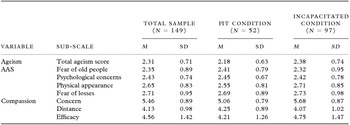
Ageist attitudes were assessed by a short version (Bodner et al., Reference Bodner, Bergman and Cohen-Fridel2012) of the Fraboni scale of ageism (Fraboni et al., Reference Fraboni, Saltstone and Hughes1990). Participants rate 18 items on a scale ranging from 1 (lower ageist attitudes) to 6 (higher ageist attitudes), and the scale can be indexed by a general score. The scale is considered to be one of the main tools for assessing ageism, and its internal validity has been demonstrated in many cultures, including Israel (see Bodner et al., Reference Bodner, Bergman and Cohen-Fridel2012). In this study, items were adapted to the video clips, and were reformulated in reference to the figures depicted in the experimental conditions (e.g. instead of “Many old people just live in the past,” “They look like people who just live in the past”). In light of this alteration, we conducted a confirmatory factor analysis with varimax rotation in order to validate the structure of the scale. Following this analysis, three items which loaded lower than 0.35 were dropped, and a mean score of ageism was calculated from the remaining 15 items, ranging from 1 to 5.20 (M = 2.31, SD = 0.71; see Table 1 for descriptive statistics regarding all research variables). Cronbach's α was 0.88.
Means and standard deviations of ageism, aging anxiety, and compassion for the study groups

Concern, distance, and efficacy were examined by the three relevant sub-scales of Cameron and Payne's (Reference Cameron and Payne2011) compassion scales, which are rated on a seven-point Likert scale, ranging from 1 (“Not at all”) to 7 (“Extremely”). As these scales were designed to elicit opinions following visual stimuli, no exploration of their internal structure was required. The concern sub-scale (nine items) relates to warm and empathic feelings, the target elicits (e.g. “How touched were you by the figures?”); The distance sub-scale (eight items) assesses the need to create an emotional gap between oneself and the targets (e.g. “How emotionally distant do you feel from the figures?”); the efficacy sub-scale (two items) examines one's own feelings of adequacy and ability with regard to make a significant change (e.g. “Do you think you would make a difference in helping the figures?”). Cameron and Payne (Reference Cameron and Payne2011) demonstrated high internal reliabilities (i.e. Cronbach's α ranging between 0.81 and 0.83), and this was also found in the current study for concern (0.82), distance (0.77), and efficacy (0.86). Scores ranges were 3–7 for concern, 1.63–6.63 for distance, and 1–7 for efficacy (see Table 1).
Aging anxiety was examined by the anxiety about aging scale (AAS; Lasher and Faulkender, Reference Lasher and Faulkender1993), a scale comprised of 20 items rated on a five-point Likert scale ranging from 1 (“Strongly disagree”) to 5 (“Strongly agree”). Four sub-scales are derived from the AAS: fear of old people (Cronbach's α = 0.88), which measures nervousness and fear regarding older adults (e.g. “I feel very comfortable when I’m around an old person,” a reversed item); psychological concerns (Cronbach's α = 0.71), which relates to the worries people have regarding growing old (e.g. “I fear it will be very hard for me to find contentment in old age”); physical appearance (Cronbach's α = 0.69), which indicates sensitivity toward changes in physical appearance (e.g. “When I look in the mirror, it bothers me to see how my looks have changed with age”); and fear of losses (Cronbach's α = 0.73), which relates to worries about the future deteriorations in one's health and social life (e.g. “I fear that when I am old all my friends will be gone”). The authors demonstrated good internal structure, with Cronbach's α ranging from 0.69 to 0.78 (Lasher and Faulkender; see also Bergman et al., 2013).
Procedure
The experiment was conducted in small groups, each trial including about 20 participants. After all participants filled out the AAS scale, they were subsequently introduced to one of two experimental conditions, both of which exposed them to different types of behaviors which can be observed in older adults. In the experimental condition (“Incapacitated behavior”) participants watched an edited 3-minute video (Grandma's chorus, 2011), which showed five older adults sitting down with their walkers and wheelchairs beside them in what seems like a hall of a sheltered housing facility, and singing loudly and out of tune two old songs (“This land is your land” and “Over the rainbow”) accompanied by a piano. In the control condition (“Fit behavior”), participants were shown an edited 3-minute video (Old people dancing with Michael Jackson, 2010), which depicted three older adults energetically performing a synchronized dance to the tune of “Billie Jean.” All older adults were dressed in the same manner (white shirt/blouse and black trousers) and lacked gender-specific characteristics (e.g. short vs. long hair). Both videos were shot in similar conditions (e.g. fluorescent lights), and included men and women, all of whom displayed the relevant behavior. After viewing the clips, each participant was asked to fill out scales which assessed ageism and compassion toward the performers he/she had seen, together with a socio-demographic scale. No contact or conversation between participants was observed by the research assistants. All scales were translated into Hebrew by back-translation, using two bilingual psychologists. The study was approved by the ethical institutional review board at Bar-Ilan University.
Data analysis
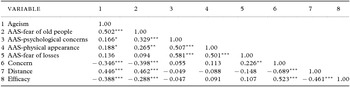
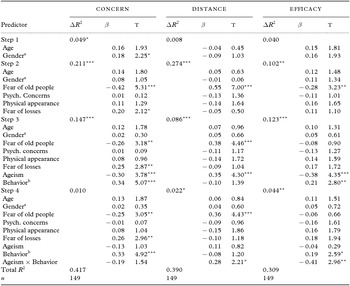
Analyses were conducted using the Statistical Package for the Social Sciences software (SPSS-21). First, correlations were examined in order to establish the preliminary connections between the study variables (see Table 2). Subsequently, three identical hierarchical regressions were used to examine the interactions of the type of behavior observed and ageism on the three dependent variables: concern, distance, and efficacy. The first step included the socio-demographic factors of participants’ age and gender which are both related to ageism (see Bodner et al., Reference Bodner, Bergman and Cohen-Fridel2012); In the second step, we inserted the four sub-scales of aging anxiety in order to control for their association with ageism (Allan and Johnson, Reference Allan and Johnson2009; Boswell, Reference Boswell2012); The third step included the ageism score and the experimental condition (fit behavior/incapacitated behavior), and the interaction between the two was inserted in the fourth and final step (see Table 3 for regression coefficients). Normal distributions for the three predicted variables were examined using quantile–quantile (Q–Q) plots, which demonstrated a near-straight line, suggesting normal distribution. Homoscedasticity, an additional prerequisite for using regressions, was examined using Levene's test (see Field, Reference Field2013), which yielded insignificant results, indicating equal variances between the groups. Additionally, we ran scatterplots which demonstrated that observations were centered around the regression line, thus indicating linearity. Significant interactions were examined using PROCESS procedure for SPSS (Hayes, Reference Hayes2013).
Pearson correlations among study variables

Note: * = p < 0.05; ** = p < 0.01; *** = p < 0.001.
Regression coefficients of the three dependent variables: concern, distance, and efficacy

Comments: a: 0 = Male, 1 = Female.
b: 0 = Fit behavior, 1 = Incapacitated behavior.
*= p < 0.05, ** = p < 0.01, *** = p < 0.001.
In order to verify that while ageism and aging anxieties are closely related, they represent two distinct characteristics, we ran the three regressions excluding the four aging anxiety variables in the second step. While all interactions, both significant and non-significant, were not affected, all significant findings regarding ageism were nullified. Therefore, in order to determine the aforementioned separateness, we re-ran the three original regressions and examined potential multicollinearity. These analyses were in accordance with the rules used in the literature, which state that a tolerance rate of less than 0.20 and/or a variance inflation factor (VIF) of 5 and above indicate a multicollinearity problem (O’Brien, Reference O’Brien2007). The value ranges of both tolerance (0.24–0.94) and VIF (1.06–4.05) rates demonstrate that subsequent analyses remain unaffected by multicollinearity issues.
Results
Initial correlations between the study variables were calculated, in order to examine the inter-connections between the four factors of aging anxiety and both ageism and the three compassion sub-scales (see Table 2). The results demonstrated moderate to strong correlations between ageism and three of the four aging anxiety factors (0.13 ≤ |r| ≤ 0.50), as well as between fear of growing old and all three compassion factors (0.29 ≤ |r| ≤ 0.46). This can be seen as an additional justification for controlling the variance of aging anxiety upon predicting compassion through ageism and exposure to fit/incapacitated behavior.
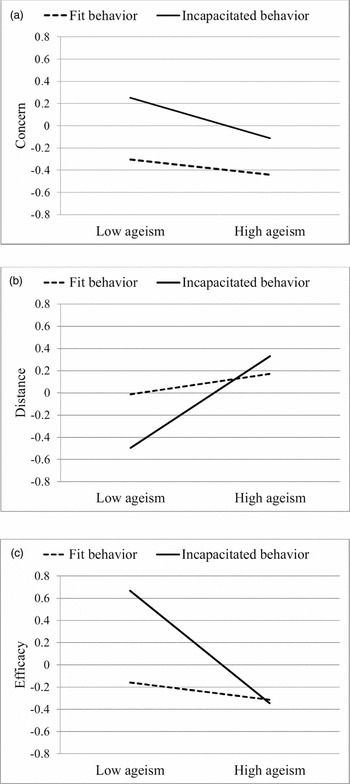
In order to examine the moderating role of viewing fit versus incapacitated behavior on the connection between ageism and compassion, we conducted three hierarchical regressions for the three factors of concern, distance, and efficacy. The regression predicting concern (Table 3, left column) revealed that concern was predicted by increased fear of old people and fear of losses (p < 0.01). In line with the first two hypotheses, the third step demonstrated that reduced ageism (p < 0.001) and viewing incapacitated behavior (p < 0.001) predicted enhanced concern toward the figures demonstrating these behaviors. However, the third hypothesis regarding the interaction between ageism and behavior type (i.e. high ageism is expected to be linked with the dependent variable only among experimental group), was not discovered for concern (see Figure 1a).
(a) The two-way interaction between ageist attitudes and type of behavior in predicting concern, (b). The two-way interaction between ageist attitudes and type of behavior in predicting distance, (c). The two-way interaction between ageist attitudes and type of behavior in predicting efficacy.

The regression predicting distance (Table 3, middle column) demonstrated a main effect of fear of old people (p < 0.001), so that individual anxieties regarding the aging process predict perceived distance from the figures depicted in both groups, regardless of the behavior shown. While the third step indicated a positive main effect of ageism (β = 0.35, p < 0.001), it was nullified by a significant interaction between ageism and the type of behavior. PROCESS procedure (Hayes, Reference Hayes2013) revealed that in line with our hypothesis, ageism predicted increased distance among individuals who were exposed to incapacitated behaviors (β = 0.45, p < 0.001), while this effect was non-significant for subjects who viewed fit behaviors (β = 0.11, p > 0.05; see Figure 1b).
The regression predicting perceived efficacy (Table 3, right column) demonstrated that efficacy is predicted by exposure to incapacitated behavior, and here too, a negative main effect of ageism (β = −0.45, p < 0.001) was nullified by a significant interaction of ageism × behavior. PROCESS procedure (Hayes, Reference Hayes2013) revealed that as with the previous interaction, the negative connection between ageism and efficacy was significant only among individuals exposed to the age-incapacitated behavior (β = −0.52, p < 0.001), so that ageism predicted decreased efficacy upon viewing behavior which is connected to the more negative aspects of aging. This effect was not found for the age-fit behaviors (β = −0.04, p > 0.05; see Figure 1c).
Discussion
Compassion and empathy toward the predicament of others can be seen as a trait different from feeling sad or distressed. Whereas distress motivates individuals to focus on themselves and reduce their own suffering, compassion is concerned with alleviating the suffering of others (Goetz et al., Reference Goetz, Keltner and Simon-Thomas2010). Previous research has shown that individuals displaying obvious physical impairments promote compassion under certain circumstances, or lead to a need to distance oneself from such people (Hirschberger et al., Reference Hirschberger, Florian and Mikulincer2005; Reference Hirschberger, Ein-Dor and Almakias2008). The current research attempted to clarify how exposure to the more dire physical aspects of aging affects concern toward, distance from, and efficacy toward older adults, and examined the role negative stereotypes play in moderating this affect.
Overall, findings were consistent with our first hypothesis regarding the negative connection between ageism and the three compassion factors. Increased ageism was associated with less concern, whereas the significant effects for distance (positive) and efficacy (negative) were nullified by the significant interactions of ageism × behavior. More specifically, ageist individuals who viewed incapacitated older adults reacted with a greater need for distance and reduced belief in their ability to assist them, an effect which was not observed in the fit behavior condition. The inverse relationships between ageist attitudes and empathy or compassionate tendencies are in line with previous studies indicating that negative attitudes toward older adults hinder one's ability to feel compassion (Boswell, Reference Boswell2012; Bodner and Cohen-Fridel, Reference Bodner and Cohen-Fridel2014). However, our findings show that ageism diminishes the tendency to respond in a prosocial manner not only when it appears as a personality tendency, but also when it is examined in response to a situational stimulus (images of older adults projected on a computer screen).
Our second hypothesis was also generally supported. Individuals who were exposed to older adults’ incapacitated behavior demonstrated increased concern toward these adults, and a stronger belief in their ability to help them in comparison with the control group. This can be seen in line with the stereotype content model (Fiske et al., Reference Fiske, Cuddy, Glick and Xu2002), which delineates how two underlying dimensions of stereotypes, warmth and competence, are the basis of prejudice toward various out-groups in society. According to this model, which is supported by a vast amount of findings, older adults are typically stereotyped as high on warmth (e.g. friendly, sincere), but low on competence (e.g. skillful, capable; see Cuddy et al., Reference Cuddy, Norton and Fiske2005). It seems that older adults sitting down with their walkers and wheelchairs fit better into this typical stereotype than older adults who are dancing and demonstrate no physical incompetence, and this may explain why incapacitated older adults evoked more concern and involvement from the participants.
The significant interactions of ageism × behavior (the third hypothesis) clearly demonstrate how the negative aspects of ageism interfere with the more positive aspects of the aforementioned stereotype of the older adult, thus blocking the ability for compassion toward incapacitated older adults, who, in fact, are in greater need for compassion in comparison to their fit counterparts. We suggest that while ageism did not interfere with the perception of older adults as incompetent, it annulled participants’ ability to see them as warm, and therefore was negatively associated with prosocial attitudes. However, it seems that such a change in prosocial attitudes requires a more theoretically based account, and this can be found in the realm of TMT.
As previously stated, TMT claims that when individuals are faced with awareness of death, symbolic defense mechanisms are employed in order to ward off death-related anxieties (e.g. Goldenberg et al., Reference Goldenberg, Heflick and Cooper2008). In this regard, research has shown that human physicality poses a threat to terror management defenses (see Hirschberger, Reference Hirschberger, Mikulincer and Shaver2010), and that encountering physical disability may interfere with prosocial behavior (Hirschberger et al., Reference Hirschberger, Ein-Dor and Almakias2008). Moreover, when death is not salient, observers’ reactions toward disabled individuals are often more positive than they are toward non-disabled people.
This salience may be the key for understanding why ageism leads to decreased prosocial attitudes and behaviors. It is plausible that for some individuals, the sight of an incapacitated older adult serves as a stimulus eliciting death awareness, which requires an immediate reaction in order to deflect this anxiety-provoking stimulus. This is in line with Martens and colleagues (Reference Martens, Greenberg, Schimel and Landau2004), who claim that “people under certain circumstances find elderly people threatening because they are reminders of one's own death” (p. 1525). In this case, we argue that by employing an ageist attitude and reverting to the “classic” negative stereotype of the older adult, such individuals succeed in creating a barrier between themselves and their subjective experiences and feelings. Their ageist attitudes provide them with justification to distance themselves from older individuals, which may also be supported by their decreased belief in their ability to assist them. It is speculated that among the control group, which was not exposed to this negative image of the aging body, the sight of the older adults performing fit behavior did not elicit death awareness, and therefore, ageism was not connected with the decrease in prosocial feelings and desires. However, this idea requires further validation through explicit manipulation and subsequent assessment of death awareness.
Our study has several limitations. First, we used a relatively small convenience sample composed of Israeli undergraduate students from the Social Sciences. In this regard, previous studies have found that Israeli undergraduates report attitudes toward older adults which are comparable to those of their peers in many European countries (see review by Bodner et al., Reference Bodner, Bergman and Cohen-Fridel2012). However, future studies may wish to provide additional proof of the generalizability of the results, by examining the model on larger and more representative samples (i.e. older individuals; students from different disciplines), or to expand the examination to other cultures. Furthermore, while the videos used for the experimental manipulation were quite compatible, they were filmed and posted by amateur photographers. This fact hindered our ability to control all aspects concerned (e.g. the exact number of people appearing on each video), and this issue needs to be taken into account in the future. Additionally, we did not examine the role of several causative mechanisms in the relationships between ageist attitudes and compassion. We are referring here to mechanisms such as various personality qualities, which may impact the attribution of controllability and blame, or warmth and incompetence to the incapacitated older adults. In addition, we did not measure death awareness or death anxiety. More information is needed with regard to the roles of each suggested mechanism, perhaps through a series of experimental studies.
Nevertheless, our results seem to imply that ageism seems to cause people to relinquish positive feelings toward people who are in need of assistance. Thus, exposing young adults to realistic accounts of growing old may be important in reducing the fear which underlies the negative attitude. This could be done, for example, by promoting contact between older and younger adults (see review by Bodner, Reference Bodner2009). Moreover, it seems that societies should focus on reducing such negative stereotypes regarding older adults, opting for a realistic portrayal of both the benefits and the difficulties in the aging process. It may be that in a society which provides accurate information, and promotes through its available resources (e.g. the media; see Bodner, Reference Bodner2009) the idea that physical changes are only a single aspect of the aging process, the link between the aging body and impending death may possibly become less pronounced. This, in turn, could lead to more favorable attitudes toward those who are in real need for compassion.
Conflict of interest
None.
Description of authors’ roles
Dr. Bergman and Prof. Bodner were both responsible for the concept and study design. Dr. Bergman carried out the statistical analyses and contributed the methodological parts. Both authors wrote the paper.