For supplementary material, please visit http://dx.doi.org/10.15184/aqy.2015.2
Introduction
Current research into Chinese prehistory suffers from a dearth of information concerning the cultural and social changes that occurred during the transition from the Terminal Pleistocene to the early Holocene period (e.g. Bar-Yosef & Wang Reference Bar-Yosef and Wang2012; Liu & Chen Reference Liu and Chen2012; Qu et al. Reference Qu, Bar-Yosef, Wang and Wu2013; Wagner et al. Reference Wagner, Tarasov, Hosner, Fleck, Ehrich, Chen and Leipe2013; Wang et al. Reference Wang, Zhang, Gu, Wang, He, Zhang and Qu2013). This period is crucial to our understanding of the transition from mobile hunter-gatherer groups to sedentary communities of foragers, as it is widely agreed to be the time when cultivation of millet, in the north, and rice, in the south, most likely began. The sites of the first hunter-gatherers to practise cultivation are as yet unknown, but within two or three millennia the new subsistence strategy resulted in the domestication of millet and rice (e.g. Crawford Reference Crawford and Stark2006; Zhang & Hung Reference Zhang and Hung2008, Reference Zhang and Hung2012; Bettinger et al. Reference Bettinger, Barton and Morgan2010; Liu et al. Reference Liu, Field, Fullagar, Zhao, Chen and Yu2010; Z. Zhao Reference Zhao2010, Reference Zhao2011; Bar-Yosef Reference Bar-Yosef2011; Cohen Reference Cohen2011; Fuller et al. Reference Fuller, Asouti and Purugganan2011; Liu & Chen Reference Liu and Chen2012; Yang et al. Reference Yang, Wan, Perry, Lu, Wang, Zhao, Li, Xie, Yu, Cui, Wang and Ge2012; Wagner et al. Reference Wagner, Tarasov, Hosner, Fleck, Ehrich, Chen and Leipe2013). While excavations of sites dating to this period considerably increase our understanding of the complex processes that led to the emergence of farming in China, they are few in number. Sites of this date that have been excavated in northern China include Donghulin, Zhuanian and Nanzhuangtou (e.g. Cohen Reference Cohen2011; Liu & Chen Reference Liu and Chen2012).
During the Late Pleistocene in northern China, the world of foraging societies was different from that of the southern regions. All across the area from the western semi-desert regions and the highlands of Qinghai and Tibet through the lowlands and plateaus of the Yellow River, Inner Mongolia and north-eastern China were mobile groups of foragers who were the creators of the microblade industries.
Microblades, a term researchers in East Asia adopted from the American literature (e.g. Morlan Reference Morlan1967; Inizan Reference Inizan1991; Inizan et al. Reference Inizan, Lechevallier, Plumet, Vandiver, Druzik, Wheller and Freestone1992), are very small blades (generally less than 10mm wide), and it is often assumed that their production technique evolved from the earlier Upper Palaeolithic knapping of larger blades (see online supplementary material for a description of the operational sequence and typology of microblades). While visually they look similar, the operational sequences for obtaining these microlithic bladelets are different. Therefore, the shift from the common reduction sequences of blades to the making of these small bladelets requires additional technical knowledge.
The study of microblade assemblages has benefited from in-depth investigations conducted in Siberia, Korea, the Japanese archipelago and western North America (e.g. Kobayashi Reference Kobayashi1970; Flenniken Reference Flenniken1987; West Reference West1996; Lu Reference Lu1998; Seong Reference Seong1998; Bleed Reference Bleed2001, Reference Bleed, Elston and Kuhn2002, Reference Bleed2008; Elston & Kuhn Reference Elston and Kuhn2002; Goebel et al. Reference Goebel, Waters and Dikova2003; Nakazawa et al. Reference Nakazawa, Izuho, Takakura and Yamada2005; Kuzmin et al. Reference Kuzmin, Keates and Shen2007; Bae Reference Bae2010; Elston et al. Reference Elston, Dong and Zhang2011).
A cross-continental review would place the microblade assemblages in a well-established chronological scheme that would allow us to posit questions concerning the origins and dispersal of the makers and their skills. The current challenge in China is to trace the entire sequence of microblade industries made by mobile foragers that first appeared in the archaeological record c. 28–26000 years ago (e.g. Zhang et al. Reference Zhang, Wang, Qiu, Shelach, Hu, Fu, Zhuang and Zhou2011; Nian et al. Reference Nian, Gao, Xie, Mei and Zhou2014) and to trace their fate in view of the establishment of farming communities.
Within this chrono-cultural context, this paper reports two discoveries from the site of Lijiagou. First, it demonstrates a relatively close chronological relationship between the late hunter-gatherer makers of microblade industries and early farmers in China's central plain. Second, it announces the discovery of previously unknown pottery production by foragers, a cultural attribute known from southern China from some 20–18800 years ago (e.g. Boaretto et al. Reference Boaretto, Wu, Yuan, Bar-Yosef, Chu, Pan, Liu, Cohen, Jiao, Li, Gu, Goldberg and Weiner2009; Wu et al. Reference Wu, Zhang, Goldberg, Cohen, Pan, Arpin and Bar-Yosef2012). The making of pots is archaeologically recorded among other hunter-gatherer societies across the world, demonstrating independent invention in more than one geographic region (Jordan & Zvelebil Reference Jordan and Zvelebil2009).
The site and its environment
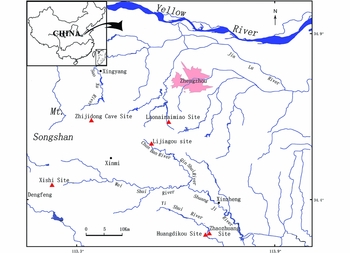
The site of Lijiagou (N 34°33’55”, E 113°31’25”) is located on the left bank of the Chunban River, a tributary of the Huai River system and about 100km from Jiahu (Figure 1). The site was discovered in 2004 during a survey of the Palaeolithic landscape around Zhengzhou City, led by the Zhengzhou Municipal Institution of Archaeology. Following the discovery of the site, excavations were conducted jointly by the Zhengzhou Municipal Institution and the School of Archaeology and Museology of Peking University over four months in autumn 2009 and spring 2010.
Geographic location of the Lijiagou site.

The site is located in the central plain of China on a tributary of the Huai River, one of the most important river basins for the investigation of early plant domestication (e.g. Zhang & Hung Reference Zhang and Hung2012, Reference Zhang and Hung2013). The best-known regional site that offers sound evidence for early farming in this basin is Jiahu. Jiahu produced evidence for probable rice cultivation, partly in wet fields, as well as evidence for the gathering of wild rice, wild soybeans, acorns and water chestnuts, suggesting that gathering wild plants continued alongside cultivation. Jiahu also provided evidence for both domesticated pigs and hunted game, including more than one species of deer, cattle and rabbit. It is also known for the discovery of a large collection of musical flutes (e.g. Zhang et al. Reference Zhang, Harbottle, Wang and Kong1999; Zhao & Zhang Reference Zhao and Zhang2011; Zhang & Hung Reference Zhang and Hung2013).
According to new analysis by Zhang and Hung (Reference Zhang and Hung2013), Jiahu represents the earlier phase of the well-known and well-spread Peiligang culture, the classic early village farming complex of northern China. Zhang and Hung suggest that this early phase should be named after the early period of Jiahu as ‘Jiahu 1 culture’ and that during this phase there appears to be long-distance contact with the Pengtoushan-Bashidang culture in the mid-Yangtze River area. According to the lists of 14C dates assembled by Zhang and Hung (Reference Zhang and Hung2013: 52–53), the early Neolithic culture of Jiahu phase 1 dates to c. 7500/7000–6600 cal BC. Therefore, tracing the presence of the last foragers and the emergence of farming in the Huai River basin presents a challenge to archaeologists. The main difficulty is the deep sequence of alluvial deposits that accumulated during the Late Pleistocene and early Holocene, and which buried the prehistoric sites in the Huai River basin, as well as in other parts of the central plain.
Systematic surveys of natural sections created by erosion that occurred during historical and recent times, as well as by widespread agricultural activities and quarrying for clays for the production of bricks, have revealed the presence of buried sites of Middle and Upper Palaeolithic date (Wang & Qu Reference Wang and Qu2014). This is the case at the Lijiagou site that was found in a gully formed by the collapse of a coal mine below the surface. Local farmers modified the gully as a deep ditch to facilitate the irrigation of their fields by a flow of water from the Chunban River. The new exposures uncovered a series of archaeological horizons embedded in early Holocene deposits that overlay the Pleistocene Malan yellow soil.
Our excavations at Lijiagou were limited to the widening of the farmers’ trench and by the trees planted on the top of the river terraces of the Chunban River. While we were unable to expand the surface of the excavations and could not affirm the size of this prehistoric site, we believe that the excavations represent a pioneering effort to close the cultural and chronological gap between hunter-gatherer societies in this region and the later settlements of sedentary communities identified as the Jiahu 1 and Peiligang cultures.
The excavation, stratigraphy and material culture
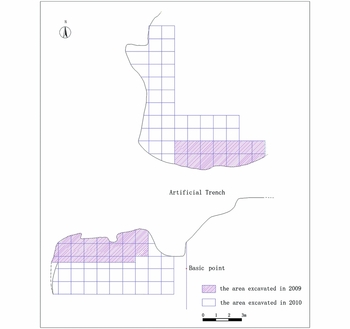
The excavations on both sides of the gully (Figure 2) were undertaken within a grid system of 1m × 1m divisions. All spits were 50mm thick and were sieved in water. Flotation of a large number of samples was systematically done, but unfortunately no plant remains were recovered. Minute quantities of charcoal specks were found in the different layers and were used for dating.
Plan of the excavations at Lijiagou, showing the north and south areas.

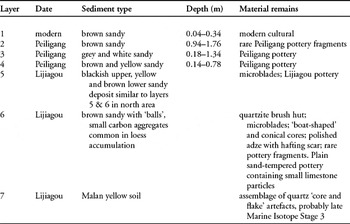
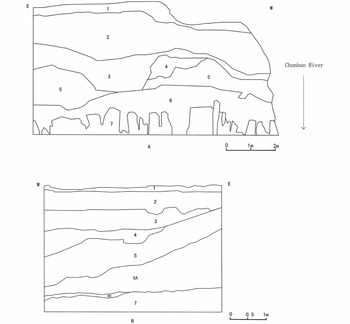
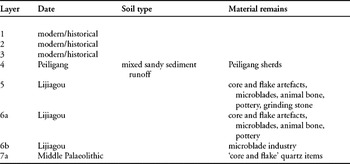
An area of slightly over 100m2 was exposed on both sides of the gully. The two sides are referred to as the north and south areas, and were some 5–6m apart (Figure 2). The main sections of these two areas exposed similar stratigraphy from the late Palaeolithic to the Neolithic (Figure 3). The stratigraphy of the south area (Figure 3a) was sub-divided into seven layers (detailed in Table 1).
Stratigraphy of south area at Lijiagou.

Stratigraphic sections of: A) the south area; and B) the north area.

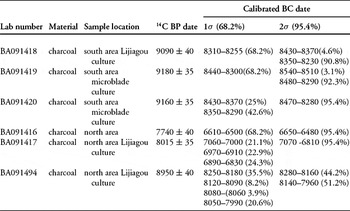
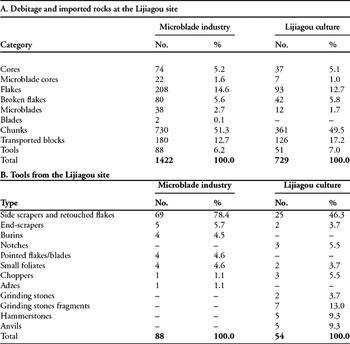
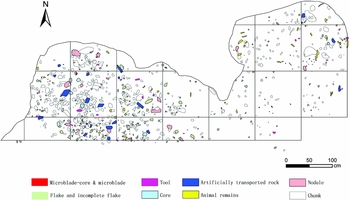
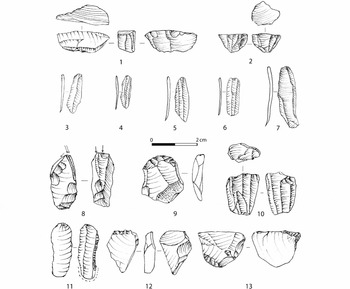
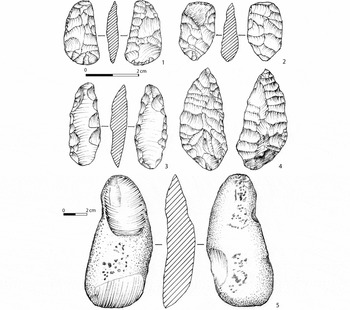
The pottery assemblage from the south area included rare pottery fragments attributed to the Peiligang culture, found in layer 2 (Zhang et al. Reference Zhang, Zin, Hu and Yan2008). Many fragments of a previously unknown style of sand-tempered pressed-decorated pottery, named ‘Lijiagou culture’ after the site, were also discovered in layer 5. Radiocarbon dates (Table 2) indicate that this pottery probably preceded the earliest phase of the Jiahu sequence by a relatively short time (Zhang & Li Reference Zhang and Li1996; Zhang & Hung Reference Zhang and Hung2012, Reference Zhang and Hung2013). The sediments in layer 5 are similar in nature to those of layers 5 and 6 in the north area where radiocarbon dates were obtained (Table 2). Most finds from layer 6 were distributed in a semi-circular area enclosed by several blocks of quartzite, interpreted as the remains of a brush hut (Figure 4). The lithic assemblage was typical of a microblade industry and contained a range of artefacts including ‘boat-shaped’ and conical cores as well as numerous microblades (see Figures 5 & 6; Table 3a). An elongated cobble with one polished edge and the profile of a typical ‘adze’ was also discovered in layer 6; one end of the adze shows an extensive longitudinal scar that might be related to hafting (Figure 6). Based on several other excavated sites in the Zhengzhou region, the small assemblage of quartz ‘core and flake’ artefacts discovered in layer 7 probably date to the range of the late Marine Isotope Stage 3 c. 50–35 ka cal BP (Xia et al. Reference Xia, Liu, Wang and Qu2008; Wang et al. Reference Wang, Zhang, Gu, Wang, He, Zhang and Qu2013).
Radiocarbon dates of the various deposits at the Lijiagou site.

Lithics of the earlier microblade industry and the Lijiagou culture.

Plan of excavated part of layer 6 in the south area, showing the distribution of artefacts and bones.

The microblade industry of layer 6: 1–2) microcores; 3–6) microbladelets; 7) blade; 8) burin on thick flake; 9) endscraper on flake; 10) semi-conical microcore; 11) retouched blade with signs of use; 12) scraper on ventral face of a flake; 13) retouched core tablet.

The microblade industry: 1–4) foliates; 5) adze.

The stratification of the north area (Figure 3b) was sub-divided into eight layers, as detailed in Table 4. Layers 5 and 6a are attributed to the newly discovered Lijiagou culture, and they included: core and flake artefacts; microblades; animal bones (Tables 3a & b and 5); fragments of pottery (Figure 7b) and a grinding stone (Figure 8). Layer 6b consisted of the same type of sediment as 6a but contained a microblade industry that corresponded to layer 6 in the south area. Layer 7 contained a few of the same type of ‘core and flake’ quartz items as those found in layer 7 in the south area. This industry, known from other sites in the region, is attributed to the late Middle Palaeolithic (Qu et al. Reference Qu, Bar-Yosef, Wang and Wu2013).
Stratigraphy of the north area at Lijiagou.

Faunal assemblages of the microblade layers and the Lijiagou culture.

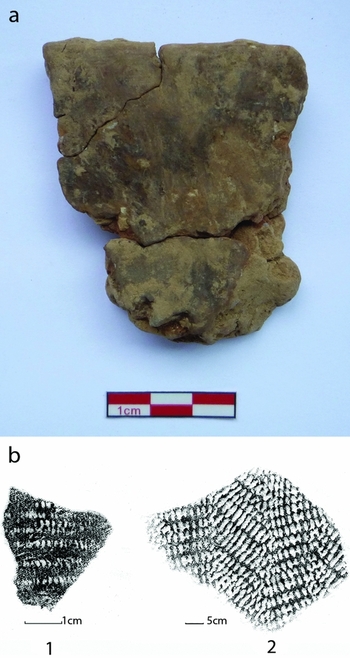
A) Sherd found with the microblade industry; B) sherds found with the Lijiagou culture.

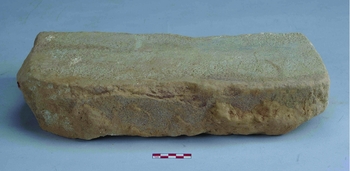
Lijiagou culture grinding stone (photograph: Lijiagou archive).

Radiocarbon dates
Table 2 lists the five radiocarbon dates obtained from charcoal samples from the south and north areas, together with calibrated dates BC (Reimer et al. Reference Reimer, Baillie, Bard, Bayliss, Beck, Bertrand, Blackwell, Buck, Burr, Cutler, Damon, Edwards, Fairbanks, Friedrich, Guilderson, Hughen, Kromer, McCormac, Manning, Bronk Ramsey, Reimer, Remmele, Southon, Stuiver, Talamo, Taylor, van der Plicht and Weyhenmeyer2004). For comparison, readers should consult the dates from Jiahu phase I that are now believed to represent the earliest Neolithic culture in central China, preceding the Peiligang culture and dated to 7500/7000–6600 BC (see Zhang & Hung Reference Zhang and Hung2013: 48 and Table 2). The Lijiagou dates allow us to conclude that the pottery discovered in layer 5, in both areas, and layer 6a in the north area, is earlier than the Jiahu 1 culture (Zhang & Hung Reference Zhang and Hung2013). Due to the run-off effects in the accumulation of layer 4 in the north area that affected the top of layer 5, it is quite possible that the date of 7070 BC–6810 BC (95.4% probability; BA-091417) is intrusive. We therefore suggest that the Lijiagou culture dates to c. 8300–8000 cal BC and precedes the Jiahu I culture by about 500–1000 years. Additional readings from both sites may, of course, indicate a shorter time gap.
The microblade industry
Microblade industries are known from a large area in northern China (e.g. Lu Reference Lu1998; Qu et al. Reference Qu, Bar-Yosef, Wang and Wu2013). The earliest microblade sites, currently dated to c. 28–22 ka cal BP, were excavated in Shaanxi and Shanxi provinces, next to the Yellow River, and include Longwangchan (Zhang et al. Reference Zhang, Wang, Qiu, Shelach, Hu, Fu, Zhuang and Zhou2011) and the cluster of Shizitan sites (Shizitan Team 2002). The cluster of Xiachuan sites is located at a higher elevation on the loess plateau in Shanxi (Tang Reference Tang2000; Qu et al. Reference Qu, Bar-Yosef, Wang and Wu2013). The optically stimulated luminescence dates, with their ±2.0/2.1 standard deviation, obtained at the Youfang site in the northern Nihewan area (Nian et al. Reference Nian, Gao, Xie, Mei and Zhou2014), fall within the same period. Later dates are known from more recent sites in Xiaochuan, Shizitan (Shi & Song Reference Shi and Song2010) and farther north, at Shuidonggou site 12 (Yi et al. Reference Yi, Barton, Morgan, Liu, Chen, Zhang, Pei, Guan, Wang, Gao and Bettinger2013).
The microblade assemblage at Lijiagou is best preserved in layer 6 in the south area (Table 3a & b and Figure 4). The base of the layer, immediately above the Malan loess formation, contained a dense activity area forming an elliptical distribution about 3.5m long and 2.5m wide (Figure 4). It contained numerous cores, flakes, bladelets, chopping tools, grinding stones and animal bones (Table 5). There were also quartzite blocks (up to 0.3–0.4m in diameter) brought from an outcrop along the river bank some 50m away. The larger ones seem to have been used as the outline of a small brush hut; one or two served as anvils. Most of the lithic products are made of flint, chert, quartz or quartzite, including a few scrapers and an apparently discarded adze with a unifacial polished cutting edge found at the southern end of the activity area.
Microblades were abundant in this context and can be classified into several categories including micro cores, micro flakes and bladelets. The micro cores are ‘boat-shaped’ and conical (Figure 5). Numerous flakes resulted from core preparations and the reshaping of other artefacts; many seem not to have been used and are counted as debitage. The flint tools consisted mainly of scrapers, retouched flakes, rare burins and a few bifacial points made from flint and quartzite (Figure 6). This layer also contained a few chopping tools made of quartzite. Worthy of special mention is a rare adze, which is the only polished tool (Figure 6). Similar polished tools associated with microblade assemblages of Terminal Pleistocene–early Holocene age are rare, found only in Donghulin and Nanzhuangtuo (Zhao et al. Reference Zhao, Wang, Wu, Liu, Yuan, Yu and Guo2006). In addition to the stone tools and the imported blocks mentioned above, there is evidence for the use of other raw materials such as sandstone and quartzite, which was considered to be largely for an expedient industry of flakes and irregular items.
Two pottery fragments were found with this microblade assemblage. Both were plain, with no decoration, limestone-tempered and fired at a low temperature (Figure 7a). The shape of the pots seems to have been rounded, similar to early pots in southern China.
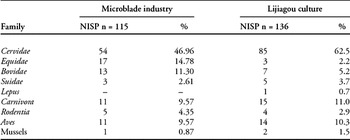
The faunal assemblage of this layer (Table 5) was dominated by Cervus axis (chital deer), Carpreolus sp. (roe deer), Equus sp. (horse family), Sus sp. (wild pig), Bos sp. (cattle), Nyctereutes procyonoides (racoon), Vulpes vulpes (fox), Lepus capensis (cape hare), rodentidae (voles) and a few fragments of ostrich egg shells. The deer species are indicative of a forested area where wild boar were probably present, while the carnivores, hare and ostrich indicate open grassland. Cattle bones were generally broken into smaller fragments, perhaps suggesting that they were boiled for grease. Most of the large ungulate bones were concentrated in the eastern part of the excavated area. Apparently, this was either the place of butchering and processing or simply the ‘discard zone’ where the waste was dumped.
The remains of the Lijiagou culture
The cultural remains uncovered in layers 5 and 6a in the north area include numerous pottery fragments with a few additions in the south area; these were attributed to a new ceramic style called the ‘Lijiagou culture’. The discovery of pottery in the central plain of China earlier than Jiahu 1 is surprising. It is known that hunter-gatherers had been making pots for a long time in southern China. This observation was established by the dates of 20–19000 cal BP attributed to pottery in Xianrending and Diatonghuan caves in Jiangxi Province (Wu et al. Reference Wu, Zhang, Goldberg, Cohen, Pan, Arpin and Bar-Yosef2012), and some of a later date (18–17000 cal BP) in Yuchanyan cave in Hunan Province (Boaretto et al. Reference Boaretto, Wu, Yuan, Bar-Yosef, Chu, Pan, Liu, Cohen, Jiao, Li, Gu, Goldberg and Weiner2009). However, due to the close proximity in age of the large assemblage of sherds from layers 5 and 6a in the north area at Lijiagou to the early Neolithic of the Jiahu 1 culture, where evidence for cultivation is indicated by plant remains (Zhang & Hung Reference Zhang and Hung2012), we attributed the Lijiagou assemblage to the pre-Neolithic period of this region.
Layers 5 and 6a in the north area, where the deposits are thicker than the later or earlier layers, probably demonstrate a much longer duration of human activity compared with the preceding occupation by the microblade makers. For example, during the 2009 season, more than 200 fragments of pottery were uncovered within an area of 10m2. This particular pottery signifies the uniqueness of this cultural layer.
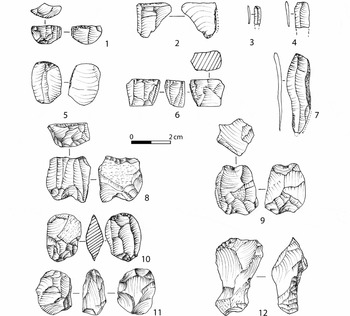
The stone tools of the ‘Lijiagou culture’ contexts are slightly different from those in the previous layer (Figure 9). Rare conical microblade cores were found in this context, and most of the other items are made of chert and quartzite and are scarcely retouched (Table 3a & b). This assemblage of expedient tools was made of indurated sandstone and quartzite, and their exact use is not yet known. Worth noting is the presence of a rare, broken, bone awl bearing a short series of incisions near the proximal end. In addition, several fragments of grinding tools were recovered. One complete rectangular item with a round edge made from grey sandstone is presented in Figure 8.
Lithics of the Lijiagou culture: 1) microblade core; 2) retouched flake with signs of use indicated by dots; 3–4) microbladelets; 5) end scraper on flake; 6) microblade core; 7) blade with signs of use; 8) core for bladelet; 9) core; 10) pièce esquillée; 11) core; 12) retouched flake.

The faunal remains of the Lijiagou culture layers (Table 5) are the same as those of the microblade industry layer 6b, suggesting that the natural environment remained the same over several centuries. The list includes Père David's deer (Elaphurus davidianus), chital deer (Cervus axis), Chinese water deer (Hydropotes inermisor) or musk deer (Moschus) and a feline species (felidae). Among the deer, Père David's and Chinese water deer suggest that a wetland landscape characterised the immediate vicinity of the site, as they often graze in marshy areas and open grassland. Roe deer are indicative of open forest, as are chital deer and wild boar. The wild cattle may represent mixed forest and grassland, and ostrich a more open landscape. Apparently, the area around Lijiagou at that time was a mosaic environment, providing rich resources for exploitation that allowed foragers to become sedentary.
The most important discovery in layers 5 and 6a was the pottery. It comprised 200 fragments, some of which fit together to reconstruct a vessel (Figure 7b). These hand-made vessels of clay, mixed with sandy temper, were fired at high temperatures, resulting in a light yellow or red colour. The most common form of what is now called the ‘Lijiagou culture’ is a straight, barrel-shaped vessel. The outer surface of the pots shows several different decorations, mostly pressed on the ceramics before firing. The patterns include cord-marked decorations and incisions. Some sherds are better fired than others, indicating that these ceramics were already of better quality than the rare sherds uncovered with the earlier microblade industry. Finally, the shapes and styles of the Lijiagou pottery are entirely different from the later Jiahu 1 and Peiligang cultures. We hypothesise that the technology of firing pots at higher temperatures appeared in this region around 10000 years ago and could be the result of the movement of people from southern China, or cultural communication with regions where pottery making was practised earlier.
Remains of the Peiligang culture
There was later occupation at Lijiagou in the Peiligang phase. The sherds of Peiligang culture were uncovered mainly in layers 2 and 3 in the south area, with some layer 3 fragments having accumulated due to the erosion of earlier Peiligang-age deposits. Typologically, the Peiligang sherds in layer 2 are similar to those of many sites of this culture that are well documented in Henan Province (e.g. Zhang et al. Reference Zhang, Zin, Hu and Yan2008). We note also that the assemblage of layer 2 is similar to the contexts from the Tanghu site (Xinzheng City county), a large Peiligang site that lies about 25km from Lijiagou.
Conclusion
The importance of the Lijiagou site is twofold; the microblade assemblage provides a wealth of information and is one of the few reported and dated assemblages from the area south of the Yellow River basin. However, the discovery of this assemblage, together with rare fragments of an unknown pottery type that preceded the Lijiagou culture, is hugely significant and deserves additional field research.
The microblade assemblage retrieved from layer 6 in the southern area is dominated by ‘boat-shaped’ and conical-shaped cores, and reveals the connections between Lijiagou and other sites in the central plain of China, such as Dagang in Wuyang county (Henan province; Zhang & Li Reference Zhang and Li1996), Limgjing near Xuchang City (Henan Province; Li 2010) and the Shizitan sites in Ji County (Shanxi Province; She & Song 2010) near the Yellow River. The reduction sequence and the final shape and size of bladelets at Lijiagou are similar to detachment techniques of bladelets common in other microblade assemblages in northern China (e.g. Yi et al. Reference Yi, Barton, Morgan, Liu, Chen, Zhang, Pei, Guan, Wang, Gao and Bettinger2013). They are generally obtained by pressure flaking from preheated cores. The dates of this assemblage fall within the later period of the microblade cultural sequence that originated before the Late Glacial Maximum and continued through the early Holocene (e.g. Qu et al. Reference Qu, Bar-Yosef, Wang and Wu2013).
The Lijiagou cultural contexts demonstrate a paucity of microblade elements, probably indicating that their production had decreased drastically. Whether microblades were produced in Neolithic farming communities in the region is unknown. However, two hypotheses can be put forward. First, the artisans who knew the techniques and produced these mini-bladelets abandoned their production, perhaps because there was no need for these artefacts; second, fine sieving was not practised during the excavation of early Neolithic sites. In addition, the makers of the microblades were originally members of bands of foragers. The establishment of sedentary farming communities limited the ability of hunter-gatherers to move around according to their needs, and they abandoned the region. Thus, by the time of the Lijiagou culture, around 8500–8200 cal BC, major social changes were taking place in the Huai River basin.
Interestingly, the grinding stone found in the Lijiagou culture context continued the tradition of plant food preparation demonstrated at Shizitan 14, dating to the Late Glacial Maximum (e.g. Liu et al. Reference Liu, Bestel, Shi, Song and Chen2013); Shizitan 9, dating to the Terminal Pleistocene (Liu et al. Reference Liu, Ge, Bestela, Jones, Shi, Song and Chen2011); and Donghulin, dating to the early Holocene (Liu et al. Reference Liu, Field, Fullagar, Zhao, Chen and Yu2010). Starch analysis revealed the exploitation of acorns and small grasses, and apparently these plants continued to be part of the diet of hunter-gatherers for many millennia. However, for the central plain of China the uniqueness of the Lijiagou microblade context, and in particular the Lijiagou culture, is the discovery of pottery-making, which had not yet been found at late Palaeolithic sites in this vast region.
The archaeological evidence from Lijiagou helps us to identify the socio-economic changes that occurred prior to the appearance of the Jiahu 1 culture and, in particular, the widespread Peiligang culture. Together with evidence from the Dagang site, it may indicate that the farmers of the Jiahu 1 culture were immigrants from elsewhere and that the Jiahu 1 culture did not emerge from local traditions. In addition, the unknown pottery assemblage, marked by cord-decorated vessels now found in northern China, shows that pottery technology was not limited to southern China as previously thought. Future investigations will help to determine whether the Lijiagou culture, dated to the early Holocene, is the last phase of a long sequence of foragers that heralds the establishment of later Neolithic farming villages in the central plain of China.
Acknowledgements
This work was supported by a grant from the China National Philosophy and Social Science Foundation (no. 11&ZD120). We thank our colleagues from the Zhengzhou Municipal Institute of Cultural Relics and Archaeology, School of Archaeology and Museology at Peking University, for their assistance in completing this phase of research. O. Bar-Yosef thanks the American School for Prehistoric Research (Peabody Museum), Harvard University, for supporting his joint research in China.