Through her work with black American choreographer and Haitian vodou initiate Katherine Dunham, avant-garde filmmaker Maya Deren discovered that the religion's practitioners would submit themselves to loa (spirits) during ceremonies, thereby abandoning the self to a community ritual.Footnote 1 Relegation of the traditionally privileged human subject in favour of communal experience underpinned Deren's concept of “depersonalization.” As she explained in An Anagram of Ideas on Art, Form and Film (1946) shortly before her own visits to Haiti to document vodou,
The ritualistic form treats the human being not as the source of the dramatic action, but as a somewhat depersonalized element in a dramatic whole. The intent of such depersonalization is not the destruction of the individual; on the contrary, it enlarges him beyond the personal dimension and frees him from the specializations and confines of personality. He becomes part of a dynamic whole which, like all such creative relationships, in turn, endow its parts with a measure of its larger meaning.Footnote 2
Deren's treatment of Black American dancer Talley Beatty in her 1945 short A Study in Choreography for Camera can be read as an attempt to re-create cinematically this understanding of vodou, in which, she believed, sacrifice of the individual performer to the larger filmic “ritual” would imbue their performance with deeper spiritual meaning. Beatty is depicted dancing seamlessly across disparate locations. The camera deindividualizes him by treating him both as a device by which to bridge geographical boundaries and as the host of what might be termed a ritualistic encounter between film and viewer in which the audience is drawn into a hypnotic visual dialogue invoked by radical editing techniques. Yet it would be inaccurate to suggest that Deren's camera undercuts Beatty's artistry. The balletic style that he adopts evidences his creative influence. In a 1977 interview, Beatty claimed that, although Deren devised movement concepts prior to a scene, the production was based on close consultation between director and dancer: “she would tell me what the idea was, the movement idea, and we would agree upon it.”Footnote 3 The film should thus be read as a collaborative, cross-cultural celebration of black cultural practices and artistry that combines a visual interpretation of Caribbean ritual form with Beatty's balletic technique and breaks down racialized-looking relationships by implicating the viewer in the psychological intensity and virtuosity of his dance.
Erotic and exotic images of black bodies permeated US society throughout the early twentieth century as the emergence of ragtime and jazz drew white audiences to black artistry. The 1921 all-black Broadway show Shuffle Along was regarded as a major instigator of the jazz age, of which black dance styles, including tap and the Charleston, were key symbols. For white cultural consumers, the syncopated rhythms of black dance forms emblematized the psychological dislocations of rapid industrialization whilst simultaneously offering access to a “pre-civilized,” physically liberated past. Leading Euro-American choreographers such as Ruth St. Denis and Doris Humphrey also drew on “primitive” themes in their efforts to establish a distinctively American form of modern dance. In such an environment, the artistry and humanity of black dancers was obscured; they were depicted as crude and instinctive. Visual representations of black dancers on sheet music covers and in the work of white artists such as Stuart Davis and Adolf Dehn took their inspiration from the minstrel era's dehumanizing caricatures of black bodies. Such distortions impacted on the thinking of African American intellectuals such as Charles Johnson and Alain Locke, who dismissed black dance as uncultured and therefore at odds with their efforts to “uplift the race.” Black painters, sculptors, writers and modern dancers such as Aaron Douglas, Richmond Barthé, Langston Hughes, Zora Neale Hurston, Hemsley Winfield and Katherine Dunham sought to evidence the ritual and cultural significances of black dance and the beauty of black dancers.Footnote 4 However, their work was frequently read through a primitivist critical lens, which upheld a binary separation between black and white bodies and performance cultures.
By positioning a black dancer as the central figure in a new form of artistic expression based on movement and the moving image, Study is historically significant for rupturing such racist paradigms. Beatty, whose family fled racist persecution in the South when he was a baby and who was raised on Chicago's South Side, and the Jewish and Ukrainian-born Deren, came from very different social and cultural backgrounds, yet a cross-cultural exploration of dance developed in the late 1930s, which emphasized the psychological significance of black cultural forms, influenced them both. Emerging out of but rebelling against early twentieth-century fascinations with psychology and ritual in art and science and directly influenced by the choreographic and ethnographic innovations of dancer–anthropologist Katherine Dunham, Study helps to unearth the cross-cultural influences shaping Deren's art and is a vital visual record of her efforts to break down cultural boundaries. Equally, it is a celebration of the artistry and physical beauty of a black male ballet dancer produced many years before African Americans gained meaningful success in the field, and Maurice O. Wallace has described it as “undoubtedly among the most important prefiguring works of late twentieth-century black male performance art.”Footnote 5 Beatty's technically proficient performance shows how he confronted the cultural anxiety that worked to exclude African Americans from ballet throughout much of the twentieth century. Authorial tensions between the artistic intentions of Deren, who worked to downgrade the individual performer in favour of the filmic “ritual,” and Beatty, who sought to display his skills as a technically accomplished dancer, should not be overlooked. However, by positioning Beatty's dancing body as its visual centre and by situating his performance as an embodied signification of complex human experience, Study represents a vital cinematic platform by which an African American performer managed to intervene in rigid definitions of art and performance cultures.
Staking a claim for film's status as “art” in opposition to what she perceived as the commercialism and superficiality of Hollywood, Deren was the recipient of the first Guggenheim Fellowship for filmmaking and her innovative techniques and self-distribution methods laid the groundwork for avant-garde cinema in the US. The earliest avant-garde films had appeared in 1920s Europe, when Dadaist and surrealist artists such as Hans Richter, Luis Buñuel and Salvador Dali explored the moving image as an expression of the unconscious. Soviet filmmakers, including Sergei Eisenstein and Dziga Vertov, also introduced radical editing and documentary techniques at this time. However, the US lacked an experimental cinema movement. A number of creative productions had appeared before World War II, but filmmakers worked in isolation. Initially limited to showing her films to New York artists and intellectuals, who misinterpreted her work by reading it through dominant art theories, Deren established new distribution channels for avant-garde cinema by arranging showings of her work at universities, museums and community centres. Her screening of Study and two other films at Greenwich Village's Provincetown Playhouse in 1946 also influenced Amos Vogel to form Cinema 16, the most successful film society of the 1950s.
Deren's radicalism lay in her rejection of narrative and symbolism and embrace of film as a spatial art. In her first application to the Guggenheim Foundation shortly before making Study, she asserted that, thus far, “the creative effort of the artist had been put primarily into the selection and the arrangement of the objects in front of the lens, rather than into the manner of employing the mechanism behind the lens.”Footnote 6 Privileging the camera's technical capabilities to probe new depths of visual experience on-screen, Deren hoped to create new ways of seeing and experiencing reality. She turned to dance, recognizing that the art form's multidimensionality would be an ideal model for exploring film's spatial potentialities without recourse to verbal language. In Study, her third completed film, the dancer and camera enter into a symbiotic relationship, with the camera augmenting Beatty's movements and thus appearing to dance with him. The production was the first experimental dance film to feature in the New York Times and Dance Magazine, and critic John Martin hailed it as marking the beginning of a new art form, which he termed “chorecinema.”Footnote 7
Deren's work was underpinned by two key principles: what she termed “verticality,” in which narrative-based, or “horizontal,” filmmaking was rejected in favour of in-depth exploration of an action; and depersonalization, in which actors sublimated to the wider filmic “ritual.” Both of these principles were informed by her interest in the psychological complexities of traditionally disregarded cultures. Deren sought to challenge cultural hierarchies by exploring the community functions of group practices traditionally categorized as “rituals,” such as states of heightened emotional experience achieved in vodou, and by emphasizing psychological equivalences between these practices and common activities and behaviours in the USA. Such a cultural-relativist approach recalls a wider concern in modern art, and surrealism in particular, to explore formal parallels across art cultures. However, the filmmaker concluded ultimately that surrealism and other modern art forms privileged personal feelings and sensationalism, and she lambasted the primitivist movement's “crude simplifications” of complex societies.Footnote 8 Instead, Deren believed that art had a moral responsibility to re-create the “fullness of dimension” of a culture, and thus to capture its collective emotional experiences.Footnote 9
Unlike the surrealists, Deren emphasized conscious rather than unconscious experience and her interest in psychology owed itself not to Sigmund Freud and Jacques Lacan but to the work of her father, Solomon Deren, who, as a student of pioneering Russian psychiatrist Vladimir Bekhterev, explored trance and hypnosis as neurological states. However, Deren's specific interest in the group function of community rites appears to have stemmed from her work with Katherine Dunham. The observations that Dunham made in the Caribbean in the mid-1930s led her to create pioneering cross-cultural choreography that combined Haitian rituals with ballet and would have a significant influence on the development of jazz dance. In 1941, Deren sought out Dunham for her anthropological expertise on dance, hoping to collaborate with her on a children's dance book. For nine months, Deren served as Dunham's editorial assistant and secretary, eventually leaving during the Dunham Company's tour of Hollywood to marry documentary-maker Alexander Hammid, who introduced her to film.
Dunham developed an unusually immersive approach to anthropology and was indoctrinated into vodou. She sought to re-create in her choreography the psychological significances of the dance rituals she observed in the Caribbean. Her ideas about the communal purposes of dance and relationships between Caribbean and US dance practices are explored in two articles that Deren helped to edit, “The Negro Dance” and “Thesis Turned Broadway.”Footnote 10 That such works had a direct influence on Deren's art is evidenced by the fact that she sought to visit Haiti whilst still working with Dunham, but was prevented from doing so by the US's entry into World War II. Like Dunham, Deren developed a creative method that explored the fluidity of identities and the arbitrary nature of social and cultural hierarchies. Using techniques similar to those seen in modern dance, such as rhythmic manipulation and the stylization of ordinary movement patterns, she sought to explore cinema's potential as a “time–space art” that could re-create humanity's dynamic relationship with the modern world, thus countering the visual stasis of traditional art forms such as painting and photography.Footnote 11 She also shared Dunham's particular fascination with vodou. As early as 1941, she published an article, “Religious Possession in Dancing,” that explored the group psychology of the practice.Footnote 12 When Deren finally travelled to Haiti in 1947, she did so with the purpose of documenting vodou, and she returned to the island three times to create a substantive visual record of the religion. The book she wrote to accompany the footage, Divine Horseman: The Living Gods of Haiti (1953), remains a leading scholarly text on vodou.
Equally, Dunham had a profound influence on Beatty's art. Beatty trained with the choreographer from the age of twelve and was one of the original members of her dance company. Dunham's cross-cultural artistry and celebration of black dance was an inspiration for the social protest work that Beatty later devised, and he referred to her as “my Toussaint l'Ouverture.”Footnote 13 Deren and Beatty met through their work with Dunham. Deren persuaded Beatty to participate in Study because she lacked technical dance skills and admired his artistry and she relied on his physical expertise to create her cinematic effects. Along with the Trinidad-born Rita Christiani, who appeared interchangeably with Deren in Ritual in Transfigured Time (1946), Beatty was one of two former Dunham dancers that Deren employed in her films.
Analyses of the impact of Dunham's work, and of dance more generally, on Deren's films have so far been extremely limited. Only Mark Franko, Ok Hee Jeong and Erin Brannigan have seriously considered the dance influences in Deren's art.Footnote 14 Critical consideration of Study, Deren's most overtly dance-themed film, is confined mainly to brief works by Franko and Maurice O. Wallace, whose bifurcated responses to Beatty's performance simplify its collaborative underpinnings. Wallace suggests that Beatty's dance “defies the limits of the cinematic frame” and “subverts the spectragraphic condition,” an interpretation that obscures Deren's authorship and careful positioning of Beatty's body on-screen.Footnote 15 Deren's cinematic techniques dictate the spaces that Beatty occupies, leading Franko to conclude that much of his performance is constructed synthetically through editing and that he is on the “periphery” of the spaces he inhabits.Footnote 16 For Franko, “Beatty is both present and absent, a product of the film's manipulation of time and space as well as the vehicle wherein the film itself attains movement.”Footnote 17 Franko does attempt to locate the film within modern dance traditions and Beatty's own career, which Wallace does not, but he fails to analyse his performance in detail or to consider the technical complexity of his art. In reality, the film represents an authorial interplay between director and performer in which Beatty is objectified by the camera and yet simultaneously able to show off his artistic virtuosity.
At just two and a half minutes in length, shorn of narrative and sound and self-produced and distributed, Study is filmmaking at its most elemental and experimental. Beatty is shown in four contrasting locations as he shows off his balletic technique and the camera attempts to capture the psychological intensity of his movements. The film begins with two title cards, which acknowledge that the film is silent and list Deren and Beatty as its authors. Such recognition of Beatty underscores his creative contribution to the production. It demonstrates that Deren saw the film as an artistic partnership, thereby allowing Beatty to exercise significant authorial influence, and she subtitled the film “Pas de Deux.” Due to Deren's concern with nonliterary representation, there was no narrative and the only “script” consisted of shot-by-shot directions by the filmmaker, which seemingly left little room for improvisation. However, in an interview, film editor Miriam Arsham, who was present during the making of Study, emphasized Beatty's role in the production. Arsham claimed that Deren and Beatty “discussed very very clearly what the camera will see, what the dance design should be. It really was a collaboration. Outside of Meshes, it's possibly the closest collaboration she had with anyone.”Footnote 18 In a letter to the Guggenheim Foundation in 1947, Deren claimed that, aside from Hammid, who taught her the basics of filmmaking and worked on her first cinematic project, Meshes of the Afternoon (1943), Beatty was the only person who could rightfully be regarded as a collaborator.Footnote 19
Deren's acknowledgement of Beatty as one of only two cinematic partners evidences the kinaesthetic underpinnings of an artistic style that centred on a dynamic relationship between camera and viewer. In Study, Deren treats both dancer and director as “choreographers” whose purpose it is to make the film appear to dance through a creative use of space and editing. By showing that film can “dance,” Deren is able to assert its status as “art” and also to create a dialogue between Beatty and space that emphasizes the ritualistic significations of his movements. Simultaneously, a focus on the mechanics of performance through the use of close-ups and rapid editing highlights the dancer's relationship with his environment and forces the viewer to acknowledge the technical complexity of Beatty's artistry.
In the opening sequence, a camera pans slowly in a circle across a forest of silver birches and encounters a meditative Beatty. The dancer, who is naked except for a pair of men's ballet tights, rises equally slowly on his knees as he stares into the distance. As the camera continues to rove, careful editing enables Beatty to rematerialize again and again on-screen, caught each time in progressive phases of the same rising movement. Beatty is shown from a different angle on each appearance, which, together with his semi-nakedness and the apparent privacy of his performance, appears to implicate the viewer in a voyeuristic fantasy. Such a construction can be read as an allusion to early ethnographic filmmaking, which claimed to offer privileged access to non-European cultures in their “natural” state. Yet the setting and Beatty's performance rupture such associations. Wallace asserts that “no dance could be more antithetical to the racist caricature of the native African in his jungled environs,” and the silver birches situate Beatty firmly within a temperate climate.Footnote 20 Deren's original plan for the scene reveals that she intended Beatty's slow rise to represent an awakening movement and to have a “pastoral, contemplative quality,” thus connecting the dancer to European fantasies of a rural ideal. Further, Beatty's “disappearance” and “reappearance” position him as a forest spirit, linking him to ethereal beings of European folklore.Footnote 21
Such a representation disrupts racialized cultural binaries and stakes a claim for a black performer's work to be recognized as “high” art. The scene has particular historic significance because it speaks directly to Beatty's frustrated career aspirations and is an almost exceptional mid-twentieth-century cinematic depiction of an African American ballet dancer. Beatty was one of the first black dancers to attempt a career in ballet. On leaving the Dunham Company in the mid-1940s, he formed a nightclub partnership with fellow Dunham dancer Janet Collins, who would later become the Metropolitan Opera's first black ballerina. However, the couple were compelled to perform under the Latin American pseudonyms “Rea and Rico De Gard” to secure bookings.Footnote 22 Shortly after Study was made, George Balanchine and Lincoln Kirstein, cofounders of what would become the New York City Ballet, hired Beatty with the intention of forming a black contingent, but their plans fell through and he appeared just once onstage, in Lew Christensen's minstrel ballet Blackface (1947). When Beatty formed his own company and embarked on a European tour in the late 1940s, his manager convinced him to include Caribbean themes in his work, as his mentor, Dunham, had done, on the basis that such elements would satisfy audiences’ “exotic” conceptions of black dance.Footnote 23
Beatty's frustrated ballet career epitomizes entrenched prejudices towards black dancers in the early and mid-twentieth century. As a child, Beatty was segregated from white ballet students and forced to take classes in a dressing room and tutor's office.Footnote 24 Balanchine invited Beatty to train at his school as early as 1940, but the school refused to believe that Balanchine had sent an African American student and would not enrol him.Footnote 25 When touring with the Dunham Company for the first time in the early 1940s, Beatty was singled out by New York Times dance critic John Martin for his “distressing tendency to introduce the technique of the academic ballet.”Footnote 26 For Martin, “Negro dance” and ballet were “foreign” to one another, as the former was “not designed to delve into philosophy or psychology but to externalize the impulses of a high-spirited, rhythmic and gracious race.”Footnote 27 Ballet was regarded as a “Euro-classical” art form, in contrast to black dance, which was considered to lack emotional depth. Further, black bodies were deemed to have the wrong build to convey the “ethereal” qualities held to be necessary in ballet. Martin's celebration of Study as “chorecinema” suggests that the film disrupted such racist perceptions of black and white bodies and performance cultures, as the critic found himself admiring a black dancer's work as “art.” However, according to dance historian Richard A. Long, it was not until Arthur Mitchell created the Dance Theatre of Harlem in the late 1960s, more than two decades after Study was made, that a significant black presence in ballet was achieved in the United States.Footnote 28
Instead, Beatty forged a career in modern dance, and he developed a style which, like Dunham, combined ballet with jazz dance and social themes. He worked closely with fellow African American choreographer Alvin Ailey and continued to choreograph until shortly before his death in 1995. Although Ailey's achievements would come to overshadow his own, Beatty's Mourner's Bench (1947) and Road of the Phoebe Snow (1959) are still regarded as seminal pieces of twentieth-century social-protest dance.
The style that Beatty adopts in Study allows him to show off his balletic potential and positions him as a key participant in the film's aesthetic vision. Rising gradually on his knees, Beatty displays tremendous strength and balance, thereby positioning his work as a carefully rehearsed art. Outtakes from the film evidence the physical power and self-control required by Beatty to perform in the confined spaces established by Deren's camera, and the dancer would later remember many of the movements as being “uncomfortable” and “difficult” to execute.Footnote 29 Contemporary reviewers of Beatty's choreographic work applauded him for the technical virtuosity of his art.Footnote 30 In his review of “Toccata” from Beatty's Montgomery Variations (1967), the New York Times's critic Clive Barnes remarked, “At first glance it probably would look little different from the dancing in a television spectacular, yet underpinning its seeming simplicity is enormous craftsmanship and a shrewd understanding of choreographic weights and measures.”Footnote 31 John O. Perpener, one of the few scholars to theorize Beatty's work, contends that the dancer cultivated a technically difficult approach to his art to prove that it was a carefully developed skill, and thus to challenge racist readings of black performers as mindless. Perpener asserts, “The breathless urgency of his dancers’ virtuosity becomes a visual metaphor for the consummate technical proficiency of black dancers, as if Beatty were saying to them, ‘Yes, we can dance better than anyone else and do it twice as fast.’”Footnote 32 By executing such a physically demanding action in this scene, Beatty asserts his position as an accomplished artist and challenges rigid notions of art and performance cultures.
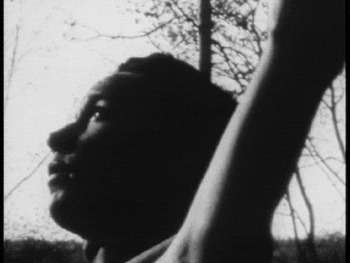
Beatty is next shown apparently rising above the ground, his body facing the camera and his arms outstretched. His slender body and elongated limbs appear to mimic the willowy trunks of the birch trees, establishing an affinity between the dancer and his surroundings. The camera pans upwards and catches Beatty's face in close-up (see Figure 1). The blankness of the dancer's countenance encourages readings of mind–body divisions, potentially positioning Beatty's art as mindless. Yet Beatty's physical composure also invokes the impassive facial expressions adopted by bebop musicians and therefore can be read as a deliberate negation of the exaggerated expressions of minstrelsy-derived representations of black performers. It enables Beatty to present a sense of inner calm that offsets erotic readings and emphasizes his harmonious relationship with his environment.
Beatty's blank expression in the opening section. A Study in Choreography for Camera (1945).

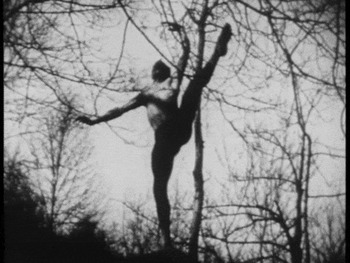
A long shot then captures Beatty in full view as he lowers himself using just his knees and leans backwards whilst keeping his spine erect so that his calves become perpendicular to the rest of his body. Positioned next to one of the trees, he imitates its strength to assert his corporeal power. In a display of striking self-control and physical prowess, he draws his knees almost to the ground before he arches his back and raises one leg in the air whilst balancing on the other (see Figure 2). He lifts his leg to almost its fullest height before bringing his foot down. Then, in a match-on-action editing technique that situates Deren's camera as an active participant in Beatty's dance and imbues the performer with superhuman qualities by suggesting that he can transcend geographical boundaries, he steps seamlessly into an apartment.
Beatty raising his leg in the air in the forest. A Study in Choreography for Camera (1945).

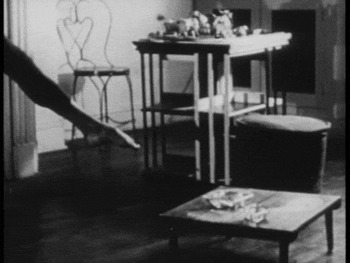
Beatty stepping into the apartment. A Study in Choreography for Camera (1945).
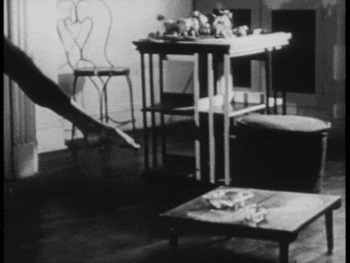
Close-ups of Beatty's foot, together with such an arresting spatial transition, compel the audience to follow the movement of the dancer into the apartment (see Figure 3). Deren's application of a match on action, a highly innovative technique in the 1940s, evidences her attempt to devise a cinematic method that would enable film itself to “dance,” and she described the production as “an effort to remove the dancer from the static space of a theatre stage to one which was as mobile and volatile as himself.”Footnote 33 Beatty's relationship with his environment can also be read as a specific reference to the historic experiences of vodou practitioners, which, Deren noted, consisted of a “relatively heterogeneous amalgam which has undergone a violent cultural and geographic transplantation.”Footnote 34 The film therefore creates interplay between dancer and camera which allows Beatty to show off his artistry at the same time that the psychological significances of his actions are explored.
Deren originally intended to include a prepared piano composition by John Cage alongside Beatty's performance.Footnote 35 Cage had appeared in Deren's second film, At Land (1944), and his aurally distorted, percussive piano technique had redefined modern dance composition, not only in the work of his life partner, Merce Cunningham, but also in pieces for the early black modern dancers Pearl Primus, Wilson Williams and Dunham Company member Syvilla Fort. Deren's plan to work with Cage underscores Study's cross-cultural and ritualistic purposes. Through her involvement with the Dunham Company, Deren is likely to have known that Cage's first prepared-piano composition, Bacchanale (1940), was a collaboration with Fort based on a fusion of Euro-American and Caribbean dance.Footnote 36 Deren hoped to use sound “as an element in its own terms which, when brought together with the visual image, will create a synthesis – an effect which is different in quality from both the visual image and the sound image.”Footnote 37 As with her concept of depersonalization, Deren intended to fuse sound and image to create a sensory effect that was greater than its individual components, suggesting that she meant to invoke the heightened emotional state of a vodou ritual.
Deren sought to break down racialized-looking relationships and artistic hierarchies by compelling her audiences, who were originally composed primarily of members of New York's Euro-American art scene, to experience visually the psychological profundity of black diasporic religious practices. In notes found with her shooting script for Study, Deren claimed, “Movements should be rather an extension and perfection of a normal movement so that [the] audience is kinaesthetically identified with them, under [the] illusion that they too are capable of it.”Footnote 38 A close-up of Beatty reveals his muscular frame as he arches forward and twists his arm around his body. He repeats his action and his head and shoulders are shown again, as if time is repeating itself for the camera. In this instance of identification with the dancer, the audience feels, because it sees closely and repeatedly, the action of Beatty's muscles and the momentum of his limbs. The film's depiction of Beatty's dancing body adheres to Deren's notion of vertical film, which sought to explore in-depth the quality of cinematic moments in order to convey what such moments felt like or meant.
Beatty had worked previously in Hollywood with Dunham and Janet Collins, where his artistry was consigned to racially segregated musical numbers. Beatty and Deren's collaboration establishes an intimate aesthetic relationship between camera and dancer that challenges such distancing. Cinematic techniques, including jump cuts and matches on action, make the camera an active participant in the dance in a film intended to celebrate the ritualistic significance of Beatty's movements. Deren's presence as filmmaker and Beatty's status as subject upend traditional gendered looking relationships identified by Laura Mulvey, in which the role of women in cinema was to be “simultaneously looked at and displayed,” and thus to be passive objects for the consumption of male voyeurs.Footnote 39 Equally, Beatty and Deren's co-authorship disrupts the “imperialist gaze” of early ethnographic cinema. Beatty's semi-nakedness does recall the historical erotic objectification of black bodies in the visual arts, appearing to reduce him to a sexual fantasy founded on perceived difference. However, Deren claimed to have conceived Study as a deliberate counternarrative to racist representations of black performers in contemporary US culture. In a letter to Beatty, Deren wrote, “I thought it important that this was one of the rare cases when a Negro was presented, not as and because he was a Negro, but purely and simply because he was an artist.”Footnote 40 The film's incorporation of ballet ruptures racialized artistic hierarchies by linking Beatty's performance to European art. His symbiotic relationship with the camera also allows him to resist the role of passive spectacle; instead, he appears to be directing what the camera and viewer see. Figure 4
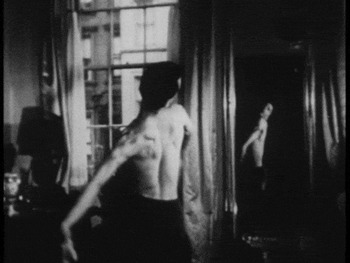
Beatty looking in the mirror. A Study in Choreography for Camera (1945).

.
Beatty spies himself in a mirror in an act of shared viewing that troubles racialized looking relations and subject–object positions still further, as it represents a brief moment in which the performer and audience simultaneously admire the dancer's physique (see Figure 4). As the camera's eye represents the viewer's eye, the latter is compelled to experience the camera's “movements” and therefore to internalize them. Thus the viewer is caught in a psychological relationship with the dancer because they are not just watching the movements but feeling them too. Independent filmmaker Shirley Clarke, writing in 1967, indicated that she was affected in such a way by Study. Clearly identifying with the dancer, she recalled that “your sense of crossing eons of time and worlds of space was astounding.”Footnote 41
Beatty turns from the mirror, and the camera cuts yet again to create the impression that he has been magically transported to the Egyptian Hall of New York's Metropolitan Museum of Art. By occupying such a space, Beatty appears to take on the status of a living museum object, a position that once again recalls a wider history of ethnographic display. However, Deren's experimental cinematic technique, together with Beatty's dancing, complicates such a reading. Beatty's constantly moving body resists representational fixity, whilst his balletic technique demonstrates “classical” artistry and evidences control over his environment. As Beatty crosses the museum space, Deren uses a wide-angle lens to exaggerate the scene's perspective and create the impression that Beatty is able to travel a vast distance in a short period. The sequence exemplifies Deren's belief that, by dancing, a person achieves a more magical relationship with space, and she claimed that, in making the film, she “wanted to put the entire world at the feet of the dancer,” thereby enabling Beatty to cross cultural and racial boundaries.Footnote 42
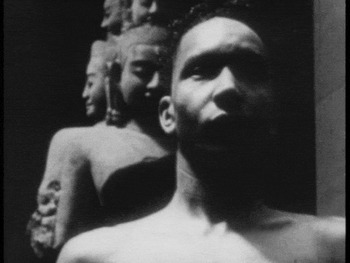
As Beatty returns to the front of the museum space, he chaînés, or turns, three times before appearing to execute an impossibly long pirouette. The movement is another cinematic effect, which once again positions the camera as an active element in Beatty's dance. Beatty is in fact performing a dervish turn, a meditative exercise practised by Mevlevi orders in Turkey as a means of achieving religious ecstasy. To create such an illusion, the camera does not reveal Beatty's body as he dances; instead, the focus shifts to his concentrated expression. Beatty's head is positioned in front of the museum's eight-faced bust of the dancing Buddhist deity Hevajra, making it appear as if it is one of its many faces (see Figure 5). In “Religious Possession in Dancing,” which was written whilst Deren was still working with the Dunham Company, the filmmaker sought to challenge crude depictions of states of heightened emotional intensity achieved in vodou by equating them with cultural beliefs still held in high esteem. She remarked that
the phenomenon of concentration upon an imaginative concept to a high degree of intensity [as embodied in ritual possession] has been shunted into the province of abnormal psychology as “delusion.” At the same time, “inspiration” and “insight” have retained their validity; while Spinoza's philosophy, Chinese civilization (which owes so much to Buddha), the revelation on Mt. Sinai, the visions of the saints – all of these substantial contributions to the complex of beliefs and mores which constitute our own culture – all of these have retained their prestige.Footnote 43
The association of Beatty with a dancing Buddhist deity is therefore a deliberate assertion of the philosophical implications of his performance. Thus the scene's purpose is to break down cultural hierarchies by claiming Beatty's work as “high” art and recovering the psychological significances of disregarded cultural practices such as vodou. Beatty's spin cycle is edited to appear almost endless and even to speed up, two feats that would be impossible in a real pirouette. His seemingly superhuman action creates a trancelike effect and his proximity to the camera has a hypnotic quality, once again making the viewer a participant in his ritualistic display.
Beatty “pirouetting” in front of the Buddha statue. A Study in Choreography for Camera (1945).

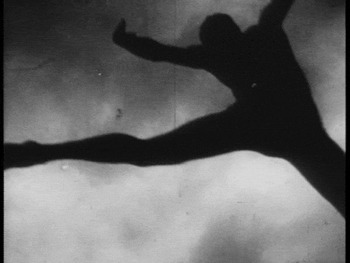
The camera cuts again and Beatty returns to the outdoors, shifting apparently effortlessly from his endless spin into a powerful grand jeté, a long horizontal jump in ballet. His movement is once more constructed as superhuman, as his body rises far from the ground and the audience sees only the pinnacle of his leap, not the exertion of his takeoff. In reality, the action was filmed backwards, with Beatty dropping from a height. According to Deren, such a method was adopted to give the impression that the dancer was rising “with the same quality of release and ease with which a balloon mounts when it is suddenly freed.”Footnote 44 Beatty's action therefore positions him as a figure in command of time and space. Such a depiction enables him to escape sociological constructions of black subjects in favour of heightened emotional experience. The action is extended by the camera, which shows the jump repeatedly from different angles. By lengthening the movement in this way, Deren underscores its psychological intensity whilst simultaneously emphasizing the dancer's strength, power and physical beauty.
Silhouette of Beatty in the air. A Study in Choreography for Camera (1945).

Beatty is captured in shadow during the act (see Figure 6). His body is thus reduced to an abstraction, a construction that recalls the troubling racial history of the silhouette. In the eighteenth century, the silhouette was used as a means of identifying enslaved men and women who tried to escape their bondage. Early Swiss physiognomist Johann Kasper Lavater also used its imprint as “evidence” for his theory that moral difference was based on physical attributes, anticipating the racist thinking of physical anthropology. But the construction of Beatty's body resists associations with such a history. Instead of a distorted image, the audience witnesses Beatty's graceful actions and well-defined physique. Beatty's frame is both powerful and lean; he displays a carefully developed musculature acquired through years of dance training, countering crude pictorial distortions of black men's physicalities. The silhouette's one-dimensional aspect also renders Beatty's identity ambiguous, forcing the audience to engage with the physical perfection of his body without regard to racist preconceptions. The camera devotes particular attention to the suppleness of Beatty's upper body and hand, an action that reinforces the grace of his movements and undermines commodified and sexualized constructions of black men's bodies still further.
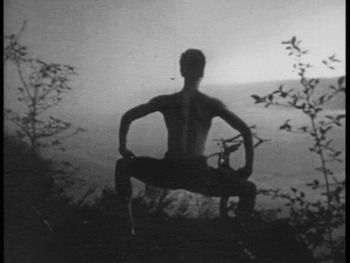
Beatty landing in second position – final shot. A Study in Choreography for Camera (1945).
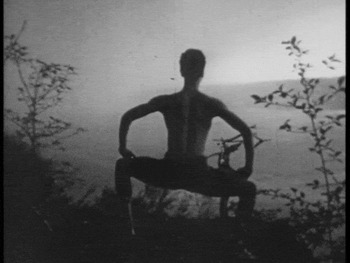
Eventually, Beatty lands perfectly at a high point overlooking a seascape, his feet turned out in second position, his knees bent and his arms outstretched (see Figure 7). His back is facing the camera and his bent knees show off his muscular thighs and calves. In this, the final shot in the film, Beatty's body is once again on display to the viewer; yet the audience is forced to acknowledge his physical strength and balance. In her production notes, Deren indicated that Beatty was meant to occupy a “quiet but strong position,” and he rests his hands on his knees in contemplation, his body in harmony with its surroundings.Footnote 45
Study represents an early cinematic attempt to cross cultural boundaries and to assert a black dancer's place as artist and film as art. Beatty's performance is carefully framed by Deren's experimental filmmaking, while close-ups situate his body as the site of a ritualistic encounter between camera and viewer. Further, the film's temporal limitations allow audiences only a very brief sense of Beatty's artistic talents. Nevertheless, his carefully controlled performance and mastery of balletic technique negate dominant cultural constructions of black performers as unschooled entertainers. Deren's conflation of vodou with more widely esteemed cultural beliefs such as Buddhism, and her implication of the viewer in Beatty's movements, undermine such constructions still further, creating an intimate visual relationship between the dancer and his audience. The film shows how Beatty and Deren sought to upend racial and artistic binaries by blurring cultural forms and identities, thus presenting a cinematic vision of black subjecthood that could be read as “high” art. As a film that upends racialized looking relationships, Study is a riposte to racist perceptions of performance and religious cultures and thus a historically significant moment in 1940s cinema in which the artistry and psychology of a black male dancer's movements were afforded centre stage.