1 Introduction
This paper proposes a new analysis of certain lenition and fortition phenomena. The terms lenition and fortition have been used to describe an extremely broad class of phonological patterns; one claim of the current paper is that this class includes at least two sets, which are phonetically and phonologically distinct and thus require different analyses. They are referred to here as loss lenition and continuity lenition. The term loss lenition is meant to suggest the loss of length, features or gestures; it also often entails the loss of one or more contrasts. It generally targets consonants or contrasts in perceptually weak positions, such as the ends of prosodic domains. Debuccalisation (e.g. [k’]→[ʔ]) is an example of loss lenition. The term continuity lenition is meant to suggest that consonants are realised so as to minimise the auditory disruption they create in the context of high-intensity sounds. By hypothesis, these phenomena are driven by preferences for preserving auditory continuity inside prosodic constituents and maximising auditory disruption at the edges of constituents. Continuity lenition often targets consonants in perceptually strong positions, for example between vowels. Unlike loss lenition, it rarely neutralises contrasts that are present elsewhere in a language; instead it is generally accompanied by domain-initial fortition. Spirantisation (e.g. [k]→[x]) is an example of continuity lenition.
This paper proposes that the two types of lenition are driven by different sets of constraints. Loss lenition has no special status in phonology; it is a label for a set of phenomena that do not share the special formal and functional properties of continuity lenition. As such, it is driven by whatever constraints drive other kinds of positional neutralisation or allophonic patterns. There is no shortage of proposals in the literature for what kinds of constraints these may be; I briefly discuss this in §3.
Continuity lenition, on the other hand, cannot be accurately described using any previously proposed constraint family. All previous proposals predict that positional neutralisation should be a pervasive consequence of continuity lenition, but it is not. I introduce a new family of boundary-disruption constraints, which call for points of auditory disruption to occur at and only at prosodic boundaries of a particular strength. In this theory, continuity lenition is simply any pattern driven by boundary-disruption constraints. These constraints are unusual in marking one set of segments in one prosodic context and the complement of that set in complementary contexts; for instance, one such constraint favours stops at prosodic boundaries, while continuants are favoured internally. This property predicts that allophonic variation should be the norm in continuity lenition, with positional neutralisation being severely restricted. The typological claim advanced in §2 and §4 is that continuity lenition involving a single feature never neutralises contrasts in the absence of some confounding positional factor. The principal ‘confounding factors’ alluded to in this statement are prosodic prominence (stress/accent) and whether a particular morpheme is a root or affix.
Several of the generalisations taken up here have been proposed in one ‘corner’ of the phonetic or phonological literature on lenition, without having much impact on other areas of the literature. One goal of the current paper is to provide a better theory of lenition by uniting these disparate threads. Loss lenition and continuity lenition occur in different positions, involve different features and affect contrast differently, because they result from different types of constraints: markedness and positional faithfulness in the case of loss lenition; constraints on the perceptual properties of prosodic systems in the case of continuity lenition.
The paper is structured as follows: the remainder of this section introduces relevant background about contrast, lenition and positional factors, and §2 presents a typological overview and analysis of continuity lenition, §3 more briefly discusses loss lenition, §4 discusses cases of apparent neutralising lenition and §5 examines the theoretical and empirical implications of the analysis.
1.1 Allophony and neutralisation
All theories of phonology share a fundamental prediction about features and contrast: if some process or constraint has the effect of changing a feature, and if that feature is contrastive in some language, then the process or constraint can neutralise a contrast in a language where the relevant feature is contrastive. This eminently sensible claim is rarely explicitly acknowledged, because it seems to self-evidently reflect a basic feature of phonology: allophonic processes have neutralising counterparts and vice versa. This is illustrated in (1) with pre-/i/ palatalisation, but many other common phonological phenomena would suffice to make the point.
-
(1)

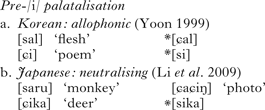
The Korean pattern suggests a rule that changes /s/ to [ɕ] before /i/, or a markedness constraint against [si] sequences. Alveolar and alveopalatal fricatives happen not to contrast in Korean, so the pattern is allophonic. If, instead, alveolar and alveopalatal fricatives contrasted before other vowels, this process would result in positional neutralisation before [i]; this is precisely what we see in Japanese. The rule or constraint responsible for this pattern refers to the feature [anterior], which distinguishes /s/ and /ɕ/, but does not contain any reference to the contrastiveness (or lack thereof) of [anterior]. The process ‘doesn't care’ whether it results in neutralisation.
I show in this paper that continuity lenition is a prima facie counterexample to this basic prediction of phonological theory. Intervocalic voicing of [p] to [b], for instance, is always allophonic, and never neutralises a voicing contrast available in word-initial position. Other continuity-lenition phenomena are similar (though a few exceptions are discussed in §4). In other words, the processes that occur in a language are not independent of the system of contrasts in that language: some processes (e.g. intervocalic voicing) systematically fail to occur in languages with certain systems of contrast (e.g. voicing contrasts). This is problematic for linguistic theory. In §2, I attempt to resolve the problem by linking the realisation of both initial and medial consonants to a single constraint family. This analysis essentially says that continuity lenition is ‘special’ because it pertains not solely to properties of individual segments, but to the global implementation of prosodic structure.
1.2 The nature of lenition
The term lenition is used to refer to a wide array of synchronic and diachronic phenomena; the literature is enormous, and goes back decades, if not centuries. I do not attempt a comprehensive review here. Honeybone (2008) gives an extremely detailed history of the terminology and ideas surrounding lenition; Kirchner (Reference Kirchner1998) and Gurevich (Reference Gurevich2003) offer review chapters concerned with empirical and theoretical details of more recent literature. This section focuses on aspects of lenition that will be particularly relevant in the current context: the phonetic and functional nature of lenition, and the question of whether lenition is a unified phenomenon.
To know how lenition works, we must first agree on what it means. Although there is a fair bit of variation in how the term is used, most researchers agree on certain core phenomena that ‘count’ as lenition: these include at least the processes listed in (2).
-
(2)
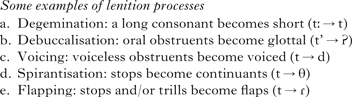
Why do we have a single name for this collection of processes? Some phonetic or phonological proposals treat the collection as unified. For instance, some approaches characterise all lenition phenomena as reduction. One sense of ‘reduction’ would be coming closer to non-existence, and Hyman (Reference Hyman1975) quotes Theo Vennemann's description of lenition: ‘a segment X is said to be weaker than a segment Y if Y goes through an X stage on its way to zero’. This could be understood as referring to either diachronic or synchronic phenomena: all lenition processes have a unified characterisation as involving movement along a scale that ends in zero. This notion finds a parallel in the feature-geometric notion of node delinking and in element theory, where lenition is the loss of privative features (Harris Reference Harris1990, Ségéral & Scheer Reference Ségéral and Scheer1999). Debuccalisation, for instance, is the deletion of supralaryngeal place features or delinking of the place node; if we continue deleting or delinking, we will eventually be left with a null segment.
These are abstract, phonological notions of lenition. The phonetic nature of the phonological entities being lost is not really relevant: lenition is simply the loss of any phonological material, by definition a phonological step on the path to zero. Noting weaknesses in this approach, other researchers have attempted to ground the notion of weakening or reduction in physical terms. Kirchner (Reference Kirchner1998) provides one such analysis: lenition is any phonological phenomenon that results from a reduction in articulatory effort. This is a unified theory of lenition in both phonetic and phonological terms: lenition phenomena are driven by grammatical constraints that refer to levels of physical effort; this constrains the set of possible languages, because if any less effortful structure is subject to lenition then so are all more effortful structures. In this approach, spirantisation of a stop to a fricative between two vowels, for example, occurs because the constriction target for the fricative, being wider than for the stop, is closer to the targets for the flanking vowels, and moving to and from that target is therefore less effortful. If a stop lenites to a fricative adjacent to a word boundary or consonant, where movement to a stop closure would be less effortful, then it must also lenite between two vowels, where the movement would be more effortful.
Kingston (Reference Kingston, Colantoni and Steele2008) provides strong arguments, both a priori and empirical, that this effort-based conception of lenition is wrong, at least for voicing and spirantisation. The a priori arguments concern the notion of effort: the difference between stop and fricative articulation is one of millimetres, and the difference in effort would be negligible; furthermore, the increased precision required for a fricative may well be more effortful than for a stop, which is free to overshoot its target. Kingston's empirical arguments concern distinctions in triggering environments for lenition: because the articulatory differences in stricture between various consonants are small compared to the differences in stricture between vowels, then, if lenition is sensitive to articulatory distance, lenition processes should be sensitive to the height of surrounding vowels more often than they are sensitive to the stricture of surrounding consonants. Kingston shows that the opposite is true: lenition frequently applies adjacent to some consonants but not others, while Kirchner's few examples of sensitivity to the height of surrounding vowels are, Kingston argues, either illusory or subject to different analyses.
Kingston's proposal for what is relevant to lenition will figure prominently in this paper: he proposes that lenition and fortition are two sides of the same coin, decreasing intensity at the edges of prosodic constituents and increasing intensity within those constituents. For instance, voiced stops are more intense than voiceless stops, fricatives and approximants are more intense than stops, and vowels are generally the most intense segments. Intervocalic voicing and spirantisation can thus be characterised as rendering consonants more similar to surrounding vowels in terms of intensity, and therefore less disruptive in the context of those vowels. Fortifying or failing to lenite at the beginning or end of a constituent will render consonants in these positions less like vowels in terms of intensity than their lenited counterparts would be, and thus more disruptive. This is the source of the term ‘continuity lenition’ proposed in this paper: these types of lenition are primarily organised to preserve auditory continuity within prosodic constituents.
The motivation behind this pattern is that it aligns auditory disruptions with constituent boundaries, and lack of disruption with lack of boundaries, which plausibly helps a listener detect where the boundaries are. This general idea has precursors in the work of Harris (Reference Harris, Solé, Recasens and Romero2003) and Keating (Reference Keating, Harrington and Tabain2006). Although there has been little experimental work on how these particular features contribute to listeners’ perception of continuity and disruption, there is a large literature showing that allophonic variation in general can be helpful during word segmentation. Infants as young as 10.5 months can use allophonic patterns such as coarticulation (Johnson & Jusczyk Reference Johnson and Jusczyk2001) and stop non-release (Jusczyk et al. Reference Jusczyk, Hohne and Bauman1999) to aid word segmentation. Adults also use allophonic patterns to aid in word segmentation (Nakatani & Dukes Reference Nakatani and Dukes1977). Prosodically conditioned duration variation such as final lengthening assists word segmentation (Saffran et al. Reference Saffran, Newport and Aslin1996, Bagou et al. Reference Bagou, Fougeron, Frauenfelder, Bel and Marlien2002); I suggest in this paper that contextual duration variation is a central component in some lenition processes.
1.3 The two kinds of lenition
While this explanation seems promising for processes like spirantisation and voicing, there are many other phenomena that are sometimes referred to as lenition but have completely different phonetic and phonological properties; this residue is what I refer to as loss lenition. Work from the last 20 years has shown that the two kinds of lenition can be distinguished phonologically.
Ségéral & Scheer (Reference Ségéral and Scheer1999) were to the best of my knowledge the first to point out that some types of lenition, such as spirantisation and voicing, frequently occur intervocalically to the exclusion of other contexts, while other types, such as debuccalisation and liquid gliding, do not single out intervocalic position, but frequently occur in coda position to the exclusion of other contexts.
Subsequent research has produced a substantive view of this split (Ségéral & Scheer Reference Ségéral, Scheer and de Carvalho2008, Szigetvári Reference Szigetvári and de Carvalho2008). Smith (Reference Smith and de Carvalho2008), for instance, proposes that processes that typically occur in syllable-, word- or phrase-final position involve a reduction in phonological markedness, while those that typically occur in medial position involve an increase in sonority. Although I largely agree with the divisions Smith makes, I do not agree that the notion of intensity which is relevant to lenition is the same as the one relevant to sonority phenomena. The idea that lenition progresses along the same scale relevant to sonority phenomena is proposed by, among others, Smith (Reference Smith and de Carvalho2008), Kingston (Reference Kingston, Colantoni and Steele2008) and Bye & de Lacy (Reference Bye, de Lacy and de Carvalho2008). I briefly digress to explain why this seems implausible.
Kirchner (Reference Kirchner1998) and Szigetvári (Reference Szigetvári and de Carvalho2008) argue that the scales involved in lenition are not the same as those involved in sonority phenomena. One problem is that nasals clearly participate in sonority phenomena, while lenition never results in alternations between nasal and oral consonants. A second problem relates to obstruents. Szigetvári (Reference Szigetvári and de Carvalho2008) notes that lenition frequently distinguishes between various obstruents, while sonority sequencing rarely does. In my view, the problem is even worse: at least one scalar relation must be reversed between the two domains. If we take typological asymmetries in complex onset ‘reversibility’ (i.e. the sonority sequencing principle) to be a diagnostic of sonority, voiceless non-sibilant fricatives come out lower in sonority than voiceless stops.Footnote 1 Many languages allow voiceless fricative–stop onsets while disallowing stop–fricative onsets, e.g. Muniche (Michael et al. Reference Michael, Farmer, Finley, Beier and Sullón Acosta2013), Takelma (Sapir 1912), Yatée Zapotec (Jaeger & van Valin Reference Jaeger and van Valin1982) and Camsa (Howard Reference Howard and Elson1967). The opposite pattern is extremely rare: Nivkh (Shiraishi Reference Shiraishi2006) is the only example of which I am aware. Yet voiceless fricatives are often the result of leniting voiceless stops, as in Tiberian Hebrew and Kupia (Gurevich Reference Gurevich2003). This argues against conflation of the concept ‘sonorous’ with ‘lenis’.
In what follows, the primary diagnostic criterion for continuity lenition is the position in which it occurs: continuity lenition always targets intervocalic consonants, and lenition processes targeting intervocalic consonants (to the exclusion of others) are always continuity-based. Note that many continuity lenition processes target medial consonants in positions in addition to intervocalic ones. A secondary criterion is the realisation of medial consonants as less disruptive, in a sense to be made more precise in §2. It is not always immediately apparent what does and does not ‘count’ as continuity lenition. In particular, features involved in continuity lenition, such as voicing and continuancy, are sometimes targeted by processes that are not continuity lenition. Some cases are discussed in §4.
1.4 Lenition and contrast
A final claim that serves as a starting point for this paper is that lenition rarely neutralises a contrast in one position if it is found in another position in the same language. Gurevich (Reference Gurevich2003) documents this tendency with an impressive cross-linguistic survey of lenition and contrast. I argue in this paper that, because Gurevich does not distinguish between continuity and loss lenition, she cannot capture part of the generalisation: loss lenition is as likely as any other process to result in positional neutralisation, but the number of neutralising cases of continuity lenition is vanishingly small, and corresponds to the exceptions predicted by boundary-disruption (BD) constraints.Footnote 2 Using a fairly expansive definition of lenition and a fairly restrictive notion of neutralisation, Gurevich gathers 230 lenition processes from 153 languages, classifying 8% of them as neutralising. Gurevich's survey is heavily skewed towards continuity lenition, but almost all of the neutralising cases she discusses are loss lenition (or processes like voicing assimilation that most researchers wouldn't label as lenition). She finds no neutralising cases of voicing or tapping; four continuancy alternations are classified as neutralising, but I argue in §4 that these are different from spirantisation lenition.
The main claim of this paper, then, is that a cluster of properties in three different domains distinguishes between loss lenition and continuity lenition: the former involves the loss of features or segments, is most likely in perceptually weak positions and may neutralise contrasts; the latter involves increased intensity and/or decreased duration, is most likely between vowels and rarely neutralises contrasts licensed in other positions. This last fact is particularly troubling, because phonological theory predicts that every allophonic process has a neutralising counterpart. I argue here that Kingston's hypothesis helps solve this problem: because continuity lenition indicates that a prosodic boundary is not present, it is most useful when coupled with a strategy for indicating when a boundary is present, i.e. fortition. If constraints refer directly to this motivation, the allophonic nature of continuity lenition is explained.
2 Continuity lenition and boundary marking
2.1 The typology of continuity lenition
The distinguishing characteristics of continuity lenition are that it often targets consonants in intervocalic position to the exclusion of consonants in other positions, and that it results in consonants that are shorter and/or more intense than their counterparts in other positions. The two most frequent types of continuity lenition are spirantisation and voicing; these are briefly illustrated below.
In the literature on lenition, the term ‘spirantisation’ has been used for the alternation of stops in one context with either fricatives or approximants in another context. This is illustrated with data elicited from two Venezuelan Spanish speakers in (3); the pattern is similar across many varieties of Spanish (Harris Reference Harris1969, Baković Reference Baković1997).
-
(3)

Voiced stops are in complementary distribution with approximants. Stops appear at the beginning of a phonological phrase, as in (a). Between vowels, approximants or glides, we find continuants, as in (b, c). Following a nasal, only stops appear (d), and the coronal remains a stop following /l/ (e). Finally, clusters of two voiced obstruents, which are fairly rare in Spanish, are generally described as continuants, as in (e) (Harris Reference Harris1969, Baković Reference Baković1997). Our elicitation suggests, based on the presence or absence of audible stop bursts, that all combinations of stop and continuant in either position are possible, but stops in both positions do often spirantise. The only voiced stop that appears word-finally, and thus phrase-finally, in Spanish is the coronal, as in (f). In this position, it is somewhat difficult to characterise phonetically: it displays neither an audible release nor any period of frication; preceding a vowel in a following phrase it is often heavily glottalised (this dialect inserts glottal stop in vowel-initial phrases). The non-glottalised realisations are consistent with an unreleased voiced stop or an extremely short approximant.
Ondarroan Basque shows a nearly identical pattern to Spanish (Saadah Reference Saadah2011). Kinande also spirantises voiced stops between vowels and glides, but not after nasals; this is illustrated in (4) with data elicited from a native speaker.
-
(4)

Note that consonant–glide and nasal–stop sequences are the only clusters in this language. In phrase-initial and medial post-nasal positions (a), voiced stops surface. But when a vowel occurs before the relevant consonant, due to affixation or lexical variation (b), continuants appear instead. While (4) is meant to show alternations, the most obvious evidence for spirantisation in Kinande, as in Spanish, is the complementary distribution of voiced stops and approximants.
Similar patterns of spirantisation (sometimes limited to specific places of articulation) occur in Badimaya (Dunn Reference Dunn1988), Shina (Schmidt & Kohistani Reference Schmidt and Kohistani2008) and Japanese (Kawahara Reference Kawahara2006). These data illustrate several widespread cross-linguistic characteristics of spirantisation. It is most frequently observed between vowels and sonorant consonants, less frequently in medial clusters and final position, and is often blocked following nasals. It rarely results in positional neutralisation of contrasts found elsewhere in a language. Kirchner (Reference Kirchner1998), Lavoie (Reference Lavoie2001) and Gurevich (Reference Gurevich2003) provide brief descriptions of dozens more spirantisation phenomena, which overwhelmingly conform to this characterisation.
In voicing lenition, voiceless stops in initial position alternate with voiced stops elsewhere. This is illustrated in (5) ,with an optional alternation from Sanuma (Borgman Reference Borgman, Derbyshire and Pullum1990). Stops (and the alveolar affricate) do not contrast for voicing in any position in Sanuma: voiceless unaspirated stops appear word-initially, and voiced stops appear optionally elsewhere.
-
(5)
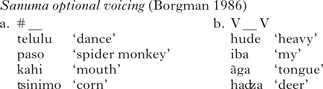
Because Sanuma is largely a CV language, the ‘elsewhere’ condition is intervocalic. A similar optional intervocalic voicing phenomenon is described in Urubu-Kaapor (Kakumasu Reference Kakumasu1986). Voicing lenition in a language with more complex phonotactics is illustrated in (6) with data from Chungli Ao. The pattern is shown only for the velar stop; it is identical for the labial and coronal stops and the palatal affricate (Gowda Reference Gowda1975). Word-initially, voiceless aspirated and unaspirated stops are in free variation (a), while voiced stops appear between vowels and sonorant consonants (b). Clusters of obstruents are voiceless unaspirated (c), and word-final stops are described as unreleased and voiceless (d).
-
(6)
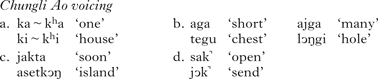
It is not clear from the description whether obstruents following a vowel and preceding a sonorant are voiced; this context would fall under the elsewhere condition given for voiceless stops, but it is not specifically discussed, and the only examples of words with such clusters are given in phonemic transcription, which ignores allophonic voicing. Popjes & Popjes (Reference Popjes and Popjes1986) describe a very similar pattern in Canela-Krahô, although there is some ambiguity in their description of the environment (hinging on whether the term ‘voicing’ in the descriptions ‘preceding voicing’ and ‘following voicing’ is meant to include vowels).
These examples illustrate several generalisations about voicing lenition. It most often targets intervocalic consonants, resulting in complementary distribution between voiced intervocalic obstruents and voiceless initial ones. It also sometimes affects obstruents adjacent to liquids, glides and nasals. Unlike spirantisation, we have no cases where voicing lenition extends to final obstruents or through clusters of obstruents. The theoretical proposal in §2.5, however, does not attempt to ‘hardwire’ this restriction into phonology; the sample is not large enough to conclude that it is a systematic typological fact. Kirchner (Reference Kirchner1998), Lavoie (Reference Lavoie2001) and Gurevich (Reference Gurevich2003) provide brief descriptions of many more voicing phenomena which overwhelmingly conform to the generalisations given here (although not as many as spirantisation, which seems to be more common).
2.2 The problem with continuity lenition
There has been an enormous amount of work on the analysis of lenition, using many different formal devices: positional markedness (Smith Reference Smith and de Carvalho2008), positional faithfulness (Kingston Reference Kingston, Colantoni and Steele2008), articulatory constraints (Kirchner Reference Kirchner1998), the dispersion theory of contrast (Kaplan Reference Kaplan2010) and government phonology (Ségéral & Scheer Reference Ségéral, Scheer and de Carvalho2008, Szigetvári Reference Szigetvári and de Carvalho2008) are all represented in this literature. While all of these approaches offer interesting data, insights and analysis, I argue that they share a problematic feature: both lenition and fortition may be neutralising, and there is no implication between the two. If my claim about the near-absence of neutralising continuity lenition (and its inverse fortition) is correct, then none of these approaches can describe the facts correctly. I illustrate this with a simplified version of Smith's (Reference Smith and de Carvalho2008) positional markedness theory, because her proposal is laid out in an admirably clear and precise manner. The same general logic applies to the other approaches mentioned above, while details obviously differ. The basic constraints driving lenition and fortition are shown in (7).
-
(7)

Positional markedness constraints drive voicing lenition between vowels and devoicing fortition in syllable onsets. Voicing specifications are protected by faithfulness. It should be clear that if the lenition and fortition constraints dominate faithfulness, segments always lenite and fortify in the relevant positions, and the result is allophony. Equally clear is that if a faithfulness constraint dominates both lenition and fortition constraints, segments will never change their underlying voicing specifications, and the result will be contrasts in all positions. What particularly interests us here is the two other possible configurations, where faithfulness is ranked between lenition and fortition.
These are illustrated schematically in (8) and (9). In (8), stops contrast for voicing initially, but neutralise to voiced between vowels.
-
(8)
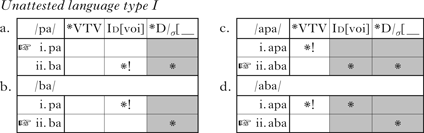
In (9), stops contrast for voicing in the coda, but neutralise to voiceless in the onset.
-
(9)

Although hundreds of cases of continuity lenition have been described, these language types are virtually unattested. A handful of cases resembling (8) are discussed in §4 and given different analyses. I am not aware of any languages like (9), which preserve laryngeal contrasts in preconsonantal and domain-final position while neutralising them elsewhere. As long as there are two positional constraints (markedness or faithfulness), with a general constraint of the other type ranked between them, however, patterns like (8) and (9) are always possible outcomes.
Although the discussion here is couched in OT terms, this is not an OT problem: the absence of positional neutralisation is problematic for all existing theories. In an approach where lenition is a default fill-in rule (Jacobs & Wetzels Reference Jacobs, Wetzels, van der Hulst and Smith1988), one must explain why these cross-linguistically common rules differ from others precisely in that they are always default rules. In government phonology (e.g. Ségéral & Scheer Reference Ségéral and Scheer1999) or element theory (Harris & Urua Reference Harris, Urua, Faulkner, Rosen and Holland2001), one must explain why prime deletion only targets primes that are not contrastive in other positions. And under the hypothesis that lenition is blocked from diachronically entering a language by contrast maintenance (Gurevich Reference Gurevich2003), one must explain why lenition differs from other sound changes (e.g. final devoicing) in this respect.
I claim that the analysis of continuity lenition ought not to display the formal properties that allow positional neutralisation. How can such predictions be avoided? Note that the rankings for attested languages are those where lenition and fortition constraints are ranked the same with regard to faithfulness; in unattested languages, they are differently ranked with regard to faithfulness. This suggests a formal solution: there is only one constraint enforcing both lenition and fortition. If lenition and fortition constraints are not separate, then they can't be ranked on either side of an intervening faithfulness constraint. To illustrate this point, I use a temporary ‘placeholder’ constraint, LenFort, leaving its content unspecified until §2.3. For now, the only important point is that LenFort militates against both lenited consonants in initial position and unlenited consonants in medial positions.
The interaction of this constraint with faithfulness is illustrated in (10) and (11). With regard to any given lenition process, these two constraints only derive two language types. In (10), lenition obtains domain-medially and fortition obtains initially; the result is complementary distribution.
-
(10)
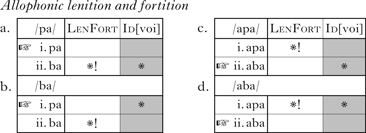
In (11), neither lenition nor fortition obtains; the result is contrast in all positions. I claim that this is essentially the correct typology for single-feature lenitions of the type illustrated here.
-
(11)

Although the unified formalism in (10) seems to be a step in the right direction in terms of analysing continuity lenition, it relies on a formally unusual constraint. LenFort calls for two opposite properties (lenis, fortis) to hold in complementary sets of environments. This is quite unlike most markedness constraints, even positional ones, which mark entities in a single environment. In the next section, I propose a family of constraints that fulfil this unusual function.
2.3 Boundary-disruption constraints
Why would a constraint simultaneously target a feature value in one set of positions and the opposite feature value in the complement set of positions? The strategy of changing feature values from one set of positions to its complement set is, I suggest, useful for delimiting prosodic units. If phonetic realisation is predictable from prosodic position, and vice versa, it is possible to identify prosodic units through their phonetic properties.
Several researchers have proposed that lenition serves precisely such a demarcative function. Harris (Reference Harris, Solé, Recasens and Romero2003) proposes that what makes lenition special is that it renders consonants more similar to the ‘carrier signal’, which is essentially an unobstructed vocal tract; in other words, lenition makes consonants less distinct from the vowels around them. Harris also claims, based on patterns of stem-initial contrast preservation in Ibibio (to be discussed in §4), that lenition tends to make fewer contrasts available internal to prosodic domains. Although the view advanced here has a lot in common with Harris's, it differs on this last point: typological surveys show that continuity lenition is extremely unlikely to neutralise contrasts.
Kingston (Reference Kingston, Colantoni and Steele2008) fleshes out the demarcation idea in a way that has more in common with the formulation here: lenition tends to preserve auditory continuity of the speech stream domain-internally, by making consonants more like the vowels that surround them in terms of intensity. Conversely, fortition tends to disrupt continuity domain-initially, by making consonants less like surrounding. The idea of a demarcative function for ‘strengthening’ is also mentioned in work by Keating and various colleagues (see Keating Reference Keating, Harrington and Tabain2006 for a review).
In this approach, continuity lenition is fundamentally about helping the listener distinguish between the presence and absence of a prosodic boundary. We can think of the relevant constraints as calling for the degree of auditory disruption at any point in the speech stream to match the degree of prosodic juncture at that point. A more specific way of implementing this general hypothesis is illustrated by the constraint schema in (12).
-
(12)

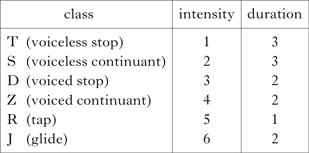
The constraint has three parameters. The P parameter characterises the scalar nature of prosodic boundaries in triggering lenition and fortition: if a boundary at some level triggers fortition, then all higher-level boundaries do as well; if lenition applies across a boundary at some level, then it applies across all lower levels. The I and D parameters deal with the perceptual grounding of the constraints. We do not have a complete, experimentally tested theory of what makes a consonant disruptive in a stream of vowels. But two dimensions that necessarily contribute to disruption, intensity and duration, will suffice to derive all of the lenition patterns discussed here. The assumptions about the relative disruption associated with various consonant classes, based on gross characteristics of intensity and duration, are shown in Table I. This is not meant to be a detailed quantitative model. As such, levels for the phonetic parameters are given in arbitrary small-integer units. The only crucial assumptions embedded in this toy model are the ones concerning relative values. For instance, while it is important for the theory that voiced stops have shorter durations than voiceless ones, it is not important that the former are assigned duration 2 and the latter duration 3.
Disruption indices for major consonant classes.

These disruption indices and the phrasing at and only at in the constraint schema in (12) combine to produce the unusual complementary properties noted in §2.2. For example, the constraint BD(1,3,ω) assigns one mark for every decrease in intensity to level 1 or lower for at least duration 3 (e.g. a voiceless stop) that is not adjacent to a word boundary, and one mark for every word boundary that is not adjacent to such a drop.
There are some complications with the notion ‘intensity of a segment’ that will not be settled here, but are worth calling attention to. Although the periodic component of voiced sounds adds intensity, the aperiodic components of these sounds are generally less intense than their voiceless counterparts. It may be that the relevant notion of intensity here is weighted towards the low end of the frequency spectrum. Although this seems sensible, we simply do not have the kind of phonetic data that would provide reliable evidence for such a hypothesis. Note that the hypothesis would help explain why sibilant fricatives are rare as the output of spirantisation (Kirchner Reference Kirchner1998): while they are generally more intense than other fricatives, the intensity pertains to very high frequencies.
A further difficulty is that the intensity of a segment changes during the course of its articulation. This is most obvious for stops, but is plausibly true for other segments as well. I take the position that something like average intensity over the length of a segment is what is relevant to these constraints. A more principled way of dealing with stops would be to break them down into their component parts, so a voiceless stop might be characterised as intensity 0 for two units of time (closure) and then intensity 2 for one unit of time (burst), for instance. This approach is more complex than is required for the following analyses, so I do not pursue it here.
Different values of I, D and P define a stringency hierarchy (de Lacy Reference de Lacy2002). The idea is that if a BD constraint marks some segment as too disruptive internal to a constituent, then it marks all more disruptive segments as well; the same is true, mutatis mutandis, for constituent edges. Examples are shown in (13). Here and in other cases where duration is not directly at issue, we set the D parameter to 0. This means that any drop to level I for any duration at a boundary will satisfy the constraint, and any such drop for any duration medially will violate the constraint. The D parameter will not become crucial until §2.5.
-
(13)

In (13), strings of segments are shown on the left. Their violations of various BD constraints are shown in the following columns. The constraint BD(2,0,ω), for instance, sets an intensity threshold of 2 or lower that should only appear at a word boundary. Consonants like voiceless obstruents that are at that threshold or lower and do not appear at word boundaries, as in (13a), violate the constraint. The constraint also sets an intensity threshold of 2 or lower that must occur at word boundaries. Consonants like voiced obstruents that exceed the threshold and appear at word boundaries, as in (13b), also violate the constraint.
Some further properties of the analyses that follow are worth outlining here. They are subject to the general OT requirement known as richness of the base: phonological generalisations result from constraints, not from properties of the lexicon. This means that the proposed analyses must derive patterns of allophony in the output regardless of how the relevant features are configured in the input. In practical terms, this means that I present analyses of possible but never realised contrasting forms in every context in what follows. While this entails an unfortunate abundance of tableaux, it is an absolute necessity if the analysis is to have any explanatory power. I often include one or more inactive (low-ranked) BD constraints in tableaux. These are not crucial for the analyses, and can be safely ignored. I include them to illustrate how the stringency hierarchy works; they stand in for the full set of inactive BD constraints.
With the BD constraint family in place, I turn to some analyses of the continuity-lenition patterns presented in §2.1. These patterns are very much the norm, as found in cross-linguistic surveys. In §4, I consider exceptional patterns of neutralising lenition and fortition.
2.4 Continuity lenition in Spanish
Analysing Spanish continuity lenition requires one crucially active BD constraint; I include several more inactive ones for illustrative purposes, as shown in (14).
-
(14)

Recall that voiced stops in phrase-initial position in Spanish are in complementary distribution with continuants in medial positions. The analysis of these facts in (15) is a good illustration of some of the formal properties of this approach. Lenited voiced segments in initial position and unlenited segments in medial position violate BD(3,0,φ), which is high-ranked in Spanish. Initial voiced continuants violate the constraint because phrase-initial boundaries are not aligned with a drop in intensity to 3 or lower. Medial stops violate it because they entail a drop in intensity to 3 that is not aligned with a phrase boundary. These violations of a high-ranked markedness constraint compel violations of faithfulness to continuancy. The result is allophonic continuancy. (15) shows, in accordance with the richness of the base, that even if continuancy for voiced obstruents were underlyingly contrastive in Spanish, the contrast would be allophonically neutralised.
-
(15)

Leniting a voiceless stop, on the other hand, provides ‘diminishing returns’: it is not enough to satisfy the highest-ranked BD constraint (because voiceless fricatives only have intensity 2) unless voicing is also altered, as in (16). Another way of describing this pattern is that voiceless stops are subject to more pressure to lenite than voiced stops because they violate more BD constraints, but there is no way for voiceless stops to satisfy the high-ranked BD constraint while changing only one feature. In Spanish, BD constraints are not high-ranked enough to compel changes in voicing; in other languages this ranking differs. There is no implicational asymmetry between lenition of voiced stops and lenition of voiceless ones. Either class can lenite independently of the other (Gurevich Reference Gurevich2003 describes Kupia as spirantising voiceless but not voiced stops), or they can both lenite (Gurevich gives Tiberian Hebrew as an example).
-
(16)

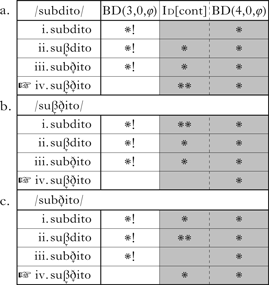
High-ranked BD(3,0,φ) also predicts lenition in medial clusters regardless of their underlying continuancy, as in (17). Here, the only way to avoid a drop in intensity to level 3 that isn't aligned with a phrase boundary is to lenite both stops. Given the ranking of BD(3,0, φ) above Ident[cont], this is the optimal outcome.
-
(17)
Recall that Spanish spirantisation displays somewhat complex blocking effects. Voiced stops fail to spirantise following nasals, and /d/ fails to spirantise following /l/. Following Baković (Reference Baković1997) and Kingston (Reference Kingston, Colantoni and Steele2008), I propose that this pattern is not related to lenition per se, but is an instance of a typologically frequent post-nasal hardening phenomenon. One influential analysis is that this pattern optimises for articulatory efficiency: homorganic ND clusters are less marked than NZ because ND can share a single closure gesture (Padgett Reference Padgett1994). This analysis is independently motivated by the typology of contour segments and place assimilation. It is less standard to extend this analysis to /ld/ and /lð/ clusters, but there are good reasons to do so. There is no reason why the complete tongue-tip closure in /l/ cannot be shared with a following stop.Footnote 3 Crucially, this is not the case in /ɾd/ clusters: /ɾ/ is a ‘ballistic’ gesture that lacks a sustained closure, unlike /l/, and, correspondingly, lenition is not blocked in /ɾd/ clusters. To prevent other post-/l/ consonants from assimilating to /l/ as /d/ does, we require a high-ranked constraint preserving major place features in prevocalic position.
The analysis also relies on nasalised continuants being marked. Again, there is independent evidence for this from both phonetics and phonology. Nasalised continuants create aerodynamic (Cohn Reference Cohn, Huffman and Krakow1993) and perceptual (Shosted Reference Shosted2006) difficulties, and the typology of inventories reflects this (Padgett Reference Padgett1994). Finally, the possibility of /l/ assimilating to a following continuant (and thus sharing a constriction gesture) is ruled out by a constraint against geminates, which are absent in Spanish (although rhotics are sometimes analysed as contrasting for geminacy).
(18) shows the constraints used to encode these principles and the analysis of constriction sharing.
-
(18)
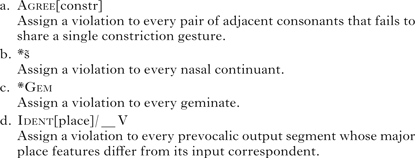
Outputs that fail to share a constriction across the cluster are ruled out by (18a), as shown in (19). Amongst possible constriction-sharing candidates, nasal–stop clusters are preferred because geminates or nasal-contour fricatives are subject to the high-ranked markedness constraints in (18b) and (c); these rankings are independently necessary to explain the absence of such segments in the language. For non-coronal segments following /l/, progressive place assimilation is ruled out by (d), which preserves major place features in prevocalic position, where they are especially well-cued. Finally, alternative repair strategies such as deletion are ruled out by faithfulness constraints that outrank Ident[cont]. I omit faithful mappings, whose outcomes would be the same as shown below, to conserve space.
-
(19)

A final point of interest concerns domain-final voiced obstruents. BD constraints call for them to be realised with maximum disruption. This predicts that final consonants ought to be realised in the same way as initial ones. In my materials (real and nonsense words elicited in carrier sentences from two Venezuelan speakers), these sounds are different from both initial and medial consonants: they are realised as unreleased stops or possibly very short continuants. Their short duration, rapid fall in intensity and occasional glottalisation clearly set them apart from phrase-medial voiced obstruents. So it is inaccurate to describe these segments as being like medial ones. They are also different from initial stops, which are clearly released.
I propose that silence is the crucial part of a final obstruent: the most disruptive event in a stream of sonorous sounds is the complete cessation of energy, and non-release with or without glottalisation achieves this goal. The constraint BD(0,0,φ) favours complete cessation of energy for some duration at a prosodic boundary. By hypothesis, faithfulness to stop release is not included in grammar (otherwise we would find languages with contrastive stop release, which do not appear to exist); as such, the release properties of these stops are entirely dictated by markedness constraints, here BD(0,0,φ) in (20).
-
(20)

This is illustrated in (21).
-
(21)

The overall pattern that emerges here is that continuancy in voiced segments is allophonic, and dictated by peripherality (initial or final) or non-peripherality within a φ. More complex patterns derive from blocking of otherwise favoured medial outputs by independent factors such as post-nasal hardening and geminate avoidance. A crucial aspect of the analysis is that ranking the constraint BD(3,0,φ) over faithfulness to continuancy predicts that continuancy for the affected segments can only be allophonic: if the preference for outputs that satisfy BD(3,0,φ) prevails in one position, it will prevail in all positions.
2.5 Continuity lenition in Chungli Ao
Voicing lenition can in principle be analysed in several different ways in the BD framework. Voicing adds some intensity to the signal, although the difference between voiced and voiceless stops or fricatives in this regard is probably not as large as that between, for instance, voiced stops and approximants (as in Spanish). The noise portion of voiceless obstruents is generally more intense than voiced ones. Voiced and voiceless medial stops, however, also generally display a large difference in duration: voiceless stops have longer closures in intervocalic position (Lisker Reference Lisker1957). Because stops are inherently disruptive in the middle of a stream of vowels, it may be that minimising the duration of this disruption is a driving force behind ‘voicing’ lenition (cf. Lavoie Reference Lavoie2001), with voicing itself being a secondary consequence of shortening. Extremely short stops may also be more likely to lack full closure, due to undershoot, which would render them even less disruptive.
Although either voicing or duration is a possible driver of lenition, I adopt the duration approach here, because it nicely captures the relationship between voicing and duration, and because I suspect that duration matters more than voicing for the relevant notion of ‘disruption’. This means that we will need to use the D parameter of the BD constraints to analyse voicing lenition. Stringency hierarchies involving this parameter are shown in (22).
-
(22)
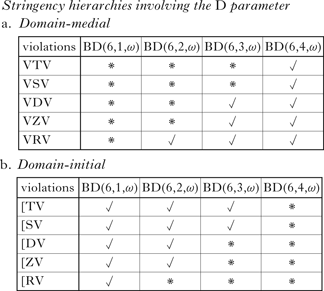
In this example, we set I to a fairly high level, 6 (associated with a glide). Segments of lesser intensity violate these constraints word-medially if they last as long as D. For instance, BD(6,3,ω) is violated by voiceless obstruents (duration 3), but not by voiced obstruents (duration 2) or taps (duration 1). This is because voiceless obstruents entail a drop to intensity lower than 6 that is not aligned with a word boundary for at least duration 3. Voiced obstruents entail a drop below 6 that is not aligned with a word boundary, but it does not last for at least duration 3, so the constraint is not violated. In word-initial position, voiceless obstruents satisfy BD(6,3,ω), because they align the word boundary with a drop below intensity 6 for at least duration 3; voiced obstruents violate BD(6,3,ω), because the intensity drop they align with the word boundary does not last for duration 3.
These constraints can drive the type of lenition seen in Chungli Ao. In the data in (6) above, voiceless stops in word-initial position and in obstruent clusters are in complementary distribution with medial voiced stops. The analysis also requires faithfulness constraints and the constraint penalising voiced obstruents in (23).
-
(23)

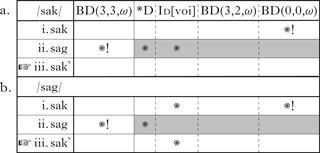
BD(3,3,ω) penalises initial voiced stops for not being long enough (less than duration 3) and punishes medial voiceless stops for being too long (duration 3), as in (24).
-
(24)

(24b) shows, in accordance with richness of the base, that even if voicing were underlyingly contrastive in Chungli Ao, it would be allophonically neutralised on the surface. (24a) involves assessing the acoustic duration of a domain-initial voiceless stop; at the beginning of an utterance, of course, this would be impossible. I thus stipulate that a listener inferring this grammar assesses duration through analogy to the non-utterance-initial context or to their own production.
Similar to Spanish, the occurrence of final stops without audible release is due to BD(0,0,ω), as in (25). This analysis requires assessing the duration of final unreleased stops. I assume that the listener, in the absence of any good way of judging the duration of such segments, attributes all the silence she hears at the end of a word or phrase to the stop closure.
-
(25)
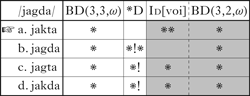
The duration-based formulation of the high-ranked BD constraint also helps explain the behaviour of medial clusters of obstruents, which surface as voiceless, as in (26). The insight here is that, as a sequence of consonants gets longer, sustaining voicing through that sequence will generate diminishing returns for auditory continuity. Sequences of obstruents thus devoice because they are too long to be ‘helped’ much by voicing. BD(3,3,ω) penalises a sequence of two stops for being long, whether or not it is voiced, because any sequence of two stops will involve a decrease in intensity to level 3 or lower for at least duration 3.
-
(26)
2.6 A note on nasalisation lenition
As observed in §1.2, I am not aware of lenition processes that turn non-nasal consonants into nasals. This may seem surprising, as nasals are more intense than obstruents. They should thus better satisfy BD constraints medially, and be possible as lenition outputs. I suggest that nasalisation lenition doesn't occur because it involves perceptually larger changes than approximantisation, while yielding less intense outputs. For instance, lenition of /b/ to approximant [ß] will always be preferred to lenition of /b/ to [m]. The approximant better satisfies BD constraints, and requires a smaller perceptual change to the input /b/ segment. In terms of Steriade's (Reference Steriade, Hanson and Inkelas2009) P-map proposal, faithfulness to the feature separating /b/ and /ß/, say [+approximant], is always ranked lower than faithfulness to nasality, because changes in nasality are more perceptually salient. This predicts that, whenever a markedness constraint can be satisfied by either changing approximancy or nasality, approximancy will be preferred. The result, shown in (27), is that spirantisation to an approximant is always preferred to nasalisation. For this illustration, I assume that approximant [ß] has intensity 5 and nasals have 4.
-
(27)

This analysis relies crucially on the hypothesis that stop–approximant pairs are more similar than stop–nasal pairs. I know of no perceptual studies that specifically examine this question. There are, however, at least two studies that report relevant data on consonant confusability in noise. Woods et al. (Reference Woods, Yund, Herron and Ua Cruadhlaoich2010) used American English stimuli and listeners; Pols (Reference Pols1983) used Dutch stimuli and listeners. Both studies published raw count data involving voiced stops, nasals and liquids; the Dutch study also included glides. I constructed a Biased Choice Model (Luce Reference Luce, Luce, Bush and Galanter1963) for each study and examined the perceptual distance parameters d associated with those models. The d parameter is defined for any two categories x and y as the negative log of the eta similarity measure (p(y|x) × p(x|y)) / (p(x|x) × p(y|y)). d is thus a positive number that increases for more distinct pairs. For Woods et al.'s (2010) data, pairs of voiced stops and liquids are on average less distant (d=7.08) than pairs of voiced stops and nasals (d=8.17). A one-tailed t-test suggests the difference is significant: t = 1.92 on 10 df; p = 0.04. For Pols’ (Reference Pols1983) data, pairs of voiced stops and approximants are on average less distant (6.79) than pairs of voiced stops and nasals (8.05). A one-tailed t-test comes up just short of significance: t = 1.58 on 10 df; p = 0.07. This demonstrates the plausibility of the perceptual hypothesis mentioned above.
3 Loss lenition
Loss lenition is a descriptive label for processes that have been called lenition in the literature, but are not ‘special’ in the ways that continuity lenition is. These phenomena are in a sense less interesting than continuity lenition, because they behave a lot like other phonological phenomena, and pose no particular challenge to existing phonological frameworks. I do, however, give an overview and a sketch of an analysis, in part to draw a contrast with continuity lenition.
The phenomenon of debuccalisation, where a consonant loses its supralaryngeal features, is illustrated with data from Arbore in (28) (from Harris Reference Harris1990).
-
(28)
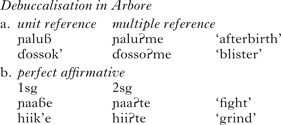
Ejectives and implosives neutralise to a glottal stop before consonants, but not word-finally or before vowels. In languages such as Slave (Rice Reference Rice1989), debuccalisation (and frication) of consonants extends to both preconsonantal and word-final, but not prevocalic, positions. Kirchner (Reference Kirchner1998), Lavoie (Reference Lavoie2001) and Gurevich (Reference Gurevich2003) summarise several further cases of both types of debuccalisation.
A second type of loss lenition is degemination, when a long consonant becomes short. This is illustrated in (29) with Polish data from Rubach & Booij (Reference Rubach and Booij1990) and Pająk (Reference Pająk2010).
-
(29)

The forms in (a) and (b) show that geminates contrast with singletons between vowels; in (a) we see that the contrast is neutralised to a singleton domain-finally. The word-formation processes in (c) show that the contrast also neutralises preceding or following a consonant. This prohibition results in both degemination (c.i) and the blocking of junctural ‘fake’ geminates (c.ii), which are otherwise allowed in Polish.
Note that geminates are marginally possible word-initially in Polish: there are four monomorphemic words that begin with geminate obstruents, and word-initial geminate fricatives can be formed from fricative prefixes (Pająk Reference Pająk2010). A more robust pattern of geminates licensed in intervocalic and word-initial positions occurs in Ganda (Clements Reference Clements, Wetzels and Sezer1986). Dmitrieva (Reference Dmitrieva2012) and Pająk (Reference Pająk2010) offer more examples and details on the cross-linguistic distribution of geminates.
The examples above are meant to illustrate several cross-linguistic generalisations about debuccalisation and degemination. Both processes may result in positional neutralisation of contrasts. When neutralisation does occur, it reflects a positional scale: neutralisation in some positions entails neutralisation in other positions. For debuccalisation, the scale can be stated (from least likely to neutralise to most likely) as prevocalic < word-final < preconsonantal. The scale for degemination is similar, but not identical: intervocalic < word-edge (vowel-adjacent) < consonant-adjacent. Loss lenition thus involves positional constraints. Debuccalisation targets place features in classically ‘weak’ positions such as syllable codas; it is a case of non-assimilatory place and voicing neutralisation. Degemination, while it targets different environments (non-intervocalic, in particular), can also be analysed as a case of positional neutralisation.
Many formal devices have been used in analysing positional neutralisation. Some theories posit neutralisation pressures that target segments in weak positions; this includes the Coda Condition (Itô Reference Itô1986), which can be construed as positional markedness constraints in OT (Lombardi Reference Lombardi and Lombardi2001), deletion of phonological primes (privative features) in governed or unlicensed positions (Ségéral & Scheer Reference Ségéral and Scheer1999) and pressure to neutralise contrasts that are perceptually weak (Flemming Reference Flemming1995). Positional faithfulness (Beckman Reference Beckman1998) and its phonetically driven cousin the P-map (Steriade Reference Steriade, Hume and Johnson2001) instead posit pressure against neutralisation that singles out strong positions. Theories disagree on how to characterise ‘strong’ and ‘weak’ positions: they may pertain to syllable structure, empty nuclei or the availability of cues to phonological contrasts.
Although a full analysis of loss lenition is not given here, because of space limitations, the general form of such an analysis is fairly clear. In a P-map framework, for instance, contexts with the most distinct place and voicing contrasts will be subject to the most positional faithfulness constraints; these will generally be prevocalic (Steriade Reference Steriade, Hume and Johnson2001). If these contrasts are neutralised by debuccalisation in prevocalic position, which is subject to more faithfulness constraints, then they are neutralised in all non-prevocalic positions. The converse, however, does not hold, which is how we derive asymmetries in positional neutralisation. The same type of analysis is available for geminacy, but the details of which contexts are more or less perceptually distinct will be different for these contrasts; see Dmitrieva (Reference Dmitrieva2012) and Kawahara (Reference Kawahara2012) for details.
4 Neutralising continuity lenition
Although the allophonic patterns of continuity lenition described in §2 constitute the vast majority of attested cases, the phonological literature does include some processes that appear to neutralise contrasts in one position or another. In this section, I describe all such phenomena that I am aware of. A few cases are not lenition. In several other cases, we will see that the lenis–fortis distinction is confounded with some other difference that is independently known to affect patterns of phonological contrast. In perhaps the best-known case of neutralising continuity lenition, American English flapping, what is occurring is two parallel lenitions to a third, less disruptive category, an exception that is predicted by the BD formalism.
4.1 Linking morphemes
Burmese contrasts voiced, voiceless unaspirated and aspirated stops (the aspirated series is not relevant here). Smith (Reference Smith and de Carvalho2008) cites Burmese as a language with neutralising intervocalic voicing lenition, as in (30a): when the second element in certain compounds begins with a voiceless stop, it surfaces as voiced (30b); data from Okell (Reference Okell1969) and Green (Reference Green and Watkins2005).
-
(30)
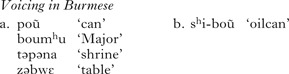
In compounding, then, the voicing contrast licensed elsewhere in the language is neutralised by intervocalic voicing. Note that this phenomenon is nearly identical to Japanese rendaku (e.g. McCawley Reference McCawley1968). One influential analysis of rendaku is that it results from a compound-linking morpheme consisting solely of the feature [+voice] (Itô & Mester Reference Itô and Mester1986). The motivation behind this move is in part to keep the phenomenon in question out of the phonology, moving it instead to the lexicon. If the rendaku and Burmese facts were limited to those shown in (30), it might be plausible to analyse them as neutralising voicing lenition, with blocking in non-derived environments. Both rendaku and its Burmese equivalent, however, apply only in certain cases of compounding. Neither of them is a general characteristic of affixation or phrasal phonology, for instance. As such, it is not possible to state the environment of the phenomenon in phonological terms: it only occurs in a particular construction. This type of idiosyncrasy is why such phenomena are better analysed in lexical rather than phonological terms.
The Dravidian language Kannada may display a similar compound voicing phenomenon. Gurevich (Reference Gurevich2003) describes it in terms nearly identical to the above, citing Andronov (Reference Andronov1969). Other grammars, however, differ in their descriptions. Upadhyaya (Reference Upadhyaya1976) fails to mention the process at all; his transcriptions of compounds in four dialects suggest that this linking occurs irregularly, and is not limited to intervocalic context when it does occur. Nayak's (Reference Nayak2001) illustration of compounding leads to a similar conclusion, but only /k/ appears to be affected.
4.2 Other continuancy alternations
There are several processes attested that turn stops into continuants and neutralise contrasts in doing so, but do not otherwise fit the profile of continuity lenition. The most common of these is assibilation: affrication or frication of (mainly coronal) stops before high vowels (see Hall & Hamann Reference Hall and Hamann2006 for a typological overview). Indeed, one of the handful of neutralising spirantisations noted by Gurevich (Reference Gurevich2003) is assibilation in Turkana. Choosing whether to characterise such patterns as lenition is largely a matter of personal taste. What is important for the theory advanced here is that, above and beyond their potential to neutralise contrasts, they differ from continuity lenition in both their characteristic environment and their functional motivation. Assibilation singles out contexts with following high vocoids (or other segments with high tongue positions) in particular; it is not common in intervocalic position before a non-high vowel. Ohala (Reference Ohala and MacNeilage1983) proposes a functional motivation: the pressure build-up of a stop released directly into the relatively narrow channel associated with a high tongue position causes the beginning of the second sound to be fricated. Over time, this noise component is reanalysed as part of the preceding stop or even replaces that stop. So while assibilation can neutralise contrasts, as in Turkana, it is not driven by the BD constraints proposed here.
Other examples of neutralising spirantisation from Gurevich's (Reference Gurevich2003) survey are not as typologically widespread nor as clear in their functional motivations as assibilation. These processes, however, do not affect stops in intervocalic position. Thus, in Nez Perce, some voiceless stops become fricatives before certain consonants or at the end of a phonological word. In Lama, the contrast between /p/ and /w/ neutralises to /w/ at the end of a word. These phenomena cannot be analysed with BD constraints. As such, it is not surprising that they differ from BD-driven processes in how likely they are to neutralise contrasts.
4.3 Affixal neutralising lenition
A case of neutralising lenition from the Djapu variety of Yolngu (Chong Reference Chong2011) is shown in (31). Certain suffixes have initial consonants that are realised as stops following obstruents and nasals (b), but as glides between vowels or glides (c). The stop and glide realisations of these morphemes are segments that contrast elsewhere in the language (a). This is thus a case of neutralising continuity lenition (and neutralising post-stop hardening).
-
(31)
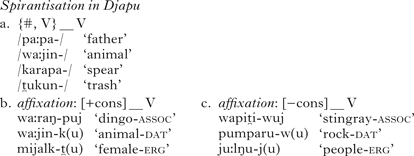
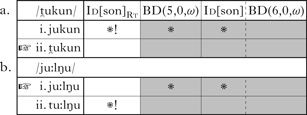
An important point here is that lenition is neutralising a contrast in a particular context, given certain morphological conditions. Those conditions, namely being part of an affix as opposed to a root, display pervasive interactions with the licensing of phonological contrasts cross-linguistically. The most common analysis of these facts in OT is faithfulness to the root (Beckman Reference Beckman1998); this analysis is motivated by cross-linguistic evidence that has nothing to do with lenition. The root-faithfulness account can be incorporated into the BD approach introduced here as in (32) and (33). In polymorphemic contexts, BD constraints are only assessed for the affix-initial consonant that is at issue here. The analysis is that Djapu essentially displays two systems of contrast. In the affix system, the stop–glide contrast is allophonically neutralised, because the relevant BD constraint is ranked higher than general faithfulness, as in (32).
-
(32)

In the root system (33), stops contrast with glides, because the BD constraint is not ranked higher than root-specific faithfulness. Both systems are perfectly well-behaved from the standpoint of the BD approach.
-
(33)
4.4 Prominence-sensitive neutralising lenition
A number of languages display contrasts for laryngeal features or continuancy in stem-initial position that are neutralised medially. These include Nivkh (also called Gilyak; Shiraishi Reference Shiraishi2006), a number of Benue-Congo languages, including Feʔfeʔ, Koyo and Tiene (Hyman Reference Hyman1972, Reference Hyman2008, Reference Hyman, Wohlgemuth and Cysouw2010 respectively) and Ibibio (Harris & Urua Reference Harris, Urua, Faulkner, Rosen and Holland2001), and some Khoisan languages (Downing Reference Downing2004). The general pattern is illustrated with Feʔfeʔ verbal stems in (34).
-
(34)
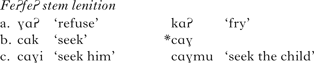
The forms in (a) show that /k/ and /ɣ/ contrast in stem-initial position. The voicing and continuancy contrast is neutralised elsewhere, described as voiceless word-finally ((b), although Larry Hyman indicates (personal communication) that the phonetic voicing here is in question) and as voiced non-finally (c). This pattern is one of neutralising medial lenition (and final devoicing). Nivkh shows a similar pattern: obstruents contrast for laryngeal specifications word-initially, but those contrasts are neutralised in other positions, as in (35) (from Shiraishi Reference Shiraishi2006).
-
(35)

Both stops and fricatives contrast for laryngeal features (a), but these contrasts are neutralised in other contexts: for fricatives, voiced between two sonorants and voiceless elsewhere; for stops, voiced following a sonorant consonant and voiceless unaspirated elsewhere. This is a case of neutralising continuity lenition: aspiration/voicing contrasts in word-initial position are neutralised by voicing or deaspiration in all other positions.
These languages display a pattern with more segments licensed in stem- or word-initial position than in non-initial position. But the positional distinction is confounded with another factor here: prominence. Nivkh has fixed initial stress (Shiraishi Reference Shiraishi2006). And the Feʔfeʔ alternations are part of a much broader pattern observed in West African languages: expanded consonantal, vocalic and tonal contrasts in stem-initial position (see Downing Reference Downing2004 for a review). This pattern is sometimes referred to as ‘accentual prominence’ and is analysed as a type of prosodic prominence (Downing Reference Downing2004, Hyman Reference Hyman2008).
This means that all of the examples mentioned above can be analysed as prominence-sensitive neutralisation. Much like root vs. affix asymmetries, this pattern can be captured with independently attested positional faithfulness constraints (Beckman Reference Beckman1998); here, segments in prominent syllables are protected by specific faithfulness. This is illustrated in (36) for Nivkh. I do not consider the issue of stress placement here, assuming that Nivkh features an undominated constraint calling for stress at the left word edge.
-
(36)
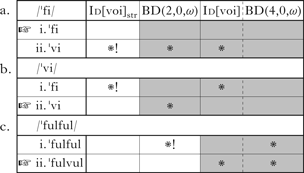
It is thus possible to analyse Nivkh with stress-sensitive positional neutralisation, which is all that is required for the language to be consistent with the BD framework. A stronger argument would be that the prominence-based account is better than its initiality-based counterpart. There seem to be no arguments either way for Nivkh. For the African languages mentioned above, however, there is such an argument. Voicing and continuancy are one part of a pervasive pattern of non-stem-initial neutralisation in these languages (Downing Reference Downing2004, Hyman Reference Hyman2008). Even in languages like Basaá (Hyman Reference Hyman2008), where the voicing and continuancy alternations are allophonic rather than neutralising, other contrasts such as tone, vowel quality and place of assimilation are still neutralised in non-stem-initial position.Footnote 4 If voicing and continuancy alternations in such languages are driven by neutralising lenition constraints, they must be analysed as entirely independent from other stem-initiality effects. Other features such as vowel quality and tone, which are not targeted in lenition, would neutralise under the influence of entirely different constraints. The fact that these other features cluster with neutralising lenition across languages would thus only be seen as a coincidence. Under the prominence analysis, these facts are given a unified explanation: contrasts surface stem-initially because prosodic prominence drives special faithfulness.
One might be concerned that the prominence-based analysis given here vitiates the predictive power of the BD framework. If any exception can simply be waved away as prominence-based, does the proposal advanced here actually make any predictions? It predicts that, if a language appears to display a domain-initial contrast for some feature that is neutralised domain-medially by lenition, then that language should independently display properties associated with prosodic prominence domain-initially. For Nivkh, this is presumably some phonetic properties associated with stress, such as duration and F0 movement. For the African languages discussed above, the properties are expanded contrasts for tone, vowel quality, vowel quantity and syllable structure. An approach with neutralising lenition constraints makes no predictions about the connection between these prominence-driven properties and the existence of neutralising lenition.
4.5 Length-as-voicing lenition
Butcher (Reference Butcher2004) describes a group of non-Pama-Nyungan Australian languages that display what is often called a fortis–lenis contrast for medial stops; he notes that it is sometimes also described as voiced–voiceless, short–long or singleton–geminate. The language he investigates is Burarra, whose stop distinction is described by Glasgow (Reference Glasgow and Waters1981) as in (37); I ignore allophonic variation in the realisation of schwa here, which is irrelevant to the phenomena under consideration.
-
(37)

Stops contrast between vowels (a) and sonorants (b); the contrast is neutralised to the voiceless series word-initially (c). As transcribed here, this is a perfect example of neutralising fortition. This would be an unusual pattern for voicing neutralisation, which tends to target consonants in non-prevocalic position; as a pattern of length neutralisation, however, it would be completely typical. And in fact there is evidence that the relevant phonetic distinction here is duration rather than voicing. Butcher (Reference Butcher2004: 550) describes VOT in Burarra and related languages as ‘short-lag and variable (in both series), and not a reliable cue to the stop contrast’. He claims furthermore that ‘the most consistent cue to the contrast appears to be the duration of the articulatory stricture’, and presents data showing that the acoustic correlate of closure in /p/ is 70% longer than in /b/. Glasgow (Reference Glasgow and Waters1981) explains in a footnote that she had been using singleton/geminate notation, but that a Burarra teaching assistant she worked with preferred the voiced/voiceless notation. This decision, then, had nothing to do with the phonetics of the language.
Butcher (Reference Butcher2004) notes that Burarra and related languages that display this type of length contrast neutralise it everywhere but medially. The pattern is best viewed, then, as positional neutralisation of an underlying length contrast; between two vowels or sonorants tends to be the context where such contrasts are most perceptually distinct and where they are least likely to neutralise (see Dmitrieva Reference Dmitrieva2012 for a review). Any P-map analysis of such positional neutralisation would posit high-ranked positional faithfulness constraints in such contexts, and these constraints would also be applicable to Burarra. This means we do not need separate lenition and fortition constraints to explain the neutralisation.
Butcher argues that a different group of non-Pama-Nyungan Australian languages, including Murrinh-Patha, have a true voicing contrast. This contrast, however, only neutralises in final position, exactly in line with laryngeal neutralisation in other languages. Correspondingly, Butcher shows that one Murrinh-Patha speaker produces medial /p/ and /b/ with a far smaller duration distinction than the Burarra speaker.
4.6 Parallel lenitions
The most extensively studied case of neutralising lenition is probably American English flapping (Kahn Reference Kahn1980; see de Jong Reference De Jong, van Oostendorp, Ewen, Hume and Rice2011 for a review). In this phenomenon, non-foot-initial intersonorant alveolar stops are realised as taps or flaps (Jensen Reference Jensen2000). The formulation ‘non-foot-initial’ expresses the fact that in word-medial position the phenomenon generally only holds before unstressed vowels; I take stress to be a diagnostic of foot-initiality in English, and assume that every left word edge is also a foot edge. Note that there are some word-medial intervocalic alveolar stops before unstressed vowels that do not tap, e.g. Navratilova, Mediterranean; Davis & Cho (Reference Davis and Cho2003) use this to argue for a more elaborated foot structure. The simple pattern is illustrated in (38) with data from the author's dialect; note that blocking contexts (and many irrelevant phonetic details) are ignored here.
-
(38)

The laryngeal contrast attested word-initially and before stressed syllables is neutralised medially to tap. This is a case of neutralising continuity lenition. This particular pattern, however, is one of the few ways in which the BD theory does predict the existence of neutralisation: two sounds leniting to a third, more lenis one. This is illustrated in (39) and (40). In accordance with Table I, I assume intensity 5 and duration 1 for tap. I omit faithfulness to features that distinguish between stop and tap here, which are low-ranked; voicing is the only faithfulness constraint that figures crucially in the analysis. Flapping is driven by a BD constraint militating against drops in intensity to the level of a voiced stop or lower domain-internally; this constraint incidentally compels changes to laryngeal features in the case of /t/, as in (39).
-
(39)

At domain boundaries, the same constraint will penalise any drop in intensity that is not at least as low as that of a voiced stop. But changing the laryngeal specifications of /t/ or /d/ won't make any difference in this environment, because they both already satisfy the constraint; it is only the tap that must be altered domain-initially, as in (40). Another way of describing the pattern is that both /t/ and /d/ are in allophonic alternation with tap; the fact that /t/ and /d/ happen to also neutralise with each other is a secondary effect.
-
(40)
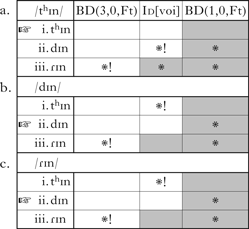
This is one of the few configurations in which the BD approach predicts neutralising lenition. A more abstract and general way of describing the situation is that there are three segments: segment A of intensity n, the most fortis, segment B of intensity n+1, intermediate, and segment C of intensity n+2, the most lenis. In the English case just discussed, A–C would be instantiated by [t], [d] and [ɾ] respectively. Segments A and B are distinguished only by feature F (voicing in the English example); segment C is distinguished from B only by feature G (flapping), and therefore distinguished from A by both F and G. The BD constraint calling for events of intensity n+1 or lower to be aligned with boundaries is ranked above faithfulness to both F and G (Ident[voi] and Ident[tap] or its featural equivalent). In initial position, C (tap/flap) is the only segment of the three that violates this BD constraint; it will be minimally modified to satisfy it (by changing feature G). In medial position, both A and B ([t] and [d]) violate the BD constraint, so features F and G both change as needed to satisfy the constraint. The result is that F (voicing) is contrastive in initial position but not medial, while G (flapping) is contrastive in neither position. The scenario above is one where two segments that contrast in some context both map to a third segment in complementary distribution with the first two. The theory thus only predicts neutralisation with more than two categories involved, or, equivalently, with at least two features.
4.7 Word-initial exceptionality and its limits
Beckman's (Reference Beckman1998) positional faithfulness theory singles out root-initial consonants as being protected by special positional faithfulness constraints, due to their psycholinguistic prominence. If such constraints exist, they should sometimes block fortition in root-initial position without affecting lenition elsewhere, resulting in neutralising lenition. I have claimed here that such patterns are exceedingly rare. What data, then, is the Beckman theory based on?
First, it is based on an impressive and rather convincing catalogue of cases where a greater variety of vowel qualities, quantities and/or syllable structures are licensed in the initial syllable of a root than elsewhere. The idea that initial onset consonants should also be protected by special constraints fits in quite nicely with this view, but Beckman actually presents very little evidence that word-initial consonants in particular are ‘protected’ in this way. Two of the three cases she presents involve click licensing in !Xóõ and secondary articulations in Doyayo; these languages both fall in the class of initial-accent languages discussed in §4.4. The last example involves secondary articulations in Shilluk, a Nilotic language whose close relative Dholuo is described as having fixed stem-initial stress (Downing Reference Downing2004).
None of these inventory asymmetries, which involve airstream mechanisms and secondary articulations, need to be analysed as continuity lenition. So one possibility is that word-initial consonant faithfulness exists and protects certain features, but not the ones involved in lenition. However, given the small number of cases identified by Beckman and the plausible hypothesis that these languages all have initial stress or accent, I favour the hypothesis that these are all cases of prominence-sensitive faithfulness ‘masquerading’ as word-initial faithfulness. Under this hypothesis, Beckman's positional faithfulness constraints may refer to the structure or nucleus of a root-initial syllable, but not to the segmental characteristics of a root-initial consonant. This would help explain the relative paucity of initial consonant contrast preservation.
5 Conclusion
I have argued that the term ‘lenition’ as used in the phonological literature includes at least two distinct types of phenomena, which differ in their functional, substantive and positional properties. One type of lenition, referred to here as continuity, is particularly problematic for phonological theory, as it seems to exist primarily in allophonic form. I proposed a phonetically driven theory that correctly captures the differences between different types of lenition. Putative cases of neutralising continuity lenition were discussed, and it was demonstrated that the current proposal can adequately describe such cases. In conclusion, I discuss some theoretical and empirical implications of the approach taken here.
5.1 Partitioning lenition processes
I have proposed a cluster of typological properties that distinguish between continuity and loss lenition. The claim is that particular featural changes tend to occur in particular positions and have particular consequences for contrast. One question that arises is how to analyse phenomena that don't seem to fit neatly in either category. For instance, one might read the typology presented here as saying that voicing alternations always affect intervocalic position if they affect any position and that they never neutralise contrasts. This is obviously wrong.
In general, picking out particular lenition phenomena for analysis is not meant to suggest that the same features or contexts cannot be involved in other phenomena. In the case of voicing, it is fairly easy to tell the difference between lenition and non-lenition phenomena. This is because non-lenition voicing alternations such as assimilation and final devoicing never target intervocalic consonants, and they result in positional neutralisation almost by definition. This suggests that the intervocalic target of continuity-lenition processes is the crucial property that distinguishes it from other processes involving the same feature, and indeed this is the current working hypothesis.
Continuancy is somewhat less clear in this regard, because neutralising continuancy (and/or approximancy) alternations appear to be far less common than laryngeal ones. The few instances of which I am aware, such as Lama /p/–/w/ neutralisation and Nez Perce neutralising spirantisation (Gurevich Reference Gurevich2003), target consonants in preconsonantal and/or domain-final positions, but not intervocalic ones. As such, these particular cases should not be analysed as continuity lenition; instead, they may be neutralising consonantal manner contrasts in contexts where they are less distinct. The fact that continuancy and approximancy contrasts have robust perceptual cues internal to consonants themselves may explain why this type of positional neutralisation is less common than, for instance, neutralisation of stop voicing; laryngeal contrasts for stops depend far more on cues in adjacent segments. The logic here is that a continuancy alternation is an instance of continuity lenition if and only if it targets intervocalic stops, and that if it meets this criterion it will not neutralise contrasts present elsewhere in the language.
Duration is in some sense the clearest phonetic property in terms of identifying continuity processes. As shown in §3, consonantal length contrasts tend to neutralise in non-intervocalic position, resulting in degemination. The BD constraints proposed here suggest that continuity lenition involving duration should have the opposite effect: shortening in intervocalic position (and other medial positions). I believe this prediction is correct, but easy to miss. This is because BD constraints predict allophonic shortening of medial consonants in languages where, by definition, the length of those consonants is not contrastive. But in such a language, phonologists and phoneticians are exceedingly unlikely to refer to such alternations as ‘degemination’, a term that is generally reserved for languages with a geminacy contrast.
Instead, these patterns tend to be discussed under the rubric of ‘initial strengthening’ (see Keating Reference Keating, Harrington and Tabain2006 for a review). This general phenomenon involves several articulatory parameters: consonant gestures display greater magnitude and stiffness at the beginnings of larger constituents. These articulatory differences could plausibly correspond to larger and more abrupt drops in intensity relative to medial consonants; Kingston (Reference Kingston, Colantoni and Steele2008) shows such acoustic effects even for Spanish consonants that are not involved in spirantisation. More directly relevant, the articulatory and acoustic duration of consonants tends to be longer at the beginning of larger constituents in at least Korean (Jun Reference Jun1993), English (Fougeron & Keating Reference Fougeron and Keating1997), French (Keating et al. Reference Keating, Taehong Cho, Hsu, Local, Ogden and Temple2003), Taiwanese (Keating et al. Reference Keating, Taehong Cho, Hsu, Local, Ogden and Temple2003) and Japanese (Onaka et al. Reference Onaka, Palethorpe, Watson and Harrington2003). Presumably, the effect extends to other languages; these examples are just the ones that happen to have been tested in the relatively recent initial lengthening literature. The size of the effects ranges from extremely large for some speakers in some languages (at least as large as a typical geminacy contrast) to extremely small (up to and including small trends that don't reach statistical significance). This range of initial lengthening (or medial shortening) effects, including some of very small magnitude, fits well with the formulation of BD constraints as referencing small, non-contrastive differences in duration.
5.2 Broader theoretical implications
Finally, I consider some of the broader consequences of the analysis for phonological theory. The account given here assumes that phonological representations contain a great deal of fine phonetic detail. BD constraints make reference to small differences in intensity and duration that are not in themselves contrastive. To the extent that the analysis succeeds in places where more abstract accounts fail, it can be seen as evidence that such detail is relevant to phonology. A long list of researchers have drawn similar conclusions about the level of phonetic detail in phonological representations (e.g. McCawley Reference McCawley1967, Selkirk Reference Selkirk, van der Hulst and Smith1982, Kingston Reference Kingston1985, Browman & Goldstein Reference Browman and Goldstein1986).
The analysis also predicts that allophonic lenition patterns may include small changes in duration, aperture, timing or release that may never be minimally contrastive in any language, in addition to the ‘larger’ lenitions that tend to be noted in phonological grammars. The initial strengthening literature described above suggests that this prediction is on the right track. In general, the proposal here makes no distinction between allophony and any other kind of contextual phonetic variation. On this view, spirantisation of Spanish voiced stops and small reductions in English /n/ duration medially are both equally ‘phonetic’ or ‘phonological’. Because neither change is contrastive, if grammar regulates one, there is no principled reason why it shouldn't regulate the other. Conversely, if small contextual differences in duration are outside the scope of the phonological grammar, there is no principled reason why spirantisation should be inside the scope of that grammar.
The BD constraints have been presented here as categorical. Note, however, that the scalar representations of intensity, duration and prosodic strength that these constraints reference are equally compatible with a weighted, gradient constraint model (Flemming Reference Flemming2001). I have used the categorical model here because it is easier to work with typologically and more familiar to phonologists, and makes very similar predictions to the gradient model. The one major advantage of a gradient model is that the cost assessed to each candidate could serve as a starting point from which variability and gradience in phonetic realisation might be described. Lenition phenomena are often marked by substantial variation in both the likelihood of some outcome applying and the phonetic nature of that outcome.
Much of the lenition literature is taken up with discussion of what lenition is. I close by giving my take on the question. If continuity lenition has special formal and functional characteristics, but loss lenition does not, one reaction would be to say that only continuity lenition is real lenition. While this move has some logical appeal, attempting to change the way an entire field uses a label that has been around for so many years would seem somewhat quixotic. Instead, I assume that ‘lenition’ is a useful descriptive label given by many researchers to overlapping but non-identical sets of phonological and phonetic phenomena involving some sense of reduction. These sets tend not to correspond to coherent entities with respect to formal, functional or contextual properties. Within the class of generally recognised lenition phenomena, however, at least one functionally and phonologically cohesive subset exists, and it has a lot to teach us about the nature of phonology.