Introduction
Mental health problems are a significant problem for British businesses, accounting for an estimated 442 000 cases of work-related illness annually, including 237 000 new cases (HSE, 2008). In 2007/08, an estimated 13.5 million working days were lost through self-reported stress, depression or anxiety caused or made worse by work (HSE, 2008). Each person with a mental health problem was absent for an average of 30.6 days per year, more than for any other condition (HSE, 2008). Mental ill-health accounts for a significant proportion of long-term absences from work and is responsible for many early retirements, for example 20% among National Health Service employees (Stansfeld et al. 1995; Pattani et al. Reference Pattani, Constantinovici and Williams2001).
Attitudes towards employing someone with a history of mental health problems appear to vary considerably across Europe. A recent study found that compared to several other European cities, London had the lowest proportion of people with a diagnosis of schizophrenia losing their jobs and one of the highest rates of job acquisition (Marwaha et al. Reference Marwaha, Johnson, Bebbington, Angermeyer, Brugha, Azorin, Killian, Hansen and Toumi2009). However, 75% of those followed remained unemployed for the entire 2-year follow-up period (Marwaha et al. Reference Marwaha, Johnson, Bebbington, Angermeyer, Brugha, Azorin, Killian, Hansen and Toumi2009). In 1995, a survey of 200 Personnel Directors in British firms found considerable reluctance and ignorance concerning the employment of people with mental health problems (Manning & White, Reference Manning and White1995). They found that only half of employers would consider employing someone who was currently mentally unwell, improving to 72% when considering those who had previously been unwell. Additionally, nearly a quarter of companies would consider dismissing someone with previously undeclared mental ill-health. However, work records, job descriptions and previous sick leave were more likely to influence employment prospects than the diagnosis itself. This finding was confirmed in second survey of employers conducted in 2003, with the additional finding that the medical assessment of the applicant's fitness to work was also highly influential (Fenton et al. Reference Fenton, O'Hanlon and Allen2003). However, a third of companies were influenced by the diagnosis, with approximately the same proportion negatively influenced by a history of hospitalisation under the Mental Health Act (Fenton et al. Reference Fenton, O'Hanlon and Allen2003).
In 2006, the Shaw Trust, a UK charity that works with employers, social services and people with disabilities to help people with disabilities find employment, commissioned a survey of 550 senior representatives of a sample of UK companies and again found high levels of ignorance and a lack of preparedness to deal with mental health problems in the workplace (The Shaw Trust, 2006). Specifically, 33% of those surveyed thought that none of their employees would have any form of mental ill-health during their working life (Flatters, Reference Flatters2009). This may explain why 80% of the organisations surveyed did not have a specific mental health policy and why over 30% did not have any processes in place to monitor stress. However, the survey also illustrated a willingness on the part of companies to improve their practices with 80% suggesting that more support was required to improve the way mental health is addressed in the workplace.
Complementing the evidence from studies of employers, a survey of people with mental health problems found that 39% of respondents felt they had been denied a job, 15% had been denied promotion and 34% had been dismissed or forced to resign because of their illness; 38% reported being intimidated or harassed in the workplace, while 69% had been put off applying for jobs because of unfair treatment (The Mental Health Foundation, 1999). Despite this, most individuals with mental health problems have a strong desire to work, and evidence suggests links between employment, mental well-being and recovery (Drake et al. Reference Drake, McHugo, Bebout, Becker, Harris, Bond and Quimby1999; Murphy & Athanasou, Reference Murphy and Athanasou1999; Thomas et al. Reference Thomas, Benzeval and Stansfeld2005; Dunn et al. Reference Dunn, Wewiorski and Rogers2008; Mossakowski, Reference Mossakowski2009). Additionally, steady employment may reduce the use of mental health services and therefore associated medical costs (Bush et al. Reference Bush, Drake, Xie, McHugo and Haslett2009).
As a result of such findings, in recent years, the Government has increased its focus on mental health in the workplace, most recently through the ‘Working our way to better mental health’ framework (Health Work Wellbeing, 2009). It has tried both to assist employers in addressing mental health in the workplace, through the discrimination and sigma-reduction work of SHiFT programme (SHiFT, 2010), and also protect employees from mental health related discrimination when applying for employment. The Equality Act 2010 prohibits employers from asking candidates questions about their health until they have shown that they meet some of the non-health criteria of a job. The Act does give specific instances where the employer can make health- and disability-related enquiries before short listing a candidate after an interview, e.g. for the purposes of making reasonable adjustments to enable the disabled person to participate in the recruitment process or monitoring diversity in applications for jobs, or enabling an employer to identify suitable candidates for a job where there is a genuine occupational requirement for the person to be disabled. However, if an employer asks a question before this stage, it may be found to have directly discriminated against a disabled candidate.
In addition to the efforts of Government, several non-governmental organisations, including the Shaw Trust, Mindful Employer and the Sainsbury's Centre for Mental Health, have increased their efforts to assist employers in addressing mental health in the workplace. For example, The Shaw Trust, in addition to providing tailored advice to job seekers with mental health problems, also offers tailored advice to employers with explanations of the disability discrimination act and how they can comply with it (The Shaw Trust, 2010). The Mindful Employer initiative was set up by employers for employers to provide information, training and support for employers on mental health issues, with the aim of improving not only productivity and economic gain but also the well-being of the workplace (The Mindful Employer, 2010). The Sainsbury's Centre for Mental Health, again provides information on what employers can do and explanations of the law, with the addition of workplace-based training such as ‘Impact on depression’ aimed at improving mental health in the workplace (The Sainsbury's Centre for Mental Health, 2010).
The aim of this study was therefore to document whether, as a result of these initiatives and others, there have been any significant improvements between 2006 and 2009 in the mental health knowledge of employers or their readiness to respond to employees with mental health problems.
Methods
Data collection
The data collection methods for the original survey, conducted in March 2006, have been described previously (The Shaw Trust, 2006). In brief, the 2006 survey consisted of telephone interviews using a 14-question survey focusing on employment of individuals with mental health problems and policies in place to assist these employees. These questions were derived after a literature review and qualitative research with a broad range of representatives from employer relations organisations, governmental and non-governmental organisations, researchers, business representatives and people with experience of mental health problems and employment.
The original survey recruited a random sample of 500 Chief Executive Officers (CEO), Managing Directors (MD) or Finance Directors (FD), with an additional sample of 50 Human Resources (HR) directors. The survey was incorporated into the Business Omnibus Telephone Research Survey, conducted by Continental Research (Continental Research, 2009). Employers were randomly selected using a weighted sampling design to ensure representation of both small (£50 000–£1 million turnover (300 interviews)) and medium/large employers (>£1 million turnover (200 interviews)).
The repeat survey, conducted in June 2009, was based on the 2006 survey methods. However, we wished to increase the proportion of HR directors, especially for medium/large businesses in which the owner/MD may have little or nothing to do with personnel responsibilities and thus be unable to answer questions about mental illness in the workforce. Therefore, the sampling frame for this round of the survey differed slightly from 2006: approximately 300 small companies (1–50 employees) and 200 medium/large companies (>50 employees) were to be included in the 2009 sample. Within each of these groups, approximately 100 HR Directors were to be interviewed; the interviewees were screened to ensure that they met the criteria of decision makers in relation to HR matters. In both surveys, only companies with one or more employee (excluding the interviewee) were recruited into the survey.
Due to the increased length (five additional questions were added) and representation of HR managers, it was no longer possible to add the survey to the Annual Business Omnibus Survey. It was therefore conducted as a stand-alone survey via Computer-Aided Telephone Interviews (CATI) conduced by Teamsearch Market Research Services. Employers were again sampled from all registered British Businesses. This alteration also resulted in a slight difference in the proportion of small to medium/large businesses sampled.
Statistical analyses
All the 2006 data were re-analysed for the purposes of this report. Logistic regression models were used to test for significant differences between survey years. Due to the slightly different sampling frames used at the two time points, all survey questions were analysed using first a univariate analysis and then a multivariate analysis accounting for the size of the company (number of employees) and whether the interviewee was the HR director (these are displayed as ‘adjusted p values’).
Where the interviewee was asked to what extent they agreed with a statement, for the purposes of analysis responses were grouped into agreed (including slightly agreed and strongly agreed) and did not agree (including neither agree nor disagree, slightly disagree and strongly disagree). P < 0.05 were taken as significant. All analyses were performed using Stata Version 9.
Results
Seventy-one percent of employers contacted agreed to take part, compared to 93% in 2006. There was a significant difference in the sizes of the companies sampled in 2006 and 2009; 77% of companies were small (1–50 employees) in 2006 compared to 60% in 2009 (p < 0.001). The proportion of interviewees who were employed as HR managers was also significantly different; 9% in 2006 compared to 49% in 2009 (p < 0.001).
Knowledge of mental health in the workplace
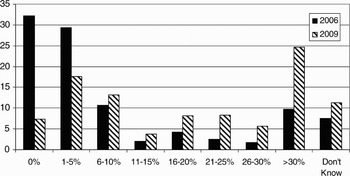
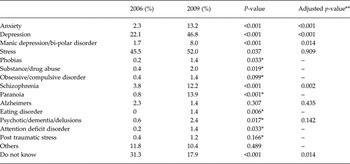
When asked what specific disorders they thought of when they heard the term ‘mental health in the workplace’ there was a general shift towards improved recognition of the more common mental health problems (see Table 1). In 2006, 33% of employers thought that none of their employees would develop a mental health problem during their working life, compared to just 7% in 2009 (adjusted p < 0.001). Similarly, in response to this question fewer employers predicted rates of between 1 and 5% in 2009, with a significant trend towards higher, more accurate, percentages in 2009 compared to 2006 (Chi-square test for trend p < 0.001) (see Fig. 1). A much larger proportion of those interviewed in 2009 were aware of employees who currently had mental health problems, 34% compared to 16% in 2006 (adjusted p = 0.002).
What percentage of your employees do you think will have a mental health problem at some point during their working life?.

What specific disorders do you think of when you hear the term ‘mental ill-health in the workplace’?

*Fisher's exact **after adjusting for HR status and number of employees.
Mental health policies in the workplace
There was no significant change in the prevalence of formal policies on stress and mental health in the workplace (27% v. 29% for 2006 and 2009, respectively). Among those who knew their company had a policy, the majority reported that they agreed that the policy was well understood by their managers (71% v. 79% in 2006 and 2009, respectively, non-significant) and their employees (70% v. 67%, non-significant). Most (78% and 82% in 2006 and 2009, respectively) agreed that their policy was effective in helping their staff to stay in work, and 66% and 76% (2006 and 2009, respectively) agreed that it was effective in helping improve employee mental health (non-significant). However, when asked whether the policy was primarily designed to help their organisation avoid litigation 51% and 34% (2006 and 2009 respectively) agreed (adjusted p = 0.014).
Current preparedness for dealing with mental health in the workplace
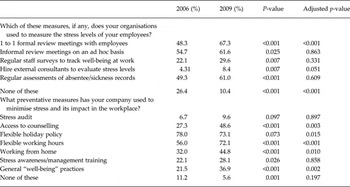
When asked which measures, if any, their organisations used for measuring employees’ stress levels, in both years a large proportion stated they used either direct or indirect interviews with their staff or assessments of staff absenteeism to monitor stress. In contradiction to the constant proportion of businesses with mental health polices in place, the proportion of businesses with each of the potential monitoring measures in place increased between 2006 and 2009 (see Table 2). When asked which measures their companies used to minimise stress and its impact in the workplace significantly more of those interviewed in 2009 reported offering access to counselling, flexible working hours, home working and general ‘wellbeing’ practices, such as a workplace gym and physiotherapy, compared to 2006 (see Table 2).
Current measures of stress levels among employees and preventative measures to minimise stress

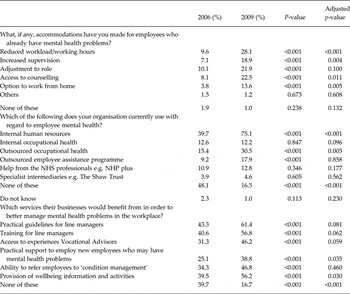
In response to the question about what, if any, ‘reasonable accommodations’ they had made for employees who already had mental health problems, there were significant increases in the availability of a variety of accommodations between 2006 and 2009 (see Table 3). In each year, only a very small proportion reported having made none of the listed adjustments. When asked if they would, in the future, be flexible in offering adjustments to someone with mental ill-health 68% of those interviewed in 2006 agreed, rising to 87% in 2009 (adjusted p < 0.001).
Current and potential accommodations and arrangements for employees who have mental health problems

Three-quarters of those interviewed in 2009 reported using internal Human Resources Departments for employees with mental health problems, compared to 40% in 2006 (adjusted p < 0.001). Similarly, the use of outsourced occupational health services and employee assistance programmes rose significantly. Correspondingly, fewer of those interviewed in 2009 reported that they did not use any of the listed services, 17% compared to 48% in 2006 (adjusted p < 0.001).
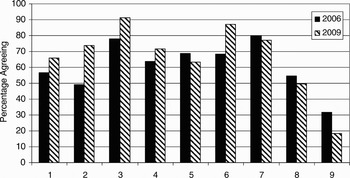
Most of those interviewed in 2006 (57%) agreed that managers in their organisations have a good understanding of mental health issues; by 2009, 67% agreed (adjusted p < 0.001) (see Fig. 2). When asked if their organisation provides a very good level of support for managers dealing with staff who have mental health problems, 49% agreed in 2006 compared to 74% in 2009 (adjusted p < 0.001).
Percentage of employers agreeing with nine mental health statements. (1) The managers in the organisation have a good understanding of mental health issues. (2) Our organisation provides a good level of support for managers dealing with staff who have mental health problems. (3) I would feel comfortable talking about mental health with my employees. (4) I would feel comfortable talking about mental health with job applicants. (5) I do not know enough about the law regarding mental health in the work place. (6) We would be flexible in offering adjustments or accommodations to someone with mental ill-health. (7) Potential employees should disclose mental health problems prior to recruitment. (8) Negative attitudes from co-workers are a major barrier to employing people with mental health problems. (9) People with mental health problems are less reliable than other employees.

A significant increase was found in the proportion that would feel comfortable talking about mental health issues with an employee; 78% agreed in 2006 compared to 91% in 2009 (adjusted p < 0.001) (see Fig. 2); however, these figures drop with respect to job applicants at 64% and 72% for 2006 and 2009, respectively (adjusted p = 0.013). Sixty-nine percent of those interviewed in 2006 agreed that they did not know enough about the law regarding mental health in the workplace, compared to 63% in 2009 (non-significant after adjustment).
When asked which services would enable their businesses to better manage mental health problems in the workplace, the largest proportion of interviewees, in both years, indicated that practical guidelines and training for line managers would be most beneficial (see Table 2).
Attitudes of employers
High proportions of those interviewed agreed that potential employees should disclose mental health problems prior to recruitment (80% and 77% in 2006 and 2009, respectively (Fig. 2)). Many of those interviewed also agreed that negative attitudes from co-workers were a major barrier to employing people with mental health problems (55% and 50% in 2006 and 2009, respectively). A small but declining proportion of respondents from each year agreed that people with mental health problems were less reliable than other employees (32% and 18% in 2006 and 2009, respectively, adjusted p = 0.004).
A small and declining proportion of respondents agreed that ‘Employees who have been off work with mental illness for more than a few weeks are unlikely to ever fully recover’; 17% in 2006 and 9% in 2009 (adjusted p = 0.016). Higher proportions agreed that their organisations take a significant risk when employing people with mental health problems in public/client facing roles but again this declined, from 49% in 2006 to 35% in 2009 (adjusted p = 0.004). However, nearly half also agreed that employees suffering from stress were able to work effectively – 43% in 2006 and 47% in 2009 (non-significant).
A large majority of interviewees agreed that ‘British industry loses a great deal of talent because it does not know how best to deal with mental health in the workplace’; 67% in 2006, increasing significantly to 81% (adjusted p < 0.001, data not shown). Seventy-six percent of those interviewed in 2006 agreed that British industry needs more support in improving the way it deals with mental health in the workplace, increasing to 88% in 2009 (p = 0.002).
Discussion
Summary of findings
Comparing the 2009 and 2006 survey results reveals significant improvement in several aspects of mental health knowledge among those interviewed. Awareness of what constitutes a mental health problem had significantly improved, with far more recognition of common diagnoses in 2009 compared to 2006. However, this alone may not improve the treatment of all mental health issues in the workplace, with Manning & White finding that discrimination varies depending on a person's diagnosis (Manning & White, Reference Manning and White1995).
Additionally, there appears to be improved knowledge about the incidence and prevalence of mental health problems in the workplace. However, a large proportion of the employers interviewed reported that they did not know enough about the law regarding mental health in the workplace; the lack of a significant change in this proportion may indicate that efforts by SHiFT and the Sainsbury's Centre, among others, to improve employers’ legal knowledge in the area have so far been unsuccessful (SHiFT, 2010; The Sainsbury's Centre for Mental Health, 2010).
Although there has been no change in the prevalence of formal mental health policies there were signs of other improvements. Where formal policies were in place they were widely felt to be well understood and effective; although this was the case even in companies which believed that they currently had no employees with mental health problems. Additionally, the proportion reporting monitoring stress in the workplace increased significantly, with 90% currently monitoring work-related stress, indicating the success of some of the agencies working with employers on this issue. Only 6% of those interviewed in 2009 offer none of the suggested stress prevention strategies, with many now offering an array of options; 99% of those interviewed offered at least one of the suggested accommodations to employees who currently have a mental health problem. There have also been improvements in the proportion of employers who have a designated route for managing employees with mental health problems, although 17% of companies still have no such structure. Of those that do, a combination of internal HR management and external resources such as the NHS or outsourced occupational health/employee assistance programmes was commonly used.
There was no change regarding disclosure in job applications; over three-quarters of employers believe that people with mental health problems should disclose prior to employment, despite this being highly discouraged by the Equality Bill. In contradiction to this, however, not all employers would be comfortable actually discussing mental health with an applicant. This is also somewhat at odds with the findings of Fenton et al., who found that depending on the size of the company, between half and three-quarters of companies never asked applicants about their mental health (Fenton et al. Reference Fenton, O'Hanlon and Allen2003).
Limitations
Several study limitations must be considered. The response rate of 71% is lower than that of 93% for the 2006 survey, so the 2009 data may be less representative of British businesses. The difference in rates is likely due to the Business Omnibus Survey being well known among employers with an exceptionally high response rate. The response rate obtained in 2009 is similar to, if not higher, than response rates obtained during other survey's of businesses/professional (Dennis, Reference Dennis2003; Brosseau & Li, Reference Brosseau and Li2005; Day et al. Reference Day, Challen and Walter2010), implying that the survey's focus on mental health was unlikely to be negatively influencing participation and may even have had a positive effect. Should this be the case, it is possible that those individuals choosing to take part in the survey may be more aware of mental health issues within the workplace than those declining, potentially having a small influence on the results. Unfortunately, we have no information on whether the response rate varied depending on the respondent's position within the company, but research suggests that top management are least likely to respond to telephone surveys (Baruch, Reference Baruch1999). This may reflect their attitude to un-recognised surveys in general or their lack of time for the particular issue being researched, possibly impacting on the results obtained.
Further, when discussing a company's policy on mental ill-health, respondents provide their subjective opinions rather than any objective measure. The survey examines the opinions of senior company executives who may have very different views from those of their middle managers, where these line managers have a stronger and more direct influence on the day to day working life of employees with mental health problems.
Interpretation
This survey revealed an encouraging improvement in both employers’ basic mental health knowledge and their reported behaviour in terms of preventing and managing mental health in the workplace between 2006 and 2009. However, as Angermeyer et al. discuss in their study of the public's emotional reaction to people with mental illness, increasing mental health literacy does not necessarily correlate with improvements in the emotional response to the issue (Angermeyer et al. Reference Angermeyer, Holzinger and Matschinger2010). For example, the lack of an overarching formal policy may suggest that measures are often introduced primarily for reasons other than to accommodate people with mental health problems.
Further, these improvements contrast with attitudes to employing those with pre-existing mental health problems; a third of respondents believe that this would be taking a significant risk, while nearly a half viewed co-worker attitudes as a barrier to employing people with mental health problems. This lack of a corresponding improvement in attitudes may indicate that the behavioural changes documented are driven more by attempts to meet perceived legal requirements, such as those required under the disability discrimination act, than by a reduction in the stigmatising attitudes that lead to the discriminatory behaviours in the first place. A legal motivation may lead to more short-term ‘quick fix’ adjustments, guided by legal checklists, compared to a more enduring attitudinal change.
Implications for research
Further research examining the motivation behind the changes found would be helpful in interpreting these findings. Going forward, it is important to continue to monitor the success of government and non-governmental initiatives with respect to employers’ knowledge, attitudes and employers’ behaviour.
Implications for policy
With respect to existing employees, there is clear evidence that additional guidance would be well received by employers, mostly in the form of practical training and guidelines for managers, despite the finding that two-thirds of those interviewed thought their managers had a good understanding of mental health issues. This may reflect increasing awareness of the importance of workplace mental health. With respect to potential employees, the finding that three-quarters of employers wish people to disclose mental health problems prior to employment suggests considerable resistance to the Equality Act 2010, which means that an employer will be deterred from asking candidates questions about their health until after they have shown that they meet some of the non-health criteria of a job. It will therefore be important to ensure employers are aware of the amendment and to provide legal assistance for those with a possible case of discrimination.
Acknowledgements
We thank Paul Flatters, Trajectory Partnership, for information on the 2006 survey and advice on repeating it in 2009. This study was carried out as a collaboration between The Shaw Trust and the NIHR Specialist Mental Health Biomedical Research Centre at the Institute of Psychiatry, King's College London and the South London and Maudsley NHS Foundation Trust.
Declaration of interest
The study was partly funded by Big Lottery and Comic Relief through their funding of the Time to Change programme. The study was also supported by a National Institute for Health Research (NIHR) Applied Programme grant awarded to the South London and Maudsley NHS Foundation Trust (RP-PG-0606-1053). GT is also funded through a NIHR specialist Mental Health Biomedical Research Centre at the Institute of Psychatry King's College London and the South London and Maudsley NHS Foundation Trust. GT has received grants for stigma-related research in the past 5 years from Lundbeck UK and from the National Institute for Health Research, and has acted as a consultant to the UK Office of the Chief Scientist. The views expressed in this publication are those of the author(s) and not necessarily those of the NHS, the NIHR or the Department of Health. The authors report no conflict of interest in the preparation of this manuscript.