1. Introduction
China's economic rise was one of the most momentous affairs of the twentieth century, changing the landscape of both regional and world politics. Its extraordinary growth has, in many ways, confirmed the power of free markets and challenged neo-classical perspectives on the foundations and limits of a market economy. The 2008 financial crisis further confirmed the strength of state-driven economic development and authoritarian models, which stood in stark contrast to the struggling democratic liberal market economies. This sparked an academic debate about the efficacy of newly strengthened industrial policies and a re-evaluation of the role of the state in the market. In both developed and developing countries, taking a mercantilist approach and adopting murky protectionist measures have become a norm rather than an exception. Desire to lead the fundamental reordering of the global economy in the fourth industrial revolution provided an added political justification to push for demand- and supply-side industrial policies with a more pronounced visible hand in the market.
Beijing has implemented a diverse array of state-led initiatives to build industrial capacity and become the world's preeminent technology superpower. China's leaders, especially President Xi Jinping, have chosen to establish more centralized control over the economy instead of experimenting with further privatization and liberalization. They know that only market forces can generate the long-term growth that can sustain the Communist Party's political survival; but, at the same time, they want to ensure that the state controls the wealth that the market generates. What are the distinctive characteristics of China's state-driven economic development model? What are the global and regional implications of its revitalized state capitalism?
This paper explores such questions by examining China's participation in multilateral and bilateral settings as a way to expand its developmental and geopolitical agenda. At the multinational level, international organizations such as the World Trade Organization (WTO) are limited in the extent they can push China toward further liberalization. Originally a cautious and passive participant in the WTO, China has moved rapidly along a learning curve to skillfully navigate the system and create spaces for its industrial policy objectives. China often takes a passive stance in agenda-setting stages, compared to other developing countries such as Brazil and India, yet maximizes its leverages at the litigation stage within the Dispute Settlement Body. China deftly shifts policy measures to comply with WTO rulings and adopts other policies with similar effects that prioritize sectoral development objectives. This approach allows China to outsmart the WTO system and continue nurturing its domestic companies as regional, national, and global champions with government protection from fierce foreign competition.
At the bilateral level, Beijing also increasingly relies on economic statecraft, or the use of economic instruments to advance foreign policy goals. China closely links purchasing and coercive diplomacy with protections for Chinese players at home and abroad. The Belt and Road Initiative (BRI), China's infrastructure development and investment project that aims to connect Asia with Europe and Africa along ancient trade routes, aims to secure footholds for Chinese national and local champions in the overseas market. China also increasingly resorts to coercive measures to pressure a targeted country to reverse certain actions. Negative sanctions not only lead to short-term trade restrictions, but also create longer-term barriers for foreign firms and their products when combined with discriminatory industrial policy measures against them. China's increasing use of economic statecraft contributes to the politicization of trade and increases the cost of economic interdependence with China.
This article explores China's efforts to create a race to the top through the lens of the automotive industry, which stands at the intersection of both traditional and green industrial policy measures. The remainder of this article proceeds as follows. Section 2 provides an overview of Chinese state capitalism and the use of industrial policies for economic developmental objectives. Section 3 introduces the characteristics of the Chinese automotive industry and modes of government intervention. Then, Section 4 illustrates China's WTO trade disputes in the automotive sector to demonstrate the country's increasing confidence in navigating the dispute resolution process as well as to address the WTO's institutional limitations in curbing governments’ interventionist measures. The following passage, Section 5, provides a detailed overview of how Beijing uses the BRI to expedite the internationalization of Chinese auto companies by expanding trade and investment links for Chinese companies and products. Section 6 explores how China resorts to economic statecraft and weaponizes foreign investment and trade, as seen in the cases of state-led boycotts and unofficial economic retaliation against South Korea. The final section discusses the implications of China's industrial policy in the context of global power competition with the United States and emphasizes that Beijing still has a keen interest in maintaining the existing global trade regime rather than disputing China's legitimacy as one of the world's largest traders and beneficiaries of the liberal economic order.
2. China's State Capitalism and Industrial Policy Tools
Defining the relationship between state institutions and economic growth has been a perennial quest in social science. Scholars in the field of economics and political science have been sharply divided about the benefits of government intervention in the economy. In the early 1980s, development policy shifted towards a more market-centered approach, limiting government intervention to horizontal and cross-sectoral industrial policies that make market outcomes more efficient by increasing competition or providing public goods. Policy makers and scholars, however, continuously argue for the benefits of vertical and sector-specific industrial policies whereby state intervention deliberately favors particular industries or firms in order to spur structural transformation that does not take place autonomously (Lin and Chang, Reference Lin and Chang2009; Harrison and Rodriguez-Clare, Reference Haley2010). Recent developments in the world economy, including the fallout from the 2007–2008 global financial crisis and the rise of state capitalism, have put industrial policy back on the agenda for both developed and developing countries alike.
China has combined capitalist institutions with a comparative predominance of direct state participation in the economy, mainly but not exclusively through state-owned enterprises (SOEs), an economic system widely referred to as ‘state capitalism’ (Bremmer, Reference Bremmer2010; Liebman and Milhaupt, Reference Li and Liu2015). Despite China's decades-long reform process, the visible hand of the Chinese state remains strong (Zheng and Huang, Reference Zheng and Huang2018). China is by no means the world's sole practitioner of state capitalism, sharing similar traits with other developed and developing countries (Musacchio and Lazzarini, Reference Mundy and Hille2015). Yet it is arguably the most successful, and certainly the largest, with several unique features (Naughton and Tsai, Reference Naughton and Tsai2015; Wu, Reference Wu2015). Instead of experimenting with further privatization and liberalization, Beijing has partially privatized a large fraction of its SOEs, but the state sector gained strength at the expense of the private sector during the Hu Jintao era (2004–2012). The 2008 global financial crisis provided a justification for further power consolidation at the top with the trend of guojinmintui (advancing the state sector and retreating the non-state sector) (Huang, Reference Huang2008; Yang and Jiang, Reference Yang, Jiang and Yang2012). China's leaders have chosen to establish more centralized control over the economy (Lardy, Reference Lardy2019).
Private firms have been important drivers of China's economic transformation and will remain a promising source of its future growth (Lardy, Reference Lardy2014). However, the focus on equity ownership overlooks key aspects of state capitalism in China because the state can capture companies with a range of ownership types. Both SOEs and private companies have limited autonomy from the state, and incorporate state policies as part of business objectives that extend beyond satisfying the corporation's shareholders and employees. The Party has various tools to facilitate state supervision over private enterprises that blur the boundary between SOEs and private firms. Such tools include party membership for private entrepreneurs as well as financial support such as subsidies, extra-legal control rights, and existence of party cells in board rooms (Milhaupt and Zheng, Reference Martin and Simmons2016; Wu, Reference Wu2016). Furthermore, foreign partners in joint ventures (JVs) are requested to allow the Communist Party cells to take a formal role in strategic management decisions such as investment plans or personnel changes (Feng, Reference Gao and Deere-Birkbeck2019).
China's state capitalism raises concerns for the multilateral trade system in light of China's growing importance in the global economy and international trade. Foreign business circles have consistently drawn attention to Chinese policy measures – subsidies, forced local content and technology transfer requirements, disregard for intellectual property rights and discrimination against foreign companies in favor of domestic actors – most of which violate WTO regulations. Foreign companies’ concerns are not limited to competition in the Chinese market and their diminishing market share in China; they also fear increasing competition from inexpensive Chinese products flooding the global market and their home markets, especially when China's subsidies can displace their exports in a common third-country market.
Additional apprehension regards the WTO's institutional limitations in regulating China's industrial policy measures, especially the ineffectiveness of the WTO's Agreement on Subsidies and Countervailing Measures. The narrow definition of what constitutes a subsidy with the focus on the financial contribution by ‘a government or public body’ allows SOEs to escape scrutiny. Moreover, many countries neglect to notify their subsidy programs to the WTO when doing so runs on a voluntary basis (Bown and Hillman, Reference Bradsher2019). Second, the protracted formal dispute settlement process, which can take months or even years, creates incentives for countries to worry less about the potential illegality of certain industrial policy measures when the economic benefits are immediate. Countries can continue benefiting from disputed policies during this initial period of legal review and repeal them only once the challenge succeeds. The Dispute Settlement Body (DSB) rulings are also prospective rather than retrospective, covering only losses as of the date of the ruling, not the date of violation. Often, winning a trade dispute depends on more than the final ruling; for example, in China, the real victory can come from buying time for domestic industry adjustments, as well as signaling its policy preferences to multinational corporations (MNCs) operating in the country (Oh, Reference Oh2015).
MNCs implicitly or explicitly support protectionist measures in China due to either their fear of retribution from Chinese government officials or their hope to gain even small pieces of the ever-enlarging pie of the Chinese economy. Fear of retribution prevents MNCs from contesting Chinese behavior or bringing evidence to support cases at the WTO. Chinese officials can flex their muscles through measures such as blocking an MNC's entrance into the Chinese market, delaying permits, withholding raw materials, and detaining finished products at ports (Oh, Reference Oh2015).
With the recognition of existing WTO rules’ shortcomings, major advanced countries rely on trilateral and bilateral channels to recognize China's unfair trading practices. In December 2017 at the WTO's 11th Ministerial Conference, the United States, European Union, and Japan have begun a trilateral process to confront the Chinese economic model and address ‘unfair market distorting and protectionist practices’, especially on the issues of industrial subsidies, SOEs, and the forced transfer of technology (United States Trade Representative, 2017). The trilateral meeting has called for the reform of the WTO system. Bilaterally, the US has pushed China with demands on fixing structural issues regarding how Beijing manages the country's economy and creating a level playing field for foreign investment regarding intellectual property protections and cybertheft of US trade secrets.
3. The Chinese Automotive Industry
The Chinese auto industry stands at the intersection of both traditional and green industrial policy measures that pertain to the active intervention of the Chinese government at the national and sub-national levels. It also serves as an illustrative example of the process and consequences of Chinese efforts to balance liberalizing and protectionist measures as a designated pillar sector since its Seventh Five-Year Plan in 1986. Labeled ‘industry of industries’, the automobile has remained one of the most important strategic drivers of economic development as the epitome of manufacturing, technological, commercial, and organizational innovation since the turn of the twentieth century (Drucker, Reference Drucker1946, 149). Given the significance in job creation, economic contributions, and industrial capacity building, the automotive industry has been the focus of industrial policy and government involvement in economic growth in many countries. A strong indigenous automotive industry also serves as a symbol of national pride that showcases industrial prowess.
For the past three decades, Beijing has endeavored to follow in the footsteps of Japan and South Korea, who created national champions by carefully crafting industrial policy and regulatory frameworks in their automotive sectors. In the traditional combustion auto sector, Beijing required global automakers to form JVs with no more than two Chinese SOEs and limited their ownership to a maximum equity share of 50%. For MNCs, such ownership regulation restricts two of their most important business strategies: entry mode and entry timing. Beijing also put JVs under strict local content requirements to build manufacturing capacity in the upstream activity of car assembly through horizontal and vertical technology spillovers from foreign partners to domestic players. Developing suppliers and creating industrial clusters are key foundations for sectoral growth, cost reduction, and industrial upgrading, given that a typical automobile contains about 2,000 functional components, 30,000 parts, and 100 million lines of software code. While the WTO has strongly attacked local content requirements for constituting non-tariff barriers of infant industry protection and control over foreign companies, policy makers in developing countries employ such policies extensively to facilitate technology transfer from foreign partners and the growth of indigenous suppliers (Hestermeyer and Nielsen, Reference Hestermeyer and Nielsen2014; Sauvé, Reference Sauvé2016; Ornelas and Puccio, 2020).
The extent to which such industrial policy measures were successful in nurturing the Chinese auto industry has generated mixed assessments. Both Chinese SOEs and private automakers have grown quantitatively in the world's largest auto market. Despite such explosive quantitative growth, Chinese SOEs who have been the main target of state support have not generated solid indigenous brands that can compete with global brands and have relied on models from their foreign JV partners. From 2010, Beijing shifted gears to prioritize investment in the development of New-Energy Vehicles (NEVs) by designating NEVs as one of the seven ‘strategic emerging industries’ in addition to its decade long focus on Electric Vehicles (EVs) (State Council of China, Reference Simmons2010). The strategic focus coincides with China's domestic need for greater energy independence and environmental protection, as well as global ambition to take the lead in renewable energy. In 2012, the Energy-Saving and New-Energy Automotive Industry Development Plan (2012–2020) set forth an industrial development blueprint for NEVs calling for the establishment of numerous regulations and subsidy programs to support domestic R&D, manufacturing, and utilization.
China's focus on developing its domestic capacity to produce NEVs was further emphasized with ‘Made in China 2025’ – the underlying plans for China's industrial upgrading and indigenous technology development to dominate the global market in critical high-tech industries (State Council of China, 2015). Made in China 2025 identifies NEVs as one of the ten target industries to improve indigenous R&D through government subsidies and intellectual property acquisition of the US and European rivals with advanced technology. It calls for indigenous EVs and NEVs together to acquire more than 70% of the domestic market share by 2020 and for NEVs over 80% by 2025. Backed by state sponsorship, local manufacturers are expected to achieve dominance at home and success abroad in critical future technologies.
China adopted similar policies with developed European countries to boost the demand and production of EVs and NEVs, including generous tax incentives for consumers to lower the cost of vehicle purchases, investment for charging infrastructure, and restrictions on the sale and use of gasoline cars. Certainly, there are emerging discussions among scholars and policy makers about WTO compatibility of the industrial policy programs that foster public interest, such as preventing climate change or in promoting renewable energy (Rubini, Reference Russel and Berger2012; Espa and Marín Durán, Reference Espa and Durán2018). However, what makes the Chinese approach distinctive is its state-dominant economic model along with its authoritarian form of governance that deploys an array of industrial policies and maintains uneven playing fields.
Beijing's policies to stimulate market performance of the Chinese domestic companies at the expense of foreign competitors have been more intensified with NEVs. Foreign NEV producers face pressure to form JVs with Chinese partners to sell in China due to a range of Chinese policies, including steep import tariffs of 25%, subsidies available for domestically produced NEVs, and a new NEV credit system.Footnote 1 Especially, the market access rules by the Ministry of Industry and Information Technology (issued in 2009 and updated in 2017) require NEV manufacturers to transfer their technologies to JVs to gain market access, and master the manufacturing technology for a complete NEV and possess key R&D capacities to be eligible for certain NEV preference programs (Howell et al., Reference Howell, Lee and Heal2014; Cheung et al., Reference Cheung, Mahnken, Seligsohn, Pollpeter, Anderson and Yang2016).
China's market size and potential for further growth keep MNCs keen on expanding their shares in the Chinese market, despite various formal and informal barriers. As the world's largest EV market, China accounted for over half of global EV sales in 2018 (Gersdorf et al., Reference Gersdorf, Hertzke, Schaufuss and Schenk2020). The penetration rate for EVs is only 2% in major cities such as Beijing, Shanghai, Hangzhou, and Shenzhen, and for NEVs the rate is less than 1.4% in the country as of mid-2019 (Ren, Reference Reilly2019). As such, Beijing has huge leverage over MNCs in enforcing its plan to have domestic companies control over 70% of the domestic market. The following sections showcase how China outsmarts the multilateral trade regime to create space for industrial policy measures that nurture local and national champions, while also expanding its overseas markets to develop its national champions into global players.
4. Convenient Compliance: Creating Space for Chinese Champions
China joined the WTO in 2001 after thirteen years of marathon negotiations, making concessions on both trade in goods and services that exceed those of other WTO member states (Qin, Reference Qin2006; Bown, Reference Bown2009). Its accession was a significant step forward in opening the Chinese market and integrating it into existing global economic governance regimes. The WTO also made a substantial move towards being a ‘world’ organization by incorporating China, a big emerging economy, into its organization. By doing so, the WTO raised the expectation to resolve trade concerns with the non-market economy more effectively than through bilateral trade negotiations. The conventional wisdom from neoliberal scholars appreciates the role the WTO plays in facilitating trade liberalization among nations by providing, monitoring, and enforcing multilateral rules (Axelrod and Keohane, Reference Aggarwal and Reddie1985; Martin and Simmons, Reference Milhaupt and Zheng1998). Once countries have joined the WTO, they tend to change behaviors and abide by international legal agreements due to the reputational costs of noncompliance (Simmons, 2000). Constructivist scholars highlight international institutions’ ability to socialize member countries into adopting international norms (Johnston, Reference Johnston2001; Kent, Reference Kent2002).
China has evolved from a cautious and passive WTO member into an active participant of the litigations at the WTO's DSB. Until its first case to go through the full panel and appeal process starting in 2006, Beijing had participated 66 cases as a third-party observer by joining almost every panel during its first five years in the WTO (World Trade Organization, n.d.). China's compliance with the DSB's final rulings reflect Beijing's realpolitik calculation to achieve its economic development goals by selectively utilizing industrial policy tools. China tends to remove disputed measures and settle disputes mainly for two reasons. First, China can easily replace the measures with alternative trade and industrial instruments to the same end. Second, at the point of dispute settlement, China has often already achieved its initial goals to put specific measures in place and thus the originally disputed actions are no longer as useful. China temporarily utilizes non-compliant policy tools during crucial stages of development but ultimately builds a reputation as a responsible WTO member by complying with the DSB rulings – a practice that I characterize as ‘convenient compliance’ (Oh, Reference Oh2015).
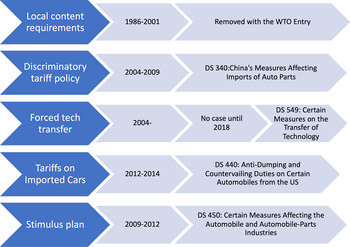
The WTO trade disputes involving China's industrial policy measures in the automotive industry provide examples of how China skillfully adopts non-compliant industrial policy measures to achieve the same goal of sectoral development even after they have been declared illegal. Upon WTO entry in 2001, Beijing successfully negotiated to maintain the JV requirements between the Chinese SOEs and global automakers. Yet, Beijing had to remove the local content requirement (the requirement to use domestically produced inputs), lower the tariffs on imported cars from the 80–100% to a fixed 25% rate, and reduce tariffs on imported parts and components from 15–50% to a fixed 10% by July 2006 (Noble et al., Reference Noble, Ravenhill and Doner2005).
To combat the dampening effects of liberalization measures on indigenous auto and auto parts makers, the Chinese government adopted two sets of policies in 2004, one on local content and another on technology transfer. First, to mitigate the adverse impact of the removal of the local content requirements on local supplier development, Beijing adopted significant restrictions on imported auto parts as a countermeasure. According to the Policy on Development of Automotive Industry in June 2004 and Measures for the Administration of Importation of Automotive Parts Characterized as Complete Vehicles in February 2005, a car with more than 60% imported parts in either quantity or value would be treated as a fully imported car and charged a 25% tariff instead of the normal 10% on parts (General Ministry of Customs, 2005). The foreign partners were under continued pressure to work with local Chinese suppliers or to convince their global suppliers to open factories directly in China, instead of importing parts into China; this setup eventually had the same effect as the forced local content requirements from China's pre-WTO entry era.
Joined by the EU and Canada, the US contested the measure at the WTO in March 2006 to open a case on China–Auto Parts.Footnote 2 The complainants claimed that such measures served as a subsidy for automakers to use domestic rather than imported parts and acted as a discriminatory charge in favor of auto parts originating in China (United States Trade Representative, 2008). This dispute became the first WTO case for which China went through the full panel and appeal process.Footnote 3 Beijing halted the implementation of import-related provisions in August 2009 following the rejection of China's appeal by the Appellate Body. The rulings had the potential to benefit auto parts exporters around the world by removing the measures against imports into China, adding competitive pressure on auto parts producers in China that had been relatively sheltered from imports. However, along with China's two-decade long local content requirements for JVs prior to the WTO entry and the four-year long litigation process at the WTO, global automakers in China had already localized their supply chains close to 90%. Automakers invited first-tier suppliers to China and cultivated local suppliers whether they entered in China's pre-WTO entry era, like Shanghai GM in 1997, or in its post-WTO entry era, like Beijing Hyundai in 2001 (Oh, Reference Oh2013).
China conveniently revoked the above-mentioned discriminatory tariff measure and continued pursuing the same goal of nurturing national champions with other policy instruments that discriminated against foreign products. Two months after the WTO panel report for the China–Auto Parts case, China launched a US$1.5 billion stimulus plan in March 2009 and offered an export-contingent subsidies program for the domestic auto and auto parts companies to develop proprietary brands and exports.Footnote 4 The plan also included lower sales taxes on vehicles with small engines, favoring existing Chinese domestic brands instead of JV models. In September 2012, the United States opened a WTO case over the stimulus plan, China–Auto Parts Industries.Footnote 5 After the consultations held in November 2012, China agreed not to renew its subsidy program (United States Trade Representative, 2019). Another case was opened in July 2012 by the US. In 2011, China enacted the anti-dumping and countervailing duties after having stated that imported American vehicles had been sold at below fair-market value and had benefited from U.S. subsidies, such as the bailouts of General Motors and Chrysler (Ministry of Commerce, 2011). The US contested such duties of more than US$3 billion on exports of American-produced cars and SUVs with engines of 2.5 liters or more at the WTO in the ‘Anti-Dumping’ case (China–Autos US).Footnote 6 After going through a full panel process, the panel ruled in favor of the US in May 2013 and China terminated the duties. As such, China's effort to develop its domestic automotive sector has never stopped, and various national policies have been continually reformulated into new instruments – whether it has been the promotion of forced local content, discriminatory tariff policies, or stimulus plans for China's domestic companies (see Figure 1).
China's industrial policy measures in the auto sector

A second set of measures was adopted to facilitate technology transfer from foreign companies to Chinese partners. The above-mentioned 2004 Automobile Policy required foreign automakers to seek approval of new automobile-production plants in China to file technology-transfer agreements, build R&D facilities, and develop new brands with local Chinese partners.Footnote 7 For example, in 2011, Volkswagen AG only obtained government permission to build a new factory in south China after the company agreed to launch a new brand with a Chinese producer, First Auto Works (Haley, Reference Harrison and Rodriguez-Clare2012).
Such pressure for technology transfer has intensified in new strategic industries such as NEVs. As explained above, foreign NEV makers are required to produce NEVs locally in the form of JVs with Chinese partners and with no more than 50% equity in order to sell in the Chinese market. They also need to become proficient in manufacturing technology to be eligible for the various subsidy programs. In June 2018, the EU (later joined by the US, Japan, and Chinese Taipei) contested such performance requirements in tandem with the forced technology transfer, ‘Certain Measures on the Transfer of Technology’ (DS 549).Footnote 8 They claimed that China's JV requirement and NEV production force foreign companies to transfer technology to their Chinese JV partners in order to get administrative approval from the Chinese authorities, which violates equal treatment for national and foreign companies (European Union, 2020). Foreign companies would also lose their ability to enforce intellectual property rights when the JV contract with the Chinese expires, leaving them vulnerable. As one trade association stated in USTR's Section 301 hearing testimony, ‘[Y]ou're simply not going to be able to sell that product in China unless that local partner has mastered the ability to leverage the technology and take it to produce it going forth’ (United States Trade Representative, 2018). Yet, foreign entrepreneurs are generally deterred from supporting a WTO case against China (Miller and Miller, Reference Miller and Miller2007). With its large market size, attractive growth potential, and strong state capacity, China skillfully crafts protective industrial policies to make spaces for its local and national champions while continuing developmental objectives with different policy toolkits and staying one step ahead of WTO rule enforcement.
As latecomers to the WTO, it is harder for developing countries to rewrite the foundational WTO rules that work as institutional constraints, and yet they find ways to increase operational room within international organizations. For example, India and Brazil used their activist and entrepreneurial leadership through proactive agenda-setting in the Doha Round (Hopewell, Reference Hopewell2016). On the other hand, China uses reactive veto capacity and takes a passive stance in agenda-setting, while maximizing leverage at the litigation and rule-interpretation process through convenient compliance. Beijing has moved rapidly along the learning curve to make a transition from ‘rule-taker’ to ‘rule-shaker’, debunking several institutional limitations of the WTO (Gao, Reference Feng2011).
5. Belt and Road Initiative: Launchpad for Internationalizing Chinese Champions
Beijing has become a ‘rule-maker’ through its new global initiative to build a vast network of trade routes and investment links between China and participating countries, awarding national and local champions opportunities to become global champions. The state manipulation of economic instruments for strategic purposes, termed economic statecraft, has long been a staple of great-power politics (Baldwin, Reference Baldwin1985). As the second largest economy and the factory of the world, China has increasingly leveraged its economic power over other countries using both negative and positive sanctions, intensifying the nexus between economy and security (Reilly, Reference Ren2013).
Since 1999, China has sought the ‘Going Global’ strategy, urging Chinese commercial actors to invest abroad. Both state-backed SOEs and private companies drove the trend of building infrastructure in the developing world and buying existing companies in the developed world. China's major effort to build friendship and buy influence through purchasing diplomacy has culminated in one of the most ambitious infrastructure and trade projects ever conceived. In 2013, President Xi Jinping announced the launch of both the Silk Road Economic Belt and the 21st Century Maritime Silk Road that form the Belt and Road Initiative, with total investment aims of US$1.3 trillion by 2027 with coverage of 120 countries. It is often compared to the 1948 Marshall plan of US$13 billion – equivalent to US$100 billion today (Shen, Reference Shen2016).
In addition to enhancing trade, foreign investment, and economic expansion for developing countries through much-needed infrastructure building, the BRI is designed to meet economic and strategic goals for China. It allows Beijing to efficiently utilize excess savings and overcapacity in construction and to consolidate economic and diplomatic relations with participating countries. It also diversifies China's import of energy and other resources through economic corridors to circumvent routes that are controlled by the US and its allies. Moreover, it provides footholds in the overseas market to spur internationalization initiatives for the Chinese local and national champions and to support building of international networks of production and distribution that leverage the different strengths of each location (Hout, Reference Hout2020).
The automotive industry has been one of the sectors that have received central and local government support through the BRI in conjunction with transportation, construction, and infrastructure sectors. In the traditional combustion engine car industry, the lack of domestic demand for indigenous brands in fierce competition with global brands of JVs has been a barrier for local companies’ growth. The BRI is expected to provide huge overseas markets and potential for local production facilities in BRI-participating countries. Guaranteed demand for Chinese indigenous brands become a launchpad for fast ascent in the Chinese technology market; under the government's aegis, Chinese players can begin to aggressively seek and capture low-price markets. After securing solid ground, they can then bring in talented experts from their rivals and pursue Mergers and Acquisitions (M&As), paving the way for entry into the high-end market. In addition to the traditional car industry, President Xi's vision of the ‘Green’ BRI, highlighting green-oriented infrastructure and energy projects, supports the growth of EVs and clear technology products in global markets.
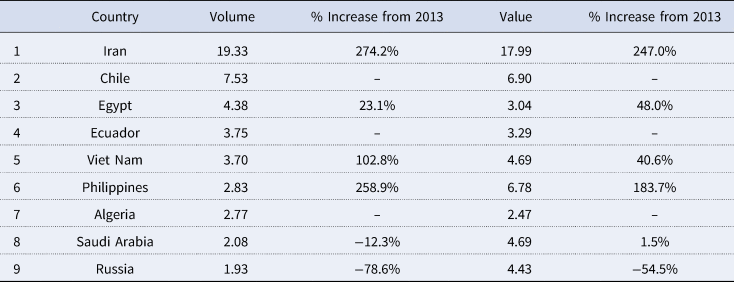
First, Beijing sought to internationalize Chinese auto companies by opening up new export markets for indigenous Chinese auto brands in BRI-participating countries. The BRI has provided wider markets for the Chinese domestic players to meet the economies of scale through expanding overseas demand (see Table 1). From 2013 to 2018, the average growth rate of China's export and value of complete vehicles to the BRI countries have been 11.6% and 12.1% respectively (Ministry of Commerce, 2019). In 2018, BRI countries accounted for 68.6% of total vehicle exports of 692,000 cars and 67.6% of total vehicle export value of US$ 102.2 billion. Chinese cars rank in the forefront of market share in countries like in Iran, Chile, and Algeria.
China's Exports of Complete Vehicles to BRI Countries in 2018 (10 thousand vehicles, billon US$)

Source: Ministry of Commerce (2019).
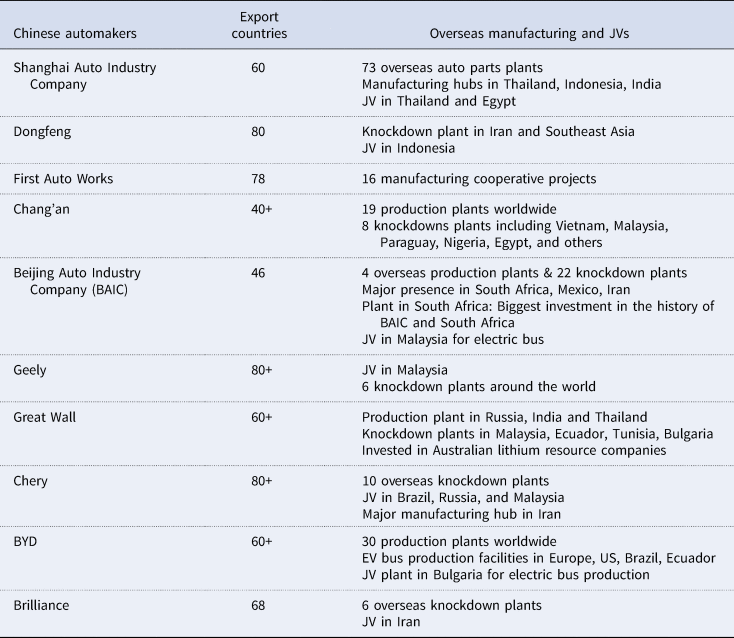
Second, the Chinese companies have actively developed plans for overseas partnerships and JV plants. With the launch of BRI initiatives in 2013, major automakers jumped into establishing new international corporations that manage overseas partnership and imports and exports. For example, the Beijing municipal government-owned Beijing Automotive Industry Company (BAIC), established new divisions in June 2013 called the BAIC International Corporation and the New Import/Export Division. As Table 2 suggests, most major Chinese auto manufacturers and parts companies have formed JVs and overseas production facilities in BRI countries.
China's exports and local production of autos in BRI countries

Source: Compiled by the author from company websites and public statements/reports, auto industry reports, and trusted news sources.
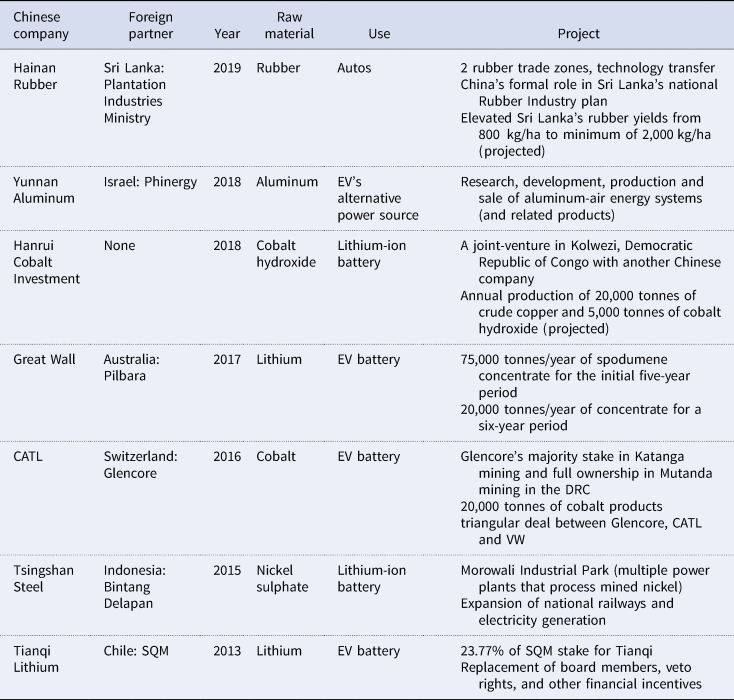
Third, both Chinese automakers and parts companies further accelerated to secure their access to critical raw materials for EV production, such as cobalt and lithium. As Table 3 suggests, the Chinese automaker Great Wall invested in Australian lithium resource companies in 2017, and Yunnan Aluminum signed a JV agreement with Israel's aluminum-air technology company Phinergy to make aluminum batteries in 2018. The world's largest and fastest-growing EV battery maker from China, CATL, also signed a contract with the world's top cobalt producer, Glencore (a Switzerland-based mining company), which has partnerships in the Democratic Republic of Congo. These active moves by the Chinese companies intensify inter-country competition to secure natural resources and energy diplomacy (Economy and Levi, Reference Economy and Levi2014).
Chinese investment in EV-related raw materials

Source: Compiled by the author from various sources.
Nevertheless, there are increasing concerns about the costs that accompany the Chinese model of state capitalism with the BRI. First, internally, Xi's original intention was to promote public–private partnerships to increase private investment and the transfer of technological expertise. MNCs, SOEs, and private enterprises are expected to leverage their respective strengths, deepen their collaboration, and boost efficiency in project implementation with a higher rate of return and high-quality development. Such collaboration would relieve some of the local governments’ debt and provide competitive pressure for SOEs to improve Chinese financial and industrial health in the process. The dominance of state-led and financially unsustainable economic development in China's approach yet does little to encourage the participation of MNCs or private firms. Furthermore, not all commercial actors respond to the government's incentives in ways that are conducive for the state's interest in expanding strategic goals (Norris, Reference Norris2016). In reality, the Chinese tactic of promoting public–private partnerships has turned to public–public partnerships, exposing the limitations of diversifying the participating actors in the project.
Second, the BRI has stirred up concerns that the program lacks transparency from project planning to budgeting and procurement and public reporting of debt levels; that it facilitates China's export of its authoritarian model; that the commercial loan terms cause ‘debt trap diplomacy’; and that the projects have inadequate environmental and social safeguards (Gerstel, Reference Gerstel2018; Hurley et al., Reference Hurley, Morris and Portelance2018; World Bank, 2019). Djibouti, Kyrgyzstan, Laos, the Maldives, Mongolia, Montenegro, Pakistan, and Tajikistan are on the list of potential debt defaulters; incumbent politicians in Malaysia, Sri Lanka, and Maldives lost office for corruption scandals involving infrastructure loans linked to the Chinese government and firms (Mundy and Hille, Reference Musacchio, Lazzarini, Liebman and Milhaup2019).
The BRI represents China's vision to increase its influence by using financial carrots and economic promises that would bring mutual gains. More research has revealed that the results of the program are mixed at best, and China is rapidly updating lending practices (Dollar, Reference Dollar2019; Russel and Berger, Reference Rubini2019). Yet, China's rhetorical carrots and materialized results thus far mark significant gaps. In addition, doubts exist about whether China's economic power has afforded Beijing political influence and resulted in foreign policy alignment by other countries. An added tension is the competitive pressure from the United States and its allies in pushing the Indo-Pacific Vision as an alternative to Chinese investment in the developing world.
6. Economic Statecraft: Revitalized Tool for Industrial Developmental Purpose
While Beijing exercises economic leverage to induce positive behaviors through economic incentives, it also increasingly uses asymmetric economic interdependence as ‘economic blackmailing’ to force its counterpart to make a certain decision or act in a way that benefits Beijing's interests (Hirschman, Reference Hirschman1945; Keohane and Nye, Reference Keohane and Nye1977; Knorr and Trager, Reference Knorr and Trager1977). Over the past decade, China has increasingly used various coercive measures as economic retaliation. For example, the country placed an import ban on Norwegian salmon in 2010 after the Nobel Peace Prize was awarded to the Chinese dissident Liu Xiaobo. It imposed an export ban on rare earth minerals to Japan in 2010 and an import ban on Filipino fruit in 2012 over the territorial dispute in the East and South China Sea. As the largest trading partner for over 100 countries around the world, China's frequent use of trade embargoes over diplomatic issues raises uncertainty around economic interdependence and politicizes trade issues. Research has revealed that such temporary measures do not necessarily create a significant change in monthly trade data (Li and Liu, Reference Liebman, Milhaupt, Liebman and Milhaupt2019). Rather, they raise the cost of enforcement for the Chinese authorities on import/export bans and minimize the welfare of Chinese citizens by limiting the choices available in the Chinese market.
China's immediate neighbor, South Korea, was also subject to economic retaliation over Seoul's decision to deploy the US missile defense system from 2016 to 2018. After Seoul's announcement in July 2016, China not only expressed outspoken resentment but immediately launched all-out economic retaliation, including the usual tactics of state-led boycotts and consumer activism wrapped with nationalistic rhetoric (Weiss, Reference Weiss2014). The official mouthpieces of China's ruling Communist Party, People's Daily and Global Times, started a massive media outpouring against Seoul's decision, sparking boycotts against Korean consumer products, including cars, pop-culture, and cosmetics.
What concerns trading partners and foreign businesses, however, goes beyond such short-term trade embargoes and state-led boycotts. Industrial policy measures that discriminate against particular foreign companies could pose mid-term to long-term challenges (Aggarwal and Reddie, Reference Axelrod and Keohane2020). South Korean companies working in the sectors in which Beijing fiercely supports local companies were met with major hurdles in their business operations in China. Hyundai Motor Company, which has a JV with BAIC, suffered from customer’ boycotts, with its sales in China dropping by 36% from 2016 to 2017 and profits suffering losses of 11.9% in 2016 (Lee, Reference Lee2018). In addition, the rift with Hyundai's JV partner has deepened over the JV's reliance on Korean suppliers, some of which have direct or indirect financial ties with Hyundai Group. In September 2017, Beijing publicly criticized the issue and asked to switch suppliers to local Chinese companies (Wang, Reference Wang2017).
Subtle exclusion of foreign firms’ access to the Chinese market is another often-used retaliatory technique in connection with industrial policy measures to move forward with the industrial upgrading of domestic players. As leading global battery makers, three Korean battery companies – LG Chemical, Samsung SDI, and SK Innovation – have expanded their market shares in lithium nickel cobalt manganese (NCM) batteries from 2015 in the world's largest booming EV market, China. Yet, the Chinese central government took retaliatory measures against them by suspending subsidies for electric buses installed with Korean-sourced NCM batteries in 2016 (Crompton, Reference Crompton2016). The Korean government issued a formal complaint that China's new subsidy policy for electric batteries was a discriminatory measure against Korean companies, who produce mostly NCM batteries, and a protectionist measure favoring Chinese local manufacturers, who produce lithium ferro phosphate (LFP) batteries.
Likewise, China's Ministry of Industry and Information Technology withdrew subsidies for EVs loaded with batteries from those Korean companies from late 2016 till December 2019 (People.Cn, Reference Ornelas and Puccio2016). Especially, the ‘seventh list of eco-friendly cars eligible for subsidies’ in 2018 excluded Korean battery-powered EVs among 340 selected vehicles, even though the China Association of Automobile Manufacturers included three Korean companies in its whitelist of high-performing companies with advanced technology and high product quality (China Association of Automotive Manufacturing, 2018). Subsidies are critical for EV makers in the Chinese market because state subsidies can cover as much as half of the price of the cars. Accordingly, such unexpected exclusion forced the Hyundai Motor company to switch battery suppliers for the Sonata plug-in hybrid from the original LG Chemical to the Chinese company CATL to be eligible for subsidies. Hyundai had to adjust the design of the car, which delayed its market debut for about a year and lost its competitiveness to a number of competing models. In the meantime, Chinese competitors were being propelled by heavy subsidies and generous R&D grants, which created about 486 EV makers in one year (Barrett, Reference Barrett2019).
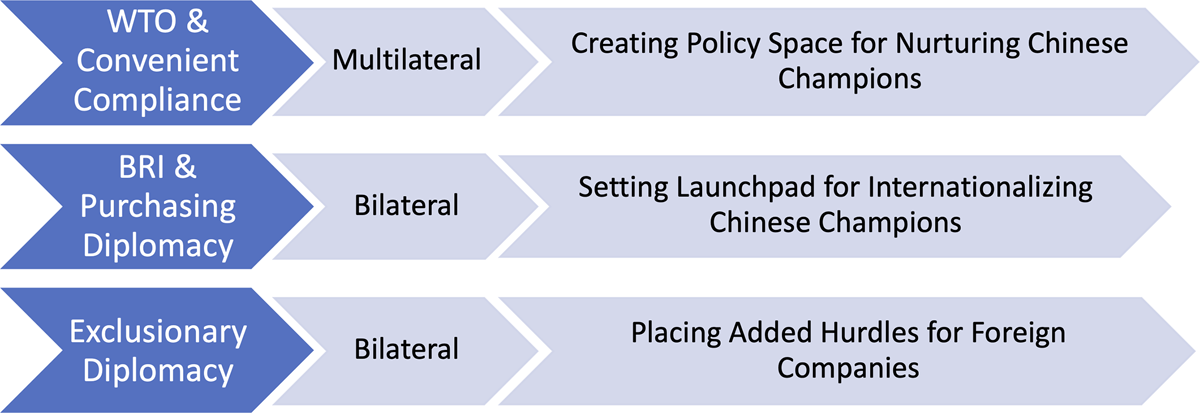
China increasingly reaches for financial and economic instruments to accomplish geopolitical objectives, adopting a multifaceted approach to state capitalism (see Figure 2). This has sparked a wave of fear among middle power countries and foreign companies who are witnessing the heightened nexus between security and economy. China's reliance on non-tariff barriers, such as subtle exclusion of foreign firms’ access in the Chinese market or unofficial state-led boycotts, deny the existence of any underpinning domestic regulation. This allows China to bypass WTO rulings, which limit the use of trade restrictions as a political tool and make trading partners vulnerable. Foreign companies find it more challenging to recover from subtle exclusionary sanctions because it is hard to reverse damages on consumer perception without an official channel. With increasing politicization of economic interdependence, states and firms are increasingly recognizing the need for robust policy in the direction of diversified supply chains and the national security implications for potential decoupling from China along with reshoring of strategic industries. Pursuing ‘China plus one’ strategies by searching for alternative markets and production location in addition to China is not just a business strategy, but a matter of geopolitical importance.
China's multifaceted approach to state capitalism

7. Conclusion
Much has changed in China since 1978, when the country embarked on the Opening and Reform policy that enabled it to occupy the center of the global trade regime. At the global political and economic stage, China has evolved from a passive rule-taker to active rule-shaker and rule-shaper. Through convenient compliance at the WTO, China skillfully facilitates local policy implementation that creates excess capacity by propping up local and national champions. Then, key initiatives like the BRI open up overseas markets to provide a firm foothold for the local and national champions to develop into global champions. In addition, China's increasing reliance on exclusionary diplomacy provides political justifications to discriminate against foreign competitors in the Chinese market for national security purposes while moving forward with the industrial upgrading of domestic players.
When linked together, these factors – all byproducts of China's approach to state-led capitalism – combine to raise the costs of economic interdependence and politicize trade with state-led boycotts and unofficial forms of retaliation. Along with authoritarian institutions and assertive nationalism, the Chinese government is likely to utilize further economic means to advance its political and strategic goals. Many other countries and companies will be vulnerable to China's economic statecraft, as China is the largest trading partner for over 100 countries and is at the center node of the global supply chain. The political risks will also increase as Chinese companies catch up with rivals and achieve technological self-sufficiency under the Chinese government's heavy subsidization and favorable industrial policies.
China's continued reliance on industrial policy raises the concern that China's gain comes at the expense of other countries. During Barack Obama's presidency, China–US relations reflected the belief that a strong and thriving China was in the United States’ long-term national interest (Barrett, Reference Barrett2019). This has been the centerpiece of the United States’ policy towards China since diplomatic normalization in 1979. Robust economic connections kept the bilateral relationship on track in times of political or military friction. American policymakers, companies, and consumers were willing to overlook the lopsided economic relationship with China. However, this optimistic approach has given way to a more skeptical outlook, and China has lost many pro-Beijing constituents in Washington. As America's manufacturing sector weakens and China's economy rapidly catches up, more voices are demanding market access, academic access, and informational flow on a reciprocal basis.
China's state-led capitalism partly contributed to the global turn toward protectionism, but it is the Chinese economy that bleeds significantly due to the clouded prospects of further trade liberalization. Four decades have passed since China's Opening and Reform, but two things remain indisputable: first, openly promoting reform is the only path toward sustainable development and continuous prosperity; second, China has achieved its large and growing share of global trade because of its participation in the global economy, not despite it. As much as China seems to challenge the liberal trading system to its own advantage, it has become a significant stakeholder in maintaining the multilateral trade system and advancing its interests within the existing global trade regime.
Acknowledgements
The author would like to thank Vinod Aggarwal, Andrew Reddie, and Philip Rogers for their invaluable comments, and also would like to thank Eva Liu and Stephanie Lee for their research assistance.