Citizens use a variety of means to evaluate the political world, including party, issues, ideology, economic performance, and scandals. But must every voter attach exactly the same weight to each factor? Most models of electoral choice assume so, and even when scholars permit different voters to weigh the ingredients of electoral choice differently, they exclusively identify individuals' abilities to obtain and process political information as the source of heterogeneity. Whether denoted “conceptualization” (Campbell et al. 1960), “sophistication” (Luskin 1987), “awareness” (Zaller 1992), “knowledge” (Delli Carpini and Keeter 1996), or education (Carmines and Stimson 1980; Sniderman, Brody, and Tetlock 1991), the standard scholarly view is that the small number of “able” voters are more likely than the mass of ill-informed voters to rely on more complex (and diagnostic) electoral criteria such as issues and ideology.
If, however, voter heterogeneity also depends on the motivation to acquire and use available information,1
See Schattschneider 1960, chap 8, for a forceful defense of American democracy that combines the observation that “an amazingly large number of people do not seem to know very much about what is going on” (129) with the axiom that modern voters “distinguish between what they must know and what they do not need to know” (134).
and not just on ability to do so, then the choice process is more complex. The voter's cognitive calculus involves a trade-off between conflicting goals:
accuracy requires voters to make decisions that correctly reflect their substantive values;
efficiency requires voters to make decisions without expending too much cognitive effort. The “new look” in public opinion research that challenged orthodox, reflexive pessimism about voter incapacity (Sniderman
1993) heavily emphasized the latter, efficiency dimension in its assertion that a “reasoning voter” might rely on shortcuts or heuristics to form meaningful appraisals of candidates (Lupia,
1994; Popkin
1991, Sniderman, Brody, and Tetlock
1991).
2 Electoral choice might be simplified by voter reliance on the parties' ideologies (Downs 1957; Hinich and Munger 1994) or on evaluative “running tallies” of performance such as party identification (Fiorina 1981; Rahn 1993) and presidential approval (Erikson, MacKuen, and Stimson 2001).
Unfortunately, Lau and Redlawsk (
2001) demonstrate that neither the use of heuristics alone nor political sophistication alone eradicates the sizable probability of making incorrect decisions.
Any description of the origins and consequences of voter heterogeneity requires a theory of how individuals resolve the tension between accuracy and efficiency in a given choice context. A voter might seek more information if a campaign subsidizes the cost of utilizing additional information, as indicated by recent scholarship on Senate elections (Kahn and Kenney 1999; Westlye 1991) and presidential primaries (Alvarez 1998); thus situational differences may exist. The desire for accurate decision-making also could motivate individuals to acquire and process additional political information. Suppose that individuals differ in the reliability they ascribe to various shortcuts to electoral choice. A voter might seek more information if the reliability of a shortcut is diminished, and the converse is also true: voters who find one shortcut to be especially reliable might choose to ignore readily available and diagnostic information, such as candidate ideology, if they do not perceive it as valuable in raising their confidence in a decision.
In our analysis of voter heterogeneity in House elections, we ask: What factors determine the conditions under which voters will relinquish reliance on partisan cues? And, when they do, what factors determine the considerations these voters turn to instead? By identifying first, the conditions in which voters are capable of reasoning ideologically but choose not to do so because partisan cues provide sufficient confidence and, second, the conditions in which campaigns help elevate voter choice, certain fears about the failure of American democracy are assuaged. Voters do not attach the same weight to each ingredient of electoral choice, but the causes of heterogeneity are driven more by the quality of party cues and the quality of campaigns than by the intellectual qualities of voters.
INFORMATION AND THE CONGRESSIONAL VOTE CHOICE
When American voters enter the polling booth, they typically do not carry much ideological or even issue-specific baggage. … As a general rule, voters reach their decisions on the basis of three considerations: party loyalties, candidate assessments, and overall judgments about the state of the nation. (Davidson and Oleszek 2001, 104)
Deciding whom to vote for in House elections is supposed to be easy; the three factors mentioned in the quote above correctly predict 92% of voters' decisions in House elections (Jacobson 2001, 150), and none of the three requires citizens to be prospective. Stokes and Miller's (1962) seminal study of the 1958 midterm election is responsible for the establishment of a general tone of pessimism about congressional elections communicating a mandate, and for two durable findings: partisanship is the dominant factor in vote choice in congressional elections, and only candidates' “salience” moderates party loyalty. As the value of party labels as a guide to voting behavior declined through the 1970s (Cover 1977; Nie, Verba, and Petrocik 1976),3
The year of Stokes and Miller's survey, 1958, was the peak of party loyalty, with 84% of partisans voting the party line; 20 years later that rate had fallen to 69% (Mann and Wolfinger 1980, 620).
scholars' emphasis logically shifted from partisan cues to candidate cues, but painting a rosy picture of voter behavior in House elections was hardly a result. Findings based on the celebrated 1978 National Election Study still comprise much of the textbook account of congressional voter behavior (cf. Jacobson
2001, chap 5), especially the finding that voters' defections overwhelmingly favored incumbents, who typically achieve superior levels of familiarity, personal favorability, and voter contact (Mann
1978; Mann and Wolfinger
1980). Presidential approval or disapproval also influenced the 1978 House elections, although further research has suggested that the effects of national forces are variable across electoral contexts. In the 1974 and 1982 midterm elections, both of which took place during Republican administrations, presidential approval had greater impact than in 1978, but it only affected voter choices in seats defended by Republican incumbents (Abramowitz
1985). Gronke, Koch, and Wilson (
2003) also indicate that presidential approval's impact on congressional candidate evaluations is conditional on the incumbent's support for the president's policies.
If one wishes to draw an optimistic inference from this scholarship, one might assert that voters are responsive to the political context, relying on different criteria as the situation permits. This inference is reinforced by scholars' acknowledgment that Senate incumbents do not share as richly in their House counterparts' advantages (cf. Gronke 2000 and Krasno 1994). The study of Senate elections has placed special emphasis on how campaign intensity affects the voter's informational environment, articulated by Westlye's (1991, 109) contention: “In a low key race, the average voter will have a hard time evaluating the candidates' issue positions or ideological postures. On the other hand, in a hard-fought campaign, sufficient information may be generated for many voters to be able to choose a candidate on the basis of ideology or individual issues instead of falling back on party identification or incumbency as decision criteria.” Gronke (2000, 148) echoes this assessment: “In low intensity elections, voters look to their partisanship, impressions of the nature of the times, and the incumbent's reputation for helpfulness. … In a high intensity election … partisanship, presidential approval, and incumbent helpfulness decline in impact.” What takes the place of these factors? Kahn and Kenney (1999) assert that “individuals adjust their decision rules depending on the closeness of contests. As campaigns become more competitive, voters respond by relying more heavily on sophisticated criteria, such as ideology and issues, when evaluating the opposing candidates. … In high intensity campaigns, voters have an incentive to seek and to reflect on detailed information available about candidates. Therefore, voters will be less likely to rely on cognitive shortcuts” (6, 26).
Campaigns might affect voter heterogeneity by means other than their intensity. Distinctiveness of candidates' ideological positions in presidential elections (Nie, Verba, and Petrocik 1976; Page 1978) and Senate elections (Abramowitz 1981) has been shown to affect the relative frequency of issue voting. Franklin (1991) found that the clarity of voters' perceptions increased when incumbents stressed issues in Senate campaigns and that the incumbent's voting behavior impacted voters' perceptions of the incumbent's issue positions. This scholarship thus paints an optimistic—but conditionally so—picture: the average voter's default might be to rely on the heuristic or unsophisticated criteria of party identification, incumbency, and presidential approval, but campaigns that are sufficiently intense or issue-oriented might boost reliance on more sophisticated criteria.
In short, previous research into heterogeneity in congressional vote choice has concentrated on the quantity of information provided by the campaigns (e.g., intensity) and the quality of information about the candidates (e.g., ideological clarity). Kahn and Kenney's analyses nonetheless indicate that hard-fought campaigns cannot overcome certain individual differences: better-informed voters rely more heavily on ideological postures and issue positions than do less informed voters across all levels of campaign intensity. We do not dispute the informational element of heterogeneity in congressional evaluations; indeed voters cannot rely on ideological or policy considerations without at least a modicum of knowledge about where the candidates stand. But Lupia and McCubbins (1998, 2) have argued that under most circumstances, even sophisticated citizens will “disregard most of the information they could acquire, and base virtually all of their decisions on remarkably little information.” That is to say, although a voter has the ability to vote ideologically, we must first identify conditions under which a voter has the motivation to use prospective information in making a political decision.
PARTISAN AMBIVALENCE AND THE CONGRESSIONAL VOTE CHOICE
Our model of voter choice builds on two established axioms of political judgment. The first axiom is the least effort principle, which states that individuals are economy-minded, in that they wish to avoid expending unnecessary amounts of cognitive energy in reaching decisions (Fiske and Taylor 1991; Simon 1976). This principle provides a compelling explanation for individuals' reliance on informational shortcuts and heuristics across a variety of political contexts (Lau and Redlawsk 2001; Lupia 1994; Sniderman, Brody, and Tetlock 1991). The second axiom is the sufficiency principle, which states that individuals are accuracy- or validity-minded, in that they desire a certain measure of judgmental confidence in their attitudes and decisions (Petty and Cacioppo 1986). Together, these principles imply that voters will “exert whatever effort is required to attain a sufficient degree of confidence” that their electoral choices accurately reflect their interests and values, but that they prefer “less effortful to more effortful modes of information processing” (Eagly and Chaiken 1993, 330). Applied to the electoral context, this implies that we must evaluate the determinants of voters' confidence in partisan cues, which will determine the conditions under which voters are motivated to recruit other considerations.
One possibility is that voters with strong partisan identifications achieve sufficient confidence in their electoral decisions on the basis of partisan cues alone, while voters with weak attachments to a political party will seek more information before making vote choices. If this is the case, weak partisans and independents might be expected to rely more heavily on specific issues, ideology, or economic performance than strong partisans.4
See Rivers 1988 for an analysis of heterogeneity in evaluating presidential candidates that proceeds in this fashion.
Another possibility is that it is not the
strength of identification per se but, rather, the
structure of a voter's reactions to party labels that determines the contribution of partisan cues to the voter's electoral confidence. Research indicates that citizens often embrace central elements of both sides of political debates, expressing both individualist and egalitarian beliefs on the question of welfare spending (Feldman and Zaller
1992) and valuing both feminism and religion on debates about abortion (Alvarez and Brehm
2002). Explanations for this phenomenon vary—few citizens possess the political wherewithal to resist arguments counter to their values and interests (Zaller
1992), policy disputes activate widely shared but incommensurable values (Alvarez and Brehm
2002), and electoral contests often provide ample amounts of positive and negative information about each of the competing campaigns—but none refute the implication that political opinions are infused with conflicting beliefs and feelings, in other words, that political opinions are frequently
ambivalent.
To date, studies of ambivalence have focused on policy issues or on candidates (e.g., Lavine 2001 and McGraw, Hasecke, and Conger 2003), but we contend that political parties are likely to be especially fertile targets of ambivalent opinion. Party labels are strongly linked to issue, value, and ideological conflict, as well as to support for distinct social groups (e.g., Miller, Wlezien, and Hildreth 1991). Embracing elements of both parties' policy positions, holding both union membership and an evangelical religious orientation, or simply admiring salient figures within each party is likely to generate attitudinal inconsistency within or across these domains, which may translate directly into ambivalent partisan attitudes.5
The authors of The American Voter recognized that an individual voter's “system of partisan attitudes” could be consistently favorable toward one party or that the elements of the system could be in conflict. They speculated that conflicted partisan attitudes would delay the formation of presidential voting intention, increase split-ticket voting, and reduce concern about the election outcome. Echoing our argument about the prevalence of party ambivalence, Campbell et al. (1960) found that fewer than 50% of voters favored one party over the other by a margin of two or more attitudes.
Most important for our purposes, research suggests that when attitudes are ambivalent, they should provide less reliable decision cues. Ambivalent opinions are held with less confidence and less clarity, and are more difficult to retrieve from memory, than relatively one-sided political opinions (Alvarez and Brehm
1995; Bargh et al.
1992; Huckfeldt and Sprague
2000; McGraw, Hasecke, and Conger
2003). Consequently they are less stable and exert less impact on political choice than univalent opinions (Lavine
2001; Zaller and Feldman
1992). By inference, voters with ambivalent partisan attitudes should derive less judgmental confidence from party cues than voters with univalent (i.e., nonambivalent) partisan attitudes and must therefore rely on alternative considerations to achieve sufficient confidence in their electoral decisions.
As we noted earlier, partisanship is the preeminent electoral cue in the House election context. Party identification should convey sufficient electoral confidence to voters to whom partisan cues are especially reliable, and further information processing should have negligible benefit. Thus when partisan ambivalence is low, partisan cues should dominate the decision-making of both informed and uninformed voters. Among voters holding ambivalent partisan attitudes, however, partisan cues will leave a substantial gap between voters' actual and their desired levels of judgmental confidence; such voters must recruit other considerations to reach their sufficiency thresholds. Partisan ambivalent voters who are well informed should endeavor to evaluate the candidates on the most diagnostic (but most costly) criteria, approximating ideological or issue voting. Partisan ambivalent voters who are poorly informed, and are by all accounts “innocent of ideology,” should increase their reliance on simpler (i.e., less costly) criteria, especially judgments about economic performance.
Intense congressional campaigns alter voter calculus by subsidizing the informational tasks confronting voters, as Gronke (2000), Kahn and Kenney (1999), and Westlye (1991) have argued. Intense campaigns might also heighten voters' sufficiency thresholds, since in hard-fought, openly ideological campaigns, voters—especially those who are highly informed to begin with—might desire greater levels of judgmental confidence in their electoral choices. For either reason, intense campaigns should increase voters' reliance on higher cost and higher value criteria, especially among voters for whom party identification provides less electoral confidence (those with ambivalent partisan attitudes). Intense campaigns should also reduce voters' reliance on low value criteria such as economic performance. We will test the following four hypotheses about voter behavior in congressional elections.
- Voters will rely less heavily on party identification and presidential approval as their level of partisan ambivalence rises.
- Highly informed voters with ambivalent partisan attitudes will rely more on ideology and/or issue positions than voters with univalent partisan attitudes or poorly informed voters with ambivalent partisan attitudes.
- Poorly informed voters with ambivalent partisan attitudes will rely more on economic perceptions than voters with univalent partisan attitudes or highly informed voters with ambivalent partisan attitudes.
- Intense campaigns will increase voters' reliance on ideology and/or issue positions at all levels of knowledge, will tend to reduce voters' reliance on economic perceptions at all levels of knowledge, and will therefore reduce the stratifying effects of political knowledge.
In short, we should observe voters with univalent partisan attitudes to be the heaviest dependents on partisan cues. We should observe two types of voters engaging in ideological voting: those who are ambivalent toward the parties and are politically knowledgeable, and those who are ambivalent toward the parties and are presented with a highly stimulating campaign. We should observe voters engaging in economic voting when three conditions are met: they are ambivalent toward the parties and they are poorly informed and the campaign provides little stimulus. That is, campaigns may act as a substitute for voters' knowledge about politics, overcoming individual differences and raising the caliber of electoral choice by less knowledgeable voters.
THE MEASURE OF PARTISAN AMBIVALENCE
Before we can turn to empirical analysis, we must bear two burdens of proof, demonstrating both that ambivalence toward parties occurs with sufficient frequency that it is worthy of serious study and that ambivalence toward parties can be operationalized adequately. As our concern is with positive and negative evaluations of the political parties, we employ the NES open-ended likes/dislikes question about the political parties, which ask: “I'd like to ask you what you think are the good and bad points about the two national parties. Is there anything in particular that you [like/dislike] about the [Democratic/Republican] Party?” Four follow-up probes are offered (“Anything else?”), thus respondents are invited to provide up to five likes and five dislikes for each of the two major parties. Wattenberg (1981, 1990) has utilized these questions to demonstrate that between 1952 and 1980, voters' evaluations of the political parties have become more neutral (and not necessarily more negative, as Nie, Verba, and Petrocik [1976] had suggested).
Behavioral conflict theorists (e.g., Mowrer 1960) and contemporary attitude theorists (e.g., Hass et al. 1991 and Thompson, Zanna, and Griffin 1995) have identified two necessary and sufficient conditions for the arousal of ambivalence. First, positive and negative reactions to the attitude object should be similar in magnitude; if one component becomes stronger than the other, attitudes become polarized and ambivalence is decreased. Second, positive and negative reactions should be of at least moderate intensity, so that ambivalence is greater when voters have many reactions than when they have few reactions. To integrate these positive and negative reactions into a numerical index, the standard practice in political science6
See, e.g., Lavine 2001; McGraw, Hasecke, and Conger 2003; Meffert, Guge, and Lodge 2004; and Steenbergen and Brewer 2004.
is to employ a measure introduced by Thompson, Zanna, and Griffin (
1995) and used by Lavine (
2001):
where P and N denote the number of positive and negative reactions to an object (e.g., a political party), respectively. Intensity is captured on the left by the average number of positive and negative reactions; similarity is captured on the right by the absolute value of the difference between the number of positive and the number of negative reactions.
Our view of partisan ambivalence demands a focus not on attitudes toward an individual party but, rather, on the extent to which respondents' reactions consistently favor one party over the other (e.g., strongly liking the Democrats and strongly disliking the Republicans), or instead are inconsistent, favoring one party in some ways and the other party in other ways. To construct a comparative index that involves both parties, let PD denote the number of positive reactions to the Democratic party, let PR denote the number of positive reactions to the Republican party, and let ND and NR denote the number of negative reactions to the relevant party. Define D as the average of the positive reactions to the Democrats and the negative reactions to the Republicans (i.e., D=(PD + NR)/2), and define R as the average of the positive reactions to the Republicans and the negative reactions to the Democrats (i.e., R=(PR + ND)/2). We compare the overall intensity of the respondent's affect toward both parties, minus the overall similarity of the respondent's reactions toward the parties, in the following way:
PD, PR, ND, and NR range from 0 to 5; therefore comparative partisan ambivalencescores range from a high of +5.0 when reactions to both parties are highly intense and ambivalent (PD=NR=ND=PR=5), to a low of–2.5 when reactions to the parties are highly polarized (when one party is strongly liked and the other strongly disliked; e.g., PR=ND=5, and NR=PD=0).7
Intermediate ambivalence scores result when reactions are less intense.
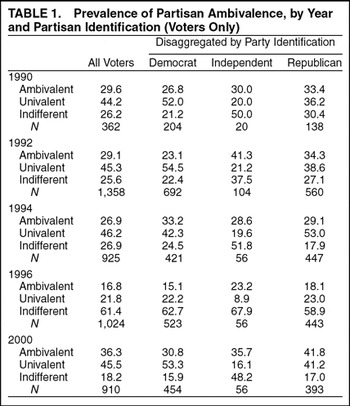
Table 1 displays the prevalence of partisan ambivalence using our “comparative” ambivalence measure, utilizing data from all National Election Studies conducted between 1990 and 2000, except 1998 (the party likes/dislikes question that we use to code partisan ambivalence was not asked that year).8
The NES half-sampled the party likes/dislikes questions in 1990. Thus, our analysis throughout reflects only those respondents who were asked this battery of open-ended questions.
We classify respondents as
ambivalent if their Ambivalence
comp scores are positive (indicating a mix of positive and negative reactions toward the parties); we classify respondents as
univalent if their scores are negative (indicating predominantly positive
or negative reactions toward the parties); we classify respondents as
indifferent if they provide no open-ended responses toward the parties.
Table 1 indicates that levels of comparative ambivalence were remarkably high. Well over one-third of voters held ambivalent partisan attitudes in 2000, and nearly 30% of voters held ambivalent partisan attitudes in 1990, 1992, and 1994.
9 Respondents with ambivalent partisan attitudes generally provided several likes and/or dislikes toward the parties. For 83% of ambivalent respondents (averaged across elections), both D and R were based on more than one response. Averaged across the five election years, the mean sum of ambivalent respondents' partisan likes and dislikes was 7.38, with an SD of 3.57 and interquartile range (25th to 75th percentiles) of 4.8 to 9.8. The average responses among voters coded as ambivalent are as follows: 1.78 likes and 1.91 dislikes toward the Democrats and 1.71 likes and 1.97 dislikes toward the Republicans.
Note that Republicans were significantly more ambivalent than Democrats in 1992 and 2000, while Democrats were more ambivalent in 1994. Independents are distinctively indifferent to the political parties, with 50% or more expressing indifferent partisan attitudes in 1990, 1994, and 1996. This comparative ambivalence measure, converted to a unit scale, is our
Partisan Ambivalence variable in the empirical work that follows.
OTHER VARIABLES
Let us now turn to our coding of other variables used in our empirical analysis of congressional voting. Two variables are specific to the voter. Party Identification is coded as a trichotomous variable from the seven-point scale, taking the value of 1 if the voter self-identified as a Republican (Strong, Weak, and Lean), 0 if the voter is an Independent, and −1 if the voter is a Democrat (Strong, Weak, and Lean). Ideology is coded as a seven-point measure of ideological self-identification, in which 1 denotes the liberal extreme and 7 the conservative extreme of the continuum.10
Ideally we would prefer to employ the voter's ideological proximity to the candidates rather than the voter's raw ideology. Unfortunately, voter placement of candidates is widely known to be plagued by projection effects, making it unreliable and leading many scholars instead to employ the average placements of the candidates across the pool of voters. Since we are using House districts, however, insufficient responses make it impossible to create averages with any degree of confidence. Also, we initially included the respondent's attitude toward the single policy item that shows up in all five elections in our sample, the government spending/services question. This variable had no direct effects and failed to interact with any of the moderators and, therefore, was dropped without any consequence.
Four variables measure candidate characteristics.
Incumbency is a trichotomous variable, taking the value of 1 if the voter's House seat is occupied by a Republican incumbent, 0 if it is an open seat, and −1 if it is occupied by a Democratic incumbent. The voter's
Familiarity with each party's candidate is coded 1 if the voter recalled the candidate's name, 0.5 if the voter recognized the candidate's name only, and 0 otherwise. The voter's
Favorability denotes the Republican candidate's net approval advantage over the Democratic candidate, coded from the open-ended likes/dislikes probes about the candidates, in which respondents are asked, “Is there is anything in particular about [candidate] that might make you want to vote [for; against] him?” Four follow-up probes are offered again, hence respondents are invited to provide up to five likes and five dislikes for each of the two major party candidates. We create a single comparative favorability scale using the formula (
PR +
ND)− (
PD +
NR); higher scores indicate a more favorable evaluation of the Republican candidate. Two additional variables are intended to capture national political forces.
Presidential Approval is assessed on a four-point scale where 1=approve strongly, 2=approve not strongly, 3=disapprove not strongly; and 4=disapprove strongly.
Business Conditions is based on subjects' perceptions that during the past year, the economy as a whole has 1=gotten better, 3=stayed the same, or 5=gotten worse. The scales for both variables are converted to a zero-to-one range, and the values from 1990 and 1992 (during a Republican presidency) are reversed so that high scores uniformly indicate more likely support for Republican candidates across elections. Because of our coding strategy, seven of these eight predictors of the vote choice are expected to have positive coefficients—the exception is Democrat familiarity—meaning that voters are more likely to vote for the Republican candidate if they identify themselves as Republican, if they identify themselves as conservative rather than liberal, if their net affective evaluation of the candidates favors the Republican candidate, and so on.
To isolate the unique effects of partisan ambivalence, we must control for the effects of two alternative sources of heterogeneity among voters. First, politically knowledgeable citizens are better able to integrate their political beliefs into a coherent structure (e.g., Delli Carpini and Keeter 1996, Luskin 1987, Sniderman, Brody, and Tetlock 1991, and Zaller 1992), therefore we must separate any effects of ambivalence from those stemming from levels of political knowledge. The variable Knowledge is coded from a test of objective political knowledge.11
Knowledge was assessed in each election year with items asking which party held the most seats in the House and the Senate prior to the election and with items assessing recognition of and knowledge about political figures (e.g., Al Gore, Tom Daschle, Newt Gingrich).
Second, to assure the effects of partisan ambivalence are independent of the strength of voters' partisan attachments, we include
Partisan Extremity, coded 1 for voters self-identified as strong partisans, .67 for moderate partisans, .33 for weak partisans, and 0 for independents.
12 Some scholars (e.g., Smith 1980, 1989, and Zaller 1992) have interpreted the absolute number of open-ended responses as a reflection of political sophistication. An earlier version of the article controlled for the voter's “loquacity” (i.e., the sum of voters' open-ended reactions to the parties) but consistently found it to be barely correlated with our ambivalence measure and to have zero effect empirically.
The (pooled) correlations of
Partisan Ambivalence with these alternative sources of heterogeneity are
r=.10 for
Knowledge and
r=− .14 for
Partisan Extremity.
The two-way interactions suggested by Hypothesis 1 pertain to the role of partisan ambivalence in moderating voters' reliance on partisan cues in House elections. As ambivalence toward the political parties increases, the influence of party identification should decline; given that Party Identification is expected to have a positive coefficient, we should observe negatively signed interactions between Partisan Ambivalence and Party Identification, and perhaps between Partisan Ambivalence and Presidential Approval as well. The three-way interactions suggested by Hypotheses 2 and 3 pertain to the joint influence of political knowledge and partisan ambivalence on voters' reliance on ideology and the economy. When a voter's partisan attitudes are characterized by ambivalence, the voter is motivated to increase reliance on nonpartisan considerations in order to achieve sufficient electoral confidence. Hypothesis 2 states that informed voters will increase their reliance on ideology, but only when partisan ambivalence is high, implying a positively signed three-way interaction of Partisan Ambivalence×Knowledge×Ideology. Hypothesis 3 states that uninformed voters with ambivalent partisan attitudes will increase their reliance on alternative easy-to-use criteria, such as economic performance; this implies a negatively signed three-way interaction of Partisan Ambivalence×Knowledge×Business Conditions. We postpone discussion of Hypothesis 4, which pertains to campaign intensity.
EMPIRICAL ANALYSIS
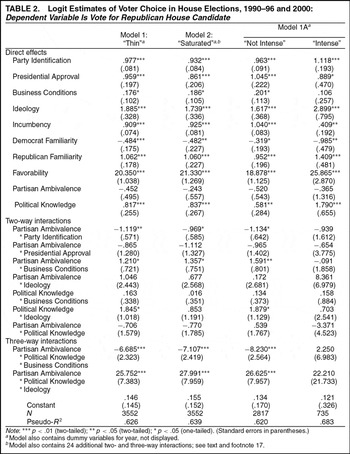
Table 2 contains a logit analysis of the vote decision, utilizing pooled data from the five elections (1990–2000, except 1998).13
We present pooled data from five surveys rather than the individual year analyses because of statistical challenges when attempting to find “moderator” or interactive effects in field studies (as opposed to in an experimental environment, in which distributions of treatment variables either are randomly assigned by the investigator or occur naturally in a roughly normal distribution). Deviations from optimal distributions can have dramatically negative impact on the effectiveness of statistical tests. McClelland and Judd (1993) show that attaining adequate statistical power to detect significant interaction effects in field studies with badly skewed distributions might require 100 times the observations that would be needed to show the same effects in an experimental setting and provide the following guidance: “What, then, can field researchers do to improve their chances of detecting interactions or quadratic effects? Obvious methods for increasing statistical power are to accept higher rates of Type I errors (a strategy not usually acceptable to journal editors) or to increase the number of observations.…Typical field study joint distributions of X and Z are so inefficient that enormous samples are required to have the statistical power of optimally designed experiments for detecting interactions” (384). Naturally, these problems are compounded when one is looking for three-way or four-way interactions.
The dependent variable in this analysis is whether the respondent voted for the Republican in the House election, taken from the postelection wave of interviews. Approximately half of respondents reported voting in each election, and due to item nonresponse on the independent variables, our total number of respondents is 3,552. Columns 2 and 3 provide two different specifications of the empirical model for all congressional districts: Column 2 contains results from the most parsimonious model possible for testing Hypotheses 1 through 3; Column 3 contains results from an analysis in which all three potential heterogeneity-inducing variables (
Partisan Ambivalence,
Knowledge, and
Extremity) are included both as first-order terms and as interactions with each of the eight standard predictors of vote choice in House elections.
14 The continuous Ambivalence and Knowledge variables and the four-point Extremity variable were mean-centered; coefficients of the first-order predictors are conditional at these variables' mean values. To test the alternative hypothesis stated on page 171, we interact Extremity of party identification with Ideology, Party Identification, Business Conditions, Incumbency, and so on. The saturated model also includes four additional three-way interactions of Ambivalence×Information with the remaining direct predictors of vote choice. Results are available on request.
The results depicted in both Column 2 and Column 3 show that most of the standard predictors of House vote choice have statistically significant coefficients with the expected signs (i.e., all positive except for
Democrat Familiarity), with the moderator variables held at their mean values.
15 The large number of collinear interaction terms in Model 2 might have caused estimation problems; however, this did not occur. Multicollinearity, as indicated by large standard errors and unstable or implausible coefficients, is not in evidence in Model 2. Standard errors and the coefficients in Column 3 are very similar to the “thin” model in Column 2, and coefficients uniformly take the expected signs.
The voter's
Party Identification,
Presidential Approval, and
Ideology each directly affect the vote choice in House elections.
Incumbency, the candidates' relative
Familiarity with and
Favorability, and
Business Conditions also each directly affect the vote choice.
16 Note that we included dummy variables for each election year; 1994 is our excluded case. The results indicate only that Republican candidates garnered more votes in 1994 than in 1992 or 2000.
Regarding Hypothesis 1, the primary question of interest is whether the effects of the partisan cues vary across levels of the voter's ambivalence toward the parties. Whether looking at the thin model in Column 2 or the saturated model that controls for other potential sources of heterogeneity in Column 3, the Partisan Ambivalence×Party Identification interaction is negative and statistically significant. The Partisan Ambivalence×Presidential Approval interaction is also negative but is not statistically significant. So when voters have ambivalent reactions to the political parties, they do reduce their reliance on partisan cues—at least the primary cue of party identification—but to what criteria do they turn?
The results in Columns 2 and 3 indicate that reliance on ideology depends jointly on high levels of both partisan ambivalence and political knowledge. The positive and statistically significant three-way interaction of Partisan Ambivalence×Knowledge×Ideology indicates that voters increase their reliance on ideology only when they are both knowledgeable and ambivalent about the political parties. As for economic voting, the two-way interaction of Partisan Ambivalence×Business Conditions is positive and statistically significant, but this two-way interaction is qualified by the expected negatively signed, statistically significant, and substantively large three-way interaction of Partisan Ambivalence×Knowledge×Business Conditions. Again, it is the joint occurrence of ambivalent partisan attitudes and low political knowledge that drives economic voting in House elections.17
Column 3 does not display the results of 24 other two- and three-way interactions. Of these, only three interactive terms reach conventional levels of statistical significance. The interaction of Extremity and Party Identification has a coefficient of 1.286 and a standard error of .314, indicating that strong partisans rely more on their own identification than weak partisans and independents, however, the results sought by Hypothesis 1 are robust to inclusion or exclusion of this interaction. The interactions of Favorability with Extremity and with Ambivalence each have negative coefficients, indicating that independents, weaker partisans, and individuals with ambivalent partisan attitudes rely more heavily on affect toward the candidates than strong partisans or individuals with univalent partisan attitudes.
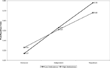
The coefficients reported in Table 2 support our hypotheses about the joint role of partisan ambivalence and political knowledge on voter heterogeneity, but we recognize that logit coefficients are difficult to interpret directly, particularly in empirical models with so many interactive terms. To provide real insight into each variable's substantive impact on House vote choice, we calculate the predicted probabilities of different prototypical individuals supporting the Republican candidate, based on the characteristics of representative voters and a representative pair of candidates. Figure 1 depicts the moderating impact of partisan ambivalence on Party Identification. We distinguish voters at three different levels of Party Identification; the figure represents voters at low ambivalence and high ambivalence (at one standard deviation below and one standard deviation above the mean, respectively).18
Although Ambivalence and Knowledge are only minimally correlated, there is greater variance in ambivalence among the knowledgeable. Accordingly, in computing predicted probabilities in which Ambivalence and Knowledge are varied simultaneously, we use the following standard deviation values for Ambivalence: .09 for low-Knowledge individuals and .18 for high-Knowledge individuals.
In general, the steeper the slope of the line, the greater the variable's
ceteris paribus impact on vote choice. Partisan ambivalence-induced heterogeneity is indicated by a difference in the slopes of the two lines, with the shallower slope for high-ambivalence voters illustrating that partisan ambivalence weakens the voter's reliance on the central cue of party identification. Self-identified Democrats with univalent party attitudes had an estimated probability of voting for the Republican House candidate of .27, compared to .78 for self-identified Republicans with univalent partisan attitudes. Meanwhile, self-identified Democrats with ambivalent party attitudes have an estimated probability of voting for the Republican House candidate of .33, compared to .68 for self-identified Republicans with ambivalent party attitudes. Partisan identifiers with ambivalent partisan attitudes display less loyalty to their own party's candidate than univalent copartisans; Hypothesis 1 is thus handsomely supported.
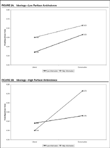
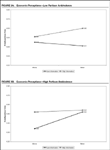
Demonstrating the extent of empirical support for Hypotheses 2 and 3 requires illustrating three-way interactions. Generically, a three-way interaction states that the interactive effect of two variables varies across levels of a third variable. To explicate the complex multiplicative terms in Table 2, Figures 2 and 3 display predicted probabilities of voting for the Republican House candidate for two levels of Ideology and two levels of perceptions of Business Conditions, respectively. Figure 2 illustrates the interactive effects of political knowledge and partisan ambivalence on a voter's reliance on ideology. The first panel displays the predicted probabilities in the low–partisan ambivalence state for knowledgeable and unknowledgeable voters separately; the second panel displays the predicted probabilities in the high–partisan ambivalence state. Since univalent voters should derive sufficient electoral confidence on the basis of party cues, the behavior of knowledgeable and unknowledgeable voters should differ less in the low-ambivalence state than in the high-ambivalence state. This pattern is demonstrated by the shallow and nearly parallel slopes of both lines in the first panel in Figure 2: the difference between the predicted probability of voting for the Republican candidate for unknowledgeable liberals (.34) and that for unknowledgeable conservatives (.53) is 19 percentage points; the difference between the predicted probability of voting Republican for knowledgeable liberals (.50) and that for knowledgeable conservatives (.63) is 13 percentage points. In the high-ambivalence state, illustrated in the second panel in Figure 2, only knowledgeable voters increase their reliance on ideology. The difference between the predicted probability of voting Republican for knowledgeable liberals (.30) and that for knowledgeable conservatives (.73) is a hefty 43 percentage points, while the predicted probability difference for unknowledgeable liberals (.38) and unknowledgeable conservatives (.46) is an anemic 8 percentage points. Simply, individual differences in political knowledge stratify voters' reliance on ideology, but only when the voter's ambivalence toward the political parties is high, supporting Hypothesis 2.
Ideology—Low Partisan Ambivalence
Economic Perceptions—Low Partisan Ambivalence
Figure 3 illustrates the interactive effects of political knowledge and partisan ambivalence on a voters' reliance on economic perceptions. In contrast to the effect of ideology, we observe that (as hypothesized) only unknowledgeable voters increase their reliance on economic perceptions as partisan ambivalence increases. The first panel in Figure 3 compares the predicted probability of voting Republican as a function of economic perceptions for voters in the low–partisan ambivalence state. (Recall that the economic perceptions variable has been coded in reverse for 1990 and 1992, so our usage of the terms “better” and “worse” must be reversed when thinking about a Republican presidency.) The difference in the predicted probabilities of voting for the Republican House candidate between voters who perceive the economy as improving and voters who perceived it as worsening is small: −4 percentage points for unknowledgeable voters (implying that they are using economic perceptions erroneously) and +9 percentage points for knowledgeable voters. The second panel displays the predicted probability for voters with ambivalent partisan attitudes. A decrease in these voters' political knowledge sharply increases voters' reliance on economic perceptions: the difference between the predicted probabilities (i.e., from worse to better) rises from +2 percentage points for knowledgeable voters to +18 percentage points for unknowledgeable voters. In other words, unknowledgeable voters with ambivalent partisan attitudes are substantially more likely to engage in economic voting in House elections than those with either univalent partisan attitudes or political knowledge.
In summary, Figures 2 and 3 illustrate our two- and three-way interaction hypotheses and our thesis that knowledge differences between voters will induce heterogeneity only when voters hold ambivalent attitudes toward the political parties. Consistent with Hypotheses 2 and 3, knowledge fails to stratify voters' reliance on either ideology or economic perceptions when ambivalence is low, in which case voters can reach confident electoral decisions largely on the basis of partisan cues and incumbency. Only when ambivalence is high, and partisan cues have become less reliable, does knowledge makes a difference. In this circumstance, knowledgeable voters rely more on ideology, while unknowledgeable voters rely more on economic perceptions to achieve sufficient confidence in their electoral choices.
We now address the question of how campaigns might alter the picture of heterogeneous voting that we have drawn and, in particular, how intense House campaigns change the voter's calculus. Columns 4 and 5 utilize the model of Column 2 but separate individuals into two categories, depending on whether the House campaign was low intensity or high intensity. To create these categories we use a three-part test. First, most scholars have argued that an important criterion of an intense race is that campaign spending be competitive; the typical measure of financial competitiveness is that the incumbent candidate should not spend more than double the amount of the challenger. We are not especially interested in seats where the incumbent is so safe that he or she spends very little to defend the seat, so we require that, in addition to the ratio not exceeding 2:1, total spending must exceed a threshold level. Second, some scholars have viewed raw spending by the challenger to be an important criterion of competitiveness, regardless of the amount spent by the incumbent, particularly in light of Jacobson's (1981, 1990) contentions that incumbent spending matters less than challenger spending and that all spending is subject to diminishing returns. Krasno (1994) uses a threshold of $300,000 spent by the challenger in the 1988 House election; we use the $300,000 threshold for 1990 but then adjust the threshold up by 18% per election to account for the actual level of inflation in campaign expenditures in the 1990s. Third, intense races should also have a competitive result (closeness is potentially both a cause and a consequence of intensity).
Taking these considerations together, we coded a campaign as competitive if (1) the margin of victory is less than 20 points and if either (2A) no candidate spends more than double his or her opponent, with total spending exceeding the threshold amount, or (2B) challenger spending exceeds the threshold amount. For the elections in our sample, this multistep criterion selects approximately 21% of districts as intense, on average 93 districts per election year.19
Of the 466 intense races (of 2,207 in our sample), only 58 races came in the 1990 election year—considered by Jacobson (2001) to be perhaps the least stimulating election in the past three decades—as opposed to 93 races in 1992, 119 races in 1994, 118 in 1996, and 78 in 2000. Of the 466 races, 227 satisfied both campaign expenditure–based criteria, 174 satisfy only the second, and 65 satisfy only the first. Our test identifies 51.4% of open-seat races, 36.8% of incumbent-contested races with experienced challengers, and only 10.2% of incumbent-contested races with inexperienced challengers as intense.
As indicated by the
N's in Columns 4 and 5, four-fifths of survey respondents in our sample were not exposed to an intense House race. The results depicted in Column 4 bear very strong resemblance to those in Columns 2 and 3 in terms of the coefficients' signs and their statistical significance. Therefore these results confirm that in the typical, low-intensity House race, voters who are ambivalent toward the parties reduce their reliance on party identification and increase reliance on either business conditions or ideology, depending on whether they are uninformed or high informed, respectively.
Hypothesis 4 pertains to the effect of campaign intensity on voting behavior; we anticipate that voters will rely more heavily on ideology and less heavily on economic perceptions. This should manifest itself in Column 5 (in comparison to Columns 2 and 4) as larger coefficients on Ideology and Partisan Ambivalence×Ideology and as smaller coefficients on Business Conditions, Partisan Ambivalence×Business Conditions, and Partisan Ambivalence×Knowledge×Business Conditions. The effects of partisan ambivalence are not expected to differ, although we might observe some of the action moving from the three-way interactions involving knowledge to the two-way interactions as the stratifying effects of knowledge diminish in these high-intensity races. A cautionary note before delving into the results: because so few campaigns are intense, our sample size is 735, barely 20% of our original sample, therefore the standard errors have doubled or tripled across the board; our attention is consequently oriented toward a comparison of coefficients. The expected patterns obtain in Column 5 (intense elections), in comparison to Column 4 (nonintense elections). The coefficient on Ideology increases from 1.62 to 2.90, and the coefficient on Partisan Ambivalence×Ideology increases from .17 to 8.36. Thus, the typical voter exposed to a high-intensity campaign finds it much easier to engage in ideological voting, although this is still primarily the choice of those who are motivated to do so by partisan ambivalence. Meanwhile, the coefficient on Business Conditions falls slightly, from .20 to .11, but the two-way interaction of Partisan Ambivalence×Business Conditions falls from 1.59 to −.09, and the previously significant three-way interaction of Partisan Ambivalence×Knowledge×Business Conditions switches signs and falls from −8.23 to 2.25 (and is now nonsignificant). These results indicate that economic perceptions have no impact among the typical voter exposed to a high-intensity campaign and, in particular, are no longer a cue relied on by high-ambivalence, low-knowledge voters.
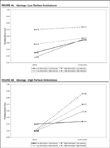
By stratifying campaigns according to their intensity, we have introduced, in effect, a rather complex four-way interaction, whereby the electoral impact of ideology now varies across levels of ambivalence, knowledge, and intensity. Our basic hypothesis was that voters will engage in ideological voting only when they are motivated to do so by their ambivalent attitudes to political parties, and only when their personal knowledge about politics or intense campaigns enables them to do so. Figure 4 illustrates this relationship by presenting the predicted probabilities of voting for the Republican House candidate for liberals and conservatives, at two levels of political knowledge, at two levels of campaign intensity; all other variables are held at their mean values. The first panel in Figure 4 depicts the behavior of voters with univalent partisan attitudes; comparing it to the first panel in Figure 2 reveals no especially interesting differences. The slopes of these lines for knowledgeable voters are consistently shallow, indicating a lack of ideological voting, although unknowledgeable voters with univalent partisan attitudes do show some signs of ideological voting in high intensity campaigns. The second panel in Figure 4 depicts the behavior of voters with ambivalent partisan attitudes. Only one line has a shallow slope here: unknowledgeable voters exposed to low-intensity campaigns. Thus, an increase in either campaign intensity or personal political knowledge dramatically increases the importance of ideology in the voter's decision-making process.20
We also recomputed the effects of party identification and business conditions in high-intensity and low-intensity campaigns, and could have included two additional figures that would correspond to Figures 1 and 3. In low-intensity campaigns, the differentiating effect of Party Identification falls from .52 among low–partisan ambivalence voters to .37 among high–partisan ambivalence voters. In high–intensity campaigns, its differentiating effect falls from .54 among low-ambivalence voters to .44 among high-ambivalence voters. As for Business Conditions, the differentiating impact is less than .06 for all but two types of voters: unknowledgeable voters with univalent partisan ambivalence in low-intensity campaigns (.11) and unknowledgeable voters with ambivalent partisan attitudes in low-intensity campaigns (.18). Tables of predicted probabilities or figures illustrating them are available on request.
Ideology—Low Partisan Ambivalence
CONCLUSION
The findings in this paper are consequential for some of the fundamental questions of American political behavior: Under what conditions are voters satisfied to rely only on partisan cues? Under what conditions do individuals engage in ideological or issue voting? What are the effects of political campaigns? To address the first question, the least effort and sufficiency principles generate the theoretical expectation that citizens with univalent partisan attitudes derive adequate confidence in their electoral choices on the basis of partisan cues, while voters with ambivalent partisan attitudes will reduce their reliance on these cues. This hypothesis is consistent with the way ambivalence is typically studied (e.g., Lavine 2001), potentially yielding a pessimistic inference that political behavior is less predictable when tainted by ambivalence. The sufficiency principle sanctions an entirely new theoretical expectation, however, that because voters with ambivalent partisan attitudes experience a discrepancy between actual and desired levels of confidence in their electoral decisions, they are motivated to expend additional cognitive resources to compensate for the reduced value of partisan cues. Only voters who are politically informed (i.e., knowledgeable or presented with an intense campaign) are capable of increasing reliance on the highly diagnostic, prospective criterion of ideology. Meanwhile uninformed voters do not abandon the quest for judgmental confidence when partisan ambivalence is high; rather they increase reliance on the easier-to-use, retrospective criterion of government performance.
Our results, limited as they are to the House context, point to a larger conceptual analysis of the voter's strategic flexibility. Prior conceptions of electoral decision-making characterized the American voter as either unable or unwilling to exert more than heuristic or low-effort thinking in the political realm. More recent thinking holds that informed voters rely on abstract considerations such as ideology, while uninformed voters fall back onto heuristics such as party identification, group affect, and the like. We find instead that the choice to turn away from party and toward ideology depends initially on the structure of a voter's attitudes toward the political parties; voters for whom party labels generate little attitudinal conflict can and do rely confidently on those labels regardless of their political knowledge or the intensity of a campaign. Thus we conclude that partisanship is not merely a crutch for the politically uninformed, unsophisticated or unstirred by campaigns.
Our results also clarify important consequences of political campaigns. Campaigns that provide insufficient stimulus leave voters to their own devices: some will rely mainly on partisan cues; some will have the motivation and knowledge to vote ideologically; others will engage in economic voting, providing little mandate to elected officials. Campaigns hold the promise of informing voters who possess little political knowledge of their own, but the impact of campaigns on increasing ideological voting depends on whether voters are motivated by their own ambivalent partisan attitudes to pay attention to campaigns' policy content. Thus an observed absence of ideological voting does not automatically imply any fault on behalf of voters or of campaigns. Rather, voters can be rationally ignorant—refusing to process information on ideological and issue positions yet still assuring that their decisions represent their values—so long as their attitudes toward political parties are clear-cut.
The relationship between constituent preferences and representatives' decisions has long caused anxiety among students of congressional elections (cf. Fiorina 1974 and W. Miller and Stokes 1963); our demonstration that ideology is potentially consequential in the minds of individual voters provides justification for the hypotheses that representatives' position-taking can have electoral consequences (see too Canes-Wrone, Brady, and Cogan 2001). We find that ordinary individuals' involvement in the political decision-making process is more meaningful—disciplining elected officials more effectively—when vigorous campaigns are waged. Likewise vigorous partisan competition at the national level clarifies party brand names, which—if this decreases partisan ambivalence—relieves ordinary individuals of the burden of ideological voting while permitting them to participate meaningfully in politics. In short, voter efficacy does not require vast amounts of political knowledge, but intense campaigns and clear partisan cues are necessary antidotes, confirming Schattschneider's (1960, 137) argument that “the people are powerless if the political enterprise is not competitive.”
The authors thank our colleagues in the Political Psychology Group at Stony Brook University, plus Alan Abramowitz, Ted Carmines, Michael Ensley, Paul Gronke, anonymous APSR referees, and seminar participants at Indiana University. Earlier versions of this paper were presented at the 2003 APSA Annual Meeting in Philadelphia, PA, and the 2004 International Society of Political Psychology Annual Conference in Lund, Sweden.






Comments
No Comments have been published for this article.