INTRODUCTION
The study of the diversity and biology of the Polychaeta, one of the most important groups of invertebrates in the benthic community, is difficult because of factors such as the breakage and elasticity of their bodies (Warwick & Price, Reference Warwick and Price1975; Yokoyama, Reference Yokoyama1988; Seitz & Schaffner, Reference Seitz and Schaffner1995; MacCord & Amaral, Reference MacCord and Amaral2005). These problems usually occur during sampling, when polychaetes tend to lose body parts; or fixation, because their bodies can contract depending on the degree of relaxation of the worms (MacCord & Amaral, Reference MacCord and Amaral2005). However, analyses of population structure, growth patterns, and secondary production using the entire length of the individual are essential to establish size–frequency and age–frequency histograms. Thus it is necessary to obtain parameters that represent the entire length of the individual with confidence (Desrosiers et al., Reference Desrosiers, Vincent, Retière and Boucher1988; MacCord & Amaral, Reference MacCord and Amaral2005).
Recently, allometric growth, or changes in body proportions during ontogeny (Katsanevakis et al., Reference Katsanevakis, Thessalou-Legaki, Karlou-Riga, Lefkaditou, Dimitriou and Verriopoulos2007), has been used to obtain reliable morphometric parameters. The allometric equation is the most extensively used method of analysis for this kind of growth. However, the classic allometric equation frequently fails to adequately represent the data, because of the existence of either non-linearity or breakpoints (Protopapas et al., Reference Protopapas, Katsanevakis, Thessalou-Legaki and Verriopoulos2007). Thus investigations that simply estimate the relative growth by means of log-transformed data using only linear models have yielded poor and misleading results (Katsanevakis et al., Reference Katsanevakis, Thessalou-Legaki, Karlou-Riga, Lefkaditou, Dimitriou and Verriopoulos2007). In this case, it is necessary to investigate allometric models that account for the influence of heteroscedasticity and the absence of linearity in the data. An alternative solution to this problem is the theory of model selection. The information-theory approach to model selection is based on alternative inferences to quantify the plausibility of each model, by extending the concept of maximum-likelihood of the parameters given both the data and model (Burnham & Anderson, Reference Burnham and Anderson2002; Katsanevakis et al., Reference Katsanevakis, Thessalou-Legaki, Karlou-Riga, Lefkaditou, Dimitriou and Verriopoulos2007).
Relative growth varies widely among different polychaete families (MacCord & Amaral, Reference MacCord and Amaral2005), and information on population dynamics is unavailable for many species that are found in hard- and soft-sediment communities (Seitz & Schaffner, Reference Seitz and Schaffner1995). This is especially true for species of the Brazilian coast, where only a few studies have been done (Spionidae: Scolelepis gaucha by Santos, Reference Santos1991, Reference Santos1994; S. squamata by Shimizu, Reference Shimizu1997; Souza & Borzone, Reference Souza and Borzone2000; S. goodbodyi and S. chilensis by MacCord, Reference MacCord2005; Nereididae: Laeonereis acuta by Florêncio, Reference Florêncio2000; Omena & Amaral, Reference Omena and Amaral2000, Reference Omena and Amaral2001; MacCord, Reference MacCord2005; and Nereis oligohalina by Pagliosa & Lana, Reference Pagliosa and Lana2000; and Ophelidae: Euzonus furciferus by Souza & Borzone, Reference Souza and Borzone2007).
Nicolea uspiana (Nogueira, Reference Nogueira2003) is a gregarious sedentary terebellid that constructs mucus tubes covered by sand grains and shell fragments in the midst of aggregates of algae, ascidians, hydroids, and bryozoans. This species is commonly found in the intertidal zone of rocky shores, always as dense populations with large numbers of individuals in different stages of maturity (Nogueira, Reference Nogueira2003; Garraffoni & Amaral, Reference Garraffoni and Amaral2009). No information regarding the relative growth, population ecology, and reproductive mode are available for this species.
The present study assessed the relative growth during ontogeny of N. uspiana. First, the models provided by Katsanevakis et al. (Reference Katsanevakis, Thessalou-Legaki, Karlou-Riga, Lefkaditou, Dimitriou and Verriopoulos2007) were used to identify the parameters that best represented the growth of various body parts. Then, based on analyses of size–frequency distributions, the population structure of N. uspiana was characterized, as well as its recruitment.
MATERIALS AND METHODS
From May 2006 to May 2007, specimens of Nicolea uspiana were collected monthly in the intertidal zone along the rocky shore of Porchat Island, on Itararé Beach (23°57′35″S 46°23′15″W, São Vicente, Brazil). The specimens were collected by removing the sand-covered mucus tubes from the rocks by means of a scalpel. Samples were kept on ice in an insulated container, in order to relax the animals. The polychaetes were transported to the laboratory and kept in an aquarium with seawater in order to sort them alive. Under a stereomicroscope, the individuals were removed from their tubes, and only complete specimens were selected. Individuals were classified as males, females, or immatures; and anaesthetized in a solution of seawater and magnesium chloride for ~30 minutes. All individuals were measured before any fixation, to avoid shrinkage. After this process, they were fixed in 6% formalin for at least 48 hours, and then transferred to 70% ethanol for storage.
Both mature (females and males) and immature individuals were classified and used in the morphometric and population-structure analyses. The parameters measured included: total length (L), segment number (Ns), total length of the notopodial region (Ln), width of segment 5 (W5), width of segment 18 (W18), and length of segment 18 (L18). Total length was considered the distance between prostomium (anterior end) and pigidium (posterior end). Student's t-test with log-transformed data were used to compare the means of the parameters between males and females. Logarithmic transformation is generally appropriate because morphological data tend to have a log-normal structure, as they are non-negative, with positively skewed distributions and variances that increase with the mean (Jolicoeur, Reference Jolicoeur1990; Ebert & Russel, Reference Ebert and Russell1994; Katsanevakis et al., Reference Katsanevakis, Thessalou-Legaki, Karlou-Riga, Lefkaditou, Dimitriou and Verriopoulos2007). The data for both sexes were also subjected to a principal components analysis (PCA), to assess possible intra-population patterns due to size arrangements. This methodology is often used for identifying a series of hypothetical variables (principal components), orthogonal to each other and which account for most of the variance in a data set (Manly, Reference Manly1986; Preston & Roberts, Reference Preston and Roberts2007).
The allometric growth of each parameter versus the total length and the number of segments was investigated by four different candidate models (linear, quadratic, cubic and broken-stick). Either the total length or the number of segments was considered as the independent variable in the regression analyses. Following Katsanevakis et al. (Reference Katsanevakis, Thessalou-Legaki, Karlou-Riga, Lefkaditou, Dimitriou and Verriopoulos2007), the linear model was fitted with simple linear regression (logY = a1+b1logX), while polynomial regression was used for the quadratic (logY = a1+b1logX+b2(logX)2) and cubic (logY = a1+b1logX+b2(logX)2+b3(logX)3), where a1 is the intercept and b changes continuously with increasing body size. The broken-stick model (logY = a1+b1logX; X ≤ B; logY = a1+(b1−b2)logB+b2logX; X > B) assumed that the breakpoint X = B varied between the minimum and maximum value of the independent variable (morphological changes). According to Katsanevakis et al. (Reference Katsanevakis, Thessalou-Legaki, Karlou-Riga, Lefkaditou, Dimitriou and Verriopoulos2007), to select the most adequate model, the correct form of Akaike's information criterion was calculated: AICc = (n(log(2π RSS/n)+1)+2k)+2k(k+1)/(n−k−1) where n is the number of observations, RSS the residual sum of squares, and k the number of regression parameters plus 1 (Hurvich & Tsai, Reference Hurvich and Tsai1989). The model with the smallest AICc value (AICc,min) was selected as the ‘best’ among those tested. The AICc differences, Δi = AICc,i – AICc,min were computed over all models. According to Burnham & Anderson (Reference Burnham and Anderson2002), models with ΔI > 10 have essentially no support and can be omitted, models with ΔI < 2 have substantial support, and there is considerably less support for models with 4 < ΔI < 7. To quantify the plausibility of each model, the Akaike weight (w i) was calculated:

The Akaike weight is considered as the weight of evidence in favour of model i being the actual best model of the available set of models (Burnham & Anderson, Reference Burnham and Anderson2002). For the parameters that adequately fitted in the allometric linear model, Student's t-test was used to compare b values with critical values of allometry (MacCord & Amaral, Reference MacCord and Amaral2005). In this case, when b < 1 the type of growth is described as negative allometric, when b > 1 as positive allometric, and when b = 1 as isometric (Katsanevakis et al., Reference Katsanevakis, Thessalou-Legaki, Karlou-Riga, Lefkaditou, Dimitriou and Verriopoulos2007). The parameter that best represented the total length of N. uspiana was used to delineate the cohorts and to analyse the population structure.
Cohorts of N. uspiana were identified by the modal-progression routine (Bhattacharya) of the FISAT program, which works by decomposing modal distributions and identifying a probable normal distribution of the population. All other analyses were done using the software Microsoft Excel 2000 and Systat 8.0 for Windows.
RESULTS
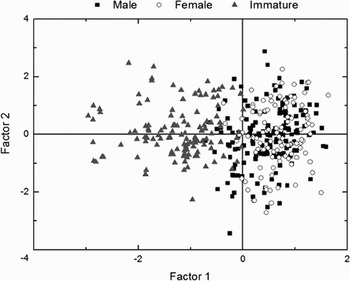
Eight hundred and forty-seven individuals of Nicolea uspiana were analysed: 391 males, 162 females, and 293 immatures. The principal components analysis did not show any pattern of dimorphism in the species (Figure 1). However, females were significantly larger than males in four (L, Ns, W5, and L18) of six measured parameters, although they showed no differences in parameters Ln and W18 (Table 1). Immatures differed from adults in total length, width of segment 5, and length of the region with notopodia, confirmed by principal component 1, with 81% of data variance, influenced by L, W5, and Ln (Figure 1).
Nicolea uspiana. Principal components analysis of the Itararé Beach population.

Mean values and standard deviation (SD) for each measured parameter for males and females of Nicolea uspiana. The values of Student's t-test (t) and probability (P) are indicated.

L, total length; Ln, length of the notopodial region; Ns, number of segments; n.s., non-significant; L18, segment 18 length; W5, segment 5 width; W18, segment 18 width.
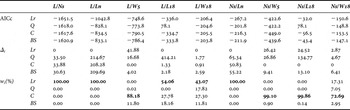
The relative growth among parameters L/Ns, L/Ln, L/L18, L/W18, and Ns/Ln was considered to be best assessed by the linear model (Table 2). The total length has a larger growth than the number of segments, length of the notopodial region, and width of segment 18 (Table 3). On the other hand, the number of segments increases in a smaller proportion than the length of the notopodial region (Table 3). An isometric relationship between the ratio L/L18 showed that the width of segment 18 was the best measure for assessing size-classes of specimens. The cubic model had the highest plausibility relationships in the ratios L/W5, Ns/W5, Ns/L18, and Ns/W18 (Table 2). In this case, the variation in the relative growth among the parameters, mainly the number of segments, was observed over time.
Values of AICc, AICc difference (Δ i), and Akaike weight (w i) for the four models applied to each relation of Nicolea uspiana. The most plausible models are indicated by bold characters.

AICc, Akaike's information criterion; BS, ‘broken-stick’ model; C, cubic model; L, total length; Ln, length of the notopodial region; Lr, linear model; L18, segment 18 length; Ns, number of segments; Q, quadratic model; W5, segment 5 width; W18, segment 18 width.
Linear regressions of most plausible regression models of Nicolea uspiana and Student's t-test results to evaluate allometry critical values.

a, Y-intercept; b, regression coefficient; L, total length; Ln, length of the notopodial region; L18, segment 18 length; N, number of individuals; Ns, number of segments; n.s., non-significant; P, probability; r 2, coefficient of determination; SD, standard deviation; W5, segment 5 width; W18, segment 18 width.
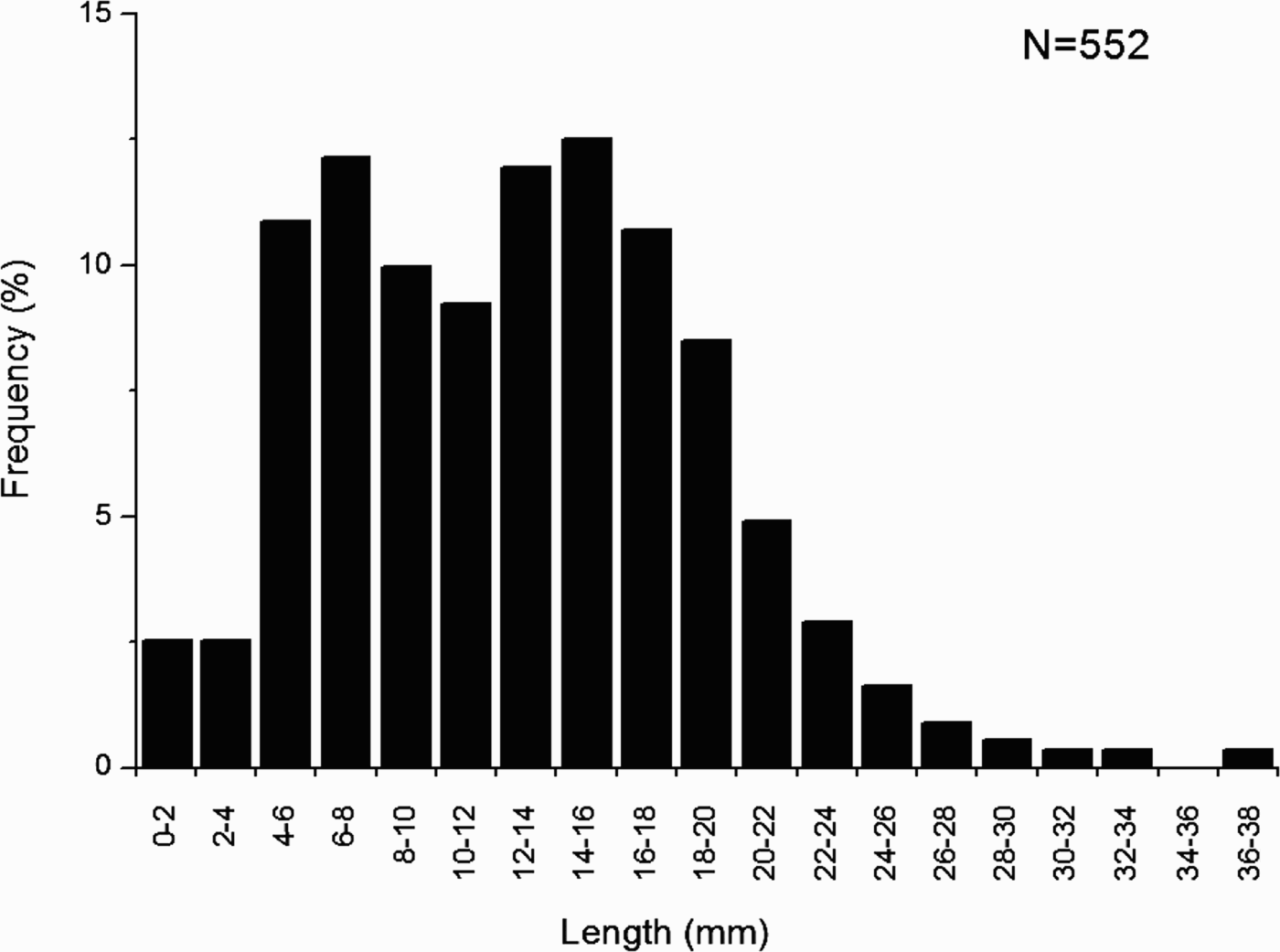
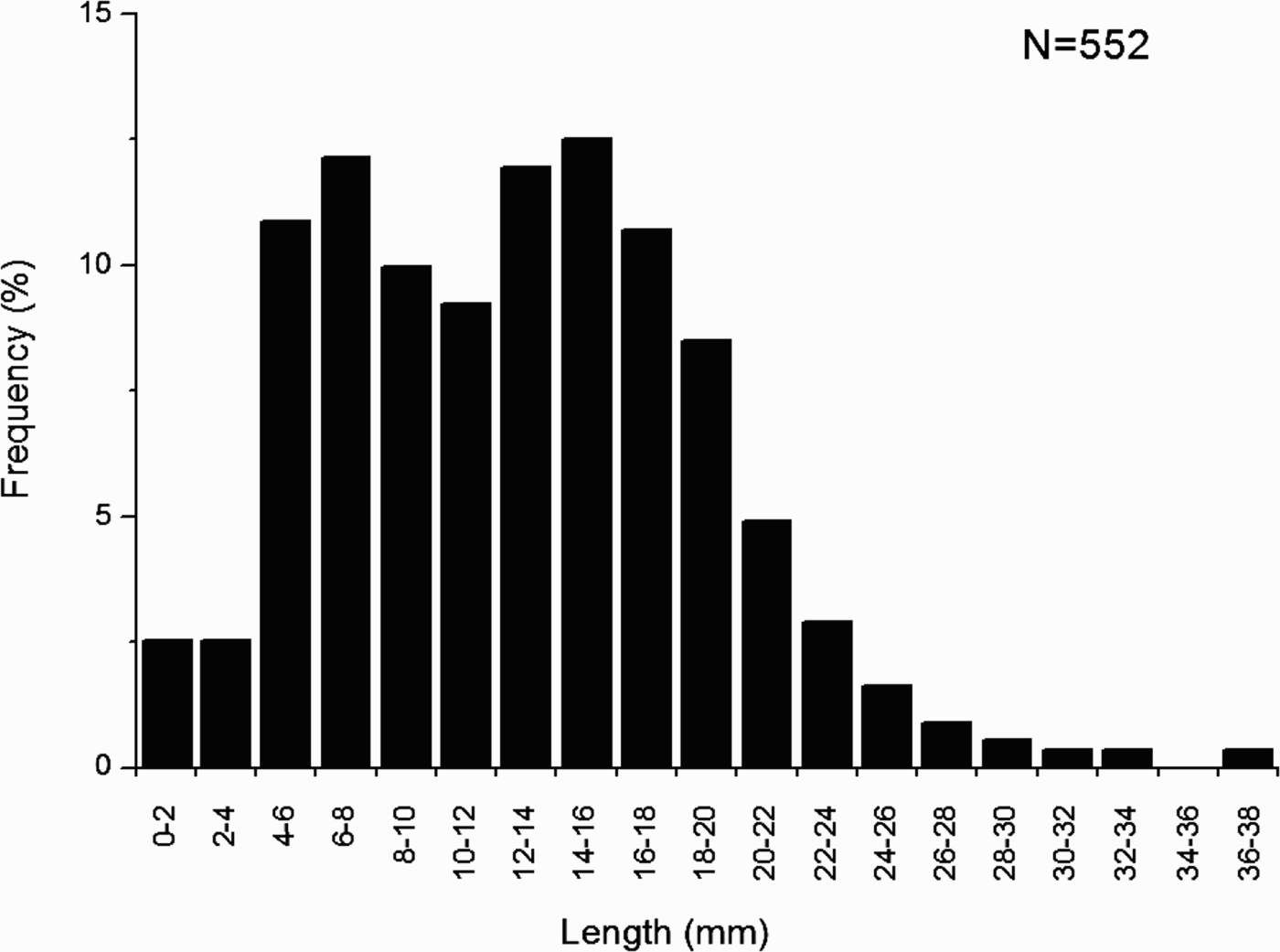
The population of N. uspiana is composed of immature and adult individuals with lengths of 1 to 37 mm (Figure 2). The size–frequency distribution varied between a unimodal and polymodal distribution, with 11 cohorts (C1 to C11) delineated during the study period (Figure 3). The first cohort was observed in May 2006, and grew until August 2006. The second cohort was detected between July and September 2006, and the third cohort between August and September 2006. In September 2006, the fourth cohort was collected, and was recorded until November 2006. In October 2006, new recruits were detected, from cohort 5, and grew to a size that blended with cohort 6, by December 2006. The sixth cohort was recorded between November and December 2006, and cohort 7 between December 2006 and January 2007. In this last month, recruits from the eighth cohort were observed, and developed until February 2007. The ninth cohort was recorded between March and April 2007, and recruits from C10 between April and May 2007. The last cohort, C11, received new recruits from May 2007.
Nicolea uspiana. Size-class distribution of the Itararé Beach population.
Nicolea uspiana. Monthly size-class distribution of the Itararé Beach population. Arrows indicate the mean mode total length of the cohort.

DISCUSSION
As in most polychaete species (Schroeder & Hermans, Reference Schroeder, Hermans, Giese and Pearse1975; Giangrande, Reference Giangrande1997), Nicolea uspiana has gonochoric reproduction, with immature individuals being common among lower size–frequencies and matures among the upper ones. Although similar differences in the morphological parameters were observed, none of them could be used to distinguish between sexes. The only externally visible sexually dimorphic feature is the genital papillae, which are located close to the notopodia (Garraffoni & Lana, Reference Garraffoni and Lana2008). Benham (Reference Benham1927) pointed out that although the number and position of the genital papillae in the two sexes are identical for a given species, the form and relative size vary in the different species. The male papillae are comparatively small, slender tubes or cones, whereas the female papillae are less distinct, resembling a glandular wall in the epidermis, close to the notopodia (the morphology of both types of papillae was clearly observed in N. uspiana). In this case, in spite of the significant sexual differentiation observed in the morphometric parameters L, Ns, L18, and W5 in N. uspiana, they cannot be used alone to classify the individuals as males and females.
During the ontogenetic development of N. uspiana, most of the morphological features showed an allometric growth pattern (either positive or negative), and few showed isometric growth. The use of non-fixed individuals assures the accuracy of these relations, once we avoided problems with shrinkage. The dependent variables changed in different proportions to the independent variable (total length and total number of segments). In four of nine analysed morphometric relationships, the linear model was not the most plausible, corroborating the hypothesis that it could not detect points of discontinuity in the curves of relative growth (Katsanevakis et al., Reference Katsanevakis, Thessalou-Legaki, Karlou-Riga, Lefkaditou, Dimitriou and Verriopoulos2007; Protopapas et al., Reference Protopapas, Katsanevakis, Thessalou-Legaki and Verriopoulos2007). However, the linear model was the most plausible for five other relationships (L/Ns, L/Ln, L/L18, L/W18 and Ns/Ln).
The total number of segments would be expected to be the best measurement for assessing age and size-classes in N. uspiana. Some authors have noted that counting the number of chaetigers is the quickest and most efficient measurement to make in polychaetes (Lewis, Reference Lewis1998; Zajac, Reference Zajac1991a; MacCord & Amaral, Reference MacCord and Amaral2005). This assumption is based on the constant number of segments during fixation, which will not result in misleading size–frequency histograms. However, in the present study, the relationships of the different measurements with the number of segments, as the independent variable, showed a lower r 2, and were not considered a good parameter. On the other hand, the total length, a measurement that is not commonly used to assess size–frequency because of possible changes during fixation, was considered adequate for N. uspiana. The total length showed negative allometry for most of the relationships, and indicates that this parameter is a good indicator of the real size of the specimen.
The size–frequency distribution of N. uspiana suggests that individuals breed continuously during the year. The presence of new recruits, represented by individuals shorter than 2.9 mm, was observed during the sampling period. The relationship between the life span and the length ratio is one of the main influences on the population structure (Giangrande, Reference Giangrande1997). Thus, analysing the post-larval development (Garraffoni & Amaral, Reference Garraffoni and Amaral2009) and the egg size–frequency distribution, we concluded that this is an iteroparous species, as the mature individuals can breed several times during their lifetime. The species showed extremely variable recruitment periods, with settlement of new juveniles occurring in several different months. Furthermore, this population has a high abundance, and a short maturation time, as the juveniles take two months to mature and begin a new reproductive cycle. A prolonged recruitment period, with numerous cohorts throughout the year, seems to be a common characteristic of terebellid polychaetes (McHugh, Reference McHugh1993; Giangrande, Reference Giangrande1997).
This kind of lifespan may be related to the availability of food, which may allow constant and high recruitment of juveniles in small and medium size-classes, which have high growth rates and productivity (Gillet & Gorman, Reference Gillet and Gorman2002; Martin & Bastida, Reference Martin and Bastida2006). Itararé Beach has fine sediments, and receives domestic wastewater from permanent drainage channels (the volume of wastewater increases on weekends and holidays, because São Vicente is a tourist centre). Thus the populations of N. uspiana may face temporary variations in the quantity and quality of food, where benthic habitat conditions may not be predictable and homogeneous, reducing the survivorship of individuals which recruit and mature during this period (Zajac, Reference Zajac1991b). This variation constrained an allocation of energy for a constant reproductive mechanism during the year, with continuous oocyte production (and consequently larval production) over the period. The frequency of ovigerous females in N. uspiana was low, and the sex-ratio was biased in favour of males. As pointed out by Méndez et al. (Reference Méndez, Romero and Flos1997), who studied the population dynamics of Capitella capitata, the low frequency of females in the samples was an effect of high amounts of organic matter, with the relatively few females able to produce large numbers of gametes.
In conclusion, our results indicated the desirability of careful selection of the most appropriate model to study morphometric growth in polychaetes. Furthermore, the use of anaesthetized individuals is more appropriate once it avoids the existence of bias because of the influence of fixation and storage. Alternative models need to be taken into account, to avoid the generation of misleading information or results. Furthermore, observation of the seasonal variation of body length in N. uspiana, together with inspection of the size–frequency, allowed us to detect long periods of settlement, suggesting a continuous reproductive pattern, with multiple spawning occurring over the study period. Thus, because N. uspiana has a small adult size, high birth and death rates, a short maturation time and life span, it can be assumed that this species is opportunistic (Yokoyama, Reference Yokoyama1990; Lewis, Reference Lewis1998) and could be used as a pollution indicator.
ACKNOWLEDGEMENTS
We thank the Fundação de Amparo à Pesquisa do Estado de São Paulo for providing a postdoctoral fellowship (Proccess 05/59809-7) to the first author, and to FAEPEX/UNICAMP and CNPq (Proccess 308072/2006-5) for financial support for this Project and to the Centro de Biologia Marinha (CEBIMar/USP) for field support. Two anonymous referees are gratefully acknowledged for offering suggestions that improved the paper. Janet Reid revised the English text.