INTRODUCTION
Amphipods are small peracaridean crustacean distributed along the world coast. They are very common and diverse on plant substrata such as algae and seagrasses (Bellan Santini, Reference Bellan Santini1999; Mc Cain, Reference Mc Cain1968). They feed on suspended materials, prey on other organisms, or graze on epibiotic fauna and flora (Caine, Reference Caine1974; Bellan Santini, Reference Bellan Santini1999). Amphipods constitute also the food of choice for consumers of small crustaceans, polychaetes, birds or fish (Bell & Harmelin-Vivien, Reference Bell and Harmelin-Vivien1983; Caine, Reference Caine1989, Reference Caine1991). Furthermore, amphipods are useful bioindicators of marine pollution and environmental stress (Bellan Santini, Reference Bellan Santini1980, Reference Bellan Santini1981; Guerra-Garcia & Guerra Gomez, Reference Guerra-Garcia and Garcia-Gomez2001).
Despite their great importance, both qualitative and quantitative, as main secondary and tertiary producers in the marine macrobenthic communities, the amphipod fauna of southern Mediterranean coasts have still been relatively unexplored compared with those of northern coasts, except for scarce and fragmented data (Chevreux, Reference Chevreux1911; Bakalem & Dauvin, Reference Bakalem and Dauvin1995; Guerra-Garcia & Takeuchi, Reference Guerra-Garcia and Takeuchi2002).
The Tunisian coasts are extremely interesting from the biogeographical point of view since they are located in the middle of the Mediterranean Sea between the eastern and western basin coasts of Tunisia spread over 1300 km and offer a marine panoply of biotopes such as Posidonia oceanica and Cymodocea nodosa meadows as well as photophilic algae such as Corallina elongata, Padina pavonica, Dictyota dichotoma, Asparagus armatus, Ulva lactuca, Cystoseira mediterranea and Jania rubens, etc.
Chevreux (Reference Chevreux1895, Reference Chevreux1910, Reference Chevreux1911) and Chevreux & Fage (Reference Chevreux and Fage1925) reported the presence of 65 species of marine amphipods on the Tunisian coast. Other restricted and fragmented citations of amphipods in Tunisia were reported by several authors (Stephensen, Reference Stephensen1915; Myers, Reference Myers1974; Ruffo & Schiecke, Reference Ruffo and Schiecke1977; Karaman, Reference Karaman1978, Reference Karaman1979; Krapp-Schickel & Meyers, Reference Krapp-Schickel and Myers1979; Zaouali, Reference Zaouali1981; Dauvin & Bellan Santini, Reference Dauvin and Bellan Santini1985; Ruffo, Reference Ruffo1938, Reference Ruffo1982, Reference Ruffo1989, Reference Ruffo1993; Daly Yahia, Reference Daly Yahia1998; Ben Souissi, Reference Ben Souissi2002; Ayari & Afli, Reference Ayari and Afli2003; Diawara et al., Reference Diawara, Zouari-Tlig, Rabaoui and Ben Hassine2008). Recently, more investigations have been conducted in this group of crustaceans (Zakhama et al., Reference Zakhama-Sraieb, Sghaïer and Charfi-Cheikhrouha2006a,Reference Zakhama-Sraieb, Sghaïer and Charfi-Cheikhrouhab, Reference Zakhama-Sraieb, Sghaïer and Charfi-Cheikhrouha2008).
This study attempts to enhance the knowledge of this important group of Tunisian shallow water amphipods and aims to establish an update of the complete nomenclature of all species of marine amphipods currently known on Tunisian coasts. Many new records and species will be reported in this study. Moreover, information on species distribution and ecology will constitute a database useful for further studies.
MATERIALS AND METHODS
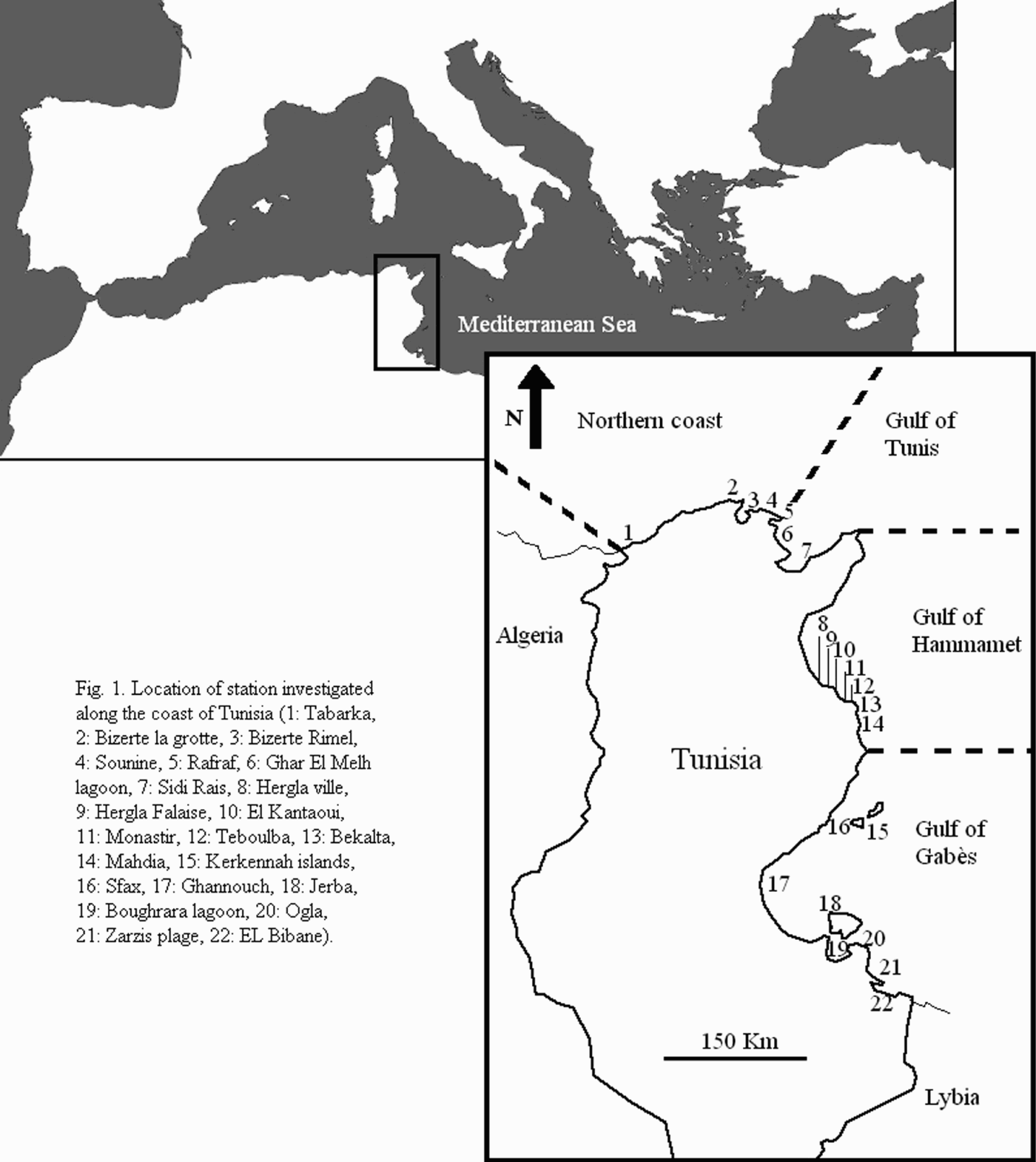
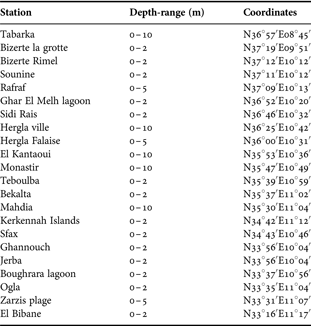
This study was conducted at the Tunisian coast (North Africa) from 2003 to 2008. Samples were collected from a total of twenty-two stations along the Tunisian coasts (Table 1) divided in four areas (Figure 1): the north coast extends from the Algerian border to Bizerte, the Gulf of Tunis from Bizerte to El Haouaria, the Gulf of Hammamet extends from El Haouaria to Chebba, and the Gulf of Gabès from Chebba to the Libyan border.
Location of stations investigated along the coast of Tunisia (1: Tabarka, 2: Bizerte la grotte, 3: Bizerte Rimel, 4: Sounine, 5: Rafraf, 6: Ghar El Melh lagoon, 7: Sidi Rais, 8: Hergla ville, 9: Hergla Falaise, 10: El Kantaoui, 11: Monastir, 12: Teboulba, 13: Bekalta, 14: Mahdia, 15: Kerkennah Islands, 16: Sfax, 17: Ghannouch, 18: Jerba, 19: Boughrara lagoon, 20: Ogla, 21: Zarzis plage, 22: El Bibane).

Sampling stations in the present study.

Several marine habitats were examined such as phanerogams and algae bottoms. Amphipods were collected within substrata by SCUBA diving or free diving at different depths, from 0 to –10 m. All samples were preserved in 70% alcohol. Amphipods were separated using a stereo dissecting microscope, sorted, and then identified. The specimens examined for this study are deposited in the Research Unity of Animal Biology and Evolutionary Systematics (Faculty of Sciences of Tunis).
For compiling this list, we reviewed all available published records of Amphipoda on Tunisian coasts. The classification of Myers & Lowry (Reference Myers and Lowry2003) is used in this study.
Species were classified in geographical distribution groups following Bellan Santini & Ruffo (Reference Bellan Santini and Ruffo2003). Four major categories of species can be identified by their type of distribution: (I) species common to the Mediterranean and Atlantic; (II) species endemic in the Mediterranean Sea; (III) species widely distributed throughout the world (cosmopolitan); and (IV) Indo-Pacific species (lessepsian species).
RESULTS AND DISCUSSION
As a result of investigations conducted in 22 stations along the Tunisian coasts, a total of 70 amphipod species belonging to 22 families and 44 genera were identified (Table 2). Among them, 19 species (27% of the total species) were recorded for the first time along the Tunisian coasts and 29 species were reported for the second time. Furthermore, Stenothoe gallensis and Deutella schieckei were reported for the first time on the North African coasts and Podocerus chelonophilus is reported for the first time in the eastern Mediterranean basin.
Marine amphipods collected from the Tunisian coasts during 2006–2008 period; habitat preference; depth-range in metres; Dist., distribution; N, northern coast; GT, Gulf of Tunis; GH, Gulf of Hammamet; GG, Gulf of Gabès; F%, percentage of occurrence; *first record on Tunisian coasts; **first record in the south of the Mediterranean Sea.

Ampithoe ramondi, A. helleri, Ericthonius punctatus, Hyale camptonyx and Ampelisca unidentata were the most frequent species in our samples; these species are present at least in half of the studied stations. However, 18 species were collected once. All species collected are found in the Mediterranean basin at similar depth and most of them are Atlantic–Mediterranean forms.
Three Indo-Pacific migrant species, Cymadusa filosa, Stenothoe gallensis and Elasmopus pectenicrus were reported on Tunisian coasts. Stenothoe gallensis and E. pectenicrus were collected in 2006 from Zarzis (south of Tunisia) confined in a small area while C. filosa has a large distribution and colonizes the whole of Tunisian coasts (Zakhama-Sraieb & Charfi-Cheikhrouha, unpublished).
Six Amphipoda species were found associated with sea turtle Caretta caretta and one species associated with Chelonia mydas in the Gulf of Gabès (Zakhama-Sraieb et al., unpublished).
Among the 70 species collected in this study, 25 have a large distribution and were collected on all Tunisian coasts; however 3, 3, 6 and 12 species were collected exclusively and respectively on the northern coast, the Gulf of Tunis, the Gulf of Hammamet and the Gulf of Gabès.
Checklist of Tunisian marine amphipods and biogeographical considerations
On the basis of the knowledge acquired until now, the marine amphipod fauna of Tunisian coasts was made up of 133 species belonging to 72 genera and 29 families (Table 3).
List of Amphipod species of the Tunisian coasts. BG, biogeographical region.

Among the 44 families reported in the Mediterranean Sea (Ruffo, Reference Ruffo1989), 29 (66%) were mentioned on the Tunisian coasts. The most frequent family is Melitidae with 10.5% of the total species, followed by the Aoridae and the Caprellidae with respectively 9.7 and 9%. The families, Colomastigidae, Liljeborgiidae, Phliantidae, Pontoporeiidae, Stegocephalidae and Synopiidae, were characterized by a single species.
The dominant species encountered on the Tunisian coasts were Ampelisca unidentata, Ericthonius punctatus, Maera inaequipes, Hyale camptonyx and Ampithoe helleri. Furthermore, Parhyale aquilina, Iphimedia minuta, Leucothoe venetiarum and Lepidepecreum longicorne were represented by few individuals (<10).
The classification of species in geographical distribution group (Table 3) shows that most species have an Atlantic–Mediterranean distribution (group I 75%), followed by groups II (Mediterranean endemics) and III (cosmopolitan) comprising each one 11% of the species. Only three lessepsian species (group IV) were collected representing 0.02%. With regard to the amphipod fauna of Tunisian coasts, this zone can be considered a typical Mediterranean locality characterized by a great affinity with the Atlantic fauna and high number of endemic species.
Additional amphipod records reported on the Tunisian coasts require confirmations; Hippomedon denticulatus reported by Chevreux (Reference Chevreux1911) in the Gulf of Gabès can be confused with H. massilensis (Ruffo, Reference Ruffo1989). Stephensen (Reference Stephensen1915) reported the presence of one female specimen of H. tunisiacus in Tunis at 190 m depth. Ruffo (Reference Ruffo1989) considered that it is perhaps synonymous with H. oculatus. Zaouali (Reference Zaouali1981) mentioned the presence of Corophium volutator in the North Tunis lagoon. The findings of Ruffo (Reference Ruffo1982) require confirmation of the presence of this species in the Mediterranean Sea, commonly confused with Corophium orientale.
The important number of new records can be explained by our sampling methods, more appropriate than the dredge method used in other surveys (Chevreux, Reference Chevreux1911; Ben Souissi, Reference Ben Souissi2002; Ayari & Afli, Reference Ayari and Afli2003). The absence of species such as Iphimedia obesa Rathke, 1843, Stegocephaloides christaniensis Boeck, 1871, Stenothoe bosphorana Sowinsky, 1898 and Pseudotiron bouvieri Chevreux, Reference Chevreux1895 among our samples is due to the fact that these species are commonly found in deeper water. The primary aim of this research was to gather more information about amphipod diversity on the Tunisian coasts, particularly in shallow water (0–10 m depth) in order to complete previous studies focused on deep water sites (Chevreux, Reference Chevreux1895, Reference Chevreux1910, Reference Chevreux1911; Chevreux & Fage, Reference Chevreux and Fage1925).