Introduction
The precise trajectory of the Palaeolithic–Neolithic transition and the associated technological and economic diversity that arose among human societies in East Asia are topics of ongoing debate (e.g. An Reference An1978; Lu Reference Lu1999; Bettinger et al. Reference Bettinger, Barton and Morgan2010; Bar-Yosef Reference Bar-Yosef2011; Liu et al. Reference Liu, Bestel, Shi, Song and Chen2013; Wang et al. Reference Wang2015; Yue et al. Reference Yue, Li and Yang2019). Many researchers have investigated the origins of food production in East Asia as a marker of Neolithisation (e.g. Zhao Reference Zhao2020). Archaeological evidence demonstrates that Palaeolithic populations living in the region of present-day China developed plant domestication independently from their contemporaries in the Fertile Crescent of South-west Asia, although the details of this process are the subject of considerable debate due to the limited evidence available. The utilisation of plants for human subsistence has a long history in northern China, where the intensive plant exploitation has been documented and dated to before or during the Last Glacial Maximum (between c. 25 and 18 ka cal BP) (Liu et al. Reference Liu, Bestel, Shi, Song and Chen2013). The low levels of food production in this region over the ten millennia prior to the start of the Holocene, however, do not represent full domestication. The advent of farming and the domestication of cereals was a slow process following the shift to sedentism and other changes that typify Neolithisation (Cohen Reference Cohen2003, Reference Cohen2011). To this end, our research in northern China focuses on the archaeology of the Terminal Palaeolithic (c. 20–10 ka cal BP) in order to explore the hunting, gathering and settlement-subsistence strategies essential for the development of knowledge necessary for the eventual adoption of sedentism.
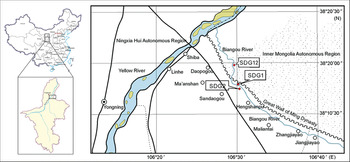
The Shuidonggou site cluster is located near Yinchuan, the capital of Ningxia Hui autonomous region of China. This cluster has attracted archaeological attention since its discovery in 1923, and eight of the 12 localities have been excavated (see Gao et al. Reference Gao, Wang, Pei and Chen2013; Li et al. Reference Li, Kuhn, Bar-Yosef, Chen, Peng and Gao2019). Shuidonggou locality 12 (38°19′40″ north, 106°29′49″ east; Figure 1) is located approximately 4km north-west of the centre of the Shuidonggou site cluster. Before the site was discovered in 2005 during a field survey, part of the sediment was destroyed by a brick factory. Excavation of a 12m2 area of Shuidonggou locality 12 in 2007, conducted by an archaeological team from the Institute of Vertebrate Paleontology and Paleoanthropology and the Ningxia Institute of Relics and Archaeology, yielded considerable evidence of human activity prior to sedentism. In 2010, a much larger area of approximately 100m2 was excavated prior to the site's destruction by the building of a reservoir.
Map showing the location of Shuidonggou localities 1–2 and 12 (modified after Liu et al. Reference Liu, Chen, Zhang, Pei, Gao and Xia2008: 296).

Here, we introduce the artefacts recovered in 2007, as the additional material from the 2010 excavation has not yet been analysed. Although the size of the prehistoric site could not be confirmed because of its partial destruction during the operation of the brick factory, we believe that the data from the 2007 excavation indicate an adaptive stage and a narrowing of the cultural gap between the Palaeolithic and Neolithic populations of northern China. While various scholars provide useful information on aspects of the site (e.g. Liu et al. Reference Liu, Chen, Zhang, Pei, Gao and Xia2008; Gao et al. Reference Gao, Guan, Chen, Yi, Pei and Wang2014; Yi et al. Reference Yi2013, Reference Yi, Bettinger, Chen, Pei and Gao2014), the chronology of Shuidonggou locality 12 was nonetheless questionable, as the radiocarbon and optically stimulated luminescence (OSL) measurements reported from the site are both inconsistent and insufficiently robust to date comprehensively the evidence of human behaviour. A host of comparable and contemporaneous finds have been discovered across northern China, but detailed reports on these discoveries are limited. Here, we systematically present the archaeological evidence from Shuidonggou locality 12 and tentatively discuss the social organisation of hunter-gatherers in northern China before the development of domestication.
Stratigraphy and chronology
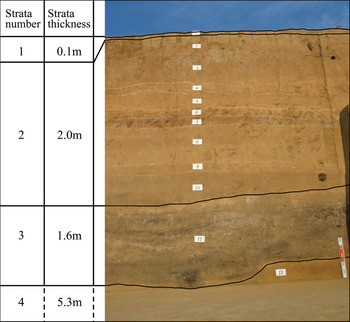
The stratigraphy exposed at Shuidonggou locality 12 reached a thickness of 9m (Figure 2), revealing a sedimentary sequence representing fluvial deposits (Liu et al. Reference Liu, Chen, Zhang, Pei, Gao and Xia2008). The natural sediment at the base is 5.3m-thick, fine, greyish-yellow sand with a thin layer of clay and planar bedding with mottles (stratum four on Figure 2). The lens-shaped stratum above is a greyish-black layer of ash containing very fine sand, along with cultural remains (stratum three on Figure 2). Extending for 50m in the exposed profile, it is a maximum of 1.60m thick. It is unclear whether this thickness represents a single prolonged phase or repeated phases of occupation at the site, as the urgent nature of the field excavation meant that the precise provenances of the archaeological materials were not recorded. Based on the characteristics of the cultural remains and the consistency of the sediment, for the purposes of this article, we treat stratum three as a single layer.
The profile of Shuidonggou locality 12 (layer labelled ‘11’ is the cultural layer; the scale at the lower right corner is 0.50m) (photograph by the authors).

A sediment comprising light-brown silt and very fine sand was deposited above stratum three. This layer (stratum two on Figure 2) is approximately 2m thick, and comprises planar bedding, with a compact, blocky structure, and is calcareously cemented. A 0.20m-thick substratum containing a small amount of charcoal is present at the lower to middle part of this horizon. The substratum is greyish-brown in colour and contains no artefacts. The upper stratum (stratum one on Figure 2) is 0.10m thick and comprises modern surficial loose silt. Disturbed cultural material, including knapped stone artefacts, pottery and metal objects, is visible on the surface—a common phenomenon in the Shuidonggou region.
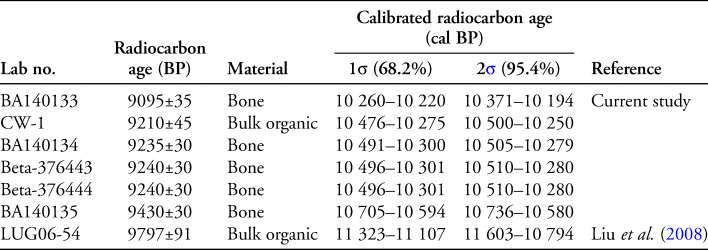
Both OSL and accelerator mass spectrometry radiocarbon dating methods have been employed in the analysis of Shuidonggou locality 12 (Liu et al. Reference Liu, Chen, Zhang, Pei, Gao and Xia2008). Four OSL samples were taken during excavation of the site in 2007. We found that sample CG2, collected from high up in the stratigraphy, was much older than sample CG3, which was collected from lower down. Furthermore, for the same reason, the results from samples CG1 and CG3 were also not applicable. A single radiocarbon date obtained from bulk organic materials collected from the cultural layer (layer 11 in stratum three on Figure 2) has been published (Table 1), suggesting that the site was occupied c. 12 000–11 000 cal BP (Liu et al. Reference Liu, Chen, Zhang, Pei, Gao and Xia2008). The OSL results are either inconsistent with the depositional sequence, or are presented with large errors. The radiocarbon date may also be unreliable, as it uses bulk organic materials. Due to the unsatisfactory nature of these chronological results, we submitted additional radiocarbon samples to different laboratories for dating (Table 1). The results demonstrate that the previously published dates are indeed inaccurate: the cultural layer instead dates to between 10 500 and 10 200 cal BP.
Radiocarbon dates on charcoal and bone samples from Shuidonggou locality 12 (dates were calibrated using OxCal 4.3 (Bronk Ramsey Reference Bronk Ramsey2009) and the IntCal 13 atmospheric curve (Reimer et al. Reference Reimer2013)).

Features of the collections
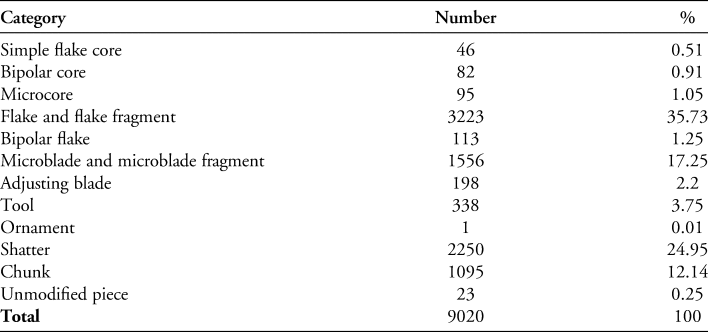
The excavation in 2007 was undertaken at a fast pace, due to the brick factory's ongoing operations. Consequently, there was insufficient time to record the 3D coordinates of each artefact. As all sediments were dry-sieved through fine mesh (approximately 2mm), the data collected from Shuidonggou locality 12 are relatively complete. Table 2 summarises the basic technological characteristics of the stone artefacts recovered from stratum three, which include numerous cores, flakes, hammers, retouched tools and grinding stones. Most of these lithic objects are made of silicified dolomite (39.5 per cent), low-quality chert (20.5 per cent), sandstone, quartz and quartzite, all of which were chiefly obtained as well-rounded pebbles from nearby rivers.
Lithic assemblage composition of Shuidonggou locality 12.

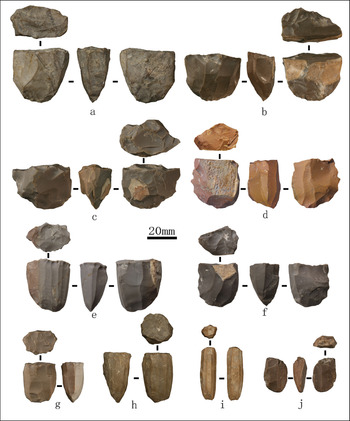
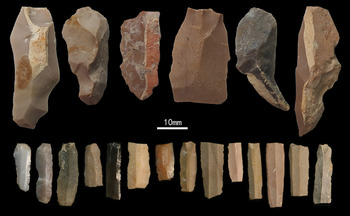
The majority of unused flakes and flake fragments found at the site originated from microcore preparations and adjustments during percussion. These artefacts are small and light. Microblade technological products are abundant in stratum three, and can be classified into several categories, including microcores, microblades and blades used to adjust the shapes of microcores (Figures 3–4). The wedge-shaped microcores are highly distinctive and indicate the existence of a systematic manufacturing process (Yi et al. Reference Yi, Gao, Wang, Pei and Chen2015).
Microcores from Shuidonggou locality 12 (figure by the authors).

Adjusting blades and microblades from Shuidonggou locality 12 (figure by the authors).

We employ the term ‘adjusting blade’ to describe some of the specialised lithic objects that were produced in the final preparation stage of wedge-shaped microcore production (Figure 4). Such artefacts are morphologically and technologically similar to blades. They exhibit traces of soft-hammer percussion via their small platforms, evidence of preparation for manufacture via the pre-treated exterior margin of the platforms and distinct lips on the ventral edges. Blade cores, however, are absent among these artefacts, and the size and morphology of some of the scars on the wedge-shaped microcores indicate a close relationship with the adjusting blade. We assume that the adjusting blades predominantly represent the by-products of the final phase of wedge-shaped microcore preparation. Shuidonggou locality 12 is not the only site in northern China that has yielded such adjusting blades. The so-called ‘blades’ from the Yujiagou site of the Hutouliang site cluster are equally as important for informing our knowledge of microblade technology (Mei Reference Mei2007).
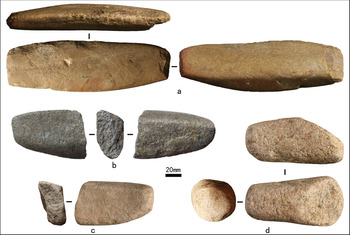
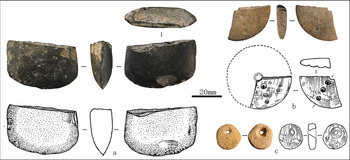
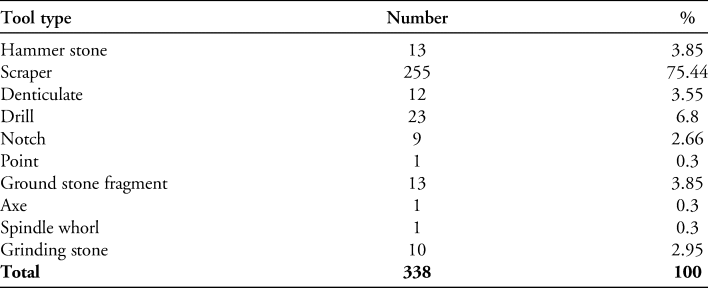
Retouched tools are uncommon at Shuidonggou locality 12 (Table 3). Sidescrapers, the most abundant retouched tools, were manufactured on flakes (35.38 per cent) or microblades (55.19 per cent), and are as expedient and informal in their production as are the other tools recovered from the site. This is probably because microblades can be used without any modification, so there is little need to retouch or modify them. The considerable quantity of microblades from the site that demonstrate clear use-wear offers supporting evidence for such an assumption. Several grinding stones were also recovered, including fragments of slabs and rubbing stones/handstones (Figure 5). We found one almost complete handstone featuring scars on both ends of its macroaxis and on the opposite side of its rubbing surface (Figure 5a). Although such artefacts were traditionally considered to be plant-processing rollers (e.g. Chen Reference Chen2019), the scars, along with the red pigment on the handstone's rubbing surface and on one end of the long axis, suggest that they might have had multiple functions. Part of a rare and bifacially polished axe merits special mention (Figure 6a). The feather-and-snap scars on its cutting edge indicate that it was used to chop wood, according to lithic use-wear experiments (Gao & Shen Reference Gao and Shen2008). Although not polished as exquisitely as the axe in Figure 6, similar contemporaneous axes/adzes associated with microblade assemblages are known from Yujiagou, Lijiagou, Donghulin, Huayang and Taoshan (Xie et al. Reference Xie, Li and Liu2006; Zhao Reference Zhao2006; Mei Reference Mei2007; Wang et al. Reference Wang2015; Yue et al. Reference Yue, Li and Yang2019).
Grinding stones from Shuidonggou locality 12 (figure by the authors).

Artefacts from Shuidonggou locality 12: a) axe; b) spindle whorl; c) ornament (figure by the authors).

Numbers and frequencies of stone tools at Shuidonggou locality 12.

In addition to the above-mentioned lithic artefacts, we also recovered a fragment of a carefully ground item that features three circles drilled in a line on each of its sides (Figure 6b). The shape of this item suggests that the original artefact was circular in shape, measured approximately 45mm in diameter and had a 56mm diameter through its centre. The cross-section resembles a convex lens, 6.84mm thick at the middle and gradually tapering to 2.90mm thick at the edge. As the artefact is comparable in size and shape to spindle whorls frequently unearthed at Neolithic sites in China it might therefore be tentatively taken to indicate that spinning activity took place at Shuidonggou locality 12, especially when combined with the evidence for bone needles. We also found another smaller, circular stone artefact measuring 17.70mm in diameter and 5.40mm thick (Figure 6c). The features, however, are less complex than those of the putative spindle whorl. Drilled bilaterally, the trumpet-like hole in this artefact is not directly in the centre (Figure 6c). We speculate that it functioned as an ornament, rather than as a tool.
More than 13 000 burnt and fire-cracked stones, with a total weight of 307kg, were collected from Shuidonggou locality 12. These irregularly shaped stones were widely distributed and randomly mixed with other cultural remains at the site. Based on morphological and lithological analyses and experimental studies, Gao et al. (Reference Gao, Guan, Chen, Yi, Pei and Wang2014) have suggested that these stones were used as heat-retainers or ‘pot boilers’, and broke apart after being heated to high temperatures and immersed in water for cooking food or boiling water. If this assessment is accurate, these stones demonstrate an advanced ability to apply heat for use in subsistence practices.
Many animal bones were preserved at the site. While these remains predominantly represent hares (Lepus sp.) and Przewalski's gazelle (Procapra przewalskii), there are a total of 1821 identified faunal elements, attributable to 11 species: 1045 hare (Lepus sp.); 103 Eurasian badger (Meles meles); 2 wildcat (Felis silvestris); 19 deer (Cervidae); 404 Przewalski's gazelle (Procapra przewalskii); 5 boar (Sus sp.); 52 Przewalski's horse (Equus przewalskii); 124 water buffalo (Bubalus sp.); and 53 other birds, 1 reptile and 13 other rodents. The return-rate is the predator's calorie acquisition per unit of time spent hunting. Although it is more difficult to prey on large animals, these yield more energy and therefore have relatively higher return-rates. Smaller, faster animals are more difficult to hunt and process, and have lower energy yields, which may cause predators to target prey with higher return-rates. Prey animals can be divided into three categories based on their return-rates: high-ranked, large animals; low-ranked, quick small game; and low-ranked, slow small game. Zooarchaeological study of the Shuidonggou locality 12 faunal assemblage suggests an even distribution of these three categories across the site. Compared with the earlier Shuidonggou cluster, the increased quantity and proportion of low-ranked animals at Shuidonggou locality 12 indicate that people living at this site ate a wide range of animals, signifying the onset of the ‘Broad Spectrum Revolution’ (Zhang et al. Reference Zhang, Zhang, Xu, Liu, Wang, Pei, Wang and Gao2013).
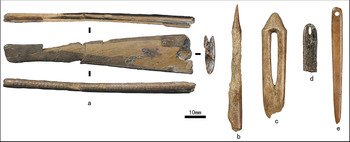
Remarkably, Shuidonggou locality 12 has yielded 36 fragments of bone artefacts, comprising a knife handle, a shuttle, seven needles and two awls (Figure 7), the blanks for which were predominantly extracted from limb and rib bones of Przewalski's gazelle (Zhang et al. Reference Zhang, Doyon, Zhang, Gao, Chen, Guan and D'Errico2018, Reference Zhang, Zhang, Gao and Chen2019). Morphometric data and stereomicroscopic examination show that scraping, grinding, grooving, notching, polishing, drilling, flaking, retouching and, occasionally, heat-treating processes were employed (Zhang et al. Reference Zhang, Gao, Pei, Chen, Niu, Xu, Zhang and Wang2016, Reference Zhang, Doyon, Zhang, Gao, Chen, Guan and D'Errico2018). The knife handle represents the earliest direct evidence for composite microblade tool production in China, indicating that microblades played a role in processing as well as hunting animals.
Bone tools from Shuidonggou locality 12: a) handle; b) awl; c) shuttle; d–e) needles (figure by the authors).

Discussion
The reduction sequences indicated by cores and debitage from Shuidonggou locality 12 reveal that lithic percussion at the site is characterised by microblade technology. This conforms with the general characteristics of Terminal Upper Palaeolithic technologies in northern China. The lithic assemblage, bone-tool manufacture, use of polished and grinding stone tools, consumption of animals, and use of fire is more diverse at Shuidonggou locality 12 than at earlier microblade sites. Contemporaneous sites with similar lithic technology include the Hutouliang and Shizitan clusters (Xie et al. Reference Xie, Li and Liu2006; Song Reference Song2011).
Previous radiocarbon dating suggests that the site was occupied c. 12 000–11 000 cal BP, during the late period of the climatically harsh Younger Dryas (Liu et al. Reference Liu, Chen, Zhang, Pei, Gao and Xia2008). Our re-examination of the dates for Shuidonggou locality 12, however, shows that it was occupied later than previously thought—after the Younger Dryas, when climatic conditions were less severe (Wünnemann et al. Reference Wünnemann, Hartmann, Janssen, Zhang, Madsen, Chen and Gao2007).
Microblade technology was the most characteristic and widespread technology across northern China in the millennia prior to the Neolithic. The connection between microblade technology and sedentary communities, however, is ambiguous. Recently published data indicate that microblade-using foragers occupied northern China after the Last Glacial Maximum (Yi Reference Yi2019). These data derive from carefully excavated sites with robust chronological determinations. The fact that sophisticated microblade technology remained an important component of Early Neolithic assemblages should not be ignored. The presence of this technology indicates that the Late Pleistocene ancestors of sedentary, Neolithic communities were related to earlier microblade-using populations. Although some Younger Dryas sites indicate a clear hiatus in occupation (Wang et al. Reference Wang, Xie, Mei and Gao2019; Yue et al. Reference Yue, Li and Yang2019), which may suggest that mobile foragers sometimes abandoned these sites or decreased their exploitation of resources, most, if not all, sites of this date in northern China were occupied by microblade-using foragers. While microblades may have been an important tool in a broad range of subsistence strategies (Cohen Reference Cohen2003; Yi et al. Reference Yi2013), it is widely accepted that they were used by highly mobile foragers as composite weapons in order to improve hunting yields in the harsh environment of North and East Asia, where hunting failures during the region's severe winters could have fatal consequences (Elston & Brantingham Reference Elston, Brantingham, Elston and Kuhn2002).
If there was indeed a trajectory from highly mobile, microblade-using populations to sedentary (farming) communities, why and how were some groups able to change their subsistence strategy radically? Current explanations for such an abrupt change in social organisation are still inadequate. Without hypotheses as to why these strategies changed, we cannot understand the processes that brought about Neolithisation in northern China. We should not merely depend on the so-called ‘earliest’ archaeological findings, because it is more important to explain why the transition took place.
Hunter-gatherer mobility has been characterised as a positioning strategy that is responsive to the structural properties of the surroundings—best known as Binford's (Reference Binford1980) ‘forager-collector continuum’ from residential to logistical mobility. Both complex and simple hunter-gatherer systems alike can be described in terms of variable mixes of these two types of mobility. Many case studies and review articles have applied Binford's model to changes in social organisation from the Pleistocene to the Holocene. Eder's (Reference Eder1984) ethnographic study of the contemporary tropical forest-foraging Batak, for example, demonstrates that a simple distinction between residential and logistical mobility is inadequate to explain the full repertoire of a group's settlement and mobility patterns. Although mobility is a property of individual behaviour, such behaviour originates within its social, organisational context. Mobility should therefore be conceptually divided into group and individual mobility. Both types are key to understanding the roles of microblades in the long transition from mobile to sedentary human settlement in northern China.
Mitochondrial DNA studies of global populations suggest that major population expansions began during the last deglaciation, including in China c. 13 000 cal BP (Laval et al. Reference Laval, Patin, Barreiro and Quintana-Murci2010; Zheng et al. Reference Zheng, Yan, Qin and Jin2012). At that time, northern China was occupied by microblade-using foragers. The balance between resource supply and the demands of the highly mobile hunter-gatherers shifted as their population grew. Accordingly, as these populations expanded, it was essential for these groups to adjust their subsistence strategies by, for example, increasing the breadth of their diet—known as the Broad Spectrum Revolution (Flannery Reference Flannery, Ucko and Dimbleby1969)—and intensifying exploitation of nearby resources. Broadened survival strategies also include the exploitation of low-ranking resource patches and marginal regions, which we term the ‘Broad Patch Revolution’. The ecological value of patches with low productivity, however, was insufficient to support a large group of foragers, even for a short time. As the frequent movement of large groups from patch to patch was not economical, they required a more efficient form of social organisation. Large groups may have set up a basecamp at a high-ranking patch, ensuring that they could efficiently explore the region over a long period of time—perhaps several weeks or months. Meanwhile, individuals and specialised teams may have left their residential location to execute specific tasks, such as monitoring their environment or obtaining resources from outlying, low-ranking patches. In short, the flexibility of high individual mobility compensates for the reduced mobility of the larger group. Some of these foraging groups eventually developed into sedentary populations. Chen and Yu (Reference Chen and Yu2017) suggest that this may have been true for those groups who inhabited the hilly region of northern China.
Technologies are developed and refined by hunter-gatherers to address ‘optima’ problems in different environments—i.e. spending the least amount of energy for maximum returns (Binford Reference Binford1979, Reference Binford1980; Kelly Reference Kelly1983). The total number of artefacts that could be carried between residential locations was ultimately limited, as the relatively high mobility of most hunter-gatherer groups reduced their overall capacity to transport material culture. Tools therefore became lighter and less specialised as mobility increased. In contrast, technological diversity increased as mobility declined until a certain threshold was reached (Torrence Reference Torrence and Bailey1983; Shott Reference Shott1986). Hence, heavy processing tools, such as grinding-stones and axes, may have been created by less mobile groups. As components of composite tools, microblades are light and therefore more portable. Microblade composite tools combine the strong and lethal features of bone/antler or flaked-stone points that were reliable for both hunting and processing. Furthermore, such tools are easy to maintain and repair. The advantages of microblade composite tools supported hunter-gatherers in North-east Asia during the climatic fluctuations of the Terminal Pleistocene (see Yi et al. Reference Yi2013, Reference Yi, Bettinger, Chen, Pei and Gao2014, Reference Yi, Gao, Li and Chen2016). These fluctuations, along with increases in hunter-gatherer populations during this period, influenced some microblade-using foragers to change their socio-economic organisation to a combination of greater group sedentism and high individual mobility. We observe evidence of both strategies at Shuidonggou locality 12. The huge quantity of heating stones, along with the faunal assemblage and heavy, durable tools such as grinding stones and axes, reveals that the Shuidonggou locality 12 occupants were based at the site for sustained periods. Meanwhile, the inhabitants also produced many microblades, which point to the demands of high individual mobility. The same combination of phenomena can be observed at the contemporaneous sites of Yujiagou (Mei Reference Mei2007) and Lijiagou (Wang et al. Reference Wang2015), where resource conditions were desirable for supporting the long-term occupation of large groups with highly mobile individuals. In contrast, foragers in ‘undesirable’ zones, such as the margins of the Tibetan Plateau, adopted an expedient and portable tool-kit during the Terminal Pleistocene, and the sizes of their sites remained small (Yi et al. Reference Yi, Gao, Zhang, Sun, Brantingham, Madsen and Rhode2011), suggesting a highly mobile socio-economic organisation in these less hospitable regions.
Conclusions
The site of Shuidonggou locality 12 in northern China can be interpreted as a sedentary basecamp occupied between c. 10 500 and 10 200 cal BP. Activities undertaken at the site included tool production and maintenance and resource processing and consumption. The inhabitants cut trees with polished axes for purposes such as heating, cooking, defence and the construction of shelters. Microblades were produced at Shuidonggou locality 12 as components of composite tools that were used for multiple purposes, including hunting, cutting meat, harvesting plants, manufacturing bone tools and maintaining wooden tools. Plant foods were processed using grinding stones. More speculatively, the quantity of hare and gazelle bones recovered from the site may suggest that trapping strategies were used to capture animals for skins and sinew. String or cordage may have been produced from fibrous plants by spinning with spindle whorls. Microblade-composite knives found at the site may have been used to process animal skins to create sophisticated winter clothing.
On the basis of this diverse combination of technologies, we argue that Shuidonggou locality 12 was probably occupied as a residential basecamp, as recorded ethnographically by Binford (Reference Binford1980), and that specialised groups were frequently dispatched from the site for specific purposes, such as to procure food or gather information. Neolithisation in northern China did not happen as an event, but was a long-term process that involved many steps. The microblade-using foragers represented by Shuidonggou locality 12 during the Palaeolithic–Neolithic transition in northern China adopted a socio-economic organisation in which individuals were highly mobile but their group was more sedentary; this, we argue, was the foundation of Neolithisation in northern China. We do not argue that all microblade-using foragers eventually became sedentary communities, but rather that some adapted to meet various challenges, and that the resulting change was a first step to farming.
Acknowledgements
We are grateful to Luo Feng and Wang Huimin for their help in the fieldwork. We thank all members of the Shuidonggou project team.
Funding statement
This research is supported by the National Social Science Foundation of China (15CKG006) and the Fund for Building World-class Universities (disciplines) of Renmin University of China (project KYGJC2019002).