1. Introduction
Primary stable isotope signatures retained in preserved carbonates (e.g. Veizer et al. Reference Veizer, Ala, Azmy, Bruckschen, Bruhn, Buhl, Carden, Diener, Ebneth, Goddris, Jasper, Korte, Pawellek, Podlaha and Strauss1999) have been found to be a potential tool for chemostratigraphic correlations, particularly for sections with poor biostratigraphic resolution. Primary/near-primary δ13C variations, associated with eustatic sealevel changes, allow the construction of reliable profiles for correlating sedimentary sequences of different depositional settings within the same basin (e.g. Miller et al. Reference Miller, Evans, Freeman, Ripperdan and Taylor2011, Reference Miller, Repetski, Nicoll, Nowlan and Ethington2014; Azomani et al. Reference Azomani, Azmy, Blamey, Brand and Al-Aasm2013) and from different palaeocontinents (e.g. Jing et al. Reference Jing, Deng, Zhao, Lu and Zhang2008; Azmy et al. Reference Azmy, Stouge, Christiansen, Harper, Knight and Boyce2010; Miller et al. Reference Miller, Evans, Freeman, Ripperdan and Taylor2011, Reference Miller, Repetski, Nicoll, Nowlan and Ethington2014). The eustatic changes along the eastern Laurentian passive margin during latest Cambrian time influenced the redox conditions of the depositional environment (e.g. Azmy et al. Reference Azmy, Kendall, Brand, Stouge and Gordon2015; Azmy, Reference Azmy2018) and, accordingly, primary organic productivity along with the C-isotope compositions of marine carbonates (e.g. Landing, Reference Landing and Landing2007, Reference Landing2012a; Landing et al. Reference Landing, Westrop, Miller, Fatka and Budil2010; Miller et al. Reference Miller, Evans, Freeman, Ripperdan and Taylor2011, Reference Miller, Repetski, Nicoll, Nowlan and Ethington2014; Terfelt et al. Reference Terfelt, Eriksson and Schmitz2014; Azmy et al. Reference Azmy, Stouge, Brand, Bagnoli and Ripperdan2014, Reference Azmy, Kendall, Brand, Stouge and Gordon2015).
The main objectives of the current study are to evaluate the petrographic and geochemical preservation of the carbonates of the lower Martin Point section (western Newfoundland, Canada) that spans the Upper Cambrian (Furongian) and to reconstruct a reliable primary C-isotope profile that allows the recognition of the stratigraphic levels of the SPICE (Steptoean Positive Carbon Isotope Excursion) and the post-SPICE (below the HERB event: Hellnmaria–Red Tops Boundary, also called the TOCE: Top Of Cambrian Excursion) events. This will also enhance the global correlation of the Upper Cambrian on Laurentia and beyond.
2. Geologic setting
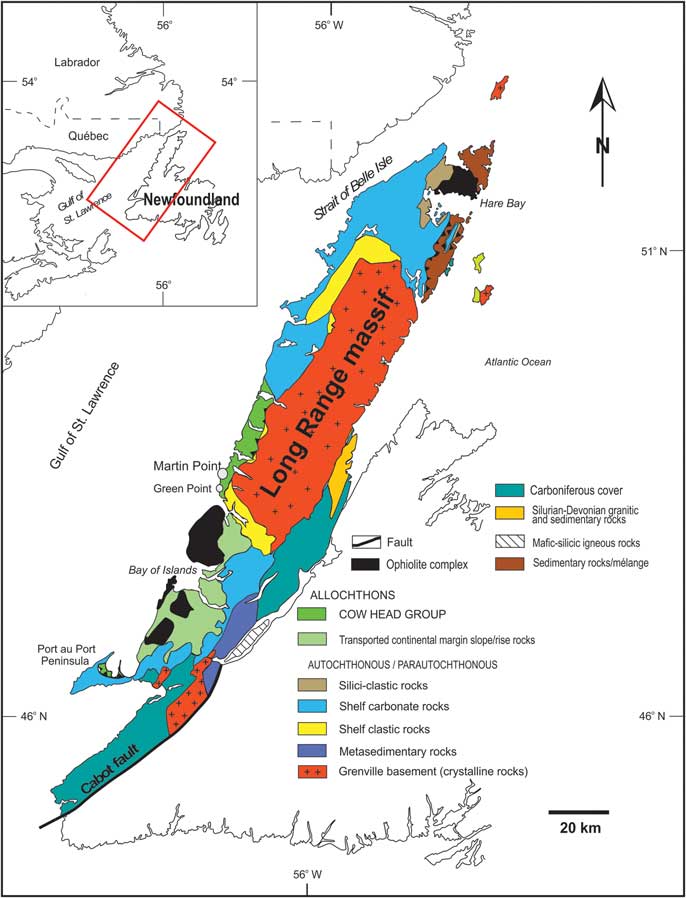
Palaeozoic sedimentary rocks of western Newfoundland in Canada (Fig. 1) were deposited on the eastern Laurentian margin. The Laurentian plate developed by active rifting around 570–550 Ma (e.g. Cawood et al. Reference Cawood, McCausland and Dunning2001; Hibbard et al. Reference Hibbard, Van Staal and Rankin2007), and a pre-platform shelf formed and was eventually covered by clastic sediments (James et al. Reference James, Stevens, Barnes, Knight, Crevello, Wilson, Sarg and Read1989). A major transgression flooded the Laurentian platform margin and resulted in the accumulation of thick carbonate deposits (Wilson et al. Reference Wilson, Medlock, Fritz, Canter, Geesaman, Candelaria and Reed1992; Landing, Reference Landing and Landing2007, Reference Landing2012a; Lavoie et al. Reference Lavoie, Desrochers, Dix, Knight, Hersi, Derby, Fritz, Longacre, Morgan and Sternbach2012).
Map of the study area showing the surface geology and location of the Martin Point section (49° 40′ 51″ N, 57° 57′ 36″ W) in western Newfoundland, Canada (modified from James & Stevens, Reference James and Stevens1986; Cooper et al. Reference Cooper, Nowlan and Williams2001).

3. Stratigraphy
3.a. Lithostratigraphy
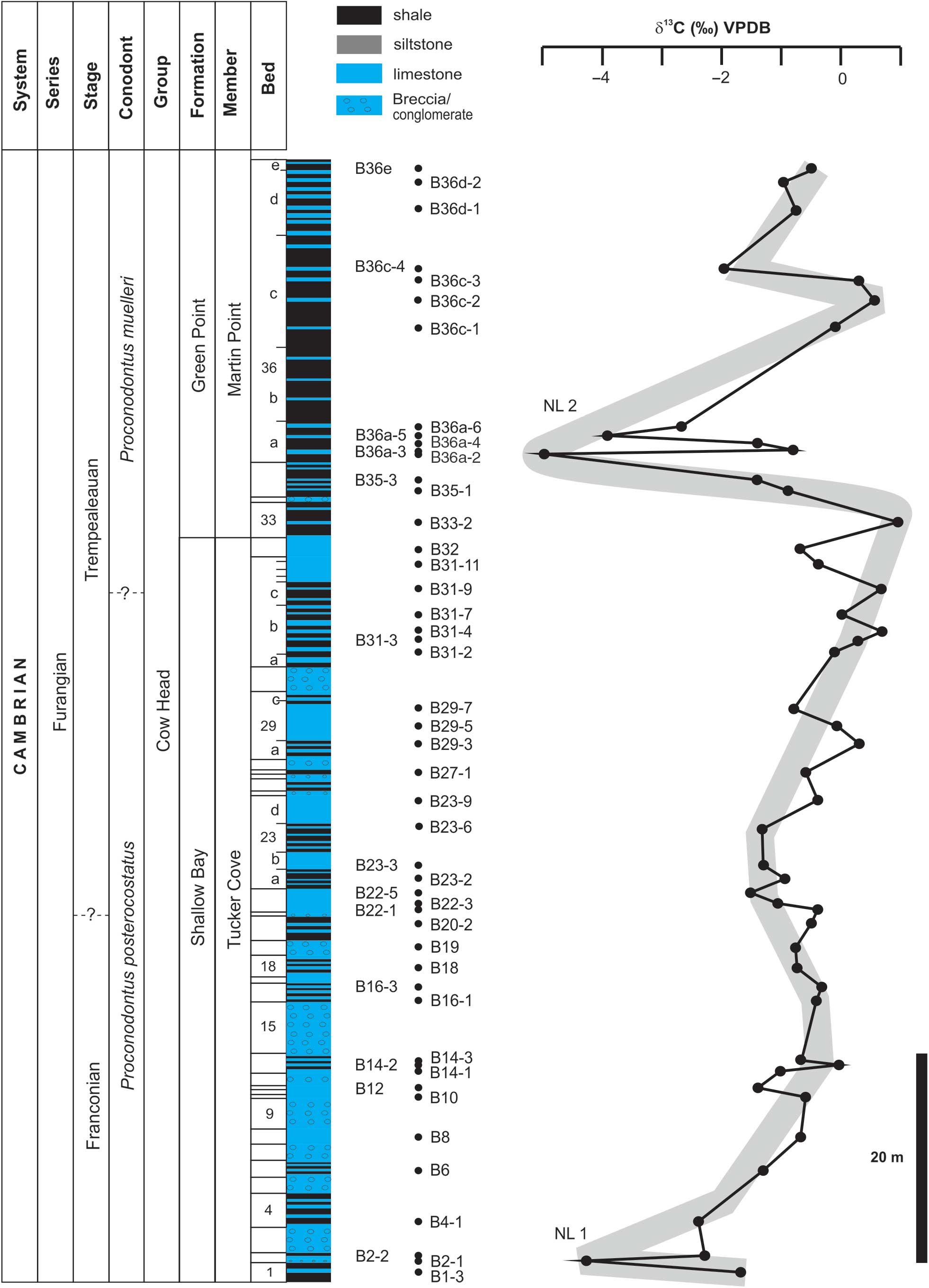
The lithostratigraphy of the investigated interval of the lower Martin Point section spans the Upper Cambrian, particularly the uppermost part of the Shallow Bay Formation (upper Tuckers Cove Member) and the lowermost part of the Green Point Formation (lower Martin Point Member) of the Cow Head Group (Fig. 2). It has been studied and discussed in detail by James & Stevens (Reference James and Stevens1986), and it will therefore only be summarized here. The section consists of dark grey to black fissile shale alternating with thin (∼1 cm thick) interbeds of ribbon limestone rhythmites. Those rhythmites were precipitated in situ slowly in a calm environment as primary carbonates either directly from seawater or possibly by biomediation, which is indicated by lamination (e.g. Della Porta et al. Reference Della, Kenter, Bahamonde, Immenhauser and Villa2003; Bahamonde et al. Reference Bahamonde, Merino-Tomé and Heredis2007; Bartley et al. Reference Bartley, Kah, Frank and Lyons2015). Siltstone interbeds (up to 1 cm thick) may co-occur with shale but are not abundant, and the limestone interbeds (rhythmites) vary from isolated and thin to up to 20 cm thick. Carbonate conglomerate/breccia beds may occur and contain clasts (up to 25 cm) of shallow-water carbonates that were transported into deep-water facies along the slope of the Laurentian margin (James & Stevens, Reference James and Stevens1986).
Stratigraphic framework of the investigated lower Martin Point section in western Newfoundland, Canada (James & Stevens, Reference James and Stevens1986) showing bed number and detailed measured positions of investigated samples. The P. muelleri and P. posterocostatus zones have not been documented yet in the Martin Point section but are based on the global scheme (e.g. Li et al. Reference Li, Zhang, Chen, Zhang, Chen, Huang, Peng and Shen2017) and also on that suggested for the Cow Head Group and North America (Barnes, Reference Barnes1988; Miller et al. Reference Miller, Evans, Freeman, Ripperdan and Taylor2011). The grey line highlights the main changes in the δ13C profile of the investigated carbonates.

3.b. Biostratigraphy
The age of the investigated interval covers the uppermost Franconian and the lowermost Trempealeauan, which is well below the upper boundary of the so-called Lotagnostus americanus trilobite Zone that has been proposed for the base of the uppermost Cambrian Stage (Cooper et al. Reference Cooper, Nowlan and Williams2001), although Landing et al. (Reference Landing, Westrop, Miller, Fatka and Budil2010, Reference Landing, Westrop and Adrain2011) and Westrop et al. (Reference Westrop, Adrain and Landing2011) limit L. americanus to topotype material in Quebec and do not agree that the lowest occurrence of this agnostoid arthropod is appropriate for defining a global chronostratigraphic unit. However, the lower boundary of the zone seems to be far down below the exposed section (Cooper et al. Reference Cooper, Nowlan and Williams2001). The conodont biozonation documented for the studied section at Martin Point (Fig. 2) spans approximately the lower part of the Proconodontus muelleri Zone and reaches down to the Proconodontus posterocostatus Zone on the global conodont biozonation scheme including that of N. America (James & Stevens, Reference James and Stevens1986; Barnes, Reference Barnes1988; Miller et al. Reference Miller, Evans, Freeman, Ripperdan and Taylor2011; Li et al. Reference Li, Zhang, Chen, Zhang, Chen, Huang, Peng and Shen2017). The P. muelleri and P. posterocostatus zones have been documented below the Eoconodontus notchpeakensis Zone in the Lawson Cove and Sneakover Pass sections of Utah, USA (Miller et al. Reference Miller, Evans, Freeman, Ripperdan and Taylor2011), where the base of the notchpeakensis Zone is marked by the distinct HERB δ13C excursion (Miller et al. Reference Miller, Evans, Freeman, Ripperdan and Taylor2011; Li et al. Reference Li, Zhang, Chen, Zhang, Chen, Huang, Peng and Shen2017; Azmy, Reference Azmy2018). The HERB δ13C excursion has been documented in the GSSP section of Green Point (e.g. Miller et al. Reference Miller, Evans, Freeman, Ripperdan and Taylor2011) and that of the Martin Point section (Azmy, Reference Azmy2018) at a stratigraphic level well above the currently investigated interval. However, the P. muelleri and P. posterocostatus zones have not been documented yet in the Martin Point section but, based on the global biozonation scheme, are expected to be at a stratigraphic level correlated with that of the currently studied interval (Fig. 2).
4. Material and methodology
Fifty closely spaced samples (Appendix Table A1; Fig. 2) were collected from the lower part of the Martin Point section (49° 40′ 51″ N, 57° 57′ 36″ W; James & Stevens, Reference James and Stevens1986; Cooper et al. Reference Cooper, Nowlan and Williams2001), western Newfoundland (Fig. 1). Samples were taken from laminated lime mudstone interbeds to avoid allochthonous clasts. Thin-sections of samples were petrographically examined with a polarizing microscope and stained with Alizarin Red–S and potassium ferricyanide solutions (Dickson, Reference Dickson1966). Cathodoluminescence (CL) observations were performed using a Technosyn 8200 MKII cold cathode instrument operated at 8 kV accelerating voltage and 0.7 mA current.
A mirror-image slab of each thin-section was also prepared and polished for microsampling. The polished slabs were washed with deionized water and dried overnight at 50 °C prior to isolating the finest grained lime mudstone free of secondary cements and other contaminants. Owing to the possible heterogeneity in geochemical compositions of texturally distinct carbonate phases in whole-rock samples, and in order to avoid silicate inclusions and secondary carbonate cements and veins, microsamples were drilled from the finest grained micritic material under a binocular microscope. Approximately 10 mg of carbonate was microsampled from the cleaned slabs using a low-speed microdrill under a binocular microscope.
For C- and O-isotope analyses, about 220 μg of powder sample was reacted in an inert atmosphere with ultrapure concentrated (100 %) orthophosphoric acid at 70 °C in a ThermoFinnigan GasBench II. The liberated CO2 was automatically delivered to a ThermoFinnigan DELTA V plus isotope ratio mass spectrometer in a stream of helium, where the gas was ionized and measured for isotope ratios. Uncertainties of better than 0.1 ‰ (2σ) for the analyses were determined by repeated measurements of NBS-19 (δ18O = –2.20 ‰ and δ13C = +1.95 ‰ v. VPDB (Vienna Pee Dee Belemnite)) and L-SVECS (δ18O = –26.64 ‰ and δ13C = –46.48 ‰ v. VPDB).
For elemental analyses, a subset of sample powder (∼10 mg each) was digested in 2 % (v/v) HNO3 and analysed for major and trace elements using an Elan DRC II inductively coupled plasma mass spectrometer (ICP-MS) (Perkin Elmer SCIEX). The relative uncertainties of these measurements are less than 5 %, and results are normalized to a 100 % carbonate basis (e.g. Azmy et al. Reference Azmy, Stouge, Brand, Bagnoli and Ripperdan2014).
5. Results
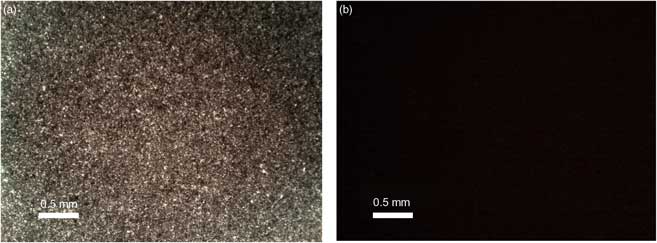
Petrographic examinations indicate that the currently investigated carbonates of the lower Martin Point section are dominantly lime mudstones, which have retained at least their near-micritic texture and appear dull under cathodoluminescence (Fig. 3a,b).
Photomicrographs of the investigated carbonates showing, (a) micritic lime mudstones (Sample B31-1) and (b) CL image of (a).

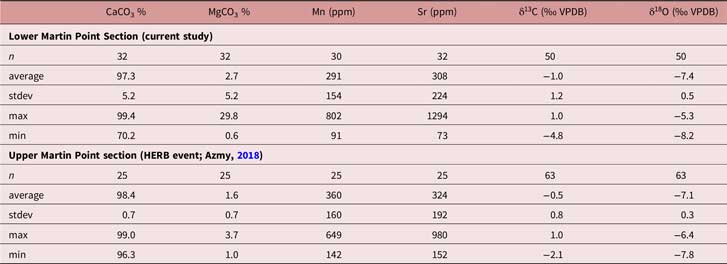
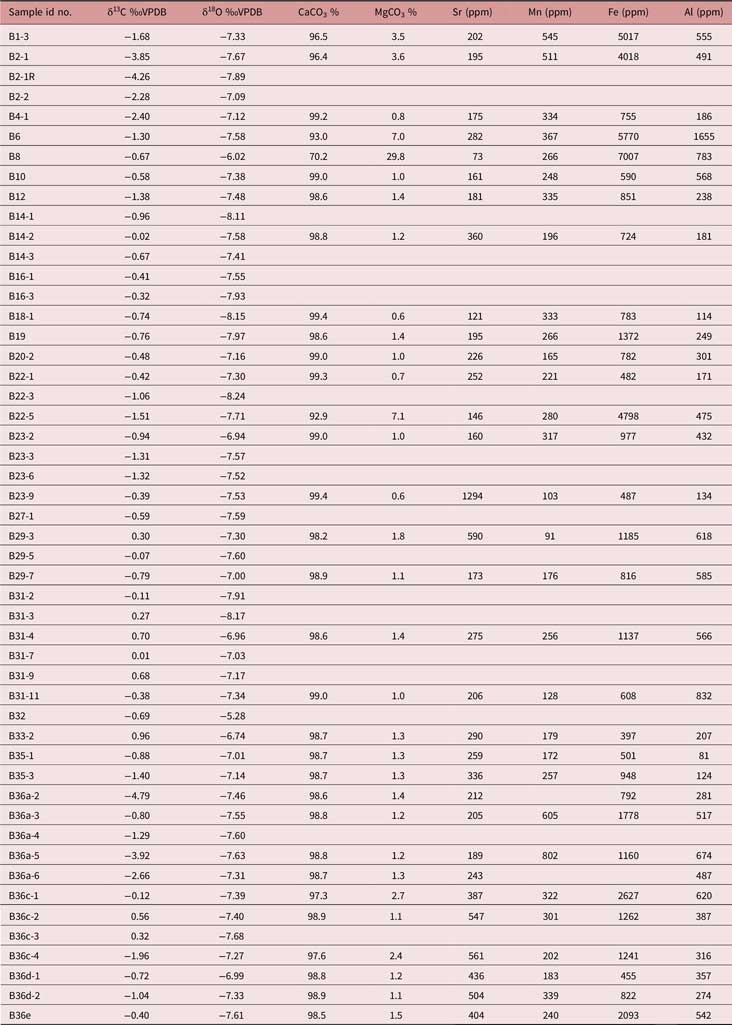
The geochemical characteristics of those carbonates are tabulated in Appendix Table A1 and the statistics of the results are summarized in Table 1. Their mean Sr content (308 ± 224 ppm) is very comparable to that of the overlying section of carbonates that records the HERB event (Table 1; Azmy, Reference Azmy2018), although their Mn content (291 ± 154 ppm) is lower (Table 1). The Mn and Fe contents of the investigated carbonates show insignificant correlations with their Sr counterparts (R2 = 0.1 and 0.06, respectively).
Summary of statistics of isotopic and trace element geochemical compositions of the investigated Upper Cambrian carbonates of the lower Martin Point section

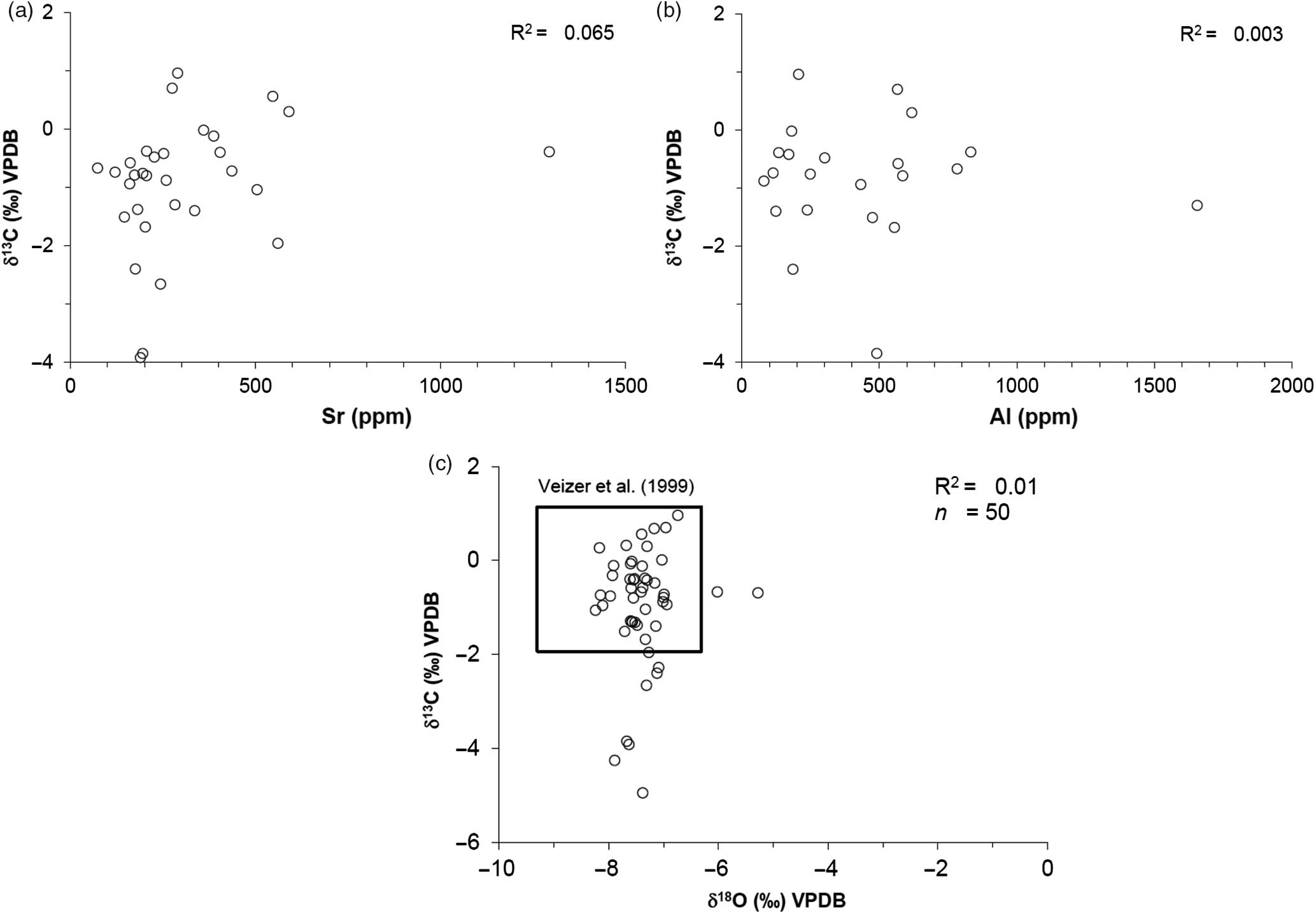
The Sr and Al values exhibit insignificant correlations with their δ13C (R2 = 0.07 and 0.003, respectively; Fig. 4a,b) and δ18O counterparts (R2 = 0.02 and 0.01, respectively; Appendix Table A1).
Scatter diagrams showing correlations of (a) Sr (b) Al and (c) δ18O with δ13C for the micritic lime mudstones from the lower Martin Point section. The rectangle in (c) marks the composition of best-preserved Upper Cambrian carbonates (Veizer et al. Reference Veizer, Ala, Azmy, Bruckschen, Bruhn, Buhl, Carden, Diener, Ebneth, Goddris, Jasper, Korte, Pawellek, Podlaha and Strauss1999).

The mean δ13C and δ18O values of the investigated carbonates (–1.0 ± 1.2 and –7.4 ± 0.5 ‰ VPDB, respectively; Table 1) fall mainly within the documented range of Upper Cambrian well-preserved marine carbonates (Fig. 4c; Veizer et al. Reference Veizer, Ala, Azmy, Bruckschen, Bruhn, Buhl, Carden, Diener, Ebneth, Goddris, Jasper, Korte, Pawellek, Podlaha and Strauss1999) and are comparable to their counterparts in the overlying section spanning the HERB event (Table 1; Azmy, Reference Azmy2018).
6. Discussion
The C-isotope composition of marine carbonates (δ13Ccarb) may reflect the influence of depositional environment and/or diagenetic conditions, and C-isotope stratigraphy has to therefore be based on the primary δ13Ccarb signatures (e.g. Veizer et al. Reference Veizer, Ala, Azmy, Bruckschen, Bruhn, Buhl, Carden, Diener, Ebneth, Goddris, Jasper, Korte, Pawellek, Podlaha and Strauss1999; Azmy, Reference Azmy2018). Although ancient carbonates, such as those from the Palaeozoic Era, are almost impossible to be retained entirely unaffected by diagenetic fluids during their burial history, their alteration is at times so limited that they retain their near-primary geochemical signatures, particularly at low water/rock interaction ratios. Thus, the evaluation of the degree of sample preservation and the retained (primary or near-primary) isotopic and elemental geochemical signatures is the solid foundation for the reconstruction of δ13C profiles that can be utilized for reliable high-resolution global chemostratigraphic correlations.
6.a. Influence of diagenesis
Multiscreening techniques (petrographic and geochemical) have been utilized to evaluate the preservation of the studied samples. The investigated carbonates of the Upper Cambrian Martin Point section are dominated by lime mudstones that exhibit insignificant recrystallization (Fig. 3). They retained their micritic to near-micritic grain size and sedimentary fabrics, thus reflecting a high degree of petrographic preservation (e.g. Azmy, Reference Azmy2018), which is also supported by their non-luminescent images under the cathodoluminscope (Fig. 3a,b). Luminescence in carbonates is mainly activated by high concentrations of Mn but quenched by high concentrations of Fe (Machel & Burton, Reference Machel, Burton, Barker, Burruss, Kopp, Machel, Marshall, Wright and Colbum1991). Dull luminescence, in many cases, indicates relative preservation of primary geochemical signatures (e.g. Azmy, Reference Azmy2018), but diagenetic carbonates, such as late-burial cements, may still appear dull to non-luminescent owing to their high Fe contents (Rush & Chafetz, Reference Rush and Chafetz1990). This may suggest that cathodoluminescence has to be taken with caution and complemented by additional screening tests (Brand et al. Reference Brand, Logan, Bitner, Griesshaber, Azmy and Buhl2011). Alteration of carbonates is associated with depletion in Sr contents and δ18O values but enrichment in Mn and Fe (Veizer, Reference Veizer, Arthur, Anderson, Kaplan, Veizer and Land1983). The investigated carbonates are believed to have been deposited in slope settings (James & Stevens, Reference James and Stevens1986), likely under less oxic (dysoxic) conditions (e.g. Azmy, Reference Azmy2018), where seawater is expected to be at least slightly more enriched in Mn than shallow water. Earlier studies have documented microbial lime mudstone in Palaeozoic slope carbonates at depths down to 300 m (Della Porta et al. Reference Della, Kenter, Bahamonde, Immenhauser and Villa2003; Bahamonde et al. Reference Bahamonde, Merino-Tomé and Heredis2007; Bartley et al. Reference Bartley, Kah, Frank and Lyons2015). Thus, the lime mudstones of the current investigation had contributions from in situ carbonates that were deposited through microbial mediation and are expected to be slightly enriched in Mn relative to those of shallow-water settings (≤ 100 ppm; Veizer, Reference Veizer, Arthur, Anderson, Kaplan, Veizer and Land1983). Therefore, the enriched Mn contents of the Martin Point lime mudstones (291 ± 154 ppm; Table 1) are likely related to deposition in Mn-rich dysoxic waters (e.g. Azmy, Reference Azmy2018) rather than diagenetic alteration. Similarly, Fe is a redox proxy and is expected to be enriched in the investigated slope carbonates (1685 ± 1741 ppm; Appendix Table A1). Both the Mn and Fe contents are insignificantly correlated with their Sr counterparts (R2 = 0.1 and 0.06, respectively), which argues against significant diagenetic alteration.
This is also consistent with the high Sr contents (up to 1294 ppm; Table 1; Appendix Table A1) and poor correlation of the Sr and Al values with their δ13C counterparts (R2 = 0.065 and 0.003; Fig. 4a,b), and with the clean, non-argillaceous lime mudstone interbeds where carbonate clasts are restricted only to the conglomeratic interbeds (Fig. 2) that occur occasionally (cf. James & Stevens, Reference James and Stevens1986; Coniglio & James, Reference Coniglio and James1990; Li et al. Reference Li, Jenkyns, Wang, Hu, Chen, Wei, Huang and Cui2006). The occurrence of shale interbeds would certainly lead to diagenetic fluids enriched in Al and consistent enrichment of Al in altered carbonates with progressive diagenesis. In addition, the poor correlation of the Sr and Mn contents with their δ18O counterparts (R2 = 0.02 and 0.03, respectively; Appendix Table A1) suggests that the alteration was likely restricted under a low water/rock interaction ratio of closed to semi-closed conditions (e.g. Azmy, Reference Azmy2018), which also explains the occurrence of the isotopic compositions of the investigated carbonates within the range of that documented for the best-preserved marine carbonates of the same age (Fig. 4c; Veizer et al. Reference Veizer, Ala, Azmy, Bruckschen, Bruhn, Buhl, Carden, Diener, Ebneth, Goddris, Jasper, Korte, Pawellek, Podlaha and Strauss1999).
Generally speaking, the preservation of primary/near-primary δ13C signatures of carbonates is to some extent highly probable because the diagenetic fluids, in many cases, do not contain significant enough concentrations of CO2 to reset the C-isotope composition unless high water/rock interaction ratios are achieved, which is associated with significant recrystallization and increase in crystal size (aggrading neomorphism). However, this is not the case in the currently investigated Martin Point lime mudstones, which retain micritc to near-micritic grain size (e.g. Azmy, Reference Azmy2018; Fig. 3a).
Recrystallization of carbonates during diagenesis may result in the alteration of their organic matter contents and the depletion of the primary δ13C signatures of the carbonates. The micritic grain size of the investigated lime mudstones argues against significant recrystallization and organic remineralization. Also, this agrees with the very poor correlation of the Al values with those of δ13C (R2 = 0.003; Fig. 4b), which reflects the insignificant input of organic matter from terrestrial sources but mainly from marine sources.
In summary, the petrographic and geochemical preservation of the investigated carbonates supports the preservation of at least near-primary δ13C compositions and suggests that their variations reflect the response to primary depositional conditions and can, therefore, be reliably utilized for high-resolution global chemostratigraphic correlations.
6.b. Carbon-isotope stratigraphy
The eustatic sealevel changes during Late Cambrian time (e.g. James & Stevens, Reference James and Stevens1986; Cooper et al. Reference Cooper, Nowlan and Williams2001; Landing, Reference Landing and Landing2007, Reference Landing2012a,b; Landing et al. Reference Landing, Westrop, Miller, Fatka and Budil2010, Reference Landing, Westrop and Adrain2011) influenced the abundance of biota and their productivity in oceans, which also resulted in changes in the global ocean water chemistry (e.g. Veizer et al. Reference Veizer, Ala, Azmy, Bruckschen, Bruhn, Buhl, Carden, Diener, Ebneth, Goddris, Jasper, Korte, Pawellek, Podlaha and Strauss1999; Li et al. Reference Li, Zhang, Chen, Zhang, Chen, Huang, Peng and Shen2017; Azmy, Reference Azmy2018) and the C-isotope composition of marine carbonates that recorded distinct negative δ13C excursions (e.g. Jing et al. Reference Jing, Deng, Zhao, Lu and Zhang2008; Sial et al. Reference Sial, Peralta, Gaucher, Alonso and Pimentel2008; Terfelt et al. Reference Terfelt, Eriksson and Schmitz2014; Miller et al. Reference Miller, Evans, Ethington, Freeman, Loch, Popov, Repetski, Ripperdan and Taylor2015; Li et al. Reference Li, Zhang, Chen, Zhang, Chen, Huang, Peng and Shen2017) due to the associated changes in redox conditions. Similar δ13C excursions, caused by variations in primary productivity or organic preservation, have been documented in marine environment throughout the Earth’s history (e.g. Veizer et al. Reference Veizer, Ala, Azmy, Bruckschen, Bruhn, Buhl, Carden, Diener, Ebneth, Goddris, Jasper, Korte, Pawellek, Podlaha and Strauss1999; Halverson et al. Reference Halverson, Hoffman, Schrag, Maloof and Rice2005).
The δ13C profile of the currently investigated interval (Fig. 2) is recorded in the lower part of the exposed section at Martin Point, which spans the Upper Cambrian and has no documented sedimentary hiatuses (cf. James & Stevens, Reference James and Stevens1986; Cooper et al. Reference Cooper, Nowlan and Williams2001). It shows a lower C-isotope excursion of ∼4 ‰ that peaks at the bottom of the section and an upper excursion of ∼6 ‰ that peaks at Bed 36a (Fig. 2). Other excursions were documented in the C-isotope profile of the overlying carbonates at the Martin Point section and are believed to be correlated with the HERB (TOCE) and Cambrian–Ordovician (Є–O) boundary (Fig. 5; Azmy et al. Reference Azmy, Stouge, Brand, Bagnoli and Ripperdan2014, Reference Azmy, Kendall, Brand, Stouge and Gordon2015; Azmy, Reference Azmy2018), which is consistent with the established bio-(Miller et al. Reference Miller, Evans, Freeman, Ripperdan and Taylor2011) and lithostratigraphic (James & Stevens, Reference James and Stevens1986; Miller et al. Reference Miller, Evans, Freeman, Ripperdan and Taylor2011) correlations between the GSSP section at Green Point and its currently studied counterpart at Martin Point.
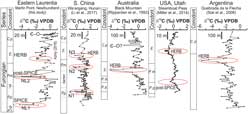
Global C-isotope chemostratigraphic correlations of the SPICE event (late Cambrian) documented in comprehensive sections from basins on different palaeocontinents (modified from Barnes, Reference Barnes1988; Miller et al. Reference Miller, Evans, Freeman, Ripperdan and Taylor2011; Li et al. Reference Li, Zhang, Chen, Zhang, Chen, Huang, Peng and Shen2017). These sections may span up to the Cambrian–Ordovician boundary. Abbreviations of conodont biozones: C.p. – Cordylodus proavus; E. – Eoconodontus; P.m. – Proconodontus muelleri; P.p. – Proconodontus posterocostatus; P.t. – Proconodontus tenuiserratus. The peaks of the C-isotope excursions are marked.
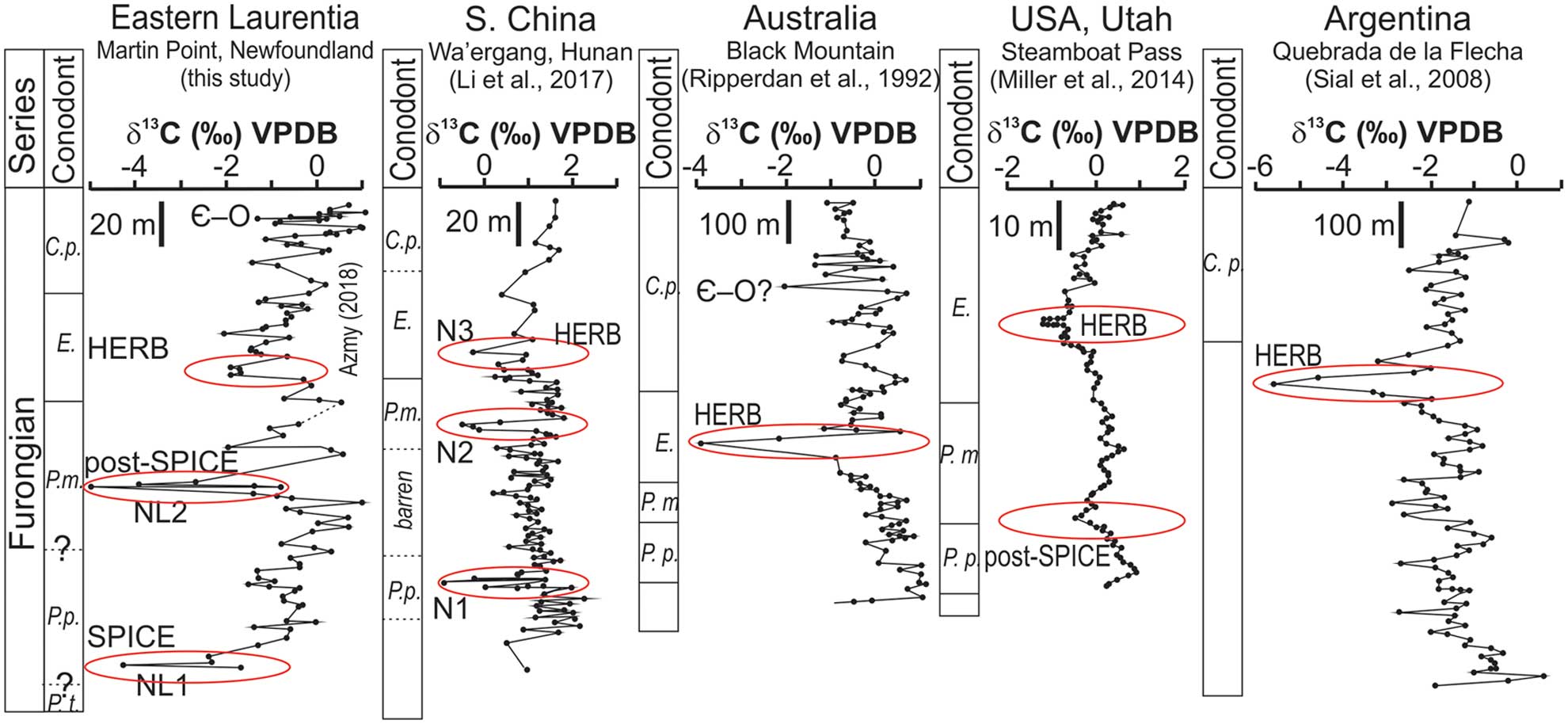
Based on the established global conodont biostratigraphic schemes of correlation for the Upper Cambrian (Barnes, Reference Barnes1988; Lazarenko et al. Reference Lazarenko, Gogin, Pegel and Abaimova2011; Miller et al. Reference Miller, Evans, Freeman, Ripperdan and Taylor2011; Peng et al. Reference Peng, Babcock, Cooper, Gradstein, Ogg, Schmitz and Ogg2012), the global δ13C profile of the Upper Cambrian (Li et al. Reference Li, Zhang, Chen, Zhang, Chen, Huang, Peng and Shen2017) generally shows a lowermost excursion called the SPICE event that correlates with the Proconodontus posterocostatus Zone, a distinct post-SPICE excursion that correlates with Proconodontus muelleri Zone, an upper excursion called HERB that correlates with the lower Eoconodontus notchpeakensis Zone and an uppermost excursion that correlates with the Є–O boundary (Fig. 5).
The global correlation of the HERB and Є–O boundary δ13C excursions of the Martin Point succession have been discussed in detail by Azmy et al. (Reference Azmy, Stouge, Brand, Bagnoli and Ripperdan2014, Reference Azmy, Kendall, Brand, Stouge and Gordon2015) and Azmy (Reference Azmy2018), where they were documented in the upper part of the section (Fig. 5), but the current investigation focuses on the global correlation of the SPICE and post-SPICE δ13C excursions from the lower part of the same section. The δ13C profile of the Martin Point section shows a distinct excursion of ∼6‰ (NL2) below the HERB event (Figs 2,5; Azmy, Reference Azmy2018) at a level possibly within the Proconodontus muelleri Zone, which is followed by a lower counterpart (NL1) of ∼4 ‰ (Figs 2,5). Unfortunately, no conodont biozonation scheme has yet been reported below the level of the P. muelleri – E. notchpeakensis boundary in the Martin Point section (Fig. 5). However, accepting that the P. muelleri and the underlying P. posterocostatus zones are implied by the global scheme to occur immediately below the E. notchpeakensis Zone, NL2 may be correlated with the P. muelleri Zone since it occurs directly below the HERB (TOCE) excursion, which is correlated with the base of the E. notchpeakensis Zone (Azmy, Reference Azmy2018; Fig. 5). Thus, NL2 could be correlated with the global post-SPICE event (Fig. 5; N2 excursion in S. China; Li et al. Reference Li, Jenkyns, Wang, Hu, Chen, Wei, Huang and Cui2006). NL1 is well below NL2 and may therefore be assigned to the P. posterocostatus Zone, but the exact position of NL1 within the P. posterocostatus Zone is not yet known since no detailed conodont biozonation has been documented below the upper boundary of the P. muelleri Zone in the Martin Point section. Further biostratigraphic studies will certainly refine the conodont biozonation scheme in the Martin Point section, and the currently proposed δ13C chemostratigraphic correlations have to therefore be taken with caution.
Similar successive and comparable negative excursions, with comparable or different magnitude, have been documented for equivalent sections of shallow-water settings in the USA (Steamboat Pass section of Utah; Miller et al. Reference Miller, Evans, Ethington, Freeman, Loch, Popov, Repetski, Ripperdan and Taylor2015), Argentina (Buggisch et al. Reference Buggisch, Keller and Lehnert2003; Sial et al. Reference Sial, Peralta, Gaucher, Alonso and Pimentel2008, Reference Sial, Peralta, Gaucher, Toselli, Ferreira, Frei, Parada, Pimentel and Pereira2013), S. China (Wa’ergang, Hunan; Li et al. Reference Li, Zhang, Chen, Zhang, Chen, Huang, Peng and Shen2017) and Australia (Black Mountain; Ripperdan et al. Reference Ripperdan, Magaritz, Nicoll and Shergold1992). The conodont biozonation scheme of the Upper Cambrian (Furongian) in Argentina starts with the Cordylodus proavus Zone at the end of the HERB event, but no record is known yet for the older interval (Miller et al. Reference Miller, Evans, Freeman, Ripperdan and Taylor2011). The lack of a conodont biozonation record below the Cordylodus proavus Zone (Fig. 5) in the Argentina section (cf. Sial et al. Reference Sial, Peralta, Gaucher, Alonso and Pimentel2008; Miller et al. Reference Miller, Evans, Freeman, Ripperdan and Taylor2011; Terfelt et al. Reference Terfelt, Eriksson and Schmitz2014) results in the correlation of its negative δ13C excursions being based mainly on the assumption of a lack of significant unconformity surfaces, the relative stratigraphic levels of the excursions (Fig. 5) and their occurrence together within a single trilobite zone (Saukia Zone) that spans a major interval of the Furongian up to the end of the Eoconodontus conodont Zone Landing et al. Reference Landing, Westrop, Miller, Fatka and Budil2010, Reference Landing, Westrop and Adrain2011; Miller et al. Reference Miller, Evans, Freeman, Ripperdan and Taylor2011). The amplitudes of the correlated δ13C excursions across the globe may vary, likely owing to differences in the local palaeo-oceanographic conditions such as depth and organic primary productivity.
The big advantage of the investigated Martin Point section is that it retains the primary full δ13C record that spans from the excursion of the lowermost SPICE event (current study) to the uppermost excursion of the Є–O boundary, which are not all recorded together in other individual equivalent sections.
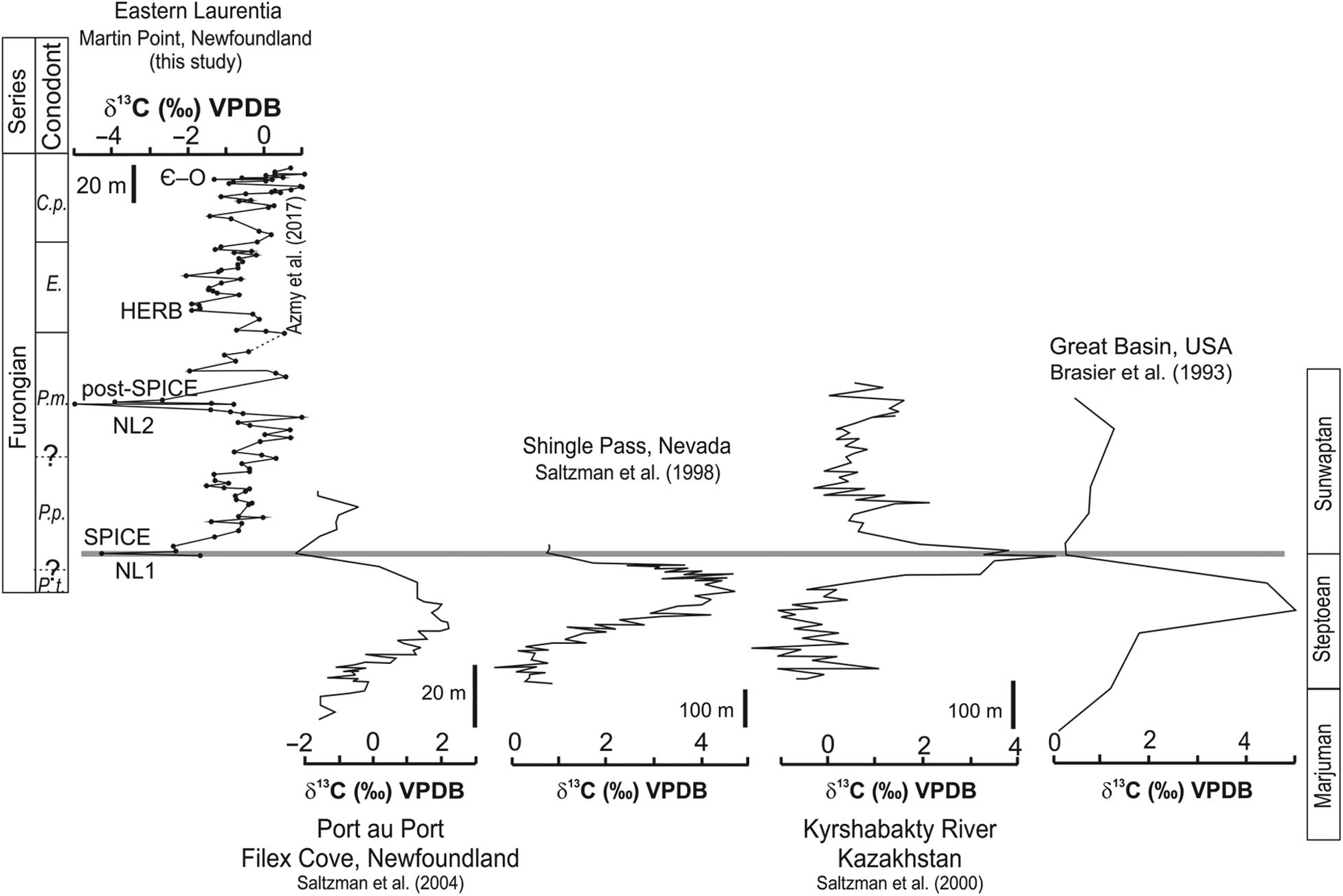
The SPICE event has been marked, in some earlier studies of carbonate sections from basins on different palaeocontinents, by an isolated individual positive δ13C shift (e.g. Brasier, Reference Brasier, Hailwood and Kidd1993; Saltzman et al. Reference Saltzman, Ripperdan, Brasier, Ergaliev, Lohmann, Robison, Chang, Peng and Runnegar2000, Reference Saltzman, Cowan, Runke, Runnegar, Stewart and Palmer2004; Glumac & Mutti, Reference Glumac and Mutti2007; Hurtgen et al. Reference Hurtgen, Pruss and Knoll2009; Fan et al. Reference Fan, Deng and Zhang2011; Gill et al. Reference Gill, Lyons, Young, Kump, Knoll and Saltzman2011; Schmid, Reference Schmid2011; Woods et al. Reference Woods, Wilby, Leng, Rushton and Williams2011; Dahl et al. Reference Dahl, Boyle, Canfield, Connelly, Gill, Lenton and Bizzaro2014) that was globally correlated based on changes in trilobite biozones (Fig. 6). However, the short time interval spanned by those sections, relative to that of the Martin Point section, and the lack of details of the immediately overlying younger δ13C variations make it hard to reconcile their profiles with that of the Martin Point section. The best fit, however, at this stage, for those positive excursions could be by placing their uppermost negative peaks (inflecting from the positive excursion) at the stratigraphic level of the peak of the negative excursion of the SPICE event on the Martin Point profile (Fig. 6). The suggested level generally matches the base of the Irvingella trilobite Zone (Saltzman et al. Reference Saltzman, Ripperdan, Brasier, Ergaliev, Lohmann, Robison, Chang, Peng and Runnegar2000), except for in very few locations such as Kazakhstan (Fig. 6; Saltzman et al. Reference Saltzman, Ripperdan, Brasier, Ergaliev, Lohmann, Robison, Chang, Peng and Runnegar2000; Fan et al. Reference Fan, Deng and Zhang2011).
Correlation of isolated positive SPICE δ13C excursions that were documented in some earlier studies from basins on different palaeocontinents. These sections did not span time intervals younger than that of the SPICE. The grey line marks the suggested possible fit relative to the C-isotope profile of the Martin Point section and also the base of the Irvingella trilobite Zone (cf. Fan et al. Reference Fan, Deng and Zhang2011). Abbreviations of conodont zones as in Figure 5.

The Martin Point section seems to be a complete and continuous interval, consisting of rhythmites with petrographically preserved lime mudstone interbeds (e.g. Azmy, Reference Azmy2018) that retain near-primary geochemical signatures, and has no documented sedimentary hiatuses (James & Stevens, Reference James and Stevens1986). It spans the entire interval of the Upper Cambrian until the Є–O boundary, and its C-isotope profile exhibits a complete set of the global δ13C excursions documented for that time interval from the SPICE event to the Є–O boundary, which suggests that the section can be a potential alternative reference for the entire Upper Cambrian on Laurentia.
7. Conclusions
(a) The petrographic and geochemical examinations support the preservation of very near-primary δ13C signatures in the investigated Upper Cambrian lime mudstone beds (rhythmites) of the continuous lower section at Martin Point in western Newfoundland. The δ13C profile shows two main negative excursions, a lower excursion (∼4 ‰) that can be correlated with the global SPICE event (Proconodontus posterocostatus Zone) and an upper post-SPICE one (∼6 ‰) that can be correlated with the Proconodontus muelleri conodont Zone. However, the muelleri and the underlying posterocostatus zones, or possibly their equivalents, have not yet been documented in the Martin Point section, and the chemostratigraphic correlation has to therefore be taken with caution.
(b) The SPICE and post-SPICE negative δ13C excursions provide a potential tool for the global correlation of the Upper Cambrian in eastern Laurentia with equivalent sections on the same palaeocontinent and beyond.
(c) The lack of sedimentary hiatuses and retention of a primary δ13C profile, with distinct excursions recording the global events from the early Late Cambrian to the Є–O boundary, make the succession at Martin Point a potential complete Upper Cambrian reference section on Laurentia.
Acknowledgements
The author wishes to thank two anonymous reviewers for their constructive reviews. Also, the efforts of Chad Deering (editor) are much appreciated. Special thanks to Dr. Svend Stouge for his help with the fieldwork. This project was supported by funding (to Karem Azmy) from the Petroleum Exploration Enhancement Program (PEEP), NL, Canada.
Appendix
Elemental and isotopic geochemical compositions of the lower section of the Martin Point carbonates