Paul Pierson’s work on the politics of welfare state reform in the era of retrenchment, beginning with his 1994 book and stretching through his 2001 edited volume, fundamentally reoriented the field of comparative social policy of post-industrial democracies. The following quote from his 1996 World Politics article well summarizes some of the main arguments of these works (Pierson Reference Pierson1996, 156):
(1) There is little evidence for broad propositions about the centrality of strong states or left power resources to retrenchment outcomes. (2) The unpopularity of retrenchment makes major cutbacks unlikely except under conditions of budgetary crisis, and radical restructuring is unlikely even then. (3) For the same reason, governments generally seek to negotiate consensus packages rather than to impose reforms unilaterally, which further diminishes the potential for radical reform. And (4) far from creating a self-reinforcing dynamic, cutbacks tend to replenish support for the welfare state.
I argue that these four arguments have withstood the test of time.
THE DECLINE OF THE IMPACT OF PARTISANSHIP
Pierson’s first proposition concerns the decline of the impact of partisan government on welfare state reform in the era of retrenchment. Evelyne Huber and I are among the strongest proponents of the importance of partisan government for welfare state outcomes in the era of welfare state expansion (Huber, Ragin, and Stephens Reference Huber, Ragin and Stephens1993; Huber and Stephens Reference Huber and Stephens2001, Chapters 3 and 5; Stephens Reference Stephens1979), but we concur that, as countries enter the era of retrenchment, the role of partisanship in shaping welfare state outcomes declines (Huber and Stephens Reference Huber and Stephens2001, Chapters 6 and 7; Stephens, Huber, and Ray Reference Stephens, Huber, Ray, Kitschelt, Lange, Marks and Stephens1999). Our explanation for the change is much the same as Pierson’s. The cornerstone of Pierson’s work on retrenchment is that once policies have been instituted, the welfare state is popular and that support for the welfare state is much greater than the coalitions assembled to pass the policies. This is above all true of the universalistic policies such as education, pensions, sickness pay, and health care, which cover nearly all of the population. Precisely because these policies cover such a large portion of the population, they are expensive, and most of social spending in all countries goes to these policies. Social assistance, cash payments to the nonworking poor (“welfare” in the American parlance), is not popular in any country, but because it benefits few people and the payments are generally meager, governments cannot save much money by cutting them. The popularity of universalistic policies is what restrains right parties, who historically opposed the passage of many of these programs, from cutting them.
Left parties, in contrast, are restrained from exploiting this popularity and expanding programs by the fact that post-industrial societies are in an era of “permanent austerity” in Pierson’s (Reference Pierson2001) words. Permanent austerity perhaps overstates the case, but it does catch the fact that the post-war “thirty glorious years” of rapid economic growth and welfare state expansion ended in the mid 1970s, which means that fiscal resources have become much harder to come by. Per capita income growth in 21 post-industrial democracies fell from 4.4% per annum in 1960–73 to 2.3% in 1983–1999 (Brady, Huber, and Stephens Reference Brady, Huber and Stephens2014 from Penn World Tables data). Moreover, the welfare state had “grown to limits” in the most advanced welfare states, as total taxation reached half of GDP and coverage and benefit levels assured comprehensive social protection for the male industrial worker, the target of most social welfare legislation in the initial three post-war decades.
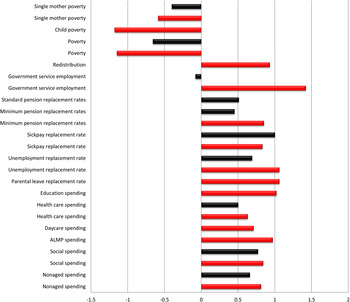
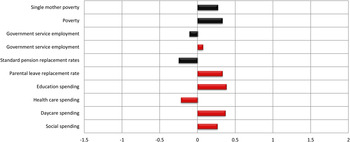
Recently, Evelyne Huber and I have carried out a comprehensive assessment of change in partisan impact on social policy in the eras of welfare state expansion and retrenchment (Huber and Stephens Reference Huber and Stephens2014). Examining Scruggs’ (Reference Scruggs2013) data on replacement rates in three transfer programs—pensions, sickness pay, and unemployment compensation—we date the transition from expansion to retrenchment as 1985, because replacement rates increased until the mid 1980s and stagnated after that time. In this study, we regressed measures of social spending, social rights, government employment, poverty, and redistribution on measures of left and Christian democratic cabinet share separated by period and six control variables. Footnote 1 To develop measures that were comparable across independent variables, we calculated the effect of a two standard deviation change in the partisanship variables on the dependent variables. These figures varied greatly because of the variations in standard deviations of the dependent variable (e.g., less than 0.6 for daycare and active labor market policy spending to over 20 for parental leave, sick pay, and unemployment replacement rates), so we divided the two standard deviation change figures by the values of the standard deviation of the dependent variables yielding the figures shown in bar graphs in figures 1 and 2. We display only significant values of the partisanship variable. A value of one means that a two standard deviation change in the partisanship variable is associated with a one standard deviation change in the dependent variable, a very large effect. Similarly, values between 0.5 and 1 are large effects, between 0.25 and 0.5 modest effects, and below 0.25 small effects.
Effects of Left Cabinet (grey bars) and Christian Democratic Cabinet (black bars) in the Pre-1986 Period

Effects of Left Cabinet (grey bars) and Christian Democratic Cabinet (black bars) in the Post-1985 Period

As figure 1 shows, partisan cabinet effects were pervasive before 1986 and many of them were large or very large. The patterning across the two party families meets theoretical expectations. Left government is associated with almost every measure of welfare state effort and distributive outcome. By contrast, Christian democratic government is only related to social rights measures tapping protection of male production workers (replacement rates in pensions, sick pay, and unemployment insurance) and the spending variables, which cover transfers in these three programs and child allowances. Footnote 2 Christian democratic government is associated with two of the poverty variables, but not with redistribution. By contrast, left government is also associated with policy and spending variables associated with addressing new social risks and social investment (active labor market policy, daycare, education, government service employment) and both poverty and redistribution.
Comparing figure 1 and figure 2, the decline in partisan effects is immediately apparent. There are fewer significant effects; the ones that remain are smaller, and many represent retrenching moves, less generous policy, or increased poverty. Strikingly, there are no positive coefficients for policies representing the old welfare state, protection of the male production worker. Christian democratic government is perverse, associated with less generous social policy and more poverty. The positive values for left government are all for variables representing protection against new social risks and social investment. In sum, our analysis strongly supports Pierson’s argument of two decades ago that partisan government is much less important for the welfare state outcomes in the era of retrenchment.
Christian democratic government is perverse, associated with less generous social policy and more poverty.
THE RARITY OF MAJOR CUTBACKS
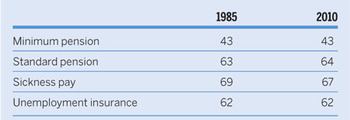
Pierson’s second major point (“the unpopularity of retrenchment makes major cutbacks unlikely”) is also supported by subsequent developments and subsequent data collection efforts, particularly Lyle Scruggs’s (Reference Scruggs2013) Comparative Welfare Entitlements Database. Table 1 shows the average replacement rate in three major transfer programs for 21 countries from that dataset. The stability of the average replacement rates since 1985 is remarkable. Thus, it might be said that the post-1985 period is not so much the era of retrenchment but rather marks the end of the period of rapid welfare state expansion. Even here we have to nuance the picture. The Nordic countries continued to expand work and family reconciliation and social investment policies, and more recently the United Kingdom (UK), the Netherlands, and Germany “shifted paths” to adopt significant expansions of parental leave and daycare (Morgan Reference Morgan2013).
Replacement rates for standard production worker (21 countries)

Source: Scruggs (Reference Scruggs2013)
This does not mean that no countries made dramatic cutbacks in social provision; the UK did under Thatcher and Major, and to a lesser extent, New Zealand did under the Fourth National Government (1990–99). The cuts in replacement rates in unemployment and sick pay replacement rates in the UK were particularly steep, from more than 60% in 1978 to less than 30% in 1995. One reason Pierson missed this dramatic change is that there were no social rights data in the public domain when he did his study, so tracing changes in replacement rates involved painstaking primary research. Social spending data for the UK did not show such dramatic cuts, primarily because of the increase in recipients, especially pensioners.
While developments in the UK do not conform to Pierson’s analysis of that case, they do support the logic of his argument. The UK political system has no veto points. The House of Commons is sovereign; it is not bound by any precedent and no other body can overrule it, and as part of a unitary system, no lower level of government limits its power. The electoral system, single member districts and plurality elections, allows a minority of voters to elect a large seat majority in the Commons. Thus, Thatcher and Major enjoyed large seat majorities on the basis of a minority of voters, always less than 44%. Many of Thatcher’s policies, especially the cuts to the education system and National Health Service, were very unpopular. These cuts were only possible because the political system endowed the sitting government with huge powers despite that it did not have the support of the median voter. Although Blair is seen as a moderate within the European social democratic camp, the Labour Party actually presided over the largest increases in social spending in British history, largely reversing the cuts in education and health spending of preceding Conservative governments, which is consistent with the logic of Pierson’s argument. The only other political system with a similar design is New Zealand prior to the introduction of proportional representation in 1996. There, the National Government of the early 1990s enacted similarly large cuts in social spending. New Zealand voters blamed the political system precisely because it endowed a government with the support of a minority of voters such large powers. They demanded, and received, the introduction of proportional representation so that such a situation could not arise again.
As the flaws in the existing system became increasingly apparent to the major parties and the labor market partners, oversized coalitions were assembled to spread the blame around to pass the painful reforms.
CONSENSUS BUILIDING FOR RETRENCHING REFORMS
Pierson might have added to his third point (“governments generally seek to negotiate consensus packages rather than to impose reforms unilaterally, which further diminishes the potential for radical reform”) that this is also a reason why partisan government is less important now than it was in the era of expansion. “Blame avoidance,” to use Weaver’s (Reference Weaver1986) terminology, is most clear in the reform of comprehensive earnings related defined benefit pay-as-you-go pension systems, where governments in countries as diverse as Sweden, Germany, and Italy have passed pension reforms either with the support of oversized majority coalitions of parties, or the support of the labor market partners, or both. As Pierson and Myles (Reference Myles, Pierson and Pierson2001) point out, these systems, which finance generous pensions through generational transfers, became unviable by the 1990s because of the decline in wage growth and fertility. Thus, as compared to the 1960s, fewer wage earners, with lower wages relative to retirees when they were working, were supporting more retirees. It was necessary to raise the retirement age, cut benefit levels, raise contribution levels, or gradually introduce a funded tier (and thus new contributions to pay for the funded tier) or a combination of these measures, all painful and unpopular. As the flaws in the existing system became increasingly apparent to the major parties and the labor market partners, oversized coalitions were assembled to spread the blame around to pass the painful reforms.
POLICY LEGACY BUT NOT PATH DEPENDENCE
Pierson’s fourth point (“far from creating a self-reinforcing dynamic, cutbacks tend to replenish support for the welfare state”) is readily apparent from the developments in New Zealand and the United Kingdom, which I just recounted. In both countries, cuts in the welfare state created angry reactions among citizens, who demanded restoration of benefits and spending on social services. Likewise, the cuts that were introduced in Sweden in reaction to the banking collapse and unemployment spike in the early and mid-1990s were restored in the late 1990s (Huber and Stephens Reference Huber and Stephens2001, 250).
CONCLUDING REMARKS
Paul Pierson’s arguments about the politics of retrenchment of two decades ago have proven remarkably durable. The central insight that strong public support for the welfare state makes it an “immovable object,” which however, is confronted with an “irresistible force” in demographic and economic change, is as true now as it was 20 years ago (Pierson Reference Pierson1998).