INTRODUCTION
Prospective memory (PM) is the act of remembering to perform an intended action in the future. Examples of PM tasks include giving a school permission slip to a parent to sign, or passing a note to a friend the next time he/she is seen (Herrmann, Brubaker, Yoder, Sheets, & Tio, Reference Herrmann, Brubaker, Yoder, Sheets, Tio and Durso1999). These examples illustrate types of event-based PM (EB-PM) tasks in which one remembers to perform an intended action in response to a certain target event (Einstein & McDaniel, Reference Einstein and McDaniel1990, Reference Einstein, McDaniel, Brandimonte, Einstein and McDaniel1996). PM may be considered an essential ability to effectively handle the challenges of daily life (Harris, Reference Harris, Gruneberg, Morris and Sykes1984; Meacham & Dumitru, Reference Meacham and Dumitru1976; Meacham & Leiman, Reference Meacham, Leiman and Neisser1982; Wilkins & Baddeley, Reference Wilkins, Baddeley, Gruneberg, Morris and Sykes1978; Winograd, Reference Winograd, Gruneberg, Morris and Sykes1988). In studies of PM lapses in patients with mixed etiologies of brain injury, it has been demonstrated that the ability to effectively compensate for PM impairments after injury was a significant predictor of independent living (Fortin, Godbout, & Braun, Reference Fortin, Godbout and Braun2002, Reference Fortin, Godbout and Braun2003; Thöne-Otto & Walther, Reference Thöne-Otto and Walther2003; Wilson, Reference Wilson1987). Recent work by Woods and colleagues (Woods, et al., Reference Woods, Iudicello, Moran, Carey, Dawson and Grant2008a, Reference Woods, Moran, Carey, Dawson, Iudicello and Gibson2008b) has found that impaired PM in patients with HIV/AIDS was associated with poor medication regimen adherence and poorer independence for activities of daily living. In an interview study (Ward, Shum, Dick, McKinlay, & Baker-Tweney, Reference Ward, Shum, Dick, McKinlay and Baker-Tweney2004), parents of children with TBI had serious concerns for their child’s safety and ability to be left unsupervised due to the degree of their PM impairments. Given the negative impact of PM impairments on independent living in persons with acquired brain injury and the ubiquity with which PM tasks are encountered in daily life, the practical importance of investigating PM remediation strategies is clear.
Although a number of studies have investigated the effects of traumatic brain injury (TBI) on PM in adults (Cockburn, Reference Cockburn1995; Fortin et al., Reference Fortin, Godbout and Braun2002; Groot, Wilson, Evans, & Watson, Reference Groot, Wilson, Evans and Watson2002; Hannon, Adams, Harrington, Fries-Dias, & Gipson, Reference Hannon, Adams, Harrington, Fries-Dias and Gipson1995; Henry et al., Reference Henry, Phillips, Crawford, Kliegel, Theodorou and Summers2007; Kinsella et al., Reference Kinsella, Murtagh, Landry, Homfray, Hammond and O’Beirne1996; Kliegel, Eschen, & Thöne-Otto, Reference Kliegel, Eschen and Thöne-Otto2004; Knight, Harnett, & Titov, Reference Knight, Harnett and Titov2005; Knight, Titov, & Crawford, Reference Knight, Titov and Crawford2006; Louda, Loseva, & Mielke, Reference Louda, Loseva and Mielke2007; Mathias & Mansfield, Reference Mathias and Mansfield2005; Roche, Fleming, & Shum, Reference Roche, Fleming and Shum2002; Roche, Moody, Szabo, Fleming, & Shum, Reference Roche, Moody, Szabo, Fleming and Shum2007; Shum, Valentine, & Cutmore, Reference Shum, Valentine and Cutmore1999), few have been conducted involving children with TBI (McCauley & Levin, Reference McCauley and Levin2004; McCauley, McDaniel, Pedroza, Chapman, & Levin, Reference McCauley, McDaniel, Pedroza, Chapman and Levin2009; Ward, Shum, McKinlay, Baker, & Wallace, Reference Ward, Shum, McKinlay, Baker and Wallace2007). These experiments, using laboratory EB-PM tasks, revealed that children and adolescents with TBI demonstrated impaired PM functioning relative to orthopedically-injured controls (McCauley & Levin, Reference McCauley and Levin2004) and typically developing children (Ward, et al., Reference Ward, Shum, McKinlay, Baker and Wallace2007).
To our knowledge, the first and one of the few studies of PM rehabilitation (Furst, Reference Furst1986) investigated the effect of an incentive in adults with acquired brain injury participating in a postacute rehabilitation program in which points were awarded for accurate performance and later traded for prizes in a six-week “Memory Derby.” Differential effects of this extrinsic incentive could not be evaluated because the same incentive schedule was used for all participants. To date, only one study of PM rehabilitation in children has been conducted using motivational enhancements (McCauley et al., Reference McCauley, McDaniel, Pedroza, Chapman and Levin2009). This retrospective study found that the use of monetary incentives improved EB-PM performance in children 1–15 years following mild or severe TBI. Therefore, the main objective of the present study was to continue the examination of EB-PM in children and adolescents with TBI in a prospective cohort evaluated more acutely postinjury, but using the same methodology as that of McCauley and colleagues (Reference McCauley, McDaniel, Pedroza, Chapman and Levin2009).
In this study, we varied motivation using two levels of monetary incentive; participants were able to exchange points for units of money (1:1 ratio) for accurate PM performance. We hypothesized that, based on our previous work, children with TBI would demonstrate significantly improved EB-PM performance under high versus low motivation conditions in the subacute recovery period following moderate to severe TBI.
METHOD
Participants
Informed consent was obtained from the parent/guardian through a procedure and consent form approved by the Institutional Review Boards of Baylor College of Medicine, the University of Texas at Dallas, the University of Texas Southwestern Medical Center, and the University of Miami School of Medicine. Child assent was obtained in accordance with federal regulations (45 CFR 46.404). Participants were prospectively recruited from consecutive admissions to level-1 trauma centers in Houston, Dallas, and Miami as part of a longitudinal study of neurobehavioral outcome following TBI.
TBI severity was determined through the lowest postresuscitation Glasgow Coma Scale (GCS) score (Teasdale & Jennett, Reference Teasdale and Jennett1974) in the first 24 hours postinjury. This sample included children and adolescents ranging in age from 7 to 16 years: 30 children with severe TBI (postresuscitation GCS ≤ 8), 28 children with moderate TBI [either postresuscitation GCS of 13–15 with trauma-related abnormalities on computed tomography (CT) scan of the head at hospital admission (Williams, Levin, & Eisenberg, Reference Williams, Levin and Eisenberg1990) or GCS of 9–12 irrespective of CT results], and 61 children who sustained orthopedic injuries (OI) not involving the head (e.g., broken bones, fractures, etc.) requiring emergency room treatment. The OI participants had mild to moderate injuries as defined by the Abbreviated Injury Scale (Committee on Injury Scaling, 1990). Children with OI were specifically included in this study to control for risk factors predisposing children to traumatic injury and to equate for nonspecific factors associated with trauma and hospitalization. All participants were fluent in English, full-term births (i.e., ≥ 37 weeks of gestation and > 2500 g), had no preexisting major neuropsychiatric disorder (e.g., schizophrenia, bipolar disorder), and no previous hospitalization for head injury. As part of the design of the larger study, children were assessed at baseline, which was defined as the earliest postinjury date when the child had emerged from posttraumatic amnesia (PTA; for children with TBI), was considered medically stable (e.g., procedures had been completed involving surgery, casting, splinting, particularly for the OI group), and could cooperate adequately enough to undergo a neuropsychological evaluation.
Measures
Socioeconomic Composite Index
The Socioeconomic Composite Index (SCI; Yeates, et al., Reference Yeates, Taylor, Drotar, Wade, Klein, Stancin and Schatschneider1997) provides a measure of a family’s socioeconomic status (SES) by computing z-scores based on the combined distributions of the OI and TBI groups for three variables: (a) an 8-point scale coding family income, (b) a 7-point scale of parent/guardian education, and (c) occupational prestige rating using the Total Socioeconomic Index (TSEI; Hauser & Warren, Reference Hauser, Warren and Raftery1997). The z-scores for these variables were then summed and standardized (mean = 0, SD = 1) based on the aggregate sample of participants (OI and TBI) forming the SCI score. For parents/guardians who were not working outside of the home (and thus having no assignable TSEI rating), the mean TSEI of the total sample was imputed. The SCI has been shown to moderate the effects of severe TBI on long-term outcomes (Yeates et al., Reference Yeates, Taylor, Drotar, Wade, Klein, Stancin and Schatschneider1997).
Event-Based Prospective Memory Task
The following are the scripts used in the administration of the “naturalistic” EB-PM task. To maximize the ecological validity of the experiment, we attempted to make the EB-PM task as naturalistic as possible within the limits of the laboratory setting. Using a casual phrase that would not seem out of place during a battery of neuropsychological tests seemed to be a reasonable compromise between the ecological validity of a truly naturalistic task and the laboratory control of an experimental or “artificial” task (Kvavilashvili, Reference Kvavilashvili1992). The child was asked to repeat the task instructions to ensure adequate comprehension of the gist of the task. Instructions were repeated as necessary until it was clear that the child understood the task.
High motivation condition. Participants were given the following verbatim instructions: “We will be doing several different types of tests this morning. I want you to listen carefully and every time I say ‘Let’s try something different,’ I would like you to say ‘Please give me three points.’ At the end of testing today, you’ll be able to trade those points in for dollar bills. The more points you get, the more dollar bills you’ll get. Okay, now tell me what it is that I would like you to do.”
Low motivation condition. Participants were given the following verbatim instructions: “We will be doing some more tests. I want you to listen carefully and every time I say ‘Let’s try something different,’ I would like you to say ‘Please give me three points.’ At the end of testing today, you’ll be able to trade those points in for pennies. The more points you get, the more pennies you’ll get. Okay, now tell me what it is that I would like you to do.”
Design and Procedure
The study used a crossover design with two motivation conditions and two periods (first vs. second hour of testing with no wash-out interval) as detailed in McCauley et al. (Reference McCauley, McDaniel, Pedroza, Chapman and Levin2009). Briefly, the extrinsic motivation conditions involved the monetary units of either dollars (high) or pennies (low). A randomization table was used to vary motivation condition order across participants. The instructions for each motivation condition were administered at the beginning of the first and second hours of testing. While performing other tasks during the neuropsychological battery (a standard battery order for all participants was used to control for ongoing task difficulty), the child was asked to respond “Please give me three points” each time the examiner said “Let’s try something different.” This EB-PM cue was presented every 15–20 minutes, with three PM cue presentations in each of the motivation conditions; each motivation block required one hour. Children were allowed five seconds to make their PM response; however, no child in any group made PM responses (correct or incorrect) after the five seconds had elapsed. The scoring algorithm for the EB-PM task was: 2 points for realizing the delayed intention (PM component) and 2 additional points for recalling the correct phrase (retrospective memory component or RM). Thus, correct responses were awarded 4 points, and responses with incorrect RM content (e.g., “Please give me five points” or “Please give me some points”) were awarded 2 points. A maximum of 12 points was available in each condition. No performance feedback was given until after both conditions had been completed. Cash payments were made at the end of the testing session, well after completing the EB-PM task.
Data Analysis
Statistical significance was defined as α = .05 for all analyses unless otherwise specified. Planned comparisons were analyzed holding significance at α = .05, and all post-hoc comparisons were adjusted using the Bonferroni correction for multiple comparisons. All analyses were conducted with SAS software for Windows, Version 9.2. Categorical variables were analyzed with the chi-square test and Fisher’s exact test was used instead of chi-square when proportions were markedly unbalanced (percentages more extreme than 80/20). The data were analyzed as a crossover design using a mixed model. Sequence (motivation condition order) and Period (time factor for repeated measures) effects were included in the model. Sequence was nested within subject and the subject variable was treated as a random effect to account for correlation between multiple measures within the same subject. Other model effects of interest included: Age-at-Test, Gender, SCI, Race/Ethnicity, Group, Time Postinjury, Motivation Condition, and 2-way interactions between Group and Sequence, Period, Time Postinjury, and Motivation Condition.
RESULTS
Sample Characteristics
The groups did not differ significantly by SCI, gender, or handedness (Table 1). The groups differed significantly by racial/ethnic composition due to the higher percentage of African Americans in the OI group. The groups also differed by Age-at-Test as the severe TBI group was significantly older than the OI group (p < .05), but not the moderate TBI group; the moderate TBI group was not significantly older than the OI group. The groups differed significantly by mechanism of injury, as the OI group sustained more relatively low-velocity injuries (e.g., sports/play) compared to the greater proportion of high-velocity injuries sustained by both TBI groups [e.g., motor vehicle accident (MVA), auto-pedestrian; Fisher’s exact test, p < .0001]; however, the moderate and severe TBI groups were comparable for mechanism of injury (Fisher’s exact test, p = .12). As would be expected, the groups differed by time postinjury, such that the severe TBI group was assessed later than the OI group, but no other between-group comparisons were significant at the .05 level.
Demographic and injury variables of the sample

Note
OI = orthopedic injuries, TBI = traumatic brain injury, SCI = Socioeconomic Composite Index, GCS = Glasgow Coma Scale score, MVA = motor vehicle accident, MCA = motorcycle accident, RV = recreational or other off-road vehicle, * Fisher’s exact test.
Prospective Memory Performance
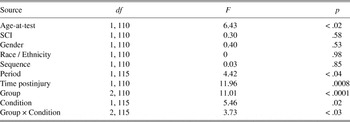
The test for a carryover effect (Motivation Condition × Period) was not significant (F = 0). There were no significant effects of gender, race/ethnicity, or SCI (all F < 1). The Group × Sequence, Group × Period, and Group × Time Postinjury interactions were not significant (F < 1) and were subsequently removed from the model. The model was then reestimated retaining the Group × Motivation Condition interaction, which was significant (p < .03; Table 2). Examination of the interaction revealed that both the OI and moderate TBI groups demonstrated significantly better EB-PM performance in response to the high motivation incentive (Cohen’s d effect sizes of .59 and .44, respectively, indicating moderate effects of motivation condition), but that the severe TBI group failed to demonstrate significant improvement (Cohen’s d = –.12; see Figure 1). Regarding main effects, adolescents performed better compared to younger children and participants performed better in the second period (i.e., the second hour of testing) compared to the first, irrespective of motivation condition. EB-PM performance was better in the high compared to the low motivation condition (for the OI and moderate TBI groups only) and also improved with increasing time postinjury.
Event-based prospective memory (EB-PM) least-squares mean scores by Group and Motivation Condition are shown here to illustrate the significant improvement within the OI and moderate TBI groups under the High- versus Low-Motivation conditions. Error bars represent standard errors.

Type III tests of fixed effects for the event-based prospective memory scores

Note
SCI = Socioeconomic Composite Index.
While holding the level of significance at the Bonferroni-corrected level of α < .0083 for multiple comparisons, post-hoc analyses revealed a positive trend (p = .08) for better performance in the OI group compared to moderate TBI group in the high motivation condition. The OI, t(115) = 5.31, p < .0001, and moderate TBI, t(115) = 3.10, p < .003, groups both outperformed the severe TBI group in the high motivation condition. Post-hoc analyses in the low motivation condition again revealed a trend (p = .06) for better performance in the OI group compared to moderate TBI group. While the OI group outperformed the severe TBI group, t(115) = 3.01, p = .003, the performance of the moderate and severe TBI groups did not differ significantly (p = .33).
DISCUSSION
In the present study, we investigated the effect of a monetary incentive (i.e., an extrinsic motivator) on EB-PM performance in children and adolescents with moderate to severe TBI. In contrast to the findings of McCauley et al. (Reference McCauley, McDaniel, Pedroza, Chapman and Levin2009) and our primary hypothesis, children with severe TBI responded to EB-PM cues less robustly in the high motivation condition than children with OI and moderate TBI. Thus, our main hypothesis was only partially supported, in that higher incentives improved EB-PM in children with OI and moderate TBI. This result suggests that children with severe TBI were not able to improve their PM performance in the subacute phase following brain injury, whereas children with severe TBI who were an average of 4.3 years postinjury were able to benefit from the high monetary incentive level (McCauley et al., Reference McCauley, McDaniel, Pedroza, Chapman and Levin2009). The results of our previous study have been extended by the finding of significantly improved EB-PM performance in children with moderate TBI in the subacute phase; this is the first time that the PM performance of children with moderate TBI have been specifically investigated. What remains to be determined with the moderate TBI group is if the effect was due to the initiation and recruitment of compensatory PM strategies or to general effects of arousal in response to reward. As a corollary to this, it remains an open question as to whether or not the failure of the children with severe TBI to improve performance in the face of incentive was directly due to the lack of compensatory PM strategies, a failure to appreciate the differential nature of the rewards, or a substantial failure of arousal to the reward (as has been found in adults with severe TBI; Larson, Kelly, Stigge-Kaufman, Schmalfuss, & Perlstein, Reference Larson, Kelly, Stigge-Kaufman, Schmalfuss and Perlstein2007). These issues remain to be addressed by future investigations. Although children with moderate TBI demonstrated substantial improvement under the high motivation condition, their performance demonstrated a trend for falling below that of the OI group’s high motivation condition performance.
These results are informative, as they are the first to examine the efficacy of a monetary incentive on EB-PM performance in a prospective cohort of children with TBI. Furthermore, these results also support the idea that motivation is an important factor to consider in PM research of not only children with TBI, but also children with OI or typically-developing children (Baddeley, Reference Baddeley1990; Best, Reference Best, Herrmann, Searleman, Searleman and McEvoy1992; Einstein & McDaniel, Reference Einstein, McDaniel, Brandimonte, Einstein and McDaniel1996; Gentry & Herrmann, Reference Gentry and Herrmann1990; Winograd, Reference Winograd, Gruneberg, Morris and Sykes1988), given the improved EB-PM response in the face of a high-value incentive in the OI group in this study. An important point for clinicians working with children and adolescents in TBI rehabilitation settings is that, unlike the significant response to incentive demonstrated several years postinjury, children with severe TBI in the subacute recovery phase may not benefit substantially from some forms of motivation enhancement. Future studies will be needed to determine if other classes of extrinsic or intrinsic motivators could significantly improve EB-PM following severe TBI in these children.
Consistent with findings in PM studies of normal adults (Einstein & McDaniel, Reference Einstein and McDaniel1990; Kidder, Park, Hertzog, & Morrell, Reference Kidder, Park, Hertzog and Morrell1997; Maujean, Shum, & McQueen, Reference Maujean, Shum and McQueen2003) or typically-developing children (Kerns, Reference Kerns2000; Kerns & Price, Reference Kerns and Price2001) and a retrospective study of children with TBI (McCauley et al., Reference McCauley, McDaniel, Pedroza, Chapman and Levin2009), no gender effect was found. Although SES is known to moderate outcomes of children with TBI (Taylor, Reference Taylor2004; Taylor et al., Reference Taylor, Yeates, Wade, Drotar, Klein and Stancin1999, Reference Taylor, Yeates, Wade, Drotar, Stancin and Minich2002; Yeates et al., Reference Yeates, Taylor, Drotar, Wade, Klein, Stancin and Schatschneider1997), no significant effect of SES on EB-PM performance was found. This is similar to findings in a retrospective cohort study by McCauley and colleagues (Reference McCauley, McDaniel, Pedroza, Chapman and Levin2009).
There are some limitations in this study that should be addressed. Due to the design of the larger study, an assessment of retrospective memory (RM) was not performed, which could have determined the degree to which poor RM abilities might have accounted for impaired EB-PM performance. However, studies have found that PM and RM are not strongly related in adults and healthy elderly (Brandimonte & Passolunghi, Reference Brandimonte and Passolunghi1994; Driscoll, McDaniel, & Guynn, Reference Driscoll, McDaniel and Guynn2005; Einstein & McDaniel, Reference Einstein and McDaniel1990; Huppert & Beardsall, Reference Huppert and Beardsall1993; Kidder et al., Reference Kidder, Park, Hertzog and Morrell1997; Kvavilashvili, Reference Kvavilashvili1987; Maylor, Reference Maylor1990; McDaniel & Einstein, Reference McDaniel and Einstein1993; Salthouse, Berish, & Siedlech, Reference Salthouse, Berish and Siedlech2004), typically-developing children (Kvavilashvili, Messer, & Ebdon, Reference Kvavilashvili, Messer and Ebdon2001), or children with sickle cell disease (McCauley & Pedroza, in press). These two categories of memory appear to be closely related quite early in development and tend to dissociate quickly (Guajardo & Best, Reference Guajardo and Best2000; Ruther & Best, Reference Ruther and Best1993). Findings in adults with TBI have produced contradictory findings on the relation between PM and RM (Groot et al., Reference Groot, Wilson, Evans and Watson2002; Henry et al., Reference Henry, Phillips, Crawford, Kliegel, Theodorou and Summers2007; Mathias & Mansfield, Reference Mathias and Mansfield2005). Generalizing these contradictory results in adults with TBI to children with TBI is imprudent; it remains an open question as to what degree PM functioning in children with TBI is dependent on RM and medial temporal lobe integrity. The inclusion of formal assessment of RM abilities and advanced neuroimaging in children with TBI is advised to more definitively elucidate the direct effects of TBI on EB-PM.
ACKNOWLEDGMENTS
This work was presented (in part) at the 7th Annual Meeting of the North American Brain Injury Society, Austin, Texas, October 2009 and was supported by the National Center for Medical Rehabilitation Research grant K23 HD-40896 (“Prospective memory in normal and head-injured children,” awarded to Stephen R. McCauley) and the National Institute of Neurological Disorders and Stroke grant NS-21889 (“Neurobehavioral outcome of head injury in children,” awarded to Harvey S. Levin). The information in this manuscript and the manuscript itself have never been published either electronically or in print. None of the authors have any financial or other relationship(s) that could be construed as a conflict of interest with respect to the content of this manuscript. The content is solely the responsibility of the authors and does not necessarily represent the official views of the National Center for Medical Rehabilitation Research or the National Institutes of Health.
We sincerely thank the participants and their families for their interest and willingness to take part in this research. I would like to extend my personal appreciation to Drs. Mark McDaniel and Harvey Levin who graciously served as mentors on my K-23 mentored patient-oriented research career development award.