Introduction
The loss of a child is a devastating event, and bereaved parents are known to suffer intense and long-lasting grief reactions and to be at risk for psychological symptoms (Rando, Reference Rando1983; Hendrickson, Reference Hendrickson2009; Rosenberg et al., Reference Rosenberg, Baker and Syrjala2012). Grief is the emotional response to loss and may include changes to mental and physical health, social relationships, and spirituality. Most people suffer after a loss, but can eventually find ways to integrate it into their lives. Bereaved parents have to deal with the rupture of the natural course of family life expectations (Bogensperger and Lueger-Schuster, Reference Bogensperger and Lueger-Schuster2014) and this, combined with the strong attachment bond to the child, means that they often struggle to “make meaning” out of the loss (Lichtenthal and Breitbart, Reference Lichtenthal and Breitbart2015). Many bereaved parents face a crisis of meaning (Neimeyer, Reference Neimeyer2019) — and adapting to the loss of a child takes time. Evidence shows that cancer-bereaved parents are vulnerable to prolonged grief and psychological symptoms up to 6 years after the death of their child (Lannen et al., Reference Lannen, Wolfe and Prigerson2008; Pohlkamp et al., Reference Pohlkamp, Kreicbergs and Sveen2019).
Various theories on grief, from stage models and theories on attachment to coping influenced models, aid the understanding of how people manage grief reactions and increase respect for the complexity of the mental and social processes involved in the grief experience (Parkes, Reference Parkes1993; Archer, Reference Archer, Stroebe, Hansson, Schut and Stroebe2008). The idea of a need to maintain a bond with the deceased as part of adjustment to a loss (Field et al., Reference Field, Gao and Paderna2005) was first presented in the nineties. In the same decade, the Dual Process Model of coping with bereavement (DPM) (Stroebe and Schut, Reference Stroebe and Schut1999) was published and has influenced the direction of research into bereavement coping strategies with its focus on psychological and practical adjustment to loss in everyday life. Coping with grief can be challenging for a person, both as an individual and as a member of a family system, since a loss affects all relationships (Stroebe and Schut, Reference Stroebe and Schut2015). The DPM (Stroebe and Schut, Reference Stroebe and Schut1999) clarifies how coping with grief involves oscillation between two types of coping activities: loss-oriented coping and restauration-oriented coping. Coping with stressors relating mainly to the loss (loss-oriented coping) entails confronting aspects of the loss experience and dealing with grief-related emotions and cognitions, while restoration orientation entails coping activities focusing on the changes in life caused by the death. The alternation between the two coping strategies is central in the model; the bereaved person repeatedly relives the loss and the associated emotions, but also tries out new roles and masters new skills and responsibilities in a changed world without the loved one (Stroebe and Schut, Reference Stroebe and Schut1999). This is believed to facilitate psychological and practical adaptation to the loss. Another relevant theoretical perspective is the “meaning reconstruction” approach to grief (Neimeyer, Reference Neimeyer2019) since many bereaved parents struggle to make sense of their child's death by struggling to make sense of life without the child. Such struggles are associated with greater intensity of grief (Keesee et al., Reference Keesee, Currier and Neimeyer2008).
Past research on grief coping among bereaved parents has largely been based on interviews and small samples (Sirkiä et al., Reference Sirkiä, Saarinen-Pihkala and Hovi2000; Meert et al., Reference Meert, Thurston and Thomas2001; Riley et al., Reference Riley, LaMontagne and Hepworth2007) and showed that positive reframing and actively seeking support promoted positive coping in bereaved mothers (Riley et al., Reference Riley, LaMontagne and Hepworth2007). It also showed that parents’ coping resources and perception of a caring emotional attitude from pediatric care staff influenced the intensity of grief (Meert et al., Reference Meert, Thurston and Thomas2001). One study showed that the parental ability to cope with grief did not differ depending on if the child had died during cancer or during palliative care treatment (Sirkiä et al., Reference Sirkiä, Saarinen-Pihkala and Hovi2000). Thus far, there are not many studies on large samples. There is a Swedish nationwide study on cancer-bereaved parents, which showed that parents who had shared their problems with others during the child's illness and had access to psychological support during the last month of their child's life were more likely to have worked through their grief 4–9 years after the loss (Kreicbergs et al., Reference Kreicbergs, Lannen and Onelöv2007). Parents with unresolved grief were more likely to report psychological ill health and sleep disturbances than parents with resolved grief (Lannen et al., Reference Lannen, Wolfe and Prigerson2008).
More understanding is needed regarding bereaved parents’ experiences of coping with bereavement, as they are a vulnerable group at risk for intense and long-lasting grief reactions. Knowledge about factors that can facilitate or complicate coping with grief is needed to help professionals and others improve bereavement support services to these parents in order to prevent psychological symptoms. This paper, based on a nationwide survey, therefore aimed to explore bereaved parents’ views on what facilitated or complicated their grief coping 1–5 years after losing a child to cancer.
Methods
Study design and population
In 2016, a population-based nationwide survey was conducted among parents who had lost a child to cancer between August 2010 and July 2015 in Sweden. Potential participants were identified using the Swedish Childhood Cancer Registry supplemented with the Swedish Population Register at the Swedish Tax Agency. The Swedish Childhood Cancer Registry is a national database with information on all children who have received a cancer diagnosis. Through linkage with the Cause of Death Registry, the children who had died because of their cancer were identified. Their personal identification numbers could then be used to identify their parents through the Swedish Population Register at the Swedish Tax Agency. Eligible parents were those living in Sweden and who understood Swedish. Ethical approval for this study was obtained from the Regional Ethical Review Board in Stockholm, Sweden (No. 2015/2183-31/5).
Procedure
Eligible parents (N = 512) received an information letter describing the study purpose and procedure and inviting them to participate. Parents could contact the research group with questions or to opt out of the study and further contact. Next, a research assistant contacted each parent of each child separately, by telephone, and asked if they would consent to participate. Parents with unlisted telephone numbers received a request by post to contact us. Seventy-six parents could not be reached, 63 declined to participate, and 373 consented to do so. No questionnaires were sent without consent. After a few weeks, reminder calls were made to those who had not returned the questionnaire. Out of 373 individuals who consented to participate, 232 returned the questionnaire, including 76 parent dyads. No significant differences between responders (n = 232) and non-responders (n = 141) were found regarding parent age at the time of the study, the time of the child's death, years since loss, child's gender age at time of diagnosis and death. The only significant difference was that the percentage of women was higher among responders than among non-responders (p < 0.05).
Measures
The questionnaire was based on items from an earlier survey (Kreicbergs et al., Reference Kreicbergs, Valdimarsdottir and Onelov2004) and covered socio-demographics, parents’ experiences from their child's illness trajectory, perceived social support, family communication, and prolonged grief symptoms. It also contained instruments measuring mental health. While developing the questionnaire, the first author conducted face-to-face interviews with eight cancer-bereaved parents to validate the questionnaire prior to use. Minor changes were made based on their suggestions. The current study is based on two open-ended questions from the questionnaire: “Is there anything that has helped you cope with your grief after your child's death?” and “Is there anything that made it difficult for you to cope with your grief?” Out of the 232 respondents, 161 (including 51 parent dyads) had written a response to at least one of these two questions.
Data analysis
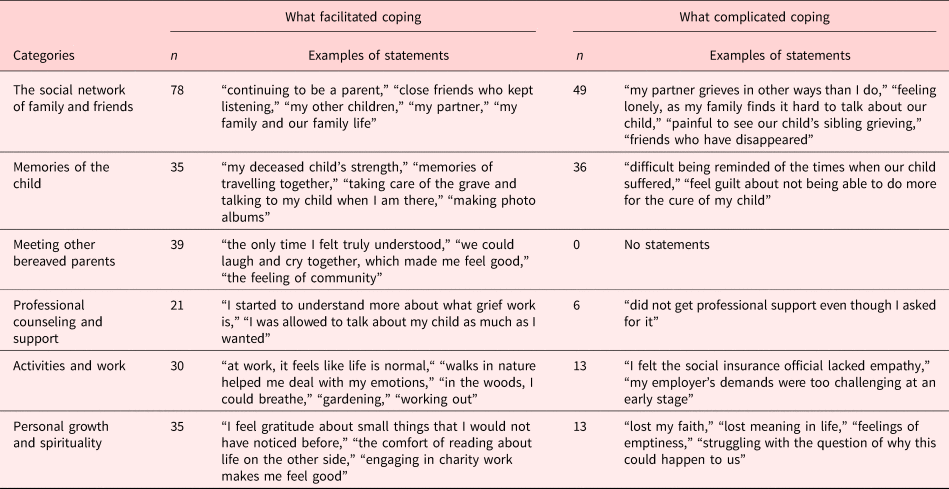
The study used a conventional content analysis (Hsieh and Shannon, Reference Hsieh and Shannon2005) approach. All the written responses to both open-ended questions were documented in a text file. To get a sense of the whole, the responses were then read by all authors independently. The authors have a variety of clinical and research experience, and overall first impressions were briefly discussed in the group of authors. The first author then condensed each response into one or several parental statements, and these were coded based on their content, finally tentative categories were articulated. All categories were revised in the research group until agreement was achieved. To account for random agreement, Cohen's kappa was calculated for a random selection of 20% of the statements and ranged from 0.77 to 0.87 between rater pairs (p < 0.001 in all analyses), with an average Cohen's kappa of 0.84. Examples of quotes from the parents are shown in the Results section and in Table 1.
Bereaved parents’ statements on coping with grief, by category

Results
Participant characteristics
At the time of the study, the mean age of the parents was 45 years; 108 (67%) were mothers and 53 (33%) fathers. The mean age of the deceased children (n = 151) was 7 years at diagnosis and 9 years at death (Table 2).
Characteristics of the parents (n = 161) and deceased children

Parents’ views on what facilitated or complicated their grief coping
From the total of 355 statements that derived from the parents’ responses to the open-ended questions on grief coping, six categories emerged: (1) the social network of family and friends, (2) memories of the child, (3) meeting other bereaved parents, (4) professional counseling and support, (5) activities and work, and (6) personal growth and spirituality.
The social network of family and friends
The support received from the social network — partners, parents, friends, and relatives — was reported by many parents to be essential for their grief coping. They felt grateful for the secure relationships within the family (with surviving and/or new children), and with supportive relatives and friends. Participating in the activities of everyday family life was considered beneficial in coping with grief; the feeling of “still being a parent” was frequently mentioned as helpful. On the other hand, seeing the grief of the deceased child's siblings caused a lot of parental suffering and was considered hard to handle. When partners or friends were not supportive, or did not want to talk about the deceased child, parents reported that this caused sadness, disappointment, and loneliness. Bereaved parents who had suffered additional losses, i.e., relatives who passed away during the child's illness or soon after the death of the child, stated that this had also complicated their grief coping. Some parents had experienced that “forgotten” losses returned to them: “I had to work through the grief for my father, who died when I was 9 years old.” Divorces or illnesses in the family were also considered to make coping harder; parents could feel overwhelmed and drained of energy.
Memories of the child
A sense of purpose from having been the parent of the deceased child was mentioned as an important part of the meaning and motivation described as necessary in life after the loss. Having known and lived with the child gave many parents keys for coping with their grief. “He would want us to continue family life like before,” wrote one parent. Taking action to keep memories of the child alive in various contexts, including in meetings with pediatric care staff, was also reported as facilitating grief coping. Parents would honor their child's characteristics, such as courage or an optimistic attitude, by adopting those characteristics themselves. Taking loving care of the child's pet or keeping in touch with the child's friends and attending events at school also facilitated coping with grief, even if this triggered negative emotions when confronted with the loss — the other children at school were still alive, but their child was not. Visiting and taking care of the child's grave was also as reported by parents as a way to connect with the child and helped them in their grief. Something that made coping more difficult for the parents was if they had memories of their child suffering because of painful cancer treatments.
Meeting other bereaved parents
Some parents described meeting with other bereaved parents to be invaluable as a way of coping with grief: “With other bereaved parents, it is possible to share emotions and experiences, in a way that is not possible with friends and family, even if they want to be there for us.” Attending support groups offered by the Childhood Cancer Foundation or other nonprofit organizations for parents who lost children facilitated grief coping; it gave a sense of community and thus alleviated the sensation of loneliness in grief. Parents found it helpful to be able to talk about their deceased child or show pictures of the child's grave, without making others feel awkward. Seeing that the loss of a child had happened to others and how those families managed to get on with life was also mentioned as important.
Professional counseling and support
Many parents stated that “endless” talking about their child and about their experiences during the period of the child's illness helped them in coping with grief; they needed to talk about their despair and feelings of powerlessness from not being able to protect their child. The support from counselors was mentioned by many parents as necessary for coping with their grief and finding new ways to go on with life. Conversations with professional counselors or clergymen also enabled a cognitive understanding of the grief process and thus helped parents endure the emotional rollercoaster of the grieving process. Parents stated that meeting a professional was necessary since it provided a place to talk about thoughts and emotions that needed to be dealt with, when people in their social network seemed to avoid talking about the deceased child or were tired of listening.
Activities and work
Some parents stated that they used physical activity as a way of coping with their grief or that they often went for walks in nature: “the only place where I can breathe.” Other activities were reading, painting, playing an instrument, or listening to music that conveyed feelings, which sometimes ameliorated the emotional pain evoked by the loss. Going back to work was perceived as facilitating grief coping for some: “a possibility to feel like life is normal.” On the other hand, for other parents, work could complicate their coping with grief; when they perceived that colleagues were not sensitive to their emotional reactions to the loss, when they had to go back to work too soon, or when they felt demands from employers were too challenging at an early stage.
Personal growth and spirituality
Responses concerning aspects of personal development that had helped parents in their coping with grief were multifaceted; they included thoughts on personal growth, understanding more about human suffering and becoming more empathetic to others. Many parents expressed a deeper understanding of what really matters in life; they experienced stronger feelings of “gratitude for the little things” and consequently changed their priorities in life. Some parents read books about others who had survived disasters and found this helpful in their grief coping. Some parents who had not been spiritual or religious before now found comfort in believing in life after death or reincarnation. “I want to believe my grandparents now look after our daughter in heaven,” as one parent wrote. Some parents became involved in concrete activities to help others in need, such as fundraising activities for the Childhood Cancer Foundation or charity work with homeless people, which helped them cope with grief.
Discussion
The findings in this study revealed a depth in the parents’ experiences of coping with grief and their endeavors to find purpose and make meaning in the loss of their child. The parents described the importance of meeting other cancer-bereaved parents to share memories of their child's illness and treatment. They felt their emotions were profoundly understood in conversations with these people. Also, being able to share the emotional impact of the loss within the family or with friends was mentioned as helpful for parents in coping with grief. The parents’ efforts to maintain bonds with the deceased child were found helpful in adjusting to a life without the child, as was meeting professional counselors. Experiencing additional losses in the social network, perceiving a lack of shared emotions or empathy from a partner, friends, relatives, or colleagues made grief coping harder, as did demands from employers that were too challenging at an early stage.
The network of family members and social relationships was experienced as very helpful for parents in grief coping, helping to create a feeling of security in a shattered world. Being surrounded by people to whom one is closely attached is known to alleviate the pain associated with a loss (Xu et al., Reference Xu, Fu and He2015). Especially in the case of a loss of a child, a parent's closest attachment figure, family and near friends can give the security needed to manage the strong yearning and emotional pain in the new reality. Integrating the child's death is part of reworking the attachment relationship to the lost child (Neimeyer, Reference Neimeyer2019). The parents reported that they felt they could share the emotional impact of the loss of their child with family members and friends, which is part of loss-oriented coping according to the DPM. Another element of being with family or close friends is the sense of purpose gained by engaging in daily life (Lichtenthal et al., Reference Lichtenthal, Catarozoli and Masterson2019). The same can be achieved by doing family activities with a partner and any remaining children. The parents in this study reported social interactions as healing. After the loss of a child, a majority of parents feel vulnerable and one aspect of coping with grief is the need to redefine parenthood (Nuss, Reference Nuss2014), which is done both in private and within social networks. As an element of meaning making in everyday family life, the parents reported that they felt a sense of control over their functioning, despite the continuing pain of their loss. This experience of coming “back to normal life” in everyday family functioning is considered to be a balanced integration of grief following the loss of a child, in line with a study on parents’ bereavement patterns (Barrera et al., Reference Barrera, D'Agostino and Schneiderman2007). Meeting other bereaved parents was important, as it made parents realize they were not the only family with this devastating experience, which helped them reconstruct the narrative of their lives (Lichtenthal et al., Reference Lichtenthal, Catarozoli and Masterson2019). Losing a child may lead to a shattered parent identity; they had believed that, being a parent, they could protect their child. Sharing the reconstruction of the parental self and feelings of loneliness with other bereaved parents was helpful.
So-called meaning reconstruction and creating new life narratives is usually associated with grief coping (Neimeyer et al., Reference Neimeyer, Prigerson and Davies2016). Meeting family and friends and other bereaved parents can also be seen as engaging in loss-oriented coping (Stroebe and Schut, Reference Stroebe and Schut1999); sharing, thinking, and dealing with the emotions and sometimes unexpected behaviors induced by the loss may serve as a grief coping strategy. The way parents try to maintain bonds with the deceased child and find purpose in the child's shortened life is known to be associated with bereavement outcomes (Rubin and Shechory-Stahl, Reference Rubin and Shechory-Stahl2013). In this study, parents mentioned engaging in activities like keeping in touch with the deceased child's friends and school. Even more important was continuous contact with pediatric care staff from the settings where the child had been cared for during the illness period, also evidenced by Weidner et al. (Reference Weidner, Cameron and Lee2011). Parents appreciated reminiscing about the child together with those with whom they had become close during the most distressing period of their lives and reported that this helped them cope with their grief (Lichtenthal et al., Reference Lichtenthal, Sweeney and Roberts2015). They did not want to lose contact with those to whom they became attached (Kearney and Byrne, Reference Kearney and Byrne2015). Parents reported that a lack of shared emotions or empathy from their partner, friends, relatives, or colleagues made coping with grief harder. This shows how social expectations on mourning influence social relations, especially if a bereaved person does not react as expected.
The parents in this study engaged in loss-oriented coping by sharing and dealing with the pain of their bereavement with family, friends, and other bereaved parents. They engaged in restorative-oriented coping by finding new activities and trying to go back to work. The reports on changed priorities and values in life may reflect the parents’ integration of the loss and adjustment to the new reality without their child, a process that takes time (Buchi et al., Reference Buchi, Morgeli and Schnyder2007). Support from professional counselors to understand and move forward in the grieving process was mentioned by the bereaved parents as helpful and can be seen as restorative-oriented coping, along with going back to work and taking up activities like physical exercise or new hobbies. The bereaved parents felt that being forced to return to work too soon and not being able to do what was expected from employers made it harder to cope with grief.
The facilitating and complicating factors for coping with grief found in this study can also be seen in a review article (Snaman et al., Reference Snaman, Morris and Rosenberg2019) on parents of children who had died from cancer. Some of the results in this study confirm factors in their findings, e.g., social support and personal growth, which were labeled as protective factors. Other findings in the current study, e.g., that parents find it hard to go back to work and meet demands from employers, are not explicitly mentioned by the parents in the review article, but can contribute to the financial strain found to be a risk factor. As shown in a study on bereaved parents in Australia and the US (Dussel et al., Reference Dussel, Bona and Heath2011), these factors can add economic stress to families that have often suffered work disruptions during the child's illness and are thus already burdened.
Methodological considerations
To our knowledge, this is the first nationwide study with free-text comments from cancer-bereaved mothers and fathers on their ways of coping with grief. Nevertheless, the study has some limitations that should be considered. Its cross-sectional nature does not allow understanding of the evolution of coping strategies during the grief process; however, the results can be understood in the light of several theoretical frameworks, which have been shown to be of value in understanding parental grief 1–5 years after the death of a child. In the 51 parent dyads included in the sample, parents may have influenced each other's responses, even though they have submitted individual questionnaires. Strengths were that the sample size of this nationwide study was quite large. Although all the bereaved parents in this study had lost their child to cancer, their reports may be valid also for parents who have lost children to other diseases.
Conclusion and clinical implications
The parents reported that social functioning in their network of family and friends, keeping the memory of the child alive, professional counseling support, activities, or work facilitated grief coping. Experiences of spiritual and personal growth, sometimes called post-traumatic growth, were reported as benefits from the painful process of adjustment to the loss of a child. These findings can be understood in the light of theoretical frameworks such as DPM and meaning reconstruction in grief. The empirical data can be used in several ways by professionals and others when supporting parents in coping with grief. Firstly, asking about parents’ social functioning can be beneficial, as this has been shown to be an important element of grief integration. Secondly, psycho-education can be offered to parents to increase their understanding of their own grief responses and the possible impact of their grief on others. Bereaved parents may need help to explain to others what can be normal and expected in the grief experience and to understand how family and friends can support them. Thirdly, at a societal level, health insurance organizations and workplaces may need to develop facilitating policies for bereaved parents who return to work.
Ethical standards
The authors assert that all procedures contributing to this work comply with the ethical standards of the relevant national and institutional committees and with the Helsinki Declaration of 1975, as revised in 2013.
Acknowledgments
We thank all the parents who participated in the study. Funding for this project has been provided by the Swedish Childhood Cancer Foundation, the Gålö Foundation, and Ersta Sköndal Bräcke University College.