




Introduction
Climate change is one of the greatest threats to public health, potentially reversing decades of progress (The Lancet Respiratory Medicine, 2023). The World Health Organization (WHO) estimates 13 million deaths to be annually attributed to environmental factors and projects climate change to cause 250.000 additional yearly deaths between 2030 and 2050 (Prüss-Üstün et al., Reference Prüss-Üstün, Wolf, Corvalán, Bos and Neira2016; WHO, 2023). The imprints of the climate crisis on human health are already observed in daily clinical practice, manifesting as: heat-related health outcomes (acute kidney injury, heatstroke) and mortality; exacerbation of cardiovascular diseases and chronic respiratory conditions; increased burden and pressure on mental health and well-being; epidemiological shift in vector, food and water-borne diseases; food insecurity and water scarcity; and damages to critical health infrastructure (Romanello et al., Reference Romanello, Di Napoli, Drummond, Green, Kennard, Lampard, Scamman, Arnell, Ayeb-Karlsson, Ford, Belesova, Bowen, Cai, Callaghan, Campbell-Lendrum, Chambers, Van Daalen, Dalin, Dasandi, Dasgupta, Davies, Dominguez-Salas, Dubrow, Ebi, Eckelman, Ekins, Escobar, Georgeson, Graham, Gunther, Hamilton, Hang, Hänninen, Hartinger, He, Hess, Hsu, Jankin, Jamart, Jay, Kelman, Kiesewetter, Kinney, Kjellstrom, Kniveton, Lee, Lemke, Liu, Liu and Lott2022). Currently, half of the global population resides in areas highly susceptible to climate change (IPCC, 2023). Climate-sensitive risks and health impacts are disproportionately borne by populations that contribute the least to global greenhouse gas emissions. Women, the elderly, children, ethnic minorities, displaced persons, and individuals with underlying health conditions are among those expected to face a growing and inequitable share of this burden (WHO, 2023).
Threatening to upend the universally adopted goal of improving health, well-being, and universal health coverage (UN, 2015), WHO called for the establishment of climate-resilient health systems and structures (WHO, 2015). Though the World Organization of Family Doctors called upon primary care physicians (PCPs) to advocate for and foster planetary health since 2019 (Iacobucci, Reference Iacobucci2019), the importance of acting on safeguarding and promoting environmental health was further acknowledged in the aftermath of the COVID-19 pandemic. Human and animal health are interdependent, related to the ecosystem they live in, and any changes thereof can have detrimental impact on the spillover of infectious pathogens. Understanding such complex interactions and pursuing an One Health approach is key in preventing, increasing preparedness and addressing potential future spillover diseases (Sironi et al., Reference Sironi, Inglese and Lavazza2022). In addition, the significance of PCPs in addressing interconnected human, animal, and environmental health challenges – aligned with the One Health approach – was recently recognized as the cornerstone of General Practice/Family Medicine (GP/FM) in the revised European Definition (WONCA Europe, 2023).
In futureproofing health systems to withstand and respond to the challenges posed by the environmental crisis, engaging health providers is of utmost importance. While most providers may feel well informed in their civic capacity, their knowledge on planetary health and the impact of climate change on population health is low (Sarfaty et al., Reference Sarfaty, Bloodhart, Ewart, Thurston, Balmes, Guidotti and Maibach2015; André et al., Reference André, Gonzalez Holguera, Depoux, Pasquier, Haller, Rodondi, Schwarz and Senn2022). Raising awareness and educating PCPs about the health impacts of climate change is essential, given their central role in health promotion, disease prevention, chronic disease management, and the overall well-being of the communities they serve. Primary health care (PHC) is additionally uniquely positioned to manage and mitigate climate-related health events, as PCPs have a comprehensive understanding of their community’s vulnerabilities and constitute the first point of contact for patients. As PCPs are trained to increase their community’s resilience and are considered the most trusted source of information by patients, they can lead climate-related community information initiatives (Xie et al., Reference Xie, De Barros, Abelsohn, Stein and Haines2018). Educating their community, advocating for sustainability and environmental stewardess on individual, community and policymaking levels increases resilience, mitigates climate change’s impact and unlocks multiple co-benefits for individuals and the ecosystem (Maibach et al., Reference Maibach, Sarfaty, Mitchell and Gould2019; WONCA Europe, 2023).
Despite the acknowledgement of climate change’s impact on human health and the imperative for swift action, a growing body of literature underscores PCPs’ struggle to translate climate awareness into actionable practices (Kotcher et al., Reference Kotcher, Maibach, Miller, Campbell, Alqodmani, Maiero and Wyns2021; André et al., Reference André, Gonzalez Holguera, Depoux, Pasquier, Haller, Rodondi, Schwarz and Senn2022; Redvers et al., Reference Redvers, Wright, Hartmann-Boyce and Tonkin-Crine2023; Sigrist et al., Reference Sigrist, Richardet, Senn and Schwarz2025). Gaining an understanding of the phenomenon “through the eyes” of frontline processionals is vital for developing effective policies that enhance the climate resilience of health systems. Available evidence on the impact, perception and practices regarding the climate crisis and planetary health within the Southern European and Greek context are scarce. Considering the updated definition of GP/FM, this qualitative study aimed to investigate Greek PCPs’ beliefs about the climate crisis and its impacts on community health, their perceptions of climate change as a professional priority, and their understanding of their professional role in promoting environmental health and sustainability.
Methods
Design and setting
A qualitative design allowed for deeper understanding and analysis of PCPs’ perceptions regarding the climate crisis. We explored PCPs’ perspectives utilizing semi-structured, individual interviews, conducted in spring 2023. To address the research questions, interviews were conducted and data were iteratively collected and processed until new codes ceased to emerge, and data saturation was achieved (Glaser and Strauss, Reference Glaser and Strauss2017).
Recruitment and sampling
PCPs from across the country were invited to participate. Study inclusion criteria were: (a) having the medical specialty of GP/FM; (b) working in primary care (PC) units, either public or private; (c) working experience of at least one year in PC settings; and (d) provision of signed informed consent form, after being informed about the purposes of the study. Purposive sampling was employed among PCPs that responded to an email invitation from the Hippocrates Hellenic Society of GP/FM. As the climate crisis and its impact on community health is expected to be experienced differently depending on the area of living and employment, purposive sampling was utilized in efforts to best capture the perspectives PCPs with different gender, various levels of work experience, from urban, semi-urban, rural and island regions and work settings (public and private practices). Recruitment occurred simultaneously with data analysis and PCPs were recruited until no new themes emerged, indicating that data saturation was achieved. PCPs were informed of their right to withdraw consent and remove related data at any given time during the study, without repercussions. No incentives were provided to study participants. No dropouts were recorded, and no repeat/follow-up interviews were conducted.
Data collection and interview guide
Prior to the semi-structured interviews, PCPs completed a short sociodemographics questionnaire. The interview guide was developed based on extensive literature review, was pilot tested in one interview and reviewed by the research team. Main topics were PCPs’ beliefs, awareness and risk perception regarding climate change, its impacts on the health of their population, and their perceived role in elevating their community’s climate consciousness to strengthen resilience.
Interviews were virtually conducted outside working hours by an experienced researcher (DV), were audio-recorded, and transcribed verbatim, ensuring anonymization of identifiable data. Field notes were taken during the duration of interviews. Transcripts were compared to respective recordings and field notes to increase accuracy. Participants were a priori informed and consented to audio recording the interviews.
Data processing
Transcribing of recorded interviews and data processing was performed independently and manually (via Microsoft Word and Excel) by two authors (DV and ZT), who themselves are PCPs with experience in conducting qualitative research. To analyse data provided by the semi-structured, individual interviews, thematic analysis was conducted (Braun and Clarke, Reference Braun and Clarke2006). An inductive approach was utilized to identify and formulate concepts and overarching emergent themes from available raw data (Fossey et al., Reference Fossey, Harvey, McDermott and Davidson2002). Researchers first familiarized with the available material from the initial interviews and noted preliminary coding theories. They then began open coding participants’ responses and collected data and context relevant to each code. Identified codes were then sorted in general, preliminary overarching themes. The latter were then reviewed to identify fitness to the original coded extracts and the overall data set. Researchers then met to compare identified themes, sub-themes and codes and discuss differences in the independent analysis until consensus was reached. In the event of disagreements or divergent interpretations, a third, independent researcher was asked to provide input (IP). A common coding framework was adopted and subsequently applied to all transcripts, leading to the final generation of themes and sub-themes from the raw data. Authors iteratively refined the former whilst interviews were underway. Once coding saturation was reached and no new codes and themes emerged, typically achieved with nine interviews (Hennink et al., Reference Hennink, Kaiser and Marconi2017), recruitment of study participants ceased. The Standards for Reporting Qualitative Research (SRQR) were adhered to during the development, implementation, and reporting of this study (O’Brien et al., Reference O’Brien, Harris, Beckman, Reed and Cook2014).
A systematic and impartial approach was adopted in efforts to minimize personal bias in collecting, processing, and reporting data. Both researchers (DV and ZT) shared pro-environmental attitudes, whereas adoption of healthy lifestyle decisions and preventive medicine were in the heart of one researcher’s practice (DV). Yet, the inclusion and viewpoint of One Health, planetary health and sustainability as the foundation of the GP/FM discipline constituted a novelty, especially in the Greek context where environmental awareness in the health sector was scarce. As such, the WONCA Europe declaration triggered an inherent interest in exploring stances and strategies in a poorly lit area. Prior to study commencement, researchers discussed their standing on the matter, acknowledged their beliefs and values, reviewed relevant literature and constructed the semi-structured interview guide. Reviewed by a non-health professional researcher, questions in the interview guide were rephrased in a manner that avoids eliciting desirable responses. Aware of her own stance on the issue, the author who conducted the interviews took care to follow an impartial stance, to explore and not downplay participants’ opposing views. Recruiting participants through open email invitations and professional contacts was considered to have minimized social desirability bias and skewed power dynamics, as no acquaintance with the interviewer prior to the study prompted truthful responses. During data processing, authors focused strictly on the evident content of manuscript data and engaged in reflective discussions seeking to avoid overinterpretation of findings in line with personal views as well as under-coding and de-emphasizing of opposing views.
Results
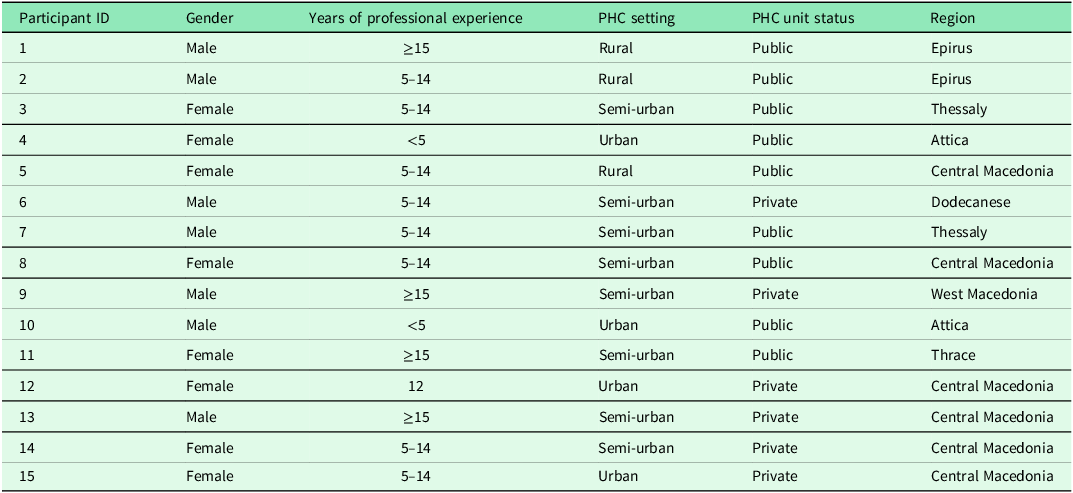
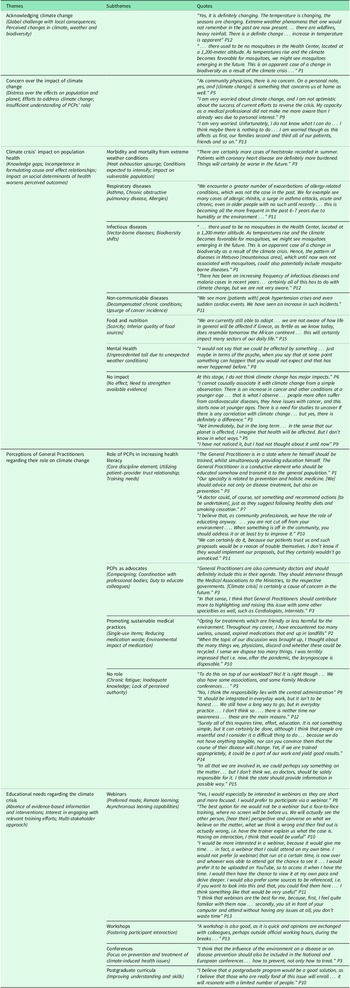
In total, 15 PCPs (53%, n = 8 women) from nine prefectures (eight in mainland Greece and one insular area) took part in the semi-structured, individual interviews. Mean age of study participants was 44 years old (±18, min. 26–max. 56), and mean working experience in PHC settings was 12 years (±16, min. 1–max. 28). Participants’ demographic characteristics are illustrated in Table 1. The average duration of interviews was 31 minutes. Selected illustrative quotes are presented in Table 2.
Demographic characteristics of study participants (n = 15)

Table 1. Long description
The table has 15 rows and 6 columns. The columns are labeled Participant ID, Gender, Years of professional experience, PHC setting, PHC unit status, and Region. Each row lists the demographic characteristics of a study participant. Row 1: Participant ID 1, Male, ≥15 years of professional experience, Rural PHC setting, Public PHC unit status, Epirus Region. Row 2: Participant ID 2, Male, 5–14 years of professional experience, Rural PHC setting, Public PHC unit status, Epirus Region. Row 3: Participant ID 3, Female, 5–14 years of professional experience, Semi-urban PHC setting, Public PHC unit status, Thessaly Region. Row 4: Participant ID 4, Female, <5 years of professional experience, Urban PHC setting, Public PHC unit status, Attica Region. Row 5: Participant ID 5, Female, 5–14 years of professional experience, Rural PHC setting, Public PHC unit status, Central Macedonia Region. Row 6: Participant ID 6, Male, 5–14 years of professional experience, Semi-urban PHC setting, Private PHC unit status, Dodecanese Region. Row 7: Participant ID 7, Male, 5–14 years of professional experience, Semi-urban PHC setting, Public PHC unit status, Thessaly Region. Row 8: Participant ID 8, Female, 5–14 years of professional experience, Semi-urban PHC setting, Public PHC unit status, Central Macedonia Region. Row 9: Participant ID 9, Male, ≥15 years of professional experience, Semi-urban PHC setting, Private PHC unit status, West Macedonia Region. Row 10: Participant ID 10, Male, <5 years of professional experience, Urban PHC setting, Public PHC unit status, Attica Region. Row 11: Participant ID 11, Female, ≥15 years of professional experience, Semi-urban PHC setting, Public PHC unit status, Thrace Region. Row 12: Participant ID 12, Female, 12 years of professional experience, Urban PHC setting, Private PHC unit status, Central Macedonia Region. Row 13: Participant ID 13, Male, ≥15 years of professional experience, Semi-urban PHC setting, Private PHC unit status, Central Macedonia Region. Row 14: Participant ID 14, Female, 5–14 years of professional experience, Semi-urban PHC setting, Private PHC unit status, Central Macedonia Region. Row 15: Participant ID 15, Female, 5–14 years of professional experience, Urban PHC setting, Private PHC unit status, Central Macedonia Region.
Illustrative quotes of primary care professionals’ perceptions regarding the climate crisis, its effects on health and their role in strengthening their community’s climate resilience. Theme and subtheme summaries are provided in italics

Long description
A table with 11 rows and 2 columns. The columns are labeled ‘Themes’ and ‘Quotes’. The table presents quotes from primary care professionals regarding their perceptions of the climate crisis, its effects on health, and their role in strengthening community climate resilience. Themes include acknowledging climate change, concerns over its impact, climate crisis impacts on population health, infectious diseases, non-communicable diseases, food and nutrition security, mental health, perceptions of general practitioners, PCPs as advocates, promoting sustainable development, and educational needs. Each row provides a specific quote related to the corresponding theme.
Acknowledging climate change
All participants acknowledged that climate change is a global phenomenon whose consequences affect their country. The increase in recorded air temperature, rainfalls, Saharan dust storm events, the frequent occurrence and increased severity of extreme weather conditions (such as heavy rainfall, flooding, heat waves, whirlwinds), and the overall modification of the temperate climate were mainly reported. Concerns over the climate crisis’ impact on biodiversity in the foreseeable future were noted.
“… Extreme weather phenomena that one would not remember in the past are now present… There is a definite change…” P12
Concern over the impact of climate change
Participating PCPs expressed the concern about the impact of climate crisis on the planet and the population. Notably, some participants emphasized that their concerns, fears, and reflections on climate change stemmed solely from their identity as citizens, rather than from their professional role as PCPs. Through recycling and limiting non-renewable energy consumption, they aspire to impede climate change as citizens, whilst expressing inadequate awareness of their potentially special role in fostering resilience as PCPs. Ultimately, one PCP noted that despite grave concern, no proper way of acting was recognized.
“As community physicians, there is no concern. On a personal note, yes, [climate change] is something that concerns us at home as well.” P5
Climate crisis’ impact on population health
PCPs self-reported relatively low levels of awareness regarding the effects of climate change on population health. Whilst the majority strongly believed that climate change has indeed increased the incidence of several medical conditions, their inability to formulate cause–effect relationships was recorded. Social determinants of health, such as housing and employment, were also acknowledged to be in grave danger in the wake of frequent extreme weather conditions, impacting the physical, mental health of individuals as well as the overall community health and prosperity. Their concerns over the impacts on mental and physical health of the population are summarized in six main themes.
“I think that this will potentially pose the greatest public health challenge in the future generations.” P9
Morbidity and mortality from extreme weather conditions. An upsurge in the incidence of heat exhaustion and heatstroke during the summer months was underscored. Inadvertently impacting the older population, as well as those with pre-existing, chronic conditions, it will be reportedly intensified in the future.
Respiratory diseases. Asthma, chronic obstructive pulmonary disease, allergy spectrum conditions and exacerbations of chronic respiratory conditions were reportedly primarily affected by the climate crisis.
Infectious diseases. PCPs associated the climate crisis and the consequent increase in global temperature with a resurgence of infectious diseases. In the foreseeable future, concerns over the climate crisis’ impact on biodiversity and the potential emergence of vector-borne diseases in non-endemic areas were also recorded.
Non-communicable diseases. PCPs underscored an upsurge in the incidence and dysregulation of chronic diseases, such as cardiovascular diseases and cancer.
Food and nutrition. A handful of participants highlighted the association of the overall health of the population with the inferior quality and scarcity of available food, due to the alteration and disturbance of soil quality, feared to reap unknown consequences.
Mental health. The psychological burden on citizens was highlighted, both from extreme weather conditions, such as prolonged heat waves and floods, the change of seasons, as well as the unexpected and unknown nature of weather phenomena.
Data analysis also highlighted a fraction of participants that believe no tangible impact of climate change on health is noted at this stage, a perception also thought to be attributed to the lack of PCPs’ awareness. Others underscored that the association between climate change and the increased incidence of diseases or their manifestation at a younger age remains to be proven. Nevertheless, PCPs were open to acknowledging potential effects on health should they be demonstrated in the future.
“No. I cannot comprehend this. I do not have measurable ways to understand [the impact].” P13
Perceptions regarding PCPs’ role on climate change
The interview guide provided space for participants to elaborate on how they envision their role as PCPs regarding the climate crisis. Most argued that PCPs could and ought to advocate for climate protection, enhance the sustainability of their practices, as well as elevate their community’s climate consciousness, given their role in health promotion and unique patient–provider relationships.
Increasing health literacy. Promoting the community’s literacy on health-related matters was highlighted as one of the key pillars of GP/FM alongside prevention and management of chronic diseases. Despite their heavy, daily workload, most PCPs underscored their role in strengthening the general population’s literacy regarding the climate’s health impact. The strength of the patient–PCP relationship was underlined, with participants further accentuating the trust patients exhibit towards the validity of information provided by their PCP. This genuine relationship is considered particularly important and fundamental in instilling and forming new beliefs and behaviours. In educating, consulting patients over climate-related issues and increasing community awareness, provision of related training was considered of utmost importance.
“I believe that, as community professionals, we have the role of educating anyway… When something is off in the community, you should address it or at least try to improve it.” P10
PCPs as advocates. Echoing the updated definition of GP/FM, our PCPs underscored their vital role in advocating for environmental stewardess and climate resilience. With the aid of their professional organizations, PCPs ought to bring the attention of relevant authorities towards the health consequences of the climate crisis. Their duty in increasing awareness over the climate-related health consequences across health providers of different disciplines was also noted.
“In that sense, I think that GPs should contribute more to highlighting and raising this issue with some other specialties as well, such as Cardiologists, Internists.” P3
Promoting sustainable medical practices. Few PCPs highlighted the issue of sustainability of daily medical practices, expressing their concern over the predominant utilization of disposable items that intensified after the COVID-19 pandemic. Considering the environmental factors of treatment plans was also deemed crucial in reducing waste.
“Opting for treatments which are friendly or less harmful for the environment. Throughout my career, I have encountered too many useless, unused, expired medications that end up in landfills.” P2
Some participants indicated that community health literacy on climate-related issues does not fall under their competence as PCPs, citing: (a) chronic fatigue; (b) lack of providers’ education; and (c) responsibility of other institutions on the matter. Troubled between the perceived necessity of involvement with the matter and the excessive post-COVID-19 workload, PCPs noted the lack of drive and time to touch upon the climate crisis during consultations, especially when the community is still ill-educated. Concerns regarding providers’ lack of own training on the climate emergency and health-related impacts were also expressed, potentially hindering PCPs’ involvement in efforts to increase climate literacy. Ultimately, few expressed firm belief that community physicians should not be burdened with such tasks, allocating the full responsibility of enhancing climate literacy solely to central authority and institutions.
“It should be integrated in everyday work, but it isn’t to be honest… We still have a long way to go, but in everyday practice… I don’t think so…. there is neither time nor awareness…” P12
Educational needs regarding the climate crisis
Despite being generally informed about the climate emergency as citizens, PCPs noted with considerable dissatisfaction that no evidence-based training and education were provided regarding the health impacts of the climate emergency. The aforementioned absence of correlation between the climate crisis and subsequent health conditions was attributed to PCPs’ insufficient training and low awareness. As per continuous education, though most participants highlighted the absence of relevant courses, two PCPs make note of relevant conference and workshops which they opted out of.
“No, except for a round table at a conference… I thought that the topic did not concern me directly, as did other more popular topics…” P4
Recognizing the issue’s grave importance, all participants stated their interest in being trained on the topic. The establishment of educational opportunities on climate emergency and health was encouraged by PCPs via: (a) webinars; (b) workshops; (c) conferences; and even (d) a relevant postgraduate degree. To better equip, prepare and future-proof PCPs, mobilization of Academic Institutions, Medical Associations and Colleges, and the Ministry of Health was considered important.
“I would be interested, and I would prefer to take part in training… because it is new and before us. Shouldn’t we be prepared?” P7
Webinars. Webinars constituted participants’ preferred mode of training, as they are brief, targeted, allow remote participation, and provide brief introduction to the issue through a familiar learning format, especially in the aftermath of the pandemic. Asynchronous, offline participation and provision of resources for further, in-depth training would also be valued. Yet, despite their popularity among PCPs, the advantages of physical, in-person training ought not to be overlooked.
Workshops. Requiring physical presence, the organization of brief, related workshops was also a popular choice, since it also promoted interaction with other colleagues on the issue.
Conferences. Several PCPs viewed the inclusion of climate emergency in medical conferences as important. In such cases, emphasis should not be solely placed on treatment, but also on the prevention of climate-related health issues.
Postgraduate Curricula. One PCP considered the establishment of a relevant postgraduate programme a useful medium in raising health providers’ awareness and expertise.
Discussion
This study aimed in exploring PCPs’ stances on the climate crisis, its association with their community’s health and how they perceive their role. Study participation sparked introspection on a topic that had failed to be systematically noticed in the past. Though most PCPs acknowledged the climate emergency’s already-present impact on population health, a handful were unaware and unconvinced about the phenomenon and its effects. Participants were troubled over the increased incidence of respiratory, infectious, mental health, non-communicable diseases, increased morbidity and mortality, as well as the impact on food production. PCPs were divided over their role in elevating their community’s climate literacy. Whilst the need and intent to educate their community over the climate and associated health implications was highlighted, several perceived such actions to fall outside their competences. Underlining the current gap, findings indicate PCPs’ firm commitment and appeal to establish training opportunities on climate and health.
Participants recognized the global nature of the climate crisis and its effect on key social determinants of health. Yet, they self-reported low levels of awareness over the climate emergency’s impact on population health and difficulties in establishing direct cause and effect relationships. Our findings echoed those of the American Thoracic Society physicians who also reported lack of causal inference between climate change and health (Sarfaty et al., Reference Sarfaty, Bloodhart, Ewart, Thurston, Balmes, Guidotti and Maibach2015). In a similar manner, though Swiss GPs were increasingly aware and considered climate change an area of interest in daily practice, their self-reported knowledge on specific topics, including population health, was low (André et al., Reference André, Gonzalez Holguera, Depoux, Pasquier, Haller, Rodondi, Schwarz and Senn2022). Ultimately, it is important to acknowledge that climate change is not universally perceived as a threat to population health – a perspective shared by both few PCPs in our study and their Swiss counterparts (André et al., Reference André, Gonzalez Holguera, Depoux, Pasquier, Haller, Rodondi, Schwarz and Senn2022).
Participating PCPs underscored their concerns over the impact of the environmental degradation in population health, which corroborate with the threats and challenges annotated in the relevant literature (Watts et al., Reference Watts, Amann, Ayeb-Karlsson, Belesova, Bouley, Boykoff, Byass, Cai, Campbell-Lendrum, Chambers, Cox, Daly, Dasandi, Davies, Depledge, Depoux, Dominguez-Salas, Drummond, Ekins, Flahault, Frumkin, Georgeson, Ghanei, Grace, Graham, Grojsman, Haines, Hamilton, Hartinger, Johnson, Kelman, Kiesewetter, Kniveton, Liang, Lott, Lowe, Mace, Odhiambo Sewe, Maslin, Mikhaylov, Milner, Latifi, Moradi-Lakeh, Morrissey, Murray, Neville, Nilsson, Oreszczyn, Owfi and Costello2018; Walsh et al., Reference Walsh, O’Leary and Lynch2025). Health providers in a multinational study acknowledged the increased incidence of mental health issues, vector, water and food-borne diseases, air quality-related illnesses, and conditions deriving from extreme weather events, economic and housing hardships and disruption of healthcare services (Kotcher et al., Reference Kotcher, Maibach, Miller, Campbell, Alqodmani, Maiero and Wyns2021). Like their Greek counterparts, increased mortality was associated with prolonged heatwaves among German and Irish PCPs (Herrmann and Sauerborn, Reference Herrmann and Sauerborn2018; Walsh et al., Reference Walsh, O’Leary and Lynch2025). Moving forward, as global temperature increases above the sustainable thresholds, PCPs in international studies identified the need to adapt and acquaint their clinical practice to care for increased burden from heat-related, vector-borne, cardiorespiratory diseases, mental health conditions, skin neoplasms, suboptimal nutrition, water, and food scarcity (Purcell and McGirr, Reference Purcell and McGirr2014; Watts et al., Reference Watts, Amann, Ayeb-Karlsson, Belesova, Bouley, Boykoff, Byass, Cai, Campbell-Lendrum, Chambers, Cox, Daly, Dasandi, Davies, Depledge, Depoux, Dominguez-Salas, Drummond, Ekins, Flahault, Frumkin, Georgeson, Ghanei, Grace, Graham, Grojsman, Haines, Hamilton, Hartinger, Johnson, Kelman, Kiesewetter, Kniveton, Liang, Lott, Lowe, Mace, Odhiambo Sewe, Maslin, Mikhaylov, Milner, Latifi, Moradi-Lakeh, Morrissey, Murray, Neville, Nilsson, Oreszczyn, Owfi and Costello2018; André et al., Reference André, Gonzalez Holguera, Depoux, Pasquier, Haller, Rodondi, Schwarz and Senn2022).
Our findings indicate conflicting viewpoints over PCPs’ role in educating about the climate crisis. Few PCPs noted that engaging in planetary health topics is beyond their competence, an insight also brought forward by Redvers et al.’s review (Reference Redvers, Wright, Hartmann-Boyce and Tonkin-Crine2023). Yet, as patient education constitutes a core GP/FM competence, most Greek PCPs underscored the need to encompass environmental and climate awareness. The latter is in accordance with the revised European Definition of GP/FM, where the role of PCPs in disseminating accurate information and advocating for measures to counteract, mitigate, and protect their communities from the health impacts of climate change is explicitly emphasized. Health providers already expressed the need to bring climate change and its consequences to the attention of the community and policymakers in a global study (Kotcher et al., Reference Kotcher, Maibach, Miller, Campbell, Alqodmani, Maiero and Wyns2021). Building on their expertise and unique relationships of trust, PCPs are well equipped to advocate for change in individual, local, and institutional levels to meet the agreed climate goals, encourage the drafting of community preparedness plans and promote changes in diet and mobility behaviours yielding shared benefits for human and planetary health (Xie et al., Reference Xie, De Barros, Abelsohn, Stein and Haines2018; Maibach et al., Reference Maibach, Sarfaty, Mitchell and Gould2019; WONCA, Planetary Health Alliance, and Clinicians for Planetary Health Working Group, 2019; Windak et al., Reference Windak, Rochfort and Jacquet2024). Despite acknowledging their role in patient education, Swiss PCPs self-reported low confidence and lack of perceived legitimacy in discussing the issue during consultations, a finding also shared by patients as well (André et al., Reference André, Gonzalez Holguera, Depoux, Pasquier, Haller, Rodondi, Schwarz and Senn2022; Sigrist et al., Reference Sigrist, Richardet, Senn and Schwarz2025). Like their Greek counterparts, health providers indicated that lack of official guidance, clinical practice recommendations, time constraints as well as the polarizing nature of environmental health also deter them from engaging in relevant conversations (Kotcher et al., Reference Kotcher, Maibach, Miller, Campbell, Alqodmani, Maiero and Wyns2021; André et al., Reference André, Gonzalez Holguera, Depoux, Pasquier, Haller, Rodondi, Schwarz and Senn2022; Redvers et al., Reference Redvers, Wright, Hartmann-Boyce and Tonkin-Crine2023; Sigrist et al., Reference Sigrist, Richardet, Senn and Schwarz2025).
Echoing the reportedly insufficient guidance, our participants called academic and institutional actors to establish and incorporate planetary and human health in formal trainings. Requests for the introduction of planetary health, climate change, and advocacy in university curricula, GP/FM training and continuous professional development are gaining ground (Purcell and McGirr, Reference Purcell and McGirr2014; Sarfaty et al., Reference Sarfaty, Bloodhart, Ewart, Thurston, Balmes, Guidotti and Maibach2015; Maxwell and Blashki, Reference Maxwell and Blashki2016; Solomon and LaRocque, Reference Solomon and Larocque2019; Goshua et al., Reference Goshua, Gomez, Erny, Burke, Luby, Sokolow, Labeaud, Auerbach, Gisondi and Nadeau2021; MacNeill et al., Reference MacNeill, McGain and Sherman2021;André et al., Reference André, Gonzalez Holguera, Depoux, Pasquier, Haller, Rodondi, Schwarz and Senn2022; Wild et al., Reference Wild, Tapley, Fielding, Holliday, Ball, Horton, Blashki, Davey, Van Driel, Turner, Fitzgerald, Spike and Magin2023; Windak et al., Reference Windak, Rochfort and Jacquet2024), indicating health providers’ strong drive and interest. To this date, a growing number of institutions recognize environmental stewardship as a core professional competence and incorporate planetary health on their curricula (Sherman et al., Reference Sherman, Thiel, MacNeill, Eckelman, Dubrow, Hopf, Lagasse, Bialowitz, Costello, Forbes, Stancliffe, Anastas, Anderko, Baratz, Barna, Bhatnagar, Burnham, Cai, Cassels-Brown, Cimprich, Cole, Coronado-Garcia, Duane, Grisotti, Hartwell, Kumar, Kurth, Leapman, Morris, Overcash, Parvatker, Pencheon, Pollard, Robaire, Rockne and Sadler2020).
As healthcare systems constitute major emitters of environmental pollutants, calls for mitigating the carbon footprint of the care sector to improve planetary and human health have long been made (Solomon and LaRocque, Reference Solomon and Larocque2019; Watts et al., Reference Watts, Amann, Ayeb-Karlsson, Belesova, Bouley, Boykoff, Byass, Cai, Campbell-Lendrum, Chambers, Cox, Daly, Dasandi, Davies, Depledge, Depoux, Dominguez-Salas, Drummond, Ekins, Flahault, Frumkin, Georgeson, Ghanei, Grace, Graham, Grojsman, Haines, Hamilton, Hartinger, Johnson, Kelman, Kiesewetter, Kniveton, Liang, Lott, Lowe, Mace, Odhiambo Sewe, Maslin, Mikhaylov, Milner, Latifi, Moradi-Lakeh, Morrissey, Murray, Neville, Nilsson, Oreszczyn, Owfi and Costello2018). Our PCPs commented on the sustainability of daily clinical practice, focusing on the disposal of single use equipment, its recycling potential and the use of low-impact medication. Fehrer et al. (Reference Fehrer, Poss-Doering, Weis, Wensing, Szecsenyi and Litke2023) and Walsh et al. (Reference Walsh, O’Leary and Lynch2025) had also reflected on green practices in German and Irish PHC, highlighting PCPs’ focus on reducing waste, maximizing recycling, avoiding single used materials and environmentally friendly prescribing. To this end, Sherman et al. (Reference Sherman, Thiel, MacNeill, Eckelman, Dubrow, Hopf, Lagasse, Bialowitz, Costello, Forbes, Stancliffe, Anastas, Anderko, Baratz, Barna, Bhatnagar, Burnham, Cai, Cassels-Brown, Cimprich, Cole, Coronado-Garcia, Duane, Grisotti, Hartwell, Kumar, Kurth, Leapman, Morris, Overcash, Parvatker, Pencheon, Pollard, Robaire, Rockne and Sadler2020) identified a large body of work over the environmental impact of care services’ processes, equipment, and medication, whilst Storz (Reference Storz2018) proposed practical strategies for curbing health providers’ and system’s footprint.
Findings aid in informing the strategic priorities for a future sustainable PHC, as perceived by its professionals. In the Greek context, the need to reform educational opportunities for PCPs regarding planetary health and sustainability was unanimously underscored. Ranging from the design and delivery of formal trainings, as well as the establishment of specialized postgraduate studies, our findings demonstrated strong commitment and willingness from PCPs to strengthen their skills and knowledge in environmental health. Though training opportunities establish and raise awareness, systematic approach is needed to address the issue. Whilst Greek PHC practices have been recently renovated to maximize energy efficiency, official guidance for health providers in mitigating the effects of the climate crisis and engaging in relevant conversations with patients remains undeveloped. In this regard, practice and physician-led changes may still constitute the most achievable interventions to increase awareness and foster sustainability. A Swiss study noted the effectiveness of visual cues and educational material in waiting rooms in sparking discussions and informing change. When engaging in discussions on planetary health, PCPs are suggested to avoid guilt-inducing messaging and emphasize individual health co-benefits (Sigrist et al., Reference Sigrist, Richardet, Senn and Schwarz2025). Beyond the local context, our findings echoed those of international counterparts, who are divided over their role in advocating for the environment and elevating their community’s climate literacy. The relationship and relevance of PCPs’ planetary responsibilities and their clinical duties need further exploring to solidify its perceived importance as the foundation of their discipline. Looking ahead, an array of health advocacy means and strategies for PCPs to meaningfully influence their community and leaders were developed (Hancher-Rauch et al., Reference Hancher-Rauch, Gebru and Carson2019).
To the best of the authors’ knowledge, this is the first study in Greece to map and provide qualitative insights on PCPs’ perspectives, concerns and needs about the climate emergency. Qualitative methodology allows for in-depth analysis and understanding of their beliefs in a novel study area. Although purposive sampling was employed, it is important to acknowledge that certain perspectives may still be underrepresented in our findings. Nonetheless, the inclusion of participants from urban, semi-urban, and rural settings – including mountainous and island regions – enhanced the breadth of perspectives and contributed to a more holistic understanding of the health impacts of climate change. Mailing the invitation through the official communication channel of a National GP/FM Association provided the opportunity to reach out and recruit a nationwide study sample from diverse backgrounds. Yet, we acknowledge that PCPs with no membership and involvement in a GP/FM association may not have been informed about the study and their perceptions and practices may have not been reflected in our findings. Self-selection bias could have also influenced our findings, as PCPs who are passionate advocates as well as opponents of environmental health may be more likely to have replied to the open invitation. Though the number of participating PCPs was sufficient to achieve code saturation, revealing emergent themes on perceptions and proposals to strengthen planetary health in PHC, a larger sample size would have potentially enriched and provided a deeper understanding of the subject (Hennink et al., Reference Hennink, Kaiser and Marconi2017). Moreover, utilizing an online platform for conducting the interviews may have limited researchers in recording and analysing non-verbal communication and participant cues. Yet, research suggests that online interviewing is a comparable alternative to in-person interviews with high-quality output (Thunberg and Arnell, Reference Thunberg and Arnell2022). Online interviews may have excluded PCPs not familiar with such means. Though their views might be underrepresented, the online platform allowed the recruitment of participants with tight schedules and from remote regions, who would express themselves in a familiar environment, at home. Whilst individuals may hesitate to respond in an honest manner during an interview, we consider the no prior acquaintance with the research team and the declaration of anonymization of data to minimize PCPs’ social desirability bias. Ultimately, researchers’ personal stances on the issue of planetary health and sustainability may have additionally skewed the interpretation of findings through an advocacy lens. Yet, we consider that the reflective strategies employed in the study design, collection, and processing of data have minimized the authors’ preconceptions (Tufford and Newman, Reference Tufford and Newman2012).
Conclusions
Climate change and its impacts on population health constitute a tangible challenge the global community is called upon to address promptly and in a coordinated manner. As PHC constitutes the PC and contact point for communities, exploring the attitudes, beliefs, and practices of health workers of diverse disciplines is crucial in addressing and mitigating the health impacts of the climate emergency. Acknowledging the impact of the climate crisis on the local context, our participants underscored increased willingness to respond under their civic capacity. Inadequate awareness over the climate emergency’s impact on population health was noted, as was their understanding of their role as PCPs in mitigating the crisis. Health professionals ought to contribute to this direction, as they are expected to manage the complex impacts of climate change on their communities, from infectious, chronic, and mental conditions to food insecurity and nutrition. Regarding their role, most envisioned themselves as advocates for climate resilience and healthcare sustainability, as well as educators for their communities and their colleagues, whilst others considered environmental health to not constitute a core GP/FM competence. PCPs called for the establishment of coordinated, formal trainings to provide necessary tools, increase awareness, improve self-efficacy, and boost the capacity of health providers to strengthen their community’s resilience. Empowering patients, raising awareness, promoting health, climate, and environmental health literacy are essential in futureproofing their community.
Data availability statement
Data presented in this study are available upon reasonable request from the corresponding author.
Acknowledgements
We would like to thank all participants for their time and openness in sharing their perceptions and their engagement in this research. The publication of the article in OA mode is financially supported by HEAL-Link.
Author contribution
Conceptualization: D.V., A.A, K.C.M., and Z.T.; formal analysis: D.V., I.P., and C.M.K.; investigation: D.V. and C.M.K.; methodology: I.P., A.A., K.C.M., and Z.T.; project administration: D.V., I.P., and C.M.K.; supervision: Z.T.; writing – original draft preparation: D.V., and I.P.; writing – review and editing: D.V., I.P., C.M.K., A.A., K.C.M., and Z.T.
Funding statement
The authors declare that no funding was received during the study and preparation of this manuscript.
Competing interests
None.
Ethical standards
The study received ethical approval by the Bioethics Committee of the School of Medicine, Aristotle University of Thessaloniki (Protocol Number 25/10.11.2022). All participants provided written informed consent before participating in the study.

 Open access

