The first wave of research on resilience in the behavioral sciences emerged around 1970 from research by scientists seeking to understand and prevent the development of psychopathology (Masten, Reference Masten and Cicchetti1989, Reference Masten2001, Reference Masten2007). Pioneering investigators were inspired by dramatic individual cases of resilience and also by the striking variability of outcome among individuals in groups carrying high risk for developing problems due to parental psychopathology, poverty, trauma, or disaster (Anthony & Koupernik, Reference Anthony and Koupernik1974; Garmezy, Reference Garmezy and Stevenson1985; Garmezy & Nuechterlein, Reference Garmezy and Nuechterlein1972; Garmezy & Rutter, Reference Garmezy and Rutter1983; Rutter, Reference Rutter, Kent and Rolf1979, Reference Rutter1985; Werner & Smith, Reference Werner and Smith1982). From the outset, resilience investigators shared a translational agenda, recognizing that it was essential to understand strengths and positive adaptation as well as risks or pathological processes in order to prevent or ameliorate the ravages of extreme adversity (Masten, Reference Masten2001, Reference Masten2007). Pioneering scientists argued that crucial aspects of human function and development, essential for understanding and promoting prevention of, resistance to, or recovery from psychopathology, had been profoundly neglected. This cadre of influential investigators, their colleagues, and students mobilized the first wave of resilience research.
Four decades of research ensued as other scientists took on the challenges of researching resilience phenomena (Masten, Reference Masten2007). In the first wave of work, investigators focused on fundamental issues of defining and operationalizing the concepts and their measurement to gain basic descriptive data on these phenomena. Later waves shifted to focus on the more difficult aims of understanding process and change, testing emerging theories, and developing strategies to actively promote resilience (Masten, Reference Masten2007). The second wave of work attempted to move beyond description to probe the processes that might account for the differences observed in the first wave. Throughout its history, however, resilience research has never strayed far from its translational agenda. The rationale for this research was deeply compelling given the obvious suffering of children threatened globally, as well as next door, by trauma and adversities of many kinds. Children caught in the turbulence of extreme threats to life and development held special concern; early reviews of the literature focused on children traumatized by major disasters, violence in the home, extreme poverty, and war (e.g., Garmezy, Reference Garmezy, Garmezy and Rutter1983, Reference Garmezy and Stevenson1985; Rutter, Reference Rutter1985). The third wave emerged as experiments began to produce resilience by targeting hypothesized processes. However, designing and implementing experimental research, the gold standard of evidence to establish the efficacy of an intervention, was a slow process. Even as investigators struggled with the challenges of the intervention research agenda, they began to offer suggestions for practice and policy, with caveats appropriate to the limited state of the knowledge at any given time (e.g., Cicchetti, Rappaport, Sandler, & Weissberg, Reference Cicchetti, Rappaport, Sandler and Weissberg2000; Coie et al., 1993; Masten, Reference Masten, Glantz and Johnson1999, Reference Masten, Flynn, Dudding and Barber2006; Masten & Powell, Reference Masten, Powell and Luthar2003). Resilience-framed models have been articulated for diverse disciplines and contexts of threat, including child maltreatment (Cicchetti & Rogosch, Reference Cicchetti and Rogosch1997; Cicchetti & Toth, Reference Cicchetti, Toth and Hansen2000), child welfare (Flynn, Dudding, & Barber, Reference Flynn, Dudding and Barber2006; Masten, Reference Masten, Flynn, Dudding and Barber2006), school counseling (Akos & Galassi, Reference Akos and Galassi2008), and disaster (Masten & Obradović, Reference Masten and Obradović2008).
This article delineates parallel frameworks that grew from the research on risk and resilience over these decades, including a framework for research and a framework for application, and closes with commentary on the promise of an emerging synthesis. Highlighted research findings are drawn from studies of individuals under conditions of extreme adversity, and particularly from research by the Project Competence group of researchers at the University of Minnesota on resilience among young survivors of war, children in homeless families, and immigrant youth. This group was founded by Norman Garmezy and subsequently led by the author.
Situations involving children endangered by extreme and often complex adversities require all those concerned, including scientists, professionals, and humanitarians, as well as families and communities, to confront challenging issues. Among these is the urgency posed by immediate threats to life and development that cannot wait for research to be complete before action must be taken. This urgency called for a translational framework to apply the evidence base, however incomplete, to inform intervention efforts to protect or facilitate recovery in children and their families.
The first section on the resilience framework for research provides a brief overview of conceptual and methodological progress, organized in sections on meaning, mission, models, methods and measures, and multilevel dynamics in the study of resilience. The second section describes the parallel resilience-based framework for application of research on resilience, focusing the discussion on efforts to promote resilience in children threatened by extreme adversity. The concluding section on translational synergy discusses the potential for a synthesis of basic and applied resilience frameworks in terms of next steps toward realizing the original objective and promise of resilience science.
A Framework for Resilience Research
Meaning
“Resilience science” denotes a broad domain of inquiry, spanning multiple disciplines and levels of focus. Two highly influential streams of resilience science in ecology and the behavioral sciences are converging, due in large part to concerns about preparing for and recovery from major disasters that threaten many levels of function at the same time (Masten & Obradaović, Reference Masten and Obradović2008). The first waves of resilience theory and research in ecology and behavioral sciences emerged about the same time (circa 1970) in the wake of general systems theory (von Bertalanffy, Reference von Bertalanffy1968). As motivation for integrating research on resilience grows, there has been a strong impetus to define resilience for scalability across disciplines and levels, with usability from the cellular to the global level, and across fields and systems as diverse as fish populations, individual people, families, computer systems, local and global economies, and so forth.
Early in the history of resilience in psychology and psychiatry, resilience was often defined in simple terms of doing well despite adversity or risk. Resilience was recognized as an inferential construct, in that two components had to be considered to identify or define the phenomenon: (a) risk or threat to the person and (b) positive adaptation (Luthar & Cicchetti, Reference Luthar and Cicchetti2000; Masten & Coatsworth, Reference Masten and Coatsworth1998). In early descriptive research, these two components were measured, along with potential qualities of the person, their relationships, or context, which might account for individual differences in how well a person was adapting following adversity or risk exposure.
As subsequent waves of research shifted to a more dynamic and process-oriented focus, the definitions of resilience also became more dynamic: “the capacity, processes, or outcomes of successful adaptation in the context of significant threats to function or development” (Masten, Best, & Garmezy, Reference Masten, Best and Garmezy1990, p. 426); “Resilience is a dynamic process wherein individuals display positive adaptation despite experiences of significant adversity or trauma” (Luthar & Cicchetti, Reference Luthar and Cicchetti2000, p. 858). As interest in more integrated approaches to resilience grew across disciplines, there was a growing need for concepts that could work across system levels and the disciplines that focus on different kinds of levels of systems.
In the interests of integrated constructs and the shared context of dynamic systems theory, resilience can be defined most broadly as follows:
The capacity of a dynamic system to withstand or recover from significant challenges that threaten its stability, viability, or development.
In research on psychology or human development, resilience in individual people is usually the focus of concern, with an emphasis on the processes that may account for individual differences in patterns of adaptation, function, or development that occur during or following experiences that pose significant threats to the individual. As a domain of inquiry, resilience science in human development refers to the study of the processes of, capacity for, or pathways and patterns of positive adaptation during or following significant threats or disturbances.
Mission
The overarching goal for studying resilience phenomena was to understand risk and resilience well enough to promote resilience and prevent harm. Early work focused on the study of naturally occurring resilience and this descriptive work continues to this day. More recent work has shifted toward efforts to promote resilience (Masten, Reference Masten2007).
The importance of this mission for resilience science cannot be overstated. Resilience models emphasize positive influences without discounting risks and vulnerabilities. The focus on positive goals of understanding strengths and protective processes, or promoting competence and positive development, was revolutionary in clinical psychology and psychiatry at the time because prevailing models were deficit based, including the “medical model” of mental illness. Reframing the mission from reducing symptoms or “fixing problems” to promoting healthy function and development has had a transformative effect on models of practice and policy, discussed further below.
Models
Models have played important roles in the delineation of conceptual frameworks in resilience research and also as guides to data analysis. These models delineated the components of resilience as well as the functional relation among the components, including the risks (adversity, trauma, cumulative life events, or specific traumatic experience), the positive adaptation criteria of interest (general or specific competence indicators, psychological well-being, or other mental health indicators), and the other components of interest, most particularly the variables or influences that might contribute to better adaptation, often denoted as promotive or protective factors. These models described hypothetical forms of naturally occurring resilience and also served as guideposts for the possible role and targets of intervention.
These models were often grouped by their focus on the whole person or variables of particular interest (Masten, Reference Masten2001). Person-focused models study whole individuals, often identifying resilient individuals or groups of individual for comparison to other nonresilient individuals or groups, or examining the life course of individuals. Variable-focused models study associations among variables, often utilizing multivariate analyses (e.g., regression, structural, equation modeling) to study patterns of association among the variables of interest. These latter models have attractive links to methods for testing hypotheses with powerful statistics, although meeting the demands for data collection can be daunting. In resilience research, person-focused analyses, especially those based on multiple criteria for adaptive behavior and adversity, were well suited to the search for clues to broadly important factors for resilience and configurations or profiles that occur in real people, whereas variable-focused methods were more suited to the search for specific or differential factors and processes for particular domains of function (Bergman & Magnusson, Reference Bergman and Magnusson1997; Masten, Reference Masten2001). Some studies combine both approaches to draw on the strengths of each approach, or employ mixed models.
Variable-focused models were historically influential in resilience research for underscoring the differences between main effects and interactions, although these could be tested in person-focused studies as well. One of the earliest descriptions of this distinction by the Project Competence group can be found in Garmezy, Masten, and Tellegen (Reference Garmezy, Masten and Tellegen1984), in the section on “Models of Stress Resistance in a Multivariate Regression Approach to Data Analysis.” We argued that hierarchical regression analysis offered a means for clarifying complex associations linking adversity exposure, personal attributes that might be helpful or harmful, and the outcomes of interest (in this case, a dimension of competence). Three generic models were described in that article. In the compensatory (or main effects) model, stress factors, and attributes (often termed assets, resources, or promotive factors) combine additively in predicting competence; in the challenge (quadratic) model, stress has an inverted U-shaped, curvilinear relation to competence, with lower stress enhancing competence and higher stress reducing it; and, in the immunity versus vulnerability (interaction effects) model, the association of stress with the outcome varies depending on the level of the attribute under consideration (the attribute has moderating effects).
Variations and elaborations on these basic models, sometimes with illustrations, have been published over the years by our group (Masten, Reference Masten2001, in press; Masten et al., Reference Masten, Garmezy, Tellegen, Pellegrini, Larkin and Larsen1988; Masten, Monn, & Supkoff, in press; Masten & Shaffer, Reference Masten, Shaffer, Clarke-Stewart and Dunn2006), Luthar and Cicchetti (Reference Luthar and Cicchetti2000), and others. Intervention strategies can be added to these models as well (see Masten et al., in press).
Pathway models also have been influential in resilience science, but difficult to document empirically because they require repeated measures over time. To date, most pathway models are conceptual, although empirical studies with a focus on longitudinal patterns of growth and change are increasing. With the advent of growth curve modeling and trajectory analysis, the methods for analyzing individual and group pathways of resilience became more accessible. Nonetheless, the challenges associated with assembling the longitudinal data necessary for such analyses remain daunting.
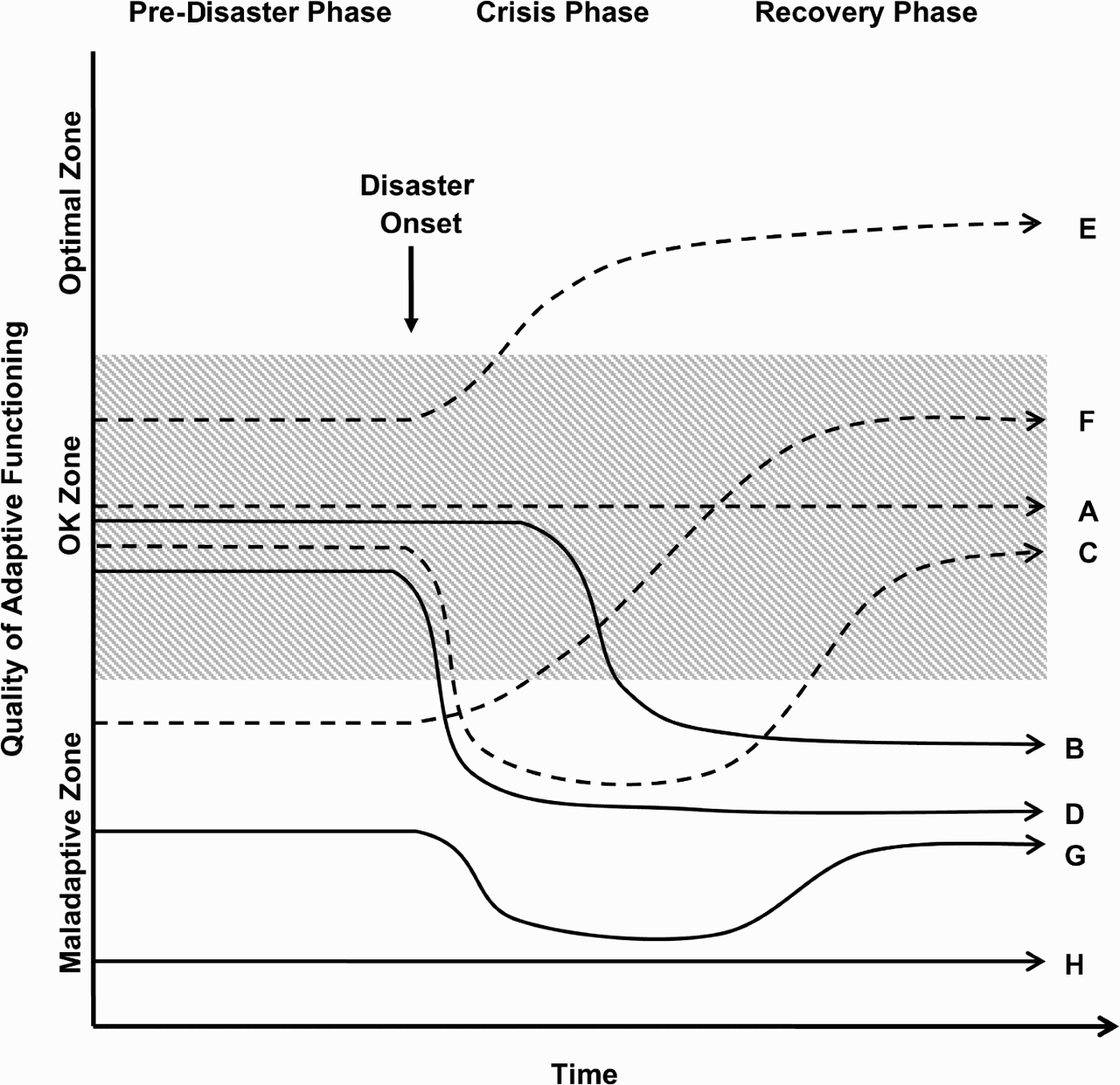
Pathway models of resilience and nonresilience in human behavior were described in early, influential publications by leading investigators in this area (e.g., Rutter, Reference Rutter, Rolf, Masten, Cicchetti, Nuechterlein and Weintraub1990). Later publications illustrated the concept of pathways visually and underscored the idea of different paths. Bonanno (Reference Bonanno2004) as well as publications by our group (Masten, in press; Masten & Obradović, Reference Masten and Obradović2008; Masten & Reed, Reference Masten, Reed, Snyder and Lopez2002) provide visual pathway models that illustrate hypothesized patterns of adaptive function before, during, and after acute or chronic periods of trauma or adversity that challenge the adaptive function of the individual. Our models were rooted in pathway models in developmental psychopathology (e.g., Sroufe, Reference Sroufe1979), and especially the diathesis–stressor pathway models of Gottesman (Reference Gottesman and Pick1974). Figure 1 shows an example of hypothetical pathways of response to an acute onset, massive scale traumatic event, such as a natural disaster or act of terror (Masten & Obradović, Reference Masten and Obradović2008). All dashed paths in the figure represent resilience pathways, varying in form or adaptive level. Continuing to function well after a calamity is illustrated by pathway A, representing resistance or a stress-resistant path. Path C represents a disturbance-with-recovery pathway, reflecting temporary (although sometimes prolonged) breakdown in good function followed by recovery. Path C would be viewed as normative in the case of extreme catastrophe. Paths E and F both show posttraumatic growth or improvements in function, beginning at different initial levels of adaptive function. Maladaptive paths are shown with solid lines, with some showing large, small, or delayed response to the disaster. These paths are depicted as smooth lines for simplicity, but of course observable behavior would not show such a smooth course.
Examples of adaptive and maladaptive pathways in the context of an acute-onset disaster. All paths that end with resilience within the time frame of the figure are shown with dashed lines. A, resistance; B, delayed breakdown; C, disturbance with recovery; D, breakdown without recovery; E and F, positive transformation; G, persistent maladaptive path with disaster-related dip in functioning; H, unresponsive maladaptive pattern, possibly indicating a floor effect. Reprinted from “Disaster Preparation and Recovery: Lessons From Research on Resilience in Human Development,” by A. S. Masten and J. Obradović, Reference Masten and Obradović2008, Ecology and Society, 13, Article 9. Copyright 2008 by A. S. Masten and J. Obradović. Reprinted with permission.
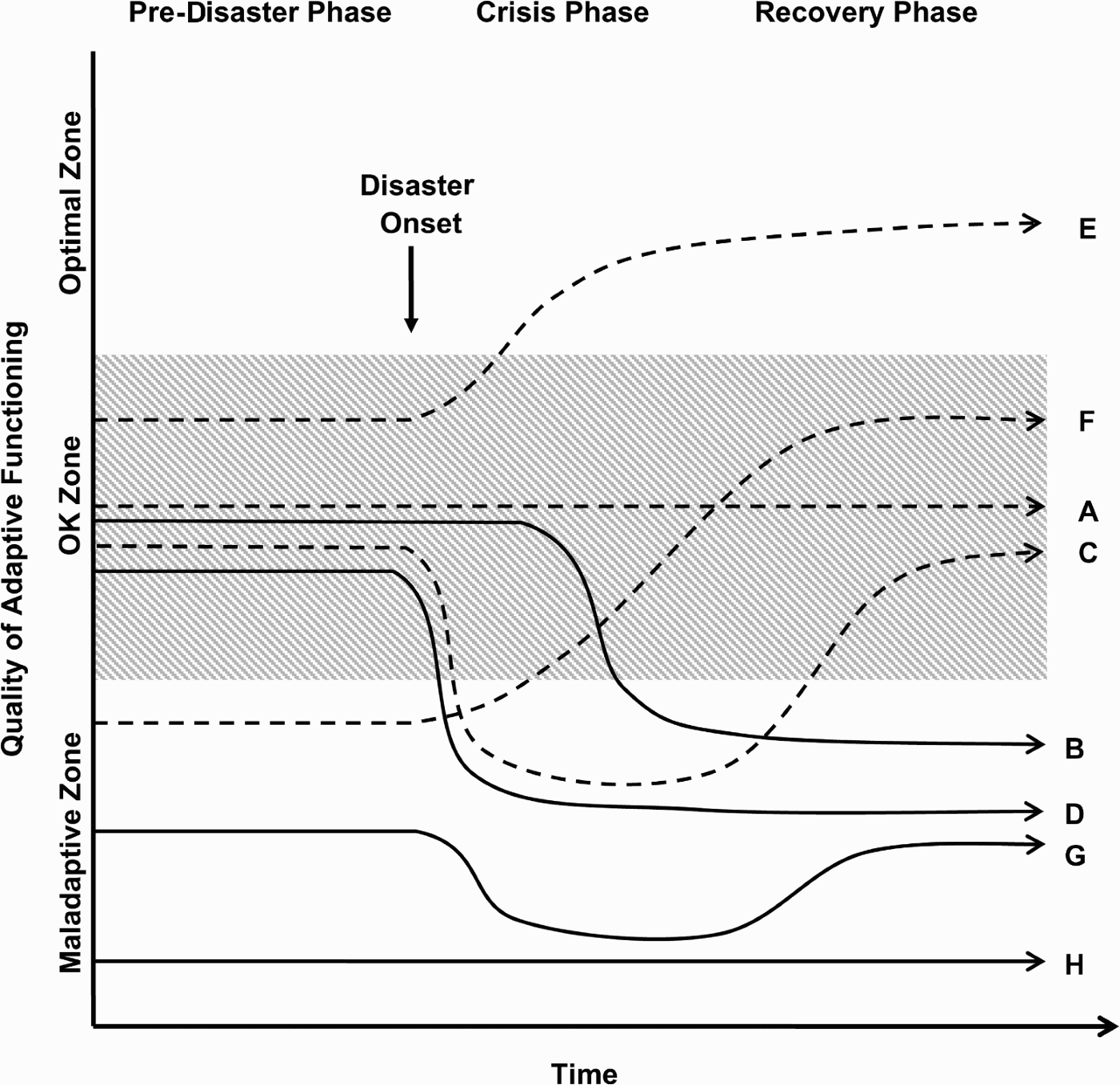
There has been some disagreement in the literature on the boundaries of the resilience concept, particularly in terms of the timing in the case of recovery from disrupted function. In some models, including the pathways depicted in Figure 1, the concept of resilience encompasses recovery patterns that could require considerable time, perhaps because the adversity continues for a long period or because the adaptive systems have been damaged in such a way that restoration requires time. Delayed or prolonged recovery is classified as a different pattern of resilience but included under this broad conceptual umbrella (Masten, in press; Masten & Obradović, Reference Masten and Obradović2008). In contrast, Bonanno (Reference Bonanno2004) differentiates resilience from recovery. In an influential article, Bonanno illustrated prototypical patterns of disruption in normal functioning following trauma exposure, with patterns quite similar to those portrayed here in Figure 1, except that resilience only applied to patterns with initial resistance or very small disturbances in function. Major disturbances in function followed by return to good function after traumatic experiences are distinguished from resilience. Both approaches recognize a similar set of distinct potential pathways of adaptation, but they differ in whether the conception of resilience encompasses recovery (as we do) or not (Bonanno).
Perhaps more surprising is the degree of similarity shown by these various resilience pathway models in the behavioral sciences and independent models that emerged in ecology. In soil science, for example, Tugel et al. (Reference Tugel, Herrick, Brown, Mausbach, Puckett and Hipple2005) illustrated resistance and resilience to disturbances with illustrations that bear a striking resemblance to patterns illustrated by our group and by Bonanno. These similarities suggest some fundamental similarities across diverse sciences on the general meaning of resilience in dynamic systems.
Models of naturally occurring resilience implicitly implicated models for intervention. Intervention could be conceptualized as deliberate efforts to reduce risk exposure, strengthen, or increase compensatory or promotive factors, or moderate the impact of adversity by boosting protection or reducing susceptibility or both. These efforts could be timed for prevention effects before or early in the threat processes or for ameliorative effects or to spur recovery after adversity had already exerted substantial negative effects. These methods of intervention are discussed further below in the framework for intervention.
Methods and measures
Models of resilience suggested methods for analysis and also the targets for measurement. Interest in resilience motivated investigators to measure positive adaptive behavior as well as problems, assets or resources as well as risk factors, and potential protective factors. To operationalize the study of resilience, it was crucial to define and measure positive adaptation. Most investigators were not satisfied with the notion that resilience referred only to fewer symptoms or disorders, and they began to examine positive indicators of adaptation. Our research group focused on the assessment of competence, a concept with deep roots in the history of developmental science, psychiatry, and psychology (Masten, Burt, & Coatsworth, 1995). This focus grew naturally from Garmezy's many decades of research on the significance of competence for the course of psychopathology (Garmezy, Reference Garmezy and Dean1973; Garmezy & Streitman, Reference Garmezy and Streitman1974). Eventually, we would define competence in terms of satisfactory performance in age-salient developmental tasks (Masten & Coatsworth, Reference Masten and Coatsworth1998). We assumed that competence was multidimensional and our studies, along with those of numerous other investigators, would corroborate that assumption (Masten et al., Reference Masten, Coatsworth, Neemann, Gest, Tellegen and Garmezy1995, Reference Masten, Roisman, Long, Burt, Obradović and Riley2005). In school-aged children, for example, we assessed academic achievement, getting along with other children, and rule-governed conduct, using multiple methods and informants. At the time of the early research in Project Competence, so little research had focused on positive development that we often had to develop the tools to match the concepts, adapting or creating methods to expand the assessment of positive behavior. The “Revised Class Play,” for example, was revised primarily to expand the number of positive roles (Masten, Morison, & Pellegrini, Reference Masten, Morison and Pellegrini1985).
Research on the nature and assessment of adaptation also led to interest in the patterns of continuity and change within and across multiple domains of competence and psychopathology within and across time. Eventually, this focus generated a line of work on developmental cascades, focused on the progressive effects over time among domains of adaptive behavior (see Masten & Cicchetti, Reference Masten and Cicchetti2010a, Reference Masten and Cicchetti2010c). Cascade effects have important implications for interventions and their timing (Dodge et al., 2008; Heckman, Reference Heckman2006; Masten, Burt, & Coatsworth, Reference Masten, Burt, Coatsworth, Cicchetti and Cohen2006; Masten & Cicchetti, Reference Masten and Cicchetti2010b). Interventions can be timed and targeted to initiate a positive cascade of consequences or to interrupt a negative cascade before lasting effects spread to other domains. Problems in self-regulation skills associated with early conduct problems, for example, could be addressed in young children before they enter school, to prevent the widely observed effects of poorly regulated attention, emotion, and impulses on learning, peer and teacher relationships once children do enter the school context.
Resilience studies also required assessment of the disturbances to life, which are the threats or trauma or negative life experience or risks, and many methods were developed to assess adverse life experiences. In various Project Competence studies, we developed the Life Events Questionnaire (see Masten et al., Reference Masten, Garmezy, Tellegen, Pellegrini, Larkin and Larsen1988), the Life Events Questionnaire for Adolescents (Masten, Neeman, & Andenas, Reference Masten, Neemann and Andenas1994), a Traumatic Life Events Questionnaire for studies of Cambodian survivors of the Khmer Rouge (Hubbard, Realmuto, Northwood, & Masten, Reference Hubbard, Realmuto, Northwood and Masten1995; Realmuto et al., Reference Realmuto, Masten, Carole, Hubbard, Groteluschen and Chhun1992; Wright, Masten, Northwood, & Hubbard, Reference Wright, Masten, Northwood, Hubbard, Cicchetti and Toth1997), a Lifetime Life Events Questionnaire for homeless families (Masten, Miliotis, Graham-Bermann, Ramirez, & Neeman, 1993) and a number of variations of these for parents and young adults. We also used structured contextual life experience interviews and developed methods for pooling information across methods into life charts for cumulative adversity ratings (Gest, Reed, & Masten, Reference Gest, Reed and Masten1999). Our approach to he assessment of adversity was strongly influenced by the work of Brown and Harris (Reference Brown and Harris1978), Coddington (Reference Coddington1972), and Holmes and Rahe (Reference Holmes and Rahe1967), among others.
Across different populations, our studies of negative life experiences often showed an overall association of adversity exposure and adaptive outcome (both symptoms and competence). For example, our studies of Cambodian youth who survived the revolution and genocide perpetrated by the Khmer Rouge and immigrated to Minnesota, indicated extremely high exposure to severe trauma and atrocities usually not seen except in war. High exposure was associated with age at the time (older children had more exposure) and both lifetime and current posttraumatic stress disorder (Hubbard, Reference Hubbard1997; Realmuto et al., Reference Realmuto, Masten, Carole, Hubbard, Groteluschen and Chhun1992). These effects were consistent with the idea of exposure “dose effects” but also were modest in magnitude. The modest level of the association indicated considerable variability in adaptive function among individuals with apparently similar levels of adversity exposure.
Of course, it is extremely difficult to define and assess “true” exposure to adversity. Not only do individuals perceive and respond differently to the “same” experience, but many other processes enter in to the processes of exposure and response. The complexity of adversity exposure and processes of interaction involved are well illustrated by research on major disasters and traumas involving exposure of many people. Clearly, there are general dose effects (e.g., closer proximity to the devastation is related to more distress) and just as clearly there are differences in the significance of events, depending on many other factors and individual differences, including the cognitive awareness of the person, the behavior of other people, previous trauma experiences, cultural beliefs, and the current context (Masten & Osofsky, Reference Masten and Osofsky2010).
In addition to direct measures of adverse experiences, we also assessed risk factors and cumulative risk indexed by well-established predictors of child problems, such as low maternal education or low socioeconomic status. These risk factors are assumed to index situations with more challenges or fewer resources or some combination of the two for the group of people who share the risk factor. Negative life experiences represent one type of risk factor, but risk is a broader concept, encompassing any kind of predictor of an undesirable outcome. A discussion of risk is beyond the scope of this article (see Obradović, Shaffer, & Masten, in press). However, our approach was strongly influenced by the work of Sameroff (e.g., Sameroff, Reference Sameroff2000; Sameroff & Chandler, Reference Sameroff, Chandler, Horowitz, Hethterington, Scarr-Salapatek and Siegel1975) and Rutter (Reference Rutter, Kent and Rolf1979, Reference Rutter, Rolf, Masten, Cicchetti, Nuechterlein and Weintraub1990), as well as by the risk research in schizophrenia (Gottesman, Reference Gottesman and Pick1974; Watt, Anthony, Wynne, & Rolf, Reference Watt, Anthony, Wynne and Rolf1984). Over the years in various studies, we have created risk gradients based on counting up risk factors in a person's life and looked for “off-gradient” cases of children doing much better (or worse) than one might expect from the level of risk (see Masten & Obradović, Reference Masten and Obradović2006). In some cases, we define risk solely by sociodemographic factors (e.g., education level of parents, income or unemployment, minority status, young age of mother), whereas in others we have combined these with negative life experiences, such as maltreatment.
Our studies of children in homeless families provide examples of risk research and risk gradients. From the outset, we assumed that homelessness was a risk factor for children and our studies, along with many others, corroborate the idea that homelessness indicates an elevated probability of behavioral, educational, and health problems (Samuel, Shinn, & Buckner, 1010). We compared children and their parents who were homeless with similar low-income families who were not currently homeless, which suggested that homeless families represented a more extreme group on a continuum of risk linked to poverty (Masten et al., Reference Masten, Miliotis, Graham-Bermann, Ramirez and Neemann1993). We recently have corroborated this risk continuum with longitudinal data from an urban school district (Obradović et al., Reference Obradović, Long, Cutuli, Chan, Hinz and Heistad2009). Based on growth curve analyses for reading and math on a standardized test, children who were identified as homeless or highly mobile at any time during the period studied showed lower achievement over time than children on free or reduced fee lunch, who in turn had lower achievement than children who were neither homeless nor low income.
At the same time, our studies of homeless families have revealed striking variability within homeless populations, both in the degree of risk and also the level of competence or problems. For example, if one examines individual growth curves for children identified as homeless/highly mobile in the district, the variability becomes evident (see Masten & Sesma, Reference Masten and Sesma1999; Obradović et al., Reference Obradović, Long, Cutuli, Chan, Hinz and Heistad2009). Some children show consistent academic resilience, if one defines resilience as average or better reading or math achievement scores, whereas others show consistent problems, covering a range of 5 SD or more.
The variation could be related to many factors, including differences in key components of resilience (risks, promotive, or protective factors). The circumstances of homeless families vary. “Risk gradients” can be produced by counting known risk factors for child development and then plotting an adaptive criterion of interest (for an example, see Masten & Sesma, Reference Masten and Sesma1999). We have noted that low risk in these graphs typically also implies more assets, because many of the so-called “risk” indicators, excluding traumatic experiences, actually assess a dichotomy or bipolar dimension that could be inverted to index resources or assets (e.g., two-parent household, well-educated parent).
Risk moderators can be tested as well. In a recent study of young homeless children, parenting quality was found to moderate risk (Herbers et al., 2011). When risk was high, parenting quality assessed during a shelter stay had a stronger relation to academic achievement at school in a sample of children entering kindergarten or first grade. With a history of lower risk, current parenting quality appeared to make less of a difference. This result was congruent with either a protective effect of effective parenting for children with higher risk, or the vulnerability of children in this very high-risk situation who are left unprotected by ineffective parenting.
Mediators of risk or assets also can be examined to gain clues about the processes by which hazardous conditions for children undermine adaptive behavior. Economic hardship and the many other risk factors associated with acute or chronic poverty could undermine parenting, which in turn could undermine the development of competence in multiple domains of function that are crucial for positive school adjustment, such as good conduct or self-regulation skills (Masten & Shaffer, Reference Masten, Shaffer, Clarke-Stewart and Dunn2006). Conversely, good parenting in the midst of risk can promote the development of self-control and other school readiness skills that facilitate positive school adaptation. In our current research with homeless families, we are interested in the processes by which effective parents promote resilience, including their role in fostering EF skills. Our early results show that one of the major ways that parenting “goes to school” is via the EF skills of their children. Over the years in our research with homeless families, parenting skills measured by multiple methods have shown strong associations with child cognitive skills and adaptive behavior at school. In recent research, we have found that EF skills (measured by laboratory tasks) mediate the positive association of parenting to academic success in the early grades of school (Herbers et al., 2011).
Resilience investigators were searching for explanations of diverse outcomes under high- risk conditions. Thus, they tried to measure the qualities of person, relationships, or context that might account for this variation. This mission called for broader measures than earlier studies focused exclusively on risk and psychopathology, and dramatic case histories provided early clues to what might matter. However, this search was also guided by a body of knowledge on normative development related to learning, social development, conduct, and achievement in school. In addition to qualities of parenting for promoting resilience in children, there was good reason to consider individual differences in personality (e.g., easy going or stress reactive), intellectual functioning, self-regulation skills, and self-concept, as well as differences in the quality of supportive relationships and socioeconomic advantages (Luthar, Reference Luthar, Cicchetti and Cohen2006; Masten, Burt, & Coatsworth, Reference Masten, Burt, Coatsworth, Cicchetti and Cohen2006). Over the years, many potential explanatory variables would be examined in resilience studies, often with different samples, methods and measures, which led to growing criticism of this literature (Luthar, Cicchetti, & Becker, Reference Luthar, Cicchetti and Becker2000; Masten, Reference Masten, Glantz and Johnson1999). Nonetheless, the findings had considerable consistency, discussed below.
Studies based on person-focused models included single case examples as well as comparisons of groups of people diagnosed by criteria as resilient or not. The case of Sara, for example, described the catastrophic events and recovery in the life of a vulnerable young girl of a mentally ill and homeless mother who entered foster care a few days after birth (Masten & Obradović, Reference Masten and Obradović2006; Masten & O'Connor, Reference Masten and O'Connor1989). Young Sara developed well until the foster father died and she subsequently was removed without warning from this home to a home ill suited to her needs. About 15 months later, when Sara was 30 months old, she was hospitalized with growth failure and many other symptoms. After a full evaluation revealed no medical basis for her condition, a powerful intervention was “prescribed” for her in the form of a well-matched adoption. Sara made a dramatic recovery and continued to develop well through childhood and into adulthood. Sara's growth chart during the years leading up to hospitalization and after adoption illustrate a “catastrophe and recovery” pathway or pattern of resilience, with recovery presumably triggered by intervention. Such cases have compelling and heuristic power, but suffer from generalizability issues. Sara's situation was in many respects unique, and thus there was interest in learning from the aggregation of cases of resilience that would have greater generalizability.
Aggregating larger numbers of cases required a classification system with systematic diagnostic criteria for defining and identifying resilient and other cases. These criteria defined the parameters or thresholds by which individuals would be diagnosed as resilient or not and therefore required two kinds of judgment, as noted above. In the classic version of this approach, a subgroup of adaptive individuals is identified within a larger group of people known to be at risk for problems related to well-established risks or adversity exposure. The high-risk group often was defined by multiple risks. These two groups, the resilient subgroup and the nonresilient remainder, can be compared to test for potential differentiating factors. This requires clear criteria for deciding on positive adaptation or development with the high-risk group.
The seminal study of the children of Kauai by Werner and Smith (Reference Werner and Smith1982, Reference Werner and Smith1992, Reference Werner and Smith2001) offers a classic example of what can be gleaned from identifying and comparing subgroups of children with similarly high-risk levels and diverging patterns of development. A sample of children from this birth cohort with multiple risk factors for developmental problems (e.g., early poverty, family conflict) were grouped by how well they were doing in expected domains of competence and mental health around ages 10, 18, and later as young adults. Those who were succeeding in life at the time of evaluation could be compared to those who were struggling. Early and late bloomers could be compared as well. Many of the individual and family variables that differentiated the resilient from their nonresilient peers in this study have been corroborated in numerous studies over the years, including the quality of parent–child relationship, self-confidence, motivation, appealing personalities, beliefs that life was meaningful, and supportive relationships with relatives and others in the community.
Many subsequent studies have followed this straightforward approach for gaining initial ideas about “what makes a difference” for resilience. It is well suited to early-stage studies of resilience, when there are specific threat situations or when comparable low-risk comparison groups are not available or feasible. A recent example is provided by Obradović (Reference Obradović2010), who compared young homeless children (families recruited in an emergency shelter) who were relatively successful in school (learning, getting along with peers and teacher, behaving appropriately in the classroom) to peers from the shelter who struggled at school, in order to test the hypothesis that executive function (EF) skills, and more specifically inhibitory control skills measured by EF tasks, might make a difference for these homeless/highly mobile children. Results supported this hypothesis, with substantial group differences observed between the resilient and nonresilient group of children. Without the low-risk groups, however, it is not clear whether EF function plays a special role in very high risk situations such as homelessness or whether there is simply an pervasive association of EF with the quality of adaptation at school that would also be observed in low risk groups. Adding low-risk groups to the diagnostic models clarifies whether the differences between resilient and less adaptive groups are particularly large when risk is high or about the same at any level of risk. Differential effects when risk is high versus low suggest moderator effects.
In the Project Competence longitudinal study of competence and resilience, the diagnostic model was expanded to include low-risk groups, specifically to examine the similarities and differences among high- and low-risk groups that varied in outcome. This longitudinal study followed a group of 205 children from the elementary school years into adulthood, with assessments after 7, 10, and 20 years (to date; see Masten & Powell, Reference Masten, Powell and Luthar2003; or Masten et al., Reference Masten, Burt, Roisman, Obradović, Long and Tellegen2004, Reference Masten, Roisman, Long, Burt, Obradović and Riley2005). The cohort was a community sample of urban school children typical of the children attending the public schools at the time, with wide-ranging exposure to adversity. Adaptation was defined in terms of competence in age-salient developmental tasks, which in adolescence included academic achievement, friendship, and rule-abiding (vs. antisocial) behavior (Masten et al., Reference Masten, Hubbard, Gest, Tellegen, Garmezy and Ramirez1999). Adversity was based on information compiled across multiple measures (over time) and then rated by independent judges (see Gest et al., Reference Gest, Reed and Masten1999). The cohort could be placed into categories of resilience (high adversity with good adaptation), competence (low adversity with good adaptation), maladaptation (high adversity with poor adaptation), and vulnerability (low adversity with poor adaptation). Groups then could be compared on a number of potential differences in the person or their relationships. Many differences have been found in this study between the maladaptive and the two adaptive groups (competent and resilient groups), whereas many similarities have been observed between the latter two groups. These results indicated that the young people who did well despite exposure to high adversity had many of the same resources as their peers from lower risk backgrounds (e.g., good parenting, good intellectual skills), whereas the maladaptive young people faced very high adversity with limited adaptive tools or supports. Very few of the participants in this study of an urban school-based cohort fell into the “vulnerability” category, which could be described as a nearly empty cell (Masten et al., Reference Masten, Hubbard, Gest, Tellegen, Garmezy and Ramirez1999). In this cohort, maladaptive behavior was typically associated with a combination of high adversity and low human or social capital; when adversity was very low, maladaptive outcomes were uncommon. Results from our study, very distant in miles and culture from Kauai, implicated many of the same predictors of competence and resilience.
Young people could change category over time and these changes often coincided with life changes and turning points (see Masten et al., Reference Masten, Burt, Roisman, Obradović, Long and Tellegen2004). “Late bloomers” were observed, whose lives changed course between adolescence and young adulthood, a phenomenon observed in other longitudinal studies of resilience as well (see Werner & Smith, Reference Werner and Smith2001). Young people who would move from the maladaptive to the resilient category between adolescence and young adulthood assessments 10 years later were already beginning to show differences from peers who would exhibit continuity of maladaptation over the same transition. These late bloomers scored significantly higher on variables indexing planfulness and motivation for the future, autonomy, and adult support. Results were consistent with the possibility that emerging adulthood offers a window of opportunity for changing developmental direction if opportunities and protective influences converge (Masten, Obradović, & Burt, Reference Masten, Obradović, Burt, Arnett and Tanner2006; Schulenberg, Sameroff, & Cicchetti, Reference Schulenberg, Sameroff and Cicchetti2004). Late bloomers also suggest different pathways to resilience in adulthood for young people who grow up with severe adversity exposure, although the study of categorical change is not an ideal method for examining dynamic trajectories of resilience.
Mediating effects could also be tested through these multivariate methods, in an effort to gain an understanding of risk or promotive processes. One could study how adversity or risk might indirectly effect outcomes through changing another key component of a person's life, such as undermining parenting quality, or how an asset might enhance the same key component. Mediating effects would be important for developing the models tested in intervention experiments.
Intervention can be conceptualized as promoting resilience (or recovery) in children at risk for (or already showing) psychopathology and related problems. Thus, from a resilience perspective, intervention experiments could be viewed as tests of resilience theory or hypotheses about specific protective processes. Prevention scientists recognized early that resilience models could guide their work, suggesting that “cumulative protections” were needed to counter high cumulative risk and that promoting competence prevented problems (Cicchetti et al., Reference Cicchetti, Rappaport, Sandler and Weissberg2000; Coie et al., 1993; Hawkins & Catalano, Reference Hawkins and Catalano1992; Nation et al., Reference Nation, Crusto, Wandersman, Kumpfer, Seybolt and Morrissey-Kane2003; Toth, Pianta, & Erickson, in press; Wang & Gordon, Reference Wang and Gordon1994; Wyman, Sandler, Wolchik, & Nelson, Reference Wyman, Sandler, Wolchik, Nelson, Cicchetti, Rappaport, Sandler and Weissberg2000; Yoshikawa, Reference Yoshikawa1994). Prevention scientists and resilience investigators also shared a strong focus on competence and its assessment, which often was monitored in prevention studies, both as target of change and outcome of interest.
Multilevel dynamics
The final aspect of the resilience framework for research recognizes the role of multiple levels of interaction in the shaping of adaptation and development in resilience. This perspective is an inherent part of a developmental systems approach to resilience and research (Cicchetti & Curtis, Reference Cicchetti and Curtis2007; Masten, Reference Masten2007). Resilience is assumed to emerge from interactions that cross-levels of function (multilevel dynamics), and thus can be examined at many levels of analysis. For many years resilience research focused on behavior and social levels of analysis and interactions of individuals and people in their microsystems (e.g., families, peers, schools), although other levels were important in theory. Despite calls for resilience research grounded in human biology and neuroscience (Cicchetti & Curtis, Reference Cicchetti, Curtis, Cicchetti and Cohen2006; Curtis & Cicchetti, Reference Curtis and Cicchetti2003; Masten & Curtis, Reference Masten and Curtis2000), these levels were acknowledged but rarely studied. Similarly, resilience studies grounded in cultural context were neglected (Luthar, Reference Luthar, Cicchetti and Cohen2006; Masten & Wright, Reference Masten, Wright, Reich, Zautra and Hall2010). This has changed with the rise of the “fourth wave” of resilience science (Masten, Reference Masten2007), which is focused on multilevel analyses and integration (Cicchetti, Reference Cicchetti2010; Cicchetti & Curtis, Reference Cicchetti and Curtis2007; Masten & Wright, Reference Masten, Wright, Reich, Zautra and Hall2010). New tools for measuring genes, brain function, and the complexities of complex systems spurred this wave, and interest in biology, neurology, the social ecology, and the economics of resilience is rapidly spreading. At the same time, there is growing attention to the role of culture and context.
Concerns about global threats to humanity played an important role in motivating the integrative studies of resilience across levels and disciplines (Masten & Obradović, Reference Masten and Obradović2008). Globalization and growing concerns about climate change, international financial crises, flu pandemic, war, terrorism, and natural disasters highlighted the multisystem nature of catastrophic adversities affecting potentially large numbers of people. Ecologists, psychologists, physicians, economists, computer scientists, engineers and many other professionals were asked to sit down at the same table to address these concerns and more specifically to plan and prepare for response and particularly to promote resilience in the context of major disasters. As part of a small network on “Building an Interdisciplinary Study of Resilience,” funded by the National Science Foundation initiative on Human and Social Dynamics, the author worked with a group of senior and junior scholars to begin the formidable task of building a conversation across disciplines on resilience, along with a scalable language for resilience research. Initial results of that effort were published in the journal, Society and Ecology in a 2010 special feature on “Managing Surprises in Complex Systems: Multidisciplinary Perspectives on Resilience” (see Longstaff, Reference Longstaff2009).
Evidence of the growing interest in resilience across disciplines and scales is widespread. In 2008 the first international conference on resilience was held in Stockholm, sponsored by the Swedish Academy of Sciences and the Resilience Alliance. The second will be held in 2011 in Arizona. There is a six nation effort to reframe public service delivery based on resilience principles, in an effort called The New Synthesis (http://www.ns6newsynthesis.com). Books on resilience are burgeoning across diverse fields, including economics, business, medicine, public policy, ecology, and many others.
Concluding note on the research framework
The resilience framework for research continues to develop, but much has been accomplished in the past four decades of research pursued within this framework. The yield cannot be summarized here, but it has been reviewed extensively by numerous scholars over the years (for recent reviews, see Cicchetti, Reference Cicchetti2010; Feder, Nestler, & Charney, 2010; Luthar, Reference Luthar, Cicchetti and Cohen2006; Masten, Reference Masten2007, in press; Rutter, Reference Rutter2006). As research proceeded, however, the need for intervention guided by a resilience framework did not abate.
A Framework for Promoting Resilience
Although resilience science expanded rapidly, knowledge accumulates with frustrating slowness in relation to the urgent needs of children and youth threatened with adversity across the globe. Children suffering now or threatened with imminent harm cannot wait for definitive science and experimental evidence on what works best for every child and situation. Thus, from nearly the outset of resilience research, scientists have been asked for evidence-based recommendations and practitioners have translated the admittedly incomplete science into action. This ongoing translation process has transformed practice and the conceptual framework for intervention in diverse fields focused on promoting child welfare and development, particularly among children at risk because of psychosocial disadvantages or traumatic experiences. This shift reflects a fundamental change away from deficit-focused models toward strength-based or competence-focused models. Examples include the focus on enhancing competence or wellness in prevention science (Cicchetti et al., Reference Cicchetti, Rappaport, Sandler and Weissberg2000; Greenberg, Reference Greenberg2006); the strength-based school counseling movement (Akos & Galassi, Reference Akos and Galassi2008; Masten, Herbers, Cutuli, & Lafavor, Reference Masten, Herbers, Cutuli and Lafavor2008); the “Looking After Children” child welfare movement (Flynn et al., Reference Flynn, Dudding and Barber2006); and the growing emphasis on resilience and recovery in medicine (e.g., Madden & Basting, Reference Madden and Basting2010; Southwick, Litz, Charney, & Friedman, in press), family practice (Walsh, Reference Walsh2006), and other fields.
The resilience framework that emerged for research, described above, had parallel implications for conceptualizing efforts to support or boost resilience through intervention. In addition, however, many lessons were learned in the trenches of translation, gleaned from the work of many scholars and practitioners over the years, and these lessons have shaped this working framework for translating resilience science into action.
Mission: Frame-positive goals
A basic “take home” from research on resilience, both basic and applied, was the power of positive objectives. Although largely anecdotal, this observation is widely reported (for reports on the transformative effects of the Looking After Children child welfare reform movement on clients and social workers, see Flynn et al., Reference Flynn, Dudding and Barber2006). Researchers find community partners more supportive of research aiming to understand or promote positive outcomes in young people at risk. Stakeholders, including parents and young people, are more enthusiastic about research and intervention framed in positive goals with a focus on measuring progress toward those goals. Staff morale and motivation improve when models shift away from a deficit-focus to strength-based approaches and progress to positive goals is rewarded at every level in a system.
Models: Include positive influences and outcomes in models of change
Resilience models also highlighted positive processes and outcomes that had been omitted or overlooked in earlier models of intervention that focused narrowly on risks, vulnerability, symptoms, and disorder. This does not mean that risks and problems are ignored, but rather that a broader array of strategies for change are considered, including some of the most powerful engines for human adaptation and development (Masten, Reference Masten2001, Reference Masten2007). Prevention science and programs promoting positive youth development were early adopters of broader models, with the growing realization that preventing problems before they developed also meant fostering competence and healthy development (Cicchetti et al., Reference Cicchetti, Rappaport, Sandler and Weissberg2000; Greenberg, Reference Greenberg2006; Masten, Burt, & Coatsworth, Reference Masten, Burt, Coatsworth, Cicchetti and Cohen2006; Reynolds & Ou, Reference Reynolds, Ou and Luthar2003; Weissberg, Kumpfer, & Seligman, Reference Weissberg, Kumpfer and Seligman2003). Promoting competence as a prevention strategy also holds the potential for initiating positive developmental cascades, as noted above, with evidence mounting in support of the idea that competence begets competence, with effects that spread or snowball (Heckman, Reference Heckman2006; Masten & Cicchetti, Reference Masten and Cicchetti2010a, Reference Masten and Cicchetti2010c; Masten et al., Reference Masten, Roisman, Long, Burt, Obradović and Riley2005).
Resilience models also underscored the importance of tracking progress in terms of positive development and achievements in expected developmental tasks, along with improvements in symptoms. Broadening the assessment of change highlights the effects as well as the limitations of intervention, and may reveal unanticipated benefits.
Measures: Include positive indicators of resources and change
Assessments of change in targeted (and untargeted) processes or outcomes are particularly important for testing and refining the theories of change behind intervention design and development. The shift in focus to positive processes and positive outcomes required better assessment of developmental task domains of development, as well as indicators of change in targeted adaptive systems, such as parenting.
One of the key contributions of resilience research was focusing greater attention on reliable and valid, developmentally appropriate measurement of positive behavior and outcomes (Masten & Obradović, Reference Masten and Obradović2006). Measures were expanded and improved, although there continues to be great need for culturally appropriate measures that assess well being and competence, particularly for international research. In many cases, tools were developed for practice. For example, the implementation of the Looking After Children child welfare model required new tools for assessing progress in the “seven developmental dimensions of well-being,” which led to a comprehensive set of assessment tools known as the Assessment and Action Record (see Flynn et al., Reference Flynn, Dudding and Barber2006). There was a similar need for retooling as the goals and standards of school counseling practice shifted away from a deficit-focused model to a competence-promoting model for all students (Galassi & Akos, Reference Galassi and Akos2007; American School Counselor Association [ASCA], 2004). The ASCA National Standards set a national goal of building a set of competencies in all students and the strength-based school counseling model and its proponents set forth methods for operationalizing the standards that required reliable and valid assessments of these competences (Akos & Galassi, Reference Akos and Galassi2008).
Methods: Consider multiple approaches and systems
Resilience models suggest a number of distinctly different approaches to intervention, depending on timing, targets, and theory of change. Main effect models, for example, suggest the possibilities of reducing risk or boosting assets. Interaction models suggest the possibility of reducing vulnerability influences or boosting protective influences, as well as the possibility of tailoring interventions to susceptibilities or strengths of the person.
Interventions targeting risk aim to reduce or eliminate exposure to conditions that have the potential to threaten function or development. Examples include interventions as diverse as prenatal care (to prevent premature birth or low birth weight), treating maternal depression or maltreatment (to prevent the consequences for development), removing land mines, preventing homelessness, and ending wars. These strategies all target harm reduction from well-established risks before damaging effects (or full harmful impact) can occur. In contrast, interventions targeting assets or resources aim to increase potential promotive or compensatory factors, such as food, medical care, homes, income, schools, tutors, books, recreation centers, neighborhood safety, and effective teachers. Adding such assets would be expected to contribute to positive adaptation in most children and youth and not just high-risk children. This strategy does not represent attempts to intervene directly into the function or development of a key adaptive system, although it might have that effect for some children.
Intervening to alter powerful moderators could target change in vulnerability or protections or both. Mobilizing or improving adaptive systems is the most ambitious form of intervention, designed to increase the enduring capacity of the person for development and resilience. The case of Sara illustrates the power of this kind of intervention, where the goal is to mobilize or restore one of the fundamental systems for human development, in that case the attachment relationships and security afforded by a loving and competent family. Interventions that target change in attachment relationships, parenting, self-efficacy or mastery motivation, emotional or behavioral self-regulation, and problem-solving ability are directed at fundamental human adaptive systems. The resilience literature strongly suggests that when these adaptive systems are operating well, capacity for resilience in the face of challenge will be good (Masten, Reference Masten2001, Reference Masten2007, in press). Moreover, these systems are the major engines of human development, so that even in the absence of significant challenges, these systems generate learning and adaptive competence.
Given the many interacting systems that play a role in human life, there are many systems and levels to consider as potential targets for boosting the odds of resilience. These possibilities continually evolve with ongoing science. As knowledge of genetic moderators and the processes by which they work increases, it may be possible to eliminate vulnerability or boost resilience through gene replacements or changes we can only begin to imagine at this date. As more is learned about the role of prenatal and later experiences in the development and programming of adaptive systems, it may be possible to intervene to protect these systems or to reorganize how they work.
Resilience research also suggested that developmental timing plays a role in resilience and must be considered in intervention. Young children and adolescents will have different experiences in war and disaster, different capacities and supports for responding, and different responses to interventions. Moreover, there appears to be windows of opportunity when the leverage for change is greater, including developmental transitions and times of concentrated change for other reasons. Tailoring interventions to optimize developmental timing is likely to result in better outcomes (Toth & Cicchetti, Reference Toth, Cicchetti, Russ and Ollendick1999).
Multiple levels and disciplines: Collaborate for change
Resilience appears to arise from complex interactions among many systems of a person's life, from the molecular to the global. Most interventions will target change in a few levels at most. Nonetheless, even in the simplest case, it is likely that multidisciplinary perspectives and collaborations will be informative. Intervention expertise tends to cluster around specific domains or levels of adaptive processes, as does research expertise. Collaboration is challenging at best, but teams may be required to develop and implement the most effective interventions, particularly for innovative approaches.
An example is provided by our recent collaborative efforts to understand and promote resilience in young homeless children, working closely with shelter providers, nursery school teachers from shelters and local schools, the school district, experts in curriculum design for preschoolers, as well as researchers with expertise in EF and its neural correlates, the neurobiology of stress, dyadic assessment, parent training, prevention design, competence, and resilience. Early stages of this research were focused on developing the collaboration and the tools for assessment, corroborating the importance of EF skills and parenting as potentially malleable predictors of resilience, and building both research and intervention capacity on site, including the establishment of labs and preschool programming for children in shelter. Now the agenda has shifted to small experiments to test the feasibility and short-term effect of efforts to change EF skills in the children. Individual components of intervention (e.g., preschool curriculum, parent education, or one-on-one training) are developed, field tested, and refined with the goal of building tools for change based on theory and basic research but also appealing and suitable to the context. Teachers with extensive experience in preschool work with homeless children, as well as parents, inform this process, as do leading scholars from the university. This process appears to work from the perspective of the practices and research under development; and the enthusiasm of the families, teachers, agencies, and researchers involved underscores the benefits of this kind of collaboration.
Next steps: Translational synergy
The framework that shaped empirical studies of resilience yielded models, methods, and findings, along with controversies and many new questions and hypotheses for study. This body of work includes intervention studies (the third wave), although the speed of progress at best might be described as “measured.” Necessity gave rise to a parallel framework that has guided applications aimed at promoting resilience, often without the benefit of evaluation, much less the gold standard of testing by a randomized, controlled design. Yet the transformation of intervention models within a resilience framework continues unabated, as if a body of compelling evidence was growing apace. Clearly, the applied framework has appeal, but how sustainable is the transformation without the evidence to back it up, especially in an era of slim budgets and accountability? A new synthesis is required to blaze a trail for translational resilience research that accelerates simultaneously the theoretical and practical knowledge on resilience. What follows is a first step in outlining the shape of this emerging synthesis.
The original mission of resilience science serves this purpose well, with a slight adjustment. Instead of delineating the goal as “understanding resilience well enough to promote it,” the reformulated goal is to promote resilience well enough to understand it. In other words, the mission of this new work is to increase knowledge on resilience processes through deliberate and theory-informative change research.
The models for change also require very little adjustment. They will center on hypothesized resilience processes that are targeted for change. That could mean adding specific resources to counteract specific threats, such as a safety plan for families living in a hurricane or a war zone, or targeting a fundamental adaptive system, such as changing the quality of an attachment relationship, increasing self-efficacy, or boosting the capacity for effective self-control. The theory of the intervention must be delineated to make clear what change is targeted and how this is expected to change the outcome of interest.
Methods and measures of many kinds will be considered to balance the dual requirements of practical utility and theory-informative designs. Design will of necessity be forged in the field but also in the context of collaborating scientists and practitioners who develop and refine interventions together. Measures will have to be contextually appropriate and efficient, as well as reliable and valid. University-based efficacy trials will continue to have a place in basic resilience research. Similarly, innovative applications of resilience theory to emergent field situations, such as refugee camps after disasters, will continue to have a place in the application of resilience models. However, the mission for the new translational research agenda requires something in between these two extremes.
Multiple partners working collaboratively are required for this purpose, bringing different kinds of expertise to the table and the translational process (cf. Toth, Manly, & Nilsen, Reference Toth, Manly and Nilsen2008). These areas of expertise will depend on the goals of the work, but might include expertise on the culture of the participants or the nature of the context for the work, the community systems that must cooperate for effective implementation or assessment, the resilience theory pertinent to the targets for change (ideally with the perspective of multiple levels or systems that may be involved), the measures that are needed, or the most promising methods that have shown promise in regard to the change targets. Mutual respect and commitment to the process also must come to the table along with the partners. Translational synergy is expected from the ongoing interaction among the experts, as they move down the path together, learning from successes and failures of theoretical and practical kinds.
Intervention will need to be defined as an iterative process, continually informed by data from change experiments, large or small. Small probes in a change process could prove to be as informative as large-scale efforts to change the course of development. Lessons learned from each step along the way will be shared among partners and stakeholders, as well as through publications and presentations to peers. The so-called “translational gap” between gains in knowledge and their application to benefit children or families, as well as the gaps between field lessons and theory, both with respect to time and communication, can be eliminated by this approach.
This emerging translational framework for accelerating progress on resilience and its applications already has quiet champions that lead the way by their example. Their work as pathfinders is demonstrating the benefits to practice and science that accrue when collaborative teams embedded in a matrix of practical theory and theoretical practice work together to promote resilience.