INTRODUCTION
Offering psychological support to families and caregivers is an integral element of palliative care for advanced cancer patients. The challenge for healthcare professionals is to make palliative care treatment accessible to all patients with advanced life-threatening illnesses, including elderly patients with such progressive diseases as dementia, in order to guarantee quality of care at the end of life (WHO, 2002).
The World Health Organization (WHO), considers palliative care an interdisciplinary approach provided to improve the quality of end-of-life care for patients and their families that includes preventing and relieving physical, psychosocial, and spiritual issues that cause suffering (WHO, 2002). This situation has been complicated due to the absence of a straightforward model of how palliative care should be provided to patients with advanced dementia (Hughes et al., Reference Hughes, Jolley and Jordan2007).
Palliative care has been proved to be beneficial for patients with advanced dementia when they experience a range of complicated symptoms and the suffering associated with a short life expectancy. These symptoms were similar to the progression of other chronic diseases in patients with reduced survival rates (Rexach, Reference Rexach2012). The pattern of distressing symptoms in advanced dementia is similar to that in patients with terminal cancer, both of which should be understood as precursors of death (Mitchell et al., Reference Mitchell, Teno and Kiely2009). A retrospective study comparing symptoms suffered in the final year of life between dementia patients and cancer patients showed common symptom burden and similar health care needs (McCarthy et al., Reference McCarthy, Addington-Hall and Altmann1997). However, while the advanced stages of dementia may be recognized as a terminal condition, healthcare professionals often fail to adopt a palliative approach to patient care that would recognize the end of life in advanced dementia (Campbell et al., Reference Campbell and Guzman2004; Mitchell et al., Reference Mitchell, Kiely and Hamel2004; Formiga et al., Reference Formiga, Vidaller and Mascaró2005).
The failure to recognize these key indicators of imminent death in dementia could explain why deaths from dementia are more likely to take place in a nursing home (61%) compared with deaths from cancer, which frequently (70%) occurred at home, in a hospital, or in a hospice, considering that these were institutional forms of palliative care (Houttekier et al., Reference Houttekier, Cohen and Bilsen2010).
With regard to the quality of end-of-life care in the elderly in Europe, patients dying from dementia or from nonmalignant diseases are most frequently left without support from specialized palliative healthcare providers, while patients dying from cancer are not. In addition, support for family caregivers may not be viewed as a priority (McCarthy et al., Reference McCarthy, Addington-Hall and Altmann1997; Piers et al., Reference Piers, Pautex and Curale2010). Sampson and colleagues (Reference Sampson, Gould and Lee2006) reported that patients with end-stage dementia were less likely referred to palliative care teams than patients with other non-oncological end-stage disease (9 vs. 25%), and that dementia patients were prescribed fewer palliative medications (28 vs. 51%). Some investigators have found that it is important to provide measures of comfort and improve patient quality of life (e.g., Cordner et al., Reference Cordner, Blass and Rabins2010) for patients with advanced dementia and a terminal prognosis, since this lessens the psychological distress of their families (Rexach, Reference Rexach2012; Kiely et al., Reference Kiely, Prigerson and Mitchell2008), as worsened patient discomfort contributes to increased caregiver distress and burden of caring (Given et al., Reference Given, Stommel and Given1993; Harding et al., Reference Harding, Higginson and Donaldson2003). Especially in dementia patients, palliative care should not merely provide patient comfort in terms of symptom relief, but it should also include their families, who often have suffered the burden of care for many years. Likewise, the caregivers' emotional fragility can be affected by the unpredictable course of the disease. The periods of stability in dementia patients can be interrupted by acute exacerbations, in contrast to the usually inevitable but predictable decline of advanced cancer.
Caregiver distress includes the emotional state felt with respect to an ill relative. These feelings can encompass anger, anxiety, guilt, and depression. Caregiver burden is related to the impact of taking care of a relative (Vernooij-Dassen et al., Reference Vernooij-Dassen, Draskovic and Downs2011). This is a multidimensional construct that involves the physical, social, financial, and emotional components of a caregiver's function (Higginson et al., Reference Higginson, Gao and Jackson2010).
Based on the above-mentioned studies, there is a great need for palliative care at the end of life for patients with dementia and their caregivers that are not being met, or even being accorded due regard. Our study aimed to describe caregivers' psychological distress during end-of-life care in cancer and the final stage of dementia, and to compare caregiver burden related to these two advanced illnesses.
METHODS
Our study included caregivers recruited at the Antic Hospital Sant Jaume i Santa Magdalena, which is a socio-health center in Barcelona, Spain. Participants were identified from two departments at the hospital—palliative care and psychogeriatrics. Data were recorded on patients admitted to each unit from January 2009 to December 2011.
To be eligible, participants needed to: (1) be the primary caregiver (identified by the patient or by nursing staff), the person most involved in actual care; (2) have an ill relative admitted to an acute medical ward with either end-stage metastatic cancer or advanced primary dementia whose prognosis was considered to be less than 6 months; (3) be 18 years of age or older; and (4) be able to understand the study and read the questionnaires. An assessment was done at least one day after the patient was admitted to the hospital. The criteria for defining end-stage dementia were based on the medical guidelines of the National Hospice and Palliative Care Organization for determining a prognosis of dementia and eligibility for hospice care. This included a Functional Assessment Staging (FAST) of stage 7b or worse, as determined by a physician, in addition to the presence of medical complications (e.g., aspiration pneumonia, sepsis, pressures ulcers) (National Hospice Organization, 1996). Permission to conduct this study was received from the institutional review board at the Antic Hospital and was approved by their research ethics committees. All participants enrolled in the study provided a signed informed consent form.
Procedure
Family caregivers were recruited and invited to participate in the study. All eligible caregivers were informed about the objectives of the study before being asked to complete the questionnaires, and then signed consent forms. Caregivers were interviewed by a clinical psychologist in a private area without the patients being present. Subjects offered data on their sociodemographic characteristics and were asked to complete the self-reporting instruments. Carers completed questionnaires by themselves, with an interviewer available for questions at all times. The assessment protocol lasted 10 to 20 minutes.
Measurements
The demographic questionnaire collected data about the patient's sociodemographic characteristics and medical status. Patient characteristics and disease-related variables included gender, age, diagnosis, and length of stay in the hospital. The characteristics of caregivers were registered—including gender, age, and relationship—along with the patient.
Caregiver burden was assessed with the Zarit Burden Inventory (ZBI), short form version. It is a validated seven-item questionnaire that has been found to be appropriate for measuring caregiver burden in palliative care (Higginson et al., Reference Higginson, Gao and Jackson2010). Responses to each item were on a five-point (0–4) Likert scale. Gort and colleagues (Reference Gort, March and Gómez2005) found the ZBI-7 short form to be strongly valid and internally consistent, identifying a cutoff score of 17 or higher to discriminate clinically significant burden.
Different instruments for assessment of psychological distress were utilized in each caregiver group, because our study was part of a previous project about caregiver psychological distress in a palliative care unit. Caregivers of dementia patients completed the General Health Questionnaire (GHQ-28), which is employed to assess morbidity in four dimensions: depression, anxiety-related symptoms, social dysfunction, and somatic symptoms (seven items each). The items were rated on a four-point Likert scale. A cutoff score of 5/6 was utilized to discriminate clinically significant morbidity, which had been validated in a Spanish population with acceptable psychometric properties (Lobo et al., Reference Lobo, Pérez-Echeverría and Artal1986).
In cancer patient caregivers, psychological distress was measured with the Hospital Anxiety and Depression Scale (HADS) (Zigmond & Snaith, Reference Zigmond and Snaith1983). This is a 14-item instrument to measure depression and anxiety symptomatology. Each item was rated on a four-point scale from 0 to 3. The HADS has been previously validated and has good internal consistency with Spanish cancer patients (Quintana et al., Reference Quintana, Padierna and Esteban2003). An optimal cutoff score of 12 or higher was used to identify clinically significant distress in a Spanish population (Herrero et al., Reference Herrero, Blanch and Peri2003).
Although psychological distress was measured for each group of caregivers with different instruments, empirical studies have evidenced no significant differences between the GHQ and the HADS (z = 0.13; p = 0.9) in their ability to detect minor psychiatric disorders (Lewis & Wessely, Reference Lewis and Wessely1990); nor have any significant differences been evinced between the GHQ and the HADS depression (z = –0.58; p = 0.56) and anxiety (z = –01.15; p = 0.25) subscales in their ability to detect clinical cases of depression or anxiety symptomatology (O'Rourke et al., Reference O'Rourke, MacHale and Signorini1998). Moreover, no significant differences were found in a palliative care setting between the two screening instruments for detection of psychological distress (Le Fevre et al., Reference Le Fevre, Devereux and Smith1999).
Statistical Analysis
Descriptive statistics have been reported to characterize the sample. Considering each caregiver sample (cancer and dementia patients) separately, linear regression analyses were utilized to calculate the variance explained by psychological distress in the dependent variable (caregiver burden). Regression analyses were performed controlling for caregiver age, gender, and relationship to patients. A t test was then used to compare differences between samples in terms of caregiver burden. For all statistical tests, a p score <0.01 was considered statistically significant. Statistical analyses were conducted using the Statistical Package for Social Sciences (SPSS, version 15).
RESULTS
Subjects
Originally, 69 caregivers of dementia patients and 78 caregivers of cancer patients were approached, and 9 dementia caregivers and 11 cancer caregivers declined to participate. The main reasons for not filling out the questionnaire included disinterest in the study (n = 3 in each caregiver sample), patient's death (n = 5 in dementia, n = 7 in cancer), and or failure to hand in questionnaires (n = 1 in each caregiver sample). The remaining 60 (86.95%) caregivers of dementia patients and 67 (85.89%) of cancer patients participated.
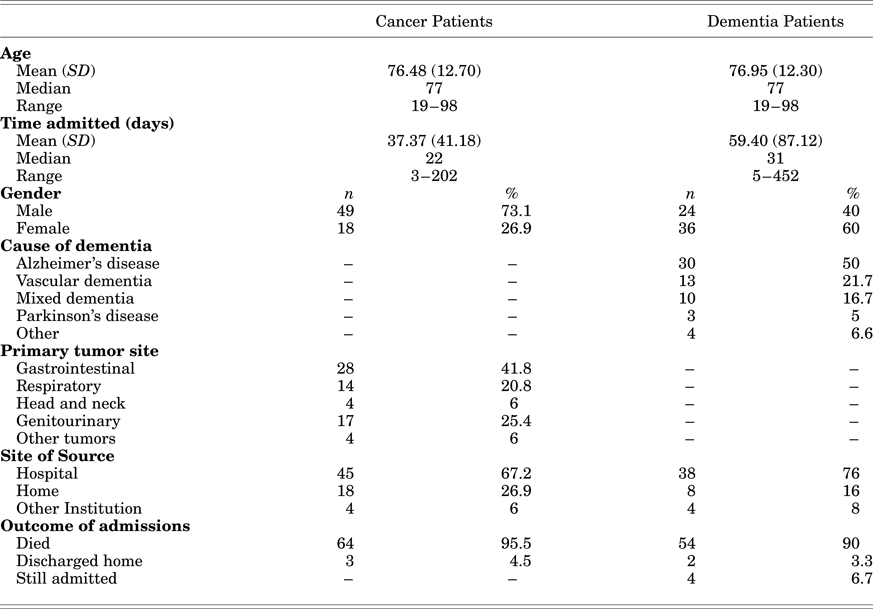
The median age of patients was 76.7 years (SD = 12.42); there were 73 men (57.5%). Regarding the patients admitted, 118 died (92.9%) in hospital; the patients discharged alive were either sent home or transferred to other departments of the hospital. The mean duration of hospital stay for all patients was 46.68 days (SD = 65.27). These data are presented in Table 1.
Patient sociodemographic and clinical characteristics

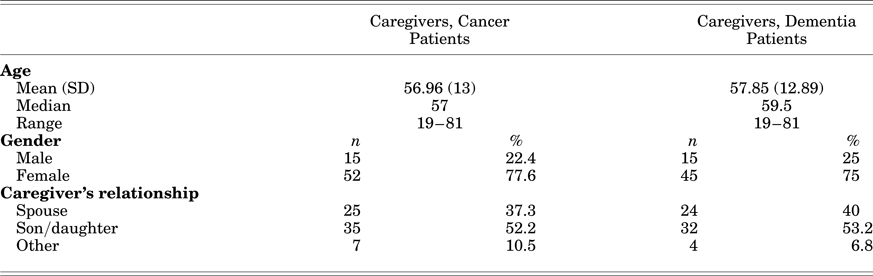
The median age of caregivers was 57.38 years (SD = 12.90); there were 97 women (76.4%). Their relationships to patients were mainly described as child 67 (52.8%) and spouse 49 (38.6%); other relationships included grandchild, niece, and nephew. Nonsignificant differences between cancer and dementia patients and caregiver sociodemographic characteristics were found, even considering the time admitted into the unit, which appeared longer for dementia patients. None of the comorbidity variables (time admitted, referral to admission, and admission outcome) were significantly correlated with caregiver burden. Table 2 provides a summary of caregiver sociodemographic characteristics for each sample.
Caregiver sociodemographic characteristics

Caregiver Psychological Distress
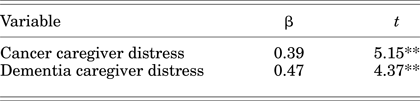
Psychological morbidity among cancer caregivers was found in greater proportion (77.6%, n = 52) along with probable clinically significant morbidity when using a total HADS cutoff score ≥12; the mean total score for HADS was 20.5 (SD = 9.32). A multiple regression analysis was conducted to evaluate the contribution of psychological distress to caregiver burden. Multicollinearity was not a concern based on its indicators, with condition index values of 4.64–3.29. Regarding the regression analysis, caregiver distress accounted for 27.9% of variance in caregiver burden (F 1, 66 = 26.51; p < 0.01). These findings (see Table 3) pointed to the fact that caregiver distress for cancer patients was a significant predictor of burden symptomatology.
Regression analysis predicting caregiver burden

**p < 0.01.
With regard to caregivers of dementia patients, 72.4% (n = 42) of participants had probable clinical symptoms using a GHQ-28 cutoff score >5; the mean score for morbidity symptoms on GHQ-28 was 9.01 (SD = 6.07). When considering the regression analysis, caregiver distress accounted for 24.4% of variance in caregiver burden (F 1, 66 = 19.10; p < 0.01). This result indicated that caregiver distress in dementia patients was a significant predictor of burden symptomatology, as shown in Table 3.
Comparing Caregiver Burden
Considering caregiver burden, 48.3% (n = 28) of caregivers for dementia patients had significant burden symptoms using a ZBI cutoff score ≥17 (Gort et al., Reference Gort, March and Gómez2005). Similarly, in caregivers for cancer patients, 50.7% (n = 34) had significant burden symptoms. Using t tests to compare caregiver burden, no significant differences in burden symptoms were observed (t = 0.06; p = 0.94) in ZBI-7 score between caregivers for dementia (ZBI-7 mean, 17.09, SD = 5.62) and cancer patients (ZBI-7 mean, 17.03, SD = 6.88).
DISCUSSION
The current study underlines the fact that caregivers for cancer and dementia patients at the end of life suffer a similar degree of caregiver burden symptoms. Moreover, a high percentage of caregivers (72–77%) demonstrated significant psychological distress in each advanced disease. These data support the notion of providing care for those who are caring for patients with advanced disease. The prevalence of psychiatric morbidity in caregivers of patients with advanced dementia (43%) was greater compared to some other studies (e.g., Schulz et al., Reference Schulz, Mendelsohn and Haley2003) and was similar (84%) to home caregivers of cancer patients receiving palliative treatment.
Our study demonstrates that the level of caregiver distress is an important predictor of caregiver burden in patients' final stages of dementia or advanced cancer. Previous studies found similar results, that is, the level of caregiver psychological distress is significantly associated with caregiver burden in cancer patients with palliative treatment (Grov et al., Reference Grov, Fossa and Sorebo2006). Our findings indicate that caregiver clinical burden symptoms are fewer (48–51%) than that reported in other studies (72%) when caregiver burden is calculated only by a subjective assessment (Schulz et al., Reference Schulz, Mendelsohn and Haley2003). Caregiver burden did not differ significantly between the two types of advanced disease, cancer and dementia. Furthermore, family caregivers of end-stage dementia patients have more than symptoms of discomfort during the final stages of the disease. This is associated with the behaviors typical of the disease, the loss experienced when the patient is transferred to a hospice or admitted to hospital, and factors involved in end-of-life care decision making (Goodman et al., Reference Goodman, Evans and Wilcock2010). Caregiver burden among those caring for patients with dementia has been shown to be a predictor of institutional placement (Schulz et al., Reference Schulz, Belle and Czaja2004). Likewise, institutionalization of dementia patients has been associated with greater caregiver psychological distress (specifically, pre-death grieving) (Kiely et al., Reference Kiely, Prigerson and Mitchell2008; Sampson et al., Reference Sampson, Jones and Thuné-Boyle2010). Psychological distress among caregivers of dementia patients may be exacerbated by patient stability, which leads to prolongation of the terminal phase due to improved patient comfort and prevention of complications (Formiga et al., Reference Formiga, Robles and Fort2009).
A holistic approach is required in palliative care for patients at the final stage of dementia, similar to that for advanced cancer patients. In addition to symptom management when a patient is admitted to hospital, support for family caregivers of dementia patients is essential. Support for caregiver distress, providing interventions to engage families in structured discussion for end-of-life planning, should also be considered (Sampson et al., Reference Sampson, Jones and Thuné-Boyle2010; Mahtani-Chugani et al., Reference Mahtani-Chugani, González-Castro and Sáez de Ormijana-Hernández2010). Further, family caregivers of patients with dementia who are approaching the end of life have equivalent needs in response to bereavement as caregivers of patients dying from other diseases that could require psychological support (Schulz et al., Reference Schulz, Mendelsohn and Haley2003).
Inclusion of palliative care in advanced dementia is a hallmark of good end-of-life care. It requires a well-rounded approach and interdisciplinary interventions that may improve the quality of care to attenuate symptoms, along with attention to the full range of needs of the dying patient and consideration of the psychosocial concerns arising in caregivers when living with a patient's life-limiting illness (WHO, 2002).
LIMITATIONS
Our study has some limitations. First, we employed a cross-sectional design that looked at random points during patients' hospitalization, and so we were bound to miss changes in caregiver psychological distress and burden symptoms over time. Second, we did not analyze the relevance of patient physical comorbidities to caregiver burden and distress and how they might affect progression of the disease, nor did we analyze the sociodemographic characteristics of caregivers that could have influenced their burden. Third, many end-of-life outcomes that might affect caregiver psychological distress were not included, such as their decision-making process related to patient end-of-life care. Finally, the data were collected in only one Southern European country. Nevertheless, although there are limitations to our study, the current findings highlight the need for psychological support for family caregivers of patients with advanced dementia, recognizing that this condition is a terminal illness with similar needs as in advanced oncological disease.
ACKNOWLEDGMENTS
The authors thank those caregivers who kindly volunteered to participate in our study and to share their experiences. The authors also thank all the staff of the socio-health center at Antic Hospital Sant Jaume i Santa Magdalena for their kind and gracious support in this research.