Implications
The heat stress effects can be harmful for milk production and quality. The genotype×environment interaction due to heat stress can affect the genetic association between these traits and lead to the reranking of sires in poorly adapted cattle breeds. Selection for milk traits may result in a poor response of the animals to heat stress, as a genetic antagonism was observed between the production level and specific ability to respond to heat stress. The selection of Holstein cattle under highly modified environments in tropical and sub-tropical regions should take into consideration the genetic variation in heat stress.
Introduction
The tropical environments are restrictive for dairy production due to several factors such as lack of industry organization, poor husbandry practices, poor nutrition, parasites, diseases and climate (Madalena et al., Reference Madalena1990). In general, the Brazilian climate is characterized by high temperature and humidity almost throughout the year. Under these conditions, purebred Zebu breeds and on a larger scale Bos taurus×Bos indicus crosses may be preferred and recommended for milk production. According to Madalena (Reference Madalena, Teodoro, Lemos, Monteiro and Barbosa1990) and Madalena et al. (Reference Madalena1990), European dairy breeds can sustain adequate performance in tropical environment if the environmental restrictions are removed or at least attenuated. Thus, Holstein cattle plays an important role in the Brazilian dairy industry as purebred and as the main dairy breed used in crosses. Despite the efforts of farmers to employ environmental modifications to alleviate the effects of heat stress, productive and reproductive losses in Holsteins are still frequent. The temperature–humidity index (THI) has been widely used to evaluate heat stress in dairy cattle and has permitted the quantification of performance losses due to heat stress (Ravagnolo et al., Reference Ravagnolo, Misztal and Hoogenboom2000; Freitas et al., Reference Freitas, Misztal, Bohmanova and Torres2006; Hill and Wall, Reference Hill and Wall2015). Furthermore, the THI in conjunction with reaction norm models has proven useful to infer on the genetic merit of animals for heat tolerance (Ravagnolo and Misztal, Reference Ravagnolo and Misztal2000; Aguilar et al., Reference Aguilar, Misztal and Tsuruta2009).
Several studies have demonstrated the effects of heat stress either directly on animal production or on the profitability of the production system. St-Pierre et al. (Reference St-Pierre, Cobanov and Schnitkey2003) estimated average annual losses of 897 to 1.5 million dollars for the dairy industry in the United States. In the temperate climate of Luxembourg, Hammami et al. (Reference Hammami, Bormann, M’hamdi, Montaldo and Gengler2013) reported average changes per increase of 1 THI unit of −0.109 to −0.164 kg of milk, −0.013 to −0.023 kg of fat, −0.010 to −0.013 kg of protein and 0.002 to 0.005 units of somatic cell score (SCS) in primiparous cows. In Italy, Bernabucci et al. (Reference Bernabucci, Lacetera, Baumgard, Rhoads, Ronchi and Nardone2014) concluded that multiparous cows are more susceptible to heat stress and that in some cases the loss of milk production on a single day was >1 kg/animal. Aguilar et al. (Reference Aguilar, Misztal and Tsuruta2010) estimated the genetic trends for milk yield (MY) of cows in the United States and observed that the genetic merit of the animals for MY increased consistently over the years, whereas the genetic tolerance to heat stress decreased. Another relevant factor related to heat stress is G×E. Carabaño et al. (Reference Carabaño, Bachagha, Ramón and Díaz2014) and Hammami et al. (Reference Hammami, Vandenplas, Vanrobays, Rekik, Bastin and Gengler2015) identified G×E due to heat stress for milk production and milk quality traits of primiparous Holstein cows raised in Spain and Belgium, respectively. In both studies, changes in the genetic correlations within some traits were observed across the environmental scale (THI or only temperature). In this respect, the best sires from the Holstein breed in the thermal comfort zone are not necessarily the same under conditions of heat stress.
Although more than 15 years have passed since the first studies that identified genetic variability in heat stress in dairy cattle using random regression models (Ravagnolo and Misztal, Reference Ravagnolo and Misztal2000), little is known so far about this important topic for cattle raised under tropical and sub-tropical conditions. Particularly in the case of advanced lactations, knowledge of the effects, parameters and genetic trends related to heat stress is limited (Aguilar et al., Reference Aguilar, Misztal and Tsuruta2010; Bernabucci et al., Reference Bernabucci, Lacetera, Baumgard, Rhoads, Ronchi and Nardone2014). Therefore, the main objectives of the present study were as follows: (1) to quantify losses in milk production and quality due to heat stress; (2) to estimate genetic correlations within and between production and quality of milk; and (3) to evaluate the trends of genetic components of tolerance to heat stress in multiple lactations of Brazilian Holstein cows.
Material and methods
Data
The database used in the present study belonged to the Dairy Cattle Genetic Breeding Program of CRV Lagoa (Gestor Leite). The data set comprised of test-day (TD) records for MY (kg), fat percentage (F%), protein percentage (P%) and somatic cell count (1000 cells/ml) from three first lactations of purebred Holstein cows calved between 1989 and 2012 and belonging to 75 herds located in 39 municipalities (many are close to each other in milk production regions) of seven Brazilian states (Espírito Santo, 1.2%; Goiás, 3.5%; Minas Gerais, 12.8%; Paraná, 62.0%; Rio Grande do Sul, 0.8%; Santa Catarina, 0.4%; and São Paulo, 19.2% of the total TD records). The analyzed herds represent the most intensive areas of milk production in Brazil. The states of southern Brazil (Paraná, Santa Catarina and Rio Grande do Sul, 63.2% of the TD records) concentrate most of the herds in a predominantly sub-tropical climate. The states of the southeast (Espírito Santo, Minas Gerais and São Paulo) and midwest (Goiás) regions of Brazil are characterized by highland tropical or humid tropical climate. The management systems of the analyzed herds are mostly based in freestall housing with use of concentrate, corn silage, sugarcane with urea. In some regions (e.g. Minas Gerais and São Paulo states), rotational grazing systems in combination with concentrated feeding are also adopted (about 25% of the herds). Most farms have at least fan systems for the animals and more technified farms also employ sprinklers. The parasite control is carried out systematically, especially in herds adopting rotational grazing systems. All these environmental modifications should ensure that most animals have the effect of potential tropical stressors at least alleviated.
The SCS was defined as the natural logarithm of somatic cell count. Calving age was restricted to 21 to 45 months for parity 1, 31 to 55 months for parity 2 and 42 to 65 months for parity 3. TD records obtained between days 5 and 305 of lactation were used. Only cows with at least three TD records during lactation were included in the analysis, with the first test being performed up to 45 days after calving. The contemporary groups were defined as herd-TD, with the restriction that each group should contain at least five animals. The climate variables were daily dry bulb temperature (T, °C) and relative humidity (RH, %) recorded by the Instituto Nacional de Meteorologia (INMET, Brasília-DF) at 22 weather stations located <50 km away from the farms. T and RH were recorded at three standardized times every day (0900, 1500 and 2100 h) in each weather station. The data recording procedure in the weather stations are standardized throughout the country according to the recommendation of the World Meteorological Organization. Temperature and humidity were combined in an index, THI, using the equation described by National Research Council (NRC, 1971):
 $$\eqalignno {{\rm THI}\,=\,( {1.8{\times}{\rm T}{\plus}32}) {\minus} ({0.55{\minus} ({0.0055{\times}{\rm RH}}){\times}( {1.8{\times}{\rm T}{\minus}26})})$$
This formula was adopted because it is suited to the climatic variables available in Brazilian weather stations (T and RH). In addition, several studies show the usefulness of this formula for this type of study (Bohmanova et al., 2008; Brügemann et al., Reference Brügemann, Gernand, Koenig von Borstel and Koenig2011 and Reference Brügemann, Gernand, von Borstel and Koenig2012). The average daily THI, obtained as the average over 3 days (two before and the test date), was assigned to each TD record. The choice of 3 days was based on a preliminary analysis in which it was shown that the moving average over 3 days explained more variability in milk production than just 1 or 2 days before the TD or only the test date. A similar procedure was also adopted by Bohmanova et al. (2008). The night time conditions are important for helping animals recover from the effects of heat stress during the day, but the only information available for this study was obtained in the three standard times mentioned above.
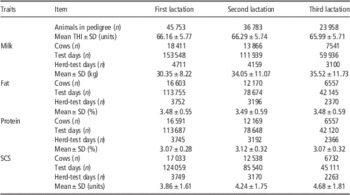
Table 1 shows the summary statistics of the weather and production data set after editing.
Summary of the data set per trait and lactation in Brazilian Holsteins

THI=temperature–humidity index; SCS=somatic cell score.
Effect of heat stress
A GLM that included the fixed effects (contemporary group, milking frequency, days in milk (DIM), cow’s age at calving, THI) and the random effect of animal (ignoring the genetic relationship between animals) was used to show the pattern of response of each trait as a function of THI values and to estimate the least squares means. The effect of THI per cow per day for each THI unit increase on each trait and lactation was obtained by fitting THI as a linear covariate in the fixed model. The effects of THI stratified according to lactation stage (five stages: 5⩽DIM⩽65, 66⩽DIM⩽125, 126⩽DIM⩽185, 186⩽DIM⩽245 and 246⩽DIM⩽305) were obtained by nesting the THI as a linear covariate within stages.
Genetic analysis
Nine analyses using two-trait random regression animal models were carried out to estimate variance components and genetic parameters for MY and milk quality traits (three lactations: MY×F%, MY×P% and MY×SCS). The following random regression TD model was applied to the data:
 $$\eqalignno{ y_{{ijklm}} =\,&CG_{i} {\plus}MF_{j} {\plus}\mathop{\sum}\limits_{p\,=\,1}^2 {b_{p} x_{l}^{p} } {\plus}THIc\,{\rm (}DIMc{\rm )}_{k} \cr & {\plus}\mathop{\sum}\limits_{n\,=\,1}^q {{\beta _{ln} \omega }_n \,(d)} {\plus}\mathop{\sum}\limits_{n\,=\,1}^q {\gamma _{ln} \omega _{n} \,(d)} \cr & {\plus} \mathop{\sum}\limits_{n\,=\,1}^q {\delta _{ln} \omega _{n} \,(t)} {\plus}\mathop{\sum}\limits_{n\,=\,1}^q {{\varepsilon}_{{ln}} \omega _{n} \,(t)} {\plus}e_{{ijklm}} $$
where y ijklm is the mth TD record of the lth cow; CG i a fixed effect of the ith contemporary group (defined as above), MF j the jth milking frequency (2 or 3 times/day, effect considered only for MY); b p the regression coefficient for the linear (p=1) and quadratic (p=2) effects of cow’s age x l at calving (in months); THIc (DIMc) k the kth fixed effect of the THI class (with classes defined every 6 THI units, THIc=1 to 7) within DIM class (with classes defined every 30 days, DIMc=1 to 10); β ln the nth random regression coefficient for the additive genetic effect of cow l by DIM; γ ln the nth random regression coefficient for the permanent environmental effect of cow l by DIM; δ ln the nth random regression coefficient for the additive genetic effect of cow l by THI; ε ln the nth random regression coefficient for the permanent environmental effect of cow l by THI; q the number of regression coefficients; ω n (d) the nth orthogonal Legendre polynomial corresponding to DIM d; ω n (t) the nth orthogonal Legendre polynomial corresponding to THI t; and e ijklm the random residual effect. The random regressions were modeled with Legendre polynomials of order 3 (intercept, linear, quadratic and cubic terms) for DIM and 1 for THI (intercept and linear terms). Residual variance was assumed to be homogeneous across lactation and THI values. The (co)variance structure follows:
 $$\left[ \matrix{ \beta \hfill \cr \delta \hfill \cr \gamma \hfill \cr {\varepsilon} \hfill \cr e \hfill \cr} \right]= \cr\left[ {\matrix{ {A\,\otimes\,G_{\beta } } & {A\,\otimes\,G_{{\beta \delta }} } & 0 & 0 & 0 \cr {A\,\otimes\,G_{{\delta \beta }} } & {A\,\otimes\,G_{\delta } } & 0 & 0 & 0 \cr 0 & 0 & {I_{l} \,\otimes\,P_{\gamma } } & {I_{l} \,\otimes\,P_{{\gamma {\varepsilon}}} } & 0 \cr 0 & 0 & {I_{l} \,\otimes\,P_{{{\varepsilon}\gamma }} } & {I_{l} \,\otimes\,P_{{\varepsilon}} } & 0 \cr 0 & 0 & 0 & 0 & {I_{m} \sigma _{e}^{2} } \cr } } \right]$$
where G
β
and G
δ
are (co)variance matrices of the random regression coefficients for additive genetic effects by DIM and THI, respectively; G
βδ
and G
δβ
the covariance matrices for additive genetic effects for combinations of DIM and THI; A the additive genetic relationship matrix;
 $$\,\otimes\,$$
the Kronecker product; P
γ
and P
ε
the (co)variance matrices of the random regression coefficients for permanent environmental effects by DIM and THI, respectively; P
γε
and P
εγ
the covariance matrices for permanent environmental effects for combinations of DIM and THI; and
 $$\sigma _e^2 $$
the residual variance. I
l
is an identity matrix of appropriate size for the permanent environmental effect (l is the number of cows with records) and I
m
an identity matrix of appropriate size for the residual (m is the number of TD records).
The genetic analyses were performed under a Bayesian approach using the GIBBS2F90 program (Misztal et al., Reference Misztal, Tsuruta, Strabel, Auvray, Druet and Lee2002). The prior distributions for all random effects were inverse Wishart distributions. The analysis consisted of a single chain of 250 000 cycles, with a burn-in period of 25 000 cycles and a thinning interval of 25 cycles. Convergence was determined by graphical inspection of the posterior chains of the parameters.
Genetic trend
Genetic trends for the estimated breeding value of the random regression intercept (general production level) and linear term (specific ability to respond to heat stress, THI) for each trait and lactation according to year of birth were computed.
Results
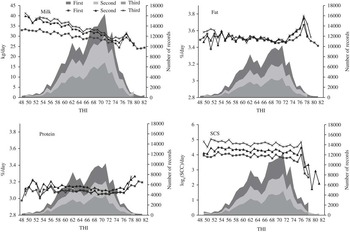
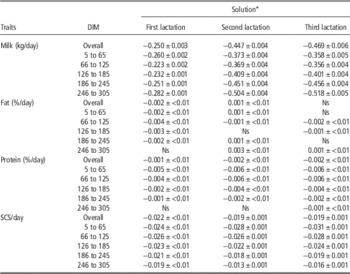
Figure 1 shows the number of TD records and least squares means of the traits studied as a function of THI values. On average, about 53% of all TD records were obtained at THI values above 66 and 14% at values above 72. The trend of least squares means across THI values revealed an evident decline in MY with increasing THI values in the three lactations. For F% and P%, there was a slight average decrease with increasing THI values; however, an increase in the means of the two traits was observed for THI values above 72. For SCS, a slight average decrease was observed with increasing THI values and a strong decrease in mean SCS for THI values >76. Table 2 shows the mean changes in the traits studied according to THI increase. In general, MY losses were greater in advanced lactations, reaching values of >0.5 kg/THI per day per cow at the end of second and third lactation. The effect of heat stress on MY was more detrimental at the end of lactation. The same was observed for the effect reported as percentage of the phenotypic mean. For F% and P%, the average changes with increasing THI values were small and mainly negative. Some average increases in F% with increasing THI values were observed, particularly in the second and third lactation. The SCS decreased in all lactations with increasing THI. Greater reductions were observed at the beginning of lactation for both SCS and P%. The same was verified for the effect reported as mean phenotypic percentage.
Number of records (area) and least squares means (lines) of test-day milk yield (kg), fat (%), protein (%) and somatic cell score (SCS) per temperature–humidity index (THI) unit and lactation in Brazilian Holsteins. SCC=somatic cell count.

Linear regression solution±SE (overall and according to days in milk (DIM)) for the effect of temperature–humidity index on milk yield and quality traits of Brazilian Holsteins

SCS=somatic cell score; NS = not significant.
* Fixed linear regression solution (P<0.01).
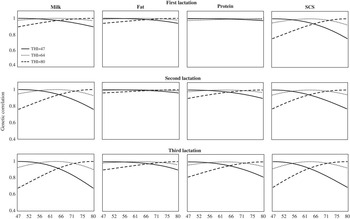
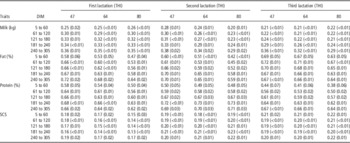
In general, the mean heritability estimates were higher for lower THI values and longer DIM (Table 3). In contrast, the heritability estimates for SCS increased with increasing THI values in the second and third lactation. For all traits, lower genetic correlations (different from unity) were observed between opposite extremes of THI (THI 47 v. THI 80) and in advanced lactations (Figure 2). For MY in the first, second and third lactation, the genetic correlations between extreme THI values were up to 0.90, 0.76 and 0.68, respectively. For F% and P%, the genetic correlations were always 0.80 or higher in the three lactations. The genetic correlations of SCS between opposite environments reached values of 0.76, 0.77 and 0.69 in the first, second and third lactation, respectively.
Posterior means of the genetic correlations between test-day milk yield (kg), fat (%), protein (%) and somatic cell score (SCS) in specific temperature–humidity indexes (THI=47, 64, or 80) with all other THI values in Brazilian Holsteins.

Posterior means of the heritability estimates (SD) for milk yield and quality traits according to the combination of days in milk (DIM) and temperature–humidity index (THI) in Brazilian Holsteins

SCS=somatic cell score.
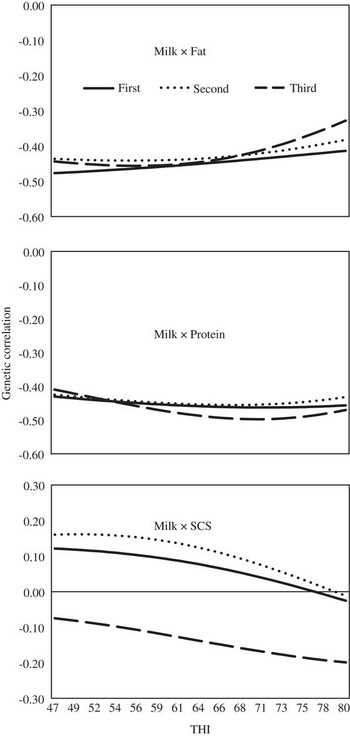
The genetic correlations between MY and milk quality traits varied across the THI scale and lactations (Figure 3). The most discrepant genetic correlation estimates were obtained for the third lactation in all cases. Genetic correlations of moderate magnitude were observed between MY and F% and between MY and P%, and correlations of small magnitude were observed between MY and SCS. For MY and F%, increases in the genetic correlation estimates (i.e. became less negative) were observed with increasing THI values, and especially in the third lactation (−0.46 to −0.33). For MY and P%, the genetic correlations tended to decrease with increasing THI values (i.e. became more negative) and ranged from −0.46 to −0.43, from −0.46 to −0.42 and from −0.50 to −0.41 in the first, second and third lactation, respectively. For MY and SCS, the genetic correlation estimates showed an evident trend of reduction with increasing THI values. For the third lactation, the genetic correlations between MY and SCS were always negative. Variations in the genetic correlation between these traits of −0.03 to 0.12, −0.01 to 0.16 and −0.20 to −0.07 were observed in the first, second and third lactation, respectively.
Posterior means of the genetic correlations between test-day milk yield (kg), fat (%), protein (%) and somatic cell score (SCS) across temperature–humidity index (THI) values for the three first lactations of Brazilian Holsteins.

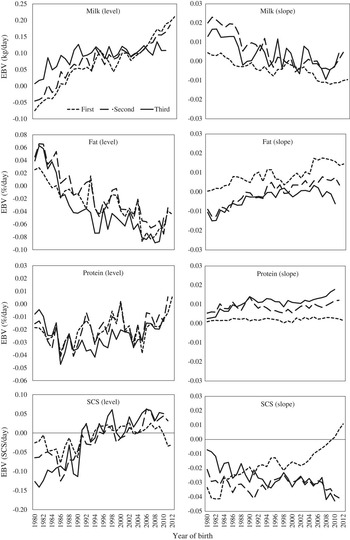
The genetic trends for the random regression intercept (general production level) and linear term (slope, specific ability to respond to heat stress) of the reaction norm are shown in Figure 4. There was a clear trend toward an increase in the general production level over the years for MY and SCS. For F%, the general production level decreased considerably over the years. In contrast, P% showed an erratic pattern of a slight increase over time. The specific ability of tolerance to heat stress decreased over the years for MY in all lactations. In contrast, for F% the ability to respond to heat stress increased over time, especially in the first lactation. Differences in the slopes of the reaction norms between lactations were observed for P%, but these differences were relatively constant over the years. The slope of the reaction norms of animals for SCS tended to increase over time in the first lactation, whereas the opposite was observed in the second and third lactation.
Genetic trends for the posterior mean estimates (estimated breeding value (EBV)) of random regression coefficients of level (left) and slope (right) for test-day milk yield (kg), fat (%), protein (%) and somatic cell score (SCS) for the three first lactations of Brazilian Holsteins.

Discussion
The present study demonstrated that the effects of heat stress can be harmful for traits related to milk production and milk quality of Holstein cattle raised in modified environments in tropical and sub-tropical regions. Importantly, most of the analyzed herds had access to cooling systems (not necessarily effective or sufficient) and thus the effects of heat stress on milk production and quality traits may have been underestimated. Particularly in the case of MY, the effect of heat stress was more detrimental in advanced lactations. The effect of THI was dependent on the lactation stage, so the effect of THI on lactation started in a given month is different from that observed on the lactation started in other month of the year. As the THI values follow a relatively predictable pattern throughout a year in a particular region, the adoption of the genetic model used in this study should allow the selection of suitable animals to produce in a specific season and region. Despite the various approaches adopted in different studies to quantify the effect of heat stress on animal performance, the results obtained here generally agree with those reported in the literature. The most frequently used approaches basically differ in terms of the formula used for the calculation of THI, number of days of delay in relation to TD for the calculation of THI and linear regression with or without considering a heat stress threshold. A two-phase linear regression procedure was adopted in an attempt to identify a heat stress threshold for the different traits and lactations, but without success (except for SCS). In many cases, the threshold was not valid or was simply one of the lowest values of the THI scale (THI⩽50). This could have been due to the fact that part of the farms included in the present study had no effective cooling system. In a study involving a large single Brazilian Holstein herd, Santana et al. (Reference Santana, Eler, Bignardi, Menéndez-Buxadera, Cardoso and Ferraz2016) identified a THI value of 66 as the heat stress threshold for MY in primiparous cows. However, the herd studied used cooling systems. These authors found an MY loss of −0.230 kg/day per THI. Freitas et al. (Reference Freitas, Misztal, Bohmanova and Torres2006) identified losses of −0.150 to −0.360 kg/day per THI in primiparous cows from the southern states of the United States. Hammami et al. (Reference Hammami, Bormann, M’hamdi, Montaldo and Gengler2013) reported MY losses of −0.164 kg/THI per day in Luxembourg Holstein cows. Following the same trend observed in the present study, the effect of heat stress on MY was more detrimental during advanced lactations in Italian Holstein cows (Bernabucci et al., Reference Bernabucci, Lacetera, Baumgard, Rhoads, Ronchi and Nardone2014). These authors reported important losses of −0.910, −1.160 and −1.270 kg/day per THI in the first, second and third parity, respectively. Heat stress occurs when the body temperature of the cow exceeds the interval specified for its normal activity, which results in a total heat load (internal production and environment) that exceeds the capacity of heat dissipation (Bernabucci et al., Reference Bernabucci, Biffani, Buggiotti, Vitali, Lacetera and Nardone2010). As multiparous cows normally produce more milk, they also generate more metabolic heat, a fact favoring the occurrence of heat stress.
The losses due to heat stress for F% and P% were small as shown in Table 2. Similar results for these traits have been reported in the literature. Brügemann et al. (Reference Brügemann, Gernand, von Borstel and Koenig2012) found no valid heat stress threshold for F% or P% in German Holstein cows and reported that the least squares means of F% and P% tended to increase at high THI values. According to these authors, the explanation for this finding is related to the genetic antagonism between MY and its components (F% and P%). Lower mean milk production was observed at high THI values (Figure 1), a fact that can lead to the absence of change or even higher concentrations of F% and P% in milk. The increase in THI values favored a reduction in the SCS of milk, particularly for THI⩾76. However, the results of studies investigating the effect of heat stress on SCS are controversial. Smith et al. (Reference Smith, Smith, Rude and Ward2013) observed a lower SCS under conditions of heat stress (THI>68) in both Holstein and Jersey cows kept under the same management conditions. These authors reached the same conclusion in the case of severe heat stress (THI>90). Carabaño et al. (Reference Carabaño, Bachagha, Ramón and Díaz2014) reported a reduction in SCS with increasing average temperature for Spanish Holstein cows. In contrast, Brügemann et al. (Reference Brügemann, Gernand, von Borstel and Koenig2012) and Hammami et al. (Reference Hammami, Bormann, M’hamdi, Montaldo and Gengler2013) found that SCS tended to increase at both low and high THI in Holstein cows raised in the maritime region of Germany and in Luxembourg, respectively. Hence, the effect of heat stress particularly on SCS depends on the environmental conditions under which the animals are reared.
The heritability estimates obtained for the different combinations of DIM and THI indicate that the response to selection can vary as a function of both DIM and THI, a fact also reported in other studies (Aguilar et al., Reference Aguilar, Misztal and Tsuruta2009; Brügemann et al., Reference Brügemann, Gernand, Koenig von Borstel and Koenig2011; Bohlouli et al., Reference Bohlouli, Shodja, Alijani and Eghbal2013). As most of the heritability estimates were higher at lower THI values (Table 3), the greatest responses to selection can be expected for the thermal comfort zone. Brügemann et al. (Reference Brügemann, Gernand, Koenig von Borstel and Koenig2011) have reported similar results for German Holstein cows and Bohlouli et al. (Reference Bohlouli, Shodja, Alijani and Eghbal2013) for Iranian Holstein cows. Brügemann et al. (Reference Brügemann, Gernand, Koenig von Borstel and Koenig2011) stated that the effect of heat stress can suppress the full expression of the genetic potential of animals. According to Santana et al. (Reference Santana, Eler, Bignardi, Menéndez-Buxadera, Cardoso and Ferraz2016), poorly adapted animals raised in tropical environments partially modified may be being selected most of the time within the stress zone. Consequently, there may be less genetic variability of production in this zone. Importantly, the optimum selection environment depends not only on the breed type of the animals (tropically adapted or poorly adapted), but also depends on the heritability, on the degree of G×E and on the correlation between level and slope of the reaction norms (Kolmodin and Bijma, Reference Kolmodin and Bijma2004).
The genetic correlations within traits (especially MY and SCS) across environments were often different from unity (Figure 2), indicating that the expression of these traits can vary according to THI values. Thus, G×E due to heat stress can be considered an important factor for genetic evaluations of Holstein cattle raised in modified environments in tropical and sub-tropical regions. The G×E due to heat stress is less important in the case of F% and P% considering the high genetic correlations across the THI scale. This result agrees with the findings of Hammami et al. (Reference Hammami, Vandenplas, Vanrobays, Rekik, Bastin and Gengler2015) who obtained genetic correlations for F% and P% >0.80 in Holstein cattle from the Walloon region of Belgium. The slope variance/intercept variance (magnitude G×E) of the reaction norms shown in Supplementary Table S1 supports the view that G×E due to heat stress was more important for MY and SCS and that this type of G×E is more important in advanced lactations. Aguilar et al. (Reference Aguilar, Misztal and Tsuruta2009) observed that the genetic variance in heat stress for MY increased substantially from the first to the third lactation. Bernabucci et al. (Reference Bernabucci, Lacetera, Baumgard, Rhoads, Ronchi and Nardone2014) also obtained considerably higher genetic variance estimates of heat stress from the first to third parity for MY, F% and P% in Italian Holstein cows. The genetic correlations across the THI scale for SCS were similar to those obtained by Hammami et al. (Reference Hammami, Vandenplas, Vanrobays, Rekik, Bastin and Gengler2015) for Belgian Holstein cattle (values of up to 0.65). The latter authors concluded that SCS is sensitive to hot conditions in temperate climates. On the basis of the correlation between SCS at low and high temperatures, Carabaño et al. (Reference Carabaño, Bachagha, Ramón and Díaz2014) concluded that G×E are strong for this trait in Spanish Holstein cattle. This trait therefore typically exhibits strong G×E due to heat stress. This finding is expected as traits such as SCS that are less heritable are usually more plastic (environmentally sensitive) and associated with stronger G×E (Tonsor et al., Reference Tonsor, Elnaccash and Scheiner2013; Santana et al., Reference Santana, Bignardi, Pereira, Menéndez-Buxadera and El Faro2015).
There are few studies in the literature addressing the genetic association between MY and other traits of economic interest across the THI scale. An antagonistic genetic association between MY and F% was observed across the THI scale, in such a way that selection for higher MY would lead to a reduction in F% for any THI (Figure 3). However, the genetic association between MY and F% became less unfavorable for higher THI values, particularly in the third lactation. This finding may be explained by a reduction in MY under conditions of heat stress, which would result in the maintenance or even in an increase in milk fat content. In contrast, the genetic association between MY and P% tended to be slightly more antagonistic for higher THI values. Among all associations investigated here, the genetic association between MY and P% was least affected by the variation in THI values. Hammami et al. (Reference Hammami, Vandenplas, Vanrobays, Rekik, Bastin and Gengler2015) found even more negative approximate genetic correlations between MY and milk fat and protein content. However, the authors observed that the approximate genetic correlations between these traits became slightly unfavorable for higher THI values. Nevertheless, it is clear that the genetic association between MY and F% and between MY and P% was little affected by THI, especially in the first and second lactation. The genetic association between MY and SCS differed more between lactations than between THI values. Positive genetic correlations between MY and somatic cell concentration in the first lactation, but negative in subsequent lactations were also reported by Banos and Shook (Reference Banos and Shook1990) and Koivula et al. (Reference Koivula, Mäntysaari, Negussie and Serenius2005). Banos and Shook (Reference Banos and Shook1990) argued that different genetic mechanisms could be involved in the expression of these traits in advanced lactations and pointed out that the culling practice of primiparous cows based on milk production, mastitis or both could affect the genetic association between MY and somatic cell concentration in advanced lactations. Among all genetic associations studied here, this association mostly depended on THI values. The genetic association between MY and SCS became less unfavorable with increasing THI values, irrespective of the number of lactation. At high THI values, selection for higher MY should therefore result in lower SCS as a correlated response, especially in the third lactation. Hammami et al. (Reference Hammami, Vandenplas, Vanrobays, Rekik, Bastin and Gengler2015) reported a genetic correlation between MY and SCS that was of similar magnitude to those obtained here; however, the genetic correlation became more unfavorable (more positive estimates) at higher THI values.
The genetic trends for general production level (intercept) of the animals and specific ability to respond to heat stress (slope) were a reflection of the genetic correlations between level and slope (Supplementary Table S1) and also between traits (Figure 3). The genetic correlations between level and slope for MY, F% and P% were always negative, indicating a genetic antagonism between these components. Consequently, selection for higher MY, F% or P% may result in a poor response of the poorly adapted animals to heat stress. A genetic antagonism between general production level and specific ability to respond to heat stress has also been reported in other studies on dairy cattle (Aguilar et al., Reference Aguilar, Misztal and Tsuruta2009; Carabaño et al., Reference Carabaño, Bachagha, Ramón and Díaz2014; Santana et al., Reference Santana, Eler, Bignardi, Menéndez-Buxadera, Cardoso and Ferraz2016). The genetic trends show that, for MY, there was considerable genetic progress in the general production level over the years studied in all three lactations. In contrast, for F% and SCS, the average genetic merit (level) of the population has shown a trend contrary to the interests of breeders. For P%, the genetic progress was almost 0 in three decades. The genetic merit for specific heat stress response (slope of reaction norms) has decreased over the years for MY, indicating that the animals have become genetically more sensitive to heat stress. The opposite was observed for P%. Aguilar et al. (Reference Aguilar, Misztal and Tsuruta2010) also identified an increase in the general production level of animals for MY and a reduction in the breeding value for tolerance to heat stress over time in Holstein cattle from the United States. According to these authors, the deterioration trends of genetic merit for tolerance heat stress (slope) were stronger in advanced lactations. In this respect, Aguilar et al. (Reference Aguilar, Misztal and Tsuruta2010) recommended the inclusion of advanced lactation records in studies investigating genetic components of heat stress. In summary, the failure to consider the genetic sensitivity of animals to heat stress can lead to a deterioration in animal performance.
Conclusion
Heat stress exerts detrimental effects on MY, P% and F% in poorly adapted Holstein cattle. MY is negatively affected by heat stress, especially in advanced lactations. In contrast, heat stress contributes to a reduction in SCS. The G×E due to heat stress was more important for MY and SCS, particularly in advanced lactations, and can affect the genetic relationship between MY and milk quality traits. Selection of Holstein cattle for higher MY, F% or P% may result in a poor response of the animals to heat stress, as a genetic antagonism was observed between the general production level and specific ability to respond to heat stress in this breed. The genetic trends confirm the adverse responses in the genetic components of heat stress over the years for milk production and quality. The failure to consider the genetic sensitivity of poorly adapted animals to heat stress can lead to deterioration in animal performance in light of constant climate change. Consequently, the selection of Holstein cattle raised in modified environments in tropical and sub-tropical regions should take into consideration the genetic variation in tolerance to heat stress.
Acknowledgments
The authors are indebted to the Genetic Breeding Program of CRV Lagoa (Gestor Leite) for providing access to the database used in this study. The authors also thank the INMET (BDMEP: Banco de Dados Meteorológicos para Ensino e Pesquisa) for providing the weather data.
Supplementary Material
To view supplementary material for this article, please visit http://dx.doi.org/10.1017/S1751731116001725