What is the most sustainable way for musicians to distribute their recordings in the 21st century? And what is the most sustainable way for consumers to listen to those recordings?Footnote 1 These questions are asked frequently by students on popular music and music industries courses, at least in our experience. Yet such questions are notoriously difficult to answer. From an economic perspective, is it worth manufacturing copies of recordings in addition to hosting them on digital music infrastructures like streaming and download platforms? If so, then how many copies and on which formats? And from an environmental perspective, is the plastic waste generated from physical formats more hazardous than the energy consumption it takes to stream music from the cloud? What factors do we need to consider when making these decisions?Footnote 2
When interrogating sustainable practices of recorded music production and consumption, we must first define what we mean by ‘sustainable’. The concept of sustainability is notoriously slippery. As such, sustainable development research tends to cover multiple lines of inquiry to address the overall challenge to ‘meet the needs of the present without compromising the ability of future generations to meet their own needs’, in the words of the oft-quoted 1987 World Commission on Environment and Development (also called the Brundtland Commission). Research on sustainability has therefore historically defined the term with regard to three interdependent pillars: economy, equity and environment. The underlying assumption is that sustainable development can only occur when these priorities are considered in relation to one another.
Allen et al. (Reference Allen, Titon and Von Glahn2014, p. 7) have summarised three contrasting models of how economic, equitable and environmental priorities might be balanced. The first model (Figure 1, left) is one where each pillar is considered to be of equal importance, with ‘economy, environment, and equity balancing an enduring world, one that supports humanity's place in, and as part of, nature’. As Allen points out, though, this model has been critiqued for giving equal roles to social and financial issues when environmental sustainability is already at a point of catastrophe owing to climate change. This leads to a second ‘nested basket’ model (centre), which illustrates the dependency of economy and society on a sustainable environment. Allen ultimately introduces the notion of aesthetics into sustainability (models), arguing that the ‘kind of world … we want to sustain’ is ‘not one that just considers environment, equity, and economics, but also one that includes joy, excitement, emotion, goodness, and beauty – a world that looks good, feels good, sounds good, and is good’ (Allen Reference Allen, Titon and Von Glahn2014, p. 9).
Figure 1.

To complicate matters further, research on the intersection between music and sustainability has arguably tended to emphasise one area of sustainability at the expense of others. Researchers in applied ethnomusicology (e.g. Titon Reference Titon2009; Schippers and Grant Reference Schippers and Grant2016), for example, often focus on equity and the social sustainability of endangered indigenous musical traditions, while research in popular music studies and the sociology of music (e.g. Oliver Reference Oliver2010; Behr et al. Reference Behr, Brennan, Cloonan, Frith and Webster2016b) privileges the economic aspects of ‘sustainability’ while ignoring environmental impact considerations. Recent work on the political ecology of music (Brennan et al. Reference Brennan, Collinson-Scott, Connelly and Lawrence2019; Devine Reference Devine2015, Reference Devine2019) looks at the materiality and environmental sustainability of musical activity.Footnote 3 Meanwhile, the research presented in this article focuses on the recorded music sector in relation to two pillars of sustainability: economic, on the one hand, and environmental, on the other.
The discussion that follows is the product of a collaboration between the two authors. Having previously researched the live music sector from the perspectives of economic (Behr et al. Reference Behr, Brennan, Cloonan, Frith and Webster2016b) and environmental sustainability (Brennan et al. Reference Brennan, Collinson-Scott, Connelly and Lawrence2019), Brennan was interested in exploring these two pillars in the area of recorded music via a creative practice project, namely the release of an album of original music. After discussions with Devine, who was completing a book about the political ecology of music with a focus on the recording industry, the two authors embarked on a joint project called The Cost of Music. We deliberately chose to frame our collaborative work in terms of cost as a response to existing work on culture being often framed in terms of its value (see Ahlhadeff Reference Alhadeff2006; Behr et al. Reference Behr, Brennan and Cloonan2016a, Reference Behr, Brennan, Cloonan, Frith and Websterb; Frith Reference Frith1996; O'Brien Reference O'Brien2010; Taylor Reference Taylor2007, Reference Taylor2017; Marshall Reference Marshall2019). By framing recorded music in terms of cost as opposed to value, we can ask a different sort of question: what are we willing to miss out on – economically, socially, environmentally – to enjoy the luxury of listening to our choice of records?
The rest of this article is divided into four sections, which address the questions outlined above. First, we examine how the price of records has changed over history and across the seven most economically significant formats in the United States (phonograph, gramophone, turntable, cassette deck, CD player, digital audio player and streaming device).Footnote 4 We chart the gradual decline in the price of recorded music up to the present, and consider what questions it raises for the cultural value of recorded music. Second, we discuss the environmental and human costs of music by looking at what recordings are made out of, where those materials come from and what happens to them when they are disposed of. Despite what narratives of digital dematerialisation imply (see, for example, Savage Reference Savage2019), we show that the transition towards paying to remotely access recorded music via digital infrastructures – as opposed to paying for a commodity to keep in the home – does not erase, or even mitigate, inhumane labour conditions in the digital electronics and IT industries that make access to recorded music possible. Similarly, we show that the amount of greenhouse gases released by the US recording industry could actually be higher today than at the height of any previous format. Third, we discuss our experience of encouraging a public conversation about the costs of recorded music through the creation and dissemination of a series of six experiments in practice-research (sometimes referred to as practice-based research in the UK or research-creation in Canada): an album release, a public engagement essay for The Conversation, three short films, a sculpture, a live event and a fanzine. Finally, we conclude by asking the obvious (but by no means straightforward) question: given the issues surrounding the various costs of recorded music, what are musicians and fans to do?
Economic cost
The economic cost component of this project was driven by an underlying question: roughly how much have consumers paid for the luxury of listening to their choice of recorded music, and how has this changed across playback formats and over history? This is a very difficult question to accurately answer owing to the number of variables one could potentially factor into the calculation, but we hope the methodology and dataset we have used can act as a starting point to be improved upon by future researchers.
The data collection for the economic cost research was carried out by research assistant Paul Archibald at the British Library Sound Archive in London in the first half of 2018. Using the United States as a case study, we aimed to gather three types of data: (a) the peak years of production for different recording formats; (b) an indicative cost per unit of each format in its peak year of production; and (c) the average weekly salary of a US citizen in those years, which we then used to estimate what percentage of their average weekly salary consumers typically would have had to give up to purchase recorded music on each format in its peak year. (We realise this is an artificially imposed metric, but the same could be said of any metric used to compare the changing price of recorded music over time.) Similar to the deployment of ‘wallet share’ as a tool for understanding the changing price of recorded music (Page Reference Page2011), we regard percentage of average weekly salary to be an imperfect but nevertheless useful concept to contribute to debates about the changing economic cost of recorded music consumption (for more on the challenges of researching the economics of recorded music at all, see Marshall Reference Marshall2019). We also chose to narrow our focus to commercial playback formats that were dominant in the market during the peak of their popularity. This means that we excluded an examination of the eight-track tape, for example, because even at the peak of its popularity it never outsold the vinyl LP. Neither did the minidisc ever outsell the compact disc, to offer another of several possible other formats. Based on these constraints, we gathered data from 178 sources, entered these into cross-referenced spreadsheets and compiled the spreadsheets into a dataset that can be downloaded online (Brennan and Archibald Reference Brennan and Archibald2019).
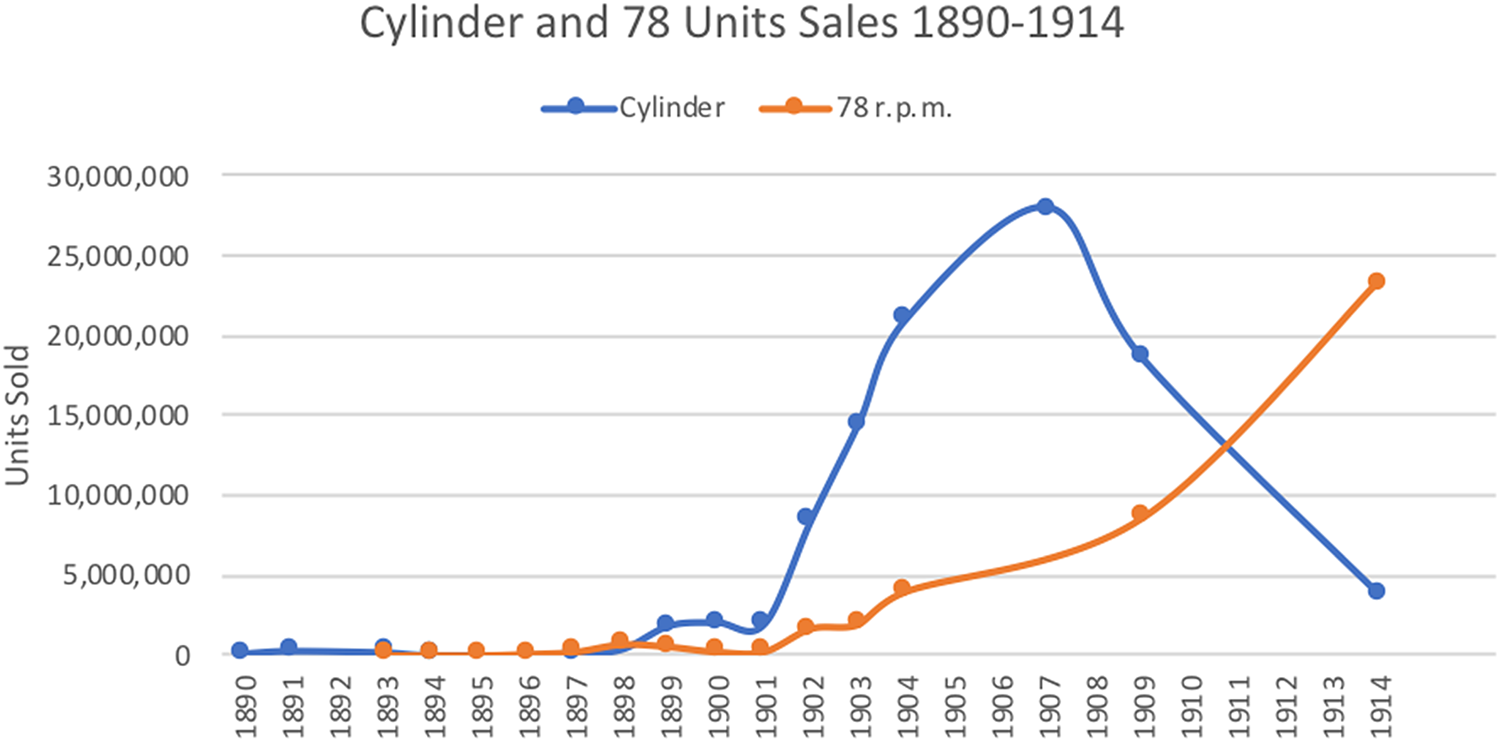
The first task was to map unit production for each format over time prior to standardised unit sales data published from 1973 onward by the Recording Industry Association of America. Sources prior to 1973 occasionally failed to distinguish between annual estimates of ‘units produced’ vs. ‘units sold’. The data represent ‘units sold’ whenever such information was available, although in some cases (namely the early years of cylinders and 78s), figures for ‘units produced’ were used as the closest estimate available. We used 20 separate data points for production numbers between 1890 and 1920, drawing from a range of primary sources (Edison Phonograph Monthly, The Phonoscope, US Department of Commerce) and secondary sources (Gelatt Reference Gelatt1977; Gronow Reference Gronow, Moseley and Saunio1999; Koenigsberg Reference Koenigsberg1969; Klinger Reference Klinger2007; Martland Reference Martland2013; Wile Reference Wile2008). (All sources for individual data points are referenced itemised in our accompanying online dataset – see Brennan and Archibald Reference Brennan and Archibald2019; Figure 2.)
Figure 2.

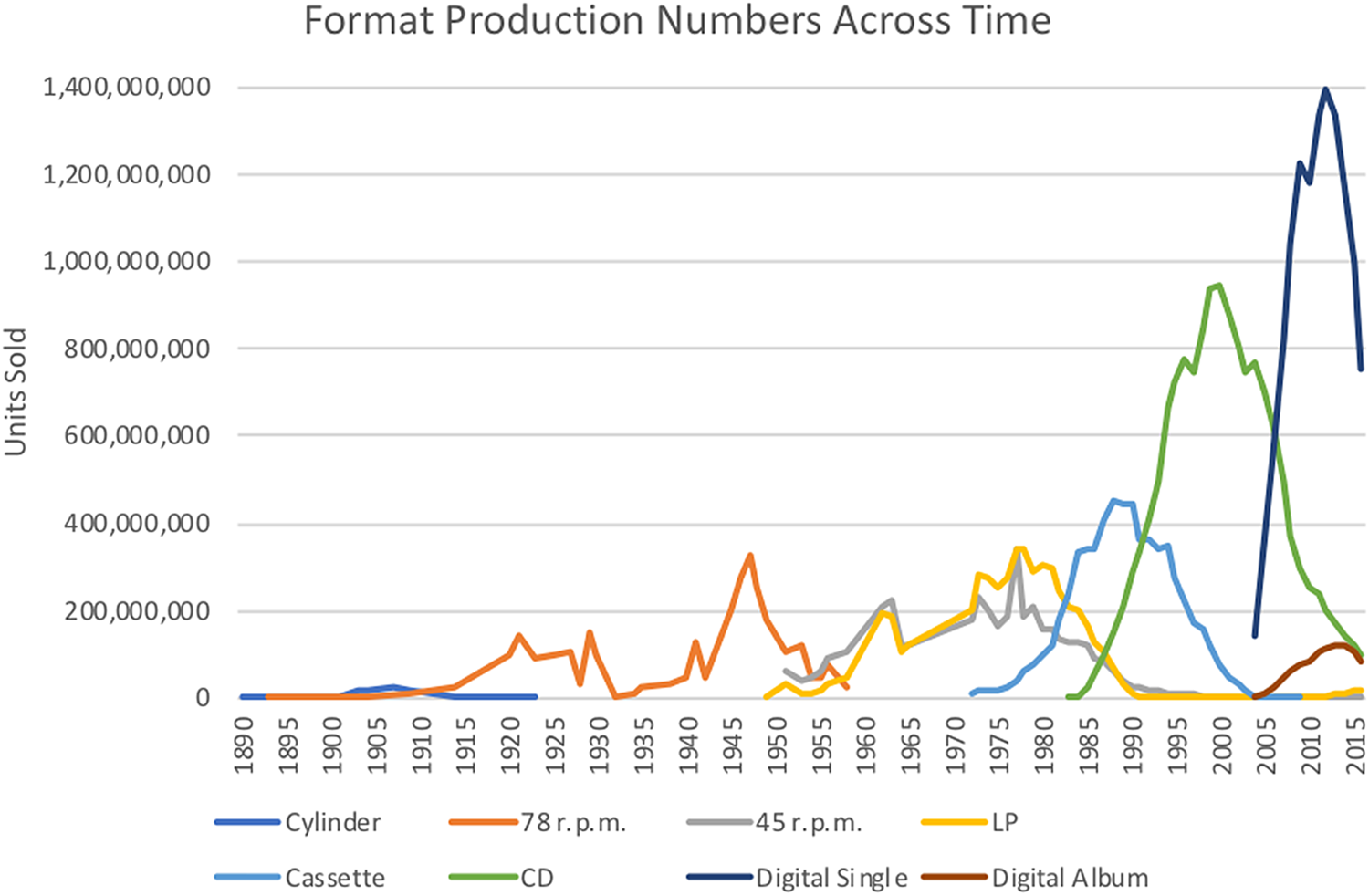
It is interesting to compare early 20th-century cylinder and 78 rpm disc unit sales against figures from the so-called vinyl revival of the 21st century. In Figure 3, we can see that in 2016 vinyl album units (not counting the substantial secondhand market) in the United States were just under 18 million units. This is markedly less than phonograph cylinder sales at their peak in 1907. However, both phonograph cylinder and 21st-century vinyl LP production numbers pale in comparison with recording unit production numbers over a broader historical scope (see Figure 4).
Figure 3.

Figure 4.

Using the data illustrated above we can determine peak years of production in the United States for each format: 1907 for the phonograph cylinder, 1947 for the gramophone disc, 1977 for the vinyl LP, 1988 for the cassette tape, 2000 for the compact disc, 2012 for the digital single purchase and 2013 for the digital album purchase.
When it comes to estimating the price of formats over time, again a combination of primary (advertisements and trade press) and secondary sources were used, then adjusted for inflation. Here the ‘unit price’ of a recording refers to the average retail price of one unit. Where possible, a stated ‘average’ price was obtained (e.g. from Billboard magazine). Where such information was lacking, however, in order to accumulate enough data, the research assistant collected examples of unit prices from advertisements in the music trade press and calculated an indicative average for that year (sources for this process are detailed in the online dataset; Brennan and Archibald Reference Brennan and Archibald2019). After adjusting for inflation, and expressing prices in current US dollars, our estimates of the rough price of a new phonograph cylinder in its peak year of production in 1907 is $13.88, vs. $10.89 for a shellac disc in its peak year of 1947. A vinyl album in its peak year of 1977 cost $28.55 in today's money, compared with $16.66 for a cassette tape in 1988, $21.59 for a CD in 2000 and $11.11 for a digital album download in 2013.Footnote 5
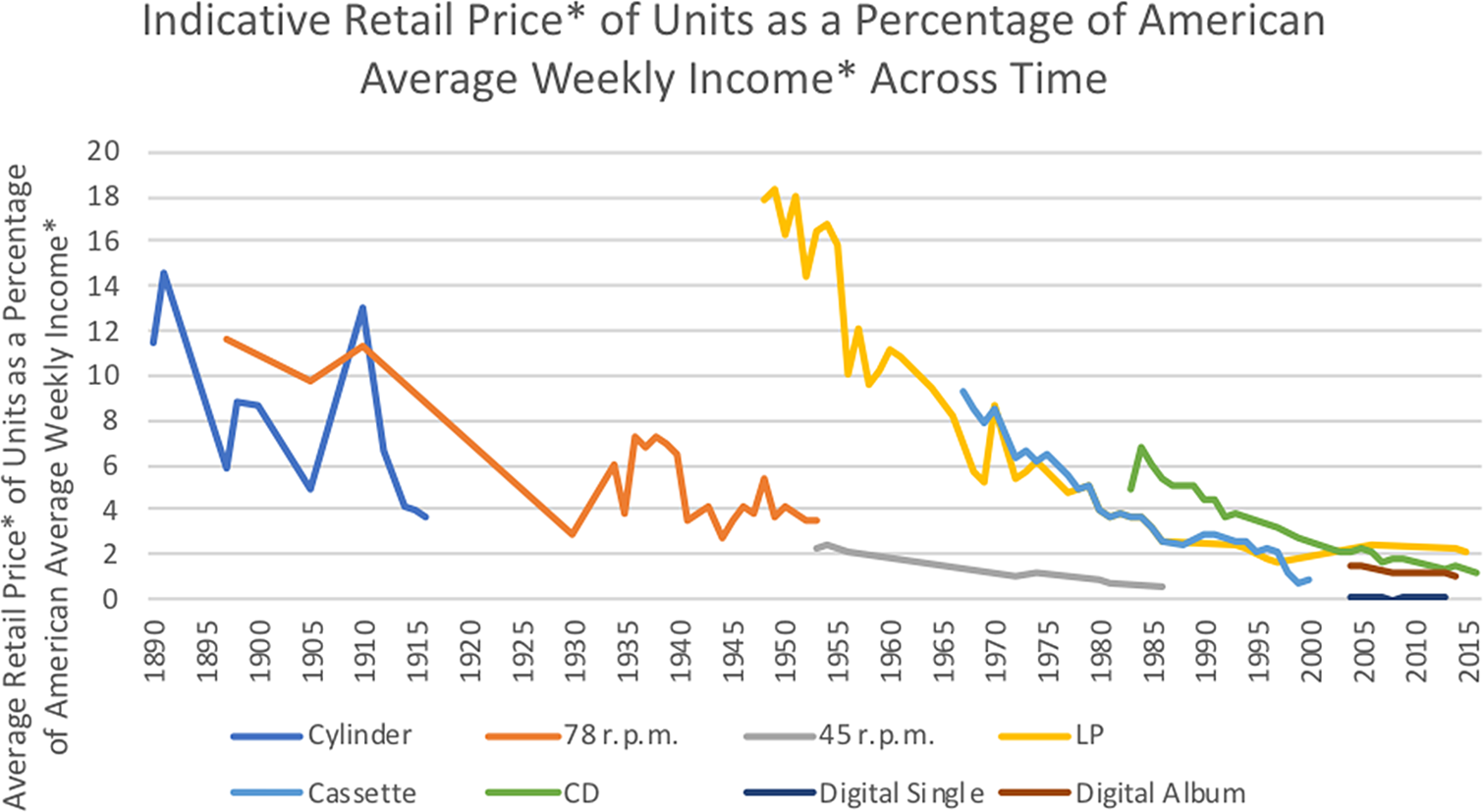
Gathering data for average salaries of US citizens was a somewhat easier task, since such data have been collated by the US Bureau of Labor Statistics. These salary figures are pre-tax, rather than take-home salary. Take-home salary figures would have been preferable, of course, but our finite research resources did not allow for this more complicated calculation. In order to determine how much money workers actually took home, additional time would have been required to study how taxation has changed in the United States over the last century. We would encourage future researchers to take up this challenge. As a result, our estimates for ‘unit price as a percentage of weekly income’ will be proportionally smaller since it is a percentage of pre-tax salary rather than actual take-home wages (see Figure 5).
Figure 5.

Having done our best to estimate how much consumers have typically paid for the luxury of listening to their choice of recorded music across playback formats and over history, we can see a clear gradual decline across formats and over time in the United States. This does not necessarily mean that consumers currently place less value on recorded music than at prior moments in history, but it does illustrate that the market value of recorded music is, broadly speaking, lower than it has ever been. When plotted against the changing average salary of a US citizen over history, consumers were willing to pay roughly 4.83 per cent of an average weekly salary in vinyl's peak year of production in 1977, a price which slips down to roughly 1.22 per cent of an average weekly salary in 2013, the peak of digital album sales.
The advent of streaming music resulted in a radical break with the previous economic model of selling recorded music. What used to be a commodity industry (buying copies to own) is now a service industry (buying access to a temporary experience of music stored on ‘the cloud’ reliant on remote server farms). Those who wish to pay a monthly subscription to access streaming platforms without advertisements, for example, can now do so for $9.99 per month, otherwise just over one per cent of the current average pre-tax weekly salary in the United States.
Environmental cost
Regardless of whether a given recording is expensive or cheap or free, the fact of the matter is that all recording formats have associated environmental and human costs. They always have. They always will. And at no point in the history of recording has any format adhered to principles of extraction, energy or exchange that might qualify as fair trade.
If there have been seven principal formats in the history of commercial sound reproduction, those formats adhere to three main forms of materiality. Between 1900 and 1950, most recordings were made from an insect-derived resin called shellac – which was harvested and processed by exploited women and children in colonial India.Footnote 6 Between 1950 and 2000, recordings were made from petrochemical plastics – which was extracted from the Earth in zones of conflict such as the Middle East and processed in factory conditions that took their toll on workers and local environments. Since 2000, downloading and streaming have become the most prominent means of listening to recordings – which now exist as microscopic digital audio files that seem utterly virtual.Footnote 7 Common intuition therefore suggests that the history of sound recording is a history, not only of dematerialisation, but also of increasing environmental friendliness: a progression from gluey resins, smoke stacks and hard labour to flowing streams, wispy clouds and effortless clicks. Nothing could be further from the truth.Footnote 8
Shellac records begin as part of the lac beetle's natural reproductive cycle. Essentially, female lac beetles coat tree branches in a resin in which they lay their eggs. When those eggs have hatched, the resin is removed from the tree branches and sent to factories for processing. According to a Government of India Labour Report (1946), these factories regularly employed women and children on some of the lowest wages in India. What's more, the factories were dirty and unsafe. This compromised the wellbeing and health of shellac workers. Indeed, the Labour Report pulled no punches in describing the Indian shellac industry as a sweatshop economy. The record business was directly involved in establishing and perpetuating these colonialist, extractivist conditions. Indeed, it was the popularity of the gramophone record that contributed to a boom in the shellac industry after 1900, and which purchased as much as half of India's shellac by the 1940s.
Long-playing records, 45s, cassettes and CDs are all made of plastic. Plastic, of course, is a petrochemical product, meaning that all of these formats begin their life as oil. Consumers are generally familiar with the environmental and political problems of petroleum. Yet this awareness does not generally influence preferences in listening to recorded music. Indeed, it is an irony that many of the fans who are invested in the nostalgia and romance of the so-called vinyl revival are also (anecdotally) those who seem most likely to drive electric cars or to ride bicycles, perhaps also to buy organic food and to choose a vegetarian lifestyle. (Of course, this contradiction makes sense as an expression of the paradoxical anti-commercialism that has been expressed through the mass medium of rock since the 1960s; cf. Frith Reference Frith1978, Keightley Reference Keightley, Frith, Straw and Street2001.) A more sober look at vinyl, though, helps to demystify its aesthetic appeal.
One of the largest suppliers of polyvinyl chloride (i.e. PVC, the main ingredient in LPs) to the US recording industry during its plastic era was the Keysor-Century Corporation, located near Los Angeles, which supplied about 20 million kilograms of vinyl per year around 1970. For nearly the entirety of the vinyl era, Keysor-Century was under investigation by the Environmental Protection Agency. This corporation dumped toxic wastewater into nearby ponds and storm trains, and it released hazardous particles into the air – both in its own plant and into an elementary school across the road. Keysor-Century's reckless and dangerous activities were eventually fined by the Environmental Protection Agency and the Federal Bureau of Investigation, to the tune of $4 million, which coincided with the bankruptcy of the Corporation.
Today, well over half of the PVC used in United States-based record manufacturing is produced by the Thai Plastic Chemicals Public Company Limited (TPC). TPC's main offices are in Bangkok. The company produces PVC compound just south of the city, where they have been known to release toxic wastewater into the Chao Phraya River. TPC also produces PVC resin in refineries on the Map Ta Phut Industrial Estate of Rayong Province, on the Gulf of Thailand – which is among ‘Thailand's most toxic hot spots with a well-documented history of air and water pollution, industrial accidents, illegal hazardous waste dumping and pollution-related health impacts including cancer and birth deformities’ (Excell and Moses Reference Excell and Moses2017, p. 20). Regardless of how much a listener might valorise vinyl for its supposedly warm sound or special feel, and regardless of the political message contained on a given record, to listen to vinyl records is to participate in petrocapitalism. The medium, as always, is the message.
Surely streaming is the way forward. Surely the seemingly immaterial click-of-a-mouse character of downloading data uses less energy and harms fewer people and communities than do shellac and plastic recording formats. To counter this notion, it is necessary to look at two essential dimensions of music downloading and streaming: accessory technologies and information infrastructures.
Accessory technologies such as smartphones and computers are undeniably material devices. And they are absolutely necessary for listening to music online. Such devices contain a variety of substances that are mined and processed under inhumane and environmentally damaging conditions in places such as the Democratic Republic of Congo (Merchant Reference Merchant2017). They are also assembled in factories in places such as China, where people labour night and day in conditions that Jack Linchuan Qiu (Reference Qiu2016) sees as continuations of slavery. Additionally, the rapid fashion cycles and planned obsolescence of these devices mean that well-resourced consumers, especially in the Global North but also elsewhere, purchase tons of them – and that those consumers often quickly dispose of them, thereby contributing to the problem of electronic waste (cf. Lepawsky Reference Lepawsky2018). While people use their phones and computers to do many things besides listen to music, that does not absolve (listening to) music from various social responsibilities. Given the extent to which these devices increasingly function as the primary means of listening to recorded music, and given the extent to which music is a key part of the way such devices are marketed, musical investments are complicit in the problems of our present digital condition.
In addition to accessory technologies, digital audio files rely on a global telecommunications infrastructure that consists of storage and processing facilities as well as transmission and delivery networks (cf. Starosielski Reference Starosielski2015). All of this requires energy. Of course, a single song or album uses a negligible amount of energy. However, there are millions of people streaming untold quantities of musical data every day. It is in examining the amount of electricity that this infrastructure requires (as well as the ways in which such electricity is generated) that we can start finding concrete grounds to compare the environmental cost of recorded music across its history.
As with Brennan's study of the economic cost of recorded music, our investigation into the environmental cost uses US streaming figures.Footnote 9 Here we will compare the US sales peaks of the LP, cassette and CD with the dominance of downloading streaming around 2016. We begin by averaging the weight of each of these formats and multiplying that by the total sales figures of all formats across each of our core samples. Here we find that, in 1977, the peak of the LP, the US recording industry would have used 58 million kilograms of plastic. At the peak of the cassette, in 1988, the amount was 56 million kilograms. And at the peak of the CD, in 2000, the industry would have used 61 million kilograms of plastic. As expected, when the primary means of listening to music shifts to downloading and streaming, the amount of plastics drops dramatically, down to 8 million kilograms around 2016 (see Figure 6). This seems to confirm the common sense notion that music digitalised is music dematerialised. However, this comparison accounts only for plastic. What happens if we account for the amount of energy used for downloading and streaming?
Figure 6.

In order to make this comparison, we converted plastics production into greenhouse gas emission equivalents (GHGs). Here we find that the amount of GHGs released in making plastic formats also remains relatively constant across our core samples: 140 million kilograms in 1977; 136 million kilograms in 1988; 157 kilograms in 2000. Yet once we consider the amount of GHG emissions required to transmit downloaded and streamed digital audio files around 2016, we encountered a surprising result. A conservative estimate suggests that the amount of GHGs actually increases in the downloading and streaming era – up to about 200 million kilograms. A more pessimistic estimate suggests that the amount could be more than double, which is up to 350 million kilograms of GHGs per year (see Figure 7).Footnote 10 This number would only rise if we were to consider countries in which streaming is just as prominent (and more) as it is in the United States, but which often use even less clean and renewable sources of power as means of generating electricity to power the infrastructure of the internet. What is more, as the recording industry continues to shift towards a subscription streaming model of listening that requires a political economy of unending cultural consumption (instanced most recently by Apple's announcement that it will discontinue iTunes; cf. Arditi Reference Arditi2018), this business model is quietly rooted in a political ecology of unending energy consumption. Music digitalised is certainly not music dematerialised.
Figure 7.

Creating a public conversation about the costs of music
One of the driving factors behind our The Cost of Music collaboration was the desire to experiment with new practice-based approaches of communicating our research ideas (that is to say ‘new ways’ for the authors as opposed to the longstanding community of practice-based scholars within popular music research). The following discussion therefore documents our experience of encouraging a public conversation about the costs of recorded music through the creation and dissemination of a series of six practice-research experiments: an album release; an interactive musical sculpture; a public engagement essay on the Conversation website; three short films; a live event; and a fanzine.
Practice-research goes under a multitude of other aliases depending on one's academic discipline and geographical location, and the nature of the relationship between practice and research in a given project. In the UK this form of academic inquiry is referred to variously as practice-led or practice-based research (e.g. Zagorski-Thomas and Henson Reference Zagorski-Thomas, Henson, Moir, Powell and Dylan-Smith2019; Brennan et al. Reference Brennan, Collinson-Scott, Connelly and Lawrence2019). In continental Europe it is more commonly labelled as artistic research (e.g. Borgdorff Reference Borgdorff2012), while in Northern America it is more often referred to as research-creation (e.g. Chapman and Sawchuk Reference Chapman and Sawchuk2012; Stévance and Lacasse Reference Sophie and Lacasse2017). In this article we will use the term ‘practice-research’ as it is defined by the UK-based Practice Research Advisory Group. Without getting into the ongoing debates surrounding this plethora of terminology and its differentiations, we position The Cost of Music project as a form of practice-research, and what follows is an account of experiments into the practice of releasing, distributing and consuming recorded music as a dual tool for both research and public engagement. In other words, this project is about interrogating the practice of putting popular music out into the world and what comes afterward, including using feedback on the release as a data collection for the project.
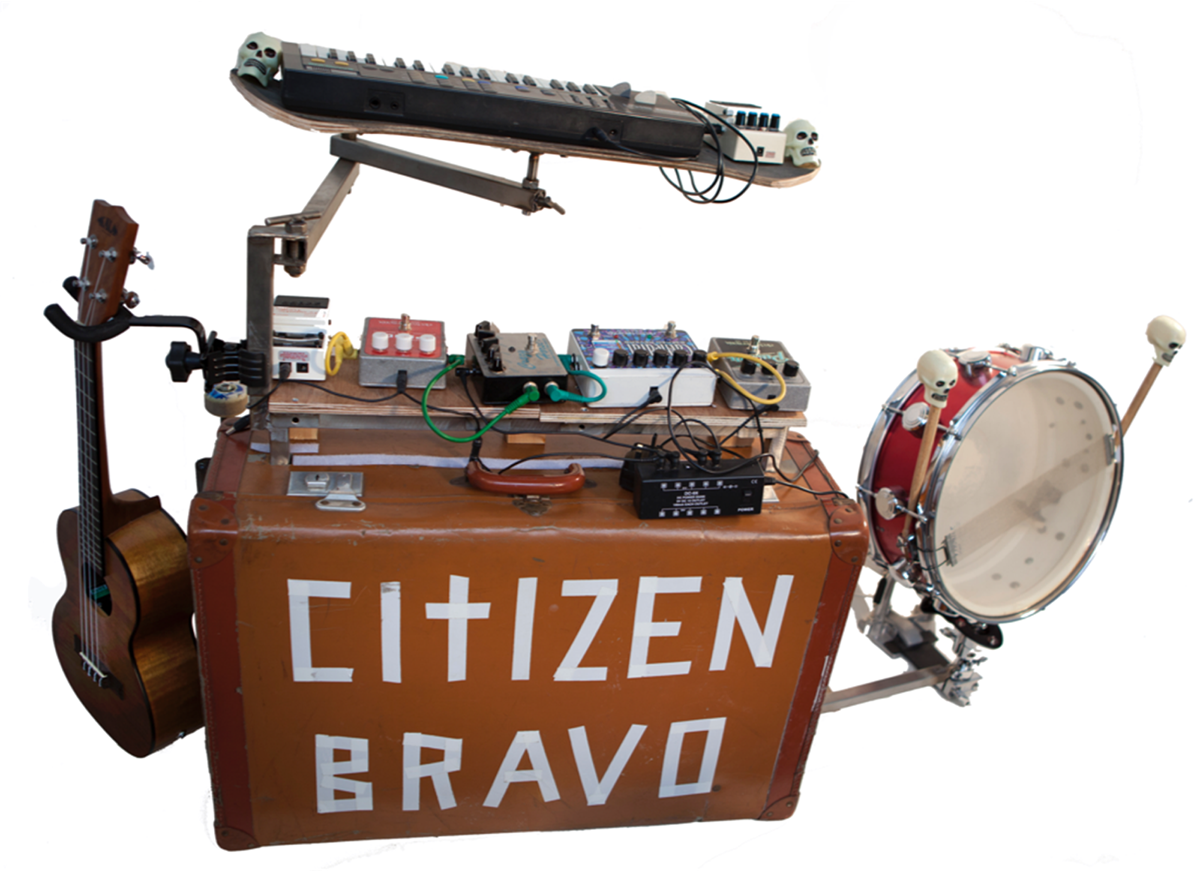
As part of his artistic practice, Brennan had previously collaborated with artisan blacksmith David C. Frazier to design and build a bespoke one-person band instrument made mostly out of found and re-purposed materials, writing and performing original music under the pseudonym Citizen Bravo. Inspired by the homespun aesthetic of Victorian-era one-person bands, Brennan and Frazier spent several weekends in a workshop on the south side of Glasgow, Scotland, building a one-man-band instrument out of a suitcase, a skateboard and scrap metal. The resulting contraption was wheeled out for a series of unruly live performances where Brennan road tested the songs that he would eventually bring into the studio (see Figure 8).
Figure 8.

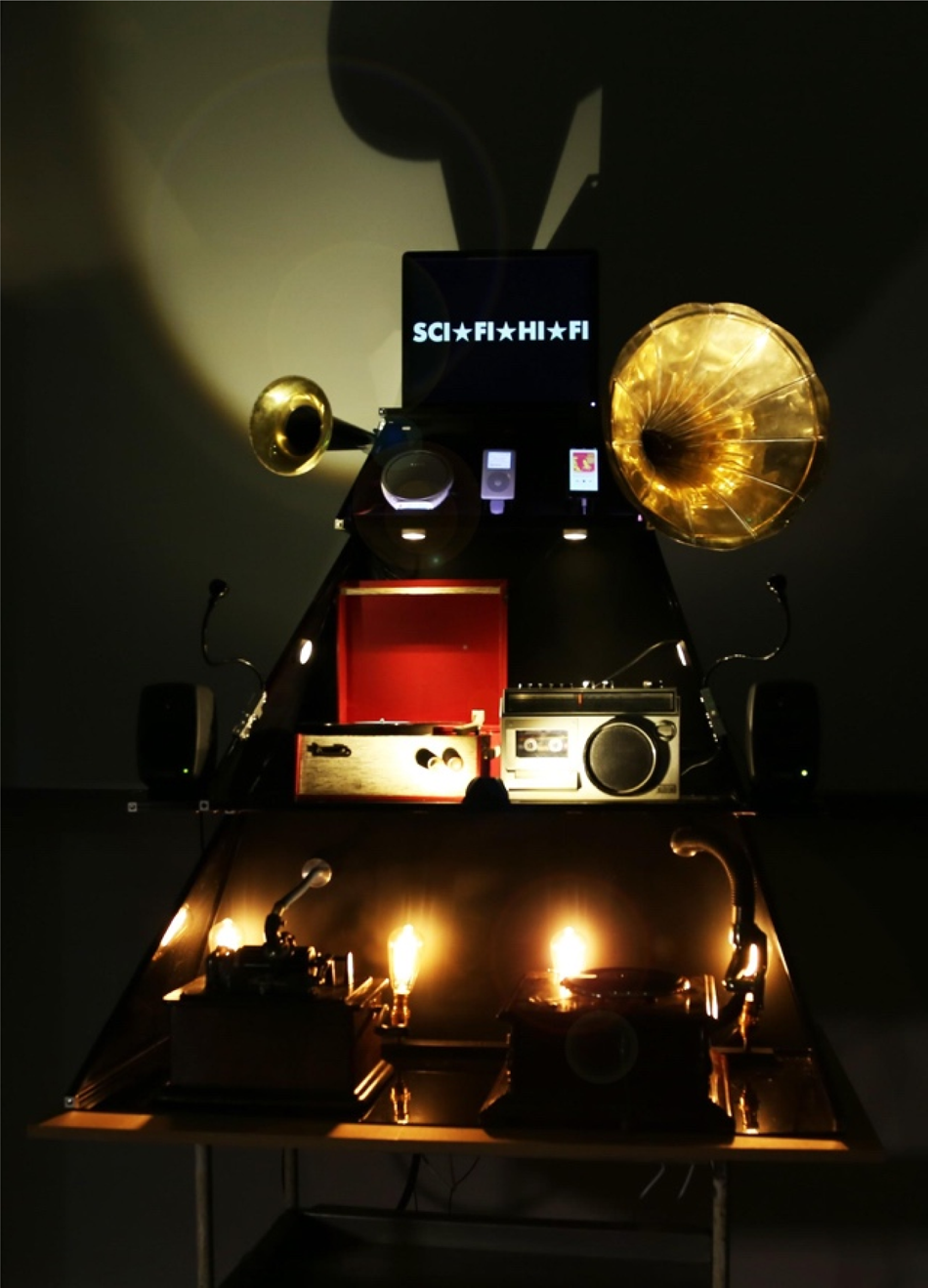
In keeping with the aesthetic of the Citizen Bravo instrument, Brennan planned to release his debut album, Build a Thing of Beauty (2019), in the form of a bespoke interactive musical sculpture made mostly out of found and re-purposed historical music playback technologies (sourced from eBay, junk and antique outlets). The resulting sculpture, dubbed the SCI★FI★HI★FI, was designed and built in collaboration with electronics engineer Peter Reid, metal worker Mark Reynolds, antique recording format specialists Aleks Kolkowski and Duncan Miller, and machine learning coder and algorithmic composer Owen Green. The SCI★FI★HI★FI is what its name suggests: a science-fiction inspired hi-fi system that can play seven of the most historically significant recording formats (Edison wax cylinder, 78 rpm disc, vinyl LP, cassette tape, compact disc, MP3 on hard drive and streaming remotely from the cloud – see Figure 9).
Figure 9.

The SCI★FI★HI★FI is designed with the aim of taking the experience of listening to recorded music – an everyday, mundane activity in the 21st century – and to approximate, albeit in an imaginative fantasy, the late 19th- and early 20th-century experience of listening to recorded music as a memorable event: a rare and intense interaction between listener and audio playback technology. Although the SCI★FI★HI★FI is a storage technology for the Build a Thing of Beauty album, it also explores how playback technology changed the parameters of musical work at different moments in history. The pairing of Build a Thing of Beauty and the SCI★FI★HI★FI is therefore intended to be not exactly a concept album, but rather an experiment exploring the concept of albums as historical artefacts. How was recorded music valued before the advent of albums, and how might it be valued after albums are gone?
The artwork also encourages the listener to consider how the scope of musical works can expand and contract via the constraints of playback technology. A wax cylinder, for example, is only able to store two minutes of lo-resolution mono sound on wax cylinder (and the listener can only experience the first song on the album via phonograph), but by the advent of streaming from the cloud the length of a musical work has expanded to become potentially infinite in length. To illustrate this point, collaborator Owen Green took the audio ‘stems’ of the recording sessions and coded a machine learning remix of the album that is generative, un-storeable and infinite in length. It can only be heard by tuning into a remote streaming broadcast.Footnote 11
Once completed, the authors used Brennan's release of the Build a Thing of Beauty album and the SCI★FI★HI★FI and Devine's then-forthcoming monograph Decomposed: The Political Ecology of Music as a means to communicate their collaborative research on the economic and environmental costs of recorded music. The album was released on digital streaming platforms via Chemikal Underground Records on 5 April 2019, accompanied by a joint authored press release and short essay for the Conversation website outlining the key findings of The Cost of Music project (Brennan and Devine Reference Brennan and Devine2019), and a launch event for the SCI★FI★HI★FI the following week. All of these events were timed to coincide with the annual Record Store Day event in the UK and United States, which took place on 13 April 2019, so that their publication could fruitfully build on any press interest in Record Store Day and the changing fates of recorded music and physical formats.
Focusing on the changing costs involved in music consumption behaviour, the outputs above presented the findings described in detail in the earlier sections of this article. Our press release headline was that ‘music consumption has unintended economic and environmental costs’, and that ‘the price consumers have been willing to pay for listening to recorded music has never been lower, while the environmental impact of listening to music has never been higher’.
Our experiment to see if we could ignite a public conversation on the cost of recorded music worked better than we could have anticipated. Within a few days our Conversation essay had been read more than 40,000 times, republished by media ranging from the Weather Network to Newsweek, and translated into Spanish, Japanese and Indonesian. The press release was also picked up by the ABC, the BBC, the CBC, Rolling Stone, Pitchfork, Billboard, and a host of other media outlets. The environmental impact of streaming recorded music from the cloud was surprising enough to enter the news cycle, and judging by the comments sections of our Conversation article, it also surprised readers. Indeed, while the comments section of any internet publication should never be taken too seriously, it is clear some of those commenting found our argument both upsetting and controversial. Perhaps most interesting was that the dialogue between commenters responding to the article shed light on the complexities and challenges of making sustainable production and consumption choices. As one commenter wrote (all errors here and in the rest of these quotes are sic):
The music isnt damaging the environment, the governments’ choices of power sources are. Electricity is essentially an infinate resource (sunlight/wind/nuclear) so when weve sorted out our energy supply issues a format of music where consumers require no additional material items to listen to new music, streaming services will be the most environmentally friendly form of music possible. (Lynch, comments section of Brennan and Devine Reference Brennan and Devine2019)
Yet another commenter quickly responded by pointing out the problem with the argument above:
‘when weve sorted out our energy supply issues’ is far harder than you might think. The rich countries cannot simply press a button to turn on clean energy sources and leave fossil fuels behind. We use far too much energy to take even half of it from renewables. Unless we drastically change our economic systems and our energy-guzzling lifestyles, climate change will send us the way of the dinosaurs and there'll be no more music to stream. (Hopkins, in comments section of Brennan and Devine Reference Brennan and Devine2019)
Other commenters pointed to the fact that corporations such as Apple, Google and Amazon are all making efforts to shift their energy consumption towards renewable sources, with some attacking the essay as ‘reverse greenwashing’ and ‘fodder for anti-environmentalists’ (Brennan and Devine Reference Brennan and Devine2019). As one commenter put it:
Streaming music is going to have an increasingly lower environmental impact in the long run that physical plastic recording devices being shipped around the world, as we shift to renewables … eventually. We should be encouraging streaming data over making plastic discs that never go away. In 50 years the power for the service will be renewable, but the CD will be around for 100s of thousands of years and take alot of energy to manufacture! (Talls, in comments section of Brennan and Devine Reference Brennan and Devine2019)
In this line of argument, there seems to be confusion that our research is somehow suggesting a return to plastic music format production as a ‘solution’ to the problem of carbon emissions produced by streaming music. This was never our argument, of course, but it was interesting and unexpected to us that our research provoked this type of response by more than one commenter. Underlying these types of comments is what might be categorised as a ‘techno-utopian’ worldview regarding current human energy consumption. In such a worldview, the problem is not unsustainable levels of energy consumption, but technological inadequacy in clean energy production – an inadequacy that will soon be overcome, allowing us to consume energy at our current rates without consequence. To put this another way, the research seemed to deeply upset some commenters at least in part because it threatened to undermine a worldview where unending energy consumption was possible. The research was also evidently upsetting because it asked readers to confront a widespread sentiment that music makes only positive contributions to social and identity formations. Music may make such contributions, of course, but it is equally true that a world in which music does not make certain claims on environments and communities is a world without music.
In addition to the press release and Conversation essay, we also created three short films in collaboration with director Graeme O'Hara: an animated video essay titled ‘How much should we pay artists for listening to their music?’ (2019), an animated video interview titled ‘What is the environmental cost of recorded music?’ (2019), and a documentary film titled The Cost of Music (2019), which chronicled the project's journey from beginning to end. The first two animated films were designed to be uploaded and shared online, while the third film was designed to be submitted and screened at film festivals. Each of the videos engaged in a different form of storytelling, but we made deliberate efforts to ensure that all three films were light in narrative tone, with a view to encouraging audiences to become curious (as opposed to depressed) about the political economy and ecology of recorded music. The launch event for Build a Thing of Beauty and the SCI★FI★HI★FI – a performance which saw the premiere of the album, sculpture, and documentary film – had similar aims: rather than simply trying to objectively present the research findings, dramatic and artistic approaches were intentionally deployed to encourage an affective response, specifically curiosity and playful engagement to discover how the economic and environmental costs of music have changed over time. In collaboration with artist Jude Thompson and with contributions from Devine and O'Hara, Brennan produced a fanzine called the ‘Terrifying Miracle Of Recorded Sound’ for audiences to take home after the event, along with a prompt to get in touch with any further responses to the work (see Figure 10).
Figure 10.

The underlying rationale for using such a range of practice-research experiments in public engagement and research communication is based on a recent turn within the world of environmental sustainability scholarship. As Bendor et al. (Reference Bendor, Maggs, Peake, Robinson and Williams2017) have proposed, convincing publics and policymakers to address the global challenge of sustainable development simply by presenting data-driven argument and scientific consensus has ultimately been perceived as a failure over the past several decades. In short, as they put it, ‘sustainability can no longer rely exclusively on scientific knowledge production to determine the right path to a single sustainable future’:
Rather it relies on how well society explores, imaginatively inhabits, and evaluates multiple possible futures; on the kind of stories societies tell about who they are and what is important to them; and on the avenues for collective action that open up as a consequence. This view also implies a significant, ontological shift: instead of a world made of objects whose reality can be established in absolute terms, we must contend with dynamic and contingent cultural forms that shape the ways such facts are constituted, expressed, and interpreted … (Bendor et al. Reference Bendor, Maggs, Peake, Robinson and Williams2017)
Accordingly, Bendor et al. and other researchers have begun to experiment with approaches to public engagement on sustainability ‘that shifts away from making people face some brute reality, away from “a single slow-moving disaster scenario” and towards enchanting them with the openness of the world as an imaginary place’ (Bendor et al. Reference Bendor, Maggs, Peake, Robinson and Williams2017). Our hope is that The Cost of Music project will serve as a modest contribution to this wider experiment.
Conclusion
We wish to conclude by offering some reflections on the potential benefits of using the concept of ‘cost’ to understand music production and consumption. Owing to its identity as an interdisciplinary field, there is a productive tendency in popular music studies to borrow concepts and terms from different disciplines. Yet, sometimes, the broader context of such ideas can be downplayed or neglected. Take the concept of ‘value’. There is a wealth of scholarly work that theorises the value of popular music (e.g. Finnegan's Hidden Musicians (Reference Finnegan1989), Frith's Performing Rites (Reference Frith1996) or Middleton's Studying Popular Music (Reference Middleton1990), all of which contain discussions on value). Or we can think of the whole range of research over the years that considers the economic, social and cultural value of popular music, employing related terms such as use value, exchange value, symbolic value, and so on (e.g. Taylor Reference Taylor2017; Marshall Reference Marshall2019). However, it is far less frequent that we discuss popular music in terms of the related concept of cost. According to the Oxford Dictionary of Economics, cost is a close cousin to value, or rather it is ‘the value of the inputs needed to produce any good or service, measured in some units … usually money’ (Black et al. Reference Black, Hashimzade and Myles2009). By framing music in terms of cost as opposed to value, we can ask a different set of questions. What are we willing to miss out on – economically, socially, and environmentally – in order to enjoy the luxury of making and listening to music?
We propose that it could be fruitful to think of musical culture in terms of three kinds of cost commonly used in economic theory. First is the concept of opportunity cost, defined as ‘the benefits that could have been obtained by choosing the best alternative opportunity’. For example, for a musician the opportunity cost of pressing an album on vinyl or CD is given by the benefits they would have received if they had chosen a digital-only release, assuming that is the best alternative. Second is real cost, defined as ‘the real resources used up in producing a good or service’, or the related third concept of social cost, defined as ‘the total cost of any activity. This includes private costs which fall directly on the person or firm conducting the activity, as well as external costs outside the price system which fall on other people [e.g. environmental harm]’ (all definitions from Black et al. Reference Black, Hashimzade and Myles2009). Music is not typically described in terms of its cost, but to do so allows one to weigh up, for example, the idea that while the economic cost of listening to recorded music is lower than ever before, we are also at a point where the environmental cost of listening to recorded music is probably higher than ever before. The next logical question is: what should musicians and fans do about it? We will focus on a few possible answers.
One answer comes in the form of what not to do. Don't look back. We cannot return to previous recording formats, to pre-recorded musical culture, or to ‘pre-technological’ forms of music-making and listening. Consider returning to previous formats. It is obvious that returning to CDs, cassettes or LPs would be unwise, given what most people now know about the problems of plastic and petroleum. Looking further back, though, to shellac 78 rpm discs and acoustically amplified hand-cranked gramophones, might seem appealing. After all, shellac is a renewable resource and biodegradable material – a seemingly ‘green disc’. And the amplification horns, springs and muscles required for acoustic playback use no electricity. But is the shellac era really what Jacob Smith (Reference Smith2015, p. 7) refers to as ‘an alternative model for new, eco-ethical modes of producing and consuming sound’ or ‘a more convivial phonography’ (Smith Reference Smith2015, p. 17)?
Recall that the working conditions in India during recorded music's shellac era were far from equitable for Indian labourers. Returning to shellac today would demand much more of the insects, forests, and workers of India (and elsewhere) to produce this material. This is because there are far more people listening to far more recorded music than there were during the years between 1900 and 1950. Even if equitable trade relations were established between the Global North and the Global South, and even if record companies developed highly efficient means of extracting and processing shellac that somehow did not establish a new ‘resource imperialism … to maintain the unsustainable consumer appetites of rich-country citizens’ (Nixon Reference Nixon2011, p. 22), an established economic principle predicts that ‘as a rule, new modes of economy will lead to an increase of consumption’ (Jevons Reference Jevons1865, pp. 103–4). Something similar can be said about a key material used to amplify gramophones in the pre-electronic era: mica.
Mica is a flaky silicate mineral that was used as an amplifying diaphragm during the acoustic era of sound reproduction. This mineral was mined in places such as Brazil and, later, was processed in Nazi concentration camps. Like shellac, though, key figures in the musical history of mica also included Indian mines as well as exploited women and children (Bronfman Reference Bronfman, Devine and Boudreault-Fournier2020). Returning to hand-wound gramophones could mean returning to mica – and needing much more of it. As we know from other commodities, stories of demanding more and more of given resources from given regions do not generally adhere to principles of conviviality. Nor do they end happily.
Similar questions would arise if we were to try returning to the predominant medium for storing and transmitting musical information that preceded sound reproduction: paper notations, made as they are from trees and ink (Devine and Boudreault-Fournier Reference Devine, Boudreault-Fournier, Devine and Boudreault-Fournier2020). It is equally problematic to think that we can reduce music's environmental and human costs by moving away from consuming recorded music and participating in live music instead. Indeed, live music is in fact a bigger polluter than recorded music, owing to its inseparability not only from electricity grids but also from global infrastructures of air travel, shipping, highways, and automotive culture (Brennan Reference Brennan, Devine and Boudreault-Fournier2020).
Perhaps, then, listeners should consider abandoning ‘technological’ means of making and listening to music altogether. Would this help the situation? There are several problems with this line of thinking. First, we cannot simply undo the cultures of listening that have developed around online music in the 21st century. Second, technology is not an optional add-on to musical practice. Music is technological, through and through – and this has always been the case (Tomlinson Reference Tomlinson2015; cf. Bradley Reference Bradley2011). Suggesting that listeners abandon recording and even notation to make music in local communities using only ‘natural’ materials such as wood, bone, skin and our own lungs – this would not make music any less technological, and it would only serve to shift the problems of music's political ecology onto other resources and groups of people. Earlier formats and ostensibly non-technological means of music-making are non-starters. Romance and nostalgia will not help.
Another kind of answer escapes the traps of technological romance and nostalgia but nevertheless introduces other ambiguities. This is the realm of elegies on icebergs, symphonies about scenery, songs about paving paradise in favour of parking lots. Indeed, perhaps the most obvious musical response to the Anthropocene is to make music about the Anthropocene. Likewise, highlighting and analysing such practices is perhaps the most obvious broadly musicological response to the Anthropocene. The conviction here, as expressed by an organisation called Green Music Australia (to take one among many examples), is that ‘musicians sing the story of our world and, by doing so, help to write it’. They continue: ‘Musicians have an amazing influence – tapping into our emotions, changing the way we think, influencing the food we eat and the clothes we wear, literally putting words in our mouths’. There is no denying that celebrity musicians exert real cultural influence and may contribute to raising awareness or shifting public opinion. But there are deeper problems and ambiguities with such musical responses to the Anthropocene.
One of the interesting things about the Anthropocene discourse is that it names a moment in which scientists have acknowledged the agency of the human world, while humanists have acknowledged the agency of the natural world (Chakrabarty Reference Chakrabarty2012, p. 10).Footnote 12 Responding to the Anthropocene requires the natural and human sciences to work across the artificial divides that have been created between these areas. This means that musical representations of the Anthropocene (along with scholarly attention to musical representations of the Anthropocene) may serve to fortify outmoded borders that are otherwise crumbling. Rob Nixon makes a related point from the realm of postcolonial literary studies:
It is sometimes argued that ecocriticism's singular contribution to environmental studies ought to be centered on the aesthetic – that an attentiveness to form is the environmental literary scholar's [or music scholar's] proper bailiwick. But there is a risk in this if the aesthetic gets walled off as a specialist domain, severed from the broader socio-political contests that animate the forms in question. The more exacting challenge … is how to articulate these vital aesthetic concerns to socio-political transformation. (Nixon Reference Nixon2011, p. 32)
In his essay on ‘The limits of Anthropocene narratives’, Zoltán Boldizsár Simon registers something similar. He notes how the genuinely new challenges posed by the Anthropocene tend to be domesticated by existing ways of thinking:
[O]n the one hand, we tend to think of the Anthropocene as the radical event, rupture, and unprecedented change that rewrites disciplinary codes as we know them and demands new arrangements of knowledge we are yet to establish; on the other, we still think about our radically new predicament in terms of our more familiar arrangements of knowledge. (Simon Reference Simon2018, p. 11)
In other words, if the condition described by the Anthropocene is one that can only be addressed by crossing boundaries between humanities and sciences, cultures and natures, then the political-aesthetic conviction that musicians ought to narrativise our present condition by writing songs about the world that may help to change it – such a notion might not be up to the challenge. Not fully, anyway. Additionally, the challenges to music and research posed by the Anthropocene cannot simply be absorbed into the field of popular music studies or its university departments in the ways they are currently constituted. Business as usual will not do (cf. Heise Reference Heise2016). The question, from this perspective, is less ‘how do we make or study music about the Anthropocene?’ and more ‘how should we make and study music in the Anthropocene?’
Another suggestion on what to do about the environmental cost of recorded music is this: popular music scholars are already doing it, right here and now – in this article, in the research that it summarises, in this special issue, in the field as a whole. To spark public and scholarly discussion is not to resolve the problems. But it is a start.
Ultimately, though, awareness campaigns, noble as they are, come with other problems. If the wider worlds of climate change and environmental communication tell us anything, it is that even though awareness of climate change may be very high in the general public today, the facts of climate change are not leading to sustained and systemic change in the way that is required. Indeed, the project of awareness has been too easily articulated to discourses of individual responsibility. Here we follow cultural geographers such as Josh Lepawsky (Reference Lepawsky2018) and Max Liboiron (in Hess and Hutton 2019), who in their own ways show that individual consumer actions are ineffective as a means of addressing global problems of resource use, pollution and waste. Paraphrasing Liboiron (in Hess and Hutton 2019), while individual musicians and fans may choose not to buy vinyl records, to adopt less constant listening practices in relation to streaming services, to write forms of music that style themselves as engines of eco-criticism – such acts do not amount to much. On the level of personal ethics and morality, of course, they matter a great deal. At the scale of the planetary problems we face, effective solutions only seem possible at the level of large-scale changes to recorded music's industries, its technologies and its cultures.
The issue, from this viewpoint, is not what listeners might do with recorded music's various material forms and media systems once they have already taken hold in the world. Rather, it is about cultivating new relationships between music and the wider worlds of economy and ecology. We need to ask what recorded music might become after shellac, after plastic, after the internet. Truly post-catastrophic recording formats would require not only technological developments but also shifts in cultural expectations. Are the widely accepted ideals of more music, more storage, more bandwidth, more devices – more everything – sustainable? Can listeners delaminate the idea of better from the expectation of more, calling for what Lepawsky (Reference Lepawsky2018) calls genuine and extended producer responsibility throughout music's supply chains and waste streams? What might the mechanisms of such a shift look like?
Here we take inspiration from Liboiron. She directs the Civic Laboratory for Environmental Action Research, ‘a feminist, anti-colonial lab specialising in monitoring plastic pollution’. Could music lovers establish a similarly post-catastrophic music laboratory? Such a laboratory might be an inclusive space of convergence where students, researchers, artists and industries from around the world would imagine and create media technologies, instruments and infrastructures of music that respond to environmental degradation and worker exploitation. The idea would be to do more than develop musical and sonic contents that act as meaningful vehicles for environmental communication (although such projects would also be integral). It would also aim to discover solutions to the fact that the mediations of music and sound always have and always will cost energy and create waste. This may mean looking to past technologies (albeit in a way that would be purged of romance or nostalgia and that would pay careful attention to post- and neocolonialism). It may mean exploring new materials for contemporary formats. It may mean thinking beyond the internet. However the issue is approached, such a laboratory would be committed to developing concepts and projects that, recognising their own materiality and contingency, open up imaginaries of and avenues towards musical practices in the future tense (cf. Grossberg Reference Grossberg2010).
Yet we do not wish to end on a utopian note. We are not especially hopeful. Alexander Galloway (Reference Galloway2016, p. 132) has registered a widespread convention in historical materialism and critiques of political economy (we would add political ecology) ‘wherein the most profoundly hopeful grammar [of their concluding remarks] often houses a boundless … pessimism about the state of world affairs, as if two hundred words of utopian pep could change the course of the preceding two hundred pages of sober assessment’. Galloway (Reference Galloway2016, p. 130) notes that such hollow optimisms take shape in relation to the invocations of morality and obligation that often follow critical investigation: the impulse to ask what ought we to do? If, in relation to recorded music's historically low economic value and its historically high environmental cost, we have described some possible ways of thinking and acting in the future tense, there is another potentially appropriate response to such issues: mourning the transgressions and losses that may be attributed to music.