The court of Common Pleas, known until the late sixteenth century as the ‘Bench’ or the ‘Common Bench’, was one of the most important courts in the English legal system from its creation in the late twelfth or early thirteenth century until it and the other central courts (the King’s Bench, Chancery and Exchequer) were abolished by the Judicature Act of 1873, which transferred their jurisdiction to a single High Court.Footnote 1 The ‘Common Bench’ separated from the Exchequer in the middle of the last decade of the twelfth century, at which time it began to hold sessions on a regular basis during four designated terms each year. From then onwards it also employed its own personnel, separate from that of the Exchequer.Footnote 2 During the reign of Henry ii (r. 1154–89), a central royal court started to sit regularly at Westminster,Footnote 3 but King John (r. 1199–1216) continued his predecessors’ practice of forgoing a permanent base for his own household, preferring to travel round his domains, so that for considerable periods during his reign several of the royal courts, including the Common Bench, suspended their activities and, as a consequence, plaintiffs and defendants were forced to seek out the king, wherever he might be, in order to sue for justice. Dissatisfaction with the resulting tedious and lengthy process led to the inclusion in Magna Carta (1215) of a clause laying down that ‘common pleas should not follow the king but should be held in some certain place’.Footnote 4 In the specific context of Magna Carta, the words ‘common pleas’ did not indicate an actual court, but rather the type of case to be heard: one which did not necessarily involve offences against the king’s peace and was therefore likely to be a civil rather than a criminal matter.
Only after 1234 (the end of the minority of Henry iii (r. 1216–72)) is it possible to identify the two principal courts of English Common law by name: the court of Common Pleas (known as curia de banco) and the court of King’s Bench (curia coram rege).Footnote 5 King’s Bench started by hearing civil cases, but developed into a court primarily concerned with criminal law (notably crimes against the king’s peace), while the court of Common Pleas heard and determined civil disputes between the king’s subjects, often relating to land, inheritance and debts, these being suits in which the king had no direct legal interest.Footnote 6 The court of Common Pleas thus boasts a history of more than 600 years, and, from at least 1234 onwards until its merger with the other superior courts, it and, from the fourteenth century, the courts of King’s Bench and Chancery met regularly to hear cases in the great eleventh-century Westminster Hall.Footnote 7 A remarkable number of records were generated by these central courts of law: it has been estimated, for example, that the courts of King’s Bench and Common Pleas collectively produced more than 10,000 formal rolls between 1273 and 1500, together ‘containing more than four million membranes’.Footnote 8
In contrast to this volume of written material, only one image has survived that represents the medieval court of Common Pleas in session.Footnote 9 This illumination, showing seven judges in red, with the chief justice of the Common Pleas in the centre seated behind a long bench covered in green, can be dated to the latter half of the reign of Henry vi (r. 1422–61 and 1470–1).Footnote 10 Lawyers wearing white coifs appear on the viewer’s side of the bench, discussing cases with their clients, while clerks sit or stand at the bench with rolls of parchment on which cases were recorded in front of them. It is not possible to deduce much from the miniature about the seniority or responsibilities of the individual clerks portrayed,Footnote 11 but it is known that a number of clerks were formally attached to the court of Common Pleas and that others may have been responsible for the written records of the court.Footnote 12 The three most important officials were known as prothonotaries, and the most senior of the three was known as the chief prothonotary. The chief prothonotary was responsible for a variety of legal duties in addition to his role as the senior administrator in the court of Common Pleas. The name of the chief prothonotary was inscribed at the foot of the first membrane or rotulet of each plea roll.Footnote 13 During the period of our study, four men held this position: Thomas Heuster (from Hilary 1417 to Trinity 1439), John Wydeslade (from Michaelmas 1439 to Trinity 1468), William Copley (from Michaelmas 1468 to Trinity 1490) and William Mordaunt (from Trinity 1490 to 1518).Footnote 14
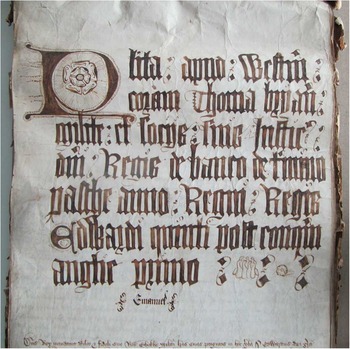
The records of the court of Common Pleas are held at The National Archives, where a single almost unbroken series of the plea rolls of the court, compiled for the chief justice of that court and bearing his name, survives for the period between 1273 and 1874 (TNA CP40). There are four rolls for each year, one for each of the quarterly law terms. Each plea roll is made up of a large number of individual pieces of parchment, known as membranes or rotulets, normally written on both sides and sewn together at the head of the document to produce the roll: each roll now lies flat in a one-metre-long box. From 1290 each rotulet, which measured roughly a metre in length and 300–400mm in width, was numbered at the foot. On the opening rotulet of each plea roll was a heading, written in enlarged display script. This heading, always in Latin in the medieval period, identified the court, the chief justice before whom the cases were heard, the specific law term, the type of litigation, simply described by the word Placita (‘Pleas’), and the king’s regnal year, thus: Placita apud Westmonasterium coram [name of chief justice] et sociis suis justiciariis domini regis de Banco de termino [specific law term] anno regni regis [regnal year and name of the king]. The wording was always the same; the only variables being the name of the chief justice and the date. What did change, however, was the decoration of the heading, which, from the 1420s onwards, almost invariably involved the initial letter ‘P’ of Placita and could also include the space over the top line and under the bottom line of the heading.
The aim of this paper is to introduce readers to aspects of the ornament and imagery that decorated these headings between 1422 and 1509 and to offer an initial exploration of the origins of the imagery and its development from simple ornament to more elaborate representations of plants, birds and animals and (in and after 1457) legal and contemporary commercial iconography and images of the sovereign as the fount of justice. The ornamentation of the Common Plea rolls also incorporates words and phrases, royal mottoes and acclamations, and verses from the Psalms chosen to underline the majesty and power of successive monarchs.
These plea roll decorations are almost unknown, even to medievalists, unlike those on the plea rolls of the court of King’s Bench, which are more familiar to scholars, thanks in no small measure to Erna Auerbach’s remarkable book, Tudor Artists.Footnote 15 Dr Auerbach’s exploration of the legal records was largely confined to the plea rolls of the court of King’s Bench, however, and in her book no mention is made of those of the court of Common Pleas. Most later authorities have followed Auerbach in concentrating on the decoration of the plea rolls of the court of King’s Bench rather than on those of Common Pleas; only relatively recently have the latter prompted any scholarly discussion.Footnote 16
Two other printed works are central to any study of the records of the court of Common Pleas in the fifteenth century. Margaret Hastings’s The Court of Common Pleas in Fifteenth Century England Footnote 17 remains an essential research resource to the court, its records, officials, clerks and procedures, though it ignores the decoration of the documents. Among her plates Hastings included the very important representation of the coronation of Edward iv in the roll for Trinity 1461 (TNA CP40/801), but she did not investigate its content or significance.Footnote 18 In addition to this work, Sir John Baker’s recent prosopographical survey of the lawyers and clerks of the Inns of Court, Chancery and the courts of common law is an invaluable resource for biographies of the judges and clerks of the court of Common Pleas between 1440 and 1540, as well as containing a list of all the officers of that court for the years 1440 to 1558.Footnote 19
The development that has done most to facilitate the production of this present paper is the AALT (Anglo-American Legal Tradition) digital archive,Footnote 20 the initiative of Professor Robert C Palmer, Cullen Professor of Law and History, University of Houston Law Center, Texas, working with the O’Quinn Law Library at the University of Houston. It has been made freely available to scholars with the agreement and support of The National Archives and offers online access to more than 8.5 million images of the original legal, Chancery and Exchequer records held at Kew.Footnote 21
Imagery and Decoration: Origin and Development 1422–56Footnote 22
The decoration of the plea rolls of the court of Common Pleas began modestly in 1422, with nothing more than a few pen flourishes and a split stem and lobe on the initial letter ‘P’ of Placita. In the early years of our survey the drawing of this recurring letter is attractive but unremarkable, being enhanced only with a lobe composed of two curved pen strokes with a blank space between them or with slight decoration within the lobe.Footnote 23 The chief prothonotary during this period was Thomas Heuster, who served as second prothonotary between 1403 and 1416 and chief prothonotary from Hilary 1417 until his death in Trinity 1439.Footnote 24 It seems unlikely that the chief prothonotary was personally responsible for executing this decoration, but we will refer to the unidentified clerk who did carry it out, working under the chief prothonotary’s supervision, as ‘the Heuster hand’.Footnote 25
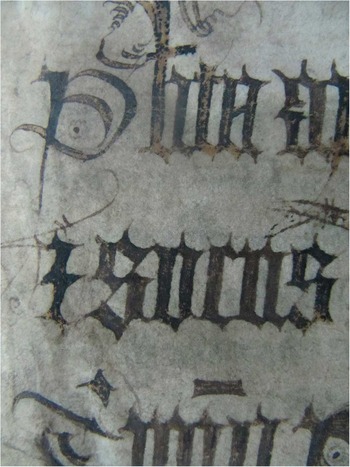
In Hilary 1426 (TNA CP40/660) the Heuster hand brought in a new element of decoration to the heading: a horizontal line of strapwork attached to ascenders, especially those of the letters ‘d’, ‘h’ and ‘b’. This strapwork may, in fact, be an early instance of its use on a text in England. In Easter 1432 (TNA CP40/685) the Heuster hand further introduced the first identifiable image, a frontal daisy flower, which thereafter appeared frequently in, on or near the ‘P’ (fig 1) as well as sometimes on Heuster’s ‘signature’ at the base of the rotulets.Footnote 26 The Heuster hand also occasionally drew a scroll,Footnote 27 a leaf at the end of the stem (Easter 1425, TNA CP40/657), a profile head on the ‘signature’ (Michaelmas 1435, TNA CP40/699) and a line ending (Easter 1424, TNA CP40/653). The appearance of the daisy flower and other minor assorted images may have loosened restraints – explicit or not – on the presentation of the heading and this established a precedent for the far more numerous images of the Wydeslade hand, named after Heuster’s successor as chief prothonotary.
Daisy flower in ‘P’ (TNA CP40/685, East. 1432). Photograph: Elizabeth Danbury, by permission of The National Archives

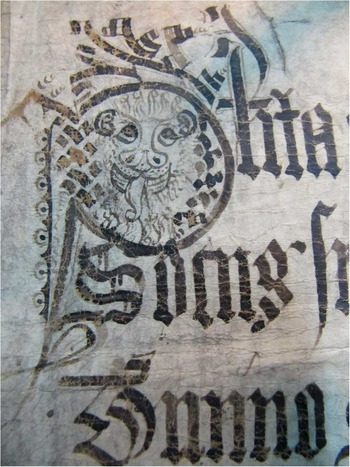
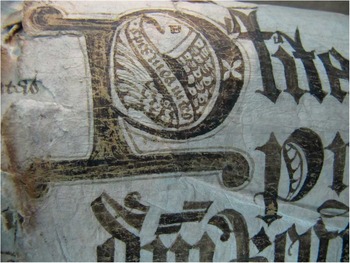
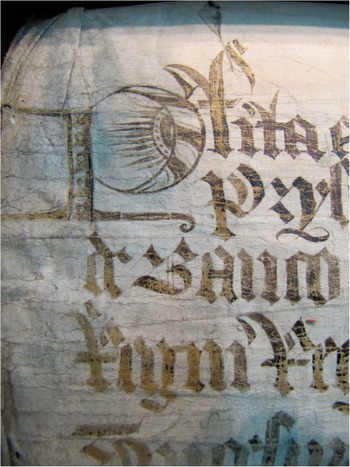
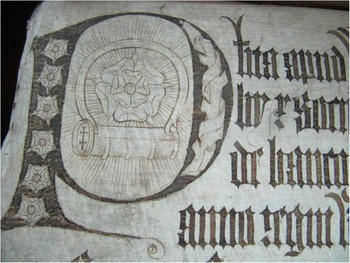
John Wydeslade was an attorney in the court of Common Pleas by 1420, a clerk by 1423 and an attorney in the King’s Bench by 1440.Footnote 28 He took office as chief prothonotary of the Common Bench at Michaelmas 1439, a position that he held until he surrendered the post in 1468 (he died in 1469). The clerk who wrote some of the headings of the plea rolls under Heuster may have continued to work under Wydeslade, for the Heuster hand’s signature daisy flower continued to be used on and off until Easter 1453 (TNA CP40/769).Footnote 29 New and inventive features were, however, introduced in the 1440s: in Trinity 1444 the Wydeslade hand added an animal head with open mouth to the base stroke of the letter ‘P’ (TNA CP40/734). In Trinity 1451 a flower with downward lines indicating a radiance appears tucked at the top of the lobe of a calligraphic ‘P’ (TNA CP40/762) and occurs again in the same position in Hilary 1452 (TNA CP40/764). In Trinity 1453 (TNA CP40/770) an inscribed scroll appears within the letter ‘P’, and in Michaelmas 1453 the Wydeslade hand contributes an animal mask in a roundel – probably a lion – with a toothy grin and protruding tongue (fig 2); such a mask was old-fashioned by 1453 and is not often seen in English manuscript decoration during this period. In Hilary 1455 (fig 3) a well-drawn fish and a scroll inscribed Spes mea in deo are enclosed within the initial ‘P’. In Trinity 1455 (fig 4) another innovation appears in the Wydeslade repertoire: a motif resembling a sun with lines of radiance is attached to the inside of the lobe of the ‘P’. This device occurs from time to time variously throughout the rolls and is more likely than the flower with radiance to have been heraldic in some instances.Footnote 30
Animal mask in ‘P’ (TNA CP40/771, Mich. 1453). Photograph: Elizabeth Danbury, by permission of The National Archives

Fish with scroll inscribed Spes mea in deo (TNA CP40/776, Hil. 1455). Photograph: Elizabeth Danbury, by permission of The National Archives

Sun motif with lines of radiance (TNA CP40/778, Trin. 1455). Photograph: Elizabeth Danbury, by permission of The National Archives

1456–7: Birds and Fabulous Beasts
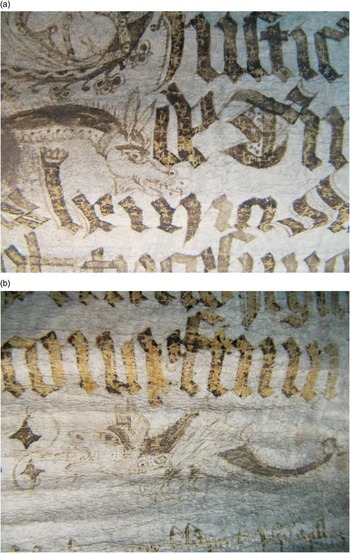
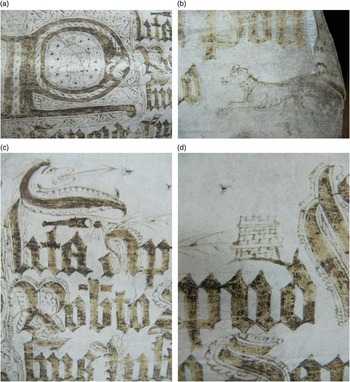
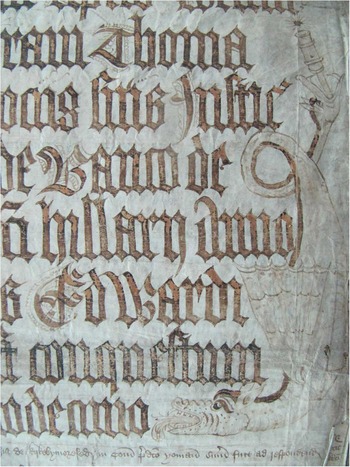
The year 1456 marks the advent of more substantial representations.Footnote 31 Before this date, the blank area following the last sentence of the heading was not decorated. Now we come upon a wyvern in the space as well as the head and neck of a spotted dragon below the initial letter ‘P’ (fig 5). The wyvern has an open mouth with visible teeth, upright ears and a loop in its tail; like many of the other dragons in the rolls, it holds a sprig in its mouth. The concept of a dragon suited to an oblong space at the end of a sentence is not new in English book art, but here the image is more imposing than the usual line ending: large, freestanding and not confined within a framed space as was customary with English line endings. The looped tail was not an innovation in the fifteenth century among English artists,Footnote 32 and it was consistently used in contemporary manuscripts.Footnote 33 This dragon is the precursor to others in the Common Plea rolls, some standing on four feet, others prostrate on their bellies, worm- or snake-like.Footnote 34
(a) Head of dragon; (b) wyvern with loop in tail as a line ending (TNA CP40/781, East. 1456). Photograph: Elizabeth Danbury, by permission of The National Archives

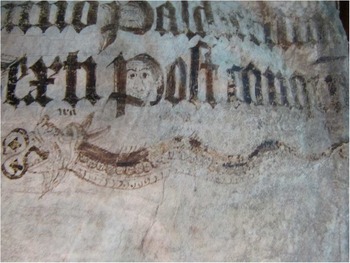
The Wydeslade hand’s images continue in Trinity 1456 (TNA CP40/782) with the head and neck of a collared dragon and a hawk’s bell with four smaller bells beside. For the first time a capital letter in the heading incorporates an image: the ‘B’ of Banco Footnote 35 contains a spotted dog with collar. The next heading has a slighter representation of a partial figure letter of a bird with spread wings on the lobe of the ‘P’ near a small dragon on a capital ‘J’ (Hilary 1457, TNA CP40/784). In Easter 1457 (fig 6) the decoration, also by the Wydeslade hand, shows the favourite motif of a dragon as a line ending in the longer snake-like version, and a capital ‘P’ within the text shows a frontal human head with a toothy grin. The off-and-on-again appearance of images and the variation in subject matter used by the Wydeslade hand raises questions about the division of clerical labour on the rolls.
Worm-like dragon as a line ending; (above) grinning frontal head (TNA CP40/785, East. 1457). Photograph: Elizabeth Danbury, by permission of The National Archives

Human Images: Legal and other Innovative Iconography
The first actual miniature in the Common Plea rolls was drawn within the Wydeslade period at Trinity 1457 (fig 7): at left, a man in a cowl, gown and chaperon (?) stands in profile, holding a book in his right hand and pointing downward with his left: he probably represents a lawyer or a serjeant, and he may have been pointing to the lost figure of a plaintiff in the margin.Footnote 36 He faces right towards a seated judge in a coif, rolled collar and cloak, who gestures towards the lawyer with his left hand and hides the right within his gown. The closest representation to this miniature in a fifteenth-century English manuscript appears in Oxford, Bodleian Library, ms Douce 159, an index to the Nova statuta of 1444/5, in a scene made not long before the Common Pleas miniature. In the small Douce image a lawyer holding a scroll and gesturing makes his point before a barrier (bar) that encloses a figure, presumably a judge, on a raised seat next to a book possibly on a lectern.Footnote 37 Otherwise, this Common Pleas iconography is rare in English manuscript art of the period and is of importance for this reason and because of the close proximity of the prothonotaries and their assistants to actual court business.
Seated judge and lawyer with book (TNA CP40/786, Trin. 1457). Photograph: Elizabeth Danbury, by permission of The National Archives

Susan L’Engle describes the field of legal iconography as ‘relatively unexplored’, but found that a ‘starting point for artists was an emblematic image ... of a figure of authority standing or seated, usually in a frontal position’, holding a display object such as a scroll or book.Footnote 38 The authoritarian figure is portrayed in the Common Pleas image and the scene as a whole (with a presumed lost figure) is a compact rendering of the onset of a court proceeding. One English manuscript with precedents for this kind of scene survives from the fourteenth century: the Omne bonum, an encyclopedic work of after 1360 and before 1375, almost certainly written and compiled by one James le Palmier.Footnote 39 This unique compilation contains ‘illustrations for a wealth of specific subjects not previously depicted in any legal text’.Footnote 40 Among the many Omne bonum miniatures of a judge in court, one scene bears a relationship to Common Pleas proceedings of the fifteenth century in that two scribes are seated behind the bar with the judge, recording the pleas.Footnote 41 In the Omne bonum scenes, however, the authority figure is always on the left and the plaintiffs, defendants and so forth on the right; for this reason, they are unlikely to have influenced the drawing in the Common Plea roll, which shows the figures the other way round. We conclude, then, that the Wydeslade clerk-illustrator of this initial was attempting to create a new image based on the reality of court procedure rather than one based on an established model or traditional scene.
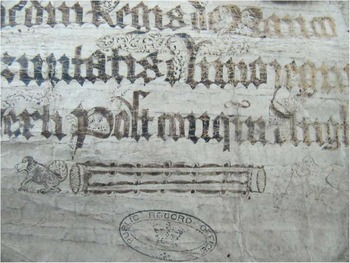
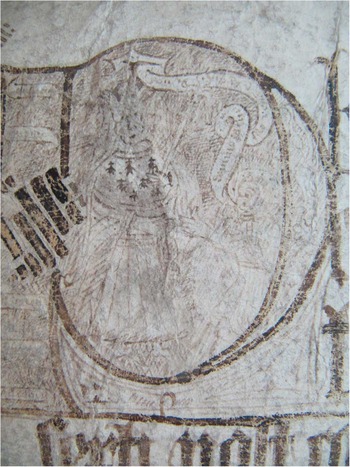
The base of the same ‘P’ on the same membrane from Trinity 1457 shown in fig 7 ends with the body, head and clawed feet of a dragon, while another worm-like dragon lies above the first line of the heading. More remarkably, the line ending concludes with a cannon that shoots from both ends at the rear end of a squatting dog to the left and to a spotted bird with raised wings to the right (fig 8). Although it has a humorous aspect, any serious motive for the scene remains obscure. In the roll for Hilary 1459 (fig 9) the miniature in the letter ‘P’ is badly damaged, but remains important in that it shows a large image of a judge in a coif and gown with full sleeves standing in front of a trestle seat, pointing and holding a scroll; figures stand slightly to the rear on each side, both wearing belts and one is perhaps a priest with a stole crossed on his chest. The prominence given to the judge figure is unusual, if not unique, in later English book art and possibly represents Chief Justice of Common Pleas John Prysot.Footnote 42 The letter ‘P’ itself is ornamented with two animal heads, not certainly dogs, but holding a bone and presumably unrelated to the miniature. The top of the heading for Michaelmas 1457 (TNA CP40/787) shows a running stag ducally gorged near the head of a coiled dragon with an arrow-shaped tongue, and the following roll for Hilary 1458 (TNA CP40/788), also by the Wydeslade hand, provides the first instance of a letter surmounted by a crown, here placed on a capital within the display text. The main initial is damaged, but can be seen to enclose a spotted wyvern turning back to bite its long curved tail.
Dog, shooting device and bird as a line ending (TNA CP40/786, Trin. 1457). Photograph: Elizabeth Danbury, by permission of The National Archives

Judge in coif in front of trestle seat (TNA CP40/792, Hil. 1459). Photograph: Elizabeth Danbury, by permission of The National Archives

The King as the Fount of Justice: The Nota Bene Sign
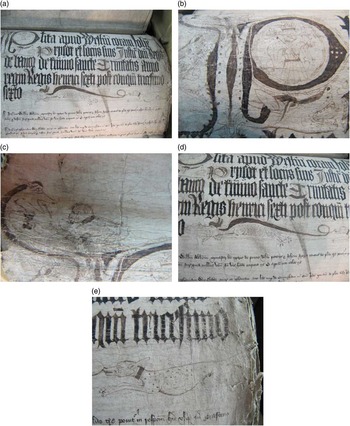
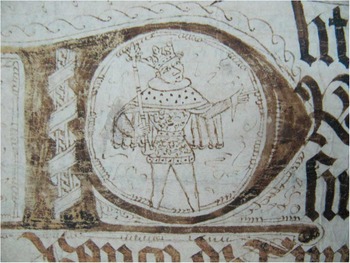
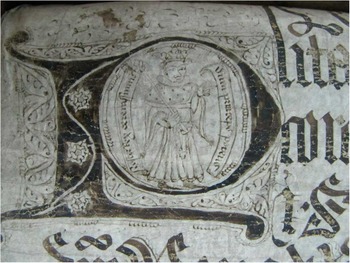
The scene for Easter 1458 (fig 10) introduces the subject of a king – presumably Henry vi – holding an upturned sword and standing beside a kneeling figure in a mitre, large collar or hood and a cope held together by a band. This bishop, who is blessing the king, carries a scroll appropriate to the scene that reads domine salvum fac regem et exaudi nos (‘Lord save the king and hear us’).Footnote 43 The next miniature, in the roll for Trinity 1458 (fig 11), also of a king, depicts him standing with a sceptre, pointing to the heading and displaying a scroll inscribed Recte iudicate (‘rightly judge’).Footnote 44 This depiction of the monarch walking and pointing, or a variation of it, is employed in the Common Plea rolls on numerous occasions as a kind of elaborate nota bene sign that indicates the display paragraphFootnote 45 and that, in performance of a grander function, reflects the role of the king in the administration of justice. The image is unknown elsewhere in later English book art, but further representations of the pointing and / or walking king occur within the introductory ‘P’ during the reign of Edward iv, in some instances with an inscribed scroll or scrolls (Hilary 1463, TNA CP40/807). The kings at Easter 1463 (fig 12) and Trinity 1463 (TNA CP40/809) point to the text without accompanying scrolls, and very similar scenes show a king walking but gesturing rather than pointing; these date from Hilary 1462 (fig 13) and Easter 1463 (TNA CP40/808). The Wydeslade hand also tendered more unusual variations on the standard walking scene: in Michaelmas 1460 (TNA CP40/799) a much damaged image of a king is drawn in reverse, walking away from the display paragraph towards the stem of the ‘P’, and in Trinity 1466 (TNA CP40/820) the king stands in majesty on a cushion in front of a tapestry backdrop with a canopy, pointing from a stationary position.
Henry vi with upturned sword, bishop kneeling (TNA CP40/789, East. 1458). Photograph: Elizabeth Danbury, by permission of The National Archives

(a) The entire heading; (b) king pointing and dragons around ‘P’; (c) (above) chained ape and dragon; (d) dragon; (e) hound (TNA CP40/790, Trin. 1458). Photograph: Elizabeth Danbury, by permission of The National Archives

King with sceptre, walking and pointing (TNA CP40/808, East. 1463). Photograph: Elizabeth Danbury, by permission of The National Archives

(a) King walking and gesturing; (b) hound; (c) dragon; (below) blow gun; (d) tower (TNA CP40/803, Hil. 1462). Photograph: Elizabeth Danbury, by permission of The National Archives

After a considerable interval, the Copley hand (named after Chief Prothonotary William Copley)Footnote 46 imitated the Wydeslade hand in producing nine drawings of a pointing king between 1474 and 1479.Footnote 47 This clerk-illustrator closely followed the execution of the Wydeslade hand, although usually without depicting the lower part of the legs and feet of the king.Footnote 48 As it happened, Copley himself had worked in a junior capacity on the same rolls as the Wydeslade hands since Easter 1458 (TNA CP40/789) and would have been well aware of the iconography of the walking pointing king. Unless an as yet undiscovered outside provenance for this depiction of a king figure comes to light, we can state with some assurance that these kings were meant to be perceived as guarantors that complaints would be heard in court and / or as nota bene signs and were not based on an external or commercial model. Their purpose in the rolls seems to have been largely practical, namely to place emphasis on matter set out in the display paragraph.
The King as the Fount of Justice: Supporting Words from the Psalms
As already noted, the first occasion on which Henry vi is portrayed as the upholder of justice is in the heading of the plea roll of the court of Common Pleas for Trinity 1458 (TNA CP40/790); the scene is reproduced here as fig 11b. One might have expected that the first representation of the king in this capacity would have been found in the records of the court of King’s Bench, since the king could, in legal theory and sometimes in practice, personally appear in this court.Footnote 49 At this point it is important to note briefly the decorative content of two of the King’s Bench plea rolls for 1460 – not long before Edward iv claimed the throne of England – as it seems to have influenced the images used in the Common Plea rolls in the early years of his reign. That for the Easter term of 1460 (TNA KB27/796) shows Henry vi enthroned between two lawyers, with the prayer Domine salvum fac regem (‘Lord save the king’) above his head, and other exhortations recte iudicate (‘rightly judge’) and domine fiat pax (‘Lord, let there be peace’) beneath the king’s feet. The phrase recte iudicate is taken from Psalm 57:2, while domine fiat pax may owe its origin to Psalm 121:7 (where it is written fiat pax in virtute tua), as well as to the Use of Sarum, where it appears as Domine fiat pax in virtute tua (‘Lord, let peace be in thy strength’) in response to the antiphon Da pacem Domine in virtute tua (‘Give peace, O Lord, in thy strength’).Footnote 50 Being derived at least in part from the Psalms, such phrases served to associate the king of England with King David, the greatest of all the kings in the Old Testament, to whom the authorship of the Psalms was commonly ascribed.
In addition to the example cited from 1458 (TNA CP40/790), the King’s Bench plea roll for Michaelmas 1460 (TNA KB27/798) may well have provided a model for the decorative content of later plea rolls, both those of the King’s Bench and of Common Pleas. It depicts Henry vi, crowned in majesty, sceptre in his right hand, clearly pointing towards the heading of the document with his left.Footnote 51 The phrase legem tenete et recte iudicate (‘keep the law and judge rightly’) appears in scrolls within the initial letter ‘P’, while the stem of the ‘P’ is almost entirely filled by a scroll wrapped round a ragged staff, the badge of Richard Neville, Earl of Warwick (1428–71). The words within the scroll read justicia et pax osculati sunt (‘justice and peace have kissed’) (fig 14).Footnote 52 When combined, the scroll and ragged staff convey an important political message: by the Act of Accord of 31 October 1460 it had been agreed that Richard, Duke of York (the father of Edward, Earl of March, the future Edward iv), should succeed Henry vi as king and that Henry’s own son and heir, Edward of Lancaster, would be excluded from the succession. A solemn ceremony took place at St Paul’s Cathedral on the following day, 1 November, when Henry vi, wearing his crown, was accompanied by a procession in which a prominent place was given to the Duke of York.Footnote 53 The king’s train was held by the duke’s eldest son, the Earl of March, while the Earl of Warwick carried the sword of state in front of Henry vi. The incorporation of the Earl of Warwick’s badge into the decoration of the King’s Bench plea roll for Michaelmas 1460 serves, for the first of many times, to underline his political influence.
Henry vi in majesty, pointing; ragged staff (TNA KB27/798, Mich. 1460). Photograph: Elizabeth Danbury, by permission of The National Archives

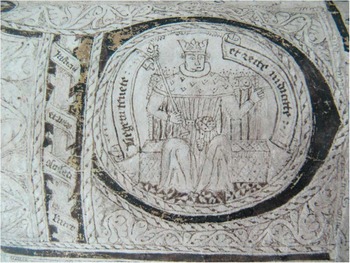
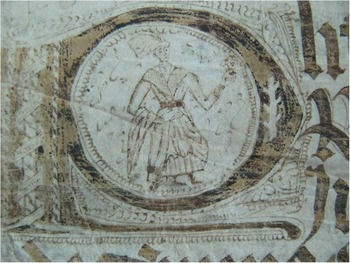
The clerk-illustrators of the plea rolls of the court of Common Pleas under Edward iv adopted and adapted images and phrases that had been employed in legal records during the final years of the reign of Henry vi. As we have seen, the court of Common Pleas was the chief court of the land for resolving civil disputes, and, after a period of lawlessness and the failure of justice, it was important to represent Edward iv as a ruler who took personal and authoritative command to protect the rights of his subjects. Certain phrases are used either to represent Edward iv as judge or to emphasise his commitment to the administration of justice. Recte iudicate is probably the most common of those used, either by itself, as in the plea rolls for Hilary 1469 (TNA CP40/830), Hilary and Easter 1470 (TNA CP40/834, 835) and Hilary 1482 (TNA CP40/879), with the qualifying legem tenete in the plea roll for Michaelmas 1476 (TNA CP40/860), or as part of a longer phrase, In omnibus legem tenete et etiam semper recte iudicate (‘In all things keep the law and also always judge rightly’), in the roll for Michaelmas 1478 (TNA CP40/868). But recte iudicate is not the only maxim employed. Fiat in omnibus justicia (‘May there be justice in all things’) decorates the initial letter ‘P’ in the roll for Trinity 1469 (TNA CP40/832), while Secundum justiciam fiat judicium (‘According to justice let there be judgement’) appears in the roll for Trinity 1472 (TNA CP40/843).Footnote 54 The overwhelming authority of Edward iv is emphasised in the heading of the plea roll for Hilary 1463 (TNA CP40/807), where he is represented in majesty within the initial letter ‘P’, with scrolls to either side, reading Noster Rex cerenissimus (sic) (‘Our most serene king’), and Sum princeps potens (‘I am a powerful prince’) (fig 15).
Edward iv in majesty (TNA CP40/807, Hil. 1463). Photograph: Elizabeth Danbury, by permission of The National Archives

Royal Costume and Armour
Since the rolls can be assigned to a specific law term and a year, they provide a rare opportunity to date the costumes worn by the royal figures. The first image (Trinity 1458, TNA CP40/790), albeit damaged, shows the king in an ankle-length pleated tunic with full sleeves of an undershirt visible, belt, small rolled collar and an ermine cowl (see fig 11b). Apart from the absence of shoes, this image establishes a pattern for some later depictions of the costume worn by the walking kings. Variations on this theme include a short jacket with tight sleeves (Michaelmas 1460: TNA CP40/799); a short pleated tunic with long cuffs (Hilary 1462: TNA CP40/803; see fig 13); a long gown and mantle with a rolled collar at the neck (Trinity 1462: TNA CP40/805); and an ankle-length pleated gown ending in a scalloped banded edge, with deeply cut sleeves ending in a tassel, and peaked shoes (Hilary 1463: TNA CP40/807; see fig 15). Edward iv was renowned for dressing after the latest fashion,Footnote 55 and the rolls depict him wearing a short scalloped cloak with a banded edge and a short pleated jacket with a belt and gloves in Easter and Trinity 1463 (TNA CP40/808, 809; see fig 12). In Michaelmas 1474, his cloak is again scalloped along the edges (TNA CP40/852), but in Michaelmas 1475 (TNA CP40/856), Hilary 1476 (TNA CP40/857) and Michaelmas 1476 (TNA CP40/860), he wears a gown with straight sleeves and round cuffs without a cloak. In contrast, in Michaelmas 1478 (TNA CP40/868), he is attired in a long mantle edged in ermine and lined with stripes of fur, with a scalloped edge on the jacket and pointed shoes.
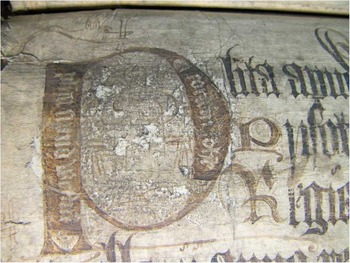
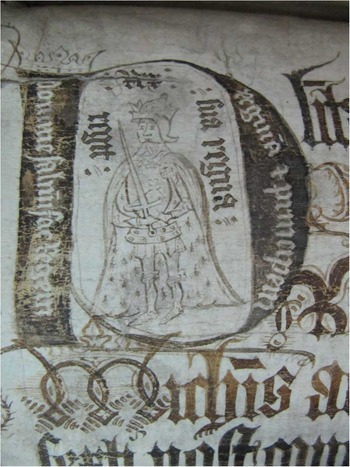
Another image shows the king in full armour, holding an upturned sword.Footnote 56 Dating from Michaelmas 1459, it presents Henry vi as a military leader (fig 16), at a time of civil war.Footnote 57 The armour is depicted in some detail, showing a crowned helm, breastplate, couters and vambraces, cuisse and greave plates, poleyns at the knees, taces, gauntlets and sabatons, with an ermine-lined mantle thrown over. Further to reinforce Henry’s authority, the stem of the initial letter ‘P’ is surmounted by a crown. In commercially produced miniatures involving a figure with an upturned sword, such as those of St Paul,Footnote 58 the weapon in this position represents the combative side of the subject’s nature and, in the case of secular historical figures, of his intentions and accomplishments through force.
Henry vi in armour and ermine mantle with upturned sword, with mottoes (TNA CP40/795, Mich. 1459). Photograph: Elizabeth Danbury, by permission of The National Archives

Coronation Miniature and other Images of Edward IV
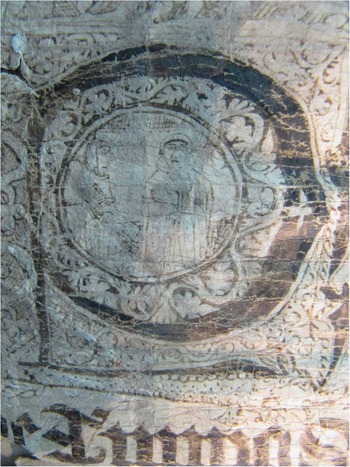
The miniature for Trinity 1461 portrays a coronation scene (fig 17),Footnote 59 undoubtedly that of Edward iv. Because of the known date of this miniature, coronation scenes in English manuscripts made earlier are of great comparative interest. They have in common with the 1461 image the presence of two archbishops, although differing in that most depict the act of coronation with the archbishops placing or touching the crown.Footnote 60 This image shows the king standing rather than seated and holding only a sceptre rather than the usual orb and sceptre.Footnote 61 He is flanked by Thomas Bourchier, Archbishop of Canterbury, and William Booth, Archbishop of York.Footnote 62 Each wears a gown with a cowl, an unusually large circular collarFootnote 63 and a mitre. Instead of placing the crown on Edward’s head, each indicates the crown with a raised hand while making a blessing with the other lowered hand. The gestures of the two archbishops seem to represent the symbolic action of supporting the crown after the coronation,Footnote 64 and the gesture the king makes with his left hand seems to be one of acknowledgement of his new power.Footnote 65 There is no earlier coronation scene that can be confidently put forward as a model for this one, so we are left to assume that the Wydeslade hand was following oral instructions or might himself have witnessed the coronation. Again, the inclusion in the upright of the ‘P’ of the ragged staff, the badge of Richard Neville, Earl of Warwick, serves to emphasise the significance of the earl’s contribution to Edward iv’s accession to the throne.
Coronation of Edward iv; heads of Jews; rose en soleil (TNA CP40/801, Trin. 1461). Photograph: Elizabeth Danbury, by permission of The National Archives

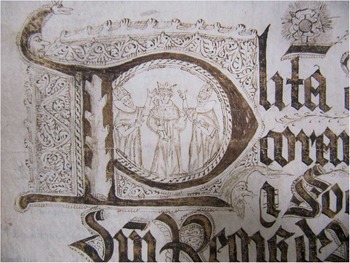
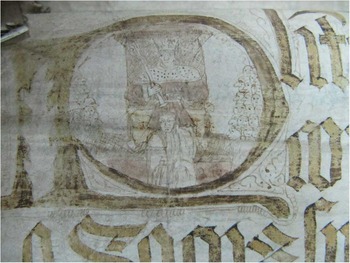
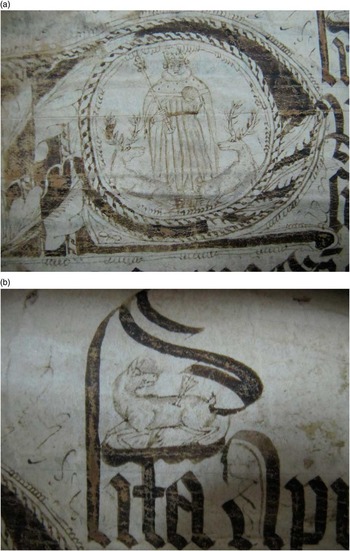
During the reign of Edward iv the Wydeslade hand made further changes to the conventional figure of the walking king. In Trinity 1462 (TNA CP40/805) is the image of a front-facing, standing king holding only a sceptre, not pointing and not apparently walking.Footnote 66 In the next roll, Michaelmas 1462, a court scene records a king holding a sceptre and upturned sword and enthroned under a canopy with a group of advisers, courtiers or onlookers on each side (fig 18). This pictorial subject is commonly found in collections of the Nova statuta, where the groups are identifiable as clerics and noblemen or religious and secular advisers or, more rarely, as legal advisers.Footnote 67 Because they are depicted only as heads in the Common Pleas image, the attendants are not easily identifiable; some of the figures on the left wear hats that suggest they are of the secular estate. In this scene the Wydeslade hand has, however, inserted other additional features: an upturned sword and the figure of a man, probably a chief justice, with a piece of material, possibly a stole, over his right shoulder, kneeling at a lower level with his back to the king. A trelliswork fence or ‘bar’ separates this figure from the attendants. A further unusual scene, for Michaelmas 1463, rendered by the same hand and not as yet found elsewhere, shows a frontal view of a king with sceptre and orb, standing between two lodged stags regardant (fig 19). The stag is not known to have been a badge of Edward iv, during whose reign the drawing was made, but it may have been a device of Sir Robert Danby (d. 1474), chief justice at this time, whose name actually occurs with that of the king in a later roll (TNA CP40/817).Footnote 68
King and court scene with (?)judge in front; ragged staff (TNA CP40/806, Mich. 1462). Photograph: Elizabeth Danbury, by permission of The National Archives

(a) Edward iv with two stags; (b) hind pierced by arrow (TNA CP40/810, Mich. 1463). Photograph: Elizabeth Danbury, by permission of The National Archives

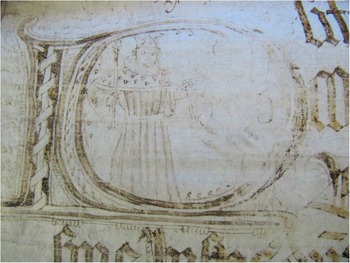
In Easter 1476 the royal personage is seated, yet still pointing to the text (TNA CP40/858) in a miniature by the Copley hand. In Hilary 1477 (fig 20), also by the Copley hand, another interesting royal miniature (damaged or partly erased) shows the frontal figure of a king in an ermine cowl and collar, holding a sceptre and an inscribed document with a hanging seal; he faces a kneeling man in a cowl with a raised hood and a gown with long sleeves and cuffs. The figure who reaches to receive the document has been identified as Sir Thomas Bryan (d. 1500),Footnote 69 who is being presented with an amended version of his patent of appointment as chief justice of Common Pleas by Edward iv.Footnote 70 This is one of the few English miniatures that may lay claim to being a pictorial record of an actual event.
Edward iv renewing the patent of Sir Thomas Bryan, chief justice of the Common Pleas (TNA CP40/861, Hil. 1477). Photograph: Elizabeth Danbury, by permission of The National Archives

In all, the miniatures depicting the figure of a king number twenty-three and appear between Easter 1458 (TNA CP40/789), late in the reign of Henry vi, and Hilary 1482 (TNA CP40/879), towards the end of the reign of Edward iv. Within this period the images of royalty cluster in the years 1458–63, 1466–7 and 1474–82. Fourteen of them were drawn by the Wydeslade hand and nine by the Copley hand,Footnote 71 the change over between the two prothonotaries occurring between Trinity and Michaelmas terms 1468 (TNA CP40/829). Because the year 1457 was the first in which a full miniature (of judge and plaintiff) appeared, it may have prompted an unofficial search for a suitable iconography to introduce the rolls, a search that settled on the king as representing a higher and more appropriate authority – in however peculiar a stance – than that of a judge.
?Elizabeth Woodville
After this long survey of king images, we return to the chronological order of the rolls to find the least predictable of the depictions considered here: that of a woman. This figure is unexpectedly found in the initial ‘P’ for the Hilary term of 1464 (fig 21), with no obvious relationship to the introductory paragraph. It is again the work of the Wydeslade hand. The woman’s costume is appropriate to the period in that it consists of a full-length gown with a deeply cut and wide V-collar, a butterfly headdress and a broad belt. The woman has raised the outer gown and thrown the material over her right arm, leaving an under-skirt exposed.Footnote 72 The scene has a hint of sexuality and may be a more or less veiled comment on the woman whom it might represent, Elizabeth Woodville, the future queen of Edward iv.Footnote 73 She also holds a posy of three flowers that, given her upper-class dress, is reminiscent of a conventional scene for May from the ‘Occupations of the Months’ sequence – also not without its sexual implications. The representation for this month usually depicts a high-status male, on foot or horseback, with a flowered sprig and / or a hawk in each hand. It rarely shows a woman.Footnote 74 Hilary term does not, of course, extend to May, but the Wydeslade hand may have drawn the scene sometime after 1 May 1464, the date usually proposed for the secret marriage of Edward and Elizabeth. The queen and her Woodville family were not held in high esteem by the established aristocracy, nor was she felt to be worthy of the king.Footnote 75 The decoration of this letter includes on the lobe of the ‘P’ a small ragged staff, the badge of Richard, Earl of Warwick; of all the king’s subjects, his approval of the marriage seemed the most important, yet he stood to lose the most by it in terms of political influence.Footnote 76
Woman with posy (?Elizabeth Woodville); ragged staff (TNA CP40/811, Hil. 1464). Photograph: Elizabeth Danbury, by permission of The National Archives

Images in Fifteenth-Century Printed Books and the Decoration of Legal Records
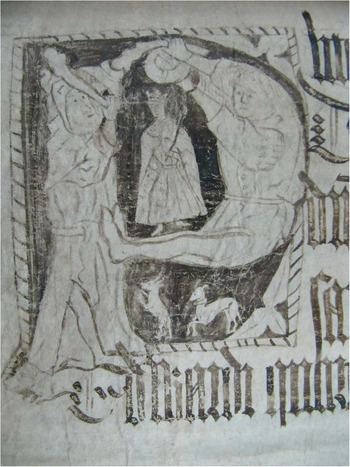
The most extraordinary image in the Common Plea rolls appears, however, in Hilary 1467 (fig 22). Here the introductory ‘P’ is presented as a figure letter composed of two men fighting. The stem is formed of a bearded man wearing a cowl with a raised peaked hood and a long belted tunic split at the side. He stands on a small animal and raises a club with one hand while raising the other to ward off with his buckler a blow from the club brandished by the other combatant. The second figure, who constitutes the lobe of the letter ‘P’, is a young man in a short belted and buttoned tunic with an apparently tight-sleeved shirt underneath. He holds a ragged club in his right hand to form the upper curve of the lobe, supported by his left arm and hand with a buckler; his legs stretch horizontally across to the waist of the first man to close the bottom of the lobe. The space formed by the lobe encloses the standing figure of a king with a sceptre. Below this space a collared hound runs towards a stag or, to judge by the short horns, possibly a goat, standing on its hind legs.
Two men fighting as ‘P’; (centre) king; (below) hunting scene (TNA CP40/822, Hil. 1467). Photograph: Elizabeth Danbury, by permission of The National Archives

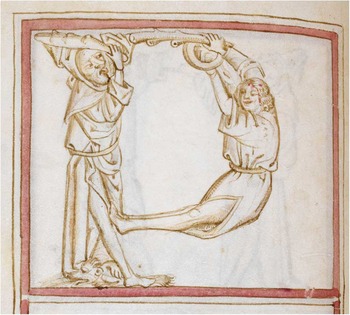
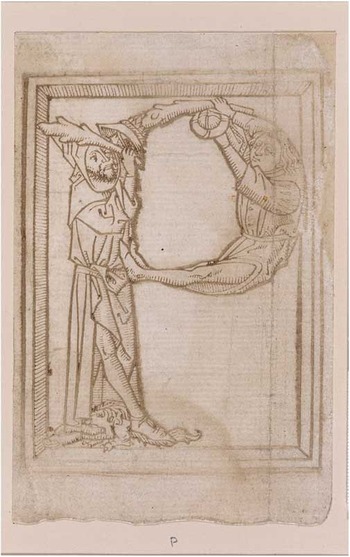
This remarkable initial is similar to two of better quality in the King’s Bench rolls.Footnote 77 Similar figure letters also occur in the Basle Alphabet Book of 1464,Footnote 78 in the Macclesfield Alphabet Book of the second half of the fifteenth century (fig 23)Footnote 79 and in a woodcut alphabet in the British Museum, whose letter ‘A’ with the date is much damaged, so the date is uncertain (fig 24).Footnote 80 The Basle woodcut alphabet has variously been ascribed to French, Flemish and Netherlandish provenances,Footnote 81 and Dodgson thought it was based on the British Museum alphabet.Footnote 82 The quality of the Common Pleas rendering by the Wydeslade hand apart, all three figure letters are very much alike, except that the Common Pleas letter distinguishes itself from the British Museum letter in not rendering the shading on the figures and frame. The Common Pleas image is, moreover, closer to the Basle letter in that both overlap the bottom frame, whereas the British Museum letter is wholly contained within it.Footnote 83 The overlap and lack of shading are scant evidence of duplication, but we may suppose that a copy closer to the Basle alphabet than to the British Museum letters was available in London for use by the Wydeslade hand.Footnote 84
Two men fighting as ‘P’ (BL, Add ms 88887, Macclesfield Alphabet Book, fol 18v). Photograph: © The British Library Board

Two men fighting as ‘P’ (BM, Prints and Drawings, woodcut B10.15, 1464 Alphabet). Photograph: © The Trustees of the British Museum

The date of 1464 for the Basle alphabet makes the copying of one of its letters only about two years later in the English legal records surprising. In what form was the alphabet transmitted to England? Did separate alphabet sheets circulate or entire model books?Footnote 85 How was a clerk of the court of Common Pleas able to see or obtain them? Did legal scribes make it their business to know the latest styles in lettering? Did they check commercial shops in London for new styles, particularly those shops at the centre of the book trade, near St Paul’s Cathedral?Footnote 86 Legal scribes may well have visited such shops, since St Paul’s is near the Inns of Court and Chancery Lane (where the royal Chancery was based), both of which would have been likely sources of learning and refreshment. They may also have met and exchanged ideas with some of the many clerks and scriveners who worked in and around the City of London, writing the documents and records of the City and the London livery companies.Footnote 87 Certainly, woodcuts, as well as engravings and printed books, were, generally speaking, widely circulated and would have facilitated the dissemination of alphabet models.Footnote 88 It is possible – even likely – that these were carried about as part of a travelling scribe or entrepreneur’s materials in full expectation of a ready market for them. There is, moreover, no doubt of the presence of continental scribes in England;Footnote 89 and, to judge by the often English decoration of their work, they would have been in touch with their counterparts in scribal and limning shops in London, if not with clerks of the courts.Footnote 90 Whatever the circumstance that brought it about, the appearance of the Basle initial in a Common Pleas roll within two years of its making is, at least, revelatory.
Dragons
In addition to their unusual miniatures, the Common Plea rolls are also notable for their minor decoration and the images on and around the text of the display paragraph. The most engaging among them are dragons.Footnote 91 These creatures were usually drawn to a prominent size as a line ending in the space at the end of the paragraph, at the top of the page on or beside the letter ‘P’, within the stem of ‘P’ with their heads in the space below, on an ascender, in the right marginal space, and on one occasion as the historiation of the initial ‘P’ (Michaelmas 1484, TNA CP40/898). The dragons can be winged, standing on two or four legs, or elongated and worm-like.Footnote 92 They were usually drawn with an open mouth and visible teeth, with a sprig or spray of foliage rather than fire emerging from their mouths. Two display an arrow-shaped tongue, most have a loop in the tail and sometimes they are shown harassing another animal.Footnote 93 As noted above, the first instance of a wyvern or standing dragon can be found in the plea roll for Easter 1456 (TNA CP40/781; see fig 5b), and the first of the worm-type in Easter 1457 (TNA CP40/785), both pre-dating the first miniature. Particularly fine specimens of dragons occur in Trinity 1466 (TNA CP40/820), by the Wydeslade hand, and in Easter 1469 (TNA CP40/831) and Hilary 1475 (TNA CP40/853) by the Copley hand. The last instance of the worm-type lies in a line ending and stretches up the right margin with two heads and flamboyant wings; its upper head projects a shooting device, a kind of blow gun that expels a radiant pellet (fig 25).Footnote 94 This weapon was first introduced to the Common Pleas iconography by the Wydeslade hand in Hilary 1462 (TNA CP40/803), and the last example was drawn in Michaelmas 1478 (TNA CP40/868) by the Copley hand. A total of twenty-nine dragons, in whole or in part, are represented in the Common Plea rolls, all in the same style but by different hands, in the years 1456 (three times), 1457 (five), 1458 (five), 1460, 1462 (twice), 1463 (twice), 1466 (twice), 1469 (twice), 1475, 1476, 1477, 1478, 1480, 1481 and 1486.Footnote 95 Because fourteen of the dragons or their heads appear during the reign of Henry vi and one during the reign of Henry vii, it is not possible to attribute their depiction in the plea rolls to ‘Edward IV’s political use’ of such imagery ‘to lay claim to the British red dragon’,Footnote 96 nor, indeed, necessarily to Henry vii’s adoption of the red dragon as a supporter of his royal arms.
Dragon with two heads, protruding tongue and blow gun (TNA CP40/853, Hil. 1475). Photograph: Elizabeth Danbury, by permission of The National Archives

The dragon was not a commonly used image in manuscript art in the fifteenth century;Footnote 97 it occurred mainly as the attribute of a saint (especially SS George, Michael and MargaretFootnote 98), as the pictorial representation of a text, or as the component of a figure letter.Footnote 99 The popularity of dragons in plea roll decoration in the second half of the fifteenth century may perhaps have been influenced by their employment in other artistic contexts. For example, St George and St Margaret, together with the dragons they slew, were allotted a prominent role in civic processions and ceremonies in towns and cities in England, including Norwich and Westminster.Footnote 100 In the processions of the Guild of St George of Norwich, gunpowder was used to make the dragons emit flames. Even so, given the dragons’ lack of obvious relationship either to the vast number of pleadings in the Common Pleas court rolls or to the occasional miniatures in the letter ‘P’ of the rolls, it is difficult to imagine that the dragons here bore any ‘freighted signification’Footnote 101 beyond that of light diversion. A blow gun that only shoots pellets, moreover, rather reduces the sense of the power of the dragon as an accomplice of SatanFootnote 102 and a symbol of evil.Footnote 103 We are left, then, with the fact that more dragons (twenty-nine) than kings (twenty-three) were represented in the Common Plea rolls and that some of these depictions of an ‘emancipated dragon’ outfitted with a blow gun are unequalled elsewhere in fifteenth-century English manuscript art (see fig 8).Footnote 104 This discussion does not, unfortunately, explain why the clerk-illustrators of the Common Plea rolls found the dragon so appealing and drew it so many times in the rolls.
Dogs, an Ape and a Hind
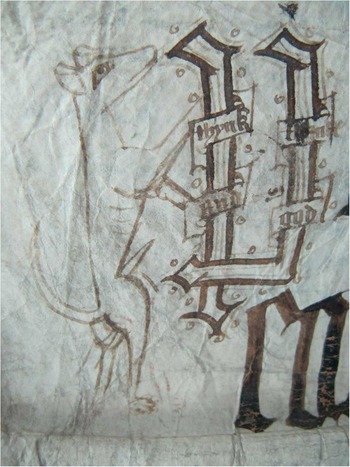
Another recognisable animal that apparently found favour with clerk-illustrators was the dog, rendered either as a spotted mongrel or as a hound. The mongrel appears in Trinity 1456 (TNA CP40/782) with a bushy tail and a collar, perhaps jumping, and in Trinity 1457 (TNA CP40/786) a dog with a collar and bushy tail squats in front of a shooting device, about to be shot. This iconography is, like so much in the Common Plea rolls, not known in English manuscript illustration or borders. The head of a dog holding a bone appears at the end of a flourish in Hilary 1460 (TNA CP40/796) opposite the profile head of a man (possibly its master).Footnote 105 An animal with a twig in its mouth, probably a dog, is drawn on top of the T of Trinitatis in 1461 (TNA CP40/801) and a dog with a collar decorates the lobe of ‘P’ in Easter 1462 (TNA CP40/803) with its head turned back towards its tail, looking at the walking king within the lobe. All these shaggy dogs were rendered by the Wydeslade hand. The final unconventional canine, which appears in Easter 1500, is probably a white greyhound, one of the badges of Henry vii (fig 26). This male dog stands on its hind legs, leaning with its front legs against the introductory ‘P’, which is wrapped in a scroll inscribed with the words ‘thynk and thank god’. The relationship between dog and motto, if any, is not obvious. The phrase was written here by the Mordaunt hand,Footnote 106 but it had been used earlier on two rolls, made during the brief reign of Edward v, with or on the ‘signature’ of William Copley.Footnote 107
Hound standing at ‘P’ with scroll: ‘thynk and thank god’ (TNA CP40/952, East. 1500). Photograph: Elizabeth Danbury, by permission of The National Archives

The hound scenes in the Common Plea rolls, on the other hand, usually derive from traditional iconography and are almost certainly a borrowing from commercial models in the hunting scenes of bas-de-pages. The first instance of a hound occurs in Trinity 1458 (TNA CP40/790; see fig 11), where it is running at full stride in a collar; the scene is far from conventional in that its quarry is a large, four-legged dragon. The subsequent four images of a hound in pursuit are rendered in the more standard iconography, running alone or chasing a stag.Footnote 108 Apart from one in Hilary 1467 (TNA CP40/822; see fig 22), all these images, as suits their natural running shape, are employed as line fillers at the end of the heading, in two instances the size of the image taking the eye of a reader away from the illustrated or decorated ‘P’ (TNA CP40/807, 830).
Only two other animals are depicted in or with the headings of the rolls, both predictably by the Wydeslade hand. In Trinity 1458 (TNA CP40/790) a spotted ape seated atop the introductory ‘P’ is chained from its collar to a weight held down by the foot of a dragon.Footnote 109 The ape, often used as a symbol of folly, the fall of man or of evil, here appears as a plaything of the dragon, a scene unknown elsewhere in English manuscript art; apes chained for the amusement of people are, however, occasionally known in English miniatures.Footnote 110 In Michaelmas 1463 (TNA CP40/810; see fig 19b) a hind crouching on a patch of ground and pierced by an arrow is supported by a pen stroke on the word Placita. The hind may have been intended to complement the two stags adjoining the king figure within the ‘P’ and is possibly a reference to the hunting activities of Edward iv.
The Human Head
Images of lesser decorative extent became more frequent in the Common Plea rolls during the mid- to later period under discussion, especially drawings of the human head in profile. Quickly rendered sketches such as these were commonly placed on the stems of letters, on catchwords, on capitals and on ascenders and descenders in every sort of text in later English manuscripts, from missals to the works of John Lydgate, and it would have been against all expectation not to find similar profile heads in these legal documents. The first human head depicted in the rolls is, however, forward facing with a grin or grimace, its teeth showing, and sketched in the ‘P’ of Post in Easter 1457 (TNA CP40/785; see fig 6). The first profile head (Michaelmas 1457, TNA CP40/787) is that of a man with a portrait-like face in a skull cap with a decorated band. In Easter 1459 (TNA CP40/793) a profile head with a long nose is an extension of the flourish of a letter ‘J’; and in Easter 1469 (TNA CP40/831) a fine profile male in a chaperon with a turban-like brim and a speech scroll is attached to a (blank) ‘P’. Such drawings of profile heads continue relatively frequently in different forms until the reign of Henry viii.Footnote 111 Of special interest, as we shall see, are two bearded profile heads, both with an open mouth and bared teeth, wearing a pagan hat.
In Trinity 1461, the first year of the reign of Edward iv, and in Michaelmas 1493 the profile heads convey more than an idle, decorative intention. In the first instance, with the coronation image of Edward iv, we find lodged against the ‘P’ two bearded heads with long noses and open mouths with bared teeth, each wearing a peculiar hat with an animal or bird head at its peak (see fig 17). In the second instance, in Michaelmas 1493 (fig 27), the stem of the letter ‘P’ supports a bearded profile head with straight hair, wearing the same unusual headgear and having a distinctly hooked nose. The latter characteristic was a commonly pictured, anti-Jewish sign in medieval iconography; indeed, ‘by 1340, the Jew needed no other visual cue than his distorted visage’.Footnote 112 Until later in medieval art the usual headdress of the Jew was a cap with a small point similar to an inverted funnel, the pileum cornutum.Footnote 113 In the two Common Plea rolls the headgear is, however, a soft pointed hat, leaning forward,Footnote 114 ending, as noted above, in an animal’s head and neck. This type of hat is depicted on tormentors actively participating in scenes of Christ’s Passion, and it can be interpreted as an allusion to the wicked character of the wearer and as an equally negative symbol when pictured on the figure of a pagan.Footnote 115 The animal-hat must have been, as Ruth Mellinkoff says, among ‘the bewildering assortment of headgear’ and the ‘inventive assortment of fantastic creations’ in which Jews were depicted.Footnote 116 Parallels can be found, for example, in a thirteenth-century depiction of the Betrayal and Arrest of Christ, where it is worn by one of the tormentors with a dark face (another indication of a Jew) and hooked nose;Footnote 117 in a manuscript of c 1340 of the Speculum humanae salvationis in a depiction of the Mocking of Christ, where it is worn by a scoffer with a caricatured nose; and in an early fifteenth-century English copy of the same manuscript (TNA CP40/801; see fig 17).Footnote 118 The animal-hat features again in the same manuscript in a scene of Christ before Pilate, where Pilate’s hat is elaborated not only with the head and neck of a bird, but also with its two raised wings.Footnote 119
Head of Jew in hat with animal head; cross of St George (TNA CP40/926, Mich. 1493). Photograph: Elizabeth Danbury, by permission of The National Archives

Jews were expelled from England after Edward i’s Edict of Expulsion of 1290 and they were only readmitted under Oliver Cromwell in the 1650s.Footnote 120 Thus, the instances in the Common Plea rolls of a Jew’s head are unlikely to be a reflection of specific events concerning Jews in or around the years 1461 and 1493, but rather of the common prejudice of the time. Another heading with a possible Jewish reference, written and decorated with profile heads by the Mordaunt hand (see below), occurs three years later in Hilary 1496 (TNA CP40/935). Three profile heads were drawn here, one with a large nose and headgear that appears to be a mitre, and with some surprise we learn that the traditional Christian bishop’s mitre ‘gradually infiltrated the Jewish symbolic repertoire’, with the horned headdress of the Christian Church repeatedly used as a sign of ‘despised New Testament Jews’.Footnote 121 This drawing cannot, however, with entire confidence be interpreted as a Jew’s head in that the horns of the mitre are not fully visible.Footnote 122
Political Events: Royal Mottoes and Acclamations
With this one exception, the legal clerk-illustrators’ awareness of political events and of the rise and fall of monarchs and of their greater subjects was considerable. This awareness was not normally illustrated by unambiguous images of actual events, however: the coronation miniature of Edward iv (TNA CP40/801) and the presentation to Sir Thomas Bryan of his patent of appointment recorded in Hilary 1477 (TNA CP40/861; see fig 20) are exceptions. Usually the political references are more subtle and take the form of badges, heraldry or words, such as the motto justitia et pax osculati sunt (‘justice and peace have kissed’) inserted into the stem of the ‘P’ of the King’s Bench plea roll for Michaelmas 1460 (TNA KB27/798), which, as proposed above, probably relates to the Act of Accord agreed by the warring factions on 31 October 1460.Footnote 123 Royal mottoes, acclamations and heraldry were frequently incorporated into the initial letter ‘P’ of the plea rolls of both Common Pleas and King’s Bench in the late fifteenth and early sixteenth century. The clerk-illustrators probably copied words and images then to be seen on clothes and badges, stained glass and escutcheons in Westminster and at the royal court; these words and images may well also have served to illustrate the loyalty of the clerks or their administrative superiors to the monarch.
During the tumultuous last months of the reign of Henry vi it is hardly surprising that the phrase Domine salvum fac regem (‘God save the king’)Footnote 124 featured in the decoration of the initial letter ‘P’ of almost all the plea rolls of the court of Common Pleas. It is first found in the roll for Easter 1458 (TNA CP40/789), and was then employed on the roll for Michaelmas 1459 (TNA CP40/795) and thereafter on those of Hilary 1460 (TNA CP40/796), Easter 1460 (TNA CP40/797) and Trinity 1460 (TNA CP40/798) – where it appears in the extended form: Domine salvum fac regem; rosam et aquilam; baculum album et nigrum et eorum bene volentes. The ‘rose’, ‘eagle’, ‘white staff’ and ‘black staff’ have provisionally been identified by Dr Hannes Kleineke as alluding to, respectively: Edward, Earl of March (the rose), Richard Neville, Earl of Salisbury (the eagle), Richard Neville, Earl of Warwick (the white staff, otherwise the ragged staff), and Edmund, Lord Grey of Ruthin (the black staff).Footnote 125 If these identifications are correct, they represent a remarkable indication of the importance of the Neville family and its supporters towards the end of Henry vi’s reign. The last occasion in which the phrase Domine salvum fac regem is employed on the plea rolls of the court of Common Pleas under Henry vi is on the final roll for his reign, that of the Hilary term 1461 (TNA CP40/800).
It has recently been suggested that the motto still in use today by the royal family, Dieu et mon droit (‘God and my right’), and the motto Domine salvum fac regem both originated in the reign of Henry vi,Footnote 126 but neither motto can be found in the plea rolls of the court of Common Pleas nor, indeed, in any other documents relating to English monarchs before 1422, though both feature on documents issued by Henry vi and on royal records dating from his reign. On the rolls for Michaelmas 1459 (TNA CP40/795) and Easter 1460 (TNA CP40/797), the wording of the phrase is extended to include not only the king, but also his queen and their son, Prince Edward of Lancaster: Domine salvum fac regem reginam et principem. A second phrase, Rex sua regna regit (‘the king rules his kingdoms’), emphasises Henry vi’s sovereignty over his kingdoms (plural), even though France had effectively been lost after the battle of Castillon in 1453.
Although Edward iv had his own motto, Comfort et Liesse, it does not appear on any of the plea rolls for his reign.Footnote 127Domine salvum fac regem occurs from time to time in the early years of his reign: for example, on the plea rolls for Easter 1462 (TNA CP40/804), Easter 1464 (TNA CP40/812), where it takes the more personal form Domine salvum me fac, and Michaelmas 1464, more specifically as Domine salvum fac regem Edwardum quartum (TNA CP40/813). In Michaelmas 1465 (fig 28) it is expanded to include the redoubtable Richard, Earl of Warwick (whose pivotal role in contemporary politics later earned him the epithet ‘Warwick the Kingmaker’): Domine salvum fac Regem Edwardum et Reginam Elizabeth ac Ricardum comitem Warr. Warwick’s name appears within his badge, the ragged staff, on the right-hand curve of the initial ‘P’, while that of chief justice of Common Pleas, Sir Robert Danby, is recorded in the upright stroke of the letter.Footnote 128 The remarkable combination of prayers for the well-being of the king, the queen and the mightiest of royal subjects is another powerful illustration of the political influence wielded by the Earl of Warwick in the years following Edward iv’s accession. He was the only subject whose badge appears on more than one of the plea rolls. The motto Domine salvum fac regem was not used in the plea rolls of the later part of Edward iv’s reign, although, as has been argued above, other biblical phrases relating to the administration of justice were incorporated into the decoration of the initial letters of several of the plea roll headings.
Crowned white rose on stalk; royal motto (TNA CP40/817, Mich. 1465). Photograph: Elizabeth Danbury, by permission of The National Archives

Neither of the two mottoes Domine salvum fac regem or Dieu et mon droit appears on the plea rolls of the court of Common Pleas during the short reign of Edward v. However, one remarkable acclamation or comment was incorporated in the first of them: that for Easter 1483 (fig 29). Underneath the heading, in the same hand as that of the display script employed there, is the word Emanuel, meaning ‘God is with us’.Footnote 129 This single word seems to reflect optimism at the succession of the young king. Such a positive view is further emphasised by the insertion of a flower – a columbine, which was thought to look like a white dove, while seven columbine petals on one stalk were frequently employed to symbolise the Seven Gifts of the Holy Spirit, as described in Isaiah 11:2: ‘And the spirit of the Lord shall rest upon him, the spirit of wisdom and understanding, the spirit of counsel and might, the spirit of knowledge and the fear of the Lord’.Footnote 130 No royal mottoes or acclamations were employed in any of the Common Plea rolls for the reign of Richard iii, though the initial letter ‘P’ of the plea roll for the court of King’s Bench for the Hilary term of 1485 (TNA KB27/894) includes both the mottoes Dieu et mon droit and Domine salvum fac regem. Perhaps more surprisingly, given the Tudors’ shrewd use of propaganda, neither motto was used to decorate any of the plea rolls of the court of Common Pleas for the reign of Henry vii, although both appear in several of the court of King’s Bench between 1485 and 1509.
White rose en soleil; columbine, rose; (below) ‘Emanuel’ (TNA CP40/884, East. 1483). Photograph: Elizabeth Danbury, by permission of The National Archives

Royal Badges and Emblems
Henry vi’s badges do not appear to have been used to embellish the plea rolls of either the court of King’s Bench or of Common Pleas, even though they do feature on royal charters and letters patent dating from his reign. Some verses from the Psalms, which might be considered appropriate for any king, form part of the decorative programme for a few of the plea rolls: for example, in domino confido (‘in God I trust’) in the initial letter for Trinity 1453 (TNA CP40/770) and spes mea in deo (‘my hope is in God’) in that of Hilary 1455 (TNA CP40/776).Footnote 131 Henry’s badges of the antelope, swan, spotted panther and crossed ostrich feathers are, on the other hand, conspicuous by their absence.
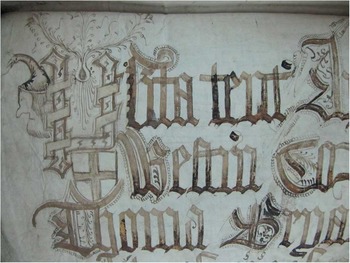
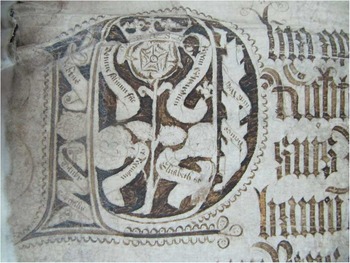
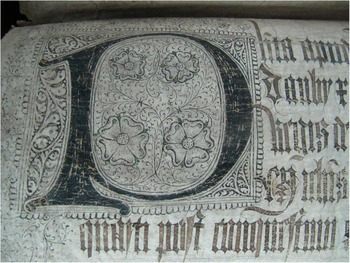
The employment of royal badges and emblems to decorate legal records thus seems to have begun in the reign of his Yorkist successor, Edward iv.Footnote 132 The royal badge of the white rose features in the decoration of the roll for Trinity 1464 (TNA CP40/813) and appears, together with the royal motto and the ragged staff of Richard, Earl of Warwick, in that for Michaelmas 1465 (TNA CP40/817). No fewer than three of Edward’s badges – the white rose, the rose en soleil and the fetterlock – are illustrated in the plea roll for Hilary 1466 (fig 30) and all four plea rolls for 1466 are elaborately decorated.Footnote 133 The roll for Easter 1466 (TNA CP40/819) has an elaborate strapwork initial letter decorated in yellow ink and featuring a crowned rose; that for Trinity 1466 (TNA CP40/820) shows the crowned king pointing to the heading of the document with his left hand, while a small ragged staff can be seen on the left-hand side of the ‘P’, the last occasion on which this badge appeared in the decoration of the plea rolls; while the space within the initial letter ‘P’ of the roll for Michaelmas 1466 (TNA CP40/821) incorporates four finely drawn pen-and-ink roses (fig 31). It is not possible to give a firm reason for this, but the decline of the Earl of Warwick as a dominant force in English politics may perhaps have prompted such conspicuous displays of royal independence.
Badges of Edward iv (fetterlock, rose en soleil, white rose) and Richard, Earl of Warwick (ragged staff) (TNA CP40/818, Hil. 1466). Photograph: Elizabeth Danbury, by permission of The National Archives

Four barbed white roses on vine; ‘P’ in flourishwork (TNA CP40/821, Mich. 1466). Photograph: Elizabeth Danbury, by permission of The National Archives

The rose features on its own in the decoration of the initial letter in the rolls for Trinity 1470 (TNA CP40/836) and in the faded and rubbed initial for Trinity 1475 (TNA CP40/855), but in the roll of Hilary 1475 (TNA CP40/853) it is depicted en soleil. Either the rose alone or en soleil is the decorative programme that seems to have been preferred for most, though not all, of the plea rolls dating from Easter 1477 (TNA 862) until the death of Edward iv in 1483.Footnote 134 The execution of the decoration of many of the rolls during the later part of Edward’s reign is much cruder than that of the 1460s. It is not clear why standards began to fall, unless it is assumed, as we have, that more than one hand was at work, and that this one was considerably less skilled than his predecessors.
The incorporation of the acclamation Emanuel in the decoration of the plea roll for Easter 1483 (TNA CP40/884) has already been noted, and the ‘P’ of this plea roll also features a white rose en soleil. The ‘P’ of the only other plea roll for the reign of Edward v, representing the first part of Trinity term 1483 (TNA CP40/885A), is embellished with a crowned white rose, while the decorative programme, like that of the roll for Easter of the same year, also includes a columbine, emphasising the gifts of the Holy Spirit to be conferred on the young king. The ‘P’ of the heading of the first plea roll of the court of Common Pleas under Richard iii, covering the second part of Trinity term 1483 (TNA CP40/885B), is faded and rubbed, but the letter, in red ink, clearly includes a tusked boar, which was one of Richard’s badges and undoubtedly the one now most closely connected with him. The initial letters of the headings of three of the subsequent plea rolls – those for Michaelmas 1483 (TNA CP40/886), Easter 1484 (TNA CP40/888, 890) and Michaelmas 1484 (TNA CP40/890) – all feature another of the king’s badges, the traditional Yorkist symbol of a rose en soleil. The last roll for Richard iii’s reign, that of Trinity 1485 (TNA CP40/893), incorporates a columbine into the initial letter ‘P’, adopting the motif used in documents of Henry vi and Edward v, perhaps with a sense of anxiety rather than optimism, as Richard’s position appeared increasingly vulnerable.
As noted above, the headings of most of the plea rolls of the court of Common Pleas for the reign of Henry vii are roughly and crudely written and decorated. Relatively little decoration embellished the plea rolls of the court of Common Pleas in the twenty-four years between 1485 and 1509. For much of the reign of Henry vii, the chief prothonotary of the court of Common Pleas was William Mordaunt (d. 1518), an armigerous lawyer who was also attorney in the court of Common Pleas for Prince Arthur from 1495 and for the queen, Elizabeth of York, by 1502.Footnote 135
Apart from royal badges, discussed below, the only drawings by the Mordaunt hand are the Jew’s head (TNA CP40/926; see fig 27) in Michaelmas 1493 and the hound with motto in Easter 1500 (TNA CP40/952; see fig 26), both mentioned above. The decoration of the letter ‘P’ by this hand lacks excitement, consisting usually of a plain letter with a double lobe, a bit of strapwork in the lobe, some leaves or an ending flourish on the stem.Footnote 136 This hand rarely enhances the capitals of the heading, and there is not even any decorative acknowledgement of the succession of Henry viii.
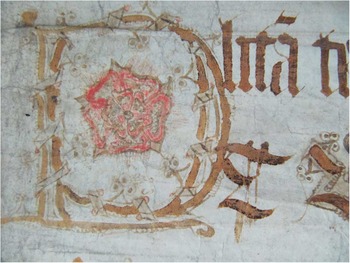
Some work featured Henry vii’s badges: for example, the second plea roll in the reign of Henry vii, for Hilary 1486 (TNA CP40/895), depicts a double red rose within the initial letter ‘P’ (fig 32). A rather crude elaboration of the initial letter of the plea roll for Michaelmas 1493 (TNA CP40/926; see fig 27) places a shield bearing the cross of St George below the letter ‘P’, while a similarly roughly written heading for Hilary 1495 (TNA CP40/931) features a rose and grotesques. Another rose appears in the centre of a red ink ‘P’ in the roll for Easter 1498 (TNA CP40/936); the decoration of this heading features several other upper-case letters written in red ink. There is a dragon in the initial letter ‘P’ of the heading for Michaelmas 1486 (TNA CP40/898). An unusual pen-and-ink ‘P’, possibly supported by another of Henry vii’s badges, the greyhound, introduces the plea roll for Easter 1500 (TNA CP40/952; see fig 26). This letter supports four scrolls containing the motto ‘think and thank God’.Footnote 137 Michaelmas 1503 (TNA CP40/966) sees the final use of the rose under Henry vii. When compared with the elaborate and beautifully executed decorations on the headings of three of the four rolls for King’s Bench in that year (TNA KB27/967, 968, 969), the appearance of these Common Plea rolls is unimpressive; further research might reveal why this was the case.
Barbed double rose tinted red (TNA CP40/895, Hil. 1486). Photograph: Elizabeth Danbury, by permission of The National Archives

Final Comments
It was not the intention of this study to identify scribal hands, but it nevertheless became obvious that, as changes in the writers of the headings of the Common Plea rolls occurred, the execution of images and of decorative motifs associated with the introductory letter ‘P’ also changed.Footnote 138 Because, however, no work has yet been done to distinguish specific clerical-scribal hands in the rolls during the period of our project, we have chosen to describe each of the chronological periods of office of the four relevant chief prothonotaries as a generalised ‘hand’ in order to underscore the point that more than one clerk may have worked as a particular ‘hand’. This nomenclature may be unsatisfactory, but it is a means of recording images without assigning their ‘ownership’ to a specific clerk or prothonotary. We leave the more precise identification of hands to other scholars and hope that divisions of labour among the scribal hands will in due course be clarified, at the same time making it possible to identify the actual names of persons making the images and decoration. Andrew Prescott has commented that ‘the formal rolls of courts like King’s Bench or Common Pleas were among the most accomplished and remarkable scribal achievements of medieval England’,Footnote 139 and more research clearly needs to be carried out on these and other legal, financial and administrative records.Footnote 140
We can at least state that there is no surviving evidence that the miniatures were executed by a hired commercial artist; that is to say, there is no evidence of instructions given to such an artist nor of any preliminary sketches, and there is sufficient deviation in the Common Pleas images from standard pictorial subjects to suggest that these were not the work of commercial artists. Oral instructions by a chief justice, justice or other court official would, of course, not survive, but if there were over the years ‘patrons’, whether judicial or clerical, who specified a certain pictorial subject or decorative work, they have remained invisible. As has been said with respect to High Romanesque English manuscript production, the ‘scribe may not be artist, but there is no opposition between the two’;Footnote 141 and we cannot put aside the possibility that a clerk-scribe made images as he worked. The presence of a guide letter in the blank lobe of a ‘P’ would suggest that an image or decoration was sometimes entered separately from the heading and possibly by a different hand.Footnote 142 Yet the clerk-scribes responsible for the writing of the headings in the plea rolls clearly had special training and in some cases must have possessed enough artistic skill to provide fine decorative initials and badges, and competent pen-drawn miniatures, even if some of the scenes must have stretched such talent to its limit.
In general we can say that the clerk-illustrators were attuned to activities at the royal court and political events as they happened and on a few occasions referred to them in their drawings, as witnessed by the scenes involving Edward iv’s coronation, Sir Thomas Bryan’s appointment as chief justice of Common Pleas and the badge of the Earl of Warwick. The clerk-illustrators were also sufficiently interested in legal procedures to include two drawings of a lawyer pleading before a judge and a portrait of a judge. Even new letter styles did not elude one of the hands as is evident from the copying of the ‘P’ from the Basle alphabet, nor were the hands unaware of conventions in contemporary iconography such as the lion mask, hunting scenes and the king and court scene. Royal mottoes and badges and quotations from the scriptures were, moreover, introduced to support the role of the king as military leader, the fount of justice and of powerful rule. The hands that wrote and illustrated the headings of the plea rolls were also not without their own inventive streak as is apparent from the walking pointing kings and the dragons with blow guns. In particular, the hand or hands working during the period when John Wydeslade was chief prothonotary showed enthusiasm and initiative when including images in the rolls and were allowed – or simply took – considerable latitude. The William Copley hands were notable mainly in the role of copyists of the Wydeslade hand, and the ‘Mordaunt hand’ showed, as we said, the least interest in imagery and decoration, ignoring the work of the previous clerk-illustrators.
The ultimate context for the thirty miniatures in the Common Plea rolls during the period covered by our project is, nevertheless, their presence in no more than slightly over one-tenth of the 347 or so initial letter ‘Ps’ in the years 1422 to 1509.Footnote 143 A not inconsiderable number remained blank and most initials were only decorated or provided with a badge, nondescript leaves, brief strapwork or an extra flourish on the lobe.Footnote 144 In short, only a very small percentage of the possible sites for illustration actually contain representations.
The artistic quality of the miniatures cannot be said to be high. The level of pictorial skill necessary to depict a court scene, whether legal or royal, with any degree of success was beyond the ability of the clerk-illustrators, and the scenes simply present a flat two-dimensional notion of space. The depictions of walking kings are on the whole more accomplished. The mantles, thrones, canopies, tiled flooring and other aspects of the costume and appurtenances of these figures provide an intrinsic means of lending depth to a picture and show an attempt to render rudimentary perspective.Footnote 145 The kings are also notable for the observation of their costume and armour.
Although we cannot be certain about who did what, one important advantage we have in dealing with these clerk-illustrators is that the ‘where’ and ‘when’ are known to us. Their place of work – Westminster – is on record, as well as the specific law term in which they worked. It cannot be emphasised sufficiently how atypical this information is in the history of fifteenth-century book illustration and decoration. The illustrations were, moreover, made by men very close to the centre of government, men who possessed inside knowledge of powerful individuals and events. This intimacy enabled them to create images that provide important – sometimes unique – insights into personal and political developments in fifteenth-century England.
ABBREVIATIONS AND BIBLIOGRAPHY
Abbreviations
- Add
Additional
- BL
British Library, London
- BM
British Museum, London
- East.
Easter
- Hil.
Hilary
- Mich.
Michaelmas
- TNA
The National Archives
- Trin.
Trinity