Introduction
Metaphor: definitions and models
Traditionally, metaphor represents a specific type of figurative language that increasingly gains in importance as a central feature of human communication, higher cognition, and abstract thought (Coulson & Lai, Reference Coulson and Lai2015; Gibbs & Colston, Reference Gibbs and Colston2012). Metaphors can be applied in non-literal ways in order to show that objects, persons, actions, or other things have the same or related qualities (see, e.g., Oxford Advanced Learner's Dictionary, 2010). In the metaphor “She got straight A's on her report card. This child is very bright”, child is named the topic and bright the vehicle (see, e.g., Glucksberg, Reference Glucksberg2001). Regarding this well-established metaphor, the properties of child and bright are processed and context-specific adequate properties are approved, whereas inadequate properties are rejected so as to get the meaning (see, e.g., Glucksberg, Reference Glucksberg2001). In this context, one would refrain from thinking the child is for example physically “radiating or reflecting much light” or “shining” but rather that this child is “intelligent” or “quick-witted” (for word definitions see, e.g., Oxford Dictionary Online, 2017) because this metaphorical light enables the child an especially clear vision of mind (for the ‘Thought as Vision system’ see, e.g., Lakoff, Reference Lakoff2014). These common properties resulting from transfers between vehicle and topic represent the ground of the metaphor (see, e.g., Glucksberg, Reference Glucksberg2001). Classical models on metaphor processing postulate that these transfers can be accomplished either by comparison or categorization processes (Gentner & Bowdle, Reference Gentner, Bowdle and Gibbs2008; Glucksberg, Reference Glucksberg2001) that can be seen as complementary processing strategies (Glucksberg & Haught, Reference Glucksberg and Haught2006).
Predictors of metaphor processing
The notion that metaphor is increasingly considered a higher-order cognitive performance (see, e.g., Coulson & Lai, Reference Coulson and Lai2015; Gibbs & Colston, Reference Gibbs and Colston2012) and that metaphorical thinking guides cognitive processes (see, e.g., Alessandroni, Reference Alessandroni2017) is supported by the number of cognitive aspects which are associated with metaphor processing, such as, for example, analogical reasoning (e.g., Nippold & Sullivan, Reference Nippold and Sullivan1987), attentional resources (Coney & Lange, Reference Coney and Lange2006), mental capacity (Johnson & Pascual-Leone, Reference Johnson and Pascual-Leone1989), or working memory (e.g., Godbee & Porter, Reference Godbee and Porter2013). Furthermore, a recent study showed a strong association between metaphor processing and cognitive flexibility as well as information processing speed (Willinger, Deckert, Schmoeger, Schaunig-Busch, Formann, & Auff, Reference Willinger, Deckert, Schmoeger, Schaunig-Busch, Formann and Auff2017).
The role of chronological and mental age
Besides these cognitive aspects, chronological age seems to be one of the most important, if not the most important, predictor of metaphor processing (see, e.g., Johnson, Reference Johnson1991), which was theoretically connected to specific developmental changes in brain structure and function (Blakemore, Reference Blakemore2008; Steinberg, Vandell, & Bornstein, Reference Steinberg, Vandell and Bornstein2010), which are probably influenced by increasing social and interpersonal exchanges (Hoff, Reference Hoff2006; Steinberg, Reference Steinberg2016).
Metaphor processing seemingly starts at very young age (Gibbs & Colston, Reference Gibbs and Colston2012), and an increasing number of studies suggest that metaphorical thought precedes metaphorical language (see, e.g., Alessandroni, Reference Alessandroni2017), which enables children to understand certain metaphors before they can successfully explain them (Gibbs, Reference Gibbs1994). Starting with overextensions of word meanings at approximately one and a half years (Clark, Reference Clark2003), at age three children are usually to some extent able to understand and to produce primary metaphors, namely metaphors that are based on physical properties and actions (Siquerra & Gibbs, Reference Siquerra and Gibbs2007; Winner, Reference Winner1988/1997), and to distinguish between ‘meaningful’ (literal and metaphorical) and anomalous phrases, but not between literal and metaphorical phrases (Billow, Reference Billow1981). Afterwards, metaphor processing markedly increases between ages three and four (Pérez-Hernández & Duvignau, Reference Pérez-Hernández and Duvignau2016; Rubio-Fernández & Grassmann, Reference Rubio-Fernández and Grassmann2016). Between ages four and six, children increasingly produce, literally understand, and explain perception-based (sensorial) metaphors based on similar object attributes (Asch & Nerlove, Reference Asch, Nerlove, Kaplan and Wapner1960; Gentner, Reference Gentner1988; Ozcaliskan, Reference Ozcaliskan2005; Winner, Reference Winner1988/1997). In the following age span between seven and ten years, the basis for higher-order metaphor processing is presumably laid as children progressively construct conjunctive and disjunctive categories based on multiple perceptual grounds (Siltanen, Reference Siltanen1989). Furthermore, these children interpret metaphors by attributing psychological meanings to terms (Winner, Rosenstiel, & Gardner, Reference Winner, Rosenstiel and Gardner1976), and begin to understand and build relational categories (Gentner, Reference Gentner1988) based on perceptual and conceptual grounds (Siltanen, Reference Siltanen1989). Based on studies which indicated that metaphors are processed at a “genuine metaphoric level” when children are eleven to twelve years old (see, e.g., Asch & Nerlove, Reference Asch, Nerlove, Kaplan and Wapner1960), a recent study indicated a qualitative developmental step at the transition from middle childhood to early adolescence (Willinger et al., Reference Willinger, Deckert, Schmoeger, Schaunig-Busch, Formann and Auff2017). Investigating metaphor processing in a sample comprising seven-, nine-, and eleven-year-olds, they showed a marked increase in metaphor processing between ages nine and eleven (for partially overlapping classification of age-groups see, e.g., Berk, Reference Berk2014; Feldman, Reference Feldman2017; Steinberg, Reference Steinberg2016). Furthermore, they showed that nine-year-olds outperform seven-year-olds regarding the ability to successfully identify as well as comprehend and explain metaphors. Nevertheless, no differences between these age-groups were shown regarding qualitative aspects of metaphor processing and metaphor preference. On top of that, extending previous literature, they indicated an age-related increase in the comprehension of and preference for relational metaphors (Willinger et al., Reference Willinger, Deckert, Schmoeger, Schaunig-Busch, Formann and Auff2017).
Besides chronological age, mental age was also shown to be associated with metaphor processing in typically developing children as well as children with Autism Spectrum Disorder and William's Syndrome (Godbee & Porter, Reference Godbee and Porter2013; Rundblad & Annaz, Reference Rundblad and Annaz2010a, Reference Rundblad and Annaz2010b; Van Herwegen, Dimitriou, & Rundblad, Reference Van Herwegen, Dimitriou and Rundblad2013). It has to be noted that, in these studies, mental age was estimated by single verbal intelligence scores, namely word knowledge/vocabulary, instead of treating mental age as a broader construct, which possibly leads to a bias in the use of the term ‘mental age’.
The role of verbal intelligence and linguistic competence
Early studies did not agree upon the association between metaphor processing and intelligence (Chapman, Reference Chapman1971; Helstrup, Reference Helstrup1988), whereas more recent studies indicate that intelligence is associated with metaphor comprehension (Godbee & Porter, Reference Godbee and Porter2013; Varga et al., Reference Varga, Schnell, Tényi, Németh, Simon, Hajnal and Herold2014) and production (Beaty & Silvia, Reference Beaty and Silvia2013). Due to the classical view of metaphor as a language type, research increasingly focused on the role of verbal intelligence. In this context, positive associations between verbal intelligence and metaphor comprehension were shown in typically developing children (Malgady Reference Malgady1981; Schaunig, Willinger, & Formann, Reference Schaunig, Willinger and Formann2004), as well as in children with autism spectrum disorder (Huang, Oi, & Taguchi, Reference Huang, Oi and Taguchi2015). Especially vocabulary shows a strong association with metaphor comprehension (see, e.g., Godbee & Porter, Reference Godbee and Porter2013; Huang et al., Reference Huang, Oi and Taguchi2015; Kasirer & Mashal, Reference Kasirer and Mashal2014; Nippold & Sullivan, Reference Nippold and Sullivan1987), whereas regarding verbal reasoning, low correlations with metaphor comprehension (Nippold & Sullivan, Reference Nippold and Sullivan1987) and high correlations with metaphor production (Pereira de Barros, Primi, Koich Miguel, Almeida, & Oliveira, Reference Pereira de Barros, Primi, Koich Miguel, Almeida and Oliveira2010) were shown.
With respect to linguistic competence, early studies suggested a number of factors influencing metaphor processing, such as linguistic load, linguistic form, or linguistic content (Vosniadou, Reference Vosniadou1987; Vosniadou, Ortony, Reynolds, & Wilson, Reference Vosniadou, Ortony, Reynolds and Wilson1984; for an overview see Johnson, Reference Johnson1991). Although metaphor “helps to ground linguistic structure and meaning” (Johnson, Reference Johnson1999, p. 15), studies suggest that linguistic skill and language proficiency are not likely to be major predictors of metaphor processing (see, e.g., Johnson, Reference Johnson1991). Interestingly, although compositional properties of language allow for a seemingly infinite range of linguistically expressed complex metaphorical thought (see Lakoff, Reference Lakoff2014), recent studies investigating the association between linguistic competence and metaphor processing are scarce.
Aims of the study
A recent study showed an age-specific increase in metaphor processing in children aged between seven and eleven years, and indicated a developmental step between ages nine and eleven (Willinger et al., Reference Willinger, Deckert, Schmoeger, Schaunig-Busch, Formann and Auff2017) using the Metaphoric Triads Task (MTT; Kogan & Chadrow, Reference Kogan and Chadrow1986; Kogan, Connor, Gross, & Fava, Reference Kogan, Connor, Gross and Fava1980). They state that metaphor processing seemingly reaches a new qualitative level at the beginning of early adolescence (in accordance with the classification of early adolescence by Steinberg, Reference Steinberg2016), which further involved entering a higher school stage. The current study aimed to investigate the developmental course of metaphorical language ability in the crucial age span between seven and ten, in which the foundation for higher-order metaphor processing is presumably laid (please see section ‘The role of chronological and mental age’ above). Therefore, using the same instrument as Willinger and colleagues (Reference Willinger, Deckert, Schmoeger, Schaunig-Busch, Formann and Auff2017), one aim was to investigate metaphor identification, comprehension, preference, and comprehension quality (see the ‘Methods’ section below), and to look for meaningful developmental changes in a sample which includes individuals in middle childhood (seven to nine years) and individuals in an age which, according to different literature sources (e.g., Berk, Reference Berk2014; Feldman, Reference Feldman2017; Steinberg, Reference Steinberg2016), can be classified as either end of middle childhood or beginning of early adolescence (ten years). More specifically, Steinberg (Reference Steinberg2016) states that early adolescence ranges between ten and thirteen years, whereas in comparison with other sources this age span overlaps with endpoints of eleven years (Berk, Reference Berk2014) and even up to twelve years (Feldman, Reference Feldman2017) of middle childhood. Subsequently, in this study, children who have reached the age of ten will be seen as individuals at the transition from middle childhood to early adolescence. Main analyses regarding chronological age will be conducted using age as a continuous measure so as to allow for detailed analyses and to avoid disadvantages regarding artificially categorizing predictor variables (see, e.g., Royston, Altman, & Sauerbrei, Reference Royston, Altman and Sauerbrei2006).
To the knowledge of the authors of the current study, to date, studies addressing the role of verbal intelligence regarding metaphor processing did not compare the predictive role of different aspects of verbal intelligence with respect to different aspects of metaphor processing using a single study design. Furthermore, the predictive value of linguistic competence is unclear, as single linguistic aspects were associated with metaphor processing whereas language proficiency in general was shown to be a rather minor predictor (e.g., Johnson, Reference Johnson1991). Therefore, another aim of the study was to investigate and to compare the associations between different aspects of metaphor processing and different well-validated verbal intelligence components (including vocabulary [see critique on previous definitions of mental age above], the Wechsler Intelligence Scale for Children – III; Wechsler, Reference Wechsler1991) as well as linguistic competence scores.
Another aim of the study was to investigate the predictive role of mental age regarding metaphor processing. So far, studies investigating this issue estimated mental age using word knowledge, which is critical as vocabulary is only a single factor of verbal intelligence (nevertheless, vocabulary will be investigated in this study, please see further below). In this study, mental age is defined by the grade the individual child completed, in terms of an ‘academic age’. At the time in which the study was conducted, the school system in Austria allowed for such a definition of mental age,Footnote 1 which can be seen as broader, more general, and of higher everyday relevance than the previous operationalization. For this purpose, school enrolment and attended grade were registered and used for analyses.
Although Willinger and colleagues (Reference Willinger, Deckert, Schmoeger, Schaunig-Busch, Formann and Auff2017) showed no gender differences in seven-, nine-, and eleven-year-olds regarding metaphor processing, this study further aimed to investigate whether gender differences or age–gender interaction effects can be found in the given sample.
In accordance with Willinger and colleagues (Reference Willinger, Deckert, Schmoeger, Schaunig-Busch, Formann and Auff2017), in this study, the MTT was chosen for the investigation as its different scores allow for an exhaustive view of different aspects of metaphor processing. Furthermore, another aim of the study was to investigate more real-lifelike aspects of metaphor encounter as the authors of the current study hold the view that conventionality and novelty of a metaphor are terms along a continuum and that comparison and categorization can be seen as complementary processing strategies that depend on the number of the topic’s and vehicle’s properties and the way in which they are aligned. In this context, the MTT was chosen because it does not claim to measure either novel or conventional metaphors (Kogan & Chadrow, Reference Kogan and Chadrow1986; Kogan et al., Reference Kogan, Connor, Gross and Fava1980, p. 1), and therefore, conventionality was not controlled in this study. In the view of the authors of the current study, using the MTT potentially allows for statements about a more naturalistic processing of metaphors.
Literature shows that between seven and ten years children are increasingly able to process metaphors based on different properties or concepts. Therefore, another aim of this study was to investigate the processing of different metaphor types in this crucial age span as the MTT comprises attributional metaphors based on physical similarities as well as relational metaphors based on affective associations and abstract cross-categorical similarities (see, e.g., Kogan & Chadrow, Reference Kogan and Chadrow1986).
This study addresses multiple important aspects of metaphorical language development in a very crucial age span in which the basis for higher-order metaphor processing is seemingly laid. This study investigates metaphor identification, preference, comprehension, and qualitative aspects of comprehension as well as the role of chronological age, mental age, gender, different aspects of verbal intelligence, and linguistic competence regarding metaphor processing. In this way, as well as by focusing on the development of processing different metaphor types, this study contributes to existing research and clearly adds new knowledge to the topic of metaphor. A big sample of children between seven and ten, of whom all were enrolled in public schools (see the ‘Methods’ section below) allows for detailed analyses and meaningful interpretations with respect to the development of metaphorical language ability. The results of the study yield information about at what age children understand and prefer which metaphors; information that is potentially useful for the future use of metaphors in work with children.
Hypotheses
H1: Metaphor identification (H1.1), comprehension (H1.2), and preference (H1.3) will be significantly predicted by age.
H2: Metaphor identification (H2.1), comprehension (H2.2), and preference (H2.3) will be significantly predicted by verbal intelligence and linguistic competence.
H3: There will be a significant difference between grades (second, third, and fourth) and gender groups with respect to metaphor identification (H3.1), comprehension (H3.2), and preference (H3.3), under consideration of verbal intelligence and linguistic competence.
H4: There will be a significant difference between grades (second, third, and fourth) and gender groups with respect to metaphor comprehension quality (0-point, l-point, and 2-point answers).
H5: There will be a significant difference with respect to metaphor identification (H5.1), comprehension (H5.2), and preference (H5.3), depending on grade (second, third, and fourth), gender, and type of metaphor (configurational, conceptual, and physiognomic).
Methods
Sample
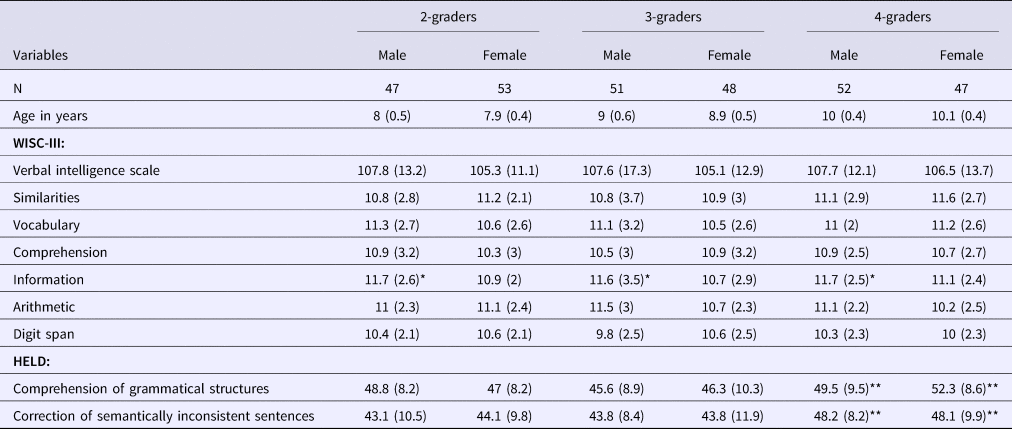
The sample comprised 298 typically developing children (49% female, 51% male) aged between 7.2 and 10.8 years (55 seven-, 102 eight-, 77 nine-, and 64 ten-year-olds). All children were enrolled in public elementary schools and attended grades two (N = 100, mean age = 7.9, SD = 0.4 years, range = 7.2–9.4 years), three (N = 99, mean age = 9.0, SD = 0.6 years, range = 7.9–10.8 years), and four (N = 99, mean age = 10.08, SD = 0.4 years, range = 9.3–10.8 years). All children showed typical language development and were native German speakers. Further information regarding the sample, separated by grade, is given in Table 1. After receiving permission by the responsible subsection of the Austrian federal ministry of education, as well as by the respective headmasters and headmistresses, letters of agreement signed by parents and participants were obtained. Prior to participation, a written informed consent form was signed by every participant and his/her legal guardian.
Sociodemographic Data and Standardized Scores of Verbal Intelligence and Linguistic Competence Measures in the Current Sample

Notes. WISC-III: Wechsler Intelligence Scale for Children III; HELD: Heidelberg Evaluation of Language Development; results of the WISC-III verbal intelligence scale are presented in standard scores (average range 90–110), whereas the results of the subtests are presented in value points (average range 7–13); results of the HELD subtests are presented in t-values (average range 40–60); * boys show significantly higher information scores than girls (p = .015); ** fourth-graders show significantly higher linguistic competence scores than second- and third-graders (p = .001, and p = .001, respectively).
Materials
Metaphor identification, comprehension, preference, and comprehension quality
Metaphor processing was assessed using set I of the German version (Schmoeger, Reference Schmoeger2004; Willinger et al., Reference Willinger, Deckert, Schmoeger, Schaunig-Busch, Formann and Auff2017) of the verbal form of the Metaphoric Triads Task (MTT; Kogan & Chadrow, Reference Kogan and Chadrow1986). Set I of the MTT (MTT-I) includes 12 items, each consisting of word triads (e.g., ‘grandfather – rocking chair – ancient tree’) that offer three pairing possibilities. One pairing per item represents a metaphoric relation whereas the other two represent non-metaphoric relations (categorical, locational functional, or other). Before performing the MTT, children were not told that this task involved metaphors; furthermore, the concept of metaphor was not explained. For each item, children were asked to select the best possible pairing, and only afterwards form any other meaningful pairings. For each pair selected, they were asked to explain why these two words go well together. Before starting the task, children were told that whenever a word was unclear, they were very welcome to ask the researcher, who then explained the word and made sure the child understood.
In this study, only the metaphoric pair was scored. Children got two points if the metaphoric pair was selected and correctly explained (2-point-answer), one point if the metaphoric pair was selected but accompanied by a less than fully adequate explanation (1-point-answer), and null points if the metaphoric pair was not selected, or selected and explained incorrectly (0-point-answer). Answers were recorded and scored afterwards based on a fixed protocol. In accordance with Willinger et al. (Reference Willinger, Deckert, Schmoeger, Schaunig-Busch, Formann and Auff2017) and Kogan and Chadrow (Reference Kogan and Chadrow1986), the following scores were calculated.
Metaphor identification measured whether metaphors were identified or not, and was represented by the number of metaphoric pair selections (number of 2-point- and 1-point-answers; range 0–12 points). Metaphor comprehension measured the extent to which metaphors were understood and verbally explained, and was calculated by summing the scores of each answer (2 points, 1 point, or 0 points; range 0–24 points). Metaphor preference measured the extent to which metaphors were at least basically understood and preferred, and was operationalized by an identification of the metaphoric pair in the first step, followed by a correct or less than fully adequate explanation (2-point- or 1-point-answer; range 0–12 points). Metaphor comprehension quality score(s) yielded a more detailed profile of metaphor comprehension and was calculated by counting the number of 2-point-, 1-point-, and 0-point-answers separately.
MTT-I consists of four configurational, three physiognomic, and five conceptual metaphors. Configurational metaphors represent perceptual similarity based on physical properties (e.g., ‘dancing ballerina – spinning top’), physiognomic metaphors represent an affective association (e.g., ‘angry man – thunderstorm’), whereas conceptual metaphors represent an abstract cross-categorical similarity (e.g., ‘grandfather – ancient tree’). Reliability analysis of the German MTT-I yielded a Cronbach's alpha of 0.84 (Willinger et al., Reference Willinger, Deckert, Schmoeger, Schaunig-Busch, Formann and Auff2017), whereas in this study inter-rater agreement ranged between 88.4% and 98.1%.
Verbal intelligence
Verbal intelligence was assessed using the German version (Tewes, Rossmann, & Schallberger, Reference Tewes, Rossmann and Schallberger1999) of the verbal scale of the Wechsler Intelligence Scale for Children – III (WISC-III; Wechsler, Reference Wechsler1991). The verbal scale is composed of the subtests information (children have to answer general-knowledge questions; measures general factual knowledge), similarities (children have to describe how two words that represent common objects or concepts are similar; measures verbal reasoning, verbal abstraction, and verbal conceptualization), vocabulary (children have to provide definitions for words; measures word knowledge and verbal expression), comprehension (children have to answer questions regarding general principles and social situations; measures knowledge about general principles and social situations), digit span (children have to repeat spoken digits, either in the same or a reverse order; measures verbal short-term memory, working memory), and arithmetic (children have to solve verbally presented arithmetic problems; measures problem-solving regarding verbally presented arithmetic problems, and verbal working memory).
Linguistic competence
Linguistic competence was assessed using the subtests comprehension of grammatical structures [Verstehen grammatischer Strukturformen] and correction of semantically inconsistent sentences [Korrektur semantisch inkonsistenter Sätze] of the widely used German Heidelberg Evaluation of Language Development (HELD) [Heidelberger Sprachentwicklungstest – HSET] (Grimm & Schoeler, Reference Grimm and Schoeler1990). In the subtest comprehension of grammatical structures, children hear sentences that describe certain situations or activities in varying grammatical complexity which they have to re-enact with toys. In the subtest correction of semantically inconsistent sentences, children hear sentences in which one word is wrong, whereupon the children have to correct the word. Both subtests measure comprehension of sentences of different levels of grammatical complexity, syntactic knowledge, detection and correction of illogical coherence in sentences, and active use of grammatical rules.
Statistics
Hypotheses of type H1 – the predictive role of age regarding metaphor processing
Three separate segmented linear regression analyses were performed with age as independent variable and identification (H1.1), comprehension (H1.2), and preference (H1.3) as dependent variables. Analyses were performed using the program SegReg (Oosterbaan, Reference Oosterbaan2011). This analysis determines whether splitting the data into two (virtual) datasets and fitting two regression lines (a segmented, broken, discontinuous line) to the datasets explains more variance than a single linear model involving one regression line. In this way, SegReg calculates a classic linear regression's coefficient of determination (R2) as well as a segmented linear regression's explanation coefficient (EC) that is similar to R2 but based on the data involving the two regression lines (segmented line). In this way, it can be determined whether introducing such a segmented line involving a breakpoint at which the slopes of the two lines change shows a better fit to the data than the single linear model. The best fit is then shown by one of seven different types of functions involving different combinations of horizontal and/or sloping lines. The breakpoint of the segmented line is significant if it is within a 90% or 95% confidence interval, respectively. Besides showing a breakpoint in the explanatory variable(s), SegReg further calculates whether the increase in explained variance by the segmented line is statistically significant. Advantages of the segmented linear regression technique are that it can be considered representative of other non-linear regression curves and is able to divide data into two datasets with different characteristics. For further information and practical use of this technique, please see, e.g., Bonny and Lourenco (Reference Bonny and Lourenco2013) or Oosterbaan (Reference Oosterbaan2002, Reference Oosterbaan2011).
Hypotheses of type H2 – the predictive role of verbal intelligence and linguistic competence regarding metaphor processing
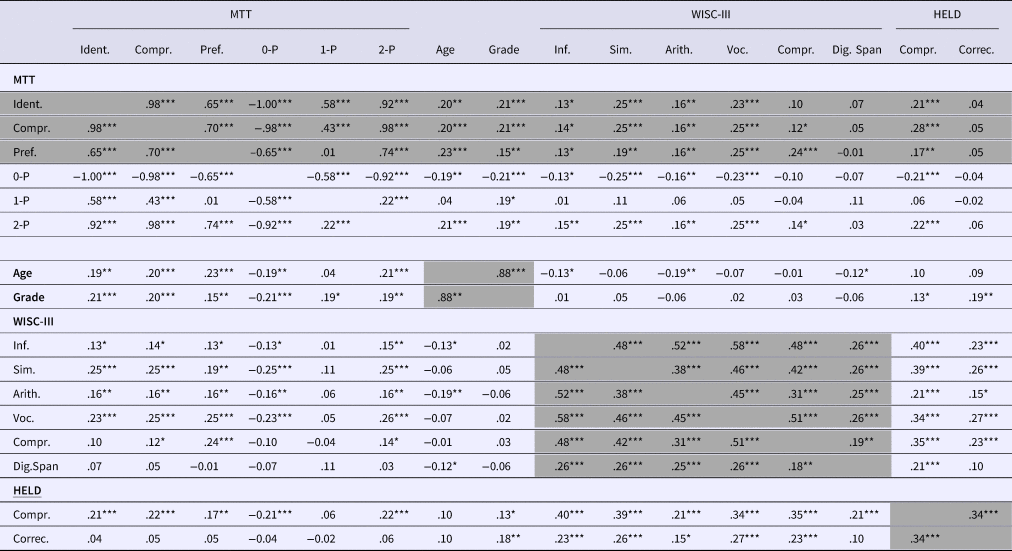
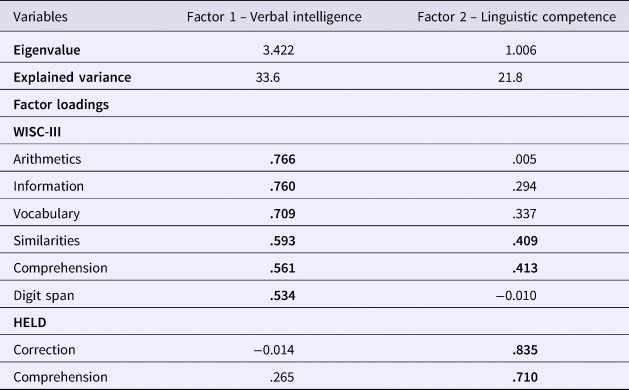
First, correlations between all dependent and independent variables were calculated. Correlations indicated a medium to high multicollinearity between independent variables (see Table 2). Correlation tables regarding dependent and independent variables for the separate age-groups and grades can be found in the ‘Supplementary Materials’ (available at <https://doi.org/10.1017/S0305000918000491>). Therefore, a factor analysis regarding those variables was performed. As a result, variables were collapsed into two factors: verbal intelligence (WISC-III verbal IQ score) and linguistic competence (mean of T-scores of both HELD subtests); see Table 3. In a next step, three separate linear regression analyses were performed with verbal intelligence and linguistic competence as independent variables, and identification (H2.1), comprehension (H2.2), and preference (H2.3) as dependent variables. Regarding the independent variables, standardized scores were used in order to eliminate age-effects regarding these variables.
Pearson Correlations between the Dependent (MTT) and Independent Variables for the Whole Sample (7-, 8-, 9-, and 10-year-olds, or Grades 2, 3, and 4, respectively)

Notes. In this analysis, age was included as continuous variable; MTT: Metaphoric Triads Task; Ident. = Identification, Compr. = Comprehension, Pref. = Preference, 0-P = Zero-point-answer, 1-P = One-point-answer, 2-P = Two-point-answer; WISC-III: Wechsler Intelligence Scale for Children III: Inf. = Information, Sim. = Similarities, Arith. = Arithmetic, Voc. = Vocabulary, Compr. = Comprehension, Dig.Span = Digit Span; age-dependent value scores were used; HELD: Heidelberg Evaluation of Language Development: Compr. = Comprehension of grammatical structures; Correc. = Correction of semantically inconsistent sentences; age-dependent T-scores were used; *** ⩽ .0001; ** ⩽ .001; * ⩽ .05.
Factor Analysis Using Varimax Rotation regarding WISC-III and HELD Subtests

Notes. WISC-III: Wechsler Intelligence Scale for Children III; HELD: Heidelberg Evaluation of Language Development; Comprehension = Comprehension of grammatical structures; Correction = Correction of semantically inconsistent sentences; Factor loadings >.40 are in boldface.
Hypotheses of type H3 – differences between mental age and gender groups regarding metaphor processing considering verbal intelligence and linguistic competence
Three separate analyses of covariance were performed with grade (3) and gender (2) as independent variables; verbal intelligence (WISC-III verbal IQ score) and linguistic competence (mean of T-scores of both HELD subtests) as covariates; as well as metaphor identification (H3.1), comprehension (H3.2), and preference (H3.3) as dependent variables. Additionally, Bonferroni post-hoc comparisons were performed. Regarding the covariates, standardized scores were used in order to eliminate additional age-effects regarding these variables. In order to show whether a gender effect with respect to verbal intelligence in this age span can be seen, a t-test with gender as independent variable and WISC-III verbal intelligence as dependent variable was performed.
Hypotheses of type H4 – differences between mental age and gender groups regarding metaphor comprehension quality
A multivariate analysis of variance was performed with grade (3) and gender (2) as independent variables; and 2-point-, l-point-, and 0-point-answers as dependent variables.
Hypotheses of type H5 – metaphor processing: the effect of mental age, gender, and type of metaphor
Three separate mixed design analyses of variance were performed with grade (3) and gender (2) as between-subjects factors; metaphor type (configurational, physiognomic, conceptual) as within-subjects factor; and metaphor identification (H5.1), comprehension (H5.2), and preference (H5.3) as dependent variables. For each analysis, mean scores regarding each metaphor type were used, due to the different number of items.
Procedure
Tasks were performed in the following order: HELD (linguistic competence), MTT-I (metaphor task), WISC-III (verbal intelligence). Children were tested in single-subject settings and all tasks were performed consecutively. Between each task children had a break of approximately two minutes. If a child showed any signs of exhaustion, she or he was asked to take a longer break (approximately five minutes).
Results
The predictive role of age regarding metaphor processing – hypotheses of type H1
Segmented regression analyses showed that age within single linear models significantly predicted metaphor identification (H1.1: F(1,296): = 11.511, p = .001, R2 = .036), comprehension (H1.2: F(1,297) = 12.825, p = .001, R2 = .041), and preference (H1.3: F(1,297) = 17.143, p = .001, R2 = .055).
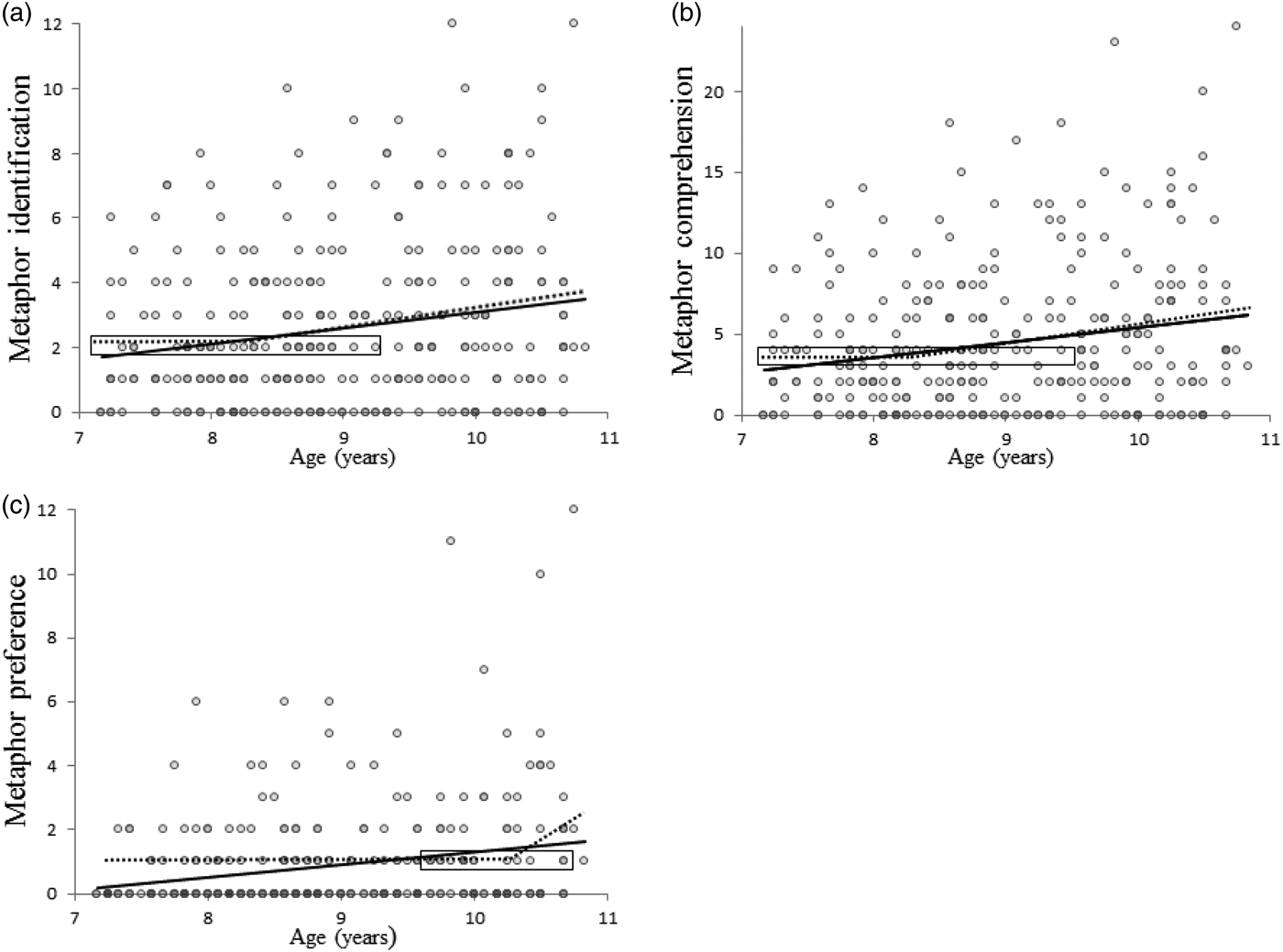
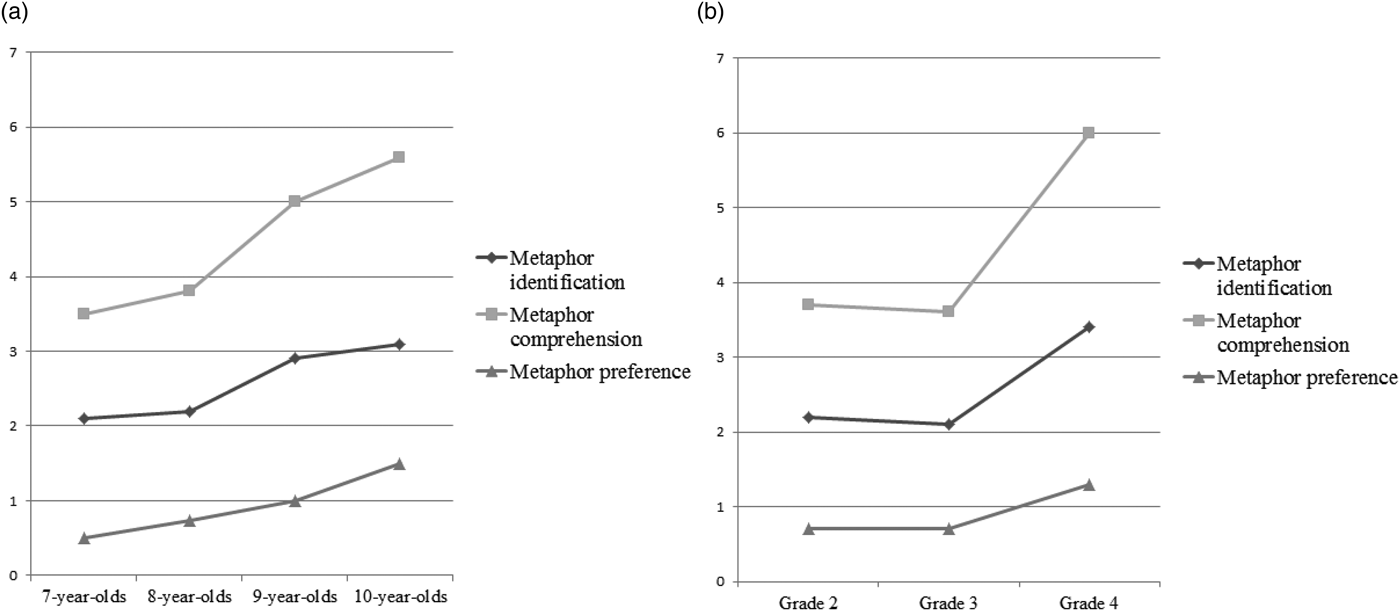
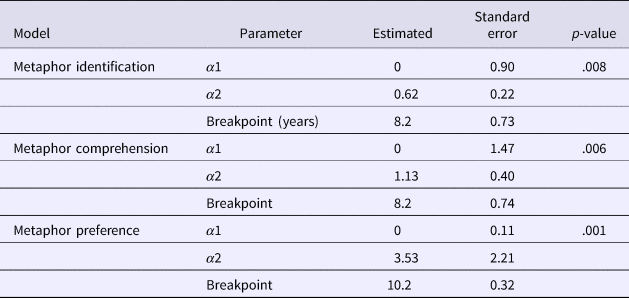
Regarding metaphor identification and comprehension, analyses suggested a breakpoint of 8.2 years within a function type three (horizontal regression segment followed by a sloping regression line; see Oosterbaan, Reference Oosterbaan2011). The segmented models yielded higher explanation rates (identification: explanation coefficient (expl. coeff.) = .038; comprehension: expl. coeff. = .042) than the linear models, whereas in both cases the increase was not significant (identification: F(2,294) = 0.339, p = .71; comprehension: F(2,294) = 0.059, p = .94), and large 95% confidence blocks can be seen for the breakpoints (see Figure l, panels A and B). With respect to preference, segmented regression analysis suggested a breakpoint of 10.2 years and yielded a higher explanation rate (explanation coefficient = .065) within a type three function than in the linear model. This analysis yielded a smaller 95% confidence block whereas the increase in explanation was not significant (F(2,294) = 1.623, p = .19). Model parameters for the three analyses can be seen in Table 4. For graphs depicting development of metaphor processing as well as given answers across discrete age-groups (seven-, eight-, nine-, ten-year-olds), see Figure 2.
Metaphor identification (panel a), comprehension (panel b), and preference (panel c) plotted against age. The continuous lines indicate the slopes of the linear regressions, the dotted lines indicate the slopes of the segmented regressions, each showing a function type 3 (one horizontal and one sloping line), calculated with SegReg (Oosterbaan, Reference Oosterbaan2011). Results indicate breakpoints of 8.2 years in panel a and b, as well as 10.2 years in panel c. The rectangles show the 95% confidence blocks around the breakpoints.

Development of metaphor processing between seven and ten years (discrete age groups, panel a) and between grades two, three, and four (panel b). The y-axis shows the mean scores for each respective score.

Segmented Regression Model Parameters regarding Metaphor Identification, Comprehension, Preference. Values Are Taken from SegReg Software (Oosterbaan, Reference Oosterbaan2011).

The predictive role of verbal intelligence and linguistic competence regarding metaphor processing – hypotheses of type H2
Metaphor identification (H2.1)
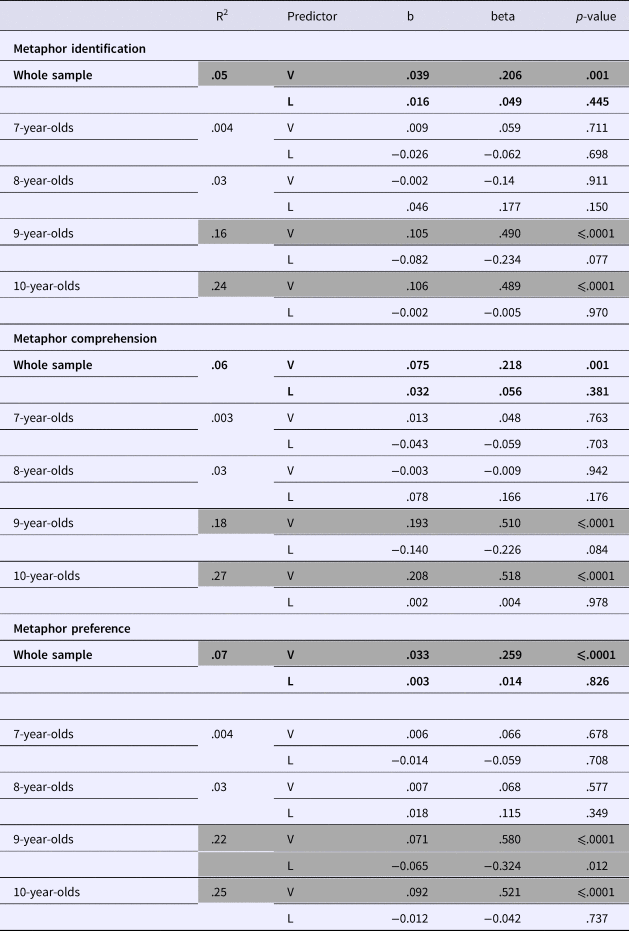
Results of the linear regression showed that metaphor identification was significantly predicted by verbal intelligence (F(2,297) = 8.440, p ⩽ .0001, R2 = .054). Taking the results regarding hypotheses H1 into account, separate regression analyses were performed for distinctive age-groups (seven-, eight, nine-, and ten-year-olds). Results showed that in age-groups seven and eight identification was not significantly predicted by verbal intelligence and linguistic competence (F(2,54) = 0.098, p = .907, R2 = .004; and F(2,101) = 1.444, p = .241, R2 = .03, respectively), whereas in age-groups nine and ten, identification was significantly predicted by verbal intelligence (F(2,76) = 7.161, p = .001, R2 = .16; and F(2,65) = 9.472, p ⩽ .0001, R2 = .24, respectively). Details can be seen in Table 5.
Linear Regression Analyses with Metaphor Identification, Comprehension, and Preference as Dependent as well as Verbal Intelligence and Linguistic Competence as Independent Variables

Notes. V = Verbal intelligence, Wechsler Intelligence Scale for Children III verbal IQ; L = Linguistic competence, Mean of T-scores of Heidelberg Evaluation of Language Development subtests ‘Comprehension of grammatical structures’ and ‘Correction of semantically inconsistent sentences’; significant results are shaded.
Metaphor comprehension (H2.2)
Results of the linear regression showed that metaphor comprehension was significantly predicted by verbal intelligence (F(2,297) = 9.743, p ⩽ .0001, R2 = .062). In age-groups seven and eight, comprehension was not significantly predicted by verbal intelligence and linguistic competence (F(2,54) = 0.080, p = .923, R2 = .003; and F(2,101) = 1.304, p = .276, R2 = .03, respectively), whereas in age-groups nine and ten comprehension was significantly predicted by verbal intelligence (F(2,76) = 8.030, p ⩽ .0001, R2 = .18; and F(2,65) = 11.286, p ⩽ .0001, R2 = .27, respectively). Details can be seen in Table 5.
Metaphor preference (H2.3)
Results of the linear regression showed that metaphor preference was significantly predicted by verbal intelligence (F(2,297) = 11.174, p ⩽ .0001, R2 = .071). In age-groups seven and eight, preference was not significantly predicted by verbal intelligence and linguistic competence (F(2,54) = 0.107, p = .899, R2 = .004; and F(2,101) = 1.348, p = .265, R2 = .03, respectively), whereas in age-group nine preference was significantly predicted by verbal intelligence and linguistic competence (F(2,76) = 10.701, p ⩽ .0001, R2 = .224), and in age-group ten by verbal intelligence (F(2,65) = 10.294, p ⩽ .0001, R2 = .252). Details can be seen in Table 5.
Differences between mental age and gender groups regarding metaphor processing considering verbal intelligence and linguistic competence – hypotheses of type H3
Analyses showed significant differences between grades with respect to metaphor identification (F(2,289) = 9.947, ηp 2 = .064, p ⩽ .0001), comprehension (F(2,289) = 9.636, ηp 2 = .062, p ⩽ .0001), and preference (F(2,289) = 6.038, ηp 2 = .040, p = .003). Metaphor identification (F(1,289) = 15.480, ηp 2 = .051, p ⩽ .0001), comprehension (F (1,289) = 16.971, ηp 2 = .055, p ⩽ .0001), and preference (F(1,289) = 22.187, ηp 2 = .071, p ⩽ .0001) were significantly adjusted for verbal intelligence but not for linguistic competence. No significant gender-effect and no significant interaction between grade and gender were shown. Post-hoc comparisons showed that second- and third-graders did not differ significantly regarding metaphor identification (M = 2.2, SD = 2.2; M = 2.1, SD = 2; p = .99), comprehension (M = 3.7, SD = 3.8; M = 3.6, SD = 3.6; p = .99), and preference (M = 0.7, SD = 1.3; M = 0.7, SD = 1.1; p = .99). Second- and third-graders, on the other hand, exhibited significantly lower results than fourth-graders with respect to metaphor identification (p = .001 and p ⩽ .0001, respectively; fourth-graders: M = 3.4, SD = 3), comprehension (p = .001 and p ⩽ .0001, respectively; fourth-graders: M = 6, SD = 5.5), and preference (p = .015; p = .004; fourth-graders: M = 1.3, SD = 2.3). For graphs depicting development of metaphor processing across grades, see Figure 2.
Differences between mental age and gender groups regarding metaphor comprehension quality – hypotheses of type H4
2-point-answers
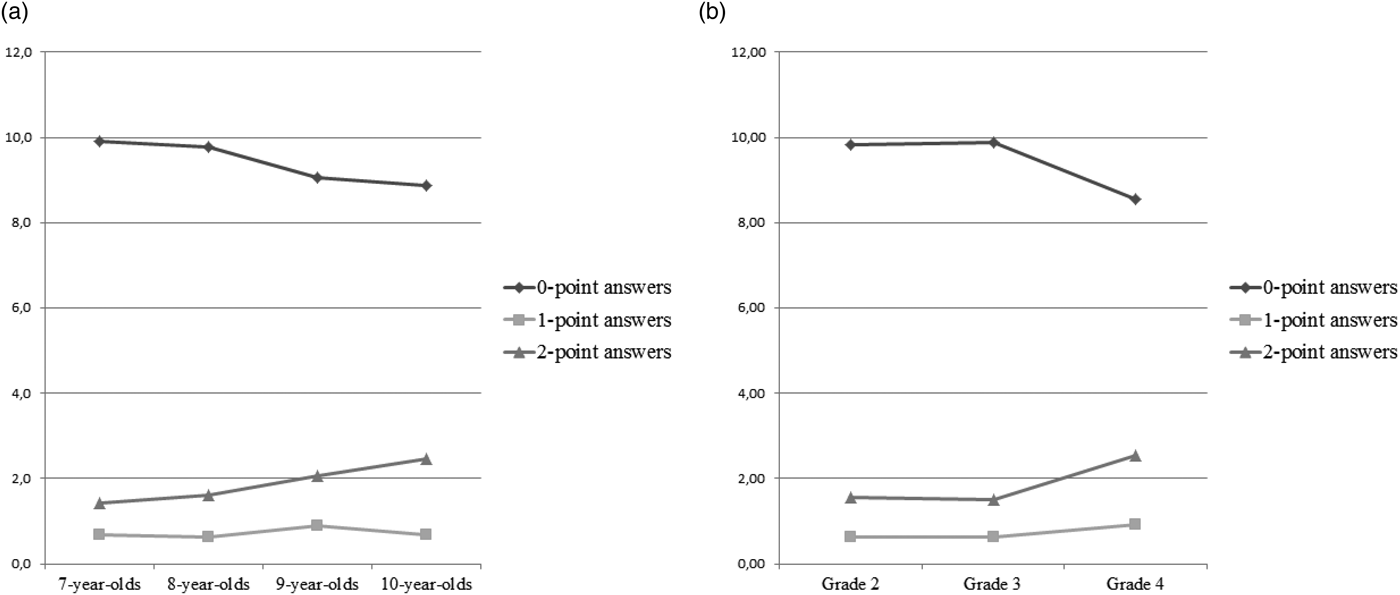
With respect to 2-point-answers, in terms of metaphor detection and subsequent correct explanation, analysis showed a significant effect of grade (F(2,294) = 8.996, ηp 2 = .03, p ⩽ .0001). No significant gender-effect and no significant interaction between grade and gender were shown. Post-hoc comparisons showed that second- and third-graders did not differ significantly (p = .99), and exhibited significantly less 2-point-answers than fourth-graders (p = .002 and p = .001, respectively). Please see Figure 3.
Sample-size adjusted mean number of 2-, 1-, and 0-point answers of the Metaphoric Triads Task between seven and ten years (discrete age groups, Panel a) and between grades two, three, and four (Panel b). The y-axes shows the mean scores for each respective score. For each item of the test, children can either achieve two, one, or zero points.

l-point-answers
With respect to 1-point-answers, in terms of metaphor detection and subsequent less than fully adequate explanation, analysis showed a significant effect of grade (F(2,294) = 3.086, ηp 2 = .01, p = .047). No significant gender-effect and no significant interaction between grade and gender were shown. Subsequent post-hoc comparisons showed no significant differences between grades. Please see Figure 3.
0-point-answers
With respect to 0-point-answers, analysis showed a significant effect of grade (F(2,294) = 10.404, ηp 2 = .004, p ⩽ .0001). No significant gender-effect and no significant interaction between grade and gender were shown. Post-hoc comparisons showed that second- and third-graders did not differ significantly (p = .99), and exhibited significantly more 0-point-answers than fourth-graders (p = .001 and p ⩽ .0001, respectively). Please see Figure 3.
Metaphor processing: The effect of mental age, gender, and type of metaphor – hypotheses of type H5
Metaphor identification (H5.1)
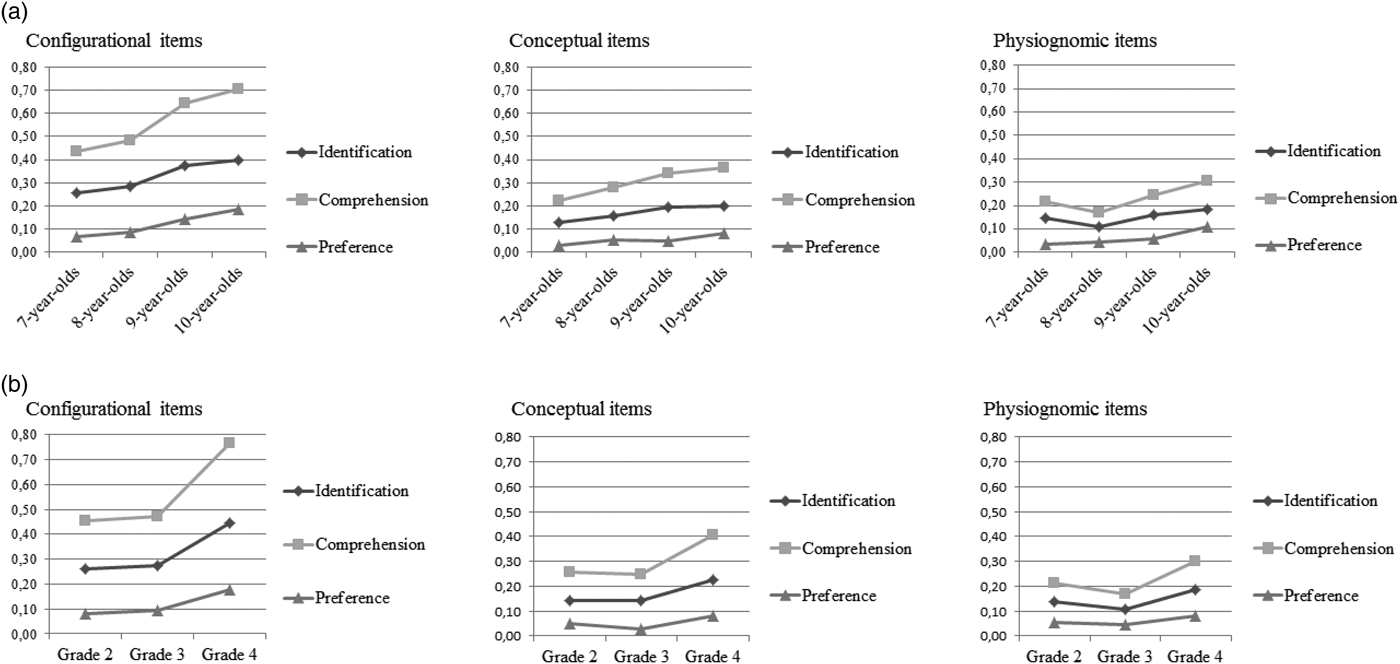
Regarding metaphor identification, analysis showed a significant effect for metaphor type (F(2,588) = 93.905, ηp 2 = .24, p ⩽ .0001) and grade (F(2,294) = 9.390, ηp 2 = .06, p ⩽ .0001). Configurational metaphors were the most frequently identified metaphors (Mean per item = 0.32, SD = 0.3), followed by conceptual (Mean per item = 0.17, SD = 0.21), and physiognomic metaphors (Mean per item = 0.14, SD = 0.25). Fourth-graders showed the highest identification scores regarding all metaphor types. Furthermore, a significant interaction between metaphor type and grade was found (F(4,588) = 4.585, ηp 2 = .03, p = .001), which shows that between grades two and three the identification of configurational metaphors slightly increases, whereas the identification of conceptual metaphors stays the same, and the identification of physiognomic metaphors even slightly decreases before it increases between grades three and four regarding all metaphor types. No significant interaction between metaphor type and gender as well as no three-way interaction between metaphor type, gender, and grade was found. Please see Figure 3.
Metaphor comprehension (H5.2)
Regarding metaphor comprehension, significant main effects of metaphor type (F(2,588) = 101.431, ηp 2 = .26, p ⩽ .0001) and grade (F(2,294) = 9.262, ηp 2 = .06, p ⩽ .0001) were shown. Configurational metaphors were best understood (Mean per item = 0.56, SD = 0.54), followed by conceptual (Mean per item = 0.30, SD = 0.38), and physiognomic metaphors (Mean per item = 0.23, SD = 0.41). Fourth-graders showed highest comprehension scores regarding all metaphor types. A significant interaction between metaphor type and grade was found (F(4,588) = 3.991, ηp 2 = .03, p = .004), which shows that between grades two and three the comprehension of configurational metaphors slightly increases, whereas the identification of conceptual and physiognomic decreases before it increases between grades three and four regarding all metaphor types. No further significant interactions were shown. Please see Figure 3.
Metaphor preference (H5.3)
With respect to preference of metaphors, analysis showed significant main effects for metaphor type (F(2,586) = 24.153, ηp 2 = .08, p ⩽ .0001) and grade (F(2,293) = 5.335, ηp 2 = .03, p = .005). Configurational metaphors were most preferred (Mean per item = 0.12, SD = 0.2), followed by physiognomic (Mean per item = 0.06, SD = 0.16), and conceptual metaphors (Mean per item = 0.05, SD = 0.15). Fourth-graders showed the highest preference scores regarding all metaphor types. Metaphor type and grade showed a significant interaction (F(4,586) = 2.683, ηp 2 = .02, p = .034), as between grades two and three preference of configurational metaphors increases whereas the preference of conceptual and physiognomic metaphors decreases before it increases between grades three and four regarding all metaphor types. No further significant interactions were shown. Please see Figure 3.
Discussion
This multivariate study investigated development of metaphor identification, preference, comprehension, and qualitative aspects of comprehension in an age span between seven and ten years, a seemingly very crucial age span for the development of higher-order metaphor processing (see, e.g., Gentner, Reference Gentner1988; Siltanen, Reference Siltanen1989; Winner et al., Reference Winner, Rosenstiel and Gardner1976). With reference to the literature (see, e.g., Berk, Reference Berk2014; Feldman, Reference Feldman2017; Steinberg, Reference Steinberg2016), in this study, children between seven and nine were referred to as individuals in middle childhood whereas ten-year-olds were seen as individuals at the transition from middle childhood to early adolescence. Furthermore, within this sample, the predictive role of verbal intelligence and linguistic competence, as well as the role of mental age regarding metaphor processing, was investigated. Additionally, this study focused on the development of the processing of different types of metaphors.
Chronological age significantly predicted the identification and comprehension of, as well as the preference for, metaphors. In the course of ongoing development, analyses indicated a greater increase regarding metaphor identification and comprehension after (approximately) age eight is reached, as well as a greater increase regarding metaphor preference after (approximately) age ten is reached. Verbal intelligence was shown to predict metaphor processing, and this effect became stronger with increasing age. Verbal intelligence scores vocabulary, arithmetic, and similarities showed the strongest associations with metaphor identification and comprehension, whereas scores vocabulary, arithmetic, and comprehension showed the strongest associations with metaphor preference. With respect to mental age, fourth-graders showed significantly higher metaphor identification, comprehension, and preference than second- and third-graders, whereas the latter two did not differ. Metaphor scores were significantly adjusted for verbal intelligence. Furthermore, fourth-graders showed highest metaphor comprehension quality, whereas second- and third-graders did not differ significantly. Finally, across all school grades, attributional (configurational) metaphors were better understood and more preferred than relational metaphors (conceptual and physiognomic), whereby fourth-graders showed the significantly highest results regarding all metaphor types.
Development of metaphor identification and comprehension: chronological age, mental age, and gender
With respect to chronological age, the results of the current study indicate that the ability to identify and comprehend metaphors increase more between approximately eight and ten years than between seven and eight years, although it has to be noted that the involvement of such a breakpoint yielded only slightly higher explanation rates in the regression models (see Figures 1, 2, and 3). These results yield new knowledge about metaphorical language ability in a previously assumed crucial age span between seven and ten years (see, e.g., Gentner, Reference Gentner1988; Siltanen, Reference Siltanen1989; Winner et al., Reference Winner, Rosenstiel and Gardner1976). Individuals were located in middle childhood and at the transition from middle childhood to early adolescence (see, e.g., Berk, Reference Berk2014; Feldman, Reference Feldman2017; Steinberg, Reference Steinberg2016; see further the ‘Aims of the study’ section above), an age span in which a lot of biological, cognitive, social, and emotional changes take place (see, e.g., Steinberg et al., Reference Steinberg, Vandell and Bornstein2010). As previous studies indicate a change in metaphor processing techniques and properties that can be processed in this age span, our study indicates a possible shift approximately in the middle of this age span, at 8.2 years.
With respect to mental age, analyses showed that fourth-graders exhibited higher metaphor scores than second- and third-graders, whereas the lower grades did not differ statistically. Furthermore, between grades three and four the number of 2-point-answers (correct explanations of metaphoric pairs) apparently increased more than the number of 1-point-answers (less than fully adequate explanations), whereas the lower grades did not differ statistically regarding these scores. These results suggest that mental age in terms of ‘academic age’ (the school system in Austria enabled such a definition, see the ‘Aims of the study’ section above) can potentially be seen as an indicator of metaphor processing. Those children who reach an academic level at which they are prepared for entering a higher school stage (see footnote 1) showed the best metaphor processing performance.
In this study, no gender differences regarding metaphor processing were shown for children before and at the transition from middle childhood to early adolescence. Although Willinger and colleagues (Reference Willinger, Deckert, Schmoeger, Schaunig-Busch, Formann and Auff2017) argued that girls might compensate for the earlier superiority of boys (Lutzer, Reference Lutzer1991) by faster developing verbal abilities, in the current study no significant differences between girls and boys regarding verbal intelligence or linguistic abilities were shown.
The developmental changes suggested in the current study are supported by studies on brain development that show great structural and functional changes in this age span. In this context, it was shown that, at around age eight, children show the highest whole brain volume and grey matter volume (Brain Development Cooperative Group, 2012; Tanaka et al., Reference Tanaka, Matsui, Uematsu, Noguchi and Miyawaki2012) with a consequent great decrease (Brain Development Cooperative Group, 2012; Lebel & Beaulieu, Reference Lebel and Beaulieu2011), most likely due to synaptic pruning processes throughout middle childhood (e.g., Huttenlocher, Reference Huttenlocher, Dawson and Fischer1994). Furthermore, great changes can be seen in children between six and ten regarding neural fibers / white matter tracts (Uda et al., Reference Uda, Matsui, Tanaka, Uematsu, Miura, Kawana and Noguchi2015), whereas children at age eight show the greatest relative increase in whole brain white matter volume (Lebel & Beaulieu, Reference Lebel and Beaulieu2011). Between ages seven and ten, children show peaks in cortical thickness in the somatosensory cortex, the striate primary visual area, the primary motor cortex, and the parietal association areas (Shaw et al., Reference Shaw, Kabani, Lerch, Eckstrand, Lenroot, Gogtay and Giedd2008). These changes support theoretical considerations regarding metaphor processing that will be discussed below (e.g., Conceptual Metaphor Theory; Lakoff & Johnson, Reference Lakoff and Johnson1980/2003). As well as these structural changes, changes in functional connectivity also occur throughout middle childhood and early adolescence as neural activity shows shifts from local to more distributed networks (e.g., Fair et al., Reference Fair, Dosenbach, Church, Cohen, Brahmbhatt, Miezin and Schlaggar2007). Furthermore, such differences in brain structure and function were shown to depend on individual experiences (see, e.g., Steinberg, Reference Steinberg2010).
Although some claim that metaphor competence develops within a continuum, the current study, as well as other recent studies (e.g., Willinger et al., Reference Willinger, Deckert, Schmoeger, Schaunig-Busch, Formann and Auff2017), indicates that children and adolescents might show spurts in metaphorical language development. Regarding the development of metaphor processing, it was shown that (very) young children also understand some metaphors (e.g., Gibbs & Colston, Reference Gibbs and Colston2012; Pérez-Hernández & Duvignau, Reference Pérez-Hernández and Duvignau2016). Research indicates that, before effectively using explicit techniques like comparison and categorization that are commonly associated with metaphoric language (Gentner & Bowdle, Reference Gentner, Bowdle and Gibbs2008; Glucksberg, Reference Glucksberg2001), pragmatic conventions are constructed long before actual language in terms of metaphorical thought (e.g., Alessandroni, Reference Alessandroni2017). In the course of development, children start very early to overextend the meanings of words in order to label things or express (mostly) non-abstract concepts for which they lack literal terms (see, e.g., Clark, Reference Clark2003; Pérez-Hernández & Duvignau, Reference Pérez-Hernández and Duvignau2016; Pouscoulous, Reference Pouscoulous2011). Until approximately age four, children use metaphors in the form of overextended meanings of terms already acquired (Nerlich, Clarke, & Todd, Reference Nerlich, Clarke, Todd, Panther and Radden1999), whereas at some point they are able to deliberately extend meanings in order to intentionally overcome literal borders (e.g., Pouscoulous, Reference Pouscoulous2011). Eventually, this could be seen as a shift from metaphorical thought to metaphorical language (Alessandroni, Reference Alessandroni2017), paving the way [sic] for higher-order metaphoric processing.
Development of metaphor identification and comprehension: metaphor types
Although metaphor processing depends on a number of factors, such as aptness, conventionality, or context (see, e.g., Blasko & Connine, Reference Blasko and Connine1993; Goldstein, Arzouan, & Faust, Reference Goldstein, Arzouan and Faust2012), metaphor competence at a younger age strongly depends on the type of metaphor. The results of the current study showed that across grades two, three, and four attributional (configurational) metaphors were more easily identified and better understood than relational metaphors (conceptual and physiognomic). Fourth-graders showed the significantly highest identification and comprehension regarding all metaphor types, whereas slight differences were shown between second- and third-graders, depending on metaphor type (see the ‘Results’ section and Figure 4). Figure 4 also shows that for chronological age similar results can be expected. Nevertheless, it has to be noted that these results are results of exploratory analyses, due to the small number of items per metaphor type.
Development of metaphor processing between seven and ten years (discrete age groups, Panel a) and between grades two, three, and four (Panel b) with respect to each metaphor type. The y-axis shows the mean scores for each respective score. Mean scores are adjusted for number of items per metaphor type.

These results show that attributional metaphors which represent perceptual similarities based on physical properties are more easily identified and better understood than relational metaphors which represent either affective associations or cross-categorical similarities. The increased comprehension of metaphors that require building relational categories based on cross-categorical and affective grounds in this age span is consistent with previous studies (e.g., Cicone, Gardner, & Winner, Reference Cicone, Gardner and Winner1981; Siltanen, Reference Siltanen1989; Winner et al., Reference Winner, Rosenstiel and Gardner1976), whereas the increase regarding attributional metaphors somehow contradicts the results of Gentner (Reference Gentner1988), which stated that the attributionality of metaphors does not increase with age. These results are in line with previous studies that showed that young children best understand and produce metaphors that are based on physical similarities (e.g., Gentner, Reference Gentner1988; Siquerra & Gibbs, Reference Siquerra and Gibbs2007; Winner, Reference Winner1988/1997).
Explanations for the better understanding of such primary metaphors can be found within the Conceptual Metaphor Theory of Lakoff and Johnson (Reference Lakoff and Johnson1980/2003). They argue that metaphorical meanings originate in sensory and sensorimotor experiences like connecting early experiences of visually seeing things and understanding things because they can be seen (e.g., Gibbs & Colston, Reference Gibbs and Colston2012; Lakoff & Johnson, Reference Lakoff and Johnson1980/2003), and therefore can be expressed in different modalities (e.g., images, gestures, sounds; see, e.g., Alessandroni, Reference Alessandroni2017; Lakoff & Johnson, Reference Lakoff and Johnson1980/2003). As children repeatedly interact with the environment, they increasingly learn to distinguish between domains and to separate domains, especially regarding the sensory and sensorimotor domains (e.g., Gibbs & Colston, Reference Gibbs and Colston2012; Lakoff & Johnson, Reference Lakoff and Johnson1980/2003). Therefore, such metaphors increasingly allow accessing abstract areas of knowledge by connecting them to more and more concrete, physical domains, making them real tools of understanding (e.g., Alessandroni, Reference Alessandroni2017; Lakoff & Johnson, Reference Lakoff and Johnson1980/2003). In this context, it was shown that some primary metaphors are learned before others, like ‘emotional intimacy is proximity’ (e.g., Gibbs & Colston, Reference Gibbs and Colston2012; Lakoff & Johnson, Reference Lakoff and Johnson1980/2003).
These theoretical considerations can be linked to the results of the current study through the Theory of Metaphor Circuity of Lakoff (Reference Lakoff2014) and Narayanan (Reference Narayanan1997). They propose that real-life interactions with the environment lead to the building of embodied metaphor mapping circuits by neural learning. In this way, subsequent metaphorical inferences originate from neural simulation of situations which are understood, whereby complex forms (e.g., linguistic forms) are linked to these metaphorical mappings. Connecting this theory to the results of the current study, it can be hypothesized that such higher-order simulations would be associated with the number of real-life experiences that are collected with chronological age, and greater cognitive abilities with a higher mental age, as well as increased neural capacities given by the structural and functional changes in the brain. The results regarding the indicated spurt around age 8.2 and regarding attributional metaphors which represent perceptual similarities can especially be seen in the light of imaging studies which show that children between seven and nine show peak cortical thickness in regions associated with visual and somatosensory perception as well as motor processes (Shaw et al., Reference Shaw, Kabani, Lerch, Eckstrand, Lenroot, Gogtay and Giedd2008). Around age nine to ten, children show peak cortical thickness in parietal association cortices (Shaw et al., Reference Shaw, Kabani, Lerch, Eckstrand, Lenroot, Gogtay and Giedd2008) which are involved in the integration of sensory and somatosensory inputs (e.g., Purves et al., Reference Purves, Augustine and Fitzpatrick2001).
Development of metaphor identification and comprehension: the role of verbal intelligence and linguistic competence
The results of the current study showed that verbal intelligence significantly predicted metaphor identification and comprehension in the age span nine to ten, but not in seven- to eight-year-olds. These results show that, with respect to metaphor processing, verbal intelligence gains in importance with increasing age. Furthermore, this supports the notion that metaphor can be seen as a central feature of higher cognition and abstract thought (Coulson & Lai, Reference Coulson and Lai2015). Metaphor identification and comprehension showed the highest associations with verbal intelligence score vocabulary, arithmetic, and similarities.
Subtest vocabulary measures semantic knowledge, verbal comprehension, and verbal expression, as well as concept formation and verbal conceptualization; furthermore, it can be seen as an indicator of general language development (Strauss, Sherman, & Spreen, Reference Strauss, Sherman and Spreen2006; Tewes et al., Reference Tewes, Rossmann and Schallberger1999). It requires the examinee to provide definitions for words (Strauss et al., Reference Strauss, Sherman and Spreen2006; Tewes et al., Reference Tewes, Rossmann and Schallberger1999). This result is in line with previous studies showing an association between vocabulary and metaphor comprehension (e.g., Kasirer & Mashal, Reference Kasirer and Mashal2014). Knowledge of words can be seen as a fundamental tool of language in general and consequently also of metaphor processing. It can be hypothesized that a greater knowledge of words and a better understanding of the objects and concepts a word stands for facilitates the task of overcoming literal boundaries. In this way, it provides a tool and/or resources for the analysis of multiple properties. Linking vocabulary to Lakoff and Narayanan's theory of metaphor circuitry (Lakoff, Reference Lakoff2014), it can be further argued that the objects and concepts a word stands for form the basic elements in linking linguistic forms to metaphorical mappings.
Subtest arithmetic measures working memory, arithmetic problem solving, verbal comprehension, concentration, and attention (Strauss et al., Reference Strauss, Sherman and Spreen2006; Tewes et al., Reference Tewes, Rossmann and Schallberger1999), as it requires the examinee to mentally solve orally presented arithmetic problems within a time limit. This result is in line with previous studies showing associations between working memory and metaphor processing (e.g., Godbee & Porter, Reference Godbee and Porter2013).
Subtest similarities measures verbal analogical reasoning, verbal abstraction, concept formation, abstract thinking in terms of categories, verbal expression, and verbal comprehension, as it requires the examinee to describe how two words that represent common objects or concepts are similar (Strauss et al., Reference Strauss, Sherman and Spreen2006; Tewes, et al., Reference Tewes, Rossmann and Schallberger1999). Similar to the processing of metaphors (see, e.g., Gentner & Bowdle, Reference Gentner, Bowdle and Gibbs2008; Glucksberg, Reference Glucksberg2001, Glucksberg & Haught, Reference Glucksberg and Haught2006), properties of objects or concepts have to be analyzed so as to see what they have in common and/or to which categories/classes they belong. Furthermore, one has to decide which properties are of importance, and subsequently reject inadequate similarities that are for example too general. It can be hypothesized that the effective complementary use of comparison and categorization techniques regarding the processing of metaphors (see Career of Metaphor Theory; Gentner & Bowdle, Reference Gentner, Bowdle and Gibbs2008, or Quality of Metaphor Theory; Glucksberg & Haught, Reference Glucksberg and Haught2006) in the MTT can be seen as verbal intelligence performance, as a similar adaptive use of different processing techniques is very likely in subtest similarities. In this context, it has been shown that verbal analogical reasoning is predictive of metaphor comprehension in children with learning disabilities (Mashal & Kasirer, Reference Mashal and Kasirer2012).
Furthermore, although not significant in the regression analyses, linguistic competence subtest comprehension showed associations with metaphor processing similar to verbal intelligence subtests. Subtest comprehension measures verbal comprehension of sentences of varying grammatical complexity, which requires the examinee to re-enact heard sentences with toys (Grimm & Schoeler, Reference Grimm and Schoeler1990). This result is in line with previous studies regarding the role of linguistic competence (see, e.g., Johnson, Reference Johnson1991). At this point, it has to be noted that, for pragmatic reasons, two representative tests of linguistic competence were investigated. It cannot be ruled out that other subtests of the HELD would have yielded positive results in the analyses.
The role of the previously mentioned predictors is shown in an exemplary MTT item: ‘Fish – Winding River – Snake’. First, the properties of ‘fish’ (animal, lives in the water, some fish are predators, differs in body size and form, …), ‘winding river’ (elongated object in the nature in which water flows, home to many animals, winds through a landscape, …), and ‘snake’ (animal, lives on land or in water, predator, moves using winding movements of its long flexible body, …) have to be accessed from knowledge (vocabulary), and the concepts they stand for understood. These words have to be saved in working memory and, using verbal reasoning techniques, compared to see which properties they have in common, whereas inadequate properties like, e.g., ‘all objects can be found in nature’ (too general) have to be rejected. Successful processing of the metaphorical pair (‘Winding river’ and ‘Snake’) requires children to overcome literal boundaries and to give answers like “both the snake and the river wind through the landscape”, “both move through the country in winding movements”, “both meander through the landscape”, or the like.
The results regarding the increasing importance of verbal intelligence are in line with studies that argue that early metaphors become gradually more linguistically articulated (e.g., Melogno, Pinto, & Levi, Reference Melogno, Pinto and Levi2012). In this context, it was shown that, between ages three and five, children repeated metaphoric sentences similar to literal sentences, but had problems repeating anomalous sentences (Pearson, Reference Pearson1990), whereas five-year-olds showed some ability to verbally reason about metaphorical mappings (Ozcaliskan, Reference Ozcaliskan2005). Furthermore, Willinger and colleagues (Reference Willinger, Deckert, Schmoeger, Schaunig-Busch, Formann and Auff2017) proposed that metaphor competence in childhood and early adolescence could be influenced by increasing communicative experience (see, e.g., Hoff, Reference Hoff2006) in the course of increasingly complex relationships (see, e.g., Steinberg et al., Reference Steinberg, Vandell and Bornstein2010).
Development of metaphor preference: chronological age, mental age, and gender
With respect to chronological age, the results of the current study indicate that the preference for metaphors increases more when individuals have reached approximately age ten than between seven and ten. Similar to metaphor identification and comprehension, it has to be noted that the involvement of such a breakpoint yielded only slightly higher explanation rates in the regression models (see Figures 1, 2, and 3). These results indicate that individuals increasingly prefer metaphors when they are at the transition from middle childhood to early adolescence, approximately at age ten, which is in line with previous studies (Silberstein, Reference Silberstein1980; Silberstein, Gardner, Phelps, & Winner, Reference Silberstein, Gardner, Phelps and Winner1982).
With respect to mental age, analyses showed that fourth-graders exhibited higher metaphor preference than second- and third-graders, whereas the lower grades did not differ statistically. Similar to metaphor identification and comprehension, results indicate that those children who reach an academic level at which they are prepared for entering a higher school stage showed the highest preference for metaphors.
Besides the previously mentioned structural and functional changes in the brain, studies further indicate peaks in frontal lobe, parietal, and temporal lobe grey matter between approximately ten and eleven years (Lenroot & Giedd, Reference Lenroot and Giedd2006; Tanaka, Matsui, Uematsu, Noguchi, & Miyawaki, Reference Tanaka, Matsui, Uematsu, Noguchi and Miyawaki2012). Furthermore, besides great changes regarding white matter tracts between ages six and ten (Uda et al., Reference Uda, Matsui, Tanaka, Uematsu, Miura, Kawana and Noguchi2015), at approximately age ten, peak cortical thickness was shown regarding parietal association cortices and the frontal pole, as well as higher-order cortical areas like the dorsolateral prefrontal cortex and the cingulate cortex (Shaw et al., Reference Shaw, Kabani, Lerch, Eckstrand, Lenroot, Gogtay and Giedd2008).
Similar to the results regarding metaphor identification and comprehension, no gender differences regarding metaphor preference were shown.
Development of metaphor preference: metaphor types
The results of the current study showed that across grades two, three, and four attributional (configurational) metaphors were more preferred than relational metaphors (conceptual and physiognomic). Fourth-graders showed the significantly highest preference regarding all metaphor types, whereas slight differences were shown between second- and third-graders, depending on metaphor type (see ‘Results’ section and Figure 4). Figure 4 also shows that for chronological age similar results can be expected.
The result that attributional metaphors were more preferred than relational metaphors is in line with previous studies offering data on metaphor preference development (e.g., Willinger et al., Reference Willinger, Deckert, Schmoeger, Schaunig-Busch, Formann and Auff2017) and the development of metaphor type comprehension (please see above). In the early years, children seemingly (unconsciously) prefer metaphors in terms of overextended word meanings in order to label things or express (mostly) non-abstract concepts for which they still lack literal terms (see, e.g., Clark, Reference Clark2003; Perez-Hernandez & Duvignau, Reference Pérez-Hernández and Duvignau2016; Pouscoulous, Reference Pouscoulous2011). Later on, they become able to deliberately extend word meanings in order to intentionally overcome literal borders (e.g., Pouscoulous, Reference Pouscoulous2011). In the course of childhood and adolescence, professionals use metaphors in the education of children (Williams, Reference Williams1988) and in clinical treatments of children (e.g., Kallady, Reference Kallady2015), for example for explaining illnesses (Whaley, Reference Whaley1994), whereas parents use metaphors with their children so as to compare similarities, add interest, and positively evaluate them (Sell, Kreuz, & Coppenrath, Reference Sell, Kreuz and Coppenrath1997). Generally, metaphors are mainly used to clarify, add interest, be eloquent, compare similarities, and to provoke thought (Roberts & Kreuz, Reference Roberts and Kreuz1994).
Development of metaphor preference: the role of verbal intelligence and linguistic competence
The results of the current study showed that verbal intelligence significantly predicted metaphor preference in the age span nine to ten but not in seven- to eight-year-olds. These results indicate that, regarding metaphor processing, verbal intelligence gains in importance with increasing age. Metaphor preference showed the highest associations with verbal intelligence scores vocabulary, arithmetic, and comprehension, whereas verbal intelligence scores vocabulary and arithmetic were already associated with metaphor identification and comprehension.
Subtest comprehension measures knowledge about general principles, knowledge about social situations and practices, verbal reasoning and concept formation, verbal comprehension and expression, practical judgment, learning from experiences, social maturity, and common sense, as well as social judgment, and is dependent on cultural aspects (Strauss et al., Reference Strauss, Sherman and Spreen2006; Tewes et al., Reference Tewes, Rossmann and Schallberger1999). The examinee is required to answer questions based on his/her understanding of general principles and social situations (Tewes et al., Reference Tewes, Rossmann and Schallberger1999).
Given this result, it can be hypothesized that children who have a greater general understanding are more interested in and show greater stimulation by metaphoric contents. Their increased understanding could enable them to overcome literal boundaries more easily and to be more receptive to the stimulating aspects of metaphors. In this context, a fMRI study showed that, compared to literal control passages, metaphor processing was associated with increases in brain regions that are associated with emotional processing (Citron, Güsten, Michaelis, & Goldberg, Reference Citron, Güsten, Michaelis and Goldberg2016). Regarding the stimulating nature of metaphor, it was further shown that metaphor processing was associated with the need for cognition (Olkoniemi, Ranta, & Kaakinen, Reference Olkoniemi, Ranta and Kaakinen2016), as well as participation in cognitively stimulating activities (Lifshitz-Vahav, Shnitzer, & Mashal, Reference Lifshitz-Vahav, Shnitzer and Mashal2016). Furthermore, metaphors are used to create and reinforce social intimacy (Horton, Reference Horton2007, Reference Horton2013), and are more often used to describe emotional states than, for example, actions (Fainsilber & Ortony, Reference Fainsilber and Ortony1987). In this context, it was further shown that even five-year-olds recognize specific emotions that are expressed by metaphors (Waggoner & Palermo, Reference Waggoner and Palermo1989) and that parents use metaphors to positively evaluate their children (Sell et al., Reference Sell, Kreuz and Coppenrath1997).
This hypothesized stimulating effect of metaphors gets support from Relevance Theory (Sperber & Wilson, Reference Sperber, Wilson, Horn and Ward2004), which can be applied to metaphors. In this context, Gibbs and Tendahl (Reference Gibbs and Tendahl2006) evaluated the predictive value of Relevance Theory with respect to metaphor processing in terms of maximizing cognitive effect and minimizing cognitive effort. In the course of this theory, some claim that metaphor processing requires additional cognitive effort but yields more effects than literal speech. Linking this claim to the current study, it can be hypothesized that individuals with increased understanding tend to accept this additional cognitive effort because they are able to (unconsciously) grasp the stimulating aspects of a metaphor. Another claim is that metaphor processing is stopped at the first interpretation that satisfies the expectation of the relevance of a linguistic content. Regarding this link, it can be hypothesized that children with greater achieved understanding increasingly use these real-life experiences to form metaphor mappings (see statements above and Lakoff, Reference Lakoff2014) and therefore grasp the simulating nature of metaphors more pronouncedly than children who do not have so many experiences at their disposal.
In this study, in accordance with Kogan and Chadrow (Reference Kogan and Chadrow1986), metaphor preference was defined as the identification of a metaphoric pair at the first attempt, followed by a correct or less than fully adequate explanation. Therefore, in this study, real preference for metaphorical contents was based on identifying as well as understanding the metaphor to a certain degree. It can be hypothesized that metaphor identification as well as comprehension itself can be seen as ‘academic’ performance that is based on logical deductive verbal reasoning and factual knowledge about words and the objects, entities, and principles they stand for. On the other hand, those who prefer metaphors can be seen as ‘connoisseurs’ who enjoy the metaphorical contents, based on understanding metaphors via inferential reasoning which itself is based on general knowledge and understanding. The authors of the current study address this topic in an upcoming publication (Deckert et al., unpublished observations).
At this point, it has to be noted that most of the explanations in this study are theoretical and raise new research questions for future studies. Future studies should investigate different aspects of metaphor processing and possible predictors using different neuroscientific imaging methods.
Prospect of a cognitive model of metaphor processing in middle childhood and early adolescence
Finally, we present a summary of cognitive predictors and theoretical considerations that build the basis of a cognitive model of metaphor processing in individuals from middle childhood to middle adulthood that is currently evaluated by our study group. In the following, we will focus on the age span investigated in a recent study (Willinger et al., Reference Willinger, Deckert, Schmoeger, Schaunig-Busch, Formann and Auff2017), as well as the current study, namely middle childhood to early adolescence.
In advance, a theoretical consideration that partially influences the model is that the authors of the current study hold the view that metaphors, at least when measured by the MTT, presumably pose to some degree some kind of ill-structure problems which involve a certain level of uncertainty (for example “WHICH of the three words have something in common?” and “WHAT do they have in common?” in the MTT vs. “WHAT do these words have in common?” in the similarities subtest used in this study). Furthermore, the following summary concerns linguistic articulated/verbal metaphors. Overlaps with the processing of visual metaphors are very likely but will not be discussed here.
First, the metaphorical words/utterances are received via verbal comprehension ability (see properties of the WISC-III subtests in the current study). Next, the properties of the objects, concepts, or principles these words/utterances stand for need to be accessed from semantic knowledge (subtest vocabulary, current study). A greater knowledge of words presumably provides a tool as well as resources for the analyses of multiple properties which are most likely fundamental components in metaphor processing (see, e.g., Lakoff, Reference Lakoff2014). Therefore, the individual is required to produce a temporary mental pool containing a number of properties regarding vehicle and topic which are mostly directly accessed from knowledge. Producing such a mental pool resembles processes of divergent thinking, a cognitive performance that has already been associated with ill-structured problems (Del Missier, Visentini, & Mäntylä, Reference Del Missier, Visentini and Mäntylä2015). Deductive/convergent thinking, on the other hand, in terms of the ability to identify and complement relational systems based on similarities (non-verbal analogical reasoning; see, e.g., Willinger et al., Reference Willinger, Deckert, Schmoeger, Schaunig-Busch, Formann and Auff2017), seemingly lays the basis for the next processing steps. Together with verbal reasoning (current study), these analogical reasoning abilities additionally allow the generation of further inferences based on these similarities (see, e.g., Gentner & Smith, Reference Gentner, Smith and Ramachandran2012). In this context, verbal reasoning (which can be seen as the language-related ability to identify and complement relational systems) seems to hold a special role in metaphor processing, together with verbal abstraction and concept formation (current study). These abilities presumably serve as ‘translation tools’ that allow for processing language contents (see vocabulary) by means of general (reasoning) and special metaphor processing techniques like comparison (Gentner & Bowdle, Reference Gentner, Bowdle and Gibbs2008) or categorization (Glucksberg, Reference Glucksberg2001). In the course of these deductive thinking procedures relevant similarities between topic and vehicle have to be identified whereas irrelevant similarities have to be rejected (see, e.g., Glucksberg, Reference Glucksberg2001), which requires decision-making ability (current study, see properties of WISC-III subtest similarities). Although the literature struggles to define exact decision criteria in metaphor processing (see Relevance Theory; Gibbs & Tendahl, Reference Gibbs and Tendahl2006), decision-making was shown to be predictive of solving ill-structured problems (Del Missier, Visentini, & Mäntylä, Reference Del Missier, Visentini and Mäntylä2015). Studies suggest that in order to process metaphors adequately it is presumably necessary to analyze words and phrases repeatedly by means of different and/or already used but modified mental operations (Willinger et al., Reference Willinger, Deckert, Schmoeger, Schaunig-Busch, Formann and Auff2017). Such procedures are possibly influenced by working memory capacity and inhibition ability, which potentially enable the maintenance of already generated interpretations in the mind for further processing and evaluation, and to successfully suppress irrelevant properties (see current study but also, e.g., Godbee & Porter, Reference Godbee and Porter2013; Kintsch, Reference Kintsch2000). These processes could be further influenced by mental capacity, which allows for the simultaneous activation of different task-relevant schemes that are not adequately activated by situational inputs (Johnson & Pascual-Leone, Reference Johnson and Pascual-Leone1989). Recent studies suggest that cognitive flexibility under time pressure, in the form of set-shifting (see Diamond, Reference Diamond2013) holds a special role in metaphor processing as it seemingly facilitates the adaption of processing strategies in a flexible and quick way as it allows for an efficient iterative processing and potentially facilitates to overcome literal boundaries (Willinger et al., Reference Willinger, Deckert, Schmoeger, Schaunig-Busch, Formann and Auff2017). Cognitive flexibility was also shown to predict performance in ill-structured decision problem solving (Vandermorris, Sheldon, Winocur, & Moscovitch, Reference Vandermorris, Sheldon, Winocur and Moscovitch2013). Furthermore, it was shown that information processing speed predicts metaphor processing as it most likely addresses the speed requirements of language processing (Willinger et al., Reference Willinger, Deckert, Schmoeger, Schaunig-Busch, Formann and Auff2017).
The authors of the current study assume that many of the previously mentioned abilities are also important for metaphor preference but refer to the results of the current study which suggest that instead of relying on semantic knowledge in the form of vocabulary and logical deductive verbal reasoning, those who prefer metaphoric contents possibly rather rely on inferential reasoning that is itself based on general knowledge.
It can be assumed that the development of metaphor processing is strongly influenced by brain development (see, e.g., Blakemore, Reference Blakemore2008; Brain Development Cooperative Group, 2012; Shaw et al., Reference Shaw, Kabani, Lerch, Eckstrand, Lenroot, Gogtay and Giedd2008; Steinberg, Reference Steinberg2010; Wendelken, O'Hare, Whitaker, Ferrer, & Bunge, Reference Wendelken, O'Hare, Whitaker, Ferrer and Bunge2011; Yin et al., Reference Yin, Liu, Zeljic, Wang, Lv, Fan and Wang2016) and presumably influenced by communication experience (see, e.g., Hoff, Reference Hoff2006; Steinberg, Reference Steinberg2016). This summary includes a number of cognitive abilities which theoretically underlie metaphor processing but there is no claim for completeness. The authors of the current study currently evaluate a cognitive model of metaphor processing by including these predictors within a single study design using a sample of individuals from middle childhood to middle adulthood (Deckert et al., unpublished observations).
Take-home message
• Throughout life, metaphor can be seen as central feature of human communication, higher cognition, and abstract thought.
• Chronological as well as mental age are positively associated with metaphor processing.
• Middle childhood and the transition from middle childhood to early adolescence is seemingly a crucial age span for the development of higher-order metaphor processing.
• Results indicate a possible spurt in metaphor comprehension at approximately 8.2 years.
• In the investigated age span, metaphors that represent perceptual similarities based on physical properties are best identified, best understood, and most preferred.
• These results are supported by studies on metaphor competence and brain development as well as by established theories.
• Verbal intelligence is positively associated with metaphor processing, whereas this effect becomes stronger with increasing age.
Supplementary Materials
For Supplementary Materials for this paper, please visit <https://doi.org/10.1017/S0305000918000491>.
Author ORCIDs
Matthias Deckert http://orcid.org/0000-0003-3003-3578.